Disclosure: airfryerkitchensupply.com is reader-supported. When you buy through links on our site, we may earn an affiliate commission at no extra cost to you.
Where to Buy
Shopping for the best air purifier for cigarette smokers? Every verified pick in this guide is sold through Amazon, where you can check price on Amazon for the current listing, confirm the exact model and filter type, and arrange delivery. The shortlist:
- WINIX 5520 — Best Overall. Check the current price on Amazon.
- LEVOIT Core 400S-P — Best Smart Mid-Size. Check the current price on Amazon.
- COWAY Mighty AP-1512HH — Best Proven Reliability. Check the current price on Amazon.
- BLUEAIR Blue 311i Max — Best Quiet Living Room. Check the current price on Amazon.
- Honeywell HPA5300B — Best for XL Rooms. Check the current price on Amazon.
- LEVOIT Core 300-P — Best Budget. Check the current price on Amazon.
Availability and filter stock move around; if a listing shows a different model suffix than the one named here, match the model name in this guide rather than the photograph.
The best air purifier for cigarette smokers has to solve a problem that never really stops. Cigarettes are smoked daily, often several times a day, usually in the same room — and each one loads the air with fine particles and a cocktail of odor gases that settle into furniture, curtains and clothing. Unlike a weekend hobby, this is a continuous exposure problem, and the machine that wins is the one that can run continuously, respond on its own, and keep its filter costs under control.
The technology split is the same as for any smoke: a HEPA stage for the particles, and activated carbon for the smell. But the emphasis shifts with cigarettes. Because the smoking is frequent and spread through the day, auto modes and air quality sensors matter more — the machine should notice a cigarette being lit in the next room and respond without anyone walking over to press a button. Filter economics matter more too, because daily smoke eats carbon steadily, month after month.
Every pick below is verified, rated for smoke by its maker, and chosen for a real cigarette-smoking household rather than a laboratory. We favored machines you can genuinely leave running around the clock: quiet at low speed, responsive at need, and honest about what they cover. Expect the smell of a smoking home to fade dramatically rather than vanish from the universe — that is what success actually looks like.
In this guide
Quick Picks
Best Overall — WINIX 5520: True HEPA + high-deodorization carbon, air quality monitor, auto mode. Rated coverage: Up to 1,882 ft² in 1 hr. Check the current price on Amazon.
Best Smart Mid-Size — LEVOIT Core 400S-P: 3-in-1 filter for smoke, air quality monitor, auto mode, AHAM Verifide. Rated coverage: Up to 1,718 ft². Check the current price on Amazon.
Best Proven Reliability — COWAY Mighty AP-1512HH: HEPA filter for smoke and odor, AQI monitor, auto and eco modes, 3-year warranty. Rated coverage: Up to 1,748 ft². Check the current price on Amazon.
Best Quiet Living Room — BLUEAIR Blue 311i Max: HEPASilent filtration, washable pre-filter, WiFi auto mode, AHAM Verified. Rated coverage: Up to 2,107 ft². Check the current price on Amazon.
Best for XL Rooms — Honeywell HPA5300B: HEPA for XL rooms, auto mode, black finish. Rated coverage: 2,423 ft² in 1 hr. Check the current price on Amazon.
Best Budget — LEVOIT Core 300-P: HEPA filter, quiet sleep mode, AHAM Verifide, compact footprint. Rated coverage: Up to 1,073 ft². Check the current price on Amazon.
How These Picks Were Chosen
Every product in this guide was verified on this site’s own storefront connection before it was written about: we searched by brand and model, matched the returned listing title to the product, and only then used its ASIN for links. Models we could not verify with confidence were left out or written about without links — we do not guess at product identifiers.
With the verified shortlist established, picks were scored on the factors that decide real-world smoke performance. First, the filter stack: a HEPA stage for particles, and activated carbon with genuine substance for odor, because smoke is both problems at once. Second, honest capacity: coverage figures quoted by makers and, where available, backed by AHAM verification, always with headroom above the rooms these machines will serve. Third, liveability: noise at working speeds, auto modes and sensors, and the size and shape a machine brings into a real room.
For cigarette duty we weighted all-day behavior: sensor quality and auto response, noise at the low speeds the machine will live at, and the cost and availability of replacement filters over years of daily use. A spectacular machine with unobtainable filters loses to a very good machine you can maintain forever.
Finally, we applied two honesty filters. Products with safety recalls were excluded outright. And nothing in this guide carries a fixed price or a fixed star rating: prices and ratings change constantly, so linked picks simply say to check the current price on Amazon, and prose describes tiers — budget, mid-range, premium — instead of numbers that would go stale.
The 6 Best Options: Best Air Purifier for Cigarette Smokers Picks Reviewed
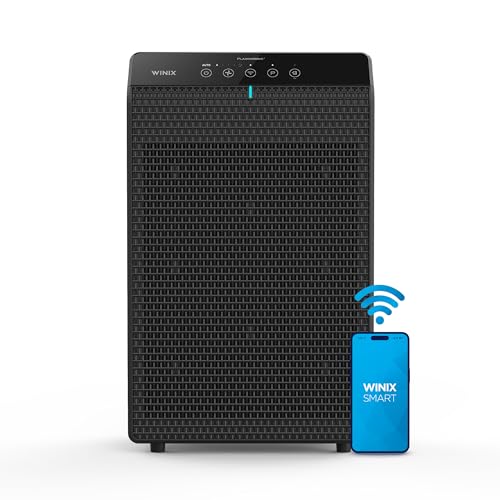
WINIX 5520 — Best Overall
Think of the 5520 as the feedback-equipped sibling of the 5510. It keeps the combination that matters for smoke — true HEPA for the particle load and a high-deodorization carbon filter for the smell — and adds an air quality monitor so you can watch a room recover after it has been smoked in. That feedback loop changes how people actually use a purifier: instead of guessing, you learn how long your room takes to clear, which speed does it, and whether the door being open helps or hurts. For a smoker trying to keep the rest of the home presentable, that information is worth as much as raw airflow.
For daily cigarette smoke, the 5520’s monitor is more than a gadget: you can watch the room spike when a cigarette is lit and learn exactly how long your space takes to recover. Paired with a deodorizing carbon filter genuinely aimed at smoke, it is the most complete cigarette-focused package here — the machine we would put in the main room of a smoking household first.
Ownership of the 5520 revolves around its sensor: keep the sensor lens dusted, because a blinded sensor makes auto mode lazy, and the machine’s whole value is its responsiveness. Filters follow the family pattern — check at six months in a smoking home, expect the carbon side to set the real interval — and the monitor gives you the evidence to judge by, since recovery times lengthen visibly as the carbon fills. It is a machine that tells you how it is doing, if you glance at it.
Strengths
- The air quality monitor gives you visible proof the room is clearing after a smoking session
- Same deodorizing carbon approach as its 5510 sibling, in a monitor-equipped package
- Auto mode stretches carbon life by not running flat-out when the air is already clean
Trade-offs
- Sensor-driven auto modes react to particles faster than to odor, so a manual turbo burst after smoking still helps
- Replacement filter cost is a real, recurring part of ownership in a smoking home
- Large-room ratings assume ideal conditions; a dedicated smoking room should be sized down from the headline number
| Specification | Detail (from maker listing) |
|---|---|
| Coverage (maker rating) | Up to 1,882 ft² in 1 hr |
| Filtration | True HEPA with high-deodorization carbon filter |
| Feedback | Onboard air quality monitor, auto mode |
Best for: Smokers who want visible air-quality feedback while the room clears / Not suited for: Anyone who will never look at a sensor readout and just wants the simplest knob-and-go machine
Check the current price on Amazon.

LEVOIT Core 400S-P — Best Smart Mid-Size
The Core 400S-P sits in the sensible middle of the LEVOIT range: enough rated coverage for a proper living room, an air quality monitor that shows the room’s state, and an auto mode that reacts when the air turns. For smoke, the honest summary is that its 3-in-1 filter handles the particle side well and the odor side adequately — fine for a household where smoking is a daily habit in one room, less fine for a round-the-clock smoking den, where you should step up to heavier carbon. As a first serious purifier for a smoker’s home, though, the balance of feedback, verified ratings and manageable size is hard to argue with.
The 400S-P is the smart, mid-size answer for an apartment or a single main room. Its sensor and auto mode handle the stop-start rhythm of cigarette smoking without supervision, and its verified rating keeps expectations honest. In a home where cigarettes are a few-times-a-day habit rather than a constant fog, it covers the problem neatly.
The 400S-P asks little of its owner: the sensor handles the day, the app handles the schedule, and the combination filter is a single cartridge swap when performance fades. In a smoking home, expect that swap to come sooner than the general guidance suggests, and use the air quality readout as your evidence — when post-session recovery stretches, the carbon is done. Keep the sensor window clean, vacuum the intake monthly, and the machine otherwise disappears into the room’s routine, which is its design intention.
Strengths
- Air quality monitor plus auto mode gives feedback and hands-free response in one mid-size package
- AHAM Verifide rating keeps the coverage claim honest compared with unrated rivals
- Black finish and child lock suit lived-in rooms rather than showroom shelves
Trade-offs
- The 3-in-1 filter’s carbon portion is modest; in constant smoke it will want changing on the early side
- Mid-size capacity means a big, heavily smoked room will ask more of it than it has
- Smart features assume you are comfortable running yet another app-connected appliance
| Specification | Detail (from maker listing) |
|---|---|
| Coverage (maker rating) | Up to 1,718 ft² |
| Filtration | 3-in-1 filter, rated for smoke |
| Feedback | Air quality monitor with auto mode |
| Verification | AHAM Verifide |
Best for: One main living space with daily smoking and a buyer who values feedback / Not suited for: The heaviest smoke loads, where deep-bed carbon machines earn their premium
Check the current price on Amazon.

COWAY Mighty AP-1512HH — Best Proven Reliability
The Mighty is the purifier equivalent of a reliable older sedan: not the newest shape, but proven in exactly the conditions this guide cares about. Its HEPA filter is rated by the maker for smoke and odor, it watches the air with a quality monitor, and its eco mode drops it to near-silence when the air is clean, spinning up when it is not. Owners keep these machines for years, replacement filters are easy to find, and the three-year warranty backs the motor. For a smoker who wants one machine in the main room and no interest in apps, it remains a very defensible default.
The Mighty suits the smoker who wants one dependable machine and no apps. Its eco mode is practically designed for cigarette households: near-silent while the air is clean, waking up when smoke appears, all day, every day. The three-year warranty and endless filter availability make it the low-risk long-term buy.
The Mighty is the ownership benchmark for buyers who keep appliances for a decade. Its filter set separates the odor-focused stage from the HEPA stage in a way that lets you judge each on its own merits, replacements are stocked everywhere this category is sold, and the three-year warranty covers the early years while the design’s long production run covers the later ones with sheer parts availability. Eco mode keeps electricity modest. There is no app to go obsolete — for many owners, that is not a missing feature but the point.
Strengths
- A long-running, widely owned design with a filter explicitly rated for smoke and odor
- Auto and eco modes keep it responsive during smoking and frugal the rest of the day
- A three-year warranty is longer cover than most rivals on this list offer
Trade-offs
- The design has been around for years, so there is no app control or smart-home integration
- Carbon capacity is mid-pack; daily heavy smoke will cycle its filters faster than the brochure schedule
- White housing and top controls show dust in a smoky room quickly
| Specification | Detail (from maker listing) |
|---|---|
| Coverage (maker rating) | Up to 1,748 ft² |
| Filtration | HEPA filter rated for smoke and odor |
| Modes | Auto and eco, with air quality monitor |
| Warranty (maker listing) | 3 years |
Best for: A main living room where proven reliability beats smart features / Not suited for: Buyers who want app control or the deepest carbon bed for constant smoke
Check the current price on Amazon.

BLUEAIR Blue 311i Max — Best Quiet Living Room
The 311i Max is the 211’s more domestic sibling: same HEPASilent idea, same whisper-level low setting, a washable pre-filter, and a coverage rating that fits a generous living room rather than a great hall. For a smoker’s home, its strengths are behavioral — it is quiet enough and automatic enough that it simply stays on, quietly turning the room over while life happens. Smoke that never lingers is smoke that never soaks into the sofa. Pair that with realistic expectations about odor — it reduces and manages rather than erasing a heavy habit — and it is one of the easiest machines here to live with.
If the smoking room is also the television room, the 311i Max’s quiet low gear is its superpower. It keeps turning the air over so gently that nobody reaches for the off switch, and that continuous, tolerated running is what stops cigarette smell from ever settling in. The washable pre-filter keeps the habit cheap to maintain.
The 311i Max’s washable pre-filter is its ownership headline: the component that clogs first in real homes costs nothing but a rinse, which protects the main filter and the household budget simultaneously. Keep its sensors dusted so auto mode stays honest, and judge the main filter by odor recovery in a smoking home rather than by the indicator alone. It is sized and priced as a main-room machine, and its running costs behave like one — moderate, predictable, and free of surprises.
Strengths
- Washable pre-filter trims running costs in hair-and-dust-heavy homes
- Quiet low-speed operation and auto mode make continuous running painless
- Rated for pet hair, allergens, dust and smoke in one mid-large package
Trade-offs
- Odor adsorption is supportive rather than class-leading; heavy smoke will test it
- Mid-large capacity still means one room at a time in practice
- Relies on its app and sensors for the best experience
| Specification | Detail (from maker listing) |
|---|---|
| Coverage (maker rating) | Up to 2,107 ft² |
| Filtration | HEPASilent with washable pre-filter |
| Noise (maker rating) | Quiet 23dB on its lowest setting |
| Verification | AHAM Verified |
Best for: Main living rooms in smoking homes that prize quiet and low upkeep / Not suited for: Cigar dens or chain-smoking rooms needing maximum carbon
Check the current price on Amazon.
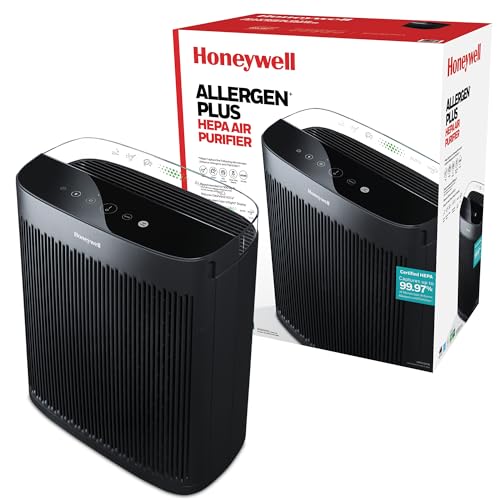
Honeywell HPA5300B — Best for XL Rooms
The HPA5300B is Honeywell’s extra-large-room answer: a HEPA machine rated to clean very large spaces within the hour, with an auto mode and a black housing that forgives the grime of a smoking household. Honeywell’s long presence in this category shows in the boring places — filters stay available, controls make sense, and the machine does not need a phone to run. For smoke, treat it as a high-volume particle and general-odor worker: excellent at keeping a big room’s air turning over, best paired with realistic expectations about the deepest smells.
For a big room or an open-plan floor where cigarette smoke spreads out, the HPA5300B brings verified large-space capacity and an auto mode, in a black housing that hides the grime smoking homes deposit. It is the volume answer for households where one small machine has already proven not to be enough.
Honeywell ownership is the conservative choice: a vast, stable filter ecosystem, controls that need no explanation, and an auto mode that spends electricity only when the air worsens. In a smoking home, the general-purpose filter set should be checked quarterly — the carbon portion works across every odor the home produces, not just smoke, and loads accordingly. The black housing hides the dust film between cleanings. Nothing about owning this machine is exciting, which after five years feels like a compliment.
Strengths
- XL-room rating with an auto mode that reacts without supervision
- Black finish hides the dust film that smoking homes deposit on appliances
- Honeywell’s filter ecosystem is widely stocked, which matters years into ownership
Trade-offs
- A big, plain appliance; the design will not win any room a style award
- Odor work is shared across a general filter set rather than a smoke-specific carbon bed
- At the speeds that clear a smoked room quickly, it is plainly audible
| Specification | Detail (from maker listing) |
|---|---|
| Coverage (maker rating) | Cleans 2,423 ft² rooms in 1 hour |
| Filtration | HEPA, for allergens, dust, pollen, pet dander, odors and smoke |
| Modes | Auto mode |
| Finish | Black |
Best for: Extra-large rooms and open spaces needing hands-off, high-volume cleaning / Not suited for: Style-led rooms or the deepest odor problems
Check the current price on Amazon.

LEVOIT Core 300-P — Best Budget
The Core 300-P is the small, honest workhorse of this roundup. It will not strip the smell out of a room where cigars are smoked nightly — no machine this size will — but for a bedroom that catches drifting smoke, a small apartment, or a first step while you learn how purification fits your home, it earns its place. The platform detail worth knowing is the replacement-filter ecosystem: a toxin-absorber variant for the Core 300 line leans harder into chemical and odor capture than the standard filter. Keep expectations matched to physics, run it continuously, and it does exactly the job its size promises.
The Core 300-P is the honest budget entry: a real HEPA machine, AHAM verified, small enough for a bedroom or a compact flat. It will not defeat a heavy habit in a big room, but for light smoking, a single room, or protecting a bedroom from smoke that drifts in, it does real work for modest money — and its toxin-absorber filter option leans into odor when you are ready to upgrade.
The Core 300-P is cheap to own in every sense: modest electricity draw, a single compact cartridge, and a platform popular enough that filters — including the toxin-absorber variant this guide recommends for odor — are easy to source. Its small carbon capacity means smoking homes will cycle cartridges faster than the box implies; treat the first change as calibration, note the interval your habit actually produces, and set a reminder accordingly. Simplicity is the maintenance plan, and it works because there is so little to neglect.
Strengths
- Compact, proven and usually the easiest entry point into real HEPA purification on this list
- A toxin-absorber replacement filter variant exists for the Core 300 platform, giving an odor-focused upgrade path
- Quiet sleep mode makes it realistic to run all night in the room where you sleep
Trade-offs
- Small carbon capacity means it manages light smoke odor rather than conquering a smoking room
- Rated coverage is for gentler duty; in a smoked-in room, treat it as a one-small-room machine
- No air quality monitor, so you judge clearing time by nose rather than numbers
| Specification | Detail (from maker listing) |
|---|---|
| Coverage (maker rating) | Up to 1,073 ft² |
| Filtration | HEPA filter with sleep mode |
| Verification | AHAM Verifide |
Best for: Bedrooms, small apartments and light or drifting smoke / Not suited for: Dedicated smoking rooms or anyone expecting one small unit to clear a whole home
Check the current price on Amazon.
Comparison Table
| Pick | Badge | Key spec | Best for |
|---|---|---|---|
| WINIX 5520 | Best Overall | True HEPA + high-deodorization carbon, air quality monitor, auto mode | Smokers who want visible air-quality feedback while the room clears |
| LEVOIT Core 400S-P | Best Smart Mid-Size | 3-in-1 filter for smoke, air quality monitor, auto mode, AHAM Verifide | One main living space with daily smoking and a buyer who values feedback |
| COWAY Mighty AP-1512HH | Best Proven Reliability | HEPA filter for smoke and odor, AQI monitor, auto and eco modes, 3-year warranty | A main living room where proven reliability beats smart features |
| BLUEAIR Blue 311i Max | Best Quiet Living Room | HEPASilent filtration, washable pre-filter, WiFi auto mode, AHAM Verified | Main living rooms in smoking homes that prize quiet and low upkeep |
| Honeywell HPA5300B | Best for XL Rooms | HEPA for XL rooms, auto mode, black finish | Extra-large rooms and open spaces needing hands-off, high-volume cleaning |
| LEVOIT Core 300-P | Best Budget | HEPA filter, quiet sleep mode, AHAM Verifide, compact footprint | Bedrooms, small apartments and light or drifting smoke |
How to Choose the Best air purifier for cigarette smokers
Match the machine to the rhythm of the habit. A pack-a-day smoker in one room creates a different problem from an occasional cigarette by an open window. For daily indoor smoking, prioritize three things in order: a carbon stage the maker rates for smoke or odor, a coverage rating comfortably above your room size so the machine can work at tolerable speeds, and an auto mode with a real air quality sensor, because nobody will manually manage a machine ten times a day.
Do the filter maths before you fall in love with a machine. In a cigarette household, carbon is a consumable with a steady appetite. Check what replacement filters cost, how often the maker suggests changing them under normal use, and then mentally shorten that interval — daily smoke is not normal use. Machines with washable pre-filters protect the expensive stages. Machines with widely stocked filters protect you from the special kind of frustration that arrives in year three when a cartridge has been discontinued.
Noise deserves more respect than it gets in reviews. A cigarette household’s purifier lives at low speed for most of its life, so the low-speed noise figure and the character of the sound matter more than the turbo roar. If the machine will share a room with television or conversation, favor the models rated in the low-to-mid 20s dB at their quiet settings, and accept that the post-cigarette clearing burst will be louder — that burst is short, and it is doing the most valuable work of the day.
Thirdhand Smoke: Why Continuous Running Matters
Secondhand smoke is what hangs in the air while and shortly after a cigarette burns. Thirdhand smoke is what it becomes: the residue that settles onto surfaces, fabrics and dust, and then slowly re-releases into the air for days and weeks. It is the reason a room can smell of cigarettes at 9am when nobody has smoked since the previous evening, and it is the part of the problem buyers most often misunderstand.
A purifier cannot scrub residue out of a sofa. What it can do — and this is genuinely valuable — is intercept smoke while it is still airborne, before it becomes residue. Every particle and odor molecule captured during and just after a cigarette is one that never settles into the curtains. That is why continuous, sensor-driven running beats heroic occasional blasts: the machine’s real job is prevention, keeping the home’s background smell from ratcheting upward week after week. Pair it with ordinary habits — emptying ashtrays, washing soft furnishings occasionally — and a smoking home can smell dramatically fresher than the habit would suggest.
The Morning-After Test: Measuring Your Home’s Real Progress
Buyers judge purifiers in the shop by specifications; households judge them at 7am. The morning-after test is the honest metric of a cigarette home’s air: walk into the smoking room first thing, before any window opens or any cigarette is lit, and breathe. In the first week with a good machine running on auto, that room will smell noticeably less stale. By the fourth week, if the filters are fresh and the machine has truly run continuously, the background note should have retreated further still — because the purifier has not only cleaned each day’s air, it has stopped each day’s smoke from becoming next month’s residue.
If the morning-after smell plateaus early, the test is diagnostic rather than disappointing. A plateau usually means one of four things: the machine is undersized for the room and never catches up; the carbon has saturated and needs replacing; the pre-filter is clogged and strangling airflow; or a standing source — a full ashtray, a smoke-heavy curtain, a coat that lives in the room — is re-loading the air as fast as the machine clears it. Work through that list in order before blaming the technology. In most homes, one of the four is fixable in an afternoon, and the test starts improving again within days.
Sizing the Machine to Your Room: A Worked Example
Work the sizing with your own room before you shop. A typical main living room where cigarettes are smoked might be 16 by 13 feet — about 210 square feet. Because the machine must work at speeds the household tolerates all day, choose from the picks rated at least twice that area; the options in this guide rated between roughly 1,000 and 2,400 square feet give you that headroom at various footprints and budgets. A bedroom that only receives drifting smoke plays by kinder rules — a compact model rated around the room’s size, run behind a closed door, defends it well. Two right-sized machines, one per problem, beat one giant asked to be everywhere.
What It Costs to Own One of These Machines
Strip away the launch prices — which this guide deliberately does not print, because they change — and a purifier’s ownership reduces to three streams. Electricity is the smallest: these are fan appliances, and on the low and auto settings where they spend most of their lives they draw about as much as the room’s lighting. Filters are the middle stream and the one that matters: a repeating cartridge purchase whose interval your habit sets, with smoking homes at the brisk end of every maker’s schedule. The third stream is your own attention, and it is the one whose bankruptcy closes the most purifiers into cupboards.
Design your ownership to spend the least attention possible. Machines with sensors and auto modes convert attention into electricity at a favorable rate. Machines with washable pre-filters convert a purchase into a chore of two minutes. Machines with mainstream filter supply convert a potential crisis — a discontinued cartridge in year four — into a non-event. Judge every pick in this guide on those three conversions and you will understand the ranking better than any specification table can explain it. The best machine is the one still running, correctly, on an ordinary Tuesday three years from now.
How to Set Up a Purifier for Everyday Cigarette Smoke
Daily smoking rewards a set-and-forget installation. Ten minutes of thought at setup saves a year of mediocre results.
- Put the purifier in the room where most cigarettes are actually smoked — not the room you wish they were smoked in. Be honest; the machine cannot clean air it never meets.
- Give it clear space: a hand’s breadth or more around intakes, away from corners, and not directly beside the smoking chair, where it would inhale a concentrated blast while the rest of the room stays dirty.
- Set it to auto mode if it has one, and confirm the sensor responds — light a cigarette across the room and watch the readout or fan react within a minute or two.
- If there is no auto mode, adopt a rhythm: a higher speed for half an hour after each smoking session, low speed the rest of the time, and never fully off while the home is occupied.
- Protect the bedroom separately if smoke drifts: a closed door helps, and a small second unit in the bedroom is often a better spend than one oversized machine fighting the whole home.
- Vacuum or wash the pre-filter monthly; ash dust and household lint clog it faster in smoking homes than anywhere else.
- Mark a filter-check date in your calendar every three months. Judge by performance — a room that clears more slowly than it used to is telling you the carbon is spent, whatever the indicator says.
Three Households, Three Right Answers
The solo smoker in a one-bedroom flat: every cigarette in the living room, the bedroom door closed at night. One mid-size sensor machine — the LEVOIT Core 400S-P or the WINIX 5520 — in the living room covers the problem almost completely, because the flat’s geography is simple and the door does the rest. Add nothing until the morning-after test says otherwise; most such households discover one good machine was the whole answer.
The mixed household: one smoker, one non-smoker, a shared living room and a partner who minds. This is the COWAY Mighty or BLUEAIR scenario — the machine must be inoffensive enough to run through every shared evening, and the bedroom deserves its own small defender so the non-smoker’s sleep is never negotiated. The social contract the machines underwrite is real: the habit stays, the smell largely goes, and nobody has to have the argument weekly.
The busy family home: cigarettes on the back step-side kitchen, children in every other room, a dog conducting inspections. Priorities reorder themselves — the smoking-adjacent room gets the responsive sensor machine, the children’s bedrooms get closed doors and, if budget allows, compact defenders, and the whole system runs on auto because no adult in that house has attention to spare. The Honeywell’s capacity suits the kitchen-diner scale; the plan matters more than the brand.
The shift worker’s home: cigarettes at odd hours, sleep at odder ones, a household running in relays. Sensor-driven auto mode is not a convenience here but the only workable arrangement, because no single person is awake for all of it. A WINIX 5520 or LEVOIT Core 400S-P in the smoking room, a quiet defender in whichever bedroom is currently occupied, and a filter rhythm owned by the household rather than by one person’s memory — that is a system that survives a rota.
Keeping It Working: The Four Jobs That Matter
Job one is the pre-filter, monthly, without exception in a smoking home. It is the cheapest component and the most consequential: everything behind it depends on air arriving, and a matted pre-filter silently converts a large machine into a small one. Wash it if it washes, vacuum it if it does not, and let it dry fully before it goes back.
Job two is the sensor, if your machine has one: a soft, dry cloth across its window whenever you clean the pre-filter. Sensor-driven auto mode is only as honest as the sensor’s eyesight, and a dust-filmed sensor makes a smart machine behave stupidly — slow to respond to a fresh cigarette, slow to settle afterwards. Job three is placement discipline: after every furniture rearrangement, party or seasonal change, confirm the machine still has clear space and still lives in the room the smoke does. Machines get exiled by tidiness more often than they fail by engineering.
Job four is the filter decision, taken on evidence. Keep a simple record — the date each cartridge went in, and a word about the room’s clearing time that month. When clearing stretches and the morning-after smell returns, the carbon has finished; replace it that week rather than negotiating. Owners who keep that small record stop experiencing filter changes as surprises and start experiencing them as fuel stops — planned, quick, and priced in. That change of relationship with the machine is, in the end, what separates the households in this guide’s success stories from the cupboard full of abandoned purifiers.
One last ownership truth, learned from every category of appliance that filters anything: the machine you maintain is the machine you own, and the machine you neglect is a fan in a box. Nothing in this section requires skill, tools or money beyond the filters themselves — a calendar note, a cloth, a vacuum, and the willingness to believe your own nose when it reports that performance has changed. Households that build those four small habits get the full value of every pick in this guide. Households that do not will conclude, wrongly and expensively, that the category itself is a fraud. The difference was never the machines; it is the rhythm, and the rhythm is free. Set it once, this week, while the purchase is still new and the intention is still warm, and let the calendar carry the discipline from here.
Common Buying Mistakes
Switching the purifier off between cigarettes. The machine’s most valuable work happens between smokes, catching what lingers and preventing build-up. Off is the one setting that cleans nothing.
Buying the smallest machine for the largest room. Undersized purifiers are the category’s biggest disappointment. In a smoking home, size up: headroom lets the machine work at speeds people tolerate.
Ignoring the carbon and buying on HEPA specs alone. Cigarette complaints are smell complaints. A superb HEPA stage with a token carbon sheet leaves the smell — and the buyer — unsatisfied.
Placing the unit in a hallway to ‘cover the home’. Air does not flow through closed doors to visit your purifier. One room, one machine, door closed while it works: that is the geometry that succeeds.
Forgetting that filters are the real subscription. The purchase is the down payment. In a daily-smoking home, budget for filter changes as a running cost from day one, and favor models whose filters are easy to buy.
Final Recommendation
For most cigarette-smoking households, start with the WINIX 5520: its deodorizing carbon is aimed at smoke, its monitor shows you the truth about your room, and its auto mode fits a habit that runs all day. The LEVOIT Core 400S-P is the smart mid-size alternative, the COWAY Mighty is the no-apps reliability pick, and the BLUEAIR Blue 311i Max wins any room where noise decides whether a machine stays on. Large spaces should step up to the Honeywell HPA5300B, and tight budgets or single rooms are honestly served by the LEVOIT Core 300-P. Set it up in the smoking room, leave it on auto, and keep its filters fresh — that combination is the whole secret. Related guides in this series: Best Air Purifier For Smokers, Best Air Purifier For Cigar Smokers, Best Air Purifier For Heavy Smokers and Best Air Purifier For Smokers House.
If you are deciding today, the shortlist to compare first is: WINIX 5520, LEVOIT Core 400S-P, COWAY Mighty AP-1512HH. Check the current price on Amazon for each, confirm the filter type matches the model name, and buy the one whose strengths match your room.
Frequently Asked Questions
Will a purifier remove the smell of cigarettes from my home completely?
It will reduce it dramatically, especially the fresh, airborne smell, but a home smoked in for years holds odor in fabrics and surfaces that air cleaning alone cannot extract. Think of the purifier as stopping the problem at source and steadily improving the background — most households are surprised how large the improvement is within the first weeks.
Should I run the purifier all the time or only when smoking?
All the time, ideally on auto. Cigarette smoke lingers and settles for hours after each cigarette, and a sensor-driven machine uses little energy while the air is clean. Continuous running is the single biggest difference between homes where purifiers ‘work’ and homes where they disappoint.
What size purifier do I need for the room I smoke in?
Choose a model whose rated coverage is comfortably above the room’s area — in a smoking room, treat the headline rating as optimistic and buy headroom. A machine working below its maximum is quieter, and quiet machines stay switched on.
How often do filters need replacing for a cigarette smoker?
More often than the general schedule suggests, because carbon loads up with every cigarette. Check quarterly and let performance judge: slower clearing and returning background smell mean the carbon is saturated. Washable pre-filters, cleaned monthly, extend the expensive stages’ lives.
Can one purifier handle a whole apartment?
In a small, open-plan apartment, a large-room model placed centrally can make a real difference. In a multi-room home with doors, no — air does not circulate through closed doors. Prioritize the smoking room first, then the bedroom, rather than one machine asked to be everywhere.
Do I still need to open windows if I have a purifier?
Ventilation and purification are partners, not rivals. A window cracked during smoking gives the purifier an easier load and removes some smoke outright. In weather that forbids it, the purifier alone still delivers most of the benefit — it just works harder and its carbon fills faster.


