Disclosure: airfryerkitchensupply.com is reader-supported. When you buy through links on our site, we may earn an affiliate commission at no extra cost to you.
Where to Buy
Shopping for the best air purifier for pot smokers? Every verified pick in this guide is sold through Amazon, where you can check price on Amazon for the current listing, confirm the exact model and filter type, and arrange delivery. The shortlist:
- LEVOIT Core 400S-P — Best Overall. Check the current price on Amazon.
- WINIX 5510 — Best Odor Carbon. Check the current price on Amazon.
- Rabbit Air MinusA2 SPA-780A (Odor Remover) — Best Discreet Design. Check the current price on Amazon.
- LEVOIT Core 300-P — Best Budget. Check the current price on Amazon.
- GermGuardian AC4825 Tower — Best Small Tower. Check the current price on Amazon.
- Medify MA-40 — Best Living Room Value. Check the current price on Amazon.
Availability and filter stock move around; if a listing shows a different model suffix than the one named here, match the model name in this guide rather than the photograph.
The best air purifier for pot smokers is really an odor-management purchase, and it helps to say so plainly. Cannabis smoke produces less lingering damage than tobacco in most homes — sessions are shorter, and the smoke is rarely an all-day presence — but its smell is pungent, distinctive and, for many people, something they would rather keep private: from neighbors in the next apartment, from guests at the door, from landlords and from family members who simply do not enjoy it.
Technically, the challenge splits in two as always. The visible smoke and its fine particles are easy: any honest HEPA machine captures them. The smell is the hard part, because cannabis odor is carried by volatile compounds — terpenes and their combustion products — that pass through HEPA media untouched and only stop at adsorbent surfaces like activated carbon. That is why this list is built around carbon quality and smart placement rather than headline room sizes, and why the guide below spends as much time on ventilation habits as on machines.
Expectations, honestly set: a good carbon-equipped purifier, running in a closed room during and after a session, cuts the smell dramatically and stops it soaking into furniture. It does not make a session undetectable to someone standing in the room while it happens — nothing does — and it works best as part of a small system: closed door, purifier running, and a window or exhaust path when the weather and the building allow. Judged on that realistic standard, these six machines perform.
In this guide
Quick Picks
Best Overall — LEVOIT Core 400S-P: 3-in-1 filter for smoke, air quality monitor, auto mode, AHAM Verifide. Rated coverage: Up to 1,718 ft². Check the current price on Amazon.
Best Odor Carbon — WINIX 5510: True HEPA + high-deodorization carbon filter, auto mode, app support. Rated coverage: Up to 1,881 ft² in 1 hr. Check the current price on Amazon.
Best Discreet Design — Rabbit Air MinusA2 SPA-780A (Odor Remover): HEPA with odor-remover customized filter, ultra quiet, wall mountable. Rated coverage: Wall-mountable slim profile. Check the current price on Amazon.
Best Budget — LEVOIT Core 300-P: HEPA filter, quiet sleep mode, AHAM Verifide, compact footprint. Rated coverage: Up to 1,073 ft². Check the current price on Amazon.
Best Small Tower — GermGuardian AC4825 Tower: 22-inch tower, HEPA + UV-C, 3 speeds, AHAM Verifide. Rated coverage: Up to 743 sq ft. Check the current price on Amazon.
Best Living Room Value — Medify MA-40: HEPA filtration to 0.3 microns, rated for smoke and odors. Rated coverage: 1,793 ft² in 1 hr. Check the current price on Amazon.
How These Picks Were Chosen
Every product in this guide was verified on this site’s own storefront connection before it was written about: we searched by brand and model, matched the returned listing title to the product, and only then used its ASIN for links. Models we could not verify with confidence were left out or written about without links — we do not guess at product identifiers.
With the verified shortlist established, picks were scored on the factors that decide real-world smoke performance. First, the filter stack: a HEPA stage for particles, and activated carbon with genuine substance for odor, because smoke is both problems at once. Second, honest capacity: coverage figures quoted by makers and, where available, backed by AHAM verification, always with headroom above the rooms these machines will serve. Third, liveability: noise at working speeds, auto modes and sensors, and the size and shape a machine brings into a real room.
For cannabis odor we prioritized carbon provision and small-to-medium room agility over maximum coverage: most pot smoking happens in one room, often an apartment living room or bedroom, where a mid-size machine with real carbon beats a giant particle-focused box. Quiet operation also scored highly, because sessions are social and a roaring machine changes the room.
Finally, we applied two honesty filters. Products with safety recalls were excluded outright. And nothing in this guide carries a fixed price or a fixed star rating: prices and ratings change constantly, so linked picks simply say to check the current price on Amazon, and prose describes tiers — budget, mid-range, premium — instead of numbers that would go stale.
The 6 Best Options: Best Air Purifier for Pot Smokers Picks Reviewed

LEVOIT Core 400S-P — Best Overall
The Core 400S-P sits in the sensible middle of the LEVOIT range: enough rated coverage for a proper living room, an air quality monitor that shows the room’s state, and an auto mode that reacts when the air turns. For smoke, the honest summary is that its 3-in-1 filter handles the particle side well and the odor side adequately — fine for a household where smoking is a daily habit in one room, less fine for a round-the-clock smoking den, where you should step up to heavier carbon. As a first serious purifier for a smoker’s home, though, the balance of feedback, verified ratings and manageable size is hard to argue with.
The 400S-P fits the apartment scenario best: its sensor notices a session starting, auto mode handles the response, and its size suits a living room without dominating it. The carbon in its combination filter handles the odor of typical sessions well, and the whole package is discreet enough to be furniture rather than a statement.
The 400S-P asks little of its owner: the sensor handles the day, the app handles the schedule, and the combination filter is a single cartridge swap when performance fades. In a smoking home, expect that swap to come sooner than the general guidance suggests, and use the air quality readout as your evidence — when post-session recovery stretches, the carbon is done. Keep the sensor window clean, vacuum the intake monthly, and the machine otherwise disappears into the room’s routine, which is its design intention.
Strengths
- Air quality monitor plus auto mode gives feedback and hands-free response in one mid-size package
- AHAM Verifide rating keeps the coverage claim honest compared with unrated rivals
- Black finish and child lock suit lived-in rooms rather than showroom shelves
Trade-offs
- The 3-in-1 filter’s carbon portion is modest; in constant smoke it will want changing on the early side
- Mid-size capacity means a big, heavily smoked room will ask more of it than it has
- Smart features assume you are comfortable running yet another app-connected appliance
| Specification | Detail (from maker listing) |
|---|---|
| Coverage (maker rating) | Up to 1,718 ft² |
| Filtration | 3-in-1 filter, rated for smoke |
| Feedback | Air quality monitor with auto mode |
| Verification | AHAM Verifide |
Best for: One main living space with daily smoking and a buyer who values feedback / Not suited for: The heaviest smoke loads, where deep-bed carbon machines earn their premium
Check the current price on Amazon.

WINIX 5510 — Best Odor Carbon
The 5510 is the current generation of a WINIX line that built its reputation in smoking households, and the reason is in the filter stack: a true HEPA element for particles paired with a carbon filter the maker explicitly rates for deodorization. That pairing matters because smoke odor lives in the gas phase. Run on auto, the machine idles quietly, senses a rise in airborne particles when someone lights up, and ramps itself without you touching a button. It is sized for a large living room on paper, and in a real smoking room you should treat that rating generously and let it run continuously rather than in bursts.
Where odor control is the top priority — a shared house, thin walls, a landlord who visits — the 5510’s high-deodorization carbon is the strongest tool in this list at a sane price. Run it in the room with the door closed and it does the most thorough job here of keeping the smell from ever reaching the hallway.
Running the 5510 is a filters-and-habit story. The combined filter cartridge should be treated as an annual appointment in a light-smoking home and checked at six months where smoking is daily; the deodorizing carbon is the part that gives out first, and the nose test — a room clearing more slowly than it used to — is the reliable gauge. App support means firmware and filter reminders arrive without effort, and replacement cartridges for WINIX’s mainstream line are consistently stocked, which matters more in year three than any launch-day feature.
Strengths
- The high-deodorization carbon filter is aimed squarely at smoke odor rather than being a token carbon sheet
- True HEPA stage handles the fine particle side of smoke, ash dust and general room grime
- Auto mode and app support make it easy to leave running as a background appliance
Trade-offs
- Carbon media still saturates in heavy smoke; budget for filter changes sooner than the allergen-only schedule
- The tall tower shape needs clear floor space around its intake to breathe properly
- App features are a convenience, not a performance gain, if you prefer physical controls
| Specification | Detail (from maker listing) |
|---|---|
| Coverage (maker rating) | Up to 1,881 ft² in 1 hr |
| Filtration | True HEPA with high-deodorization carbon filter |
| Controls | Auto mode, app support |
Best for: Living rooms and dens where smoke odor, not just particles, is the complaint / Not suited for: Very small bedrooms where a full-size tower is more machine than the room needs
Check the current price on Amazon.
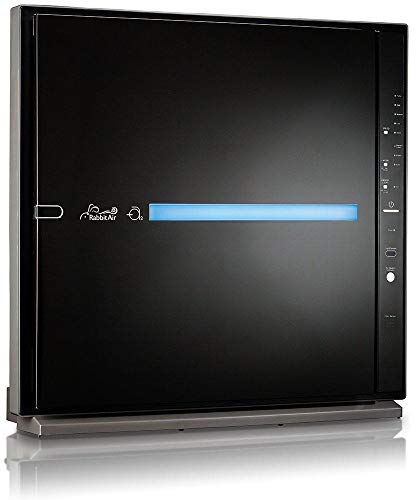
Rabbit Air MinusA2 SPA-780A (Odor Remover) — Best Discreet Design
The MinusA2 is the design-piece option for a room people actually live in. Rabbit Air sells the platform with interchangeable customized filter stages, and the odor-remover configuration is the one a smoking room wants: HEPA media for the particles, backed by odor-focused media for the lingering smell that settles into a den. It is unusually quiet, hangs on a wall like a picture frame if you want it to, and does not look like medical equipment. The trade is throughput: a slim panel cannot move tower-sized volumes of air, so it rewards being placed in the room where smoking actually happens rather than being asked to rescue a whole floor.
The MinusA2 is the connoisseur’s answer: wall-mounted, quiet, good-looking, and fitted with an odor-remover filter configuration. In a room where people gather, it works without announcing itself, and for moderate habits its odor focus matters more than raw airflow. It is the pick for a permanent, civilized setup.
Rabbit Air ownership is a premium-ecosystem experience: the customized filter kits are model-specific, priced accordingly, and absolutely central to performance, so buy the machine with its first replacement kit already budgeted. The slim panel is easy to live with and wall mounting frees floor space permanently, but plan the mounting position carefully — moving a wall-mounted purifier is a DIY job, not a whim. In return you get one of the quietest long-term presences in the category and a machine guests mistake for artwork.
Strengths
- The odor-remover filter configuration is chosen specifically for smell-heavy rooms rather than pollen duty
- Slim, wall-mountable design keeps it off the floor in a furnished lounge or den
- Runs very quietly at low speed, which suits rooms where people sit and talk for hours
Trade-offs
- Premium tier machine, and its customized replacement filters are part of that ecosystem’s cost
- Slim panel design moves less air per hour than the big towers on this list
- Wall mounting is a commitment; renters will usually stand it on furniture instead
| Specification | Detail (from maker listing) |
|---|---|
| Filtration | HEPA with odor-remover customized filter |
| Design | Slim profile, wall mountable |
| Noise character | Ultra quiet (maker description) |
Best for: Cigar lounges, dens and finished rooms where looks and quiet matter alongside odor control / Not suited for: Whole-house duty or the heaviest daily smoke load on a tight budget
Check the current price on Amazon.

LEVOIT Core 300-P — Best Budget
The Core 300-P is the small, honest workhorse of this roundup. It will not strip the smell out of a room where cigars are smoked nightly — no machine this size will — but for a bedroom that catches drifting smoke, a small apartment, or a first step while you learn how purification fits your home, it earns its place. The platform detail worth knowing is the replacement-filter ecosystem: a toxin-absorber variant for the Core 300 line leans harder into chemical and odor capture than the standard filter. Keep expectations matched to physics, run it continuously, and it does exactly the job its size promises.
The Core 300-P is the starter option that still respects the problem: a genuine HEPA machine with an available toxin-absorber filter variant that leans into odor capture. For a single room and an occasional habit, especially in a first apartment, it delivers most of the practical benefit for the least commitment.
The Core 300-P is cheap to own in every sense: modest electricity draw, a single compact cartridge, and a platform popular enough that filters — including the toxin-absorber variant this guide recommends for odor — are easy to source. Its small carbon capacity means smoking homes will cycle cartridges faster than the box implies; treat the first change as calibration, note the interval your habit actually produces, and set a reminder accordingly. Simplicity is the maintenance plan, and it works because there is so little to neglect.
Strengths
- Compact, proven and usually the easiest entry point into real HEPA purification on this list
- A toxin-absorber replacement filter variant exists for the Core 300 platform, giving an odor-focused upgrade path
- Quiet sleep mode makes it realistic to run all night in the room where you sleep
Trade-offs
- Small carbon capacity means it manages light smoke odor rather than conquering a smoking room
- Rated coverage is for gentler duty; in a smoked-in room, treat it as a one-small-room machine
- No air quality monitor, so you judge clearing time by nose rather than numbers
| Specification | Detail (from maker listing) |
|---|---|
| Coverage (maker rating) | Up to 1,073 ft² |
| Filtration | HEPA filter with sleep mode |
| Verification | AHAM Verifide |
Best for: Bedrooms, small apartments and light or drifting smoke / Not suited for: Dedicated smoking rooms or anyone expecting one small unit to clear a whole home
Check the current price on Amazon.

GermGuardian AC4825 Tower — Best Small Tower
The AC4825 is the small-tower veteran: a 22-inch column with HEPA filtration, a UV-C light, three speeds and an AHAM-verified rating for rooms up to about 743 square feet. It has survived in a fast-changing category because it does a simple job simply. For smoke, that job is a bedroom, a small office or a studio corner — places where drifting smoke and light odor are the problem, not a room that is actively smoked in all day. Set it on a medium speed, leave it alone, and it quietly keeps a small space fresher than it would otherwise be.
The AC4825’s slim tower is the small-space specialist — a studio corner, a bedroom, a home office. It will trim and manage a light habit’s odor rather than erase a heavy one, but its footprint and simplicity suit exactly the rooms where bigger machines simply do not fit.
The AC4825 is ownership at its simplest: one combined filter to replace, three speeds to choose from, and a UV-C bulb that is a secondary feature with its own long interval. Its modest capacity means its filter serves a small room honestly for a long time; in a smoking context it suits a bedroom or study rather than the main event. There is nothing to update, pair or configure. For a certain kind of buyer — and a certain kind of small, smelly room — that is the entire appeal, and it is legitimate.
Strengths
- Slim 22-inch tower footprint fits corners and small rooms the big boxes cannot
- AHAM Verifide rating keeps its modest coverage claim honest
- Simple three-speed control with no app, account or setup ritual
Trade-offs
- The smallest coverage here; it is a one-small-room machine, full stop
- Carbon provision is light, so it trims odor rather than transforming a smoky room
- UV-C is a secondary feature; the HEPA stage does the real work
| Specification | Detail (from maker listing) |
|---|---|
| Coverage (maker rating) | Up to 743 sq ft |
| Design | 22-inch tower |
| Filtration | HEPA with UV-C light |
| Speeds | 3 quiet speeds |
| Verification | AHAM Verifide |
Best for: Small rooms, bedrooms and studios with light or drifting smoke / Not suited for: Active smoking rooms or large open spaces
Check the current price on Amazon.

Medify MA-40 — Best Living Room Value
The MA-40 is the mid-size Medify: rated for smoke, wildfire air and odors, with coverage that honestly fits a living room and capture down to 0.3 microns for the fine particle fraction. Its replacement-filter design folds pre-filter, HEPA and activated carbon into one cartridge, which keeps maintenance simple — one part number, one swap. In a smoking home, that simplicity has real value, because the machine that gets its filter changed on time beats the theoretically better machine that does not. A solid, smoke-first choice for a single main room.
The MA-40 brings smoke-rated filtration and living-room coverage at a sensible tier, with a simple one-cartridge filter swap when the carbon is spent. For a household where sessions are a regular evening event in one main room, it is the steady, no-drama choice.
The MA-40’s single-cartridge design is its ownership charm: pre-filter, HEPA and carbon arrive and leave as one part, so maintenance is a dated reminder and a five-minute swap. Medify’s smoke-and-wildfire positioning means replacement filters are a core part of its range rather than an afterthought. In a smoking home, set the first reminder at six months, judge by how the room smells the morning after a session, and adjust the interval to your habit’s evidence rather than the brochure’s optimism.
Strengths
- Smoke and odor duty is in its headline rating, not buried in fine print
- Coverage fits a real living room rather than only a bedroom
- The platform’s 3-in-1 replacement filters combine pre-filter, HEPA and carbon in one swap
Trade-offs
- A generation older than the newest smart rivals, with fewer feedback features
- Odor performance depends on keeping the carbon portion fresh in heavy use
- Tower footprint needs the usual clear space around intakes
| Specification | Detail (from maker listing) |
|---|---|
| Coverage (maker rating) | 1,793 ft² coverage in 1 hr |
| Filtration | HEPA, removal to 0.3 microns |
| Rated uses (maker listing) | Smoke, wildfires, odors, pollen, pets |
Best for: A main living room wanting smoke-rated filtration and simple filter swaps / Not suited for: Whole-house coverage or app-driven automation fans
Check the current price on Amazon.
Comparison Table
| Pick | Badge | Key spec | Best for |
|---|---|---|---|
| LEVOIT Core 400S-P | Best Overall | 3-in-1 filter for smoke, air quality monitor, auto mode, AHAM Verifide | One main living space with daily smoking and a buyer who values feedback |
| WINIX 5510 | Best Odor Carbon | True HEPA + high-deodorization carbon filter, auto mode, app support | Living rooms and dens where smoke odor, not just particles, is the complaint |
| Rabbit Air MinusA2 SPA-780A (Odor Remover) | Best Discreet Design | HEPA with odor-remover customized filter, ultra quiet, wall mountable | Cigar lounges, dens and finished rooms where looks and quiet matter alongside odor control |
| LEVOIT Core 300-P | Best Budget | HEPA filter, quiet sleep mode, AHAM Verifide, compact footprint | Bedrooms, small apartments and light or drifting smoke |
| GermGuardian AC4825 Tower | Best Small Tower | 22-inch tower, HEPA + UV-C, 3 speeds, AHAM Verifide | Small rooms, bedrooms and studios with light or drifting smoke |
| Medify MA-40 | Best Living Room Value | HEPA filtration to 0.3 microns, rated for smoke and odors | A main living room wanting smoke-rated filtration and simple filter swaps |
How to Choose the Best air purifier for pot smokers
Buy carbon, then buy size. The most common mistake in this category is purchasing a well-reviewed allergy machine and discovering it does nothing for the smell. Look for machines whose filters are described in odor terms — high-deodorization carbon, odor-remover configurations, toxin-absorber cartridges — and treat a generic ‘carbon sheet’ mention as a warning sign. Cannabis sessions are short, so the carbon does not need the industrial depth a cigar room demands, but it must be real.
Size the machine to the session room, honestly. Most cannabis smoking happens in one room with the door closed. A mid-size machine rated comfortably above that room’s area will cycle the air repeatedly during and after a session, which is exactly the pattern that works. Apartment dwellers should also weigh noise and appearance: the purifier will live in a social room, so a quiet machine you are happy to look at beats a marginally stronger one that gets unplugged and closet-stored — an unplugged purifier has a capture rate of zero.
Think about the building, not just the room. In apartments, smell travels through door gaps, shared vents and hallways. A purifier’s job is to process the room’s air faster than the smell can escape, which is why running it before and during a session — not just after — matters so much. Pair it with a door that closes properly and, where allowed, a window fan exhausting outward, and a modest machine outperforms a big one used carelessly.
Purifier vs Ventilation vs Personal Filters: What Each Actually Does
Three different tools get confused in this conversation, and choosing well means knowing which job each does. A room purifier processes the air of the room it sits in: it captures particles completely and adsorbs a large share of odor, given time and closed doors. It is the only option that improves the room itself — the furniture, the curtains, the next morning.
Ventilation — a window fan blowing outward — removes smoke mass from the room entirely, which is powerful, but it depends on weather, building rules and where the exhausted air goes; in an apartment block, your exhaust can become a neighbor’s intake. Personal exhale filters, the small carbon devices you blow smoke through, cut the smell of the exhaled stream at source and genuinely help in shared spaces, but they do nothing for the smoke rising off the lit material itself, which is a large share of the room’s load. The strongest setup layers them: source control where practical, ventilation when available, and the purifier running throughout to polish the room and protect the soft furnishings. Each layer covers the others’ gaps.
Apartments and Shared Houses: The Diplomacy of Smell
In shared living situations, odor control is partly a social technology. The flatmate who never complains because the hallway smells neutral, the neighbor who has no reason to knock, the landlord whose inspection passes without comment — these outcomes are the real product a purifier sells in an apartment. That framing changes how you should buy and run one: consistency beats intensity. A machine that runs modestly at every session protects your reputation; a powerful machine used only when you remember protects nothing on the days you forget.
Build the habit into the room’s furniture. Keep the purifier permanently placed, plugged in and on standby or auto, within a few steps of the usual spot, so using it requires no decision. Keep the door’s seal honest — a draught excluder on a hollow apartment door does more for containment than a filter upgrade. And keep sources sealed between sessions: material in an airtight container, ash disposed of rather than accumulated. Neighbors rarely smell a session that was managed; they smell the accumulation of sessions that were not. The purifier is the engine of that management, but the routine is the vehicle.
Sizing the Machine to Your Room: A Worked Example
Apartment rooms make the sizing maths friendly. A typical living room or studio sleeping area of 150 to 250 square feet, door closed, is honestly served by the mid-size picks in this guide rated around 1,000 to 1,900 square feet — that headroom lets the machine clear a session’s air at speeds that do not drown conversation, which is the entire point in a social room. A small bedroom used for sessions suits the compact picks, provided expectations stay matched to their carbon capacity. Only step up to the largest machines if your sessions fill a big open-plan space; in apartments, carbon quality and door discipline outperform raw size almost every time.
What It Costs to Own One of These Machines
Strip away the launch prices — which this guide deliberately does not print, because they change — and a purifier’s ownership reduces to three streams. Electricity is the smallest: these are fan appliances, and on the low and auto settings where they spend most of their lives they draw about as much as the room’s lighting. Filters are the middle stream and the one that matters: a repeating cartridge purchase whose interval your habit sets, with smoking homes at the brisk end of every maker’s schedule. The third stream is your own attention, and it is the one whose bankruptcy closes the most purifiers into cupboards.
Design your ownership to spend the least attention possible. Machines with sensors and auto modes convert attention into electricity at a favorable rate. Machines with washable pre-filters convert a purchase into a chore of two minutes. Machines with mainstream filter supply convert a potential crisis — a discontinued cartridge in year four — into a non-event. Judge every pick in this guide on those three conversions and you will understand the ranking better than any specification table can explain it. The best machine is the one still running, correctly, on an ordinary Tuesday three years from now.
How to Use a Purifier for a Session, Step by Step
Technique multiplies hardware. This routine gets the most out of any machine on the list.
- Start the purifier at a medium-high speed ten minutes before the session, in the room you will use, with the door closed. Pre-moving air means smoke is captured as it is produced instead of pooling.
- Sit between the purifier’s intake path and the room’s air, not across the room from it; smoke that drifts past the machine gets processed on its first circuit.
- If you use a personal exhale filter, use it consistently — it removes a meaningful share of odor at source and makes the purifier’s job visibly easier.
- Where it is allowed and practical, crack a window with a fan exhausting outward on the far side of the room; keep the purifier running to handle what the exhaust misses.
- After the session, keep the door closed and let the purifier run at a good speed for at least an hour — two is better — before opening the room up to the rest of the home.
- Clear the source promptly: extinguish fully, empty and clean ashtrays and pipes, and store material in sealed containers. Lingering sources re-load the air faster than any machine can polish it.
- Check the carbon’s health monthly by nose: when sessions start leaving a next-day trace they did not used to, the carbon is nearing saturation and a replacement restores the system.
Three Living Situations, Three Right Answers
The rented flat with a visiting landlord: discretion is the requirement and consistency is the method. A mid-size carbon machine — the LEVOIT Core 400S-P — lives permanently in the session room, runs before, during and after every session without exception, and the door wears a draught excluder. Material lives in a sealed container; ash leaves the flat promptly. Nothing about the setup is dramatic, which is precisely why it works at inspections and in February alike.
The shared house with non-using housemates: the social contract is that the smell stays in one room. The WINIX 5510’s stronger carbon, a closed door, and a personal exhale filter for the worst of the stream keep that contract comfortably. Housemates judge by the hallway and the kitchen, not by your room — defend the borders, run the machine on a schedule rather than on memory, and the arrangement survives for years.
The homeowner’s evening ritual: no landlord, no housemates, just a preference for a house that does not smell of yesterday. The Rabbit Air or the Medify MA-40 in the living room, run generously, keeps furnishings neutral and the morning-after room honest. With no external audience, the temptation is to skip sessions’ routines; the furnishings keep score even when nobody else does, so the routine is the gift you give your own future nose.
The garden-level flat with a patio door: sessions half indoors, half out, in a building where the upstairs windows open onto the same air. The purifier’s job narrows to the indoor residue and the furnishings, and a GermGuardian or Core 300-P honestly suffices — provided the indoor half of the ritual gets the full routine: door closed, machine early, machine late. Outdoor smoke is the weather’s problem; indoor smoke is yours, and it is the half that soaks into sofas.
A Maintenance Calendar That Actually Survives Real Life
Daily, the machine asks for nothing — that is the point of auto mode — beyond the household’s own habits: ashtrays emptied, doors closed while rooms are being cleaned, sources sealed. If your purifier needs daily attention, it is the wrong machine or it is in the wrong mode, and this guide’s picks were chosen to need neither.
Monthly, one small job protects everything else: clean the pre-filter. Vacuum it or wash it according to its design, wipe the intake grille, and glance at the sensor window if your machine has one. Tie it to a date that already exists in your household’s rhythm — the first weekend, the rent day, the big shop — because maintenance attached to a habit survives, and maintenance attached to a resolution does not. In pet homes and heavy-smoking homes, this is also the moment to vacuum the floor the machine breathes from.
Quarterly, run the performance audit this guide keeps recommending: the morning-after test in the main room, a note of how long the room now takes to clear after a session compared with when the filter was fresh, and a decision — continue, or order the cartridge. Annually, review the whole arrangement: filter dates, the state of door seals in the rooms that matter, whether the machine’s room is still the room the smoking happens in. Habits migrate; the plan should migrate with them, once a year, deliberately, rather than drifting out of true.
One last ownership truth, learned from every category of appliance that filters anything: the machine you maintain is the machine you own, and the machine you neglect is a fan in a box. Nothing in this section requires skill, tools or money beyond the filters themselves — a calendar note, a cloth, a vacuum, and the willingness to believe your own nose when it reports that performance has changed. Households that build those four small habits get the full value of every pick in this guide. Households that do not will conclude, wrongly and expensively, that the category itself is a fraud. The difference was never the machines; it is the rhythm, and the rhythm is free. Set it once, this week, while the purchase is still new and the intention is still warm, and let the calendar carry the discipline from here.
Common Buying Mistakes
Buying a HEPA-only machine for a smell problem. The smoke will vanish and the smell will remain, and the buyer will conclude purifiers do not work. For cannabis, carbon is not an accessory; it is the point.
Switching the purifier on only after the session. By then the odor has toured the apartment. Starting before, and running during, keeps the smell contained to one closed room where the machine can win.
Leaving the door open ‘to spread the air around’. That spreads the smell around. A closed door is the purifier’s best friend; dilution into the whole home is the opposite of cleaning.
Ignoring soft furnishings. Curtains and upholstery near the usual spot absorb odor session after session. Wash or steam them occasionally, or they will re-release yesterday’s smell into today’s cleaned air.
Storing material and ash in the open. An open ashtray and an unsealed stash are continuous odor sources. Sealed storage costs nothing and removes a load no filter should have to fight.
Final Recommendation
For most people, the LEVOIT Core 400S-P is the right first answer: smart, sensor-driven, sized for a real living room, and discreet. If odor containment is the overriding concern, step up to the WINIX 5510’s deodorizing carbon; if the room deserves a permanent, quiet fixture, the Rabbit Air MinusA2 is the connoisseur’s pick. Budgets and small rooms are honestly served by the LEVOIT Core 300-P and the GermGuardian tower, and the Medify MA-40 covers a regular evening habit in a main room without drama. Whatever you run, run it early, run it with the door closed, and let it finish the job afterwards. Continue in this series: Best Air Purifier For Smokers, Best Air Purifier For Cigarette Smokers, Best Air Purifier For Smokers Home and Best Air Purifier For Pets Smokers.
If you are deciding today, the shortlist to compare first is: LEVOIT Core 400S-P, WINIX 5510, Rabbit Air MinusA2 SPA-780A (Odor Remover). Check the current price on Amazon for each, confirm the filter type matches the model name, and buy the one whose strengths match your room.
Frequently Asked Questions
Will a purifier stop cannabis smell reaching my neighbors?
It helps substantially when used properly — closed door, machine running before and during the session, and an hour or two of cleaning afterwards. Smell escapes through gaps and shared ventilation faster than any machine can process an open room, so technique matters as much as hardware. In very close quarters, layer in a personal exhale filter and window exhaust where allowed.
How long after a session until the room smells clear?
With a carbon-equipped machine running in a closed room, most of the airborne smell is typically handled within one to two hours, and — just as importantly — far less of it soaks into furnishings, so the next-day trace is much weaker. Heavily furnished rooms and heavy sessions sit at the longer end.
Is carbon or HEPA more important for cannabis smoke?
Carbon, for this use. HEPA captures the visible smoke particles easily, but the distinctive smell is gas-phase and only adsorbent media captures it. Every pick here includes both, but the ranking was decided by the carbon side of the stack.
Can I use the same purifier for tobacco and cannabis smoke?
Yes — the filtration physics are identical, and several households in this guide’s audience do exactly that. Expect carbon to saturate faster under a combined load, and judge replacement by performance: when either smell starts lingering longer than it used to, the carbon is ready.
Do personal smoke filters replace a purifier?
No — they complement one. A personal filter treats the exhaled stream only; the smoke rising from the lit material still loads the room. Used together, the filter cuts the source and the purifier protects the room and its furnishings.
Will running a purifier use a lot of electricity?
These are fan-and-filter appliances; on the medium settings used for most of a session routine, they draw modest power, comparable to a fan or a bright lamp. The expensive part of ownership is not electricity — it is replacement carbon filters over time.


