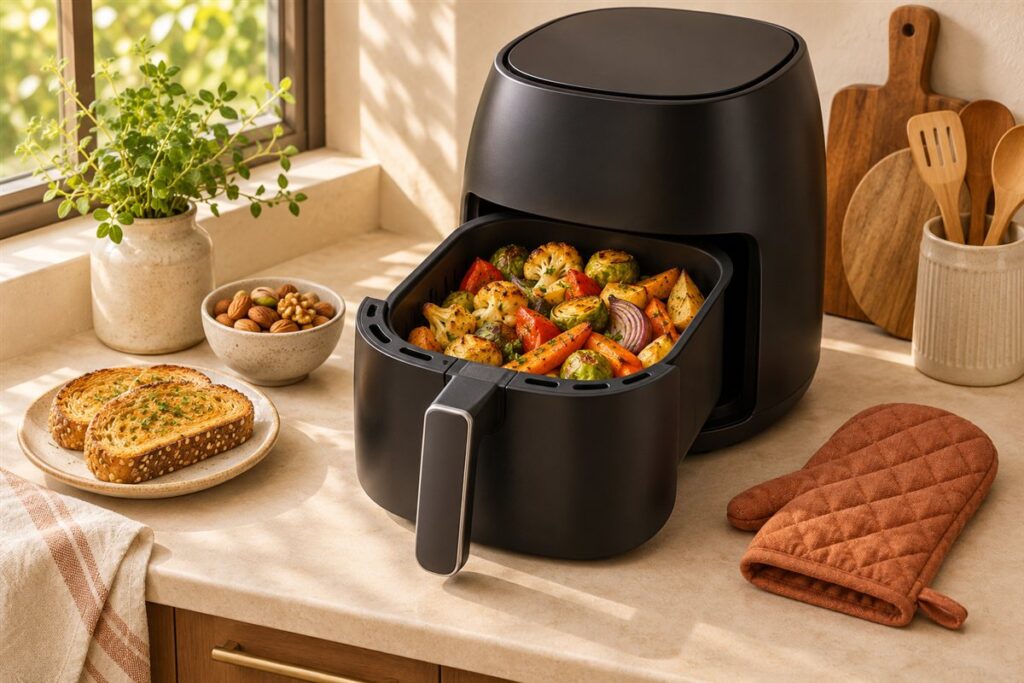
A family usually does best with a larger air fryer, a dual-basket model, or a plan to cook in batches. The right size depends on how many people you feed, what you cook, and how much space your kitchen offers.
Why Family Cooking Is Different
Cooking for several people means more food at once, and an air fryer needs food in a single layer to work well. A basket that looks big may still be too small for a family dinner if the shape is deep and narrow. Think of capacity as surface area, not just volume.
Layouts to Consider
- Large single basket: One big space, simple to load, and good for a single main item.
- Dual-basket models: Two separate zones so you can cook two foods at once, sometimes with different settings.
- Oven-style units with trays: Offer multiple layers for larger batches, though they take more counter space.
- A mid-size unit with batches: Works if you do not mind cooking in two rounds.
How to Decide Step by Step
- List the meals you cook most often and how many portions each needs.
- Note the largest item you cook, such as a whole chicken or a tray of fries.
- Check the basket or tray dimensions the maker lists.
- Measure your counter, including the clearance your manual asks for.
- Think about whether you want to cook sides and mains at the same time.
Decision Table
| Factor | Why it matters | What to check |
|---|---|---|
| Household size | Sets portions per meal | How many you feed on a typical night |
| Basket layout | Affects how foods are cooked together | One zone, two zones, or trays |
| Footprint | Large units need space | Counter area and overhead clearance |
| Cleaning | Big parts are harder to wash | Sink size and dishwasher fit |
| Power use | Larger units draw more | Outlet and circuit limits in your manual |
Planning Meals Around the Size
Even with a large unit, plan your meal in order. Cook the item that takes longest first, add quick sides later, and keep cooked food warm on a rack in a low oven. Prepare the next batch while the first one cooks. A little planning makes any size work smoothly on a busy weeknight.
Reading Capacity Claims Carefully
Capacity numbers on listings can be confusing. A figure for volume tells you the total space inside the basket, but it does not say how much food fits in a single layer, which is what matters for good results. Two baskets with the same volume can have very different floor areas. A wide, shallow basket gives more surface than a tall, narrow one, even if the number is the same.
Look for the dimensions of the cooking floor and the height of the chamber. Compare those with the foods you cook most. A tray of wedges, a family-size set of chicken pieces, or a batch of vegetables all need floor space. If the maker lists portions or serving sizes, treat that as a rough guide, because it depends on what you cook and how generous your servings are. Different makers use different methods to describe capacity, so do not rely on one number.
It also helps to check how the maker describes the usable space. Some include areas below the heating element or around dividers that do not hold food. Others mention a maximum fill line. Read the manual or product description for notes on how much to load, and keep in mind that overloading reduces airflow. If you are unsure, choose slightly larger than your usual need, since extra room makes cooking more even.
Matching Size to Household Habits
Household size is a starting point, but habits matter more. A family of four that eats air fried snacks occasionally has different needs from one that cooks full dinners in the machine most nights. Think about how you really use it, and what you would like to use it for. If it will replace the oven for weeknight meals, you may want more capacity. If it will handle sides and reheating, a smaller unit may do.
Consider the ages and appetites of your family. Teenagers and adults eat more than young children, and a growing household may need extra capacity soon. Think about guests as well. If you host often, a larger unit or a two-zone design saves time. If you cook for one or two most days and have a family only on weekends, a mid-size unit with batches might suit.
- Count how many portions you want from a single cook, not the whole meal.
- Consider whether you cook one big item or several smaller ones at once.
- Think about meal timing, since batches take longer than a single load.
- Note any special diets that need separate cooking.
Writing down your three most common meals and what they need is a practical way to test any model on paper before buying.
Space, Power, and Kitchen Limits
A big air fryer demands room. Measure the counter area and the height under cabinets, and add the clearance your manual specifies for the vents and the drawer. Remember the space needed to pull the basket out fully. If you plan to store the unit, check the cabinet or shelf as well, and make sure you can lift it comfortably. Large units can be heavy when loaded, so think about carrying distance and the height of storage.
Electrical limits count too. Larger air fryers usually draw more power, and your outlet or circuit may have limits when other appliances are running. Read the power information in the manual and avoid plugging into overloaded extension leads. If your kitchen has few sockets, check that one is within reach of the cord without stretching it.
Other limits include noise, cleaning, and sink size. A large basket may not fit flat in a small sink, and it can be awkward to wash. Check whether parts are dishwasher friendly and whether your dishwasher can take them. If space is tight, weigh a smaller unit used in batches against a larger one that takes over the counter. Neither choice is wrong; the right one is the one that fits your kitchen and routine without frustration.
Single, Dual, and Oven-Style Compared
Each layout suits different families. A single large basket is simple, easy to load, and good for one main dish. It can feel limiting if you want to cook a main and a side at the same time, since foods with different needs must be cooked in sequence. A dual-basket unit solves that problem by splitting the space, but each side is smaller than the whole, so a large item may not fit. Check the dimensions of each zone, not just the combined figure.
Oven-style units use trays and a door, and they can hold multiple layers. They suit batch cooking and larger items, and many have extra functions. They tend to take more counter space, and trays can be more awkward to clean. Airflow and results differ by layer, so you may need to rotate trays. Read the manual to see how the maker recommends loading them.
Think about how you cook for the family. If dinners often include a protein and a side with different times, a dual layout reduces waiting. If you cook large trays of one thing, an oven-style or large basket may be better. If you want flexibility and have little space, a mid-size basket with a plan for batches may be enough. Match the layout to the way your family eats, not just the number on the box.
Cooking for Picky Eaters and Busy Nights
Families often have different tastes at the same table. A dual-zone unit can help by keeping foods separate, such as plain chicken for one child and seasoned for another. With a single basket, you can use dividers or foil-free separators if the manual allows, or cook in sequence and keep food warm. Plan flavors so that strong seasonings do not carry over into the next batch.
Busy nights call for strategy. Prepare ingredients ahead, cut food evenly, and keep trays or containers ready. Cook the longest item first, add quick items later, and use a rack in a low oven to hold finished food. Tell the family what is coming so everyone is ready when the food is done. Keep a notepad of times and settings that worked, because repeating a good result is faster than experimenting.
Use the machine with older children as a learning tool, with supervision. Show them how to use mitts, how to open the drawer safely, and why they should keep hands away from vents. Keep the unit out of reach of small children. Safety habits and a simple routine make a family-sized air fryer a useful, calm part of the kitchen, whatever size you choose.
FAQ
Is a dual-basket model worth considering?
It can be if you often cook two items with different needs. It is less useful if you mostly cook one large dish.
Can I still use a smaller unit?
Yes, with batches. Cook the items that keep well first, and keep them warm on a rack in a low oven while you finish.
How do I know if my current air fryer is too small?
If you regularly cook in several rounds, crowd the basket, or end up with uneven results, it may be too small. Try spreading food in a single layer to test.
Does a bigger basket cook faster?
Not necessarily. A larger unit can hold more food, but cooking time depends on the thickness of the food and the settings. A full basket can take longer than a light one.
Can I cook a whole chicken in an air fryer?
It depends on the size of the unit and the bird. Check the interior dimensions and the maker's guidance, and use a thermometer to confirm it is cooked.
Are oven-style air fryers better for families?
They offer more space and multiple trays, which helps with batches. They also need more counter space, so weigh them against your kitchen.
Is it better to buy two small units or one large one?
It depends on your space and habits. Two units let you cook different foods at once but need more counter room and sockets.
What size works for meal prep?
A larger basket or oven-style unit helps with batch cooking. Plan the batches and check that the parts fit your sink and storage.
The Short Version
For a family, choose a large basket, a dual-basket layout, or an oven-style unit if you have space. Otherwise a mid-size model and batch cooking can do the job. Match size to your usual meals and your counter.