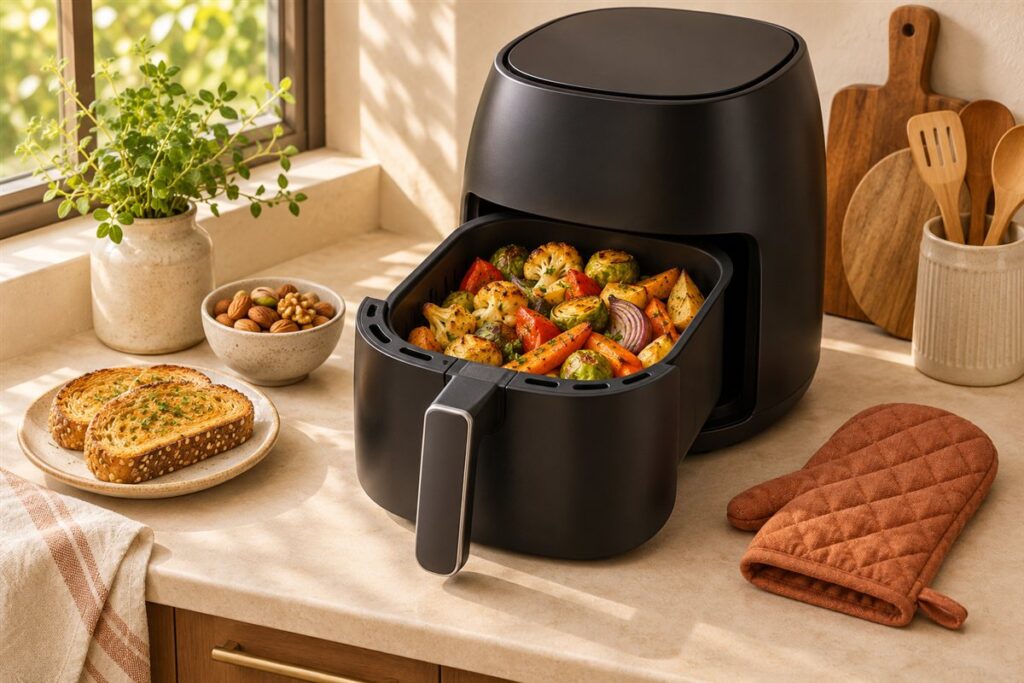
The right basket size depends on how many people you feed and how you cook. A small basket suits one or two people and quick snacks, while a larger one suits families and batch cooking. This guide lists the factors to weigh before you choose.
Decision Criteria
| Factor | Why it matters | What to check |
|---|---|---|
| Household size | More people means more food per batch | How many servings you cook at once |
| Food type | Bulky items need more floor space | Whole chicken, large fillets, or loose fries |
| Counter space | Bigger units take more room and need clearance | Width, depth, and height with the lid open |
| Storage | You may need to put it away between uses | Cabinet or shelf size |
| Cleaning | Large baskets can be hard to fit in a sink | Whether it fits your sink or dishwasher |
Floor Space Matters More Than Volume
Capacity is often given in quarts or liters, but air frying works best when food is in a single layer with gaps for airflow. A tall, narrow basket may hold a lot by volume yet have less usable floor than a wide, shallow one. Look at the floor measurements and picture your usual meal laid out on it.
Matching Size to How You Cook
- Single cooks and couples: a compact basket handles snacks, sides, and small mains.
- Small families: a mid-size basket is often enough for a main and a side, sometimes in two batches.
- Larger households or meal prep: a big basket or a dual-drawer model reduces the number of batches.
- Entertaining: consider how many batches you are willing to cook, and keep food warm between them.
Tradeoffs of Going Bigger
A larger basket does not always mean faster dinners. Overfilling blocks airflow, and food can cook unevenly in any size. A bigger unit also takes more counter space, and it may take longer to warm up. If you cook for one or two, a smaller unit often works faster and is simpler to clean.
Check the maker’s guide for suggested fill levels and times for your model.
A Quick Check of Your Own Needs
Before buying, picture a normal dinner and the batch you would cook. Count how many pieces of the main food you would cook, then imagine them side by side in one layer. If they would not fit, plan for a larger unit or two rounds. This quick mental check is often more useful than any chart.
Round, Square, and Drawer Baskets Compared
Basket shape changes how much food you can lay out in a single layer, even when the listed capacity looks the same. Round baskets are common and heat evenly, but the corners of a square plate or tray are wasted, and long foods such as fish fillets or sausages may not lie flat. Square or rectangular baskets use floor space more efficiently, which helps with fillets, wings, and flat bakes.
Drawer-style units slide out like a tray and are easy to shake, though the drawer needs clearance in front of the appliance. Oven-style units with racks offer more total area spread over several levels, but they need more counter space and food on lower racks can cook differently from food on upper racks.
When you compare shapes, think about these points:
- The foods you cook most often and whether they lie flat or need to be stacked.
- Whether you shake food in the basket or turn it with tongs.
- How easy the basket is to lift out when it is full and hot.
- Whether a divider or second drawer is part of the design.
A basket that suits your usual dishes will serve you better than one that looks large on paper. Check the interior width and depth in the product notes and picture your regular meal on it.
How Much Fits Before Crowding Starts
Capacity numbers describe the container, not a safe fill level. Air fryers cook best when hot air can reach most surfaces, so food should not be piled in deep heaps. A useful guide is to fill the basket so pieces sit mostly in one layer with small gaps, or in a loose, shallow layer for items like fries that can be shaken.
Your manual may state a maximum fill line or a recommended amount of food, and that guidance takes priority over general rules. If you find food coming out pale or soft in the middle, crowding is the usual cause. Cooking in two rounds often produces better results than one overfilled round, even though it takes longer.
Different foods have different tolerances:
- Loose snacks and fries: can be layered a little if you shake often.
- Breaded or battered items: need space so coatings crisp rather than stick together.
- Meat pieces: should have gaps so heat reaches every side.
- Leafy or light foods: need low fill because the fan can blow them around.
If you regularly feel you are fighting for space, that is a sign to compare a larger basket, not to pack in more food.
Counter, Cabinet, and Clearance Checks
A basket size is only convenient if the whole appliance fits your kitchen. Measure the footprint of the unit, including handles and any cord or vent area, then add the space your manual asks you to leave around it. Check the height with the lid or drawer open, particularly if you plan to use it under wall cabinets, which is usually not advised because steam rises from the unit.
Think about where it will live between meals. A heavy appliance that must be lifted into a high cabinet each time may end up unused, while one that stays on the counter needs a safe, level spot with open airflow. Check how the basket and tray come out, how much room you need to pull a drawer fully open, and where you will set a hot basket down.
Use this short checklist:
- Measure width, depth, and height of the appliance as listed.
- Add manual clearance at the back, sides, and top.
- Check cord length against your nearest wall outlet.
- Confirm the basket fits in your sink for washing.
Choosing a slightly smaller unit that you will really use often beats a bigger one that spends most of its time in storage.
Size and Cleaning Effort
Basket size affects cleaning more than people expect. Large baskets and trays may not fit in a small sink, and a dishwasher rack may not have room for them. Deep baskets with narrow corners can be harder to scrub than shallow, open ones. If cleaning feels like a chore, you are likely to use the air fryer less.
Check whether the basket and tray are removable, whether they are listed as dishwasher safe, and what coating they have. Nonstick surfaces need gentle sponges and no metal scrapers. Dividers, racks, and extra trays add more parts to wash, which is worth weighing if you want a quick cleanup after weeknight meals.
Some practical points:
- Wash the basket soon after cooking so grease does not harden.
- Soak stuck-on food in warm soapy water rather than scraping.
- Dry all parts fully before putting them back.
- Wipe the interior of the main body when it is cool and unplugged, following the manual.
When two sizes seem equally suitable for your cooking, the one that is easier to clean is often the better daily choice.
Signs Your Basket Is the Wrong Size
Many people only realize their basket is a poor match after a few weeks of use. The signs are fairly clear once you know them. If you constantly cook in two or three batches, dinner takes longer than it should and the first batch cools while you wait. That points to a basket that is too small for your usual meal.
If you only ever use a fraction of the floor, shake food in a basket that looks mostly empty, or find the appliance heats a large space for a small portion, you may have more unit than you need. A big appliance also takes up counter space that a compact one would free.
Look for these patterns:
- Food that regularly comes out soggy because you pack it in to save time.
- Pans and dishes that never fit, so baking stays off the menu.
- Leftovers that you never reheat because the unit is too awkward to set up.
- A cabinet or counter spot that always feels crowded.
If you recognize several of these, compare basket dimensions again before replacing the unit. Sometimes better habits solve the issue, but a persistent mismatch is a good reason to size up or down.
FAQ
Is a bigger basket always better?
No. It helps if you regularly cook large amounts, but it can be wasted space for small meals.
Can I cook two things at once in one basket?
Sometimes, with a divider or by keeping foods apart, but cooking times differ. Dual-drawer designs are made for this need.
Do I need a bigger basket if I mostly cook frozen foods?
Frozen snacks and sides need floor space to crisp, so a basket that lets you spread them in a thin layer works best. If you cook large quantities at once, a bigger or dual-drawer model may save time.
What is a dual-drawer air fryer good for?
It lets you cook two foods at once, often with separate settings for each. Check the manual for how the two drawers share power and whether both can run at full time at once.
Can I cook a whole chicken in any basket?
No. A whole bird needs enough height and width to sit without touching the heating area. Check the interior dimensions in the listing and your manual before trying.
Does a larger basket use more electricity?
It may draw more power while heating, since there is more space to warm, though total use depends on how long you cook. Check the wattage in the manual.
How full should I fill the basket?
Follow your manual first. As a general rule, aim for a single layer with gaps, or a loose shallow layer for foods you can shake.
Is a tall basket or a wide basket better?
It depends on your food. Wide, shallow baskets suit flat foods and single layers, while tall ones suit bulky items like small roasts. Compare dimensions, not just the capacity number.
The Short Version
Choose a basket that fits your usual batch size, your counter, and your storage. Look at usable floor space, not just the capacity number, and follow the manual’s fill guidance.