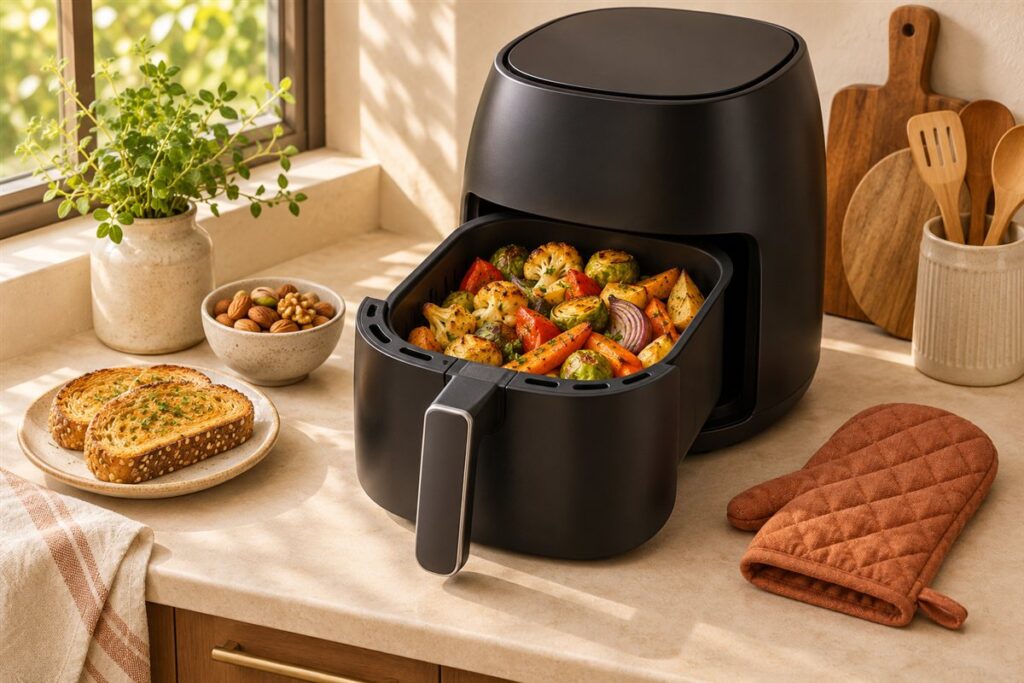
A dual zone air fryer has two separate cooking compartments that can run different settings, while a single basket model has one. Dual zone suits people who cook a main and a side together, and single basket suits simpler needs and tighter spaces. Here is how to choose.
What Each Is For
Single basket units are the classic design: one container, one temperature, one timer. They are straightforward and often smaller. Dual zone units split the cooking space in two, so each side has its own timer and temperature, and some include a feature to finish both at the same moment.
Key Differences
| Feature | Single basket | Dual zone |
|---|---|---|
| Foods at once | One kind, or several that cook alike | Two different foods |
| Settings | One timer and temperature | Separate controls per side |
| Size on counter | Often compact | Often wider |
| Batch size per side | Full basket for one food | Each drawer is smaller than a full basket |
| Cleaning | One basket to wash | Two baskets to wash |
| Accessories | More choice for a single shape | Need to fit smaller drawers |
Think About Your Meals
If you often cook chicken and vegetables together, or fries and a protein, the second zone saves time because you do not wait for one batch before the next. If you mostly cook one food at a time, a second zone may just take up counter space.
Also think about portion size. A large single basket may hold a bigger amount of one food than one side of a dual unit. Compare the size of each drawer, not just the combined number.
Who Should Choose Which
- Choose single basket if you cook for one or two, have limited space, or prefer simple controls.
- Choose dual zone if you cook for a family, like to serve a full meal at once, or batch cook often.
- Consider the number of baskets you are happy to wash.
Counter Space and Cleanup
Dual zone units are usually wider, so measure your counter and the space above it before you decide. Also think about washing. Two baskets mean two sets of slots and corners, which adds a little time after each meal. If you cook for yourself most nights, that extra effort may not be worth it. If you cook for a group, the time saved while cooking often outweighs the time spent washing.
How Dual Zone Cooking Actually Works Day to Day
A dual zone air fryer has two separate cooking compartments, each with its own drawer and usually its own temperature and timer controls. The idea is that you can cook two different foods at once, for example a protein on one side and vegetables on the other, without flavors mixing. Many models also offer a way to make both sides finish at the same moment, even if the foods need different times, but the way this works varies, so read the manual for your model.
In practice, this changes how you plan a meal. Instead of cooking one item, holding it warm and cooking another, you can start both and serve together. That can save real time on busy evenings and cut down on how often you turn on the oven. The trade-off is that each side holds less than a single large basket, so a big batch of one food may need both sides or two rounds.
It also changes how you think about airflow. Each drawer works best when food sits in a single, loose layer. If you pile one side high to compensate for its smaller size, results may be uneven. Treat each drawer as its own small air fryer and avoid overloading it.
Sizing for Your Household and Your Usual Meals
Capacity numbers on listings can be misleading, because a total figure for a dual unit is split across two drawers. Always look for the size of each drawer, not just the combined total. A single basket with the same total capacity may fit a larger roast, whole chicken pieces or a big tray of fries more easily than either side of a dual unit.
Think about the foods you cook most. If you regularly cook for one or two people, a single basket of modest size can handle most meals and take up less space. If you cook for a family, a dual model lets you cook a main and a side together, which can matter more than the total volume. If you often cook larger items such as a whole bird or a wide tray of baked goods, check that they physically fit in one drawer before choosing.
- Measure the foods you cook most and compare them with the drawer dimensions in the listing.
- Check whether the listing states depth as well as width.
- Consider how many people eat at once, not only how many live in your home.
When in doubt, size around your largest regular meal rather than your smallest snack.
Cooking Quality and Features to Compare
Both types can produce crisp, browned food when used correctly, so compare features rather than assuming one type is better. Look at the temperature range, the preset modes and whether the display shows both zones clearly. A sync or match feature can be handy for dual units, and some single models offer shake reminders. Check which modes you really need, such as roast, reheat or dehydrate, instead of paying attention only to the longest list.
Controls deserve attention. Touch panels look neat but some people prefer dials for quick adjustments. On a dual unit, clear labels for each zone prevent mistakes, such as setting the wrong side. Also see how the unit behaves when you open one drawer mid-cook, because some pause both zones and others continue on the closed side. The manual should explain this.
Noise and heat output are worth thinking about too. Two fans and two heating elements may mean more sound and warmth in a small kitchen. The listing may not state noise levels, so be wary of assumptions and look for the information in the manual or maker’s description.
Another useful check is how the display labels each side and whether the sync option can be turned off. Some people want both sides finishing at once, while others prefer to run them independently, so make sure the controls fit your habits before you buy.
Power, Electrical Needs and Kitchen Fit
Air fryers draw a lot of power for a small appliance, and dual models often use more than single baskets because two heating areas can run together. Check the wattage in the listing and compare it with the rating of your outlet and circuit. Avoid plugging the unit into an extension cord or a power strip unless the manual explicitly allows it, and consider that other high-draw appliances on the same circuit may trip a breaker.
Space is the other practical limit. Dual units are often wider, and both drawers need clearance to open fully. Measure the counter width, depth and the height under your cabinets, and leave room behind and around the unit for ventilation as described in the manual. A unit that fits only if its exhaust faces a wall is a poor choice.
Consider storage too. If you plan to put the air fryer away between uses, check its weight and whether you can lift it comfortably. A big dual unit is easier to leave on the counter, while a compact single basket may fit in a cupboard. Also think about where the cord reaches and whether the surface is heat resistant.
Also check the cord length and where the cord leaves the unit, since a short cord limits where the appliance can sit. A kitchen with one outlet far from the counter may favor a smaller unit.
Cleaning, Accessories and Long-Term Ownership
Ownership costs show up in cleaning and accessories. Two drawers mean two baskets and trays to wash, so check whether they are listed as dishwasher safe and follow the care instructions to protect the coating. A unit that is hard to clean tends to get used less, so look for smooth surfaces, removable parts and drawers that are easy to handle when slick with oil.
Accessories can be more limited for dual models, since racks, liners and pans must fit smaller drawers. Before buying extras, check the internal dimensions and what the maker approves. Use only accessories suited to your air fryer and follow the manual on liners and foil, as blocking airflow can affect cooking and safety.
Think about longevity as well. Compare warranty terms and what they cover, such as the heating element, fan and coating. Signs it is time to replace include a coating that flakes, a drawer that no longer slides smoothly, a fan that rattles or a heating element that no longer works evenly. If the coating is damaged, stop using the affected part and contact the maker. Choose the style you will actually use and clean regularly, because the best air fryer is the one that stays in daily rotation.
FAQ
Can I use both sides for one big batch?
Many dual units have a mode for this, but the way it works varies. Check the maker’s guide for your model.
Do dual models use more electricity?
They often have higher wattage, since there are two heating areas. Look at the wattage in the manual and your home circuit needs.
Can I cook two different foods at different temperatures in a dual zone model?
Yes, that is the main purpose of separate controls. Each side can be set on its own, and some models include a mode to help them finish together. Check the manual for how your model handles it.
Will foods taste like each other if cooked side by side?
The zones are separate compartments, so flavors generally stay apart. Strong smells can still linger in the unit, so clean drawers after cooking pungent foods.
Is a single basket easier to clean?
It has one basket to wash instead of two, which many people find simpler. Ease of cleaning also depends on the coating, the shape and whether the parts are dishwasher safe.
Do I need to buy new accessories for a dual model?
Accessories for large single baskets often will not fit smaller drawers. Check the inside dimensions and any maker approvals before buying racks, pans or liners.
Which type is better for reheating leftovers?
Either can do it well. A dual unit lets you reheat two items at the same time at different settings, while a single basket works fine for one dish at a time.
What should I check first when comparing two listings?
Start with drawer size, wattage, counter footprint and the way the controls work. Then compare the warranty and the cleaning instructions.
The Short Version
Choose dual zone for full meals and flexibility, and single basket for compact, simple cooking. Check drawer sizes, counter space, and the manual before you decide.