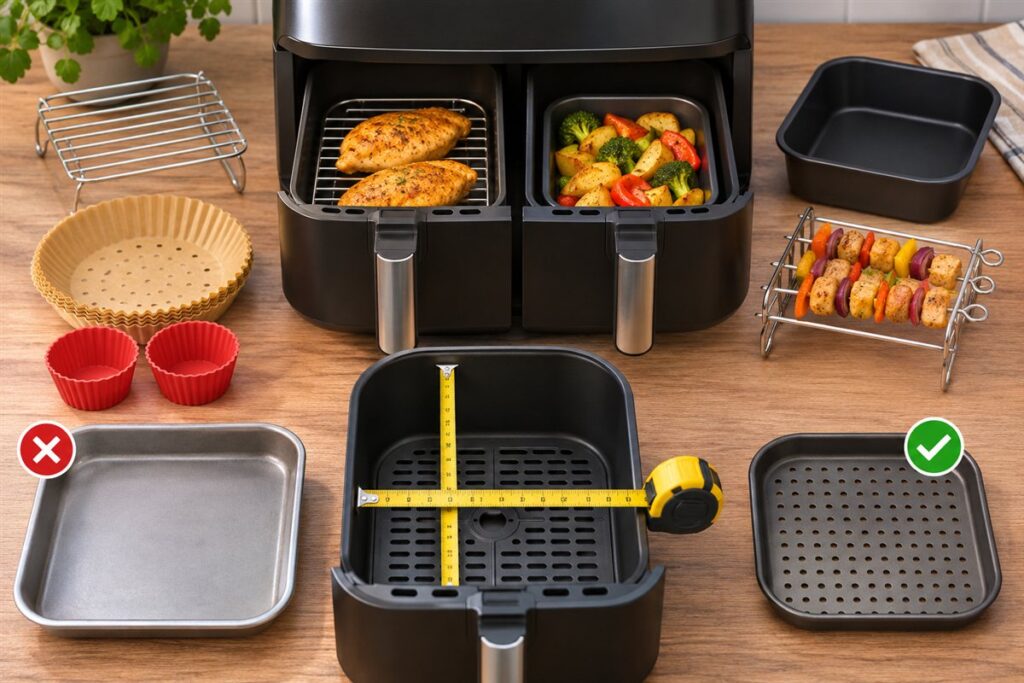
A dual zone air fryer has two cooking drawers, so every accessory has to fit one drawer and not the whole unit. Choose items sized to a single drawer floor, and think about buying them in pairs so both sides can work at the same time. Check the maker’s guide before you add anything.
Why Two Drawers Change the Shopping List
In a single-basket model, one large pan covers everything. With two drawers, each side is smaller and often has a different shape. A piece that looks big enough on a shelf may turn out narrow once it sits inside. That is why the first step is always measuring.
Pairs also make sense. If you cook a main dish on one side and a vegetable on the other, you may want matching racks or liners on both so cleanup works the same way.
Sizing Decision Table
| Factor | Why it matters | What to check |
|---|---|---|
| Single drawer floor | Each accessory lives in one drawer only | Measure length and width of the drawer base |
| Drawer depth | Tall racks can touch the heating area | Measure from floor to the top area |
| Pairs or singles | Both sides may need the same item | Decide before you buy extras |
| Divider design | Some units have a fixed crisper plate | Look at how the plate lifts out |
| Cleaning access | Drawers are narrow | Check that you can reach corners |
Useful Accessory Types
- Small racks: lift food so air reaches the underside.
- Liners with openings: reduce sticking while keeping air moving.
- Compact pans: good for small bakes and egg dishes.
- Silicone cups: handy for portions that might spread.
- Skewer racks: useful if they sit below the heating area.
Getting the Best Out of Both Sides
- Choose one accessory type per drawer for the first few cooks.
- Keep the load light so the air can move freely.
- Match cooking times by using the sync or match feature if your model has one.
- Open a drawer briefly to turn food, then slide it back in.
- Wash each piece after use and dry it before storing.
Follow the maker’s manual and safety instructions when placing anything inside a drawer. Keep loose paper and light items weighed down by food so the fan cannot lift them toward the heating element.
Things to Avoid
Avoid oversized pans that push against the drawer sides or the drawer rails. Skip accessories that cover the whole floor, since that blocks air from the plate below. Also avoid mixing materials you are not sure about; check the temperature limits for each one in the maker’s guide.
How to Measure Each Drawer Before Buying
Measuring is the single most useful step, and with two drawers it is easy to do it wrong. Take the length and width of the drawer floor at its widest usable point, not the outer rim. Many drawers taper toward the base, so an accessory that matches the opening may not sit flat inside. Then measure the height from the floor up to the point where food would get close to the heating area. That number is your height limit, and anything taller risks touching hot parts or blocking airflow.
Write the figures down and compare them with the product listing, which should state the dimensions of the accessory. If the listing gives only a general size such as small or medium, look for a more exact measurement or skip the item. Also check whether the two drawers are the same size. Some units have drawers of equal capacity, while others differ, so an accessory that suits the left side may not suit the right.
Leave a small gap around the edge. A piece that fits with no spare room can be hard to remove when hot, and it can restrict the air that needs to travel around the food. If a listing says an item is made for a particular model or capacity range, still confirm against your own measurements rather than relying on the label alone.
Protecting Airflow and the Crisper Plate
Air fryers cook by moving hot air around food, so any accessory that blocks that movement works against the machine. In a dual zone model the drawer usually has a perforated plate or insert on the floor, and the air passes through and around it. An accessory that covers the whole plate can trap steam and leave the underside of food pale and soft.
When you choose an accessory, favor open designs: racks with wide gaps, liners with plenty of openings, and shallow pans that leave space at the sides. Avoid solid, flat sheets that sit directly on the plate unless your manual says they are intended for use in the drawer.
- Check whether the plate lifts out, and if it does, whether the maker allows cooking with it removed.
- Do not stack several accessories so tightly that the fan cannot move air between them.
- Keep food away from the top of the drawer so it does not press against the heating area.
- If food browns unevenly, try a lighter load before assuming the accessory is at fault.
The manual is the final word on what can go inside, so read the section on accessories before your first cook with anything new.
Materials and Heat Tolerance
Accessories come in metal, silicone, ceramic, glass and paper. Each behaves differently in a compact, fast-moving hot environment. Metal racks and pans heat quickly and brown food well. Silicone is flexible, easy to remove and gentle on non-stick surfaces, but it is lightweight and can shift in the airflow. Ceramic and glass hold heat and are heavy, which can make them awkward in a narrow drawer.
Always check the product listing for the maximum temperature the item is rated for, and compare it with the highest setting you plan to use. If the listing does not give a rating, treat that as a reason to look elsewhere. Do not assume that something sold for ovens suits an air fryer, because the heating element is much closer to the food.
Coatings matter too. If your drawers have a non-stick finish, avoid hard metal tools or rough-edged accessories that could scratch it. Rounded edges and smooth finishes are kinder to the surface. Finally, think about weight: very light items can lift in the airflow, so make sure they are weighed down by food or designed to stay put.
Matching Accessories to How You Cook
The right set depends on what you cook most. If you mostly cook frozen foods and vegetables, you may need little beyond a pair of simple liners and perhaps one small rack. If you cook protein on one side and a side dish on the other, a rack for the meat and a shallow pan for the side can keep juices and flavors separate.
People who bake or make egg dishes will want small pans or silicone cups that fit a single drawer. Those who cook skewers or kebabs should confirm that the skewers are short enough to sit below the heating area. Families who cook large amounts may prefer sturdier racks that can hold more, as long as they still respect the height limit.
Start with one or two pieces and learn how they work before buying a full set. Many sets include items you will never use, and a few well-chosen pieces often cover most meals. Think about whether you want matching pairs, since using the same accessory in both drawers keeps timing and cleaning simple.
Care, Storage and When to Replace
Narrow drawers mean accessories need to be easy to wash. Look for designs with few crevices and smooth surfaces, since grease collects in joints and seams. Wash by hand with warm soapy water and a soft brush, or follow the listing if it says the item is dishwasher safe. Dry thoroughly before storing, because trapped moisture can cause rust on metal or odors in silicone.
Store accessories flat or nested so they do not get bent. A warped rack will sit unevenly and may not hold food securely. Keep them in a spot where you can reach them easily, or you may be tempted to cook without them.
Signs that an accessory needs replacing include peeling coatings, deep scratches, rust, cracks, sticky residue that will not wash off, and any bending that stops it sitting level. Silicone that stays greasy or smells even after washing has usually reached the end of its useful life. Replace damaged pieces rather than using them, since a failing coating or a wobbling rack is not worth the risk.
FAQ
Can I use the same accessory in both drawers?
Often yes, if the drawers are the same size. Some models have slightly different drawers, so measure each one.
Should I buy a set made for dual zone models?
A set labeled for your drawer shape can save guesswork, but still compare its dimensions with your own measurements.
Do I need to buy accessories in a set?
Not necessarily. A few well-chosen pieces that fit your drawers and suit your usual meals are often better than a large set. Check the dimensions in each listing and buy extras later if a real need appears.
Can I use my existing oven pans in a dual zone drawer?
Only if they fit within the drawer with room for air to move and the height stays clear of the heating area. Check the pan's temperature rating and your manual. Many oven pans are simply too large for a single drawer.
Will accessories change the cooking time?
They can. Racks and open liners usually have little effect, while solid pans or thick dishes may take longer. Start checking food a little early and adjust from there.
Is silicone safe to use in a dual zone air fryer?
Many silicone items are made for this, but ratings vary. Look for a stated maximum temperature on the listing and make sure it is above your cooking setting. Follow the manual's guidance on what may be placed in the drawer.
How do I stop light accessories from moving around?
Choose items with some weight or a design meant to stay in place, and make sure food sits on top of them. Never leave an empty, lightweight item in the drawer during preheating unless the manual says it is fine.
What should I do if an accessory leaves food sticking?
Check that it is clean and in good condition, and try a light coat of oil on the food rather than the accessory. Worn or scratched surfaces tend to stick more and may need replacing.
How many accessories do I really need?
Most households do well with one rack or liner type per drawer and perhaps one small pan for bakes. Add more only when a recurring recipe calls for it.
The Short Version
Size accessories to one drawer, consider pairs, and keep air moving on each side. Measure first, then add only what you will use.