Disclosure: airfryerkitchensupply.com is reader-supported. When you buy through links on our site, we may earn an affiliate commission at no extra cost to you.
Where to buy
Air fryer grills — countertop appliances that grill and air fry in one unit — are sold by the manufacturers, major retailers, and Amazon. Every pick below with an Amazon link was verified against Amazon’s catalog before this guide was published; check price on Amazon from the links in each review.
- Ninja Foodi 5-in-1 XL Indoor Grill AG301 — available on Amazon. Check the current price on Amazon.
- Ninja Foodi Smart XL 6-in-1 Indoor Grill DG551 — available on Amazon. Check the current price on Amazon.
- Ninja Foodi Smart 6-in-1 Indoor Grill FG551 — available on Amazon. Check the current price on Amazon.
- Ninja Foodi 6-in-1 Indoor Grill EG201 — available on Amazon. Check the current price on Amazon.
- Gourmia FoodStation Smokeless Indoor Grill & Air Fryer — available on Amazon. Check the current price on Amazon.
- NutriChef Indoor Smokeless Grill & Air Fryer — available on Amazon. Check the current price on Amazon.
The Best Air Fryer Grills for real sear marks indoors
If you are shopping for the best air fryer grills, you are really shopping for one capability above all others: a genuine sear. Plenty of air fryers can brown food, and plenty of indoor grills can make marks, but the short list of appliances that do both well — high-heat grilling with real char, plus the circulating-air crisping of an air fryer — is dominated by a handful of designs. This guide is about that short list: combination units with a dedicated grill grate, serious top-end heat, and an air fry mode that is a true cooking mode rather than a marketing checkbox.
Set expectations honestly at the start. No countertop appliance reproduces a charcoal fire, and none should claim to. What the best of these units do is different and, for weeknight cooking, arguably more useful: they preheat in minutes, sear proteins with convincing grill marks, crisp fries and wings without a deep fryer, and do it on a countertop in January with the windows closed. Apartment dwellers, dorm-adjacent cooks, RVers, and anyone whose outdoor grill season is short or whose patio is a fire escape will find the category genuinely liberating.
The differences that matter are heat, smoke control, capacity, and cleanup. Top-end temperature decides whether a steak sears or steams. Smoke management decides whether you can cook a ribeye without opening every window. Capacity decides whether dinner for four is one batch or three. And cleanup — dishwasher-safe grates and baskets versus hand-wash-only plates — decides whether the appliance gets used weekly or exiled to a cabinet. The picks below were ranked with those four tests in that order.
In this guide
Quick Picks
Short on time? These are the six combination grill–air fryers we recommend, from the proven all-rounder to the smoke-extracting specialist.
- Ninja Foodi 5-in-1 XL Indoor Grill AG301 — Best Overall: The original Foodi Grill formula — cyclonic grilling, XL family capacity, and five honest cooking functions. Check the current price on Amazon.
- Ninja Foodi Smart XL 6-in-1 Indoor Grill DG551 — Best Smart Pick: XL capacity plus a smart thermometer and guided doneness system for cooks who want the guesswork removed. Check the current price on Amazon.
- Ninja Foodi Smart 6-in-1 Indoor Grill FG551 — Best for Smaller Households: The smart thermometer system in a 4-quart footprint that suits couples and smaller kitchens. Check the current price on Amazon.
- Ninja Foodi 6-in-1 Indoor Grill EG201 — Best for Searing: 500°F surround searing and a virtually smoke-free design aimed squarely at steak lovers. Check the current price on Amazon.
- Gourmia FoodStation — Best Smoke Control: A smokeless grill and air fryer with active smoke-extracting technology and an extra-large nonstick cooking surface. Check the current price on Amazon.
- NutriChef Indoor Smokeless Grill & Air Fryer — Best Alternative: Seven cooking functions, a 6-litre capacity, and an included smart thermometer from outside the Ninja ecosystem. Check the current price on Amazon.
How These Picks Were Chosen
We required three things before a unit could be considered. First, a real grill grate and a grill mode with high top-end heat — not an air fryer with a ridged accessory pan. Second, a genuine air fry function with a basket or crisper plate and strong air circulation. Third, a design that manages smoke actively, through a splatter shield, a smoke control system, or extraction, because an indoor grill that smokes out the kitchen fails its basic purpose.
Every product with an Amazon link was verified through Amazon’s own catalog data before publication: brand, model number, and functions in the listing had to match the appliance described in the review. Specifications in the mini spec boxes come only from those verified listings. We have printed no prices and no fixed ratings in this guide, because both change constantly and printed numbers would mislead within weeks.
We also weighted the ownership details that reviews often skip: whether the grate and basket are dishwasher-safe, whether replacement parts exist, how much counter and cabinet space the unit truly needs, and how the control panel behaves with greasy hands. Ninja dominates this category on merit — its Foodi Grill line effectively created it — but we included the strongest alternatives where they do something genuinely different, notably active smoke extraction and a non-Ninja smart thermometer bundle.
The 6 Best Air Fryer Grills

Ninja Foodi 5-in-1 XL Indoor Grill AG301 — Best Overall
The AG301 is the appliance that proved an indoor grill could also be a first-rate air fryer, and years into the category it remains the balanced default. Its cyclonic grilling technology circulates superheated air around a heavy grill grate, which is the trick that produces edge-to-edge searing instead of the pale stripes a weak electric grill leaves. The XL capacity handles family-sized batches, and the five functions — grill, air fry, roast, bake, and dehydrate — are all genuinely usable rather than padded.
Strengths
- Cyclonic air circulation sears evenly across the whole grate, not just over the element
- XL cooking capacity suits families — burgers, chicken breasts, and vegetables in realistic single batches
- Dishwasher-safe grate, basket, and pot make weeknight cleanup a non-event
Trade-offs
- No built-in thermometer — doneness checks need a separate instant-read
- Large countertop footprint, and it needs clearance for the lid to open fully
- The smoke control is good but not absolute; fatty ribeyes still want the range hood on
| Functions | Grill, air fry, roast, bake, dehydrate (5-in-1 per Amazon listing) |
| Capacity class | XL |
| Verification | ASIN confirmed, 2026-11-20 |
Grilling is where the AG301 earns the top spot. The grate gets properly hot and the circulating air does what an open outdoor grill’s convection cannot: it cooks the top surface while the grate brands the bottom, so chicken thighs render and crisp instead of sitting in their own juices, and frozen burgers — a legitimate weeknight use case this line handles famously — cook through without turning to hockey pucks. Grill marks are real, dark, and consistent.
As an air fryer it is equally honest. The basket crisps fries, wings, and vegetables with the dry, even browning people buy air fryers for, and the capacity advantage over basket-style fryers means fewer batches. Switching between modes is a grate-out, basket-in swap that takes seconds, and everything goes in the dishwasher afterwards.
Who should skip it? Cooks who want thermometer-guided doneness should step up to the Smart models below, and very small kitchens should measure first — this is a substantial appliance. For everyone else, the AG301 is the category’s center of gravity: proven, capable, and sensibly positioned in the mid-range tier of this category.
Best for: Families who want one proven appliance that grills and air fries equally well / Not suited for: Tiny counters, or cooks who want built-in thermometer guidance
Check the current price on Amazon
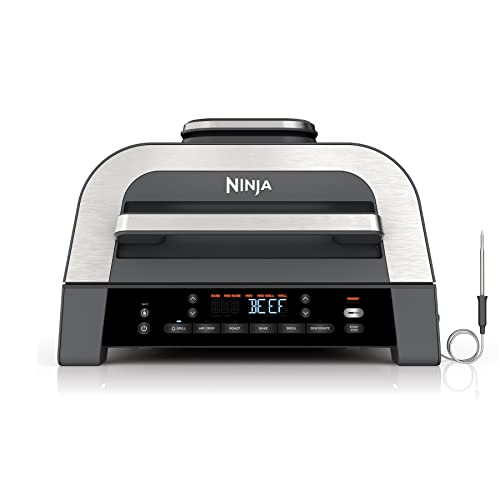
Ninja Foodi Smart XL 6-in-1 Indoor Grill DG551 — Best Smart Pick
The DG551 takes the Foodi Grill formula and adds the feature that changes how people cook: a smart thermometer paired with a doneness system. Insert the thermometer, select the protein and your target finish, and the grill manages the cook and tells you when to rest. In XL capacity with six functions, it is the most complete version of the concept — the pick for cooks who love grilled food but not the anxiety of the last three degrees.
Strengths
- Smart thermometer with doneness presets removes guesswork from steaks, chops, and roasts
- XL capacity handles family meals and entertaining without batch cooking
- Six functions including the full grill and air fry core, in one footprint
Trade-offs
- Premium tier of the category — the smart system is what you are paying for
- The thermometer cable and probe need care and add a step to quick cooks
- Same large footprint considerations as the AG301
| Functions | 6-in-1 grill and air fryer per Amazon listing |
| Key feature | Foodi Smart Thermometer with Smart Cook System |
| Verification | ASIN confirmed, 2026-11-20 |
The thermometer system deserves a precise explanation, because it is more than a probe with a display. The grill tracks the internal temperature curve and predicts the finish, prompting you to remove the food early enough that resting carryover lands it exactly on the selected doneness. For a thick steak or a pork tenderloin, that prediction is the difference between a confident cook and a hopeful one, and it works across the grill and roast modes where it matters most.
Capacity is the second half of the case. XL in Ninja’s lineup means realistic family throughput: a full load of burgers, a spatchcocked chicken’s worth of pieces, or a generous vegetable batch alongside mains in sequence. Combined with air fry capability in the same footprint, the DG551 can plausibly be the only countertop cooker a household uses on weeknights.
The honest caveat is that smart features reward cooks who use them. If your grilling is mostly burgers and dogs judged by eye, the AG301 delivers the same sear for less money. If you regularly cook expensive, thick, or unforgiving proteins indoors, the DG551’s thermometer earns its premium the first time it saves a steak.
Best for: Cooks who grill thick proteins indoors and want thermometer-guided, repeatable doneness at family capacity / Not suited for: Budget buyers, or anyone who judges doneness happily by eye and timer
Check the current price on Amazon
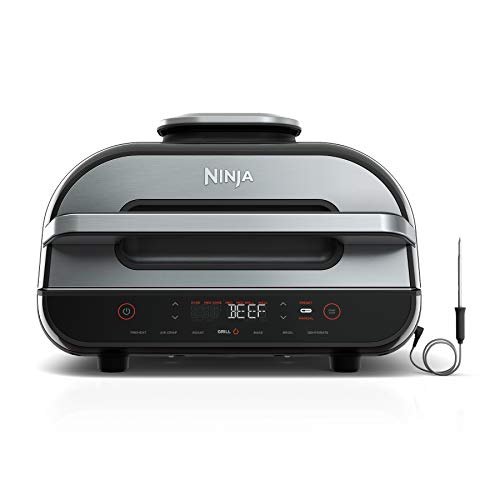
Ninja Foodi Smart 6-in-1 Indoor Grill FG551 — Best for Smaller Households
The FG551 packages the same Smart Cook System and built-in thermometer as the XL smart model into a 4-quart unit sized for one to three people. That sizing is a feature, not a compromise: smaller capacity means faster preheats, less counter space, and portions that match how couples and small households actually eat, without giving up the guided doneness that defines the smart line.
Strengths
- Full smart thermometer system in a compact 4-quart footprint
- Six functions — the complete Foodi Grill repertoire, nothing cut
- Faster preheat and easier storage than the XL models
Trade-offs
- Family-sized batches mean cooking in rounds
- Premium-tier pricing for its size class — you pay for the smart system, not the capacity
- Grill grate area limits wide items like full racks or large pizzas
| Capacity | 4 qt per Amazon listing |
| Key feature | Smart Cook System with built-in thermometer |
| Verification | ASIN confirmed, 2026-11-20 |
In practice, the FG551 is the apartment pick of this roundup. It fits counters where the XL models crowd, stores more easily, and still grills two generous steaks or four chicken breasts with the same cyclonic sear. For a household of two, that is not a limitation — it is the correct size, and the thermometer guidance makes weeknight proteins reliably perfect instead of approximately right.
The air fry side benefits from the smaller chamber, too: less air volume to heat means quick crisping for fries-for-two, reheated pizza, or a batch of wings without the wait. Owners consistently find that right-sized appliances get used more, and used appliances are the only ones worth their counter space.
Choose the FG551 if your household is small and your standards are not. Choose its XL sibling if you entertain or batch-cook. Between the two smart models, capacity — not features — is the entire decision.
Best for: Couples and small households wanting smart-thermometer grilling in a compact footprint / Not suited for: Families cooking for four or more in single batches
Check the current price on Amazon
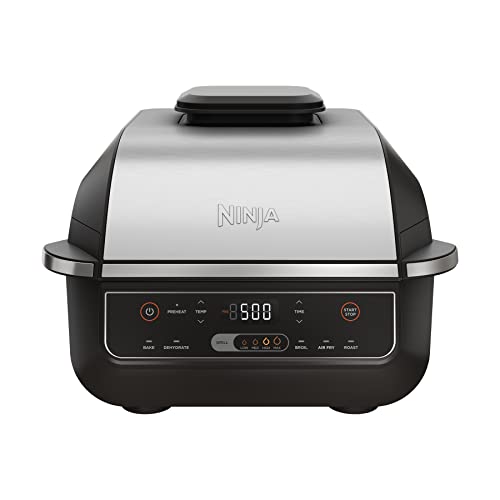
Ninja Foodi 6-in-1 Indoor Grill EG201 — Best for Searing
The EG201 is the sear specialist of the Foodi line. Its headline is 500°F surround searing: heat driven around the food as well as up through the grate, producing the dark, edge-to-edge char-grilled marks that steak lovers chase, in a design Ninja positions as virtually smoke-free. Six functions keep the air fryer side fully in play, but the personality of this model is unmistakable — it exists for people whose first question is always about the crust.
Strengths
- 500°F top-end heat with surround searing for genuine char and defined grill marks
- Virtually smoke-free design brief suits indoor steak cooking
- Six functions, so the sear specialist still air fries, roasts, and bakes credibly
Trade-offs
- No smart thermometer system — pair it with your own instant-read
- Capacity sits below the XL models for family batches
- High-heat grilling of very fatty cuts will still produce some smoke in any indoor design
| Top temperature | 500°F per Amazon listing |
| Functions | 6-in-1 grill and air fryer per Amazon listing |
| Verification | ASIN confirmed, 2026-11-20 |
Why does surround searing matter? On a basic indoor grill, only the surface touching the grate cooks hard; the top steams in the food’s own moisture until you flip. Driving heat around the food dries and browns the top surface simultaneously, so the flip reveals a steak that is already halfway to a proper crust on both sides. The result is the closest indoor analogue to a real grill’s combination of conduction and convection.
Technique still counts. Preheat fully — the grate needs to be at temperature before food touches it. Pat proteins dry, because surface moisture is the enemy of sear in any appliance. And resist pressing or moving food once it is down; marks form where contact is undisturbed. The EG201 rewards that discipline more visibly than any other pick here.
If steaks, chops, and burgers are your primary indoor grilling mission and you own a good instant-read thermometer already, the EG201 is arguably the enthusiast’s choice in this lineup — the model that spends its budget on heat rather than electronics.
Best for: Steak and chop lovers who prioritize maximum sear and grill marks indoors / Not suited for: Cooks who want guided doneness, or the largest family capacity
Check the current price on Amazon

Gourmia FoodStation Smokeless Indoor Grill & Air Fryer — Best Smoke Control
The FoodStation attacks the indoor grill’s oldest problem — smoke — with hardware rather than promises. Its smoke-extracting technology actively pulls cooking smoke through the unit while you grill on an extra-large nonstick surface, and the design leans into Korean BBQ and raclette-style tabletop cooking as well as conventional grilling and air frying. For smoke-sensitive homes, that active extraction is a genuinely different proposition from the passive splatter shields elsewhere.
Strengths
- Active smoke-extracting technology — the strongest smoke-management brief in this roundup
- Extra-large nonstick cooking surface suits tabletop and family-style grilling
- Grill and air fryer in one, with a 6-quart class capacity
Trade-offs
- The open tabletop format sears differently from lidded cyclonic designs — less convection assist
- Nonstick surfaces need non-metal utensils and gentler handling than cast grates
- Brand ecosystem and accessory range are smaller than Ninja’s
| Capacity | 6 quart FoodStation per Amazon listing |
| Key feature | Smoke Extracting Technology |
| Verification | ASIN confirmed, 2026-11-20 |
The use case that sells the FoodStation is the smoke alarm. Small apartments, open-plan kitchens, sensitive detectors, winter cooking with sealed windows — in those environments, a lidded grill that merely reduces smoke may still set the evening’s soundtrack. Active extraction changes the equation enough that tabletop grilling of marinated meats, bulgogi-style slices, and vegetables becomes a relaxed social format rather than a ventilation emergency.
As a conventional grill-and-air-fry combo it covers the fundamentals: the surface area is generous, the nonstick releases well, and the air fry function handles the fries and wings that accompany a grill night. It does not chase the extreme sear temperatures of the EG201, and lidded Ninja owners will notice the different cooking character — more open-griddle, less convection oven.
Buy the FoodStation when smoke is your binding constraint or when tabletop communal grilling is the experience you want. Buy a Foodi when maximum sear and convection performance outrank smoke extraction. Both are defensible; they are answers to different questions.
Best for: Apartments and smoke-sensitive homes, and anyone who loves tabletop Korean-BBQ-style grilling / Not suited for: Maximum-sear purists who want lidded high-heat convection grilling
Check the current price on Amazon

NutriChef Indoor Smokeless Grill & Air Fryer — Best Alternative
NutriChef’s entry is the credible non-Ninja route into this category: a smokeless indoor grill and air fryer with seven cooking functions, a 6-litre capacity, precise temperature control, nonstick removable grill plates, and — notably — a smart thermometer in the box. For buyers who want thermometer-guided cooking without buying into the Foodi line, it is the alternative that takes the brief seriously.
Strengths
- Smart thermometer included — guided doneness outside the Ninja ecosystem
- Seven cooking functions and a roomy 6-litre capacity
- Removable nonstick grill plates simplify cleanup
Trade-offs
- Smokeless performance is good, not class-leading; fatty foods still produce some smoke
- Accessory and replacement-part ecosystem is thinner than the major brands
- Temperature control is precise but the top-end sear is a step behind the 500°F specialists
| Capacity | 6 L per Amazon listing |
| Functions | 7 cooking functions per Amazon listing |
| Key feature | Smart thermometer included |
| Verification | ASIN confirmed, 2026-11-20 |
The included thermometer is the headline because it changes the value calculation. A separate quality thermometer is a real purchase; bundling one with a capable grill–air fryer makes the NutriChef the completeness pick — everything in one box, ready for a first steak night without a second order. Its temperature control is genuinely useful for the gentler jobs too: fish, vegetables, and reheating without scorching.
Set expectations at the category’s mid-range and the NutriChef meets them: it grills respectably, air fries well, and keeps smoke to indoor-acceptable levels for most foods. It does not out-sear the EG201 or out-smart the DG551’s integrated system, and we would not claim otherwise.
For a first combination unit, a second-home or RV galley, or a gift that arrives complete, it is a sensible, honest appliance at its tier — and the strongest proof in this guide that the category is bigger than one brand.
Best for: Buyers who want thermometer-included completeness without entering the Ninja lineup / Not suited for: Enthusiasts chasing the hardest sear or the deepest accessory ecosystem
Check the current price on Amazon
Comparison Table
Match the pick to your binding constraint — capacity, guidance, sear, or smoke — and the right choice usually names itself.
| Pick | Badge | Key spec | Best for |
|---|---|---|---|
| Ninja Foodi AG301 | Best Overall | 5-in-1, XL capacity, cyclonic grilling | Families who want one proven appliance that grills and air fries equally well |
| Ninja Foodi DG551 | Best Smart Pick | 6-in-1, XL, Smart Thermometer system | Thermometer-guided doneness at family capacity |
| Ninja Foodi FG551 | Best for Smaller Households | 6-in-1, 4 qt, Smart Cook System | Couples wanting smart grilling in a compact footprint |
| Ninja Foodi EG201 | Best for Searing | 500°F surround searing, 6-in-1 | Steak lovers who prioritize maximum sear indoors |
| Gourmia FoodStation | Best Smoke Control | Smoke extraction, extra-large surface, 6 qt class | Smoke-sensitive homes and tabletop grilling |
| NutriChef 7-Function | Best Alternative | 7 functions, 6 L, thermometer included | Complete-in-one-box buying outside the Ninja line |
How to Choose an Air Fryer Grill
Choose by constraint, not by function count. If your constraint is people — four or more at the table — capacity rules, and the XL models are your shortlist. If your constraint is confidence with expensive proteins, a smart thermometer system is worth more than any other feature. If your constraint is a smoke detector with a hair trigger, active extraction or the strongest smoke-control design brief wins. If your constraint is a small kitchen, measure the footprint with the lid open, not closed — the open-lid height is the number that decides whether a unit lives on your counter or in a closet it will never leave.
Second, be honest about your grill-to-air-fry ratio. These appliances all do both, but their personalities differ: the Foodi line grills with convection conviction and air fries in the same chamber, while open tabletop designs grill socially and air fry adequately. A household that air fries five nights a week and grills once might be better served by a great air fryer plus a simple grill — but if the split is anywhere near even, a combination unit earns its footprint by replacing two appliances with one.
Third, interrogate cleanup before purchase. Dishwasher-safe grates and baskets are the difference between a Tuesday-night tool and a special-occasion burden. Nonstick plates are easy to wipe but demand gentle utensils; heavier grates tolerate more abuse. Check what the verified listing actually says about the parts, and picture your own sink at 9 p.m. — that picture predicts your satisfaction better than any feature list.
Finally, budget in tiers. The budget tier buys honest grilling and frying without guidance electronics. The mid-range buys the proven all-rounders. The premium tier buys smart thermometers, XL capacity, and the hardest sears. All three tiers produce good food; the premium mainly buys certainty and speed. Spend where your constraint lives.
One electrical note that belongs in every indoor grill decision: these are high-draw appliances, and they expect a circuit that is not already sharing its load with a kettle, toaster oven, or microwave running at the same moment. In older kitchens, run the grill on its own outlet run where possible, and never use a light-duty extension cord with a heating appliance. It is unglamorous advice, but a tripped breaker mid-sear is the most preventable disappointment in the category.
How to Get Real Grill Marks Indoors
Grill marks are applied physics, and indoor appliances obey the same rules as outdoor grates. First, preheat completely: the grate must be fully at temperature before food arrives, which on these units means letting the preheat cycle finish and then giving it a moment more. A steak on a half-hot grate steams; a steak on a fully hot grate sears on contact.
Second, dry the surface. Moisture is the enemy of browning because it must boil off before the surface can exceed the boiling point of water and start the reactions that create crust and marks. Pat proteins thoroughly with paper towels, season, and — for steaks — consider salting in advance and resting uncovered in the refrigerator so the surface dries further. Wet marinades should be patted off before grilling and reapplied as a glaze at the end if you want their flavor.
Third, do not crowd and do not fuss. Leave space between pieces so steam escapes instead of condensing on neighboring food, and once food is down, leave it: marks form during undisturbed contact. Flip once, at the point the food releases naturally from the grate — if it sticks hard, it usually needs another thirty seconds. For crosshatch marks, rotate the food a quarter turn halfway through each side’s contact time.
Fourth, manage fat for smoke. Trim excess external fat from steaks, choose the grill’s smoke-control components correctly installed — splatter shields and lids positioned as designed — and run the range hood. A light film of high-heat oil on the food, rather than a pool on the grate, reduces smoking while helping release. Finish with rest: grilled meats need a few minutes off heat for juices to settle, and that rest is part of the recipe, not dead time.
Grill Mode vs Air Fry Mode: When to Use Each
Combination appliances confuse new owners less with their controls than with a simple question: the same food can often be cooked in either mode, so which one? The answer follows from what each mode physically does. Grill mode drives intense heat up through a heavy grate while circulating hot air above; its signature results are contact marks, rendered fat, and the Maillard crust on foods that benefit from a hard sear. Air fry mode suspends food in a basket and blasts it with circulating air from all sides; its signature results are even crisping, rendered coatings, and foods that emerge dry-surfaced and crunchy rather than seared.
Steaks, burgers, chops, sausages, kebabs, corn on the cob, and firm vegetables belong on the grill. These are foods with a surface you want to brand and a structure that holds together on a grate. Chicken pieces can go either way, and the choice is a preference: grill mode for charred edges and rendered skin with marks, air fry mode for the crispiest, most evenly bronzed skin. Wings are the classic air fry case — the basket’s all-around airflow crisps skin in a way a grate cannot — while a whole spatchcocked chicken roasts better than it grills in most of these units.
Breaded and coated foods belong in the air fryer almost without exception. A breaded cutlet on a grill grate sheds its coating into the ridges; in a basket, the coating sets into a shell. Fries, onion rings, frozen snacks, and reheated pizza are likewise air fry foods — the goal is dehydration-driven crispness, not searing. Vegetables split by density: asparagus, zucchini, and peppers grill beautifully, while cubed potatoes and Brussels sprouts crisp better air fried, ideally after a light oil toss.
The hybrid move experienced owners use constantly: start in one mode, finish in the other. Thick chicken thighs can air fry until nearly done, then take two minutes on the hot grate for marks and char. A steak can grill for crust and finish gently in the residual heat with the lid closed. Sausages can air fry to render without bursting, then kiss the grate. The combination appliance’s real advantage is not that it replaces two devices — it is that a single cook can use both techniques in sequence without dirtying a second pan or preheating a second machine.
One practical note on smoke: grill mode on fatty food is always the smokiest configuration, because fat drips onto the hottest surface. If you are cooking bacon, fatty burgers, or well-marbled steaks for a crowd, air fry mode produces noticeably less smoke for a small sacrifice in char. Choose the mode with your detector and your guests in mind, not just your taste buds.
Living With an Air Fryer Grill: The Daily Reality
Reviews tend to stop at cooking performance, but ownership is mostly logistics. These are among the largest countertop appliances in a kitchen, and the honest first question is storage: if the unit must be hauled from a closet for every use, it will be used monthly; if it lives on the counter, it will be used constantly. Measure your counter depth and the clearance to your upper cabinets with the lid open before ordering, and be realistic about which life the appliance will have.
Noise is the second reality. The fans that make cyclonic grilling and air frying work are audible — comparable to a microwave or a range hood on medium. It is not objectionable, but in a studio apartment it is part of the evening’s soundscape, and late-night cooking is a consideration. Heat output is the third: these units vent hot air, so they should not run pushed back against a wall or under low cabinets that trap the exhaust, both for performance and for the cabinets’ sake.
The daily-reality verdict from long-term owners is consistent: the households that love these appliances are the ones that cook proteins at home several nights a week and hated the friction of the outdoor grill — the weather, the propane check, the trip outside for a single chicken breast. For them, the countertop grill removes every excuse, and grilled food becomes a Tuesday default instead of a Saturday project. Households that grill twice a month in summer may find a simpler appliance — or the outdoor grill they already own — is the honest answer.
Accessories Worth Owning — and the Ones to Skip
The accessory market around these appliances is large, and most of it is unnecessary. Three items genuinely earn their drawer space. First, a fast instant-read thermometer: even smart-thermometer models benefit from a second opinion, and the non-smart picks in this guide require one for thick proteins. Second, long, sturdy tongs with metal tips rated for high heat — the single tool you will use on every grill session, for turning, lifting, and rescuing. Third, a silicone brush for glazing and oiling, which survives heat that destroys natural bristles and washes clean in the dishwasher.
A second category is situational. A griddle plate, where the manufacturer offers one, converts the unit into a breakfast station for eggs, pancakes, and smash burgers, and owners who cook breakfast for a family find it transformative; owners who do not, find it a cupboard tenant. Parchment liners for the air fry basket speed cleanup for sticky foods but impede airflow if overused — treat them as an occasional tool, not a default. Extra baskets and grates make sense only if you regularly cook two modes back-to-back for a crowd.
Skip the rest with confidence: elaborate multi-piece accessory kits duplicate what you own, novelty molds and pans solve problems you do not have, and third-party “universal” grates rarely match the airflow design the manufacturer engineered. The appliance was designed as a system; respect the system, add the three essentials, and spend the savings on better proteins to cook in it.
Common Buying Mistakes
The disappointments in this category are predictable, and mostly avoidable:
- Buying by function count instead of by constraint — ten modes do not help if the capacity is wrong for your household.
- Ignoring open-lid height and discovering the unit only fits on the counter with the cabinets removed from the plan.
- Expecting charcoal flavor from an electric appliance; these units deliver sear and convenience, not wood smoke.
- Skipping the preheat or crowding the grate, then blaming the appliance for pale food.
- Choosing a nonstick tabletop design for steakhouse ambitions, or a max-sear lidded unit for a smoke-sensitive studio — match the design to the mission.
- Forgetting that fatty foods smoke in every indoor grill; no “smokeless” claim repeals physics, it only manages it.
Avoid those and the category delivers exactly what it promises: grilled food, air-fried food, one appliance, any weather. The cooks who get the most from these machines treat the first week as calibration — learning how their unit browns, where its hot spots sit, and how its times compare with the charts — after which the appliance disappears into the routine and simply becomes how dinner gets cooked.
Combination Unit or Two Separate Appliances?
The fair challenge to everything in this guide is the two-appliance alternative: a dedicated basket air fryer plus a dedicated indoor grill or grill pan. That pairing has real advantages — each device is optimized for one job, a failure in one does not strand both functions, and total capacity across two machines running simultaneously beats any single unit at a party. If you have the counter and storage space for two appliances and you regularly cook for crowds, separates remain a legitimate architecture.
For most kitchens, though, the combination wins on the constraint that actually binds: space and friction. One footprint instead of two, one preheat instead of two, one set of parts to wash, and — the underrated point — one appliance that is already out on the counter, which means it gets used. The performance gap has also narrowed to the point of vanishing for everyday food: the best combination units sear as hard as dedicated indoor grills and crisp as evenly as mid-size basket fryers. What you give up is simultaneity, not quality.
Our advice: if grilled or air-fried food appears on your table three or more nights a week and your kitchen is ordinary-sized, buy the combination and never look back. If you entertain in volume or have a genuinely spacious kitchen, separates deserve their hearing. Either way, decide on your real cooking pattern — not the dinner party you host twice a year.
Final Recommendation
Most buyers should start with the Ninja Foodi AG301: it is the proven center of the category, sized for families and honest at both of its jobs. Step up to the DG551 if you want thermometer-guided doneness at the same family scale, or choose the FG551 to get that guidance in a couple-sized footprint. Steak-first cooks should look hard at the EG201 and its 500°F sear.
If smoke is your household’s hard limit, the Gourmia FoodStation and its active extraction is the pick designed around your constraint, and the NutriChef is the complete, thermometer-included alternative for buyers who prefer to step outside the dominant brand. Whichever you choose, preheat fully, dry your proteins, and give the grate room to work — technique is the accessory that makes every one of these appliances taste more expensive than it is.
Related reading on this site: Best Air Fryer Grills; Best Air Fryer That Grills; Best Airfryers With Indoor Grills; Best Air Fryers; Best Indoor Grills; Best Grills.
Related guides
Frequently Asked Questions
Can an air fryer grill really make grill marks?
Yes — the units in this guide use heavy, high-heat grill grates, and marks are simply seared contact lines. The keys are a full preheat, a dry protein surface, and undisturbed contact. What they cannot reproduce is charcoal or wood flavor; the marks and crust are real, the smoke flavor is not part of the physics.
How smoky do indoor air fryer grills get?
It depends on the food’s fat content and the unit’s smoke management. Lean proteins and vegetables produce very little smoke in any pick here. Fatty ribeyes and bacon produce some in all of them; designs with splatter shields, smoke control systems, or active extraction manage it best. Run the range hood regardless.
What size should I buy?
Match capacity to your household’s typical batch, not your biggest party. One to three people: the 4-quart class is right and preheats fastest. Families of four or more: XL models avoid batch cooking. When in doubt, measure your counter with the lid open — fit decides more purchases than capacity does.
Is a smart thermometer worth paying for?
If you regularly cook thick steaks, chops, or roasts indoors and dislike guesswork, yes — the guided doneness and rest prediction are genuinely useful. If your grilling is burgers, sausages, and chicken pieces judged by eye, the same sear is available for less in the non-smart models, paired with an inexpensive instant-read.
Can I cook frozen meat in an air fryer grill?
Yes, and it is one of the category’s signature conveniences — frozen burgers and steaks are a designed use case for the Foodi Grill line. Expect longer cook times and slightly less perfect marks than thawed meat, and use a thermometer to confirm doneness rather than trusting the clock. Frozen cooking works best with evenly shaped items of moderate thickness; a very thick frozen steak will char outside before its center is safe, so thaw the thick cuts and freeze-cook the burgers, sausages, and thinner chops.
How hard are they to clean?
The lidded combination units are the easiest: grates, baskets, and pots are typically dishwasher-safe, and the splatter shield pops out for washing. Nonstick tabletop plates wipe clean but prefer hand washing and non-metal utensils. In all cases, cleaning while the unit is still slightly warm is twice as easy as cleaning it cold the next morning. Make a habit of the splatter shield in particular: it is the component that keeps the heating element and lid interior clean, and a neglected shield is the main reason an older indoor grill starts to smoke more than it did when new. A monthly degreasing soak for the shield and grate keeps a years-old unit performing like the one you unboxed.


