Disclosure: airfryerkitchensupply.com is reader-supported. When you buy through links on our site, we may earn an affiliate commission at no extra cost to you.
Where to buy
Air conditioning grills — the registers and grilles that cover your HVAC vents — are sold by home improvement retailers and by Amazon. Every pick below with an Amazon link was verified against Amazon’s catalog before this guide was published; check price on Amazon from the links in each review, and always confirm your duct opening size before ordering.
- Decor Grates 4×10 Scroll Steel Floor Register — available on Amazon. Check the current price on Amazon.
- Howeall 4×10 Savannah Floor Register 6-Pack — available on Amazon. Check the current price on Amazon.
- EZ-FLO 14×6 Return Air Grille — available on Amazon. Check the current price on Amazon.
- VOISEN Floor Register 4×10 6-Pack — available on Amazon. Check the current price on Amazon.
- Imperial RG0033 Baseboard Return Air Grille — available on Amazon. Check the current price on Amazon.
- HOXHA Magnetic Vent Covers 5.5×12 2-Pack — available on Amazon. Check the current price on Amazon.
The Best Air Conditioning Grills for floors, walls, and returns
If you are shopping for the best air conditioning grills, it helps to know the trade’s vocabulary first, because the word “grill” on a vent cover means something different than it does in a backyard. In HVAC language, a grille is the fixed cover over a duct opening, a register is a grille with an adjustable damper behind it that lets you open, close, or throttle airflow, and a return grille covers the duct that pulls air back to the system. All three get called “air conditioning grills” in everyday speech, and all three are in this guide, because most homes need a mix of them.
Why replace them at all? Because vent covers are one of the highest-impact small upgrades in a house. The original builder-grade covers in most homes are thin stamped steel or plastic, painted over a dozen times, often rusting at the edges, rattling when the system runs, and bending the first time a vacuum or a boot hits them. A heavy steel register with a real damper and a proper finish fixes the rattle, restores airflow control room by room, and quietly makes renovated floors and freshly painted walls look finished instead of almost finished.
The catch is sizing, and it is the mistake that generates most returns in this category. Vent covers are sized by the duct opening, not by the outside dimensions of the cover you are replacing. A “4×10” register fits a 4-inch by 10-inch hole in the floor; its faceplate is larger. Every pick below is named by its duct-opening size, and the how-to section of this guide walks through measuring properly. Get that one measurement right and everything else about this purchase is easy.
In this guide
Quick Picks
Short on time? These six covers handle the vast majority of residential vent situations — supply registers for floors, returns for walls and ceilings, baseboard returns, and a simple way to block a vent you are not using.
- Decor Grates 4×10 Scroll Steel Floor Register — Best Overall: A heavy steel decorative register with an adjustable damper and a rust-proof damper box; the classic upgrade for a single visible floor vent. Check the current price on Amazon.
- Howeall 4×10 Savannah Floor Register 6-Pack — Best for Whole-Room Replacement: Walkable heavy-duty steel registers in a six-pack, so every vent in the room matches. Check the current price on Amazon.
- EZ-FLO 14×6 Return Air Grille — Best Return Air Grille: A solid steel louvered return for wall or ceiling, sized by its 14×6 duct opening. Check the current price on Amazon.
- VOISEN Floor Register 4×10 6-Pack — Best Budget: Heavy-duty steel floor vents in a budget-tier six-pack for whole-house refreshes. Check the current price on Amazon.
- Imperial RG0033 Baseboard Return Air Grille — Best Baseboard Return: A louvered steel baseboard return shaped to sit where wall meets floor. Check the current price on Amazon.
- HOXHA Magnetic Vent Covers — Best for Blocking Unused Vents: Strong magnetic covers that seal a metal vent in seconds and can be trimmed to fit. Check the current price on Amazon.
How These Picks Were Chosen
We chose covers the way a homeowner actually buys them: by location in the house. Floor vents take foot traffic and furniture legs, so the floor picks are heavy-gauge, walkable steel with dampers that adjust without tools. Wall and ceiling returns move large volumes of air at low velocity, so the return picks are louvered steel with generous free area. Baseboard returns are their own shape and got their own pick. And because nearly every house has one room that is always too hot or too cold, we included a magnetic cover for the legitimate, limited job of temporarily blocking a vent.
Every product with an Amazon link was verified through Amazon’s own catalog data before publication: brand, model, size, and product type in the listing had to match the cover described in the review. Sizes quoted in the spec boxes come from those verified listings. We have printed no prices and no fixed ratings anywhere in this guide, because both change constantly and a printed number would be wrong within weeks.
We also favored steel over plastic for anything that lives on a floor. Plastic registers are cheaper and fine in a ceiling, but floor plastic cracks under heels and chair legs, and it yellows. Where a pick is a multi-pack, we said so plainly, because per-cover value is the honest way to compare a six-pack against a single decorative register. Finally, we weighted finish quality: a vent cover is a visible object in every room, and the difference between a stamped builder cover and a finished decorative register is something you see every single day.
The 6 Best Air Conditioning Grills

Decor Grates 4×10 Scroll Steel Floor Register — Best Overall
The Decor Grates Scroll register is the cover that started the decorative vent category for most homeowners, and it remains the benchmark. The face is steel with a scroll pattern that suits traditional and transitional interiors, finished here in rubbed bronze, and behind it sits a damper box designed to resist the rust that kills cheaper registers from the underside. It drops into a standard 4×10 floor duct opening with no tools and adjusts with a simple lever.
Strengths
- Heavy steel face that feels substantial underfoot and does not flex or oil-can like stamped builder covers
- Adjustable airflow damper lets you balance rooms — throttle the vent near the thermostat, open the far bedroom
- Rust-proof damper box addresses the part of a floor register that actually fails first
Trade-offs
- Sold singly at a decorative tier, so a whole house of them adds up compared with multi-packs
- The scroll pattern is traditional; very modern interiors may prefer a linear or plain face
- Bronze finishes show dust more visibly than white on dark floors
| Fits duct opening | 4 in x 10 in floor opening |
| Material | Steel face with rust-proof damper box |
| Verification | ASIN confirmed, 2026-11-20 |
The reason this register wins the top spot is the damper. Room-to-room temperature imbalance is the most common comfort complaint in forced-air homes, and the cheapest fix is at the vent: partially close the register in the room that overheats and the system pushes more air to the rooms that lag. Builder covers often have dampers too, but they seize, bend, or rattle. This one moves smoothly and stays where you set it, which turns a decorative purchase into a genuine comfort tool.
Underfoot quality is the second reason. Floor registers live a hard life — vacuum heads, mop water, chair legs, dropped objects. A steel face with real gauge to it shrugs all of that off, and the scroll openings are small enough that heels and small toys are not a problem. Installation is a genuine drop-in: pull the old cover, vacuum the duct boot, drop this in. Two minutes, no screws, no tools.
Buy it for the vents people see and walk on — living rooms, entries, hallways. For closets and utility spaces, the budget picks below make more sense. As a single-vent upgrade or a finishing touch after new flooring, this is the cover we would choose first.
Best for: Homeowners upgrading the visible floor vents in main living areas who want a decorative finish and a working damper / Not suited for: Whole-house replacement on a tight budget, or ultra-modern interiors
Check the current price on Amazon
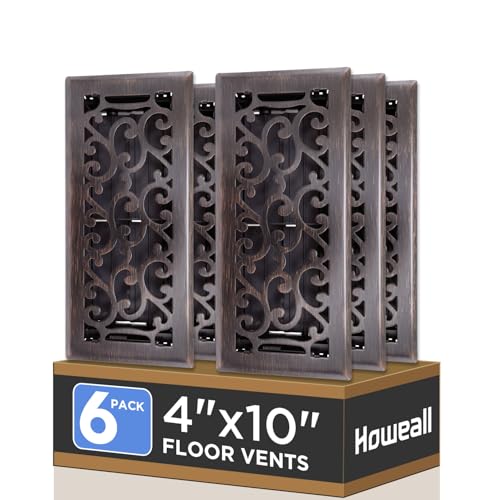
Howeall 4×10 Savannah Floor Register 6-Pack — Best for Whole-Room Replacement
Replacing one vent makes the others look worse. The Howeall Savannah six-pack solves the matching problem: six heavy-duty steel floor registers in one finish — this set in oil rubbed bronze — each rated walkable, each with an easy-adjust air supply lever. Swap every vent in a room, or the whole main floor, in one pass and everything matches.
Strengths
- Six matching heavy-duty steel registers in one box — no finish variation between separate orders
- Walkable construction stands up to foot traffic, furniture, and vacuum abuse
- Easy-adjust lever on each register for room-by-room airflow balancing
Trade-offs
- All six are the same 4×10 size; homes with mixed vent sizes need additional sizes ordered separately
- The Savannah pattern is decorative-traditional, which will not suit every interior
- Multi-pack value only materializes if you actually have several vents to replace
| Fits duct opening | 4 in x 10 in floor opening |
| Quantity | 6 registers per pack |
| Verification | ASIN confirmed, 2026-11-20 |
The walkable rating is the practical core of this pick. Howeall builds these as heavy steel vents meant to be stepped on daily, and that matters more than pattern for most buyers: a floor register that flexes, pops, or develops a sharp edge becomes a daily annoyance. These sit flat, stay quiet underfoot, and the damper lever is positioned so you can adjust it with a toe or a fingertip without pulling the register out.
There is also a renovation-logic argument for the six-pack. Vent covers are cheapest to replace when you are already doing floors or paint, and they are the detail that makes a finished room photograph — and feel — complete. Doing all of them at once in a matched finish costs less per cover than buying singles, and it avoids the slow drift of three different bronze tones across one hallway.
Measure before you order a quantity: count your 4×10 floor vents, then check the odd ones — many homes mix in a 4×12 or a wall register or two. Order the pack for the standard size and singles for the exceptions. If your count of standard vents is four or more, this pack is the economical way to buy the Decor-Grates-class upgrade.
Best for: Renovators replacing every floor vent in a room or floor at once in a matched finish / Not suited for: Homes with mostly non-standard vent sizes, or anyone replacing a single vent
Check the current price on Amazon

EZ-FLO 14×6 Return Air Grille — Best Return Air Grille
Return grilles do a different job from supply registers: they do not need dampers, they need area. The return duct pulls air back to the air handler, and a restrictive or undersized return makes the whole system louder and less efficient. The EZ-FLO 61628 is a solid steel louvered return grille for a 14×6 duct opening, made for wall or ceiling mounting, in a clean white finish that paints well if your trim color demands it.
Strengths
- Solid steel construction — no flex, no rattle, no cracked corners like aging plastic returns
- Louvered face provides generous free area for quiet return airflow
- Simple, paintable white finish suits most walls and ceilings
Trade-offs
- No damper — correct for a return, but do not buy it expecting airflow adjustment
- Fixed louver direction; plan orientation when you mount it
- Steel is heavier than plastic, so ceiling installs want both screws in solid backing or anchors
| Fits duct opening | 14 in x 6 in |
| Mounting | Wall or ceiling |
| Verification | ASIN confirmed, 2026-11-20 |
Returns are the most neglected covers in the house. They collect dust visibly on their louvers, they are often painted shut by careless painters, and their screws strip out of drywall until the cover hangs by habit. A fresh steel return fixes all three problems at once: it comes off easily for cleaning, its louvers are open and correctly angled, and new screws in the right places hold it flat and silent.
A note on noise: if a return whistles, the cause is usually too much air trying to pass through too little free area — a clogged filter, a crushed duct, or an undersized grille. Replacing a painted-shut or damaged return with this open louvered steel grille removes one cause; if the whistle persists, the problem is upstream and worth an HVAC technician’s visit rather than a bigger cover.
Choose the size by the duct opening, as always: 14×6 is the nominal opening for this model, and EZ-FLO makes the same grille in other sizes if your opening differs. For the common hallway and bedroom returns in this size, it is the straightforward, durable answer.
Best for: Replacing worn, painted-over, or rattling wall and ceiling return grilles / Not suited for: Supply vents where you need a damper, or floor use
Check the current price on Amazon

VOISEN Floor Register 4×10 6-Pack — Best Budget
Not every vent needs to be decorative. The VOISEN six-pack covers the practical end of the market: heavy-duty steel floor vent covers, walkable, in a simple brown finish, sold six at a time at a budget-tier position. This is the pick for landlords, house flippers, and homeowners refreshing a whole house where the old covers are bent, rusted, or missing.
Strengths
- Heavy-duty steel construction at a budget-tier per-cover cost
- Six-pack format matches how whole-house replacement actually happens
- Simple, inoffensive design disappears into most floors
Trade-offs
- Plain stamped look — functional, not a design feature
- Brown finish will not match every floor; check the color against your flooring before ordering quantity
- Damper action is basic compared with the premium decorative registers
| Fits duct opening | 4 in x 10 in floor opening |
| Quantity | 6 covers per pack |
| Verification | ASIN confirmed, 2026-11-20 |
The honest case for this pick is arithmetic. A typical house has eight to fifteen floor vents. At decorative-register prices, replacing all of them is a real line item; at this tier, it is an afternoon and a modest box. And the upgrade is still real: steel instead of cracked plastic, flat instead of bent, clean instead of rust-stained. In rental properties and secondary rooms, that is exactly the right level of spending.
Quality is where budget covers usually cheat — thin steel that drums underfoot. VOISEN markets these as heavy-duty walkable vents, and the steel construction is the reason they made this guide while thinner no-name covers did not. They will not feel as refined as the Decor Grates pick, and the finish options are limited, but the fundamentals — fit, flatness, damper presence — are covered.
Strategy tip: many owners mix tiers. Decorative registers in the entry and living room, this six-pack everywhere else. The rooms you live in get the finish; the bedrooms, closets, and laundry get durability at budget cost. That combination is how most satisfying whole-house vent refreshes are actually bought.
Best for: Whole-house and rental-property vent replacement where durability per dollar matters most / Not suited for: Statement finishes in primary living spaces
Check the current price on Amazon

Imperial RG0033 Baseboard Return Air Grille — Best Baseboard Return
Baseboard returns are the odd shape of the HVAC world: a return grille that lives where the wall meets the floor, often with a profile that wraps the baseboard line. Replacing one with a flat wall grille does not work — the duct opening and the trim geometry are different. The Imperial RG0033 is the purpose-built answer: a louvered steel baseboard return, 14×6, painted white, from a long-established HVAC hardware maker.
Strengths
- Correct baseboard profile — fits the opening and the trim line that flat grilles cannot
- Louvered steel face with a painted finish that blends with standard white trim
- From Imperial, a traditional HVAC supply-house brand, so sizing follows trade convention
Trade-offs
- A niche shape: measure your existing baseboard return carefully, including its depth profile
- White only in this listing — plan on painting if your trim is a custom color
- No damper, as is correct for returns
| Nominal size | 14 in x 6 in baseboard return |
| Material | Louvered steel, painted white |
| Verification | ASIN confirmed, 2026-11-20 |
Baseboard returns suffer a particular indignity: they live exactly where vacuum cleaners, mop buckets, and furniture feet strike. Dented, rust-spotted baseboard returns are standard in older homes, and because the shape is unusual, owners assume replacements are unobtainable and paint over the damage for decades. They are obtainable — this is the standard trade replacement — and swapping one takes minutes once the old screws surrender.
When measuring, note more than height and width. Baseboard returns project from the wall at the bottom; record the depth of the projection on your old unit and compare. Also check whether your opening is a true duct or a wall-cavity return, common in older construction, where the grille simply covers a framed opening between studs. This grille suits both, as the original did.
If your home has baseboard returns, this is the pick that saves you from the flat-grille mistake. Buy it, paint it with your trim paint if needed, and enjoy the small satisfaction of a detail most houses get wrong for thirty years.
Best for: Older homes with baseboard-level return openings that need a correctly shaped replacement / Not suited for: Standard flat wall returns or supply vents
Check the current price on Amazon

HOXHA Magnetic Vent Covers 5.5×12 2-Pack — Best for Blocking Unused Vents
Sometimes the right vent cover is one that stops the air entirely. A magnetic vent cover seals against a metal register in seconds: no tools, no residue, fully reversible. The HOXHA two-pack covers 5.5×12 vents, uses strong magnetism with a fall-off-preventing design, and can be cut down with scissors for smaller covers. Used correctly — sparingly — it is a legitimate comfort tool.
Strengths
- Instant, tool-free, and completely reversible — ideal for a guest room or a seasonally unused space
- Cuttable material adapts to covers slightly smaller than the sheet
- Strong magnets hold on floor, wall, and ceiling metal vents
Trade-offs
- Only works on metal vents — it will not stick to plastic or aluminum registers
- Blocking too many vents raises duct pressure and can strain the system; this is a one-or-two-vents tool, not a whole-house strategy
- A plain white sheet is functional, not decorative
| Size | 5.5 in x 12 in, cuttable |
| Quantity | 2 covers per pack |
| Verification | ASIN confirmed, 2026-11-20 |
The correct use case is narrow and real: the nursery that overheats while the far bedroom freezes, the home office that is empty all weekend, the basement vent pouring cold air into a space nobody occupies in January. Sealing one or two supply vents redirects that air to the rooms you use and can take the edge off a chronic imbalance while you plan a permanent fix.
The caution matters as much as the use case. Your blower is sized for a certain amount of total airflow resistance. Seal vent after vent and static pressure climbs, airflow falls everywhere, noise rises, and in cooling season you can invite coil icing. HVAC professionals are blunt about this for a reason. Treat magnetic covers as a scalpel — one vent, maybe two — and if a room’s imbalance is severe, the real fixes are damper adjustment, duct inspection, or a technician’s balancing visit.
Application is foolproof: clean the register face, let the sheet snap on, done. For floor vents, the magnetic hold keeps it in place under normal foot traffic, though a determined toddler or a dragging chair leg can shift it — check it when you vacuum. For the price of a pizza, it is the cheapest experiment in home comfort you can run.
Best for: Temporarily sealing one or two metal vents in unused or overheated rooms / Not suited for: Plastic vents, or any plan that involves closing many vents at once
Check the current price on Amazon
Comparison Table
The table below matches each cover to its location and job. The most common ordering error in this category is buying a supply register for a return opening or the reverse — check the job column against your vent before anything else.
| Pick | Badge | Key spec | Best for |
|---|---|---|---|
| Decor Grates 4×10 Scroll Steel Floor Register | Best Overall | Steel decorative face, adjustable damper, rust-proof damper box | Homeowners upgrading the visible floor vents in main living areas |
| Howeall 4×10 Savannah Floor Register 6-Pack | Best for Whole-Room Replacement | 6 heavy-duty walkable steel registers, one finish | Renovators replacing every floor vent in a room or floor at once |
| EZ-FLO 14×6 Return Air Grille | Best Return Air Grille | Solid steel louvered return, 14×6 duct opening | Replacing worn or rattling wall and ceiling return grilles |
| VOISEN Floor Register 4×10 6-Pack | Best Budget | 6 heavy-duty steel floor vents, budget tier | Whole-house and rental-property replacement |
| Imperial RG0033 Baseboard Return Air Grille | Best Baseboard Return | Louvered steel baseboard profile, 14×6 | Older homes with baseboard-level return openings |
| HOXHA Magnetic Vent Covers | Best for Blocking Unused Vents | Magnetic, cuttable, 5.5×12 sheets, 2-pack | Temporarily sealing one or two metal vents |
How to Choose an Air Conditioning Grill
Start by classifying the vent, because the three types are not interchangeable. A supply register delivers conditioned air and should have a damper. A return grille draws air back and should never have a damper — restricting return air starves the system. A baseboard return is a return with a special profile. Walk your house with a phone camera, photograph every vent, and label each one supply or return before you buy anything; supplies are usually smaller and near windows or floors, returns larger and often singular per room or hallway.
Second, material follows location. Floors demand steel — heavy enough to walk on without flex. Walls and ceilings can use steel or quality plastic, but steel still wins on longevity and silence. Returns in damp spaces such as bathrooms deserve finishes that resist rust, and the damper box on a floor register matters as much as the face, because condensation forms on the underside where you cannot see it.
Third, think about airflow control as a system. Adjustable supply dampers are your cheapest balancing tool: the rooms closest to the air handler usually get too much air, the far rooms too little. Throttle the near registers slightly and the far rooms gain. Magnetic covers are the extreme end of that same idea and should be used with the restraint described in that review — one or two vents, never a strategy.
Finally, budget by visibility. Spend decorative money where eyes and feet land daily — entry, living room, kitchen. Spend functional money everywhere else. That tiered approach, using the Decor Grates or Howeall picks up front and the VOISEN pack behind them, is how you get a whole house that looks finished without paying showpiece prices for a closet vent.
How to Measure and Install a Vent Cover
Measuring is the whole game, and the rule is simple: vent covers are named by the size of the duct opening, not the size of the cover. Remove the existing cover — floor registers usually lift out, wall and ceiling grilles unscrew — and measure the inside of the duct opening itself: width and height in inches. A cover sold as 4×10 fits an opening that measures 4 inches by 10 inches. The faceplate will be larger in both dimensions, which is correct and necessary to cover the edges. Write the opening size on painter’s tape and stick it to the old cover until the new one arrives; future-you will be grateful.
While the cover is off, vacuum the duct boot with a hose attachment. You will find construction debris, dust, and occasionally a lost toy; all of it restricts airflow and smells stale when the heat runs. Check the boot’s edges for gaps into the floor cavity — a bead of foil tape on a visible seam is a legitimate DIY improvement. If the duct is lined with visible mold or the debris is extensive, that is a professional duct-cleaning conversation, not a vent-cover one.
Installation is deliberately easy. Floor registers drop in and sit by gravity and fit; if one rocks, a small strip of foam tape on the flange silences it. Wall and ceiling grilles screw on — reuse the holes if they align, and if the old holes are stripped in drywall, use small wall anchors rather than longer screws into nothing. Baseboard returns screw through their flange; take care to keep the profile seated against both wall and floor. Set supply dampers about three-quarters open as a starting point, run the system for a day, and then balance room by room.
Finish with a system check: run the blower and walk the house listening for whistles and rattles. A whistle at a return means restricted air somewhere; a rattle at a supply usually means a loose damper or a cover that needs foam tape. Ten minutes of listening after install catches what a year of ignoring would not.
Supply Registers vs Return Grilles: Getting the Job Right
Because the two look similar on a shelf, this confusion deserves its own section. A supply register has a damper — a set of louvers behind the face that pivot to throttle air. You can see the adjustment lever or wheel, and the face often has directional vanes to throw air into the room. Supplies connect to the ductwork that delivers conditioned air, and they are sized for velocity: smaller openings, stronger throw.
A return grille has no damper and should have none. Its louvers are fixed, angled mainly to hide the duct from view, and its job is maximum free area at minimum resistance. Returns are typically larger, fewer in number, and placed to pull air from living spaces back toward the air handler — hallways, stairwells, and the walls of larger rooms. Putting a dampered register on a return opening and closing it “because that room is fine” restricts the entire system’s breathing; putting a fixed return grille on a supply opening throws away your balancing control. Match the cover to the job, and if you inherit a house where someone mixed them up, correcting it is one of the cheapest comfort upgrades available.
Materials and Finishes: What Actually Lasts
Steel is the default recommendation in this guide for a reason, but “steel” covers a wide range of quality. What you want is a face thick enough that it does not flex when you press its center or step on it, a damper mechanism that moves without bending, and a finish applied evenly enough that edges — where rust starts — are fully coated. The picks above were chosen with those tests in mind. Thin stamped covers fail the press test immediately, and they are the ones that drum and rattle when the blower runs, because a flexible face is a speaker cone waiting for air pressure.
Aluminum appears in this category too, usually in rust-proof or coastal contexts and in some return grilles. It does not rust, it is light, and for wall and ceiling use it is perfectly serviceable; on floors it dents more readily than steel of similar thickness. Plastic sits at the budget end: modern plastic registers are better than their reputation, they never rust, and in a ceiling they may outlive your patience with the room’s color scheme — but on a floor they remain the wrong material, cracking at screw points and under point loads.
Finishes deserve a decision rather than a default. White disappears on white ceilings and trim and is the safe choice for returns. Bronze and brushed finishes turn a floor register into a deliberate detail that coordinates with door hardware and floor registers’ neighbors — light fixtures and cabinet pulls. Black reads modern and hides dust worst of the common finishes, a fact worth knowing before you commit a hallway to it. Whatever you choose, choose it once for the whole visible floor: vent covers are small, but six mismatched finishes in one sightline read as neglect, while six matched ones read as care.
Care is minimal once installed. Wipe faces when you dust, vacuum floor boots seasonally, and touch up a chipped painted finish before rust gets a foothold — a dab of matching paint on a chip is a thirty-second job that prevents the one failure mode steel covers have. Do that, and a quality steel register is realistically a twenty-year purchase.
Vent Covers, Dust, and Indoor Air Quality
Vent covers are where your HVAC system meets your living space, and they collect the evidence. Return grilles in particular accumulate a visible film of dust on their louvers — that is dust that was airborne in the room, on its way to the filter. A grille you can remove easily is a grille you will actually clean, which is one more argument for screwed steel returns over painted-shut relics: pop it off, wash it in a sink, dry it, and the system’s front door looks and breathes better.
Supply registers matter to air quality in a quieter way. A register with a working damper, set properly, keeps air moving through every room at the rate the duct design intended. Rooms with stagnant air — the closed-up guest room, the basement corner — are where musty smells and moisture problems begin. Before reaching for a magnetic cover to seal a vent, consider the opposite move: opening a long-closed supply register and letting the system condition that space again. Many “problem rooms” are simply rooms whose vents were closed by a previous owner and forgotten.
None of this makes a vent cover a health device, and you should be skeptical of covers marketed with filtration or purification claims for standard ducts — real filtration happens at the air handler’s filter rack, where the filter is sized and sealed for the job. What good covers do is support the system’s design: unobstructed returns, balanced supplies, cleanable surfaces. Keep the actual filter changed on schedule, keep covers clean and correctly typed, and the air side of your home will take care of itself.
Common Buying Mistakes
Vent covers are simple products, which makes the recurring mistakes easy to avoid once you know them:
- Measuring the old cover’s faceplate instead of the duct opening, then ordering a cover that falls into the hole.
- Putting a dampered supply register on a return duct — or closing return grilles to “push air elsewhere,” which starves the system.
- Blocking many supply vents to force air into one room, raising duct pressure and noise while reducing total system performance.
- Buying plastic floor registers that crack under the first chair leg or heel.
- Forgetting the odd sizes: most houses have one or two vents that differ from the rest, discovered only after the multi-pack arrives.
- Painting a new steel grille with latex wall paint in thick coats that bridge the louvers — use a light spray coat if you must paint.
Avoid those six and this category becomes what it should be: a one-time, low-cost upgrade you stop thinking about for a decade. If you take one habit from this guide, make it the tape-measure habit — ninety percent of vent-cover frustration is a sizing error made in the first five minutes, and it is entirely preventable.
A Room-by-Room Replacement Plan
If the whole house needs covers, work in an order that spreads cost and effort sensibly. Start with the returns: they are few, they are usually the worst-looking covers in the house, and fresh returns with clean louvers make an outsized visual difference in hallways. Next, do the main living floor’s supply registers in your chosen finish — this is the tier where decorative spending pays daily dividends. Bedrooms follow, where budget steel is usually the right call, and finish with utility spaces, closets, and the laundry, where anything intact and steel is a victory.
Keep a simple inventory as you go: room, vent type, opening size, and what you installed. Tape it inside a kitchen cabinet door or photograph it into your phone’s notes. The next time a cover is damaged — a mover’s dolly finds the hallway register, a remodel changes a wall — you will know the exact size and finish to reorder instead of starting the measuring ritual from zero. It takes five minutes to start the list and saves the entire job’s friction forever after.
Final Recommendation
For most homes, the satisfying purchase is a combination. Put the Decor Grates Scroll register — or the Howeall Savannah six-pack if your standard vents are numerous — on the floors people see, refresh tired returns with the EZ-FLO steel return, and fill in secondary rooms with the VOISEN budget pack. Add the Imperial baseboard return if your home has that older profile, and keep a magnetic cover in a drawer for the one room that always misbehaves.
Measure every opening before you order, classify every vent as supply or return, and set dampers thoughtfully once the system runs. Do those three things and a modest box of steel covers will make the whole house feel quieter, cleaner, and more evenly comfortable — the rare home upgrade that is cheap, fast, and permanent.
Related reading on this site: Best Air Conditioning Grills; Best Grills; Best Air Purifiers; Best Ceiling Fans; Best Air Conditioners; Best Dehumidifiers.
Frequently Asked Questions
What size vent cover do I need?
Measure the duct opening itself with the old cover removed — width and height inside the hole. Covers are named by that opening size: a 4×10 register fits a 4-inch by 10-inch opening, and its faceplate is intentionally larger. Never order by the faceplate dimensions of the old cover.
What is the difference between a register and a grille?
A register is a grille with an adjustable damper behind the face, used on supply vents so you can throttle airflow. A plain grille has fixed louvers and is used on returns, where airflow should never be restricted. The words are used loosely in listings, so check for a damper in the product description.
Can I close vents in rooms I do not use?
One or two, cautiously — a magnetic cover or a mostly closed damper on a single supply vent is a reasonable experiment. Closing many vents raises duct pressure, increases noise, reduces efficiency, and can damage the system over time. Chronic imbalance is a duct or balancing problem, not a vent-closing problem.
Why does my return vent whistle?
Air is moving too fast through too little area. Common causes are a clogged filter, a grille painted nearly shut, a crushed duct, or an undersized return. Replacing a damaged or painted-over grille with an open steel one fixes the grille cause; if the whistle continues, have the ductwork inspected.
Are metal or plastic vent covers better?
Metal — specifically steel — for floors, without exception: it is walkable, quiet, durable, and repairable with a dab of paint. For walls and ceilings, steel still lasts longer and rattles less, though quality plastic is acceptable in low-visibility spots. Avoid thin stamped covers of any material; flex is what causes noise and early failure.
How often should vent covers be replaced?
There is no schedule; replace them when they are bent, rusted, cracked, painted shut, or rattling, or when you renovate floors and paint. A quality steel cover should last decades. Cleaning, by contrast, is worth doing yearly — pop floor registers out and vacuum the boots, and wipe return louvers where dust visibly collects. If you are renovating anyway, replace covers after the painters finish, not before: new covers installed before painting tend to become painted covers, which is how the previous set got ruined in the first place.


