Disclosure: airfryerkitchensupply.com is reader-supported. When you buy through links on our site, we may earn an affiliate commission at no extra cost to you.
Where to buy
Airfryers with indoor grills are sold by the manufacturers, appliance retailers, and Amazon. Every pick below with an Amazon link was verified against Amazon’s catalog before this guide was published; check price on Amazon from the links in each review.
- Ninja Foodi Smart XL 6-in-1 Indoor Grill DG551 — available on Amazon. Check the current price on Amazon.
- Ninja Foodi 5-in-1 XL Indoor Grill AG301 — available on Amazon. Check the current price on Amazon.
- Ninja Foodi Smart 6-in-1 Indoor Grill FG551 — available on Amazon. Check the current price on Amazon.
- Gourmia FoodStation Smokeless Indoor Grill & Air Fryer — available on Amazon. Check the current price on Amazon.
- Ninja Foodi 6-in-1 Indoor Grill EG201 — available on Amazon. Check the current price on Amazon.
- NutriChef Indoor Smokeless Grill & Air Fryer — available on Amazon. Check the current price on Amazon.
The Best Airfryers with Indoor Grills for year-round cooking
The best airfryers with indoor grills solve a problem that outdoor grill owners underestimate until they live it: most people, most of the year, cannot or will not grill outside. Apartments ban balcony grills outright. Winters close patios for months. Rain arrives at 6 p.m. precisely when dinner was supposed to start. An airfryer with a genuine indoor grill built in removes the weather, the lease, and the season from the equation — you get seared, marked, char-edged food from a countertop appliance that also happens to be a full air fryer for the fries and wings that go with it.
The phrase “with indoor grills” deserves scrutiny, because the market abuses it. Some products are air fryers with a ridged accessory pan, which is not a grill in any useful sense. The picks in this guide are appliances engineered around a real grill grate, high searing heat, and smoke management, with air frying as a co-equal function. That combination — grill first in capability, air fryer in the same box — is what “indoor grill” should mean, and it is the standard applied to every pick below.
Indoor living imposes its own tests, and this guide weights them heavily: smoke behavior in enclosed spaces, noise in open-plan homes, footprint on counters that also hold coffee makers and knife blocks, and cleanup that does not require a utility sink. An appliance can sear beautifully and still fail an apartment. The six picks below pass both the cooking test and the living-with-it test, at sizes from compact to family XL.
A word about what this category is not. It is not a replacement for a smoker, and it will not slow-cook a brisket into barbecue; it is not a pizza oven, though it reheats pizza better than any microwave; and it is not silent or smokeless in the absolute sense those words suggest in advertisements. It is a fast, capable, weatherproof way to grill and crisp real food in a real kitchen — judged on those terms, the best of these appliances are not compromises at all, but simply the right tool for how most people actually live.
In this guide
Quick Picks
Six indoor grill–airfryer combinations worth your counter, organized by the household each serves best.
- Ninja Foodi Smart XL DG551 — Best Overall: The complete indoor grilling station — XL capacity, smart thermometer guidance, six functions. Check the current price on Amazon.
- Ninja Foodi AG301 — Best Value: The proven XL original without the smart-system premium. Check the current price on Amazon.
- Ninja Foodi Smart FG551 — Best for Apartments: Smart guidance in a 4-quart footprint that respects small counters. Check the current price on Amazon.
- Gourmia FoodStation — Best Tabletop Experience: Smoke-extracting open grill for communal, Korean-BBQ-style indoor grilling. Check the current price on Amazon.
- Ninja Foodi EG201 — Best for Steak Nights: 500°F surround searing for the most convincing indoor steak crust in the category. Check the current price on Amazon.
- NutriChef 7-Function — Best Complete Kit: Thermometer included, seven functions, family capacity, no ecosystem lock-in. Check the current price on Amazon.
How These Picks Were Chosen
We started with the indoor grill requirement in its strictest form: a dedicated, substantial grill grate; a grill mode capable of true searing heat; and a smoke-control strategy built into the design. Then we required the airfryer half to be real — a proper basket or crisper arrangement with strong circulation — because a grill with a token air mode fails the search’s promise just as surely as a fryer with a token grate. Six appliances cleared both bars with room to spare.
Every product with an Amazon link was verified through Amazon’s own catalog data before publication: brand, model, and functions in the listing had to match the appliance described. Spec boxes use only listing-verified information. This guide prints no prices and no fixed ratings, because both change constantly and a printed figure would mislead within weeks.
Because the keyword is about indoor life, we scored livability alongside performance: how the unit behaves in a small kitchen at 7 p.m., how loud its fan is in an open-plan space, whether its parts fit a standard dishwasher rack, and whether its footprint earns permanent counter residence or closet exile. Two of the six picks exist specifically because they answer livability questions — smoke extraction and compact smart design — better than the performance leaders do.
The 6 Best Airfryers with Indoor Grills
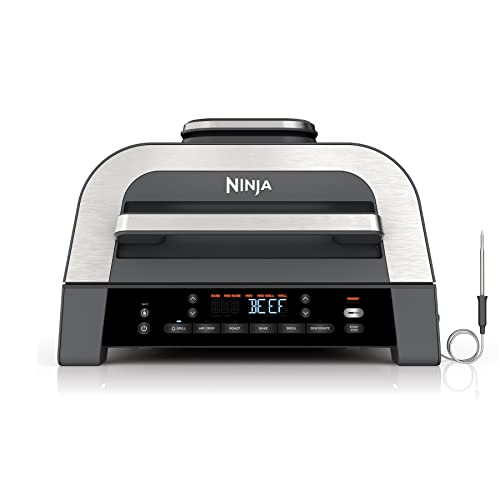
Ninja Foodi Smart XL 6-in-1 Indoor Grill DG551 — Best Overall
If one appliance has to be the indoor grill station for a household — the thing that handles Tuesday chicken, Friday steaks, and Sunday meal prep — the DG551 is the most complete candidate in this category. Its XL chamber grills family quantities at once, its air fry mode replaces a separate fryer entirely, and its Smart Cook System, built around a leave-in thermometer, supervises doneness so the cook can make the salad instead of hovering with tongs.
Strengths
- XL capacity plus six functions — the broadest single-appliance coverage in this roundup
- Smart thermometer with doneness prediction and rest guidance removes indoor grilling’s main anxiety
- Cyclonic grilling sears evenly, so the back row of burgers is not the pale row
Trade-offs
- Premium tier and the largest footprint here; small kitchens must measure honestly
- Households of one or two will underuse the chamber most nights
- The thermometer system adds parts and a small setup step to every guided cook
| Capacity class | XL per Amazon listing |
| Key feature | Smart Cook System and Foodi Smart Thermometer |
| Verification | ASIN confirmed, 2026-11-20 |
The indoor context flatters this machine. Outdoor grilling forgives inattention because the cook is standing there anyway; indoor grilling competes with everything else happening in the home, and the DG551’s alerts are designed for a cook who is also setting the table, helping with homework, or taking a call. The thermometer’s rest prediction — pulling food early enough for carryover to finish it — is the kind of detail that makes results repeatable rather than lucky.
Capacity deserves a practical translation. XL means a full family round of burgers without a second batch cooling on a plate, a generous load of chicken thighs in one pass, or meal-prep quantities of vegetables and proteins on a Sunday. In an apartment or house where the countertop grill is the only grill, that throughput is the difference between a replacement and a compromise.
Buy the DG551 if your indoor grill will be a primary cooking appliance for a family, and you value supervised, repeatable results. It is the category’s flagship for a reason, and its premium is the price of having no second appliance on the counter beside it.
Best for: Families making an indoor grill their primary grill, who want guided, repeatable results at full capacity / Not suited for: Solo cooks and small counters that a 4-quart unit would serve better
Check the current price on Amazon

Ninja Foodi 5-in-1 XL Indoor Grill AG301 — Best Value
The AG301 is the original Foodi Grill and remains the value anchor of indoor grilling: XL capacity, cyclonic searing, five functions, and none of the smart-system cost. For the large population of cooks who judge a steak by eye and a chicken by an inexpensive thermometer they already own, it delivers the category’s core experience — real indoor grilling plus real air frying — at its most sensible tier.
Strengths
- XL family capacity at a mid-range tier — the most grilling per dollar in this roundup
- Cyclonic technology produces even, convincing sear across the whole grate
- Dishwasher-safe parts make a big indoor appliance painless to live with
Trade-offs
- No built-in thermometer; guidance is your responsibility
- Large footprint, like all XL models
- Smoke control is good, though the fattiest cooks still want the hood running
| Functions | Grill, air fry, roast, bake, dehydrate (5-in-1 per Amazon listing) |
| Capacity class | XL |
| Verification | ASIN confirmed, 2026-11-20 |
Value here is not code for compromised. The AG301 grills with the same cyclonic conviction as its smarter siblings — the circulating superheated air that wraps food while the grate brands it — and its air fry basket handles the family fry load that defeats smaller fryers. What the lower tier removes is supervision, not performance. Experienced cooks will not miss it; new grillers should honestly assess whether they will.
There is also a longevity argument. Fewer electronic systems means fewer things to age, and the AG301’s long production run means parts, accessories, and collective owner knowledge are abundant. Indoor grills live hard lives of heat and grease; buying the proven, widely owned model is a rational form of insurance.
Choose the AG301 if your household is family-sized, your doneness confidence is adequate, and you would rather spend the savings on the food than on the appliance’s electronics. It is the indoor grill most households actually need.
Best for: Families wanting maximum indoor grill capacity and proven performance at a sensible tier / Not suited for: Cooks who want the appliance to supervise doneness
Check the current price on Amazon
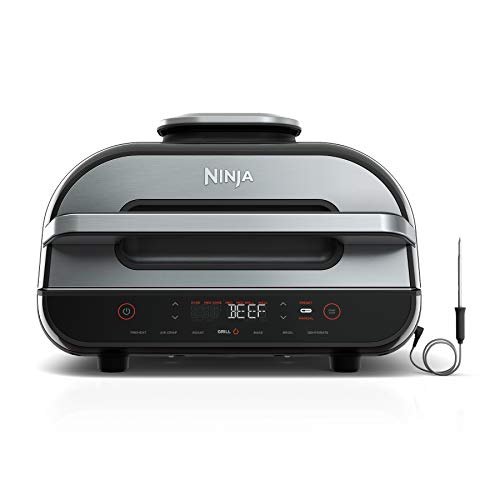
Ninja Foodi Smart 6-in-1 Indoor Grill FG551 — Best for Apartments
Apartment indoor grilling has a specific shape: a small counter, a sensitive smoke detector, one or two people eating, and a lease that forbids the balcony alternative. The FG551 fits that shape precisely. Its 4-quart chamber is the right size for its audience, its footprint respects tight counters, and its Smart Cook System gives a newer cook the confidence that apartment experimentation usually lacks.
Strengths
- Compact footprint with the full smart thermometer system — no feature compromise for small spaces
- Right-sized chamber preheats fast and crisps efficiently for one to three people
- Six functions replace several small appliances a small kitchen cannot house anyway
Trade-offs
- Entertaining means batch cooking
- Premium-tier cost for the size class
- Like all indoor grills, fatty foods still produce some smoke — detector placement remains a consideration
| Capacity | 4 qt per Amazon listing |
| Key feature | Smart Cook System with built-in thermometer |
| Verification | ASIN confirmed, 2026-11-20 |
The smart system matters more in apartments than anywhere else, because apartment cooks are disproportionately newer cooks — first kitchens, first solo dinners, first attempts at a proper steak. Guidance that says “flip now” and “rest now” compresses the learning curve into a handful of successful meals, after which the appliance has paid for its premium in confidence alone. The food, meanwhile, is indistinguishable from what the XL smart model produces; only the batch size differs.
Livability is the other half of the apartment case. The FG551 stores more easily, moves more easily when counter space must be borrowed back, and its smaller chamber means less hot air vented into a small space per cook. Its fan noise is present, as with all these appliances, but the cooks are shorter.
If your indoor grill must earn a small counter in a small home, this is the one designed for exactly that negotiation — full capability, honest size, and a supervisor built in.
Best for: Apartment dwellers and small households wanting guided indoor grilling without the XL footprint / Not suited for: Regular cooking for four or more
Check the current price on Amazon

Gourmia FoodStation Smokeless Indoor Grill & Air Fryer — Best Tabletop Experience
The FoodStation reimagines the indoor grill as a social appliance. Its open, extra-large nonstick surface with smoke-extracting technology is built for tabletop cooking in the Korean BBQ and raclette tradition — food grilling in the middle of the table while people eat — with an air fryer function folded into the same 6-quart-class unit for the rest of the week’s cooking.
Strengths
- Active smoke extraction makes communal indoor grilling practical in enclosed spaces
- Extra-large open surface suits tabletop, cook-as-you-eat formats no lidded unit can replicate
- Doubles as a full air fryer, so it is not a single-occasion appliance
Trade-offs
- Open-format grilling lacks the convection assist of lidded cyclonic designs — sear character differs
- Nonstick surface requires non-metal utensils and gentle cleaning
- Tabletop use needs a heat-safe surface and cord management at the table
| Capacity | 6 quart FoodStation per Amazon listing |
| Key feature | Smoke Extracting Technology |
| Verification | ASIN confirmed, 2026-11-20 |
The experience argument is real. Some meals are events, and grilling thin-sliced marinated meats, mushrooms, and peppers at the table — each person cooking their own bites — is a format that brings people around food in a way a kitchen-counter appliance cannot. The smoke extractor is what moves that format from a restaurant to your dining room without setting the evening’s soundtrack to “detector.”
As a weeknight appliance it remains honest: the air fry function handles the standard repertoire, the surface area swallows family quantities of vegetables and proteins, and the nonstick cleanup is a wipe rather than a scrub. It will not produce the EG201’s steak crust, and it does not pretend to; its talents lie elsewhere.
Buy the FoodStation if your indoor grilling ambitions include people gathered around the cooking, or if smoke extraction is your household’s non-negotiable requirement. It is the most sociable appliance in this guide.
Best for: Social tabletop grilling and smoke-sensitive homes / Not suited for: Maximum-crust steak cooking or cooks who prefer lidded, set-and-forget grilling
Check the current price on Amazon
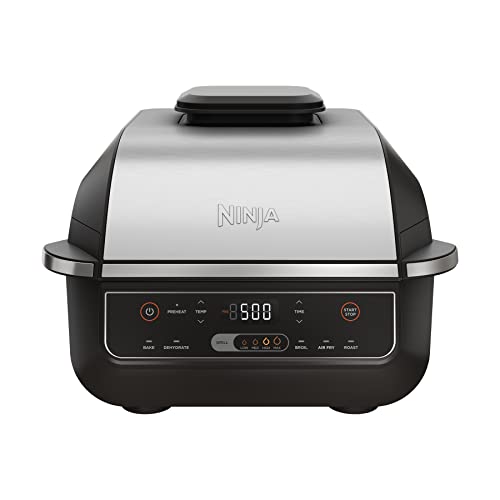
Ninja Foodi 6-in-1 Indoor Grill EG201 — Best for Steak Nights
Some indoor grill buyers have exactly one fantasy: a proper steak, with a proper crust, in February, without setting foot outside. The EG201 is built for that fantasy and honest about the physics it requires — 500°F of heat, driven around the food as surround searing while the grate does its branding work, in a virtually smoke-free design brief. The air fryer half remains fully present, but this is the steak lover’s configuration of the concept.
Strengths
- 500°F surround searing — the strongest indoor steak performance in this roundup
- Char-grilled marks with edge-to-edge browning, not just stripes
- Six functions keep it a complete weeknight appliance beyond steak night
Trade-offs
- No thermometer guidance — bring your own instant-read and your own judgment
- Capacity below the XL models
- The fattiest steaks still produce some smoke; physics outranks marketing in every design
| Top temperature | 500°F per Amazon listing |
| Functions | 6-in-1 per Amazon listing |
| Verification | ASIN confirmed, 2026-11-20 |
The steak protocol that unlocks this machine is simple and worth stating: a dry surface, a full preheat, an undisturbed first side, a single flip, and a genuine rest. The EG201 supplies more raw searing capability than any other pick here; the protocol converts that capability into the crust. Owners who skip the preheat or crowd the grate are cooking on a lesser appliance of their own making.
Beyond steaks, the high ceiling benefits everything that likes aggressive heat: skin-on chicken with rendered, crisp edges; burgers with real char; vegetables with blistered skins. The air fry mode then covers the gentler half of the repertoire without complaint.
Choose the EG201 if steak night is the reason for the purchase and you are comfortable supervising it yourself. It spends its budget on heat, and heat is what steak night is about.
Best for: Steak lovers who want the most convincing indoor crust and marks available / Not suited for: Beginners wanting guided doneness, or XL family batches
Check the current price on Amazon

NutriChef Indoor Smokeless Grill & Air Fryer — Best Complete Kit
The NutriChef is the outsider pick that earns its place on completeness: seven cooking functions, a 6-litre chamber, precise temperature control, removable nonstick plates — and a smart thermometer in the box, usable with this appliance and beyond it. For a buyer outfitting an indoor grilling setup from zero, it is the single purchase that leaves nothing on the shopping list.
Strengths
- Smart thermometer included — guided cooking without a second purchase
- Seven functions and family-scale capacity in one unit
- Removable nonstick plates make the grill side easy to live with daily
Trade-offs
- Peak sear sits a step below the 500°F lidded specialists
- Smokeless performance is good, not the best here, on the fattiest foods
- Smaller parts and accessory ecosystem than the category leader
| Capacity | 6 L per Amazon listing |
| Functions | 7 cooking functions per Amazon listing |
| Verification | ASIN confirmed, 2026-11-20 |
There is a first-home and a rental logic to this pick. When the kitchen starts empty, a complete kit that grills, air fries, and includes its thermometer is worth more than a marginally stronger appliance that needs accessories to reach the same readiness. The NutriChef’s temperature control is precise enough for delicate work — fish, vegetables, gentle reheating — that max-heat specialists treat as an afterthought.
Its smokeless design brief is honestly executed for ordinary foods: burgers, chicken, vegetables, and seafood cook indoors without drama. Reserve the range hood for bacon and ribeyes, as you should with every pick in this guide.
For buyers who want the category’s benefits without entering its dominant brand’s ecosystem — or who are buying a complete gift — the NutriChef is the sensible, self-contained answer.
Best for: First setups, rentals, and gift buyers wanting everything in one box / Not suited for: Buyers chasing peak sear or the deepest accessory range
Check the current price on Amazon
Comparison Table
Six real indoor grills with real air fryers attached. The separating questions are household size, guidance, smoke strategy, and how social you want the cooking to be.
| Pick | Badge | Key spec | Best for |
|---|---|---|---|
| Ninja Foodi DG551 | Best Overall | XL, Smart Thermometer system, 6-in-1 | Families making an indoor grill their primary grill |
| Ninja Foodi AG301 | Best Value | XL, 5-in-1, cyclonic grilling | Family capacity at a sensible tier |
| Ninja Foodi FG551 | Best for Apartments | 4 qt, Smart Cook System | Small households and small counters |
| Gourmia FoodStation | Best Tabletop Experience | Smoke extraction, extra-large open surface | Social tabletop grilling |
| Ninja Foodi EG201 | Best for Steak Nights | 500°F surround searing | Maximum indoor steak crust |
| NutriChef 7-Function | Best Complete Kit | 6 L, 7 functions, thermometer included | Complete one-box setups |
How to Choose an Airfryer with an Indoor Grill
Let your living situation lead. Apartment and condo cooks should shortlist by footprint, smoke behavior, and capacity for one to three — the FG551 and the FoodStation answer those constraints from opposite directions, one lidded and guided, one open and extractive. House cooks with families should shortlist by throughput — the XL pair — and then decide whether smart guidance is worth its premium in their kitchen. Solo steak devotees should let the EG201’s heat make the decision.
Second, audit your ventilation honestly. A ducted range hood that vents outside forgives nearly any indoor grill. A recirculating hood or a microwave vent forgives little, and in those kitchens smoke management is not a feature preference but the product requirement — favor extraction or the most disciplined lidded designs, and favor leaner grilling habits with fatty foods reserved for the best-ventilated setup you have.
Third, count the appliances this purchase replaces. In a small kitchen, an indoor grill airfryer that retires a separate fryer, a contact grill, and possibly a toaster oven’s roasting duties is not a large appliance — it is a consolidation. Judge its footprint against the combined footprint of what it displaces, and its price against the combined replacement cost, and the premium tiers often reframe themselves as the economical choice.
Finally, think about who cooks. Guided systems genuinely change outcomes for newer cooks and distracted ones; confident cooks may find them surplus. Buy the supervision your household will actually use, in the size your household actually feeds, with the smoke strategy your home actually needs. Those three honest answers select the pick.
A last consideration is the secondhand and hand-me-down reality of this category: these appliances are gifted, resold, and inherited constantly, because households upsize and downsize around them. Buying from the established end of the market — the brands that dominate this guide — means a gifted unit still has findable manuals, available replacement grates and probes, and a community of owners whose advice is one search away. That ecosystem has real value over a five-year ownership, and it is part of what the established brands’ pricing quietly includes.
How to Set Up an Indoor Grill Station
Placement comes first. Give the unit a heat-safe, stable surface with clearance on all sides and above — the lid needs its full arc, and the exhaust needs somewhere to go that is not the underside of a cabinet. If your best spot sits under cabinets, pull the unit forward during use as a matter of routine; steam and heat are unkind to cabinet finishes over months of trapped exposure. Keep the cord short, untangled, and off any hot surface, plugged directly into an outlet rather than an extension cord.
Organize the working triangle of indoor grilling: the appliance, a landing zone for raw and cooked food on separate plates, and your tools — tongs, thermometer, oil, and seasoning — within one step. Indoor grilling moves fast once food is down, and a cook who must cross the kitchen for the tongs is a cook whose steak waits. A small tray that holds the whole kit beside the unit turns setup into a ten-second habit.
Ventilation is a step, not an afterthought: hood on before the preheat, a window cracked if your kitchen allows it, and the smoke detector’s location noted — never disabled, but if yours is hypersensitive and kitchen-adjacent, cooking fattier foods earlier in the day with doors open is the pragmatic adjustment many apartment cooks adopt. After cooking, let the unit cool with the lid ajar so moisture escapes instead of condensing inside, then wash the grate, basket, and shield while the residue is young.
Store the accessories with the appliance — probe in its place, plates nested — because an indoor grill whose thermometer lives in a mystery drawer is an indoor grill that gets used without it. The station is ready when everything for a steak night is reachable without opening a second cabinet.
Indoor Grilling Without the Smoke Alarm: A Practical Playbook
Smoke management deserves its own section because it decides whether indoor grilling becomes a habit or a regret in enclosed homes. The sources of smoke are three: fat dripping onto hot surfaces, residue from previous cooks reheating, and oils heated past their smoke point. Each has a countermeasure, and together they make even modest designs livable.
For fat: trim external fat from steaks and chops to a thin edge, choose leaner grinds for indoor burgers, and let the appliance’s drip management do its designed job — which means emptying and cleaning the drip components rather than letting them accumulate into a smoke reservoir. For residue: the splatter shield and grate are the usual culprits; a shield that goes back in dirty will smoke at the next preheat like a warning. Wash both regularly and the appliance’s smoke behavior stays at its factory best. For oils: use a thin film of a high-smoke-point oil on the food, applied with a brush or your hands, rather than aerosol sprays or butter at searing temperatures.
Behavior helps too. Preheat with the hood already running so airflow is established before the first wisp. Cook fatty items in a single confident batch rather than opening repeatedly to check — every lid lift releases a accumulated puff at face height. And sequence the meal so the fattiest item cooks when ventilation is at its best, not after an hour of accumulated kitchen humidity. None of this requires the top pick in this guide; it makes every pick in this guide perform closer to its best.
Indoor Grill, Contact Grill, or Grill Pan: Sorting the Alternatives
Three older technologies compete for the indoor grilling job, and an honest guide should say why the airfryer-grill combination displaced them for most households. The contact grill — the hinged press design — cooks fast from both sides and stores flat, but it presses juices from food, produces steamed rather than seared surfaces on thick items, and offers no air frying, no roasting chamber, and limited capacity. It remains a fine panini press. As a grill for steaks and chicken, it is outclassed by every pick in this guide.
The cast iron grill pan on a stovetop is the romantic option: cheap, indestructible, capable of real marks over high burner heat. Its costs are smoke — unlimited, unextracted smoke, straight into your kitchen — splatter across the entire stovetop, and a cooking experience that demands constant attention with no temperature control beyond the burner knob. Enthusiasts with powerful ducted hoods keep one for good reason. Apartment cooks with recirculating vents learn the reason for this guide’s existence the first time they use one.
The dedicated electric indoor grill without air frying — the open countertop grill — is the closest relative, and the good ones grill respectably. What they lack is the second life: when it is not grilling, it is a large single-purpose object on your counter, while the combination units in this guide are frying, roasting, or reheating something several times a week. In small kitchens especially, versatility is not a luxury feature; it is the rent an appliance pays for its footprint. That is the argument, and for most households it is decisive.
A Year of Indoor Grilling: The Seasonal Case
The purchase case for an indoor grill compounds across a calendar. In winter, it is obvious: grilling without the patio’s cold, darkness, and snow is the entire point, and the appliance’s waste heat is a bonus in a cold kitchen rather than a burden. In spring and fall, it absorbs the rainy evenings and the too-dark-by-dinner weeks that quietly cancel outdoor plans. In summer — the season skeptics assume belongs to the outdoor grill — it earns its place differently: it cooks without heating the kitchen the way an oven does, it handles the weeknight volume while the outdoor grill rests for weekends, and it rescues the evenings when a thunderstorm parks itself over your cookout at exactly the wrong hour.
There is also the fuel and logistics ledger. No propane tanks to refill or exchange mid-season, no charcoal to store dry, no lighter cubes, no ash. For households that grill in small quantities often — two fillets, four burgers, a tray of vegetables — the outdoor grill’s setup overhead dwarfs the cooking itself, and the countertop’s two-minute readiness quietly changes how often grilled food appears on the table at all. Frequency, more than any single meal’s quality, is what owners cite a year later: they simply grill more, in every month, because the friction is gone.
Your First Week With an Indoor Grill: A Sensible Sequence
New owners get the most from these appliances by sequencing their first cooks from forgiving to ambitious. Start with sausages and burgers: fatty enough to be forgiving, quick, and the fastest way to learn your unit’s preheat behavior, hot spots, and smoke character at your own ventilation’s real capacity. Follow with chicken thighs — skin-on if you want the crisping lesson — using a thermometer and noting how your unit’s times compare with any chart you are following, because every kitchen’s unit runs slightly its own way.
Midweek, run the air fry side properly: fries or wings, in a single layer, shaken or turned once, so you learn the crisping baseline before you need it as a side for something important. Then vegetables on the grate — peppers, zucchini, onions, corn — which teach sear timing at low stakes and produce the char that makes people understand what the appliance is for. Save the thick steak for the weekend of your first week, when the preheat discipline, the drying habit, and the rest are already routine; the steak will be better for the practice, and so will your confidence in the machine.
By the end of that sequence you will know your unit’s personality — where it runs hot, how its times skew, how your kitchen handles its smoke — and that calibrated knowledge, more than any feature, is what separates owners who love these appliances from owners who return them in week two. The first week is tuition. Pay it gladly.
Keeping an Indoor Grill at Its Best: A Simple Maintenance Rhythm
These appliances age gracefully if you keep one rhythm: clean the parts that touch food and smoke after every cook, and deep-clean the system monthly if you grill weekly. The after-cook rhythm is five minutes — grate, basket, and drip parts into the dishwasher or a soapy sink while they are warm; a wipe of the chamber once it cools; the splatter shield checked and washed whenever it shows a film, because that film is next week’s smoke. Nonstick plates prefer a soft sponge to any scouring pad, and all parts should be fully dry before reassembly so the unit does not store damp.
The monthly rhythm adds three checks. Inspect the grill grate’s coating or seasoning for damage, since a compromised surface starts sticking and smoking at once. Check the thermometer probe and its cable for nicks or stiffness, and test its reading in ice water if your results have seemed off. And look at the fan intake and exhaust paths for the lint and grease film that kitchens deposit on everything — a soft brush and a damp cloth restore the airflow the smoke control depends on. None of this requires tools, products, or expertise beyond a sink and ten unhurried minutes.
What you are protecting with this rhythm is the appliance’s original smoke behavior and sear. Nearly every “it worked great for six months” complaint in this category traces to accumulated residue reheating cook after cook, not to mechanical decline. Treat the cleaning as part of the recipe — the final step, done while the food rests — and an indoor grill will hold its performance for years of weeknights.
Common Buying Mistakes
Indoor grill disappointment follows familiar patterns:
- Buying an “air fryer with grill pan” that fails the real-grate test, then concluding indoor grills do not work.
- Ignoring open-lid height and cabinet clearance until the appliance arrives.
- Choosing XL capacity for a household of one, or compact capacity for a family of five.
- Expecting zero smoke from fatty foods in any design — and returning a good appliance for obeying physics.
- Letting the splatter shield and drip parts go unwashed until the unit smokes at every preheat.
- Paying for a smart guidance system you will never engage, or skipping guidance you genuinely needed.
Match the appliance to your space, your household, and your ventilation, and indoor grilling becomes the most reliable cooking format in the home. One final habit separates satisfied owners from the rest: they decide in advance where the appliance lives, permanently, and they measure that spot before the box arrives — a five-minute task that prevents the single most common cause of buyer’s remorse in this entire category.
Final Recommendation
The default answer for families is the Ninja Foodi DG551 — complete, capacious, and supervised — with the AG301 as its value twin for cooks who bring their own judgment. Apartment cooks should choose between the guided compactness of the FG551 and the social, smoke-extracting openness of the Gourmia FoodStation, depending on whether their indoor grilling is a weeknight routine or a table event.
Steak-first buyers belong to the EG201, and anyone building a kitchen from zero should look seriously at the NutriChef and its everything-included box. Set the station up properly, keep the shield clean, run the hood — and the forecast will never cancel your grill night again.
Related reading on this site: Best Airfryers With Indoor Grills; Best Air Fryer Grills; Best Air Fryer That Grills; Best Air Fryers; Best Indoor Grills; Best Grills.
Frequently Asked Questions
Are airfryers with indoor grills worth it for apartments?
They are arguably the best apartment cooking upgrade available, because they replace the forbidden balcony grill entirely. Choose a compact or smoke-managed model, respect the ventilation habits in this guide, and you can grill year-round within a lease. The FG551 and the FoodStation exist precisely for this reader. One lease-specific caution: these are ordinary countertop appliances with no open flame and no fuel storage, which keeps them on the right side of typical lease and building rules that prohibit balcony grills — but if your building restricts even countertop appliances in writing, that document, not this guide, is the authority.
How loud are indoor grill airfryers?
Expect fan noise comparable to a microwave or a mid-speed range hood while cooking. It is noticeable in a quiet studio and unremarkable in a busy family kitchen. Cooks are typically short, which helps; none of these appliances is a background-noise appliance like a slow cooker. If you routinely cook while someone sleeps in the next room, favor the shorter, hotter cooks these appliances do well, and know that the air fry mode at moderate temperatures is generally the quieter configuration in most designs.
Can I use one on a glass-top or wooden table?
The lidded countertop units belong on heat-safe kitchen counters. The tabletop FoodStation format is designed for table use, but protect the surface with a heatproof mat, manage the cord so it cannot be pulled, and keep the area clear of paper and cloth. When in doubt, the counter is always the safer venue. Whatever surface you choose, keep the appliance’s exhaust path unobstructed and never operate it inside a closed cabinet or under a low shelf — these units move a great deal of hot air, and that air needs an honest exit route for both performance and safety.
Do indoor grills make the whole house smell like food?
Some cooking aroma is unavoidable and, to most people, pleasant. Lingering heavy smells come from grease residue — in the appliance’s shield and drip parts, and in soft furnishings after very fatty cooks. Clean parts promptly, ventilate during cooking, and aroma stays at the level of any normal home cooking. If a particular cook was unusually fatty, a bowl of simmering water with lemon on the stove afterwards, or simply an hour with a window open, resets the kitchen completely.
What foods work best in an indoor grill airfryer?
Steaks, burgers, chops, chicken pieces, salmon, sausages, kebabs, and firm vegetables on the grill side; fries, wings, roasted vegetables, and reheated foods on the air fry side. Very large roasts and whole birds belong to the XL chambers’ roast mode rather than the grate. Breakfast deserves a mention too: the grill side handles bacon-adjacent duties, sausages, and tomato halves, while the air fry side crisps hash browns — a full cooked breakfast from one countertop appliance is a weekend ritual in many owning households, and a legitimate reason some buyers choose the category at all.
How do I stop mine from smoking more as it gets older?
It is almost always residue. Degrease the splatter shield, grate, and drip components thoroughly — a soak in hot soapy water or a dishwasher cycle — and the unit’s smoke behavior returns to its new condition. If heavy smoke persists with clean parts and lean food, contact the manufacturer; that is a service question, not a usage one. While you are cleaning, empty and wash the crumb and drip areas you normally ignore — old oil pooled in a drip tray is a smoke generator hiding in plain sight.


