Disclosure: airfryerkitchensupply.com is reader-supported. When you buy through links on our site, we may earn an affiliate commission at no extra cost to you.
Where to buy
All six machines below are current models sold on Amazon by their brands or authorised sellers, verified against Amazon’s own catalogue data before publication. Start with the WINIX 5510 if odour is the whole problem — for cannabis, it usually is — or the LEVOIT Core 600S-P if you want the dedicated smoke-filter upgrade path. The rest of the shortlist: the Medify MA-50, the Shark NeverChange HP152, the WINIX 5520 and the BLUEAIR Blue 211i Max. Check the current price on Amazon for the machine and its carbon-bearing replacement filter together — with cannabis, the carbon is the machine, and its replacement cycle is the real cost of ownership.
Introduction
The best air cleaners for marijuana smokers solve a different problem from the ones built for cigarettes, and it is worth being precise about why. The best air cleaners for marijuana smokers are, above all, odour machines. Cannabis smoke carries a heavy load of aromatic compounds — the terpenes that make the smell so distinctive and so recognisable through a closed door, down a hallway, and, in attached housing, into a neighbour’s evening. Those compounds are gases. A HEPA filter, however excellent, does not capture gases at all; it clears the visible haze and the fine particles while the smell passes through untouched. The tool for the smell is activated carbon, in quantity, with enough airflow behind it to cycle the room’s air repeatedly. That single fact explains most disappointed purchases in this category — a respected allergy purifier, faithfully run, that leaves the defining problem exactly as it found it — and it is the filter this guide applies first: every pick below pairs real particle filtration with a carbon stage substantial enough to name, verified against the manufacturer’s own listing.
The context matters too, and this guide treats it plainly. In the many places where cannabis is legal for adults, the household problem is not concealment from authority — it is courtesy and comfort: a landlord’s clause, a neighbour in a shared building, children or guests in the home, a partner who does not partake, a rental deposit. An air cleaner is one part of that household management, alongside where and when smoking happens and basic ventilation. Used that way — at the source, run continuously, with fresh carbon — the machines below make a dramatic, verifiable difference to how far the smell travels and how long it stays. Used as a licence to hotbox a small flat with the windows shut, no machine in this guide, or any guide, will save you. Buy for the real job and these are excellent tools.
In this guide
Quick Picks
- WINIX 5510 — Best Overall. True HEPA behind a high-deodorisation carbon filter, auto mode and app support, rated up to 1,881 square feet in an hour. Check the current price on Amazon
- LEVOIT Core 600S-P — Best With a Smoke-Filter Upgrade Path. Coverage up to 2,933 square feet and a dedicated smoke-remover replacement filter with high-efficiency activated carbon in its own range. Check the current price on Amazon
- Medify MA-50 — Best Large Coverage. HEPA filtration rated at 2,640 square feet of coverage in an hour, built for smoke and odour duty. Check the current price on Amazon
- Shark NeverChange HP152 — Best Odour Neutraliser. A HEPA-exceeding filter with a dedicated odour-neutraliser system for smoke and household smells. Check the current price on Amazon
- WINIX 5520 — Best With Air Quality Monitor. The Winix deodorisation formula plus a built-in air quality display, rated up to 1,882 square feet in an hour. Check the current price on Amazon
- BLUEAIR Blue 211i Max — Best Quiet Large Room. HEPASilent filtration up to 3,235 square feet at a stated 23 dB quiet profile, with WiFi auto mode. Check the current price on Amazon
How These Picks Were Chosen
Carbon first, and it was not close. Every pick had to offer more than a token carbon sheet: a named high-deodorisation carbon filter, a smoke-specific replacement filter, a dedicated odour-neutralising system, or coverage and filtration explicitly rated by the maker for smoke and odours. Second, particle filtration had to be genuine — cannabis smoke is still smoke, and the fine particulate load in the room is HEPA’s job. Third, manufacturers had to publish coverage figures in their own listings, so the sizing advice here rests on stated numbers rather than enthusiasm. Fourth, we favoured sensors and auto modes, because cannabis use is episodic — an evening session, not a continuous source — and a machine that surges when the air changes and idles the rest of the day matches that rhythm without supervision.
Excluded: HEPA-only purifiers whose odour claims rest on a fragranced pad, desktop novelties, and ozone generators — ozone is a respiratory irritant and a particularly poor idea in a room people are deliberately inhaling in. Also excluded are carbon “sprays,” candles and gels marketed as air cleaners; they mask, briefly, and this guide is about removal.
The 6 Best Air Cleaners for Marijuana Smokers

WINIX 5510 — Best Overall
The Winix 5510 leads this list for the same reason it leads the general smokers’ guide, sharpened: its high-deodorisation carbon filter is the most direct answer on sale to the cannabis problem, which is a gas problem. Behind true HEPA — which clears the haze and the fine particles — the carbon stage adsorbs the aromatic compounds that make cannabis smell unmistakable, and Winix builds the machine around that stage rather than treating it as a courtesy layer. Auto mode lets it surge when a session starts, app support keeps control effortless, and coverage rated up to 1,881 square feet in an hour suits the living rooms where sessions actually happen.
Strengths
- High-deodorisation carbon filter — built for exactly the gas load cannabis produces
- True HEPA clears smoke particles and haze in the same stack
- Auto mode matches the episodic pattern of cannabis use
Trade-offs
- Cannabis terpenes are a heavy carbon load — expect a real replacement rhythm
- No machine defeats a closed, unventilated room in continuous use; habits still matter
- Functional styling
| Coverage (manufacturer) | Up to 1,881 sq ft in 1 hr |
| Filtration | True HEPA + high-deodorisation carbon filter |
| Controls | Auto mode, app support |
| Stated targets | Pet allergies, smoke |
Run the 5510 in the session room, on auto, with the door closed, and its talent shows in the hallway: the smell’s travel distance collapses. That containment — the difference between a room that smells and a home that smells — is the outcome most buyers in this category are actually purchasing, and this machine delivers it more completely than any other single unit here. Keep its carbon in date and it will keep delivering it; let the carbon lapse and it becomes an expensive fan with a HEPA hobby.
Best for: most cannabis households, especially in attached housing where smell travel is the issue / Not suited for: buyers who will not maintain a carbon replacement schedule. Check the current price on Amazon

LEVOIT Core 600S-P — Best With a Smoke-Filter Upgrade Path
The Core 600S-P earns its slot on a feature found in its parts list rather than its box: Levoit offers a dedicated smoke-remover replacement filter for this machine, a 4-in-1 filter whose high-efficiency activated carbon is made specifically for smoke and odours. That means the machine a cannabis household buys today can be re-specified at its first filter change into a more serious odour instrument, without replacing the hardware. Add coverage rated up to 2,933 square feet, smart control by app and voice, and a sleep mode, and the 600S is the large-room, upgrade-friendly answer in this category.
Strengths
- Dedicated smoke-remover replacement filter with high-efficiency activated carbon
- Large-room coverage up to 2,933 square feet
- Smart control with air quality feedback
Trade-offs
- The smoke filter is a separate purchase at replacement time — factor it into the budget from day one
- Headline coverage assumes full speed
- Largest footprint among the Levoit picks in this programme
| Coverage (manufacturer) | Up to 2,933 sq ft |
| Filtration | 3-in-1 filter for smoke, pet odour, dust; smoke-remover filter option (high-efficiency activated carbon) |
| Controls | Smart app and voice control, sleep mode |
The buying logic here is a two-step: the machine for its coverage and controls now, the smoke filter for its carbon at the first change — or immediately, if the household’s odour problem is already established. Few purifiers in this class offer a manufacturer-made, smoke-specific filter path at all, and for cannabis households, whose entire complaint lives in the carbon, that path is the most future-proof feature in this guide.
Best for: larger session rooms and buyers who want to escalate odour control without new hardware / Not suited for: small rooms, or buyers who want maximum carbon in the box on day one. Check the current price on Amazon

Medify MA-50 — Best Large Coverage
The MA-50 is Medify’s bigger tower: HEPA filtration the maker rates at 2,640 square feet of coverage in an hour, specified for smoke, wildfire, odour, pollen and pet duty, with filtration stated down to 0.3 microns. For the cannabis household whose problem room is genuinely large — a basement lounge, an open living space, a garage conversion — that coverage is the argument: odour control at scale is air changes at scale, and a machine rated to turn over a big volume hourly gives the carbon stage repeated chances at the room’s gases instead of a single pass and a prayer.
Strengths
- Coverage rated at 2,640 sq ft in one hour — session-room scale
- Maker rates it explicitly for smoke and odours
- Straightforward, no-account operation
Trade-offs
- Carbon life in a large, heavily used room is the running cost to watch
- Fewer smart behaviours than the sensor-led picks
- Tower presence is substantial in a room
| Coverage (manufacturer) | 2,640 sq ft in 1 hr |
| Filtration | HEPA filter, removal to 0.3 microns (manufacturer) |
| Stated targets | Smoke, wildfires, odours, pollen, pets |
Think of the MA-50 as the volume answer. Cannabis odour in a big room is diluted, which tempts buyers to undersize — but dilution also means the machine must process more air to achieve the same number of cleaning passes, and passes are what strip gases out. A large-coverage machine run at a moderate speed in a large room will out-deodorise a small machine screaming in the same space, and will do it at a volume the room’s occupants can talk over.
Best for: large session spaces, basements and open-plan rooms / Not suited for: small bedrooms, where its capacity and presence are wasted. Check the current price on Amazon

Shark NeverChange HP152 — Best Odour Neutraliser
Shark builds the HP152 around the smell itself: a filter the maker describes as HEPA-exceeding, paired with a dedicated odour-neutraliser system aimed at pollutants, pet dander, dust and smoke. For cannabis households, that architecture is well aimed — the neutraliser concept targets the gas phase continuously, which suits a home where the complaint is not the session itself but the background note that outlasts it by a day. In a large-room format from a mainstream brand, it is the low-fuss odour specialist of the list.
Strengths
- Dedicated odour-neutraliser system alongside high-grade particle filtration
- Aimed explicitly at smoke among its stated targets
- Large-room format, mainstream brand support
Trade-offs
- “HEPA-exceeding” is the maker’s framing — judge on stated performance
- Neutraliser consumables form part of the running story; check the schedule before buying
- Shorter track record in this specific duty than the Winix line
| Filtration | HEPA-exceeding filter with odour neutraliser (manufacturer description) |
| Stated targets | Pollutants, pet dander, dust, smoke |
| Format | Large-room home purifier |
Choose the Shark when the household’s pattern is regular, moderate use and a persistent background smell — the scenario where a neutralising system running quietly around the clock earns more than a carbon stage that only gets exercised during sessions. It is the set-and-forget odour pick, and for homes where the smoker and the non-smoker share every room, that background work is the difference between tolerance and friction.
Best for: background odour control in shared homes / Not suited for: heavy session rooms needing maximum carbon mass per pass. Check the current price on Amazon
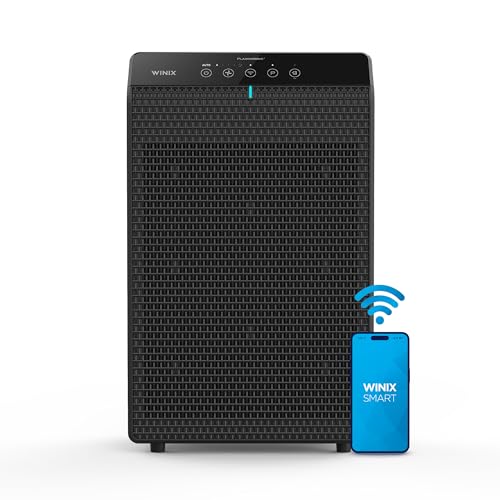
WINIX 5520 — Best With Air Quality Monitor
The 5520 is the Winix deodorisation formula with its workings made visible: the same family recipe — true HEPA, a high-deodorisation carbon filter, auto mode — plus a built-in air quality monitor that shows the room’s state and the machine’s response. Rated up to 1,882 square feet in an hour, it suits the buyer who wants evidence: light the session, watch the reading climb, watch the machine answer, and learn in a week what your room, your habits and your carbon are actually doing. In a category full of faith-based purchases, a feedback loop is a feature with real value.
Strengths
- High-deodorisation carbon filter — the Winix odour formula
- Air quality monitor makes performance visible and habits adjustable
- Auto mode with large stated coverage
Trade-offs
- Shares the family carbon-consumable economics — budget replacements
- Display-driven design will not suit buyers who want an invisible appliance
- Coverage headline is a full-speed figure
| Coverage (manufacturer) | Up to 1,882 sq ft in 1 hr |
| Filtration | True HEPA + high-deodorisation carbon filter |
| Controls | Air quality monitor, auto mode |
| Stated targets | Pet allergies, smoke, dust |
The monitor changes behaviour in a way worth paying for: households learn that the door matters, that the machine’s surge shortens when the window is cracked, and that the reading’s slow return to baseline after a session is the carbon doing its work. That literacy makes every other habit in this guide easier to adopt, because the household can see the cause and effect it is being asked to believe in.
Best for: buyers who want visible proof and feedback while they dial in their setup / Not suited for: buyers who prefer the 5510’s app-first control or a display-free machine. Check the current price on Amazon

BLUEAIR Blue 211i Max — Best Quiet Large Room
The 211i Max is the choice when the session room is also the cinema, the conversation and the guest space: HEPASilent filtration rated up to 3,235 square feet — the largest figure here — at a manufacturer-stated quiet profile of 23 dB, with WiFi auto mode and a pre-filter for the coarse load. Cannabis households in open-plan or media rooms face a specific trade: the machine must run during the session, in company, without becoming the loudest participant. That is the trade this machine was designed to win.
Strengths
- Largest stated coverage in this guide with a very low stated noise profile
- WiFi auto mode suits a machine placed across a large room
- Design suits rooms that are always on show
Trade-offs
- Particle performance leads the design; odour depends on filter configuration and freshness
- HEPASilent is proprietary — buy on the maker’s stated basis
- Premium positioning in this list
| Coverage (manufacturer) | Up to 3,235 sq ft |
| Filtration | HEPASilent filtration, pre-filter |
| Noise (manufacturer) | 23 dB quiet profile |
| Controls | WiFi, auto mode |
| Stated targets | Pet hair, allergens, dust, smoke |
Be clear-eyed about the division of labour if you choose it: the Blueair will keep a large room’s air fresh and its particle load down at a whisper, and its odour work, while real, is the supporting act rather than the headline. Pair it with good habits — door discipline, a session spot near the machine — and it is the most civilised option here. If raw deodorisation is the whole war, the Winix machines remain the heavier artillery.
Best for: large, social, open-plan rooms where noise and looks matter / Not suited for: buyers whose only metric is maximum carbon deodorisation. Check the current price on Amazon
Comparison Table
| Pick | Badge | Key spec | Best for |
|---|---|---|---|
| WINIX 5510 | Best Overall | True HEPA + high-deodorisation carbon, up to 1,881 sq ft/hr | Odour-first households |
| LEVOIT Core 600S-P | Best Smoke-Filter Upgrade Path | Up to 2,933 sq ft, smoke-remover filter option | Large rooms, escalating control |
| Medify MA-50 | Best Large Coverage | 2,640 sq ft/hr HEPA coverage | Basements, big session rooms |
| Shark NeverChange HP152 | Best Odour Neutraliser | HEPA-exceeding filter + odour neutraliser | Background smell in shared homes |
| WINIX 5520 | Best With Air Quality Monitor | Up to 1,882 sq ft/hr, AQI display, deodorisation carbon | Feedback-driven buyers |
| BLUEAIR Blue 211i Max | Best Quiet Large Room | Up to 3,235 sq ft, 23 dB profile | Social open-plan rooms |
Why Cannabis Odour Is a Carbon Problem, Not a Filter Problem
The smell of cannabis is carried by terpenes and related volatile compounds — molecules in the gas phase, orders of magnitude smaller than the particles HEPA media is built to stop. Air flows through a HEPA filter and the particles stay behind; the gases ride the same airflow straight through, which is why a room can look clear and smell unchanged. Activated carbon works by a different mechanism entirely: adsorption. Carbon treated to have a vast internal pore structure gives gas molecules an enormous surface to stick to as air passes, and the compounds are held in the pores rather than returned to the room. Two variables decide whether that works in practice. The first is mass: a deep carbon bed holds more and lasts longer than a carbon-impregnated sheet, which in a cannabis room can exhaust in days. The second is contact: air must actually pass through the bed, repeatedly — which is why coverage and running time matter as much as the filter itself. Every buying rule in this guide is those two variables wearing clothes: named deodorisation filters and smoke-specific carbon replacements are mass; rated coverage and continuous running are contact.
It also explains the failure mode owners describe as “it worked for a month.” Carbon does not wear out gradually in a straight line; it saturates, and a saturated bed returns almost nothing while the fan and HEPA continue performing, so the machine seems healthy while its odour work has quietly ended. In a cannabis household, the calendar is a liar and your nose is the instrument: when the hallway starts smelling again between sessions, the carbon is telling you its news.
How to Choose an Air Cleaner for Cannabis Smoke
Start where the problem lives: the carbon stage. Ask what it is called, what it is made of, and what its replacement costs — a maker with a genuine deodorisation filter or a smoke-specific replacement, like the Winix and Levoit paths in this guide, is answering in specifics; a maker answering in adjectives is not. Next, size for the session room with headroom, reading coverage as a full-speed maximum: cannabis sessions are episodic peaks, and a machine that can surge through a session and then hold the room at low speed for hours afterwards is the correct shape of tool. Third, weigh the feedback question. A sensor or air quality display — the Winix 5520’s monitor, the auto modes across this list — turns odour management from superstition into observation, which matters in shared housing where you may need to demonstrate, not just believe, that the smell is contained. Finally, price the carbon honestly across a year of your household’s actual use. Cannabis is a heavy gas load; a cheaper machine with expensive, short-lived carbon can cost more by spring than a dearer machine with a substantial, standard filter.
How to Use an Air Cleaner for Cannabis Smoke: Session Protocol
The protocol that works is boring, which is why it works. Before: the machine lives in the session room permanently, near the smoking spot but not so close that ash or heat reaches it, intake unobstructed. Start it — or confirm auto mode — before the session begins, so the room’s air is already moving through the carbon when the first smoke arrives. During: keep the session room’s door closed. This single habit is worth more than any specification in this guide, because it defines the volume the machine must defend and keeps the hallway out of the problem. If the room has an exhaust fan or a window that can open without sharing air with a neighbour’s window, use it as an ally during the session and let the purifier handle what remains. After: leave the machine running at a higher speed for a period after the session ends — the gases keep leaving fabrics and the room’s surfaces after the smoking stops — then let auto or a low speed hold the room. Soft furnishings in the session room go on a wash rotation; they are the reservoir that re-charges the room overnight. Always: date the carbon filter at installation, and treat a returning background smell as a filter diagnosis before it becomes a household argument.
Apartments, Neighbours and Landlords: The Courtesy Layer
In attached housing, odour management is a social technology as much as an electrical one, and the purifier is one layer of it. The others cost nothing: a consistent smoking spot nearest the purifier and furthest from the shared door; sessions timed with some awareness of a neighbour’s open windows in summer; the hallway door kept closed as a matter of routine rather than apology. Renters should know their lease’s actual language — many leases regulate smoking itself, and no purifier converts a prohibited activity into a permitted one; what it does do, in the large number of homes where use is permitted but nuisance is the clause, is provide a genuine, demonstrable reduction in the nuisance. Households that treat the machine as part of a courtesy system report the outcome everyone wants: the neighbours stop having an opinion about their evenings.
Common Buying Mistakes
Buying a HEPA purifier for a smell problem. The haze will clear and the terpenes will not notice. Carbon mass is the purchase. Buying carbon by adjective. “Carbon filter included” can mean a bed or a whisper of dusting — look for named deodorisation filters and smoke-specific replacements. Placing the machine in another room. Odour control is source work; a purifier in the hallway defends the hallway. Running it only during the session. Gases re-release from fabrics for hours; the after-period is where background smell is won. Ignoring the carbon calendar. A saturated filter converts a good machine into a fan. Date it, watch the hallway, replace on evidence. Masking instead of removing. Scented sprays and candles add a second smell to the first and convince no one, least of all a neighbour.
Troubleshooting: The Smell Is Winning
Problem: the room clears but the smell reaches the hallway anyway. Check the door discipline first, then the machine’s placement — it should be in the session room, in the smoke’s path — then the carbon’s age. Problem: it worked for weeks and then stopped working on odour. That is carbon saturation announcing itself on schedule. Replace the carbon stage; if it saturates again unusually fast, your household’s load needs a heavier carbon path, not another identical filter. Problem: the smell is worst the morning after. Fabrics re-release overnight while the machine is off or at its lowest. Run it continuously at low speed overnight in the session room and put the nearest throws and cushions through a wash. Problem: a neighbour can still tell. Audit the air paths — under-door gaps, shared vents, open windows on the same wall — because odour travels by architecture as well as by air, and no purifier seals a building.
Joints, Vapes, Concentrates and Edibles: How the Format Changes the Air Problem
Not all cannabis use loads a room equally, and a household that understands its own format buys more accurately. A joint or pipe is combustion: it produces sidestream smoke continuously while lit, the full particle load, and the strongest terpene release — the maximum version of the problem this guide addresses, and the format where source capture and door discipline pay the highest dividends. A bong or bubbler combusts too, but in shorter, denser bursts, which suits a sensor-driven machine that can surge. Dry-herb vaporisers heat without burning: the particle load drops sharply, the odour is real but lighter and dissipates faster, and most households find a mid-tier carbon machine, run during and briefly after, entirely sufficient — the heavy artillery in this guide is more than the job requires. Concentrates vaporised at high temperature produce a sharper, shorter-lived smell with very little lingering sidestream, and again the room recovers quickly with modest filtration. Edibles, obviously, produce no air problem at all — a sentence worth including because households sometimes buy filtration for a consumption pattern that never touches the air, when the actual smell in their home is coming from storage, which is the next section’s subject. Match the machine to the format honestly and you will neither underspend into disappointment nor overspend into a carbon bill your use never justifies.
The Stash Itself: Storage Smell Is Not Smoke
A common misdiagnosis in cannabis households is blaming sessions for a smell that is actually storage. Flower in a bag in a drawer perfumes its surroundings continuously, at low level, day and night — and no purifier placement fixes it, because the source never stops and is usually nowhere near the machine. The correct tool is containment at the source: airtight, genuinely smell-proof storage kept in a closed cabinet, which reduces the background load to something a room purifier barely notices. Diagnose before you spend: if the smell is present at 9 a.m. in a home where nobody has smoked since yesterday, and it concentrates near where the cannabis is kept, you have a storage problem wearing a smoke problem’s clothes. Fix the storage first — it is the cheapest odour intervention in this entire guide — and let the purifier return to its proper job, the sessions themselves.
Carbon Scrubbers and Grow Equipment: A Different Tool for a Different Job
Readers who research cannabis odour deeply will meet the carbon scrubber — an inline fan pulling air through a large carbon canister — and wonder whether it outclasses the purifiers here. It is a different instrument for a different task. Scrubbers are ventilation equipment: they excel at exhausting a defined, enclosed volume — a grow tent is the canonical case — through ducting to somewhere else. A room purifier is a recirculating appliance: it cleans the air of an occupied room, repeatedly, with no duct, no installation and no exhaust path. For a smoker’s living room, recirculation is the right architecture; for an enclosed cultivation space, it is not, and this guide’s picks should not be bought as grow equipment. The overlap is the medium — activated carbon does the odour work in both — which is why the vocabulary travels. Buy the architecture that matches the room you actually have, and be suspicious of any listing that blurs the two.
Legality, Guests and Household Agreements: The Human Layer
A purifier operates inside a household’s agreements, and in cannabis homes those agreements deserve the same clarity as the filter schedule. Where use is legal, the durable arrangements are explicit ones: which room, which hours, what happens when the landlord, the in-laws or the children are in the house, and who owns the carbon calendar. The machine supports those agreements — it is the difference between a session the household has planned around and a smell that ambushes a non-using partner in the kitchen — but it cannot substitute for them, and buying one as a way to avoid the conversation usually ends with the machine unplugged as a proxy in it. Where use is not legal, no buying guide can help with the legal exposure, and none should pretend a filter changes it; this guide’s scope is air, in homes where the underlying activity is the household’s lawful business. Within that scope, the courtesy dividend is real: partners who do not partake consistently rate the purifier as the purchase that made the arrangement comfortable, which is a higher endorsement than any specification in this article.
What a Year of Ownership Costs a Cannabis Household
Run the arithmetic before the purchase, in your own pattern rather than the brochure’s. The machine is the fixed cost. The variable costs are carbon-bearing filters at a cannabis household’s rhythm — heavier than any other domestic use in this programme, because terpene loads are dense and sessions are frequent — plus modest electricity for a machine that should run daily, and the occasional pre-filter’s wear. Households that smoke daily should expect the carbon line to dominate the three-year total, which produces a counter-intuitive buying rule: in this category, the machine with the larger, standardised carbon filter can be the cheaper machine to own even at a higher purchase price, because its filter lasts longer per change and costs less per month of service. The Winix and Levoit paths in this guide are built on standard filters for exactly this reason. The households that feel cheated by purifier economics are almost never cheated by the machine — they are surprised by a consumable they never priced, which is a research failure this section exists to prevent.
The Morning-After Test and Other Honest Measurements
Cannabis households do not need laboratory instruments to know whether their system works; they need three honest tests. The hallway test: during a session, with the door closed and the machine running, the hallway outside should smell like a hallway, not like the room’s annex — if it does not, the failure is architectural (door gap, placement) or carbon, in that order. The morning-after test: enter the session room first thing, before any use, and judge the background level against the week the machine arrived; a working system shows a room that smells like a room, with the session detectable only as history at worst. The guest test: an unadapted nose, arriving fresh, is the most sensitive instrument in the house — if guests cannot identify the household’s habit from the living room, the system has achieved what it was bought for. Run these tests monthly, and let their results — not the calendar, not hope — schedule your carbon changes. A household that measures this way stops arguing about whether the machine works and starts maintaining the machine that demonstrably does.
One Machine or Two: The Bedroom Question
Cannabis households split on the second machine, and the deciding factor is where people sleep relative to where they smoke. If the session room is the living room and the bedroom sits behind a closed door at the other end of the home, one strong machine at the source — run with the protocol in this guide — usually governs the whole arrangement, because the bedroom’s exposure is the diluted remainder. If the session room is the bedroom itself, or the flat is small enough that every room is the session room’s neighbour, a second, quiet machine for sleeping hours stops being a luxury: the hours of sleep are the longest continuous breathing the household does, and a closed bedroom door plus a small purifier is the most complete protection this category offers. The compact end of this programme’s wider guide — the single-room machines — exists for exactly that second post. Decide by architecture, not by enthusiasm: draw the floor plan, mark the session spot and the pillows, and let the distance between them make the decision.
A Final Practical Note: Smoke Detectors and Building Systems
One interaction surprises new owners: a purifier cleans air, but it does not govern the building’s other systems. Smoke detectors respond to the particles at the ceiling, and a session directly beneath one can still trigger it in a small room — position and ventilation habits, not filtration, manage that relationship, and detectors should never be disabled or covered for any reason connected with smoking. Similarly, in buildings with shared ventilation, a purifier in your unit reduces what your unit contributes to the shared air but cannot police the ductwork itself; households in such buildings get the best results by pairing the machine with the door and window discipline this guide describes, treating the building as part of the system rather than an adversary the appliance must defeat alone.
Final Recommendation
Buy the WINIX 5510 today for the most direct answer to cannabis odour available in a domestic purifier, or the LEVOIT Core 600S-P if your room is large and you want the smoke-remover filter path. The Medify MA-50 covers the biggest session spaces, the Shark NeverChange handles the shared-home background, the Winix 5520 shows you the evidence, and the Blueair 211i Max keeps a social room civilised at a whisper. Whichever you choose, the protocol matters as much as the machine: right room, closed door, fresh carbon. Related guides in this programme: Best Air Cleaner For Smokers, Best Air Filter For Smokers, Best Air Filter For Indoor Smokers and Best Air Filter For Heavy Smokers.
Frequently Asked Questions
Can an air purifier completely eliminate cannabis smell?
It can reduce it to a level most households and neighbours find unremarkable, when the carbon is substantial, fresh and run correctly in a closed room. “Completely, instantly, in an open-plan flat during a session” is beyond any domestic machine — be wary of any product that promises it. The realistic benchmark is the morning after: a room that hosted a session the previous evening should present, to a fresh nose, as a room — and that is achievable with every pick in this guide.
What matters more for cannabis: HEPA or carbon?
Carbon, for the smell — which is most households’ actual problem. HEPA still matters for the smoke particles and the room’s general air quality, and every pick here includes both, but if a product forces a choice of emphasis, cannabis buyers should choose the carbon. The corollary is just as important: a product that leads with its HEPA specification and whispers about its carbon is telling you, in its own marketing order, what it was built for — and it was not built for this.
How often will the carbon filter need replacing?
More often than in a non-smoking home, and the honest signal is performance: when the background smell stops improving or starts returning between sessions, the carbon is saturated. Regular users should budget it as a recurring consumable and keep a spare if the household cannot tolerate a gap. Daily users in small, closed rooms sit at the demanding end of the range; occasional users with a window habit sit at the gentle end — and the same machine can honestly serve both, at different filter intervals.
Does a purifier help with the smell on clothes and furniture?
Indirectly, yes: cleaner air stops re-depositing odour and slowly draws it back out of fabrics, so a room’s textiles gradually give up their stored smell into air that the carbon then captures. Items already saturated — the session chair’s cushion, curtains in the smoking room — need washing or airing in their own right; the purifier maintains the result rather than performing the rescue alone. Expect the full exchange — furnishings out-gassing into cleaned air — to take a week or two of consistent running in an established smoking room.
Is a sploof or smoke filter a substitute for a purifier?
No. Exhale filters reduce the smell of exhaled smoke at the moment of use, which can be a useful courtesy layer in a shared house or on a balcony, but they do nothing for sidestream smoke, the room’s particles, or the background build-up in fabrics. They complement a purifier; they do not replace one. Judge them as an accessory to the system in this guide, priced accordingly, and be sceptical of any that borrow the language of filtration to describe what is, at best, a scented pause.
Should I run the purifier all night after a session?
Yes — at a low or auto speed in the session room. The hours after a session are when gases leave surfaces and fabrics, and a machine running through that period is what converts a smelly morning into a neutral one. If noise is the obstacle, that is a sizing verdict rather than a schedule one: a machine with headroom, run low, should be quiet enough for the room it serves, and if yours is not, the next purchase should be capacity, not earplugs.


