Disclosure: airfryerkitchensupply.com is reader-supported. When you buy through links on our site, we may earn an affiliate commission at no extra cost to you.
Where to buy
All six machines below are current models sold on Amazon by their brands or authorised sellers, verified against Amazon’s own catalogue data before publication. Indoor smoking is a contained-space problem, so the shortlist favours right-sized, quiet machines over raw power. Start with the COWAY Mighty AP-1512HH for a main room, or the BLUEAIR Blue Pure 511i Max where the bedroom is the priority. The full list: the LEVOIT Core 300-P, the WINIX A230, the COWAY Airmega 100 and the Medify MA-14. Check the current price on Amazon for each — and for its replacement filter, because an indoor machine runs daily and its filter is a standing arrangement, not a surprise.
Introduction
The best air filter for indoor smokers is shaped by a constraint the outdoor and occasional smokers never face: the smoke has nowhere to go. The best air filter for indoor smokers works in a sealed volume — an apartment in winter, a bedroom with the door closed, a condo where the balcony is not an option and the lease has opinions — and in a sealed volume, everything changes. The pollutant concentration climbs faster and falls slower. The smell reaches soft furnishings in hours rather than days. The neighbours are on the other side of a wall, not the other side of a garden. And the machine itself must live at close quarters with the household: in the room where people sleep, talk and watch television, at a volume they can tolerate for sixteen hours a day. A purifier that would be perfect in a detached house’s den can be wrong in every particular for a studio flat — too large, too loud, too hungry for floor space that does not exist.
So this guide applies the indoor filter, literally, to the purifier market. Every pick is sized for real indoor rooms rather than headline square footage, carries a genuine HEPA-plus-carbon stack (indoor smoke is still a particle problem and an odour problem at once), and earns its place at close quarters — quiet sleep profiles, compact footprints, sensors that let the machine react without being managed from the sofa. The guide is honest about the indoor ceiling, too: filtration in a sealed space is a powerful manager of smoke, not an eraser of it, and the households that succeed indoors pair the right machine with the unglamorous disciplines — a fixed smoking spot, a closed door, furnishings that can be washed. Sized and run that way, an indoor setup can hold a room to a standard that surprises even sceptical partners and landlords.
In this guide
Quick Picks
- COWAY Mighty AP-1512HH — Best Overall for Indoor Smokers. Sensor-driven HEPA filtration rated up to 1,748 square feet, with auto and eco modes that suit sealed rooms. Check the current price on Amazon
- BLUEAIR Blue Pure 511i Max — Best for Bedrooms. A stated 19 dB night mode, 360° intake and coverage up to 1,138 square feet — the quietest brief here. Check the current price on Amazon
- LEVOIT Core 300-P — Best Budget. The proven compact: HEPA sleep mode and coverage up to 1,073 square feet at an entry tier. Check the current price on Amazon
- WINIX A230 — Best With Air Quality Monitor. True HEPA and carbon with an AQI display and auto mode, rated up to 1,110 square feet in an hour. Check the current price on Amazon
- COWAY Airmega 100 — Best Compact With Full Features. HEPA plus carbon, AQI monitor and auto mode in a small body for rooms up to 810 square feet. Check the current price on Amazon
- Medify MA-14 — Best for the Smallest Rooms. HEPA filtration rated at 470 square feet per hour — the desk-side, spare-room, studio-corner pick. Check the current price on Amazon
How These Picks Were Chosen
Indoor duty set the criteria. First, the filter stack had to be complete — HEPA for the particles that hang in sealed air, activated carbon for the gases that make a closed room smell by morning — because indoor smoke gives neither problem anywhere to dissipate to. Second, stated coverage had to match indoor geography: bedrooms, studies, living rooms and studios, with the honesty that a machine’s maximum is a full-speed figure and indoor life is lived at low speed. Third, noise at sleep and conversation levels was weighted as a primary specification, using the manufacturers’ stated quiet figures where published — indoors, a machine that is switched off for the film or the night is a machine that does not exist. Fourth, footprint and maintainability: indoor machines live in sight and in the way, so they must be sized to stay, with filters a household can actually change in a small home’s limited space.
Excluded: the heavy-duty flagships of this programme’s heavy-smokers guide, whose capacity and presence are wasted on a bedroom; desktop novelties that cannot exchange a room’s air; and ozone generators, which are at their worst exactly here, in sealed rooms where people breathe for hours.
The 6 Best Air Filters for Indoor Smokers

COWAY Mighty AP-1512HH — Best Overall for Indoor Smokers
Indoors, the most valuable purifier behaviour is judgement, because a sealed room’s air changes by the hour and nobody wants to conduct it manually. The Mighty’s air quality monitor watches the room, its auto mode answers a cigarette with airflow, and its eco mode keeps a quiet watch between episodes — the exact rhythm of indoor smoking, where the source is episodic and the space is contained. Its HEPA filtration, rated for rooms up to 1,748 square feet, covers the particle side of smoke alongside everyday allergens and dander, and a timer plus filter indicator keep the household’s side of the bargain — the filter schedule — visible and easy.
Strengths
- Air quality monitor with auto and eco modes — reacts to indoor smoke episodes itself
- HEPA filtration for smoke, allergens, pet dander and odour
- Timer and filter indicator suit an indoor machine’s daily rhythm
Trade-offs
- Carbon stage is balanced rather than a deodorisation specialist
- No app control; the intelligence is on the machine
- Sized for a main room — in a tiny bedroom it is more machine than the space needs
| Coverage (manufacturer) | Up to 1,748 sq ft |
| Filtration | HEPA filter for smoke, allergies, pet dander, odour |
| Controls | Air quality monitor, Auto & Eco mode, timer, filter indicator |
Place the Mighty in the room where indoor smoking happens — or in the living room that receives it — and its contribution is the one indoor households actually need: the room recovers between episodes without anyone’s attention, and the background level trends down week by week as the machine out-runs the furnishings’ re-release. It is the default indoor recommendation because it converts a good specification into good outcomes in the environment where outcomes are hardest to manage by hand.
Best for: main rooms in flats and houses where smoking happens indoors / Not suited for: the smallest bedrooms, or buyers who want maximum carbon above automation. Check the current price on Amazon
BLUEAIR Blue Pure 511i Max — Best for Bedrooms
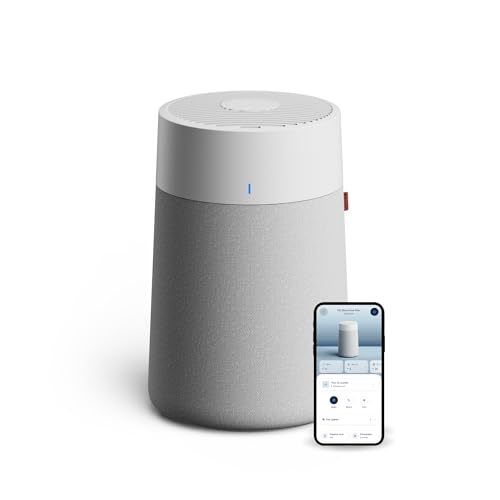
The bedroom is where indoor smoking is ultimately judged — it is the room that must smell like sleep — and the 511i Max is specified for exactly that courtroom. Blueair states a 19 dB night mode, quieter than a whisper’s reputation, with HEPASilent filtration, a 360° air intake that forgives placement against a wall or beside a bed, auto mode with WiFi app control, and coverage rated up to 1,138 square feet. For the partner who does not smoke, for the bedroom adjoining the smoking room, for the studio where the bed and the smoking chair share one airspace, this is the machine designed around the problem.
Strengths
- Stated 19 dB night mode — genuinely sleep-compatible running
- 360° intake suits tight bedroom placement
- Auto mode with WiFi control for a machine you interact with from bed
Trade-offs
- Odour capacity is bedroom-scale — it is a defender of one room, not a smoking-room workhorse
- HEPASilent is proprietary; buy on the maker’s stated basis
- Coverage ceiling is modest by design
| Coverage (manufacturer) | Up to 1,138 sq ft |
| Filtration | HEPASilent filtration |
| Noise (manufacturer) | 19 dB night mode |
| Controls | Auto mode, WiFi app |
| Intake | 360° air intake |
The 511i Max’s real argument is the closed bedroom door. Behind it, running all night at a volume below conversation’s floor, it holds the sleeping room to a standard the rest of the flat may not meet — and for many indoor-smoking households, that single defended room is the difference between an arrangement everyone can live with and a nightly negotiation. Buy it as the bedroom’s dedicated guardian, not as a whole-home answer, and it is superb at its post.
Best for: bedrooms, studios and light sleepers in indoor-smoking homes / Not suited for: serving as the sole machine in a dedicated smoking room. Check the current price on Amazon

LEVOIT Core 300-P — Best Budget
The Core 300-P is the indoor list’s value anchor: a compact cylinder with HEPA filtration, a quiet sleep mode, and coverage rated up to 1,073 square feet, at the entry tier of serious purifiers. Its indoor brief is precise — one room, defended properly. In the smoking room of a small flat, in the study where the household’s one smoker sits, or as the bedroom’s first line while a bigger decision is pending, it performs the full HEPA-plus-carbon job at a scale and price that ask little of the home around it.
Strengths
- Compact footprint fits flats, spare rooms and desk-side corners
- HEPA sleep mode for bedroom duty
- Standard, widely stocked replacement filter keeps running costs predictable
Trade-offs
- One-room machine — whole-flat expectations exceed its design
- Carbon capacity is the smallest here; heavy indoor use shortens its odour life
- No sensor-driven auto mode on this model
| Coverage (manufacturer) | Up to 1,073 sq ft |
| Filtration | 3-in-1 filter with HEPA, sleep mode |
| Form | Compact tower |
There is an honesty to the Core 300’s popularity indoors: most flats do not need a flagship, they need a machine that fits the room that matters and gets left running. Bought with its one-room brief understood — and paired with the door discipline this guide describes — it delivers the majority of the indoor benefit at a minority of the category’s cost, which is the definition of a budget pick that deserves the name.
Best for: single rooms, small flats and first indoor purchases / Not suited for: whole-home coverage or the heaviest indoor smoking. Check the current price on Amazon
WINIX A230 — Best With Air Quality Monitor
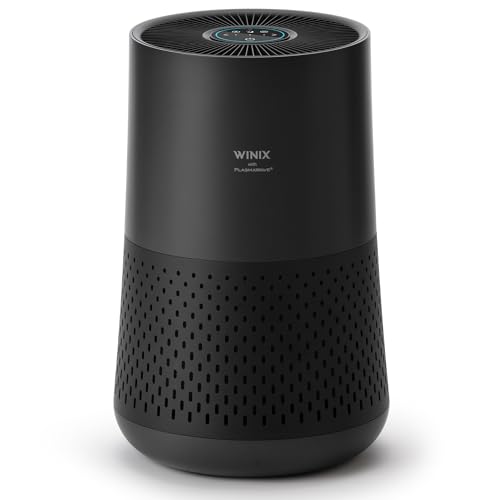
The A230 brings the Winix formula — true HEPA with a carbon filter and auto mode — down to bedroom scale, and adds the feature indoor buyers underrate until they own it: an air quality monitor that shows the room’s state. Rated up to 1,110 square feet in an hour, it suits the indoor rooms where evidence matters — the flat where a partner wants proof the arrangement works, the bedroom where a smoker wants to learn what the door, the window and the machine each contribute. Feedback turns indoor air management from folklore into adjustment.
Strengths
- Air quality monitor makes indoor performance visible
- True HEPA plus carbon in a bedroom-sized format
- Auto mode matches episodic indoor smoking
Trade-offs
- Carbon quantity is compact-class — heavy daily indoor use will cycle it faster
- Coverage is one-room-plus, not open-plan
- Display-forward design will not suit every bedroom aesthetic
| Coverage (manufacturer) | Up to 1,110 sq ft in 1 hr |
| Filtration | True HEPA, carbon filter |
| Controls | Air quality monitor, auto mode |
| Stated targets | Pet allergies, smoke, dust |
Choose the A230 when the household wants to see the system work — when the indoor arrangement is new, negotiated, or simply interesting to the person funding it. Its monitor teaches the two lessons every indoor smoker eventually learns: how much the closed door matters, and how completely the background smell is a carbon story. A machine that teaches its own correct use is worth a premium in a category full of silent boxes.
Best for: bedrooms and studies where visible feedback helps the household adapt / Not suited for: large living spaces or the heaviest indoor loads. Check the current price on Amazon

COWAY Airmega 100 — Best Compact With Full Features
Small indoor rooms usually force a choice between a toy and an overgrown tower; the Airmega 100 refuses it. In a compact body for rooms up to 810 square feet, Coway keeps the full feature set: HEPA and carbon filtration, an AQI monitor, auto mode, a timer, a filter indicator and a night light. For a studio flat, a small bedroom or a home office where someone smokes at the desk, it is the proportionate machine — full-grown behaviour at the scale the room actually is.
Strengths
- HEPA plus carbon with AQI monitor and auto mode in a compact body
- Filter indicator keeps an indoor machine’s schedule visible
- Night light and timer suit bedroom and studio life
Trade-offs
- 810-square-foot ceiling is firm — measure before buying
- Compact carbon quantity cycles faster under daily indoor smoking
- Less headroom to run quietly in a larger room
| Coverage (manufacturer) | Up to 810 sq ft |
| Filtration | HEPA and carbon filter |
| Controls | AQI monitor, auto mode, timer, filter indicator, night light |
The Airmega 100’s virtue is that it respects the room. Indoor machines fail socially when they dominate the space they protect — a tower in a studio becomes an obstacle, then an annoyance, then an unplugged ex-purifier in a cupboard. This one fits the shelf, the corner, the life — and a purifier that fits the life is the one still running in month six, which is the only performance metric that compounds.
Best for: studios, small bedrooms and home offices / Not suited for: larger rooms or open-plan spaces. Check the current price on Amazon

Medify MA-14 — Best for the Smallest Rooms
The MA-14 is the list’s specialist in miniature: HEPA filtration rated at 470 square feet per hour, from a maker whose larger machines anchor this programme’s heavy-duty guide, in a body sized for the rooms the rest of the list is too big for — the box room, the nursery-adjacent study, the caravan, the desk corner of a bedsit. Its brief is narrow and it fills it completely: real filtration, from a serious brand, at the scale of a single small room where someone smokes.
Strengths
- Genuine HEPA filtration at the smallest scale in this guide
- Serious-brand filter ecosystem behind a small machine
- Fits rooms and surfaces no other pick here can serve
Trade-offs
- 470-square-foot rating is a hard ceiling — it is a one-small-room device
- Carbon capacity is minimal; odour control is real but short-leashed
- No sensor automation at this size
| Coverage (manufacturer) | 470 sq ft per hour |
| Filtration | HEPA filter, removal to 0.3 microns (manufacturer) |
| Stated targets | Smoke, odours, pollen, pets |
Buy the MA-14 the way you would buy a reading lamp: for one defined pool of life. The smoker’s desk, the spare room that hosts a smoking guest, the small study behind a closed door — in those pools it is exactly right, and asking it to be more is the buyer’s error, not the machine’s. Small rooms concentrate smoke fastest, which is why a real filter at this scale earns a place in a guide that turns away most miniatures on principle.
Best for: the smallest indoor rooms and desk-side smoking spots / Not suited for: any room beyond its stated coverage, or whole-flat ambitions. Check the current price on Amazon
Comparison Table
| Pick | Badge | Key spec | Best for |
|---|---|---|---|
| COWAY Mighty AP-1512HH | Best Overall for Indoor Smokers | Up to 1,748 sq ft, AQI monitor, Auto & Eco | Main indoor rooms |
| BLUEAIR Blue Pure 511i Max | Best for Bedrooms | Up to 1,138 sq ft, 19 dB night mode, 360° intake | Sleeping rooms, studios |
| LEVOIT Core 300-P | Best Budget | Up to 1,073 sq ft, HEPA sleep mode | One-room defence |
| WINIX A230 | Best With Air Quality Monitor | Up to 1,110 sq ft/hr, AQI display, true HEPA + carbon | Feedback-driven households |
| COWAY Airmega 100 | Best Compact With Full Features | Up to 810 sq ft, HEPA + carbon, AQI monitor | Studios, small bedrooms |
| Medify MA-14 | Best for the Smallest Rooms | 470 sq ft/hr HEPA | Box rooms, desk corners |
Why Indoors Changes Everything: Concentration, Contact Time and Close Quarters
Three properties of indoor air explain why this guide’s picks differ from the outdoor-leaning lists. Concentration: a cigarette smoked in a closed room raises that room’s particle and gas levels far higher than the same cigarette on a porch, because the volume is small and the exits are shut — the machine’s job per hour is simply bigger. Contact time: indoor smoke does not blow away; it circulates until it deposits, which means it spends hours in contact with curtains, bedding, clothing and lungs, and the furnishings absorb a correspondingly larger share — the reservoir problem that dominates indoor odour is a contact-time problem. Close quarters: the machine shares the room with its critics. A purifier’s noise, size and light are trivial in a den and decisive in a bedroom at midnight, which is why this guide treats a stated night-mode figure as a headline specification rather than a footnote. Buy for these three properties — a complete filter stack for the concentration, continuous running for the contact time, and domestic tolerability for the close quarters — and the indoor problem becomes manageable. Buy ignoring any one of them and the machine joins the household’s stock of good intentions.
How to Choose an Air Filter for Indoor Smoking
Start with the room where smoking actually happens and measure it honestly; indoor rooms punish wishful sizing because there is no dilution to forgive it. Choose coverage so the room sits inside the machine’s range with room to run below full speed — the indoor machine’s working life is lived at low and medium, and a unit that must scream to serve a bedroom will be switched off in it. Next, the bedroom decision, which many households should make separately: if the smoking room and the sleeping room differ, consider defending the bedroom with its own quiet machine behind a closed door rather than asking one unit to cover both through a hallway. Then the carbon question, asked with indoor seriousness: in a sealed space the background smell is the carbon’s report card, so favour named carbon stages and standard filters you can replace without a hunt. Finally, the domestic audit — footprint, cord reach, filter-change access in a small home, and whether the machine’s light and display suit a sleeping room. Indoors, the best specification is the one the household can live beside.
How to Set Up an Indoor Smoking Room That a Purifier Can Actually Defend
The setup is a small system, and each part multiplies the others. Fix the smoking spot: one chair, one room, nearest the purifier and — where the building allows — nearest a window that can open without sharing air with a neighbour. Place the purifier a few feet from that spot, intake facing the room, outlet unblocked, and treat the position as permanent furniture. Manage the door as the room’s valve: closed during smoking and for a while after, because the machine defends a volume and an open door silently doubles it. Furnish for the wash: a throw over the smoking chair, cushions with removable covers, curtains that can be laundered — every washable surface is odour storage you can empty. Run the machine continuously at low or auto, surging during sessions; indoors, the between-hours are when the room’s baseline is won, as gases leave the fabrics into air the carbon is waiting for. And keep the ashtray lidded and emptied daily — in a sealed room, yesterday’s ashtray is a continuous emitter that no filter schedule can out-argue.
Maintenance indoors is monthly and brief: vacuum the pre-filter (sealed rooms concentrate the tar load on it), wipe the intake, and date the carbon. The indoor-specific failure is procrastination by proximity — the machine is so domestic, so much part of the room, that its filter becomes furniture too. The indicator lights on the Coway picks and the monitor on the Winix exist to interrupt exactly that drift; let them.
Apartments, Leases and Neighbours: The Indoor Politics
Indoor smoking in rented or attached housing sits inside other people’s rights, and the purifier’s role should be understood precisely. Many leases prohibit indoor smoking outright; no appliance converts a breach into compliance, and this guide does not pretend otherwise. Where smoking is permitted, the live issue is usually nuisance — smell travelling through gaps, vents and shared walls — and a contained smoking room with a running purifier is a real, demonstrable reduction in that travel, which matters when a neighbour complains or a landlord inspects. Residue is the second front: indoor smoke films walls and blinds faster than any other pattern, and while a purifier slows the accumulation meaningfully, the end-of-tenancy deep clean remains the smoker’s cost of doing business indoors. Households that treat the machine as one layer — alongside the fixed spot, the closed door, the washable furnishings — present the strongest possible version of indoor smoking to the people with a say in it. Households that treat it as a permission slip tend to meet the clause anyway.
Common Buying Mistakes
Buying a heavy-duty flagship for a bedroom. Capacity you cannot tolerate at midnight is capacity you do not own. Match the machine to the room’s life, not the load’s worst hour. Ignoring the night-mode figure. Indoors, the stated quiet profile predicts whether the machine runs at all — read it as a headline spec. Placing the machine in the hall. Indoor defence is room by room; the hallway is a corridor, not a destination for smoke or purifiers. Forgetting that sealed rooms concentrate everything. A small room needs a real filter sooner, not a token one — concentration is the argument for quality at small scale. Letting the ashtray live. An unemptied ashtray in a closed room out-emits the smoking it served. Expecting the purifier to negotiate the lease. It manages air, not agreements — read the clause, then equip the room.
Troubleshooting: Indoor Problems and Their Usual Causes
Problem: the bedroom smells by morning although the machine runs in the living room. Air does not turn corners or pass closed doors in useful volume. The bedroom needs its own quiet machine — that is the 511i Max’s entire brief. Problem: the room smells strongest near the smoking chair, hours later. The chair and its cushions are the reservoir. Wash what is washable, add a washable throw as a sacrificial layer, and let the machine run the after-hours. Problem: the machine is too loud to sleep beside at clearing speed. Run the surge before bedtime, then sleep mode overnight — and if the room still needs full speed to cope, the machine is undersized for the load, which is a sizing verdict to act on at the next purchase. Problem: a neighbour still notices. Audit the architecture — under-door gaps, shared vents, bathroom exhaust paths — because indoor odour travels by building as well as by air, and a door sweep can be worth a tier of purifier.
Winter Indoors: The Hardest Season for a Smoking Household
Every indoor system meets its examiner in winter. Windows close for months, heating systems stir and recirculate the home’s air, coats and soft furnishings multiply, and smoking that might have drifted to a porch in July happens entirely in the sealed volume. The purifier’s load peaks in the same weeks its allies — open windows, garden airing of cushions — are withdrawn. Households that cope treat autumn as preparation: a fresh carbon filter installed before the heating season rather than during it, the pre-filter serviced, washable throws rotated into the smoking room, and the bedroom machine — if the household has been deferring it — bought while the decision is still cheap. Winter is also when the furnace filter earns its mention in an indoor guide: a heating system running daily through a proper pleated filter is the whole home’s second line, quietly stripping the fine fraction from air the room machine never sees, and the companion guide in this programme covers that layer in full. The households that suffer through winter are rarely under-equipped in any dramatic way; they are the ones whose filters all came due in the same cold month, which is a scheduling failure dressed as a product failure.
Partners, Children and the Household Negotiation
Indoor smoking is rarely a solo arrangement, and the purifier sits inside a negotiation whether the household names it or not. The non-smoking partner’s experience is the arrangement’s true metric — they hold the unadapted nose, the bedroom standard, the verdict on whether the system works — and the purchases that succeed are the ones specified against that metric rather than the smoker’s tolerance. Children change the negotiation’s terms entirely: no filtration makes indoor smoke safe for children, and the honest household treats the purifier as exposure reduction for adults’ comfort while keeping children’s rooms and hours as smoke-free as the home allows — a boundary this guide states without qualification, because an appliance brochure is a poor place to outsource it. What the equipment can legitimately offer the negotiation is evidence and effort made visible: a monitor’s reading, a machine audibly on duty, a filter calendar kept. Households report, consistently, that the purifier’s largest effect is sometimes diplomatic — it is the purchase that demonstrates the smoking is being managed as a shared problem, in a shared home, rather than merely defended as a private habit.
Small Spaces, Storage and the Logistics of Filters in a Flat
Indoor machines live where storage does not, and the unglamorous logistics decide whether the maintenance in this guide actually happens. A spare filter needs a home — flat, dry, out of the way — and in a small flat that home must be chosen deliberately: the top of a wardrobe, the space under the bed, anywhere except the damp corner by the door where a carbon filter will spend its waiting life adsorbing the flat’s ambient odours before it is ever installed. Keep the spare sealed in its wrapping until the day it goes in, for the same reason. The old filter’s exit matters too: a tar-loaded filter is a concentrated smell object, and it should leave the home bagged, on the day it is changed, rather than perfuming a cupboard while it awaits a decision. Filter changes in small spaces also argue for the machines whose access is from the front and whose panels do not require the unit to be carried to a table — a detail invisible in specifications and decisive in a bedsit. None of this appears in any manufacturer’s headline, and all of it is the texture of owning a purifier in a small home for years rather than reviewing one for a week.
The Guest Room Problem: Occasional Indoor Smokers
A distinct indoor pattern deserves its own advice: the household that does not smoke, hosting the relative who does — or the home where smoking happens only at gatherings. The load is rare but concentrated, the machinery budget is understandably modest, and the goal is a room that recovers fully between visits rather than a system tuned for daily war. This is the natural territory of the compact picks here — the MA-14 for the spare room itself, the Core 300-P as the household’s movable-but-mostly-stationary defender — run hard during the visit with the door discipline of the main guide, and then left running for a day after the guest leaves, which is when the furnishings surrender the last of it. Hosts should know the honest limit: a smoking weekend will register in a small spare room for days without filtration, and roughly a day with it, and no purchase at any tier reduces that to zero by checkout time. What the machine buys is the difference between a guest room that smells like its last occupant and one that smells like a room — which, for the next guest and for the household’s own use of the space, is the whole purchase justified.
Energy and Noise: The Indoor Running Bill, Counted in Sleep
An indoor purifier’s running costs are paid in two currencies, and only one of them is money. The money is modest: a compact or mid-size machine at low and auto speeds draws little, and even a main-room unit running around the clock costs, across a month, a small fraction of the filter it will eventually need. The second currency is attention — the low sound, the small light, the presence in the room — and indoors it is the currency that decides whether the machine runs at all. This is why the guide weights stated night modes and auto behaviour so heavily for indoor picks: a machine that can hold a bedroom at a whisper, brighten its effort only when the air demands, and dim its own display is a machine whose running bill, in the currency that matters, is near zero. When comparing two indoor candidates that tie on filtration, choose the one that will still be switched on in February — the quieter, the more automatic, the less demanding of the room’s patience — because in the indoor category, tolerability is not the soft criterion. It is the performance criterion, measured over the only timescale that counts: every night, for years.
Smoke and Sleep: What the Night Hours Are Worth
The strongest argument in the indoor case is arithmetic about time. A household member spends more continuous hours breathing the bedroom’s air than any other air in their life, and those hours come with the slowest, deepest breathing of the day. Whatever the rest of the home’s arrangement, the sleeping room is where filtration’s benefit concentrates — which is why this guide keeps returning to the defended bedroom as the indoor system’s crown: a closed door, a quiet machine, a carbon stage in date. It is also why the bedroom machine should be bought to a stricter standard than its size suggests. A living-room purifier that disappoints costs an evening’s freshness; a bedroom machine that is too loud, too bright or too weak costs the night, every night, and is unplugged by the end of the first week with a finality few appliances recover from. Buy the bedroom machine for the sleeper’s verdict — the stated night mode, the dimmable display, the auto behaviour that never asks to be managed at midnight — and let the rest of the flat be served by whatever capacity remains. In indoor air, as in most domestic engineering, protecting the longest exposure first is simply correct prioritisation.
When the Indoor Smoker Is Also a Pet Owner, a Cook or a Candle Person
Few indoor rooms carry only one load, and the overlaps mostly argue for the same machine bought slightly larger. A cat in a small flat adds dander and a litter note to the smoke’s account — the stack that handles smoke handles both, with the pre-filter’s cleaning interval shortened by hair. A keen cook in a studio adds daily aerosolised oil, which loads filters with the same sticky enthusiasm as tar and rewards the washable-pre-filter habit. Candles and incense are smoke in miniature — fine particles, fragrance gases — and a household that burns them nightly is, for filtration purposes, a light smoking household whether or not anyone smokes. The buying conclusion is consistent: in a sealed indoor space, loads add, and headroom is the hedge against addition. The household that buys exactly to its cigarette count and then acquires a cat has underbought by precisely one animal — a sentence that sounds like a joke and functions, in this category, as sizing advice.
Final Recommendation
For a main indoor room, buy the COWAY Mighty today and let its capable sensor run the room through every single episode without asking anyone’s permission or attention. Defend the bedroom separately with the BLUEAIR 511i Max if sleep is the battleground, take the Levoit Core 300-P for a single room on a budget, the Winix A230 where feedback will help the household adapt, the Airmega 100 for a studio’s full-featured compact, and the Medify MA-14 for the smallest rooms. Indoors, the system around the machine — spot, door, washables, schedule — is worth as much as the machine; buy both. Companion guides: Best Air Cleaner For Smokers, Best Air Filter For Smokers, Best Aie Filtet For Home Smokers and Best Air Filter For Heavy Smokers.
Frequently Asked Questions
Can a purifier make indoor smoking unnoticeable to visitors?
Substantially less noticeable, yes — with the full system working together: a right-sized machine at the smoking spot, a closed door, washable furnishings kept in rotation, and continuous running that keeps the background level falling between visits instead of recovering only during them. Instantly undetectable during a session in the same room is beyond any domestic machine, and products promising it should be read as fiction.
What size purifier does a bedroom need in a smoking household?
One rated comfortably above the room’s area at full speed, so its sleep-speed running still exchanges the air meaningfully through the night — the picks here state their coverage and their quiet figures together for exactly that calculation. When in doubt, defend the bedroom with a dedicated quiet machine rather than borrowing the living room’s, because borrowed protection tends to be returned by the first evening the living room wants its machine back.
Is it better to smoke near the purifier or near a window?
Both, when the layout and the season allow: the window exports what it can, the purifier captures the rest at the source, and together they clear a room faster than either manages alone. If forced to choose indoors in winter, the purifier’s position matters more, because a closed room gives the machine repeated passes at air a shut window simply stores.
How do I stop smoke smell travelling to other rooms in a flat?
Contain at the source — closed door during and after smoking, machine in the smoking room rather than in the corridor outside it — and check the building’s own paths: under-door gaps and shared vents move more smell than most households expect, and a simple door sweep can close the largest of them for the price of a coffee. A second small machine in the room you most want to protect is the reliable backstop.
Will a purifier protect my deposit as a renting indoor smoker?
It reduces the airborne load that becomes residue, and run continuously it slows film and odour build-up across the home — a genuine help, and one a landlord can verify simply by walking into a flat that has run one for a year beside a smoker and comparing it with the alternative. It does not eliminate the need for a thorough clean at move-out, and it does not override a lease that prohibits smoking. Treat it as mitigation with a real effect, not insurance.
Can I use one purifier for the whole flat by moving it around?
You can try, and most households stop within a month: the machine is always in the previous room when the smoking starts, and a purifier being carried is a purifier filtering nothing. Fixed positions win — one machine at the source, and if the budget stretches, a second quiet one in the bedroom. A moved purifier is a part-time purifier, and indoor smoke is a full-time load. The one exception is the genuinely occasional pattern — a smoking guest twice a year — where a compact machine deployed for the visit and stored afterwards is a rational, proportionate answer.


