Disclosure: airfryerkitchensupply.com is reader-supported. When you buy through links on our site, we may earn an affiliate commission at no extra cost to you.
Where to buy
All six machines below are current models sold on Amazon by their brands or authorised sellers, verified against Amazon’s own catalogue data before this guide was published. Start with the WINIX 5510 if you want one machine that takes both problems seriously, or the LEVOIT Core 600S-P for a large shared living space. The rest of the shortlist: the COWAY Mighty AP-1512HH, the LEVOIT Vital 100S-P, the BLUEAIR Blue 211i Max and the Shark NeverChange HP152. Check the current price on Amazon for each, and check the replacement filter price in the same visit — in a house with pets and a smoker, filters are where the real money goes.
Introduction
The best air cleaner for house pets and smokers has a harder job than any other purifier in the home, because it is fighting two different wars in the same room. Pets contribute hair, dander and their own unmistakable background note; smokers contribute fine particulate and odour gases that settle into every fabric in the house. The best air cleaner for house pets and smokers has to win both wars at once: catch the coarse hair before it chokes the fine filter, capture the microscopic dander and smoke particles in a HEPA stage, and adsorb the smell in enough activated carbon to matter. Most purifiers are built to win one of those wars. A machine specified for allergies alone will drown in pet hair and ignore smoke odour; a machine built for odour alone will let dander sail through. This guide is only interested in the overlap — purifiers whose manufacturers explicitly rate them for pet hair, dander, smoke and odour together, verified against their own published listings.
There is also a loading problem unique to this household type. Pet hair and smoke tar are both sticky, high-volume pollutants: they coat a pre-filter faster than ordinary dust, and a coated pre-filter strangles airflow, which quietly turns a strong purifier into a weak one over a few weeks. That is why this guide pays unusual attention to pre-filters — washable ones especially — and to filter access. In a pets-and-smokers house, maintenance is not a footnote to performance; maintenance is performance. The picks below were chosen for the combination of filtration breadth, room coverage, odour capacity and maintainability, and the guide explains how to run them so the combination survives contact with a real household: a shedding dog, a smoker, and a sofa that hosts both.
In this guide
Quick Picks
- WINIX 5510 — Best Overall for Pets and Smoke. True HEPA plus a high-deodorisation carbon filter, auto mode and app support, rated up to 1,881 square feet in an hour. Check the current price on Amazon
- LEVOIT Core 600S-P — Best for Large Shared Rooms. The big-room Levoit: coverage up to 2,933 square feet, smart control, and a dedicated smoke-remover replacement filter in its ecosystem. Check the current price on Amazon
- COWAY Mighty AP-1512HH — Best Sensor-Driven Pick. Air quality monitor with auto and eco modes, HEPA filtration rated up to 1,748 square feet — it reacts so you do not have to. Check the current price on Amazon
- LEVOIT Vital 100S-P — Best Washable Pre-Filter for Pet Hair. A washable pre-filter in front of HEPA filtration, with a smart monitor, rated up to 1,073 square feet. Check the current price on Amazon
- BLUEAIR Blue 211i Max — Best for Big Open Spaces. HEPASilent filtration rated up to 3,235 square feet with a 23 dB quiet profile and WiFi auto mode. Check the current price on Amazon
- Shark NeverChange HP152 — Best for Odour Neutralising. A HEPA-exceeding filter with a built-in odour neutraliser, aimed squarely at pet dander, dust and smoke smells. Check the current price on Amazon
How These Picks Were Chosen
Four filters, applied in order. First, the manufacturer’s own listing had to claim the full pollutant set — pet hair or dander, smoke and odour — because a purifier only performs against what its filter stack was designed to catch, and we verify picks against the makers’ stated specifications rather than retailer enthusiasm. Second, a real HEPA-grade particle stage was non-negotiable: dander and smoke particles are both fine particulate, and that is HEPA’s home ground. Third, the carbon story had to be more than a scented sheet — a named deodorisation filter, a smoke-specific replacement filter, or an odour-neutralising system — because pet-plus-smoker odour is the complaint that survives weak carbon. Fourth, maintainability in a high-loading household: washable or easily vacuumed pre-filters scored heavily, as did filter indicators and standard replacement parts.
Excluded: purifiers marketed for pets alone with no smoke or odour claim, smoke machines with no pet-hair provision, desktop units that cannot turn over a room’s air, and anything that cleans by generating ozone — an irritant no pet or person should be breathing in a closed home. What remains are six machines that divide the territory by room size, odour intensity and maintenance style, which is how a household should choose between them.
The 6 Best Air Cleaners for House Pets and Smokers

WINIX 5510 — Best Overall for Pets and Smoke
The Winix 5510 takes the overall badge because its filter stack reads like it was specified by someone who lives in this exact household. True HEPA handles the fine work — dander, smoke particles, dust — while the high-deodorisation carbon filter behind it handles the gases: cigarette smell, pet odour, the stale background note that greets you at the door. Auto mode lets the machine respond to events (a lit cigarette, a dog shaking off the rain) without a human project manager, app support covers the households that like to check in from the sofa, and the rated coverage — up to 1,881 square feet in an hour — is honest big-room territory.
Strengths
- High-deodorisation carbon filter — the strongest odour tool in this guide for smoke
- True HEPA for dander and smoke particles in the same stack
- Auto mode plus app support suits a busy, forgetful household
Trade-offs
- Carbon in a smoking home is a consumable with a real replacement rhythm — budget for it
- Pre-filter discipline still matters; heavy shedders should vacuum it often
- Utilitarian styling — it looks like an appliance, because it is one
| Coverage (manufacturer) | Up to 1,881 sq ft in 1 hr |
| Filtration | True HEPA + high-deodorisation carbon filter |
| Controls | Auto mode, app support |
| Stated targets | Pet allergies, smoke |
In practice, the 5510 is the machine for the main living space of a pets-and-smokers home: the room where the dog sleeps, the human smokes, and guests are expected to sit down without performing a subtle sniff. Run on auto continuously, it handles the daily rhythm — bursts when events happen, a quiet strip of background odour the rest of the time. Its lineage matters too: it is the current generation of a line long recommended for exactly this double duty, with the filter supply chain to match.
Best for: the main living space in a home with both pets and a smoker / Not suited for: buyers who will not keep up a carbon replacement schedule. Check the current price on Amazon

LEVOIT Core 600S-P — Best for Large Shared Rooms
When the pets-and-smokers problem lives in a big room — an open living area, a family room that doubles as the dog’s bedroom and the smoker’s evening chair — the Core 600S-P is the Levoit built for it. The manufacturer rates coverage up to 2,933 square feet, wraps it in smart control by app and voice assistant, and — the detail that earns it this slot — supports a dedicated smoke-remover replacement filter in its own ecosystem, a 4-in-1 filter with high-efficiency activated carbon made specifically for smoke and odours. That option lets a smoking household upgrade the machine’s odour game at filter-change time rather than replacing the machine.
Strengths
- Largest Levoit coverage here — rated up to 2,933 square feet
- Dedicated smoke-remover replacement filter available in the brand’s own range
- Smart control with air quality feedback for set-and-forget running
Trade-offs
- Big-room figures are full-speed maximums; continuous quiet running covers less
- The smoke-remover filter is a separate purchase decision at replacement time
- Physically the largest footprint among the Levoit picks here
| Coverage (manufacturer) | Up to 2,933 sq ft |
| Filtration | 3-in-1 filter for smoke, pet odour, dust; smoke-remover filter option |
| Controls | Smart app and voice control, sleep mode |
The 600S-P’s real argument is headroom. Pets-and-smoke is a high-load application, and a machine running at half its capacity in your room lasts longer between filter changes, runs quieter for the same cleaning, and has something in reserve for the bad days — a wet dog, a poker night, a burnt dinner layered on top. Households that buy exactly to their room size in this category end up running at full speed and wondering why it is loud; households that buy headroom get the quiet, durable version of the same machine.
Best for: large living rooms and open shared spaces with pets and smoking / Not suited for: small bedrooms, where its capacity is wasted. Check the current price on Amazon

COWAY Mighty AP-1512HH — Best Sensor-Driven Pick
The Mighty’s talent is judgement. Its air quality monitor watches the room and its auto and eco modes act on what they see, which in a pets-and-smokers home means the machine responds to the actual events of the day: the cigarette, the dog coming in from the garden, the litter tray, the cooking. HEPA filtration rated up to 1,748 square feet covers the particle side — smoke, dander, dust — and a timer plus filter indicator handle the household scheduling that this high-load category demands. It is the pick for households that know, honestly, that nobody will remember to adjust a purifier manually.
Strengths
- Air quality monitor with auto and eco modes — reacts to smoke and pet events itself
- HEPA filtration for smoke, allergens, pet dander and odour
- Filter indicator keeps the faster replacement cycle of this household type visible
Trade-offs
- Carbon capacity is balanced rather than odour-specialist — the Winix is stronger on smell alone
- No app control on this model
- Sensor-driven behaviour rewards good placement; hide it and it cannot see the room
| Coverage (manufacturer) | Up to 1,748 sq ft |
| Filtration | HEPA filter for smoke, allergies, pet dander, odour |
| Controls | Air quality monitor, Auto & Eco mode, timer, filter indicator |
There is a behavioural truth in air purification: the best machine is the one that is running correctly at 11 p.m. on a ordinary Tuesday. The Mighty is engineered around that truth. Put it in the main room with a clear view of the air, leave it on auto, and its contribution compounds quietly — which, in a house where the pollutants arrive on a schedule set by a dog and a smoker rather than by you, is worth more than a specification-sheet victory.
Best for: households that want the machine to manage itself / Not suited for: buyers who prioritise maximum carbon mass above automation. Check the current price on Amazon
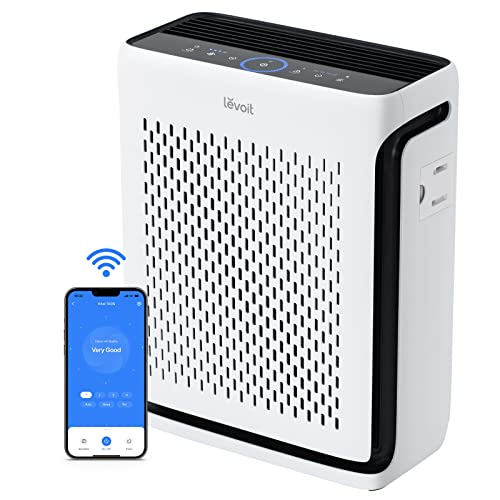
LEVOIT Vital 100S-P — Best Washable Pre-Filter for Pet Hair
Ask owners in pets-and-smokers homes what actually kills purifier performance and the answer is rarely the HEPA — it is the pre-filter, matted with hair and tar until the fan is sucking through a blanket. The Vital 100S-P is built around that failure: its pre-filter is washable, so the hair layer can be rinsed away monthly instead of slowly strangling the machine, and behind it sits HEPA filtration with a quiet sleep mode, a smart monitor, and coverage rated up to 1,073 square feet. For a heavy-shedding household, that washable layer is not a convenience feature. It is the difference between a purifier that performs in month six and one that performed in week one.
Strengths
- Washable pre-filter — the single most valuable maintenance feature for pet hair
- HEPA sleep mode for bedroom duty in a pet household
- Smart monitor with coverage up to 1,073 square feet
Trade-offs
- Mid-size coverage — it is a one-room machine, not a whole-home answer
- Carbon stage is generalist; severe smoke odour wants the Winix or the 600S smoke filter
- Washable only helps if you wash it — the discipline is still yours
| Coverage (manufacturer) | Up to 1,073 sq ft |
| Filtration | Washable pre-filter + HEPA filtration |
| Controls | Smart monitor, HEPA sleep mode |
| Stated targets | Pets, allergens, pollen, smoke |
Place the Vital 100S where the pet actually lives — beside the dog bed, in the room with the cat tree — and it becomes a hair interception system that also cleans air. It is also the natural bedroom pick for pet owners whose animals sleep in the room: quiet mode, real filtration, and a pre-filter that survives the nightly shedding. In the economics of this category, a mid-price machine with a maintainable front end beats a premium machine with a clogged one every single month.
Best for: heavy-shedding pets and owners who will actually wash a pre-filter / Not suited for: large open-plan spaces or the heaviest smoke odour loads. Check the current price on Amazon

BLUEAIR Blue 211i Max — Best for Big Open Spaces
Some pets-and-smokers homes are not rooms but volumes: open-plan floors where the kitchen, dog and smoking chair share one large airspace. The Blue 211i Max is the machine in this guide rated for that scale — up to 3,235 square feet by the manufacturer’s figures — using Blueair’s HEPASilent filtration, with WiFi auto mode, a fabric pre-filter that catches the coarse load, and a stated quiet profile of 23 dB that matters when the machine shares an open space with a television and a conversation. It is also the presentable pick: in a room that is always on show, its design does not apologise.
Strengths
- Largest stated coverage in this guide — built for open-plan volumes
- Low stated noise profile for a machine of its capacity
- Pre-filter catches pet hair before the main filter, and WiFi auto mode suits distant placement
Trade-offs
- HEPASilent is a proprietary system — buy it on the maker’s terms and test data
- Odour work depends on filter configuration; particle performance leads the pitch
- Premium tier positioning within this list
| Coverage (manufacturer) | Up to 3,235 sq ft |
| Filtration | HEPASilent filtration, pre-filter |
| Noise (manufacturer) | 23 dB quiet profile |
| Controls | WiFi, auto mode |
| Stated targets | Pet hair, allergens, dust, smoke |
The 211i Max earns its badge on a simple principle: in a big shared airspace, air changes per hour are the whole game, and this machine is rated to move big-space air at a noise level a household will tolerate all evening. Pair it with the discipline this guide repeats — pre-filter kept clean, machine left on auto — and an open-plan pets-and-smokers home stops smelling like its two hobbies and starts smelling like a home that happens to have them.
Best for: open-plan and large-format homes / Not suited for: small rooms, or buyers who want a conventional true-HEPA specification as the headline. Check the current price on Amazon

Shark NeverChange HP152 — Best for Odour Neutralising
Shark approaches the pets-and-smokers problem from the smell backwards. The NeverChange HP152 pairs a filter the maker describes as HEPA-exceeding with a dedicated odour neutraliser — a system aimed at the gases from pet dander, dust and smoke rather than only the particles — in a large-room format. Its pitch to this household is longevity and odour: a machine designed so the filter story does not dominate your calendar, in a home where two odour sources run daily and the background smell is the complaint that outlasts every party.
Strengths
- Dedicated odour-neutraliser system alongside high-grade particle filtration
- Aimed explicitly at pollutants, pet dander, dust and smoke
- Large-room format from a mainstream brand with retail support
Trade-offs
- “HEPA-exceeding” is the maker’s own framing — compare on stated performance, not labels
- Odour-neutraliser consumables are part of its running story; check the schedule
- Newer line than the Coway or Winix — a shorter owner track record in this exact duty
| Filtration | HEPA-exceeding filter with odour neutraliser (manufacturer description) |
| Stated targets | Pollutants, pet dander, dust, smoke |
| Format | Large-room home purifier |
Choose the Shark when the household’s verdict is that the air looks clean enough but never smells clean — when the dog is bathed, the smoking is moderate, and still the hallway carries a note. That is a gas-phase problem, and a machine built with odour neutralising as a headline rather than a footnote is the rational answer. It will not out-filter the Winix on deodorisation carbon mass, but as an integrated, low-fuss odour system for a pet home, it holds a place none of the others quite occupies.
Best for: homes where lingering pet-and-smoke smell is the primary complaint / Not suited for: buyers who prefer the longest-established models in this duty. Check the current price on Amazon
Comparison Table
| Pick | Badge | Key spec | Best for |
|---|---|---|---|
| WINIX 5510 | Best Overall for Pets and Smoke | True HEPA + high-deodorisation carbon, up to 1,881 sq ft/hr | Main living space, both problems |
| LEVOIT Core 600S-P | Best for Large Shared Rooms | Up to 2,933 sq ft, smoke-remover filter option | Big family rooms |
| COWAY Mighty AP-1512HH | Best Sensor-Driven | Up to 1,748 sq ft, AQI monitor, Auto & Eco | Set-and-forget households |
| LEVOIT Vital 100S-P | Best Washable Pre-Filter | Up to 1,073 sq ft, washable pre-filter | Heavy shedders, pet bedrooms |
| BLUEAIR Blue 211i Max | Best for Big Open Spaces | Up to 3,235 sq ft, 23 dB profile | Open-plan volumes |
| Shark NeverChange HP152 | Best for Odour Neutralising | HEPA-exceeding filter + odour neutraliser | Smell-first complaints |
Two Pollutants, One Machine: How the Filter Stack Divides the Work
It is worth understanding the division of labour inside these machines, because it explains every maintenance instruction in this guide. The pre-filter is the bouncer: it stops hair, large dust and the coarse, tarry fraction of smoke before they reach the expensive media. In a pet home it loads in weeks, not months, and when it mats over, airflow falls and every downstream stage underperforms — which is why washable pre-filters, like the Vital 100S-P’s, and easily vacuumed ones are worth real money in this category. The HEPA stage is the fine worker: dander particles and smoke particulate are both small, and HEPA media captures them mechanically as air passes. It does not wear out so much as fill up, gradually raising resistance until the machine’s indicator calls time. The carbon stage is the diplomat: it adsorbs the gases — smoke smell, pet odour, household chemicals — that the other stages cannot touch, and its capacity is finite in proportion to its mass. When the smell stops improving, the carbon, not the HEPA, is what has retired.
The practical order of operations for an owner follows the stack: maintain the pre-filter monthly, watch the indicator for the main filter, and judge the carbon by your nose rather than the calendar. Households that internalise that sequence get flagship performance out of mid-tier machines; households that treat the purifier as fit-and-forget get week-one performance followed by a long, quiet decline they blame on the brand.
How to Choose an Air Cleaner for a Home With Pets and a Smoker
Begin by identifying which pollutant runs your house. If visitors notice the dog first, weight pre-filter design and particle coverage; if they notice the smoking first, weight carbon mass; if they notice both — the common case — start with the Winix pattern, a balanced stack with a named deodorisation filter, and size it for the main room with headroom. Next, measure the room honestly and compare it with manufacturer coverage as a maximum at full speed: a machine that must scream to serve your room will be switched down and then off, so buy the size that cleans at a conversational volume. Third, decide the maintenance contract you will actually keep. A washable pre-filter only pays if someone washes it; a filter indicator only pays if someone reads it; an app only pays if someone opens it. Match the machine to the household’s real habits, not its aspirational ones — the Coway’s automation exists precisely for households whose honest answer is “nobody will touch it.”
Finally, consider the two-machine pattern before dismissing it as extravagance. In many pets-and-smokers homes, the winning layout is one strong machine in the main living space and one quiet, maintainable machine in the bedroom — the Vital 100S-P pattern — rather than a single flagship straining to serve both through doorways. Air does not turn corners well, and two right-sized machines routinely outperform one oversized one at a similar total outlay, with the side benefit that the bedroom — where the household spends a third of its life breathing — gets dedicated, door-closed protection.
How to Set Up and Maintain a Purifier in a Pet-and-Smoker Home
Placement is a negotiation between the two pollutants. Put the main machine in the room where both live — usually the living room — with its intake facing the room’s traffic, clear of curtains and furniture, and not in the dead corner behind the sofa where the dog hair collects undisturbed. If smoking happens in a particular chair, the machine belongs in that chair’s air path, a few feet away, not across the room. Run it continuously on auto or a medium speed; the pet load is continuous (dander does not clock off) and the smoke load is episodic, so a sensor-driven machine earns its keep by surging for the episodes and idling through the rest.
The maintenance calendar for this household type is monthly, not quarterly. Vacuum the pre-filter monthly at minimum — wash it if the design allows — and wipe the machine’s intake grille, which in a pet home grows its own felt. Groom the pet as part of air care, because hair brushed out in the garden is hair the pre-filter never meets, and wash pet bedding on the same rotation as the pre-filter: bedding is the household’s second-largest dander reservoir after the animal itself. Date the main filter at installation, keep a spare if the smoker is a daily one, and treat a returning background smell as a carbon diagnosis before anything else. None of this exceeds a few minutes a month; all of it is the difference between the performance in these reviews and the performance in a neglected installation.
Allergies, Asthma and the Limits of Comfort Claims
Many pets-and-smokers households are also allergy households, so the boundary deserves stating plainly. A purifier in this guide reduces airborne dander, dust and smoke particulate in the room it serves, and many owners experience that as real comfort — easier mornings, a bedroom that feels fresher. That is a comfort and cleanliness claim, and it is as far as an honest guide goes. These machines are not medical devices, they do not treat asthma or allergies, and a household managing a diagnosed condition should treat the purifier as one environmental measure among several agreed with their clinician — alongside source control, bedding hygiene and, where smoking is concerned, the honest recognition that no filter makes indoor smoke harmless for the asthmatic in the next room. Buy the machine for cleaner air. Let medicine be medicine.
Common Buying Mistakes
Buying a pet-only purifier for a smoking home. Pet marketing often means a pre-filter and a hope; smoke odour needs real carbon, which pet-only models skimp. Buying a smoke machine that ignores hair. Without a maintainable pre-filter, pet hair strangles it within weeks. Sizing to the headline number. Coverage figures are full-speed maximums; buy headroom or live with noise. Hiding the purifier. Behind furniture it filters the back of the sofa beautifully and the room barely at all. Forgetting the pet in the maintenance plan. Unwashed bedding and an ungroomed dog will defeat any filter stack eventually. Expecting one machine to serve a whole house through doorways. Air does not turn corners; zone your machines like you zone your heating.
Pet-Specific Air Tactics: Dogs, Cats and the Litter Tray
Different animals load the air differently, and a household that tunes for its actual animal gets more from the same machine. Dogs are primarily a hair-and-dander source with an outdoor habit: they import pollen, dust and wet-dog volatiles on a schedule set by walks, so the purifier’s hardest moments are arrivals. A machine on auto near the living area handles those surges; a mat and a towel by the door — and the discipline to use them — remove a surprising fraction of the load before the filter ever sees it. Cats are a dander-and-litter source: feline dander is fine and persistent, and the litter tray is a concentrated odour point that no room purifier should be asked to fight alone. Site the tray in a ventilated spot away from the purifier’s intake (a purifier beside the tray spends its carbon on litter gas and has none left for smoke), use a litter with genuine odour control, and let the room machine handle the diluted remainder — that division of labour is exactly what carbon filters are sized for.
Small animals and birds deserve a specific note, because their respiratory systems are more sensitive than ours. Keep purifiers in filtration-only form around them — the machines in this guide qualify — and never use ozone-generating or heavily fragrancing devices in a home with birds or small mammals. Fish tanks contribute humidity rather than particles; if a room’s air feels damp as well as loaded, that is a ventilation and humidity question, and a purifier, however good, is not a dehumidifier. The general rule stands across species: the machine handles the airborne fraction, the household handles the sources, and the combination is what visitors notice.
Seasonal Loads: Shedding Season, Closed Windows and Winter
The pets-and-smokers load is not constant across the year, and the households that cope best adjust twice annually rather than buying twice. Spring and autumn shedding seasons double the pre-filter’s workload for several weeks: move its cleaning from monthly to fortnightly for the duration, and expect the main filter’s indicator to advance faster in a shedding year with a double-coated dog. Summer, where climate allows, is the purifier’s holiday — open windows provide air changes no machine can match, and the wise household uses the season to deep-clean the machine, wash furnishings, and replace a carbon filter so the closed-window season starts fresh. Winter is the stress test: windows shut, heating stirring dust, smoking more likely to drift indoors, and the dog spending more hours inside. That is when headroom — the oversized machine bought in spring and mocked as excessive — quietly justifies itself, running at a civilised speed while a right-sized machine would be at full, audible tilt.
There is a heating-system interaction worth knowing: forced-air heating and cooling circulate the whole house’s air through the home, which distributes both dander and smoke beyond the room of origin. A room purifier still wins locally — it cleans its room repeatedly, faster than the ducts dilute it — but households with central air should also keep the system’s own filter fresh, because it is the silent partner in every room the purifier does not reach. The dedicated guide to furnace filters for smoking homes in this programme covers that partner in detail; the short version is that the two filters are complements, not substitutes.
Troubleshooting: When the House Still Smells Like Its Inhabitants
Problem: the purifier runs constantly but guests still detect the dog first. Check the pre-filter before anything else — in a shedding household it is the usual culprit — then the pet’s bedding, which is a dander reservoir no air machine can outrun unwashed. Problem: smoke smell survives a fresh HEPA filter. HEPA was never the odour tool; the carbon stage is saturated or undersized for the load. Replace the carbon, and if the problem returns quickly, step up to a deodorisation-grade filter or machine rather than replacing like with like forever. Problem: the machine’s sensor reacts to the dog but not to smoke, or the reverse. Sensors sample local air; the machine is probably placed where one pollutant’s plume reaches it and the other’s does not. Move it into the shared air path of the room — centrally, at breathing height’s airflow, not in a corner — and reassess. Problem: filter costs are mounting. Audit the pre-filter discipline first (a clean pre-filter extends every downstream stage), confirm you are buying the manufacturer’s standard filter rather than a premium variant you do not need, and check whether a washable-pre-filter model would cut your consumable bill at the next machine change.
What Ownership Actually Looks Like in Year Two
Most purifier reviews are written in week one, but a pets-and-smokers household lives in year two, and it is worth describing honestly. By year two, the household has a rhythm: the pre-filter gets its monthly vacuum without discussion, the dog’s bedding rotates through the wash, and the machine’s sound has become part of the house’s background, noticed only when it stops. The filter indicator has been answered on time at least once, and the household has learned its own carbon interval — the number of months before the hallway smell begins its slow return — which no manual could have told them, because it depends on their dog, their smoker and their rooms. The machine that survives to year two with its performance intact is never the one with the best week-one specifications; it is the one whose maintenance the household could actually sustain, whose filters were findable when needed, and whose noise never gave anyone a reason to switch it off during a film. That is the standard this guide applied when choosing, and it is why maintainability and automation are weighted here as heavily as filtration itself.
Year two is also when the honest limits show. The sofa that predates the purifier still carries its history in the cushions. The spare room, unpurified, still smells like the house used to. And the smoker’s own clothes remain their own microclimate. None of that indicts the machine; it defines the territory a single appliance can govern. Households that understand the territory expand the system — a second machine, a furnishing refresh — rather than replacing a working purifier in search of a miracle that was never on sale.
Renting With Pets and a Smoker: The Deposit Question
A significant number of households in this category are renting, and for them the purifier carries a financial argument alongside the comfort one. Pet dander and smoke residue are among the most common reasons landlords retain deposit money for professional cleaning, and both accumulate in proportion to how long the airborne load is allowed to settle into paint, carpets and curtains. A purifier running continuously does not make a rented home residue-proof — the end-of-tenancy clean still matters, and walls near a habitual smoking spot will still want washing — but it measurably slows the accumulation everywhere else, and it does so as an appliance the tenant owns and takes to the next home. For a renter, the buying calculus in this guide shifts slightly: portability and footprint matter more (the Vital 100S-P and the Coway Mighty travel between homes gracefully), landlord permission is not required for a plug-in appliance, and the filter discipline that protects the machine also protects the deposit. It is one of the few home purchases that can plausibly pay for itself at a move-out inspection.
A Short Field Test You Can Run in the First Week
New owners understandably want to know whether the machine is working, and there is a simple, honest way to find out that does not require instruments. On day one, before the machine has run, stand in the main room in the morning and note the background smell — every household has one, and it is the baseline. Run the purifier continuously for a week on auto, with the pre-filter discipline and door habits this guide describes, and repeat the morning check at the same hour. In a pets-and-smokers home the difference is not subtle when the machine is right: the stale top note goes first, then the dog’s presence stops announcing itself from the doorway, and what remains is the smell of the room itself. If a week of continuous, correctly placed running produces no change, work the troubleshooting list above — placement, pre-filter, carbon — before concluding the machine is at fault, because in this category the installation, not the appliance, is the usual suspect.
Final Recommendation
Start with the WINIX 5510 in the main room — it is the most complete answer to the double problem, and the machine against which the rest of this list should be judged if your household has both a pet and a smoker under one roof and wants one purchase to address both honestly. Choose the LEVOIT Core 600S-P for a large shared space, especially if you will use its smoke-remover filter option, the COWAY Mighty if the household runs on autopilot, the Vital 100S-P where shedding is heavy or a pet shares the bedroom, the Blueair 211i Max for open-plan volume, and the Shark NeverChange when smell is the whole complaint. Related guides in this programme: Best Air Cleaner For Smokers, Best Air Filter For Smokers, Best Aie Filtet For Home Smokers and Best Air Filter For Indoor Smokers.
Frequently Asked Questions
Can one purifier really handle both pet dander and cigarette smoke?
Yes, if its filter stack was designed for both: a maintainable pre-filter for hair, HEPA for dander and smoke particles, and substantial carbon for odour. That combination — not any single feature — is what every pick in this guide was chosen for. A machine missing any one of the three will handle part of the household’s problem well and leave the rest untouched, which is why so many owners conclude that purifiers are overrated when the truth is that their purifier was only ever specified for half of their home.
How often should I clean the pre-filter in a home with pets?
Monthly at minimum, and more often with a heavy shedder or a dog that sleeps beside the machine. A matted pre-filter is the most common cause of a purifier “stopping working,” and it is the cheapest one to fix.
Will a purifier remove the smell of a dog and cigarettes together?
It will reduce both substantially if the carbon stage is real and fresh, and if the machine is placed where the two odour sources actually mix with the household’s air rather than in a hallway that neither the dog nor the smoker ever visits. Mixed odours are a gas-load problem: keep the carbon in date, wash pet bedding and soft furnishings on a rotation, and the background note that defines the house will fade over one to two weeks of continuous running.
Where should the purifier go if the pet and the smoker are in different rooms?
Prioritise the room where people gather, then consider the two-machine pattern: the stronger unit where the pollutants mix with company, a quieter unit in the bedroom. Air does not travel well between rooms, so a single machine asked to cover both usually covers neither properly.
Are these purifiers safe to run around the pets themselves?
The filtration machines in this guide use HEPA and carbon with no ozone generation, and are designed for occupied homes, animals included. Place cords sensibly, keep a curious pet from blocking the intake with bedding, and avoid any device that markets ozone or ionisation as its cleaning method.
Does a purifier help with pet allergies?
It reduces airborne dander in the room it serves, which many owners experience as improved comfort. It is an environmental measure, not a treatment — households managing diagnosed allergies or asthma should agree their approach with a clinician and treat the purifier as support, not therapy.


