Disclosure: airfryerkitchensupply.com is reader-supported. When you buy through links on our site, we may earn an affiliate commission at no extra cost to you.
Where to buy
All six travel pillows in this guide are available through Amazon: the napfun neck pillow as the all-round memory foam standard, the Trtl Pillow for side sleepers who hate the U-shape, the BCOZZY travel pillow for chin support, the Everlasting Comfort neck pillow for full 360-degree support on long flights, the hooded travel neck pillow for privacy and darkness, and the SAIREIDER travel pillow as the budget memory foam option. Check the current price on Amazon for each — this is a category where the affordable tier is genuinely good, and the differences that matter are about shape and sleeping style, not about spending more.
The best affordable travel pillows start from a liberating fact: this category’s sweet spot is not expensive. A travel pillow is a shaped piece of foam or a clever brace, not an electronic device, and the designs that work have been understood for years. What separates a good affordable pillow from a bad cheap one is not the price — it is whether the shape matches how you actually sleep in a seat, whether the foam is dense enough to hold your head rather than decorate your neck, and whether it packs down small enough that you will actually carry it. This guide is organized around those three tests. Every pick is affordable by the category’s standards, every pick represents a distinct design philosophy — classic U-shaped memory foam, an internal-support wrap, a chin-cradling double pillow, a full-circle support, and a hooded privacy design — and the right choice among them depends on your head, your seat, and your sleep style, all of which the buying guide works through.
The failure mode to avoid is the airport impulse buy: the soft, underfilled pillow purchased at the gate that compresses to nothing by the second hour and ends the flight as a lumbar cushion of last resort. Affordable done properly — the six designs below — is something else entirely: pillows that frequent travelers buy twice, once to try and once because the first one finally wore out.
In this guide
Quick Picks
- Best Overall — napfun Neck Pillow for Traveling: pure memory foam in the classic U, upgraded for flight sleep, light grey and carry-on friendly. Check on Amazon
- Best for Side Sleepers — Trtl Pillow: a fleece wrap with hidden internal support that holds your head sideways — no U-shape, no bulk. Check on Amazon
- Best Chin Support — BCOZZY Travel Neck Pillow, Large: overlapping double support that stops the forward head-drop and the chin slip. Check on Amazon
- Best for Long Flights — Everlasting Comfort Neck Pillow: multi-position memory foam with full 360-degree support for the red-eye and the long haul. Check on Amazon
- Best for Privacy — Hooded Travel Neck Pillow: memory foam support plus an extra-large hood that shuts out the cabin. Check on Amazon
- Best Budget — SAIREIDER Travel Pillow: pure memory foam with a washable cover at the entry price of the category. Check on Amazon
How These Picks Were Chosen
Support came first, and support was judged by design rather than by softness adjectives. A travel pillow’s job is mechanical: keep the head from falling into the positions that wake you up and leave you sore. The designs here each solve that problem in a stated way — foam density and contour in the memory foam picks, a structural brace in the Trtl, doubled overlap in the BCOZZY, full-circle contact in the Everlasting Comfort — and pillows whose only claim was plushness were set aside, because a soft pillow that lets your head drop is a cushion, not a support. Packability came second: every pick compresses, rolls, or is inherently slim enough for a carry-on, since a pillow left at home supports nothing. Covers that wash were favored throughout, because a travel pillow lives against skin, hair products, and airplane air for years. Price discipline was applied as the search demands — this is the affordable end of the category, and no pick needs a premium justification. Finally, every pillow was verified against Amazon’s catalog before receiving a link.
Read the six reviews by sleeper type rather than by rank. The badges are ordered by how many travelers each design fits — the overall pick first, the specialists after — but for the individual buyer, the specialist that matches your position outranks the generalist every time. If you recognize yourself completely in one review’s opening lines, that is your pillow, and the rest of the guide is confirmation rather than competition.
The 6 Best Affordable Travel Pillows
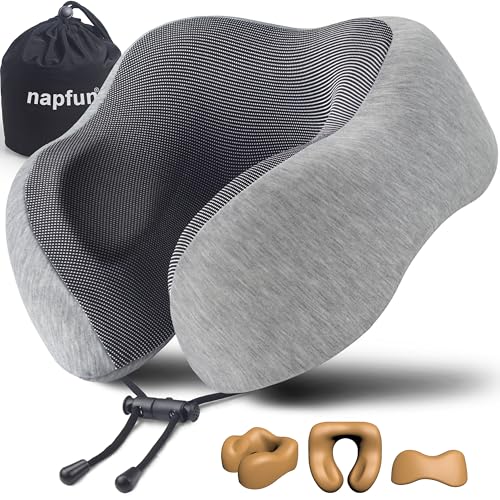
napfun Neck Pillow for Traveling — Best Overall
The napfun is the classic U-shaped memory foam pillow executed without a weak point, which is why it anchors this guide. The foam is pure memory foam — no blended fill diluting the support — shaped with the raised sides and flattened back that the design has converged on over a decade of refinement: the sides hold your head from tipping into your neighbor’s space, the thinner back avoids pushing your head forward against the headrest, and the front closes enough to give the chin somewhere to rest. It is positioned for flight sleep specifically, in a light grey that survives travel gracefully, and it compresses for the carry-on rather than dangling from it by a snap strap, collecting airport floor germs on the way to the gate. For the traveler who wants the standard answer — the pillow most likely to work for most people on most flights — this is it.
Strengths
- Pure memory foam with the category’s proven contour — raised sides, flatter back, supportive front.
- Compresses for packing instead of hanging off the bag.
- Light grey travel-friendly colorway and a design aimed squarely at airplane sleep.
Trade-offs
- A U-shape still assumes you sleep mostly upright and centered; dedicated side-leaners should read the Trtl review.
- Memory foam sleeps warm against the neck on a hot cabin day.
- One density for all — very petite and very large travelers may prefer the sized or adjustable alternatives below.
Choose the napfun if you are buying your first real travel pillow, replacing a worn one, or kitting out a family for a long trip where every seat needs a known quantity. It is the recommendation with the fewest conditions attached, and on a category this shape-dependent, the standard design’s breadth of fit is a genuine virtue rather than a lack of imagination.
Best for: most travelers on most flights / Not suited for: committed side-leaners or very hot sleepers
Check on Amazon — check price on Amazon; a full-black sibling version shares the brand’s range.

Trtl Pillow — Best for Side Sleepers
The Trtl is the category’s great heresy: it is not a pillow at all in shape, but a fleece wrap containing a hidden internal support that braces your head from one side, the way a hand or a shoulder would. You wrap it around your neck like a scarf, position the support under the ear you lean toward, and your head rests sideways at a natural angle instead of tipping, dropping, and snapping you awake. For side sleepers — the large population who cannot fall asleep facing forward and spend flights migrating toward the window or a partner’s shoulder — this design solves the actual problem rather than cushioning it. It is lightweight, machine washable, skin-friendly fleece, and it packs flat in a way no foam U can match, disappearing into a personal item rather than announcing itself on the outside of a bag.
Strengths
- Internal support design that holds the head sideways — the only pick here built for leaners.
- Packs nearly flat and weighs very little; the carry-on champion of the guide.
- Machine washable fleece, with no foam to manage or covers to unzip.
Trade-offs
- Supports one side at a time — restless sleepers who switch sides must reposition it.
- The wrap is warm around the neck; hot cabins and hot sleepers should consider that honestly.
- It looks unconventional, and the fit is personal — some travelers never take to it.
Buy the Trtl if you know from experience that you sleep leaning — against windows, on shoulders, into the aisle-side headrest wing. It is also the pick for ultralight packers and for train and car passengers, where its support works in any seat. Travelers who sleep bolt upright and centered will find the napfun’s symmetry more natural; the Trtl rewards a specific sleeper, and for that sleeper it is not a compromise but the answer.
Best for: side-leaning sleepers and light packers / Not suited for: centered upright sleepers or the heat-averse
Check on Amazon — check price on Amazon; black is the verified colorway.

BCOZZY Travel Neck Pillow — Best Chin Support
The BCOZZY attacks the most common in-flight wake-up of all: the forward drop, where the sleeping head falls toward the chest and the jolt — or the slow neck strain — ends the nap. Its design wraps the neck with overlapping, double support, so the front of the pillow is not the thin gap most U-shapes leave but a cradle the chin can rest into. The effect is a head held in the round: supported at the sides like a standard pillow, and caught at the front before the drop begins. It is soft, adjustable, washable, and light, with a carry bag included, and the large size linked here suits adults who find standard travel pillows skimpy — sizing being one of this brand’s genuine contributions to the category, since a pillow too small for your neck is a pillow that supports nothing.
Strengths
- Overlapping double support that cradles the chin and prevents the forward head-drop.
- Sized options, with the large fitting adults whom standard pillows under-serve.
- Soft, washable, lightweight, with a carry bag for clean packing.
Trade-offs
- The full wrap is more fabric around the neck — warm sleepers should weigh that.
- Softer support than dense memory foam; travelers wanting firm correction should choose the foam picks.
- The overlap design takes a moment to arrange the first few times.
Choose the BCOZZY if your flight naps end with the chin-drop jolt, if you sleep with your head forward over a tray or a book, or if standard pillows have always felt a size too small. It is also a kind design for older travelers and anyone whose neck complains after a flight, because preventing the drop is gentler than cushioning its landing.
Best for: forward droppers and larger necks / Not suited for: firm-support seekers or hot sleepers
Check on Amazon — check price on Amazon and choose the size honestly; large is the verified listing.

Everlasting Comfort Neck Pillow — Best for Long Flights
Duration changes the problem. On a two-hour flight, any decent pillow improves the nap; on a nine-hour red-eye, the pillow must work in several positions across the night, because no sleeper holds one posture for nine hours. The Everlasting Comfort is built for that reality: memory foam support that contacts the neck through a full 360 degrees, in a multi-position design that stays useful whether you are upright, leaned to the window side, or slumped in the middle seat’s narrow truce. The brand’s long-flight framing is earned by that versatility — the pillow’s job on a long haul is not to find one perfect position but to make every position survivable, and full-circle contact is what keeps support available as you migrate. It doubles at home for the same reason: a support that works in a chair works in a recliner, for the reader and the television napper as much as for the flyer.
Strengths
- Full 360-degree support that remains useful as you change positions across a long flight.
- Memory foam density suited to hours of contact rather than a short nap.
- Multi-position design that transfers to home and office use between trips.
Trade-offs
- More pillow to pack than the Trtl or the budget pick — the long-haul tool is not the ultralight one.
- Full-circle contact is warm on a hot cabin.
- Short-hop travelers are buying capability they will rarely use.
Choose the Everlasting Comfort for long-haul and red-eye flying, for middle-seat assignments where no window exists to lean on, and for travelers who will use the pillow at home between trips. If your flying is ninety minutes at a time, the napfun or the SAIREIDER serves you as well for less bulk; this pick’s virtues compound with hours, and hours are its home territory.
Best for: long-haul, red-eye, and middle-seat travelers / Not suited for: ultralight packers or short-hop flyers
Check on Amazon — check price on Amazon before ordering.

Hooded Travel Neck Pillow — Best for Privacy
Some travelers cannot sleep because of their neck; others cannot sleep because of the cabin — the light, the screens, the sense of being on display. This pillow answers the second problem with an extra-large hood built over a memory foam support: pull the hood up and the cabin’s light and gaze are shut out, creating the small private dark that makes sleep possible for light-sensitive travelers in a bright economy cabin at noon. The support underneath is proper memory foam with an ergonomic shape, the cover is breathable and washable, and the set packs into a portable bag with earplugs included — the maker’s safety-tested framing and the accessory bundle show a design thought through as a sleep kit rather than a pillow with a gimmick. The hood also answers a quieter need: privacy. Sleeping in public is an exposed act, and for many travelers the hood’s curtain is what finally lets them let go.
Strengths
- Extra-large hood that blocks cabin light and creates privacy — a sleep feature no foam density can provide.
- Genuine memory foam ergonomic support underneath the hood, not a token cushion.
- Breathable washable cover, portable bag, and earplugs — a complete sleep kit.
Trade-offs
- The hood is warm and enclosed by design — claustrophobic or heat-sensitive travelers should pass.
- Bulkier than the minimalist picks when packed.
- You will look distinctive in it; the privacy it buys is partly the point, but not everyone wants the silhouette.
Buy the hooded pillow if light and exposure are what keep you awake, if you sleep on daytime flights, or if you are a nervous flyer for whom a small sense of enclosure is calming. It is also a thoughtful gift for the frequent flyer who has every other accessory. Travelers who sleep easily in the open should take the napfun and spend the difference on nothing at all.
Best for: light-sensitive and privacy-seeking sleepers / Not suited for: the claustrophobic or heat-averse
Check on Amazon — check price on Amazon before ordering.

SAIREIDER Travel Pillow — Best Budget
The SAIREIDER is the proof of this guide’s opening claim: the affordable end of this category, done in pure memory foam with a washable cover, is genuinely good. Its formula is the category’s standard — 100% pure memory foam in the U configuration, a washable cover in black, suitability across plane, car, home, and office — executed at the entry price, without the brand premiums that accumulate on the famous names. What you give up against the napfun is refinement at the margins: the contouring is the standard shape rather than the most evolved version of it, and the finishing is functional. What you do not give up is the mechanism of support itself, which is foam of the right density in the right shape — and that is why budget buyers in this category, uniquely, are not buying a lesser experience so much as a less polished one.
Strengths
- Pure memory foam support at the category’s entry price.
- Washable cover — the hygiene feature budget pillows most often skip.
- Works across plane, car, home, and office, earning its keep between trips.
Trade-offs
- Standard contour rather than the most refined shaping in the guide.
- Finishing and accessories are functional, not generous.
- Black only in the verified listing — light-color fans should look at the napfun.
Choose the SAIREIDER for a first travel pillow on a strict budget, for equipping children and teenagers whose pillows will be lost, left, and abused, for the car and the guest drawer, and for anyone testing whether memory foam suits them before buying the refined version. It is the rare budget pick whose recommendation needs no apology attached.
Best for: strict budgets, kids, spares, and first trials / Not suited for: travelers wanting the most refined contour
Check on Amazon — check price on Amazon before ordering.
The table below compresses the guide to its decision: find your sleeper type in the best-for column, and the pick beside it is the one the full reviews argue for. Price does not appear as a column because, within this affordable set, it should not be the deciding variable — an inexpensive pillow in the wrong shape is the only genuinely wasted money in the category.
Comparison Table
| Pick | Badge | Key spec | Best for |
|---|---|---|---|
| napfun Neck Pillow | Best Overall | Pure memory foam U, contoured, compressible | Most travelers |
| Trtl Pillow | Best for Side Sleepers | Fleece wrap with internal side support, packs flat | Leaners, light packers |
| BCOZZY Travel Pillow | Best Chin Support | Overlapping double wrap, sized, washable | Forward droppers |
| Everlasting Comfort Neck Pillow | Best for Long Flights | 360-degree multi-position memory foam | Long haul, middle seats |
| Hooded Travel Neck Pillow | Best for Privacy | Memory foam plus extra-large hood, earplugs | Light-sensitive sleepers |
| SAIREIDER Travel Pillow | Best Budget | Pure memory foam, washable cover | Budgets, kids, spares |
How to Choose an Affordable Travel Pillow
Begin with your sleep position in a seat, because it eliminates half the category immediately. Watch yourself on your next trip, or remember honestly: do you sleep facing forward with your head centered, tip sideways toward the window, or drop forward? Centered sleepers are served by the classic U in memory foam. Side leaners are the Trtl’s entire reason to exist, and will fight a U-shape all flight. Forward droppers need front support — the BCOZZY’s overlap or a U whose front closes high. The most expensive travel pillow in the world fails a sleeper whose position it does not match, and the cheapest succeeds for the sleeper it fits; this is why the guide is organized by design rather than by price, and why “affordable” and “best” coexist in it so comfortably.
Foam density is the second test, and it is judged by a squeeze and a stay. A good memory foam pillow compresses slowly under your hand and recovers slowly; it should feel substantial, almost heavy for its size, because density is what holds a head’s weight for hours without bottoming out. Underfilled and bead-filled pillows feel inviting in the shop and collapse in the seat. If you are between two foam picks, choose the denser-feeling one and the one whose back panel is thinner — a thick back pushes the head forward into the exact posture you are trying to avoid, which is the design error behind a surprising share of “travel pillows don’t work” verdicts.
Packability is the third test, and it is a honesty test about your luggage. A pillow that clips outside a carry-on will be carried; a pillow that must displace clothing will be left home by the third trip. Compressible foam with a stuff sack, like the napfun’s approach, and inherently flat designs like the Trtl’s are the two honest solutions. Consider also where the pillow lives between trips — a washable cover is not a luxury on an object pressed against skin and airplane headrests for years, and the picks here were required to wash or wipe clean for exactly that reason.
Seat choice interacts with pillow choice more than buyers expect, and a sentence on it saves real discomfort. The window seat is the leaner’s paradise — a wall to brace against, where the Trtl and a foam pillow both shine and where the pillow’s side support has something to work with. The middle seat is the support desert: no wall, two neighbors, and a head with nowhere permitted to go, which is where full-circle support like the Everlasting Comfort earns its place and where the hooded pillow’s privacy is worth the most. The aisle seat offers legroom and freedom at the price of passing carts and elbows, favoring a compact pillow that does not widen your silhouette into the traffic lane. None of this changes which design your sleep position demands, but it can break a tie between two finalists — buy for your position first and your usual seat second.
Finally, spend the affordable tier’s savings wisely: on a second pillow for a travel partner, on the size upgrade if you are between sizes, or on nothing. This category punishes overspending more than most, because its premium prices buy styling and branding more readily than sleep. The designs in this guide cover the real axes of difference — position, support style, privacy, packability — and once your axis is chosen, the affordable pick on it is the right purchase, full stop.
How to Use a Travel Pillow for Actual Sleep
One preliminary deserves emphasis for first-time buyers: try the pillow at home, in a chair, before the trip. Ten minutes of reading in it teaches you which way it faces, how its closure works, and whether its size is right — discoveries that are free at home and expensive at midnight in a dark cabin. The home trial is also the moment to exchange a size that is wrong, while the exchange is still possible. Frequent travelers do this without thinking; it is the cheapest expertise in this entire guide.
Setup begins before the pillow comes out. Recline the seat to the extent courtesy and the cabin allow — even a small recline changes the head’s balance point and lets the pillow assist gravity instead of fighting it — and set the headrest wings, if your seat has them, to cradle rather than perch. Put the pillow on before you are tired, not after: arranging support while half-asleep in a dark cabin is how pillows end up backwards, and a U-pillow worn with the opening at the back — a common error — supports nothing at all. The opening belongs at the front for standard use, the back panel flat against the headrest.
Temperature management is the pillow skill nobody teaches. Cabins swing between chilly and stuffy across a single flight, and a foam or fleece pillow is a warm object around the neck by design. Board slightly cool rather than bundled — it is easier to add the blanket than to cool down once asleep — and if you wake warm, loosening the pillow’s closure or resting it as a side prop instead of a collar keeps its support available without its insulation. The hooded pick’s users should treat the hood as a dimmer, not a switch: hood up to fall asleep, hood back if the cabin warms, the sleep usually survives the adjustment because the darkness mattered most at the start.
During the flight, treat the pillow as one part of a sleep system. Darkness and quiet multiply its effect, which is the logic of the hooded pick and of the humble eye mask and earplugs alongside any other pick. Loosen the pillow rather than tightening it if you wake with a stiff jaw — over-tight wraps are a frequent self-inflicted problem — and change positions deliberately every so often on long flights, re-seating the pillow each time rather than expecting it to follow you. On arrival, the pillow’s last job is hygiene: it has spent hours against a headrest that thousands have used, so the washable cover goes in the laundry with the travel clothes, and the pillow airs before it is packed away. That small routine is what makes an affordable pillow a years-long companion instead of a single-trip consumable.
Travel Pillows for Children and Small Travelers
Children change the sizing logic completely, and handing a child an adult pillow is the category’s most common family error. An adult U around a small neck does not support — it surrounds loosely, pushes the head forward, and is discarded by the second hour, usually onto the floor of the aircraft. The correct approach for young travelers is a pillow sized to them or, failing that, the honest improvisations: the SAIREIDER’s standard foam works for older children and teenagers whose necks approach adult dimensions, which is part of why it is this guide’s family pick, while younger children often do best with the pillow used as a side prop between head and window rather than as a collar at all. The BCOZZY’s sized range is the other family-relevant design, since its adjustability tolerates the in-between sizes of growing travelers better than a fixed foam contour.
Two practical notes for family travel. First, a child’s pillow will be dropped, spilled on, and slept on in rotations with snacks — washable covers stop being a preference and become the product, so choose from the washable picks and wash without ceremony. Second, involve the child in the choice where age allows: a pillow a child helped pick is a pillow that gets worn, and the entire support argument is moot for a pillow refused. The affordable tier is the family’s friend here in a specific way — outgrown and lost pillows at this price are lessons, not losses, and equipping a family’s worth of seats from this guide costs less than one premium pillow bought in an airport.
Common Buying Mistakes
The first mistake is buying for softness — choosing the pillow that feels like a plush toy in the hand, then discovering at altitude that it offers the support of one. The second is ignoring your own sleep position and buying the category’s most famous shape instead of your shape. The third is the gate purchase: the overpriced, underfilled airport pillow bought in desperation, which this guide exists to make unnecessary — buy before the trip, from the designs above, at the affordable tier’s honest prices. Fourth is neglecting packability and abandoning the pillow at home trip after trip. Fifth is wearing the U backwards, an error so common it deserves its place here. And the last is expecting a pillow to fix a seat: a pillow manages your head’s position, but the eye mask, the earplugs, the recline courtesy, and the boarding-time sleep discipline are the rest of the system, and the travelers who sleep well in economy work the whole system rather than asking one foam shape to perform a miracle.
Final Recommendation
Most travelers should buy the napfun: it is the standard design at its best, at an affordable price. Side leaners should take the Trtl without hesitation, forward droppers the BCOZZY, long-haul and middle-seat flyers the Everlasting Comfort, the light-sensitive the hooded pillow, and strict budgets the SAIREIDER — which loses remarkably little to the leaders. Buy before you fly, match the design to your sleep position, and the affordable tier will not feel like a compromise. If you are genuinely torn between two designs after reading this guide, buy the one that matches your worst flight rather than your average one — the red-eye, the middle seat, the long haul — because a pillow that saves your worst night will serve every easier night without complaint, while the reverse is not true. Safe travels — and may your next seat be a window. Related reading: Best 100 Down Pillows, Best Affordable Pillows, Best Travel Air Purifiers, and Best 3 Inches Between Knee Gel Pillows.
The Three Support Technologies, Compared Honestly
Every travel pillow ever sold is one of three machines wearing different clothes, and knowing which machine you are buying clarifies every choice in this guide. The first is shaped foam — the U and its descendants — which supports by surrounding: it fills the space around the neck so the head has nowhere bad to go. Its virtues are universality and predictability; its limits are bulk and warmth. Foam quality is density, and density is why two visually identical U-pillows can perform entirely differently at hour three. The second machine is the brace, represented here by the Trtl: it supports not by surrounding but by propping, holding the head from one side with a structure. Braces pack smallest and solve the side-leaner’s problem most directly, at the price of one-sided support and a fit that is personal. The third machine is the wrap-and-cradle, the BCOZZY’s overlapping softness and the hooded pillow’s enclosure: support by embrace, gentler and less corrective, strongest exactly where foam is weakest — the front, where the chin drops, and the senses, where light and exposure live.
No machine wins in general, which is the honest summary the category’s marketing avoids. Foam wins for the centered sleeper and the long-haul multi-position problem. The brace wins for the leaner and the light packer. The wrap wins for the dropper and the light-sensitive. The guide’s six picks were chosen so that each machine is represented by its best affordable execution, and the buyer’s only real task is self-knowledge: which sleeper are you, at 35,000 feet, at 3 a.m. body-clock time? Answer that, and the category becomes simple — the pillow chooses itself, and the affordable tier supplies it without strain.
Beyond the Plane: Cars, Trains, and the Office Chair
A travel pillow that only flies is a poor use of even an affordable purchase, and the picks here were partly chosen for their second lives. In cars — as a passenger, never as a driver — the same support logic applies with one difference: car seats recline further and headrests sit differently, so the fuller supports like the Everlasting Comfort and the BCOZZY come into their own on road trips, while the Trtl serves the train passenger best, since rail seats are the plane seat’s upright cousin and the lean toward the window is the same lean. Road-trip passengers should also note that a pillow which works in the car earns its keep weekly rather than yearly, which changes the value math of even the guide’s most expensive pick.
The office and home are the third theater. The nap at a desk chair, the recliner during a film, the reading chair with a head that eventually nods — these are travel-pillow situations wearing domestic clothes, and the foam picks in particular transfer without modification. There is also a kindness use worth naming: a travel pillow is one of the most useful objects to lend — to a guest on the sofa bed, to a family member recovering in a chair, to a teenager on a long drive — and an affordable pillow lends without anxiety. Buy the design your sleep position demands, keep it washed and reachable rather than stored with the luggage, and it will work for its living in a dozen settings the word “travel” never mentioned.
Related guides
Frequently Asked Questions
Is a travel pillow worth it for a short flight?
For a flight under two hours, it depends on whether you intend to sleep. If you will read or watch a screen throughout, the pillow is luggage. If even a forty-minute nap is the plan — and on early departures it often should be — a compact option like the Trtl or the compressible napfun earns its small space, because short naps in a seat fail for the same positional reasons long ones do, only faster. Judge by intention, not by flight length alone.
Are affordable travel pillows actually any good?
Yes — this is one category where the affordable tier contains the genuinely best designs, because the product is a shaped support rather than a technology. What matters is design matched to your sleep position and foam dense enough to hold your head. Every pick in this guide clears both bars; the expensive end of the category mostly buys branding and marginal refinement.
Memory foam or the Trtl — which is better?
They solve different problems. Memory foam U-shapes support a centered, upright head in the round. The Trtl’s internal brace supports a head leaned to one side, and packs flat. Choose by how you sleep: leaners get more from the Trtl, centered sleepers more from foam, and travelers who do both across a long night should look at the 360-degree Everlasting Comfort.
How do I stop my head from falling forward when I sleep on a plane?
Front support is the answer — a pillow whose front closes high or overlaps, like the BCOZZY, gives the chin a cradle before the drop begins. A small recline helps by moving the balance point back, and a standard U worn correctly, opening forward, is a partial fix. The forward drop is a design problem with design solutions; it is not something you have to endure.
Can I wash a travel pillow?
The covers on the foam picks in this guide wash, and the Trtl is machine washable as a whole. Foam itself generally should not be machine washed — spot clean and air it. Wash the cover after every trip as a routine; a travel pillow lives against skin and shared headrests, and the washable cover is doing quiet hygienic work across the pillow’s whole life.
Can I use a travel pillow if I wear headphones?
Yes, with a shape caveat. Over-ear headphones compete with high-sided pillows for the same space, and the fullest 360-degree designs can press the earcups uncomfortably on long flights. Earbuds coexist with every pick here. If over-ear headphones are non-negotiable, favor the slimmer-profile designs — the Trtl’s one-sided support leaves the other ear entirely free, and standard U-shapes in a moderate height usually clear the cups where the tallest contours do not. Test the combination in the home trial, not at cruising altitude.
What size travel pillow should I buy?
One that matches your neck. A pillow too small rides up and supports nothing; too large, it crowds the jaw and pushes the head around. Where a brand offers sizes, as BCOZZY does, measure honestly and size up if you are between — adult travelers regularly under-size. Petite travelers and children are better served by the standard foam picks fitted snugly than by a large pillow worn loose.
How should I pack a travel pillow in a carry-on?
Compress it, do not clip it — a pillow dangling outside the bag collects grime from every surface it brushes and is the first thing lost at security. Foam picks like the napfun roll or compress into their sack; the Trtl packs flat against a laptop or a book. If space is truly at a premium, wear the pillow through the airport — unfashionable, effective, and the reason half the travelers in any terminal have one around their neck before boarding.
How long does a memory foam travel pillow last?
Years of regular use. Memory foam’s enemy is not time but abuse — being stored compressed, washed as a whole, or left in a hot car to bake. Store the pillow uncompressed and aired, wash only the cover, and the foam’s support outlasts the cover’s appearance. When the foam stops recovering its shape after a squeeze, or the support feels thinner than you remember, the pillow has given its service and the affordable tier makes its replacement painless.
Do travel pillows help with neck pain after flights?
They address the usual cause: hours spent with the head fallen into an unsupported angle, which the muscles then report as stiffness and soreness. A pillow matched to your sleep position keeps the head nearer neutral and prevents the drops and tips that do the damage. This is comfort mechanics, not medicine — persistent neck pain deserves a professional’s attention — but for the ordinary post-flight ache, support during the flight is the direct remedy.

