Disclosure: airfryerkitchensupply.com is reader-supported. When you buy through links on our site, we may earn an affiliate commission at no extra cost to you.
Where to buy
The fastest way to buy any pick in this guide is through Amazon, where stock and configurations change often, so check the current price on Amazon on the product page rather than relying on any number printed elsewhere. These are the verified picks for best affordable programmable slow cookers:
- Crock-Pot 6 Quart Cook & Carry Programmable Slow Cooker — Check on Amazon
- GreenLife 6 Quart Programmable Slow Cooker — Check on Amazon
- Hamilton Beach Set & Forget 4 Quart Programmable Slow Cooker — Check on Amazon
- bella SAVOR 6qt Programmable Slow Cooker — Check on Amazon
- Chefman 7 Quart Programmable Digital Slow Cooker — Check on Amazon
- Crockpot Programmable 7-Quart Cook and Carry Slow Cooker — Check on Amazon
Programmable models at the value tier rotate finishes and bundle names often. Buy the capacity and timer behaviour you decided on; the same machine in a different colour cooks identically, and stock in one finish usually means the others follow.
The best affordable programmable slow cookers exist because of one specific failure: the dinner that cooked for eleven hours because the meeting ran long. A manual slow cooker cooks until a person stops it; a programmable one cooks for the time you set, then steps itself down to warm and holds dinner there. That single behaviour — the automatic shift to warm — is what ‘programmable’ actually buys, and at the affordable tier it has become genuinely accessible: every pick in this guide offers timed cooking with an automatic warm hold, at value positioning, in sizes from a couple-friendly 4 quarts to a crowd-ready 7.
Six verified machines make the shortlist, and they differ in the ways that matter at this tier: capacity, timer range, whether a locking lid makes the cooker travel, and whether the crock is traditional stoneware or a lighter nonstick pot. What they share is the discipline this series applies everywhere — each model confirmed in its own catalogue listing before it earned a slot, with no link written on faith and no price printed anywhere, because prices at this tier change faster than any guide can chase.
A word of calibration before the picks: programmable does not mean smart, connected or app-driven at this level, and that is a virtue. These are timers and thermostats, set with buttons, doing one job reliably. If your household’s problem is scheduling rather than features, the value tier solves it completely — and the sections after the reviews explain exactly how much timer you need, and the few situations where a manual cooker is still the smarter buy.
In this guide
Quick Picks
Best Overall — Crock-Pot 6 Quart Cook & Carry Programmable Slow Cooker: The proven default: 6-quart Cook & Carry programmability with a locking lid, from the line that defined the category. Check on Amazon
Best Nonstick Crock — GreenLife 6 Quart Programmable Slow Cooker: A PFAS-free ceramic nonstick crock and five modes in a 6-quart family cooker — the lighter-pot, lighter-cleanup pick. Check on Amazon
Best for Small Households — Hamilton Beach Set & Forget 4 Quart Programmable Slow Cooker: The small-household programmable: Hamilton Beach’s Set & Forget flexibility in a 4-quart size for couples and small batches. Check on Amazon
Best Design-Forward Value — bella SAVOR 6qt Programmable Slow Cooker: bella’s 6-quart programmable in the SAVOR line — non-toxic positioning and a finish-forward design at a value tier. Check on Amazon
Best Timer Range — Chefman 7 Quart Programmable Digital Slow Cooker: The big one: 7 quarts with a 24-hour timer, the longest scheduling range in this guide. Check on Amazon
Best for Potlucks — Crockpot Programmable 7-Quart Cook and Carry Slow Cooker: Seven quarts of Cook & Carry programmability with up to 20 hours on the timer, for potluck households that cook large. Check on Amazon
How These Picks Were Chosen
Candidates had to be programmable in the meaningful sense — a settable cook time that ends in an automatic warm hold — not merely digital in display. Each was verified in its own listing for capacity, timer behaviour and control type before selection; models that could not be confirmed were excluded regardless of reputation. The six slots were then spread across the size range (4, 6 and 7 quarts) and across crock materials, because at the affordable tier those two axes decide satisfaction far more than brand.
Judging weighted the ownership details value buyers feel weekly: how legible the panel is at 7 a.m., whether the timer’s range matches real schedules (most households need 30 minutes to 10 hours, not 24), how the crock washes, and whether the lid locks for the potluck trip that programmable cookers so often make. Preset libraries and smart features were weighted at their true value-tier worth: nearly none.
The 6 Best Affordable Programmable Slow Cookers
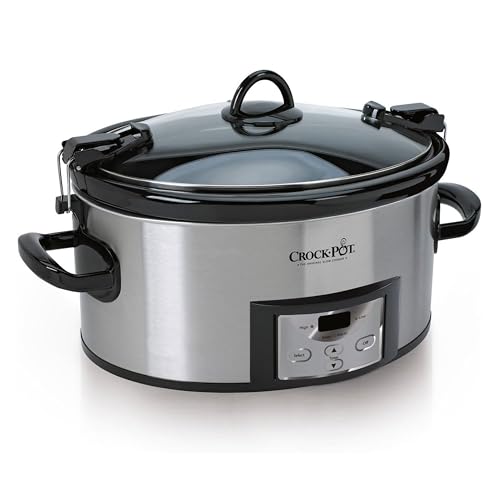
Crock-Pot 6 Quart Cook & Carry Programmable Slow Cooker — Best Overall
The Crock-Pot Cook & Carry programmable is the pick against which this category is measured, and at the affordable tier it remains the safest recommendation in the guide. The formula is complete: set the time, the cooker cooks, the timer ends the cook and steps down to warm, and if the meal is travelling, the locking lid system keeps it in the crock rather than the car. Six quarts is the family workhorse size — big enough for a whole chicken or a stew with leftovers, small enough for a Tuesday soup.
Strengths
- The mature formula: digital timer, automatic warm, and the Cook & Carry locking lid for travel
- 6-quart family capacity — the size that fits the most households’ real batches
- Stoneware crock and the deepest replacement-parts world in the class
Trade-offs
- Stoneware weight is the class standard, which is to say real, especially full
- The design is familiar to the point of invisibility — no style points on the counter
- Timer range is ample rather than class-leading; marathon schedulers should check the Chefman
Key specs: 6-quart capacity; Cook & Carry programmable with digital timer; stainless steel (per Amazon listing title).
What the affordable buyer is really purchasing here is the absence of surprises. The controls are the ones a decade of owners can describe from memory, replacement crocks and lids are stocked everywhere, and the behaviour in year three is the behaviour on day one. In a tier where unknown badges compete on features, that predictability is the feature.
Take it as the default for a household of three to six that wants dinner to survive a commute. Smaller households should look at the Hamilton Beach 4-quart below; bigger or potluck-heavy ones at the two 7-quart picks. Everyone else can stop reading here with confidence — though the GreenLife’s lighter pot tempts, fairly, below.
Best for: best overall / Not suited for: households where this matters most — stoneware weight is the class standard, which is to say real, especially full.
Check on Amazon — check the current price on Amazon before you decide, because configurations and included accessories vary by listing.

GreenLife 6 Quart Programmable Slow Cooker — Best Nonstick Crock
The GreenLife programmable answers the stoneware complaint that runs through every slow-cooker guide: the crock is heavy and beans weld themselves to it. Its ceramic nonstick pot — PFAS-free, as its listing states — is light enough to carry full without ceremony and releases a chili or a cheesy dip with a rinse and a wipe. For cooks with any lifting limitation, or anyone whose slow cooker lives or dies by cleanup speed, that pot is not a detail; it is the product.
Strengths
- PFAS-free ceramic nonstick crock: dramatically lighter than stoneware and releases food with a rinse
- Five modes give more shaping of the cook than the standard three settings
- Family-size 6 quarts in a finish that brightens a counter rather than hiding on it
Trade-offs
- Coated crocks age: no metal utensils, no scouring, and a replacement horizon stoneware does not have
- Turquoise is a commitment — your kitchen either loves it or does not
- Brand depth for spares trails Crock-Pot’s, though the crock is the main wear item
Key specs: 6-quart capacity; programmable with 5 modes; PFAS-free nonstick ceramic removable pot (per Amazon listing title).
Programmability is full-strength: set the time across five modes, and the cooker manages the shift to warm when the cook completes. Capacity matches the class standard at six family quarts, so the lighter pot costs you nothing in batch size — the trade is purely longevity, since coated surfaces wear where stoneware merely ages.
Buy it with the care bargain understood and it is the most pleasant daily driver in this guide. Households that cook daily and hard for a decade should take stoneware and accept the soak; households that cook weekly and value their wrists and their evenings should take the GreenLife and never look back.
Best for: best nonstick crock / Not suited for: households where this matters most — coated crocks age.
Check on Amazon — check the current price on Amazon before you decide, because configurations and included accessories vary by listing.

Hamilton Beach Set & Forget 4 Quart Programmable Slow Cooker — Best for Small Households
Programmable slow cooking has a sizing secret: a big cooker run half-empty cooks worse, not just sadder. Food spreads thin, edges dry, and timings drift. The Hamilton Beach Set & Forget at 4 quarts is the affordable programmable that respects this — a crock sized for couples, small households and side dishes, with the line’s signature flexibility of heat-and-time combinations and the automatic behaviour that makes programmability worth buying at any size.
Strengths
- Set & Forget programmability in a right-sized 4-quart crock — no half-empty big cooker cooking
- Flexible combinations of three heat settings and five time settings cover the small-batch repertoire
- Hamilton Beach’s legible controls, kind to whoever in the household runs it
Trade-offs
- Four quarts caps the ambition: no whole birds, no double batches, no freezer Sundays
- Cost per quart is the worst in this guide — small programmables carry a size premium
- Couples who entertain will outgrow it and buy the 6-quart anyway
Key specs: 4-quart capacity; programmable with 3 heat and 5 time settings (per Amazon listing title).
For its households it is perfectly judged. A 4-quart load is a pot roast for two with leftovers, a soup that lasts three lunches, a batch of steel-cut oats timed for morning. The crock lifts light, washes fast, and stores in cabinets a 7-quart oval laughs at. In a small kitchen, the right size is not a compromise; it is the entire quality of life of the appliance.
The warning is symmetrical: households that regularly cook for five, host, or batch for a freezer will outgrow it within a season. Buy it for the household you have, at the size your real recipes use, and it is the most satisfying pick in this guide per quart.
Best for: best for small households / Not suited for: households where this matters most — four quarts caps the ambition.
Check on Amazon — check the current price on Amazon before you decide, because configurations and included accessories vary by listing.

bella SAVOR 6qt Programmable Slow Cooker — Best Design-Forward Value
bella’s SAVOR programmable makes the case that a value cooker can be chosen, not just settled for. The 6-quart capacity and full programmable behaviour — timed cook, automatic warm — match the class standard, while the line’s non-toxic positioning and counter-worthy design speak to buyers for whom the cooker will live in sight and be used by the whole household. In small kitchens especially, an appliance that looks intentional gets used more, and used-more is the only metric that compounds.
Strengths
- 6-quart programmable capacity in bella’s SAVOR line, with non-toxic positioning the listing leads with
- A finish and form designed to live on the counter — relevant for small kitchens without cabinet room
- Full timer-and-warm behaviour at a value tier, without paying for a legacy badge
Trade-offs
- Design-forward lines rotate finishes; exact-match replacement crocks may be seasonal
- Support ecosystem is thinner than Crock-Pot’s or Hamilton Beach’s
- Listing detail is lighter than the majors’ — fewer published specifics to compare
Key specs: 6.0-quart capacity; programmable; non-toxic slow cooker (per Amazon listing title).
Functionally it covers the family repertoire at the size that fits most batches, with controls in the straightforward modern style. Nothing about the cooking asks for apology: this is a full programmable slow cooker that happens to have been designed by people who also cared how it looks at 7 a.m.
The caveats are the newer-brand caveats: a thinner spare-parts world and finishes that rotate, so a replacement crock years from now may not match the original’s colour. If your buying horizon is a few happy years of weekly use, the SAVOR’s blend of behaviour and design is the value pick with a personality. If your horizon is a decade, the Crock-Pot’s ecosystem earns its keep.
Best for: best design-forward value / Not suited for: households where this matters most — design-forward lines rotate finishes; exact-match replacement crocks may be seasonal.
Check on Amazon — check the current price on Amazon before you decide, because configurations and included accessories vary by listing.

Chefman 7 Quart Programmable Digital Slow Cooker — Best Timer Range
Scheduling is a spectrum, and the Chefman 7-quart programmable owns its long end: a 24-hour timer that lets a cook be programmed a full day out, in a 7-quart ceramic crock that holds the batches bigger households actually make. For shift workers, event cooks and anyone whose tomorrow is planned tonight, that range is not a spec-sheet flourish — it is the difference between the cooker fitting the life and the life fitting the cooker.
Strengths
- 24-hour timer — the longest scheduling window in this guide, for cooks planned a full day ahead
- 7-quart ceramic crock covers crowd batches the 6-quart class splits in two
- Digital programmability with low, high and warm in a stainless body
Trade-offs
- 24 hours of range invites over-long planning; food quality still prefers cooks that end near serving
- Seven quarts of ceramic crock is a substantial wash and a substantial shelf
- Chefman’s support world is mid-sized — better than the unknowns, behind the leaders
Key specs: 7-quart capacity; programmable digital with 24-hour timer; Low/High/Warm settings; ceramic crock; tempered glass lid; dishwasher-safe; stainless steel (per Amazon listing title).
The rest of the machine is the complete modern package: digital controls, the standard heat trio, a dishwasher-safe crock and lid, and stainless dress for counter duty. Seven quarts splits the difference between family 6 and crowd 8, and for households of five to seven it is arguably the true sweet spot of the whole category.
Use the long timer as flexibility, not as a holding strategy: program the cook to end near eating, and let warm bridge the gap, rather than parking finished food for half a day. Bought for its range and size and used with that judgment, the Chefman is the scheduling champion of the affordable programmable class.
Best for: best timer range / Not suited for: households where this matters most — 24 hours of range invites over-long planning; food quality still prefers cooks that end near serving.
Check on Amazon — check the current price on Amazon before you decide, because configurations and included accessories vary by listing.

Crockpot Programmable 7-Quart Cook and Carry Slow Cooker — Best for Potlucks
Potluck cooking has a failure mode no recipe can fix: the batch that arrives in the footwell. The Crockpot Cook & Carry at 7 quarts is engineered against it — a locking, travel-proof lid over a crowd-size crock, programmability up to 20 hours so the cook can end as the event begins, and an automatic warm that keeps the dish at serving temperature through the whole gathering. It is the most purpose-built machine in this guide, aimed at the cooks every community relies on.
Strengths
- Cook & Carry locking lid at 7 quarts — the travel system that keeps a crowd batch in the crock
- Programmable up to 20 hours with the automatic warm a long event demands
- Seven quarts feeds nine or more, per its maker’s sizing — true potluck scale
Trade-offs
- Grey finish and travel-first design prioritise function over counter style
- Seven quarts of stoneware is the heaviest lift in this guide when full
- Households that never travel with food pay for a lid system they will not use
Key specs: 7-quart capacity; Cook & Carry locking lid; programmable up to 20 hours; feeds 9+ (per Amazon listing title).
At home it is simply a large programmable Crock-Pot, with the brand’s parts and knowledge depth behind it. The capacity — sized by its maker for nine or more — covers the team dinner, the family reunion side dish and the holiday overflow that a 6-quart splits into two runs.
If your cooker never leaves your kitchen, the standard 6-quart pick above is the leaner buy. If your cooking travels — to halls, fields, offices and other people’s tables — the locking lid stops being a feature and becomes the reason, and this is your pick.
Best for: best for potlucks / Not suited for: households where this matters most — grey finish and travel-first design prioritise function over counter style.
Check on Amazon — check the current price on Amazon before you decide, because configurations and included accessories vary by listing.
Comparison Table
| Pick | Badge | Key spec | Best for |
|---|---|---|---|
| Crock-Pot 6 Quart Cook & Carry Programmable Slow Cooker | Best Overall | 6-quart capacity | Best Overall |
| GreenLife 6 Quart Programmable Slow Cooker | Best Nonstick Crock | 6-quart capacity | Best Nonstick Crock |
| Hamilton Beach Set & Forget 4 Quart Programmable Slow Cooker | Best for Small Households | 4-quart capacity | Best for Small Households |
| bella SAVOR 6qt Programmable Slow Cooker | Best Design-Forward Value | 6.0-quart capacity | Best Design-Forward Value |
| Chefman 7 Quart Programmable Digital Slow Cooker | Best Timer Range | 7-quart capacity | Best Timer Range |
| Crockpot Programmable 7-Quart Cook and Carry Slow Cooker | Best for Potlucks | 7-quart capacity | Best for Potlucks |
How to Choose an Affordable Programmable Slow Cooker
Buy the behaviour first: a settable cook time that ends in automatic warm. That is the whole definition of programmable that matters, and every pick here has it. Then size honestly to your batches — 4 quarts for couples and small kitchens, 6 for the family standard, 7 for crowds and potlucks — remembering that slow cookers cook best between half and three-quarters full, so the right size is the one your regular recipes fill properly, not the biggest the budget allows.
Timer range deserves a cooler head than marketing gives it. Most households need cooks of 4 to 10 hours with a warm hold after; ranges of 20–24 hours serve planners and shift workers, not ordinary Tuesdays, and no timer makes it wise to hold finished food for half a day. Choose range for your schedule’s real edges. Then choose your crock: stoneware for longevity and indifference, coated ceramic for lightness and release, accepting the care and lifespan trades each carries. Lids close the decision — a locking Cook & Carry system if food travels, a plain glass lid if it never does. Run those four filters and the affordable tier narrows itself to one or two machines, all of them good.
Programmable vs Manual: When the Timer Is Not Worth It
Programmability is worth its tier when cooks end in an empty house, when commutes vary, and when the cooker’s second job is holding dinner through a serving window. It is not worth it when someone is reliably home — a manual dial cooker then cooks identically, costs less, shrugs off power flickers by simply resuming, and removes the electronic board that is every programmable cooker’s eventual failure point. Retiree kitchens, work-from-home households and second holiday cookers are the manual strongholds, and this series’ manual guides serve them proudly.
The honest middle case — usually home, sometimes not — resolves in favour of programmable for most households, because the evenings it saves are the evenings dinner was going to be ruined. But it resolves that way only at affordable tiers like this guide’s; the moment programmability is bundled with apps and novelty presets at flagship prices, the manual’s argument returns with force. Buy the timer. Decline the theatre around it.
How to Program a Slow Cooker for a Workday Dinner, Step by Step
The night before or in the morning, load the crock in cooking order: root vegetables and aromatics on the bottom, meat above, liquid to halfway up the meat, seasonings over the top. Refrigerate the loaded crock overnight if your mornings are rushed — a cold crock adds a little come-up time, which a long low cook absorbs without noticing. In the morning, set the crock in the base, choose low for the all-day cook (the workday setting; high is for afternoons), and set the timer for the recipe’s time — not for the length of your absence.
That distinction is the craft: the timer should end the cook when the food is done, and the automatic warm should cover the gap until you are home. A roast done at hour eight and held warm until hour ten is perfect; a roast cooked on low for ten hours because you set the timer to your commute is overcooked by design. If your absence exceeds the recipe plus a reasonable warm window, choose a recipe that suits the longer cook — braises forgive; chicken breasts do not.
At home, lift the lid away from you, check the food, and season at the end, when salt and acid can be judged against the finished dish. Serve from the crock on warm through dinner, then portion leftovers into shallow containers within two hours. Wash the crock after a soak, dry the base’s rim, and the machine is ready for tomorrow — which, once this rhythm sets in, it will very often be asked to do.
Meal Prep with a Programmable Cooker: The Twice-a-Week System
Programmable slow cookers anchor the most sustainable meal-prep system most households ever adopt, precisely because it asks so little: two cooks a week. Cook one, early in the week, is a protein batch — a shoulder, a chicken, a pot of beans — timed to finish as you get home and portioned into the week’s lunches and two dinners. Cook two, midweek, is the soup, stew or curry that uses the first cook’s leftovers and the vegetables that need using, again finishing into its warm hold as the evening begins. The timer is what makes the system survivable on real schedules: the cooks end when the food is done whether or not the day cooperated.
Keep the system small and rotating rather than ambitious and abandoned. Three proteins, three sauces, three grain bases, mixed across weeks, produce more variety than a heroic Sunday session that burns out by February. The affordable programmable’s role in it is pure reliability — the same behaviour, twice a week, without a thought — and that is why this guide weighted boring virtues (legible panels, available crocks, predictable warm holds) over every smart feature the tier above is selling.
Power Cuts, Warm Holds and Other Programmable Realities
Programmable cookers have two behaviours every owner should learn before the first important dinner. The first is the power flicker: a brief outage may reset a digital cooker to off, where a manual dial simply resumes — so in storm season or in outage-prone areas, check the cooker after any flicker, and for the most important cooks (the holiday ham, the event chili) consider whether the household’s manual backup should take the shift. The second is the warm hold’s real limit: warm keeps cooked food at serving temperature safely for a serving window of a few hours, but it is not a storage state, and a cooker left holding from lunch to midnight serves neither safety nor quality.
Neither behaviour is a reason to avoid the format — they are the operating manual’s fine print, priced into this guide’s recommendations. The households that get a decade of happy service from an affordable programmable are the ones that program cooks to end near eating, treat warm as a bridge, and know what their machine does when the lights blink. That knowledge takes one reading of the manual and one remembered storm, and it separates the owners who trust their cooker completely — correctly — from the ones who were surprised once and never trusted it again.
The Holiday Second Cooker: Why Programmable Value Peaks in December
Ask value programmable owners when their cooker earned its keep and a surprising number name the same fortnight: the holiday season, when the main oven is a scheduled resource and every side dish, mulled drink and make-ahead gravy needs a warm, timed, unattended vessel. A programmable slow cooker at the affordable tier becomes the kitchen’s second oven and serving station in one — mashed potatoes held at serving temperature without scorching, a dip that stays molten through a party, a breakfast casserole timed to finish as guests wake. The timer-and-warm behaviour that serves a Tuesday commute serves a holiday table identically, and the cooker that cost a value tier performs like hired help.
The rest of the year, that same machine is the meal-prep anchor and the workday insurance this guide has described — which is the real answer to the affordability question. A cooker used twice a week for dinners and again at every gathering is not a cheap appliance; it is the hardest-working one in the kitchen at any tier. Buyers deciding between the picks here should therefore weight December honestly: households that host take the locking-lid travellers seriously, households that feed shift workers take the long timers seriously, and households that do both should not be surprised to end up, as so many do, with two of these machines — the second bought with the confidence the first one earned.
What to Cook First: Building a Rotation the Timer Can Serve
A programmable cooker’s value is realised through a rotation — a short list of dishes the household loves, timed and trusted — and the first month should be spent building it deliberately. Start with the forgiving braises that made the format famous: a pork shoulder that tolerates an hour’s timing error in either direction, a beef stew whose vegetables are cut large enough for the long cook, a chicken soup that finishes into its warm hold like it was designed for it, because it was. Each cook teaches the same two lessons — how your machine’s low runs against recipe times, and how your household’s schedule actually ends — and after three or four cooks, the timer settings stop being guesses.
Then add one dish from each direction the rotation will travel: a bean or grain cook for the cheap weeknight base, a breakfast cook timed for morning, and one event dish — the dip, the meatballs, the mulled drink — that the warm hold was invented for. Six dishes, cooked twice each, constitute a working rotation, and a working rotation is the point at which an affordable programmable stops being an appliance with potential and becomes the reason dinner is handled on the household’s hardest days. That transformation, not any specification, is what the picks in this guide were chosen to deliver — and it is available at every tier this guide covers, which is the affordable category’s whole argument in one sentence.
A Brief Defence of Boring: Why Simple Programmables Outlast Smart Ones
The affordable programmable occupies a sweet spot in appliance history that deserves naming: it is as automated as a slow cooker needs to be, and no more. A timer, three heats and a warm hold cover the entire behavioural repertoire of slow cooking — there is no fourth thing for a smarter machine to do with a stew — which means every feature above this tier’s is decoration on a solved problem. Decoration ages. Displays fade, apps lose support, connected services shut down and take features with them, while the timer-and-thermostat machines in this guide will behave in year eight exactly as they did on day one, because there is nothing in them that can be discontinued.
This is not nostalgia; it is the ownership mathematics that put these six machines in an affordable guide in the first place. The household buying at the value tier is buying dinners per dollar over years, and the boring programmable maximises that ratio twice — once at purchase, by declining to charge for theatre, and once across its life, by declining to break in interesting ways. When the smart flagship’s app retires, its owners will shop again. The owners of the picks above will be setting a timer, exactly as before, for a dinner that ends exactly on time. In this category, boring is not the absence of innovation. It is the innovation, finished.
Breakfast on a Timer: The Programmable Cooker’s Second Shift
The programmable slow cooker’s least expected talent appears at the other end of the day: breakfast, cooked while the household sleeps. Steel-cut oats loaded the night before — grains, liquid, fruit and spice in the crock, the timer set for a gentle cook that finishes into warm before the alarm — serve a household in shifts with no morning labour at all. Breakfast casseroles of egg, bread and cheese, timed to finish as guests wake, are the holiday version of the same trick, and they are the moment many owners report their affordable programmable stopped being a dinner appliance and became household infrastructure.
The technique asks two cautions that experience teaches once. Dairy- and egg-heavy loads belong to shorter, supervised-adjacent cooks rather than the longest overnight settings, both for texture and for prudence; oats and grains are the true overnight champions. And the warm hold, as ever, is a bridge — breakfast timed to finish near waking, held briefly, served. Respect those two notes and the second shift runs as reliably as the first, doubling the machine’s service without costing it a minute of its life — the sort of arithmetic that makes the affordable programmable, quietly, one of the best-value appliances a kitchen can own.
Setting Expectations: The First Three Cooks
New programmable owners calibrate fastest with three deliberate cooks. The first is a forgiving braise on a day someone is home — not because the machine needs supervision, but because the cook needs the education: watch the timer end, watch the warm hold begin, taste at the recipe’s time and again an hour later, and learn in one meal what the automatic shift actually does to food. The second cook is the true test, a workday dinner set in the morning and met at the door, which teaches the household’s real schedule against the recipe’s real timing. The third is a breakfast or an event dish, proving the second shift this guide described.
After those three cooks, the machine’s behaviour is known, the rotation can begin, and the timer stops being a feature being tried and becomes a fact being used. That small curriculum — supervised, scheduled, celebratory — is the fastest route from purchase to trust, and trust, in an appliance whose entire job is to cook while nobody watches, is the only specification that finally matters.
One Last Check Before You Buy
Before the purchase, run the four-question audit this guide built: Does the timer end in automatic warm? Does the size match the batch you cook most — not the biggest you can imagine? Does the crock material suit your wrists and your washing patience? And if the food travels, does the lid lock? Every pick in this guide answers its own version of those questions well; the audit simply matches the version to your household. A cooker chosen that way, at this tier, is not a compromise purchase waiting to be upgraded. It is, for most kitchens, the final slow cooker decision — the one that quietly handles dinner for years while the household thinks about other things, which was the point of the appliance all along.
Common Buying Mistakes
Setting the timer to your absence instead of the recipe. The cook should end when the food is done; warm exists to bridge the gap. Timing to the commute overcooks dinner by design.
Buying capacity for the biggest day of the year. A 7-quart run at 3 quarts cooks badly fifty weeks a year to shine on one. Size to the regular batch.
Holding food on warm indefinitely because the timer allows it. Warm is a bridge of a few hours. Beyond that, quality and safety both say refrigerate.
Paying for smart features at the affordable tier’s expense. Apps and voice control add cost and failure points; the timer-and-warm behaviour is the value. Every pick here keeps the money on the behaviour.
Forgetting that programmable cookers stop in a power cut. Manual dials resume; electronics may not. In outage-prone areas, that difference is a genuine buying factor.
Final Recommendation
The default affordable programmable is the Crock-Pot Cook & Carry 6 Quart: complete behaviour, family size, locking lid, endless spares. Take the GreenLife for a light, easy-release crock; the Hamilton Beach 4-quart for a small household done right; the bella SAVOR for design-forward value; the Chefman 7-quart for the longest timer; and the Crockpot 7-quart Cook & Carry if your cooking travels. Each one buys the only thing programmability is for — dinner that waits for you, instead of the other way around.
Neighbouring guides for the undecided: Best 8 Qt Slow Cookers, Best 4 Qt Slow Cookers, Best Affordable Pressure Cookers, Best Affordable Rice Cookers and Best 8 Quart Slow Cookers.
Short on time? Start with the top three: Crock-Pot 6 Quart Cook & Carry Programmable Slow Cooker, GreenLife 6 Quart Programmable Slow Cooker, Hamilton Beach Set & Forget 4 Quart Programmable Slow Cooker — each links to its listing so you can check the current price on Amazon and confirm the configuration before you buy.
Frequently Asked Questions
What does programmable actually mean on a slow cooker?
You set a cook time; when it ends, the cooker automatically switches to warm and holds the food at serving temperature. That is the meaningful definition, and it is what separates these picks from both manual cookers (which cook until stopped) and merely digital ones (a display without the timed behaviour).
How long can food safely stay on warm after cooking?
Treat warm as a bridge of a few hours between cooking and serving, not an all-day state. Program the cook to finish near when you will eat, let warm cover the realistic delay, and refrigerate leftovers within two hours of serving.
Is a 20- or 24-hour timer useful?
For planners and shift workers, yes — it lets a cook be set a day ahead. For most households the useful range is 4–10 hours plus warm. Buy the long range if your schedule genuinely reaches for it; do not pay a premium for it as a spec-sheet trophy.
Which size affordable programmable should I buy?
Four quarts for one to three people and small kitchens, six for the family standard of three to six, seven for crowds, potlucks and batch cooking. Match the size your regular recipes fill between half and three-quarters.
Stoneware or nonstick crock at this tier?
Stoneware lasts longest and tolerates everything, at the cost of weight and soaking. Coated ceramic crocks are light and release food beautifully, at the cost of gentle handling and a finite coating life. Choose by your wrists and your washing patience; both cook identically.
What happens to a programmable cooker in a power outage?
Depending on the model, it may resume, reset or stay off — it will not behave as simply as a manual dial, which just heats again when power returns. In outage-prone homes, that is a fair reason to choose manual, or to check on the cooker after any flicker.


