Disclosure: airfryerkitchensupply.com is reader-supported. When you buy through links on our site, we may earn an affiliate commission at no extra cost to you.
Where to buy
If you are shopping for the best affordable outdoor electric grills, start with the verified shortlist below — every model was confirmed against a live Amazon listing before earning its place. Outdoor electric is a specific niche: these are grills built to live on a patio or balcony and cook outdoors, powered from a wall outlet, for people whose lease, condo rules, or fire code forbid charcoal and gas.
Set expectations before the picks: an outdoor electric grill runs on household current, so its total power is capped, and it wins on permission, convenience, and cost-per-cook rather than raw searing violence. Within that physics, the picks below are the ones that concentrate their watts best. Confirm outlet requirements and dimensions on the listing and check the current price on Amazon.
- Char-Broil Patio Bistro TRU-Infrared Electric Grill (Best Overall Outdoor Electric) — Check the current price on Amazon
- Weber Lumin Compact Portable Electric Grill (Best Compact High-Heat) — Check the current price on Amazon
- Cuisinart CEG-115 2-in-1 Portable Outdoor Electric Grill (Best Stand-or-Tabletop Flexibility) — Check the current price on Amazon
- George Foreman Indoor/Outdoor Electric Grill with Stand, 15-Serving (Best for Outdoor Gatherings) — Check the current price on Amazon
- Techwood 15-Serving Indoor/Outdoor Electric Grill (Best Budget Big Grill) — Check the current price on Amazon
- Techwood Smokeless Indoor Electric Grill with Glass Lid (Best for Covered Patios) — Check the current price on Amazon
The best affordable outdoor electric grills exist because of a sentence in a lease. Across apartments, condos, townhouses, and fire-restricted regions, open flame on a balcony is banned — and the choice is an electric grill or no grilled food at all. The good news is that the category has matured: infrared elements, proper lids, stands, and plates sized for families have replaced the sad hotplates-with-ridges that used to define electric grilling.
This list is deliberately outdoor-first. The lead picks are true patio appliances: a lidded infrared grill on a cart-style body, a compact high-heat Weber built for balconies, a stand-or-tabletop Cuisinart that reaches temperatures most electrics only claim, and two large-format stand grills that feed a crowd. The final pick is a big countertop unit included honestly for covered patios and lanais where it will live outdoors under shelter — the way many owners actually use it.
Affordable in this category should buy you three things: enough concentrated wattage to brown food, weather-sensible construction for outdoor life, and a grease system that does not turn the balcony into a slip hazard. The reviews are blunt about heat recovery and lid discipline, because those — not brand — are what separate an electric grill you will use weekly from one that becomes balcony furniture.
In this guide
Quick Picks
Char-Broil Patio Bistro TRU-Infrared Electric Grill — Best Overall Outdoor Electric. Infrared heat under a proper lid — the electric grill that cooks most like a small gas grill.
Weber Lumin Compact Portable Electric Grill — Best Compact High-Heat. Weber’s balcony answer: compact, genuinely hot for an electric, and portable enough to store indoors.
Cuisinart CEG-115 2-in-1 Portable Outdoor Electric Grill — Best Stand-or-Tabletop Flexibility. Stand it on the patio or set it on a table — and it claims the highest heat figure in this guide, straight from its listing.
George Foreman Indoor/Outdoor Electric Grill with Stand, 15-Serving — Best for Outdoor Gatherings. The crowd-size electric: a domed 15-serving surface on a stand, at home on a patio or deck.
Techwood 15-Serving Indoor/Outdoor Electric Grill — Best Budget Big Grill. Big-surface electric grilling at the budget end, with a double-layer design for warming and overflow.
Techwood Smokeless Indoor Electric Grill with Glass Lid — Best for Covered Patios. A 1500W open grill with a glass lid, included for covered patios and lanais where it can live under shelter.
How These Picks Were Chosen
Each model was verified against a live Amazon listing on the day of writing; only listings whose titles matched the intended outdoor electric model were kept. Electric grill listings are especially prone to indoor/outdoor ambiguity, so stand configuration, lid design, and intended placement were checked from the listing text rather than the lifestyle photo.
Scoring led with heat concentration: element type and wattage relative to cooking area, lid quality, and how the design handles the heat-recovery problem when cold food lands. Infrared elements and tight lids scored up; sprawling plates on modest elements scored down. Outdoor suitability came next — stands, weather-resistant finishes, cord length and storage, and grease containment. Finally, capacity honesty: serving claims were discounted to realistic single-layer loads, because an electric grill’s true capacity is whatever fits without crowding the plate into steaming.
The six survivors map to real balcony and patio scenarios: best overall infrared, best compact high-heat, best stand-or-tabletop flexibility, best crowd capacity, best budget crowd capacity, and best covered-patio all-rounder. The buying guide explains the outlet, weather, and technique rules that make any of them succeed outdoors.
A word on how the picks were balanced: this list could have been six compact grills, because compacts dominate the category’s sales. It is not, because outdoor electric buyers divide into two real camps — small households needing permission-friendly quality, and flame-free households needing to feed people at patio scale. The stand and 15-serving picks exist for the second camp, even though their watts-per-inch math is less elegant, because a guide that only serves the first camp would fail half its readers. Judge each pick against its own camp’s brief, as the reviews do.
One more balance was struck deliberately in this list: heat concentration was never allowed to completely defeat capacity, because flame-free households include families, and a guide that only recommended compact grills would be recommending batch-cooking sieges to the very readers with the fewest alternatives. The big stand models are here with their trade-offs stated in plain language, so a family can choose capacity with open eyes and a couple can choose concentration the same way.
The 6 Best Affordable Outdoor Electric Grills
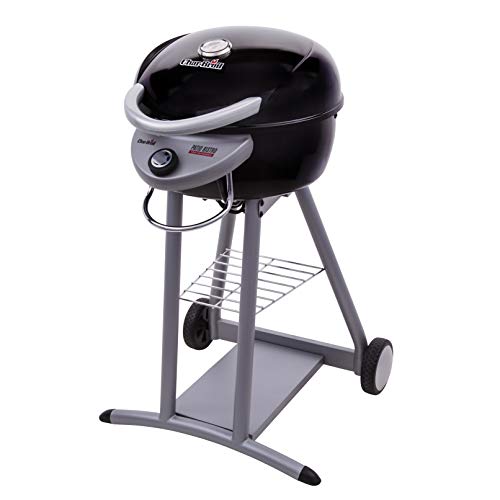
Char-Broil Patio Bistro TRU-Infrared Electric Grill — Best Overall Outdoor Electric
The Patio Bistro is the benchmark affordable outdoor electric: Char-Broil’s TRU-Infrared system puts an emitter plate between the element and the food, evening out hot spots and catching drips before they flare, under a real hinged lid on a patio-sized body. It suits balcony and small-patio cooks who want the gas-grill workflow — preheat, lid down, zones by placement — without gas.
Strengths
- Infrared emitter evens heat and reduces flare-ups and drying airflow
- Proper lid enables roasting and two-temperature cooking, not just contact grilling
- Patio format with storage below suits permanent balcony placement
Trade-offs
- Infrared plate needs regular cleaning to keep its pores open and heat even
- Heat recovery after loading is slower than gas; batch discipline matters
- Element power is capped by household current like every electric rival
| Fuel | Electric |
| Technology | TRU-Infrared (from Amazon title) |
| Format | Lidded patio bistro grill |
What the infrared plate buys you is forgiveness. Direct-element electrics scorch where the coil runs and steam between coils; the Bistro’s emitter spreads that energy across the whole grate, so chicken cooks evenly and vegetables char instead of stewing. It also catches fat above the element, which is where electric grill smoke and flare come from. Keep the emitter’s pores brushed clean — that single chore is the difference between this grill at month one and month twelve — and it delivers the most gas-like affordable electric cooking we verified. For a balcony that allows only electric, this is the default recommendation.
Best for: balcony and patio cooks wanting the most gas-like electric experience / Not suited for: anyone who loads a full grate of cold food and expects instant recovery
Check the current price on Amazon

Weber Lumin Compact Portable Electric Grill — Best Compact High-Heat
The Lumin Compact is what happens when a grill company that understands heat designs for a balcony: a small, tight-lidded electric that concentrates its output on a modest grate, reaches real grilling temperatures, and lifts away for storage when the season or the lease demands. It suits small-space cooks who grill for one to three people and refuse to accept steamed food as the price of permission.
Strengths
- Heat concentration on a compact grate gives the best browning in this class
- Lightweight and portable; stores indoors, extending its life
- Weber build and parts support in a category short on both
Trade-offs
- Compact grate means batch cooking for groups
- Premium pricing for its size class
- Cord reach still tethers you to an outlet
| Fuel | Electric |
| Format | Compact portable (from Amazon title) |
| Design | Built for small spaces (from Amazon title) |
Small is a feature in electric grilling, and the Lumin is the proof: by refusing to sprawl, it keeps its watts per square inch high, and its grate actually sears. The lid seals like a Weber, so it roasts credibly too — a small chicken or a tray of vegetables cooks in its own weather system rather than leaking heat to the balcony. Portability is the quiet second win: an electric grill that comes indoors for winter does not weather like one that cannot. If your household is small and your standards are not, this is the outdoor electric to buy.
Best for: small households and balconies where searing quality outranks capacity / Not suited for: anyone regularly cooking for five or more
Check the current price on Amazon

Cuisinart CEG-115 2-in-1 Portable Outdoor Electric Grill — Best Stand-or-Tabletop Flexibility
The CEG-115 is the flexible pick: a lidded electric grill that mounts on its included stand for patio use or lifts off for a tabletop, with a listing-rated 550°F top temperature that puts it at the hot end of household-current grilling. It suits cooks whose space changes — balcony this year, patio next — and anyone who wants one grill for home and campsite-with-power.
Strengths
- Stand-or-tabletop format adapts to balconies, patios, and powered campsites
- 550°F listing figure is the highest heat claim among these picks
- Lidded design roasts as well as grills
Trade-offs
- Verify the stand’s stability on your surface; lightweight stands reward level ground
- At full load, recovery still follows electric rules
- Smaller brand presence in grills than the category leaders
| Fuel | Electric |
| Max temperature | 550°F (from Amazon title) |
| Format | 2-in-1: stand or tabletop (from Amazon title) |
Flexibility is the CEG-115’s real specification. The stand solves the small-patio problem (no table sacrificed), the tabletop mode solves the storage and travel problem, and the heat figure — taken from its own listing — solves the electric category’s credibility problem better than most. In practice you will cook the way all successful electric grillers cook: full preheat, single layer, lid down, patience at the flip. Do that and this Cuisinart produces properly browned food in either of its two lives. For renters whose next home is unknown, it is the safest purchase in the guide.
Best for: renters and movers who need one grill for changing spaces / Not suited for: buyers wanting maximum grate size above all
Check the current price on Amazon
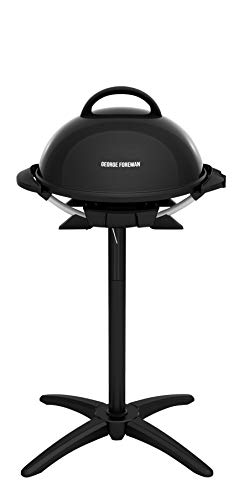
George Foreman Indoor/Outdoor Electric Grill with Stand, 15-Serving — Best for Outdoor Gatherings
Outdoor electric usually means small; this George Foreman is the exception that hosts. Its domed 15-serving surface on a stand parks on a deck or patio like a real grill, cooks for a gathering in one or two batches, and lifts off the stand for tabletop or indoor use when weather turns. It suits flame-free households that entertain.
Strengths
- Largest outdoor electric cooking surface in this guide
- Dome fits bulky food — whole chickens, big vegetable loads
- Stand removes for tabletop, indoor, or storage flexibility
Trade-offs
- Single dial control; no temperature readout
- Wide surface spreads its watts — preheat fully and avoid crowding
- Nonstick surface needs gentle tools
| Capacity | 15-serving (from Amazon title) |
| Stand | Removable (from Amazon title) |
| Format | Domed electric grill |
Capacity is this grill’s argument, and outdoors it lands: a neighborhood deck dinner of burgers, dogs, and corn is a two-batch job here instead of a four-batch siege on a compact electric. The dome matters more outside, where wind steals heat — it shelters the cooking from gusts better than open designs. The discipline is the familiar one: full preheat, single layer, lid down, and let the surface do batches rather than piles. Judged as the affordable way to feed a flame-free gathering outdoors, nothing else we verified comes close at this tier.
Best for: flame-free households that entertain outdoors / Not suited for: precision cooks or sear purists
Check the current price on Amazon
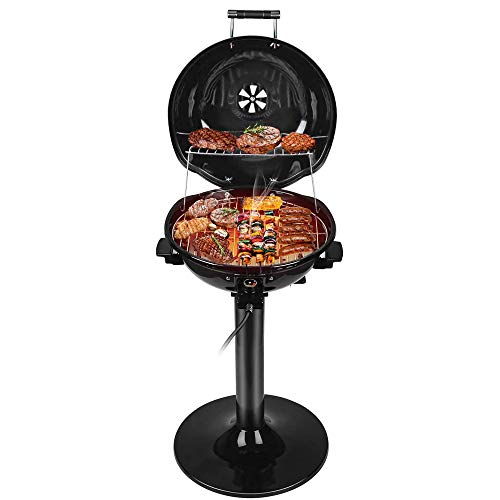
Techwood 15-Serving Indoor/Outdoor Electric Grill — Best Budget Big Grill
Techwood’s 15-serving grill is the value route to a big electric surface: a domed grill rated for family-size loads, with a double-layer arrangement that adds warming space above the main plate. It suits budget buyers feeding a household on a patio or balcony where flame is out and money is watched.
Strengths
- Family-size surface at the lowest tier in this guide
- Second layer handles warming, buns, and resting food
- Works indoors or out as the listing states
Trade-offs
- Fit, finish, and support trail the big-brand picks
- Heat spread across a big surface demands strict single-layer cooking
- Temperature control is a simple dial
| Capacity | 15-serving (from Amazon title) |
| Design | Double layer (from Amazon title) |
| Use | Indoor and outdoor (from Amazon title) |
This is the honest budget big grill: the surface is genuinely large, the concept is sound, and the compromises are the expected ones — simpler controls, lighter construction, and a support channel you hope not to test. Its double layer is more useful than it sounds outdoors, giving finished food a warm holding zone while the next batch cooks, which is how big electric grills serve a group without everything landing lukewarm. Keep it covered or store it under shelter, treat the surface gently, and it returns family-scale electric grilling for the least money here.
Best for: budget buyers feeding a family on a flame-free patio / Not suited for: buyers who prioritize build polish and brand support
Check the current price on Amazon

Techwood Smokeless Indoor Electric Grill with Glass Lid — Best for Covered Patios
This pick comes with its placement printed on the label: it is an indoor-format grill that earns its place in an outdoor guide because covered patios, lanais, and screened porches are where thousands of them actually live — outdoors in use, sheltered in storage. Its 1500W element and glass lid suit cooks grilling under a roof where smoke drift matters to the household.
Strengths
- 1500W element is properly sized for its plate
- Glass lid lets you watch without lifting and losing heat
- Open layout suits skewers and mixed grills under a covered patio
Trade-offs
- Not weatherproof: it must live under cover, never in open rain
- Open design smokes more than lidded infrared picks on fatty food
- Tabletop only; you provide the surface
| Power | 1500W (from Amazon title) |
| Lid | Glass lid (from Amazon title) |
Honesty about placement is this pick’s strength. On an open, rain-exposed deck it does not belong; under a patio roof it is a capable, affordable grill whose lid contains splatter and whose element has the wattage to brown honestly. The glass lid is a small daily pleasure — you can see the cheese melt and the edges crisp without breaking the heat seal. If your outdoor cooking happens under cover, as much balcony and lanai cooking does, this is a legitimate and inexpensive way to do it. If your patio is open to the sky, choose the Patio Bistro or the Lumin instead.
Best for: covered patios, lanais, and screened porches / Not suited for: open, rain-exposed decks — it is not weatherproof
Check the current price on Amazon
Comparison Table
| Pick | Badge | Key spec | Best for |
|---|---|---|---|
| Char-Broil Patio Bistro TRU-Infrared Electric Grill | Best Overall Outdoor Electric | TRU-Infrared electric, lidded patio format | balcony and patio cooks wanting the most gas-like electric experience |
| Weber Lumin Compact Portable Electric Grill | Best Compact High-Heat | Compact electric, high-heat design, portable | small households and balconies where searing quality outranks capacity |
| Cuisinart CEG-115 2-in-1 Portable Outdoor Electric Grill | Best Stand-or-Tabletop Flexibility | Reaches 550°F per Amazon title, stand or tabletop use | renters and movers who need one grill for changing spaces |
| George Foreman Indoor/Outdoor Electric Grill with Stand, 15-Serving | Best for Outdoor Gatherings | 15-serving domed surface, removable stand | flame-free households that entertain outdoors |
| Techwood 15-Serving Indoor/Outdoor Electric Grill | Best Budget Big Grill | 15-serving electric, double-layer design | budget buyers feeding a family on a flame-free patio |
| Techwood Smokeless Indoor Electric Grill with Glass Lid | Best for Covered Patios | 1500W element, glass lid, smokeless design | covered patios, lanais, and screened porches |
How to Choose the Best Affordable Outdoor Electric Grills
Outdoor electric grilling succeeds or fails on infrastructure: the outlet, the weather plan, and your preheat discipline. Choose with those three in mind and the model almost picks itself.
Heat concentration beats headline size, every time
Household current caps every grill in this category at similar total power, so the models that brown food are the ones that spend those watts on a smaller, tighter-lidded space. When comparing, look for infrared emitters, heavy plates, and lids that seal — and be suspicious of the largest surface at the lowest price, which is arithmetic working against browning. If you regularly cook for a crowd, accept batch cooking on a smaller, hotter grill rather than one steamed mega-batch on a big, weak one.
Plan the outlet before the grill
Outdoor electrics need a proper exterior outlet, ideally GFCI-protected, within the grill’s own cord reach. Extension cords are the category’s quiet hazard and performance killer: if one is unavoidable, it must be a short, heavy-gauge outdoor cord, never a household indoor cord, and never a chain of two. Measure from your outlet to your intended grill spot before ordering, and check whether the circuit is shared with other heavy loads that will trip it mid-cook.
Match the grill to your weather reality
Lidded, patio-format electrics like the Patio Bistro tolerate outdoor life under a cover. Tabletop and indoor-format models must live under a roof or come inside — water in an element housing is a fatal and unsafe event. Balconies add wind: domed and lidded designs hold heat in gusts that strip open plates bare. Choose for the patio you have in February, not the one in the listing photo.
Capacity claims need a single-layer translation
Serving counts assume food arranged like a puzzle with no breathing room. Translate any claim down by a third for real cooking, where pieces need space for steam to escape. A ’15-serving’ grill comfortably cooks for six to eight real people in a batch or two; a compact grill cooks for two to three. That translation, plus honest batch planning, is the difference between electric grilling that delights and electric grilling that disappoints.
GFCI, circuits, and the balcony outlet audit
Before the grill arrives, audit the power: the exterior outlet should be GFCI-protected (test it with its own test button), the circuit should not already carry another heavy load, and the grill’s cord should reach without strain. If the outlet is ancient, unprotected, or across a doorway, an electrician’s short visit is part of the purchase — cheaper than the grill, and it makes every future outdoor appliance safer too. Never defeat a tripping GFCI by moving to an unprotected outlet; a trip is information, not inconvenience.
Two-zone cooking on an electric grill
Electric grills have one element, but zones are still possible: the plate’s center runs hotter than its edges on most designs, and a lidded grill’s covered side holds gentler heat than the side you keep opening. Sear in the center, finish at the edges with the lid down, and use a small rack or foil boat to lift delicate items off direct heat. It is a humbler zoning than a two-burner’s, but combined with batch sequencing it covers the weeknight menu completely.
Living With an Outdoor Electric Grill: The Habits That Make It Work
Every successful outdoor electric griller converges on the same four habits. First, preheat like you mean it: a full ten minutes, lid down, before food is even seasoned. Electric elements store their advantage in the plate’s mass, and a rushed preheat spends the whole cook recovering. Second, cook dry: patted surfaces, marinades mostly wiped off, vegetables tossed in oil rather than dripping. Surface water is the tax every electric grill pays first, and dry food pays it in seconds instead of minutes.
Third, respect the batch. A single layer with gaps browns; a pile steams. The cooks who love these grills plate the first batch to rest under foil without apology and run the second while people pour drinks — the food is better and the cook is calmer. Fourth, keep the grease path clean and the grill covered or sheltered: fat left in a tray smokes on the next cook, and weather is the only true enemy these appliances have. None of this is difficult; all of it is the difference between the category’s fans and its one-star reviewers.
It is also worth saying what outdoor electric gives back that flame cannot: permission, silence, and pennies-per-cook running costs, plus a grill that is cool enough to bring in or cover within minutes of dinner. In the buildings and regions where these grills are necessary, they are not a compromise diet version of grilling — they are the only version, and used with the habits above they produce food your guests will not believe came off a balcony outlet.
Outdoor Electric Grilling in Bad Weather and Small Spaces: A Field Guide
Outdoor electric grills live where weather happens, so their ownership manual is partly meteorological. Wind is the everyday adversary: it strips heat from open plates and cools lids, turning a ten-minute preheat into fifteen and a sear into a simmer. The countermeasures are placement and patience — set the grill in the lee of a wall or railing, keep the lid down as a matter of religion, and extend preheats on gusty days without resentment. Lidded and domed models, which dominate this guide’s picks, are not a style preference outdoors; they are wind equipment.
Rain draws the category’s one hard line: electric grills are never operated in rain, with wet hands, or on standing water — full stop. What you can do is plan around weather like a sailor: cook under roof overhangs and covered patios where the grill itself stays dry, keep connections sheltered, and bring tabletop models in when storms threaten. A covered grill on a dry balcony cooks happily through a drizzly evening around it; an exposed grill in the same drizzle is a hazard, not a dinner plan. The distinction is the appliance’s dryness, not the sky’s mood.
Small spaces add their own discipline. Balcony grilling is neighbor cooking: smoke drifts, smells travel, and courtesy is a specification. Electric grills already minimize smoke compared with charcoal, and the habits from the how-to — dry food, clean grease tray, no sugary sauces over full heat — keep a balcony cookout welcome in the building. Heat clearances matter doubly in tight quarters: the grill’s manual clearances from railings, walls, and stored items are minimums, and a small space is where they get tested.
Storage closes the field guide. Patio-format electrics live under their covers; tabletop models live indoors, which is their secret longevity advantage — an appliance that winters in a closet does not age like one that winters on a deck. Cords should be coiled loosely, kept dry, and inspected each spring for nicks and stiffness. Do these unglamorous things and an outdoor electric grill becomes what its owners say it is: the most convenient grill they have ever owned, in the only place they are allowed to own one.
Menu Planning for Electric Heat: Cooking to the Appliance’s Strengths
Electric grills reward menus designed around steady, moderate, lid-down cooking — and punish menus borrowed from charcoal culture. The sweet spot is the great middle of grilling: burgers, sausages, chicken in all its forms, kebabs, fish, shellfish, vegetables, fruit, and flatbreads. These foods want exactly what an electric grill gives — even heat, a closed lid, and no flare-ups — and they come off the picks in this guide tasting like the patio versions of themselves, because they essentially are.
Sequence is the menu planner’s main tool, because an electric plate’s recovery is its scarcest resource. Cook in waves that respect it: the items that hold well — sausages, chicken, onions and peppers — first, resting under foil; the fast, juice-critical items — burgers, fish, asparagus — last, served straight off the heat. A menu planned this way feeds six people from a compact grill without a single steamed batch, which is why experienced electric grillers talk about order the way chefs talk about timing.
Thick cuts need a technique adjustment rather than an apology: the reverse approach works beautifully on lidded electrics. Start a thick steak or chop at the grill’s gentler setting under the lid until it nears its target internal temperature, rest it briefly, then finish it over the fully preheated plate’s hottest zone for the crust. The result will not be a charcoal crust — nothing on household current produces one — but it will be an evenly cooked, properly browned piece of meat, which is what dinner actually requires.
Dessert is the electric grill’s party trick, and worth planning for: pineapple spears, peach halves, pound cake slices, and bananas in their skins all grill quickly on a clean, cooling plate, caramelizing sugars that a dirty plate would turn bitter. Brush the plate, drop the heat, and give the meal its final course from the same appliance. Menus that end this way are how electric grills stop being the apartment compromise and start being the house tradition — planned around their strengths, which turn out to be most of the menu.
Accessories for Outdoor Electric Grills That Actually Matter
Electric grills need fewer accessories than any other category in this program, and the short list is worth stating plainly. First, the cover or the storage plan — weather is the only true enemy, and the accessory budget starts with defeating it. Second, an instant-read thermometer, which matters more on electric than on any other fuel because electric heat gives fewer visual cues: the food browns gently, the sizzle is quiet, and internal temperature is the only honest reporter in the kitchen. Third, a stiff nylon brush matched to your plate or emitter, because the wrong brush is how good surfaces become bad ones.
After those three, the list turns situational. A heavy-gauge short extension cord — bought once, correctly rated, and treated as part of the grill — serves patios whose outlet is almost in reach. A small side table or cart solves the balcony cook’s eternal shortage of horizontal surface for plates and tongs. Silicone-tipped tongs protect nonstick surfaces. A headlamp sounds like a joke until the first November cookout at 6 p.m., after which it becomes standard kit.
What does not matter: most of the grill-accessory aisle. Electric grills do not need chimney starters, ash tools, tank gauges, or pellet bins, and their owners should enjoy that simplicity rather than re-complicating it. The category’s whole economic charm is that the appliance, a cover, and a thermometer constitute the complete serious setup. Spend the savings on better food to put on it — that is the accessory strategy the appliance itself would recommend.
How to Set Up and Cook Outdoors on an Electric Grill
Setup is mostly electrical common sense and placement; the cooking routine then follows the same arc as any grill, with electric-specific discipline at the preheat and the load.
- Place the grill on a stable, level, non-combustible surface near the outlet, with clearance from walls, railings, and overhangs per the manual — and never under a low combustible ceiling.
- Plug directly into a GFCI-protected exterior outlet where possible. If a cord is unavoidable, use one short, heavy-gauge outdoor extension and keep connections off wet ground.
- Confirm the drip tray or water tray is in place before preheating — most electric grill smoke is fat hitting a hot element that a tray would have caught.
- Preheat ten minutes with the lid closed at your cooking setting. Use the wait to pat food dry and season it.
- Load a single layer with space between pieces, close the lid, and resist lifting it for the first several minutes — every peek costs heat an electric element replaces slowly.
- Flip once, finish to temperature with a thermometer for thick cuts, and rest food on a warm plate. Run subsequent batches back-to-back while the plate is at full heat.
- After cooking, let the grill cool, empty and wash the grease tray, wipe the plate or emitter as the manual directs, and cover or shelter the grill the same day.
Two or three cooks on this routine will calibrate your sense of your grill’s timing — electric grills reward cooks who learn their specific unit’s preheat and recovery, and punish improvisation less than they punish impatience.
Common Buying Mistakes
Using a household extension cord, or two cords chained. Undersized cords starve the element of power and overheat themselves. Direct outlet or one short heavy-gauge outdoor cord — nothing else.
Leaving a tabletop electric grill out in the rain. Indoor-format electrics are not weatherproof. One storm in the element housing ends the grill and creates a shock risk.
Judging electric grills by gas-grill habits. Lifting the lid every minute and crowding the plate are minor sins on gas and fatal ones on electric. Preheat, load once, lid down.
Skipping the drip tray ‘just this once.’ The tray is the smoke system. Without it, fat hits the element, the balcony fills with smoke, and the neighbors learn your menu.
Buying the biggest surface for the smallest outlet budget. Watts are fixed by your wiring; area is chosen by you. Oversized plates on household current steam food. Smaller and hotter wins.
Storing the cord draped and kinked. Cord damage is the leading electrical failure on these grills. Coil it loosely, keep it dry, and inspect it each season.
Final Recommendation
For most flame-free patios, the Char-Broil Patio Bistro is the outdoor electric to buy: infrared heat, a real lid, and a patio format that lives where it cooks. If your space is small and your standards high, the Weber Lumin Compact sears better than anything else here. The Cuisinart CEG-115 is the flexible renter’s pick, the George Foreman 15-Serving is the gathering pick, and the Techwood 15-Serving covers family capacity on the tightest budget.
The covered-patio Techwood with the glass lid rounds out the list for lanai and porch cooks — placed honestly, used under cover. Whichever you choose, wire it properly, preheat it fully, and keep its grease path clean, and an outdoor electric grill will quietly out-cook the expectations everyone brought to it.
- Char-Broil Patio Bistro TRU-Infrared Electric Grill — Check the current price on Amazon
- Weber Lumin Compact Portable Electric Grill — Check the current price on Amazon
- Cuisinart CEG-115 2-in-1 Portable Outdoor Electric Grill — Check the current price on Amazon
Keep exploring the grills in this series: Best Affordable Grills Best Affordable Indoor Grills Best Affordable Electric Grills Best Affordable Natural Gas Grills Best Affordale Grills Best Affordsble Grills
Frequently Asked Questions
Can an outdoor electric grill really sear meat?
It can brown and mark meat convincingly when the design concentrates its power — infrared emitters, compact grates, and tight lids are the tells — and when you preheat fully and cook dry, uncrowded food. It will not match a charcoal fire’s crust on a thick steak, but burgers, chicken, sausages, and vegetables come off these grills properly grilled, not steamed.
Are outdoor electric grills allowed in apartments and condos?
They are the most commonly permitted grill type where flame is banned, because there is no combustion, no fuel storage, and no open flame. Rules vary by building and municipality, though — some leases restrict all balcony cooking — so confirm your specific rules before buying, and keep the grill’s electric nature documented if a landlord asks.
Can I use an extension cord with an outdoor electric grill?
Manufacturers prefer a direct outlet connection. If distance forces a cord, use a single short, heavy-gauge cord rated for outdoor use and the grill’s full wattage, keep the connection dry and off the ground where possible, and never chain cords or use an indoor household cord — undersized cords both starve the grill and overheat.
How do outdoor electric grills handle rain and weather?
Patio-format models are built for outdoor life but still need a cover and should never run in rain. Tabletop and indoor-format models are not weatherproof at all and must be sheltered or brought inside. No electric grill should be operated in wet conditions or with wet hands on the controls — that is a hard safety line, not a preference.
What size outdoor electric grill do I need?
Translate serving claims down by about a third for real, uncrowded cooking. Compact models suit one to three people; the big 15-serving stand models handle family dinners and small gatherings in a batch or two. If you entertain often in a flame-free home, capacity matters more than sear nuance — buy the stand models.
Are electric grills expensive to run?
No — they are the cheapest grills in this entire program to operate. A cook uses roughly what a microwave or kettle uses over a similar period, with no charcoal, propane, or pellets to buy, store, or run out of. For balcony cooks especially, the running cost is effectively negligible.
Can I leave an outdoor electric grill outside all year?
Patio-format models are built for outdoor life under a cover, and that is a reasonable way to keep them — with the cord inspected seasonally and the grease tray never left full into winter. Tabletop and indoor-format models should be stored indoors or under solid shelter. No electric grill, whatever its format, should be operated in rain or left with its connections exposed to standing water.
Can I use an outdoor electric grill under a covered balcony or awning?
Generally yes, provided the grill itself stays dry, clearances from the manual are respected, and the covering is not a low combustible ceiling. Covered placement is actually the ideal for electrics — it is what the covered-patio pick in this guide is for. What is never acceptable is operating any electric grill in falling rain or with wet connections, covered or not.
How long do outdoor electric grills take to preheat, honestly?
Plan on ten minutes with the lid closed for a full preheat — longer in wind or cold — because the plate’s stored heat is the searing budget you will spend on the food. That sounds slow next to gas, but it overlaps completely with seasoning the food and carrying it out, and it is not optional: an electric grill loaded early is a steamer, while the same grill loaded on time is a grill. Build the ten minutes into the routine and it disappears; skip it and every other technique in this guide is fighting uphill.
Do outdoor electric grills work in winter?
Yes, with the same adjustments as every outdoor grill and one of their own: preheats run longer, lids stay down, and batches stay disciplined, while the element works against the cold air the whole cook. The electric-specific note is the cord and connections — keep them dry, keep them out of slush and standing meltwater, and never operate in falling snow or rain. Many balcony owners find winter is when the electric grill earns its place most, precisely because there is no fuel to freeze, gel, or run out.


