Disclosure: airfryerkitchensupply.com is reader-supported. When you buy through links on our site, we may earn an affiliate commission at no extra cost to you.
Where to buy
If you are shopping for the best affordable indoor grills, start with the verified shortlist below — every model was confirmed against a live Amazon listing before it earned a place here. Indoor grills split into three honest families: grill-and-air-fryer combos with lids and thermometers, open searing grills that mimic a patio grill on a counter, and contact griddles that press both sides at once. This list covers all three, because ‘indoor grill’ means a different appliance depending on your kitchen.
One rule before the picks: an indoor grill is not a smokeless miracle, whatever the box says. All cooking produces some smoke and splatter; the best designs manage it with lids, water trays, and smoke extractors. Confirm wattage and dimensions on the listing and check the current price on Amazon before ordering.
- Ninja Foodi Smart XL 6-in-1 Indoor Grill & Air Fryer DG551 (Best Overall) — Check the current price on Amazon
- Hamilton Beach Electric Indoor Searing Grill with Lid & Viewing Window (Best Open Searing Grill) — Check the current price on Amazon
- George Foreman Indoor/Outdoor Electric Grill with Stand, 15-Serving (Best for Feeding a Crowd Indoors) — Check the current price on Amazon
- Techwood Indoor Smokeless Grill with Turbo Smoke Extractor (Best Smoke Control) — Check the current price on Amazon
- Cuisinart Griddler FIVE GR-5B (Best Contact Grill & Griddler) — Check the current price on Amazon
- Chefman Smokeless Indoor Electric Grill XL (Best Budget XL Open Grill) — Check the current price on Amazon
The best affordable indoor grills solve a specific problem: getting grilled food — real browning, real grill marks, fat rendered away — in a kitchen, in winter, in an apartment where the patio grill is banned, impractical, or three floors down. The affordable end of this category is crowded with flimsy contact grills that steam a chicken breast grey and call it grilling. The six picks here were chosen because each one genuinely browns food, manages its own mess, and cleans up without a fight.
Three designs dominate. Lidded grill-and-air-fryer combos, led by the Ninja Foodi line, circulate superheated air over a heavy grill grate and produce the closest thing to outdoor results indoors, with the bonus of air frying in the same footprint. Open searing grills put a single ridged plate under a lid or splatter shield and behave most like a small patio grill. Contact grills and griddlers press food between two plates — fastest for sandwiches, burgers, and thin cuts, and the easiest to clean because the plates pop off and go in the sink.
Affordable here means you choose your compromise knowingly. You give up the cavernous capacity of premium multi-cookers, some temperature precision, and occasionally a dishwasher-safe part or two. You should not give up even heating, a thermostat that cycles honestly, or plates whose coating survives a year of weekly use. The reviews below are specific about which compromise each pick asks for.
In this guide
Quick Picks
Ninja Foodi Smart XL 6-in-1 Indoor Grill & Air Fryer DG551 — Best Overall. A lidded grill that air fries too, with a leave-in thermometer that ends the guesswork on thick cuts.
Hamilton Beach Electric Indoor Searing Grill with Lid & Viewing Window — Best Open Searing Grill. A patio-grill layout shrunk for the counter: one ridged plate, a real lid, and a window so you stop peeking.
George Foreman Indoor/Outdoor Electric Grill with Stand, 15-Serving — Best for Feeding a Crowd Indoors. The biggest affordable indoor cooking surface here, on a stand that frees your counter entirely.
Techwood Indoor Smokeless Grill with Turbo Smoke Extractor — Best Smoke Control. A fan pulls smoke down through a water tray as you cook — the most serious smoke management at this price tier.
Cuisinart Griddler FIVE GR-5B — Best Contact Grill & Griddler. Five appliances in one footprint: contact grill, panini press, full grill, full griddle, and half-and-half.
Chefman Smokeless Indoor Electric Grill XL — Best Budget XL Open Grill. An extra-large open plate with a water tray under it — the budget route to grilling for more than two.
How These Picks Were Chosen
Every candidate was verified against a live Amazon listing on the day this guide was written; listings whose titles did not match the intended model were rejected, which removed several lookalike units with inflated claims. Verification matters indoors more than outdoors, because copycat indoor grills borrow the shapes of the good ones while shipping weaker elements and thinner plates.
Scoring weighted browning ability first: wattage relative to plate size, whether the grill recovers heat after cold food lands, and whether marks are seared or merely steamed onto the surface. Smoke and splatter management came second — lids, splatter shields, water trays, and extractor fans were all credited, but no pick was allowed to claim ‘smokeless’ without a mechanism that plausibly reduces smoke. Cleanup was third: removable plates, drip trays that actually catch the fat, and coatings that release food were scored from design and specification, because a grill that is miserable to wash will live in a cupboard.
The six survivors cover the realistic indoor scenarios: best overall combo, best open searing grill, best big-family electric, best smokeless extractor design, best contact griddler, and best stand model for kitchens with no counter to spare. The buying guide explains the physics behind the scores so you can judge any other model you meet.
One more screening note specific to this category: we treated the word ‘smokeless’ as a claim requiring a mechanism, and you should too. Models earned their place here with water trays, extractor fans, lids, or splatter management visible in their design and listings — not with the adjective alone. If you shop beyond this list, apply the same test: find the mechanism in the product description, in words, or assume the grill smokes like the frying pan it functionally is.
The 6 Best Affordable Indoor Grills
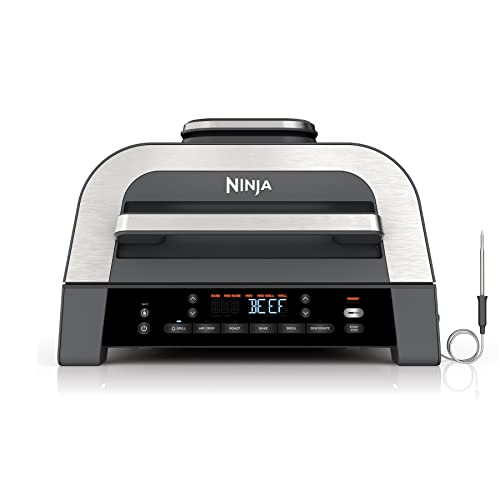
Ninja Foodi Smart XL 6-in-1 Indoor Grill & Air Fryer DG551 — Best Overall
The DG551 is the indoor grill for people who cook thick food: steaks, pork chops, whole chicken breasts, salmon fillets with skin. Its heavy grill grate sits in a lidded chamber where superheated air circulates, so food cooks from the top while it sears from below, and the included Smart Thermometer reads the interior and tells the grill when to stop. It suits serious weeknight cooks with the counter space to give it a permanent home.
Strengths
- Smart Thermometer cooks to a target internal temperature, not a timer guess
- Air fry function makes the footprint earn its keep beyond grilling
- Heavy grate produces real sear marks and holds heat through a full load
Trade-offs
- Large countertop footprint and tall with the lid open
- Lid and splatter screen need regular washing to keep smoke down
- Most expensive pick in this guide, though still the affordable end of its class
| Functions | 6-in-1 indoor grill and air fryer (from Amazon title) |
| Thermometer | Foodi Smart Thermometer included (from Amazon title) |
| Format | XL countertop, lidded |
What separates the Foodi from cheap lidded grills is thermal mass plus feedback. The grate is heavy enough to stay hot when cold steaks land, and the thermometer closes the loop that most indoor grilling leaves open: instead of cutting into a chop to check, you cook to temperature and rest it, which is how restaurants produce consistent results. The air-crisp mode is not a gimmick bolted on — it makes this the single appliance a small kitchen can justify, replacing a separate air fryer. Smoke is managed, not eliminated: fatty burgers will still haze a small kitchen, so cook near the range hood. Within that honesty, this is the most capable affordable indoor grill we verified.
Best for: cooks who grill thick cuts indoors and want doneness without guesswork / Not suited for: tiny kitchens with no spare counter, or buyers who only make sandwiches
Check the current price on Amazon

Hamilton Beach Electric Indoor Searing Grill with Lid & Viewing Window — Best Open Searing Grill
Hamilton Beach’s searing grill is the closest affordable analogue to a small outdoor grill: food sits on a ridged plate under a hinged lid, fat drains to a tray, and a viewing window lets you watch without dumping the heat every thirty seconds. It suits cooks who want the outdoor grilling workflow — flip once, lid down — without stepping outside.
Strengths
- Lid traps heat for thicker cuts and melts cheese properly
- Viewing window reduces lid-lifting and the heat loss that comes with it
- Removable plate and drip tray simplify cleanup
Trade-offs
- Open-plate design splatters more than contact grills
- Temperature dial is marked in ranges rather than precise degrees
- Footprint is wide for the cooking area it returns
| Format | Open searing grill with hinged lid |
| Lid | Viewing window in lid (from Amazon title) |
The viewing window sounds like a gimmick until you have cooked on lidded indoor grills without one: every check costs the heat you spent minutes building, and indoor elements recover slowly. This grill’s other virtue is honesty — it does not promise to air fry, dehydrate, or replace your oven; it grills, with a sear zone hot enough for burgers and steaks of normal thickness, and its parts come apart for the sink. Fat management is competent rather than brilliant, so very fatty foods still smoke a little. For the classic burger-chicken-vegetable rotation, it is the most patio-like affordable experience on this list.
Best for: cooks who want outdoor-style grilling workflow on a countertop / Not suited for: anyone whose priority is the absolute minimum smoke and splatter
Check the current price on Amazon
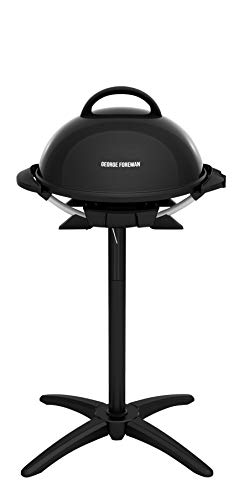
George Foreman Indoor/Outdoor Electric Grill with Stand, 15-Serving — Best for Feeding a Crowd Indoors
Most indoor grills are sized for two people and a side dish. This George Foreman is the exception: a domed 15-serving surface that can grill for a family or a small gathering, mounted on a stand that removes when you want it on a counter or a balcony. It suits households whose indoor grill has to feed everyone, not just demonstrate the concept.
Strengths
- Largest cooking surface among the affordable indoor picks
- Stand removes, so it needs no counter space at all in standing mode
- Dome lid handles thick cuts and a whole chicken better than flat grills
Trade-offs
- Single temperature dial; no precise control or thermometer
- Nonstick surface demands gentle tools and washing
- Big to store if you do not leave it assembled
| Capacity | 15-serving (from Amazon title) |
| Stand | Removable; tabletop or standing use (from Amazon title) |
| Format | Domed electric grill |
Capacity changes what an indoor grill is for. On this surface you can grill eight burgers with room for onions alongside, or a spatchcock chicken without crowding — and crowding is the enemy of browning indoors, where elements are weak and steam is the default failure mode. The trade is precision: one dial, no probe, and heat that favors patience over crust. Cook in a single layer, preheat fully, and keep the dome down, and it produces honest grilled food at family scale for apartment money. In standing mode it also solves the small-kitchen problem completely, which no countertop rival here can claim.
Best for: families and gatherings in flame-free homes / Not suited for: precision cooks who want temperature readouts and probes
Check the current price on Amazon

Techwood Indoor Smokeless Grill with Turbo Smoke Extractor — Best Smoke Control
Techwood’s approach to indoor grilling is mechanical rather than magical: a fan draws smoke and grease vapor down into a water tray before it can fill the kitchen, over a 1500W element that is properly sized for its plate. It suits apartment cooks whose smoke alarm is the real head chef, and anyone grilling fatty food indoors regularly.
Strengths
- Extractor fan and water tray visibly reduce airborne smoke
- 1500W element gives the plate genuine searing power
- Open layout fits skewers, Korean-BBQ-style spreads, and mixed grills
Trade-offs
- Fan adds noise and one more part to clean
- Water tray needs refilling on long, fatty cooks
- Brand support and parts are thinner than the big names here
| Power | 1500W (from Amazon title) |
| Smoke control | Turbo smoke extractor (from Amazon title) |
Every indoor grill should be judged on its worst cook, not its best: a tray of fatty sausages or marinated short ribs at full heat. That is where extractor designs earn their price, because the smoke is captured at the plate instead of at your ceiling. The Techwood’s fan noise is real but modest — think range hood on low — and the water tray does need attention on long cooks. In exchange, this is the pick that lets a small apartment grill marinated, fatty, genuinely smoky-tasting food on a weeknight without opening every window in January. If smoke is your binding constraint, this is your grill.
Best for: apartment cooks grilling fatty or marinated food indoors / Not suited for: buyers who want the quietest possible appliance or big-brand parts support
Check the current price on Amazon

Cuisinart Griddler FIVE GR-5B — Best Contact Grill & Griddler
The Griddler FIVE is the contact-grill answer for small kitchens that cook breakfast as seriously as dinner. Its reversible plates flip between ridged grill and flat griddle, the hinge floats to press thick sandwiches evenly, and opened flat it becomes a double griddle for pancakes and eggs. It suits couples and small households that want one appliance to cover the whole day.
Strengths
- Reversible plates cover grilling, griddling, and panini pressing
- Plates remove for washing — the cleanup benchmark of this guide
- Floating hinge presses thick food evenly instead of squeezing it out the back
Trade-offs
- Contact cooking area is sized for two to four servings, not a crowd
- Pressed cooking squeezes juices from thick steaks; use the open mode for those
- Controls are dials rather than digital readouts
| Functions | Contact grill / griddle / panini press (Griddler FIVE) |
| Plates | Reversible grill and griddle plates |
Contact grills live or die by their plates, and Cuisinart’s are the affordable benchmark: they heat evenly, release food cleanly, and survive the dishwasher, which is why Griddlers remain in daily use years after cheaper presses have been donated. The honest limitation is format — a contact press is the wrong tool for a thick ribeye or bone-in chicken, though the flat-open griddle mode covers more than people expect, including burgers with a proper smash. Buy it as the small kitchen’s hardest-working appliance rather than as a steak machine, and it will be the most-used pick in this guide.
Best for: small kitchens wanting one appliance for breakfast, sandwiches, and weeknight grilling / Not suited for: anyone regularly grilling thick, bone-in cuts
Check the current price on Amazon

Chefman Smokeless Indoor Electric Grill XL — Best Budget XL Open Grill
Chefman’s XL is the straightforward bargain of this list: a big nonstick ridged plate, a temperature dial, and a water tray beneath that catches fat and knocks down smoke, at the affordable end of the category. It suits budget buyers feeding three or four people who want an open-grill layout without paying for a combo appliance.
Strengths
- Extra-large surface cooks for a small family in one batch
- Water tray catches drips and reduces smoke at the source
- Simple dial controls with nothing to program or break
Trade-offs
- Heat recovery is slower than the premium picks; avoid overloading the plate
- Nonstick coating needs gentle handling to last
- No lid, so thick cuts cook unevenly without a flip-and-rest routine
| Format | Open tabletop electric grill, extra large |
| Surface | Nonstick (from Amazon title) |
The discipline this grill rewards is batch honesty: preheat it fully, cook in a single uncrowded layer, and it browns burgers, chicken, and vegetables convincingly. Overload it and the plate temperature sags, food steams in its own juices, and you will blame the grill for a loading error. The water tray is an old, effective trick — fat drips into water instead of onto a hot element, which is where most indoor grill smoke is actually born. At its tier, with expectations set correctly, it delivers the core indoor grilling experience for the least money in this roundup.
Best for: budget buyers feeding three or four on an open grill / Not suited for: cooks who load the plate edge to edge or want a lid for thick cuts
Check the current price on Amazon
Comparison Table
| Pick | Badge | Key spec | Best for |
|---|---|---|---|
| Ninja Foodi Smart XL 6-in-1 Indoor Grill & Air Fryer DG551 | Best Overall | 6-in-1 grill + air fryer, Smart Thermometer included | cooks who grill thick cuts indoors and want doneness without guesswork |
| Hamilton Beach Electric Indoor Searing Grill with Lid & Viewing Window | Best Open Searing Grill | Lidded searing grill with viewing window | cooks who want outdoor-style grilling workflow on a countertop |
| George Foreman Indoor/Outdoor Electric Grill with Stand, 15-Serving | Best for Feeding a Crowd Indoors | 15-serving domed surface, removable stand | families and gatherings in flame-free homes |
| Techwood Indoor Smokeless Grill with Turbo Smoke Extractor | Best Smoke Control | 1500W element, turbo smoke extractor fan | apartment cooks grilling fatty or marinated food indoors |
| Cuisinart Griddler FIVE GR-5B | Best Contact Grill & Griddler | 5-in-1 contact grill, griddle, and panini press | small kitchens wanting one appliance for breakfast, sandwiches, and weeknight grilling |
| Chefman Smokeless Indoor Electric Grill XL | Best Budget XL Open Grill | Extra-large nonstick surface, water tray smoke control | budget buyers feeding three or four on an open grill |
How to Choose the Best Affordable Indoor Grills Without Buying a Steamer
Indoor grills fail in predictable ways — weak elements, lying thermostats, plates that shed their coating. The four checks below separate the affordable grills that brown food from the ones that merely warm it indoors.
Wattage per plate is the number that predicts browning
An indoor grill runs on a household outlet, so its element is capped by your wiring, not the maker’s ambition. What matters is how that power is concentrated: a strong element under a modest plate sears; the same element spread under a huge plate steams. When comparing models, favor the one whose cooking area looks almost small for its wattage, preheat every indoor grill for a full five to ten minutes, and treat any model that suggests loading cold food onto a cold plate as confessing it cannot sear.
Pick the format that matches your food, not your fantasy
Lidded combos like the Ninja Foodi grill thick cuts best and add air frying. Open searing grills like the Hamilton Beach mimic patio cooking and handle mixed loads with a flip. Contact griddlers like the Cuisinart are fastest for sandwiches, burgers, and breakfast, and clean up easiest. Stand electrics solve space and capacity. Buying the format for the food you cook weekly — not the aspirational brisket — is the whole secret of this category.
Smoke management is engineering, not adjectives
Ignore the word smokeless and look for the mechanism. Water trays catch fat before it hits the element. Extractor fans pull vapor down and filter it. Lids and splatter screens contain and condense grease. A grill with none of these will smoke exactly like a frying pan, because that is what it is. Also cook smart: leaner cuts, patted-dry surfaces, and marinades wiped mostly off produce dramatically less smoke on any indoor grill.
Cleanup decides whether you will still use it in March
Removable plates that fit in a sink or dishwasher, a drip tray that slides out instead of a grease channel you excavate, and coatings from makers with a track record — these unglamorous details predict daily use better than any feature list. Built-in plates you must wipe in place, around a hot element, are why so many indoor grills become cupboard ballast. Every pick in this guide was screened on exactly this point.
Counter space planning: measure the open lid, not the box
The dimension that decides whether an indoor grill fits your kitchen is its footprint with the lid fully open, plus working room in front for a plate and tongs. Lidded combos need vertical clearance under cabinets; contact grills need depth for their floating hinges; stand models need floor, not counter. Measure your intended spot with a tape before ordering, and be honest about whether the grill will live out (used weekly) or be stored (used monthly, at best). A slightly smaller grill that lives on the counter will out-cook a bigger one that lives in a cupboard.
What ‘serving size’ claims mean indoors
Indoor grill capacities assume food arranged edge to edge in a single layer with no working room — a theoretical maximum, not a dinner plan. Translate claims down by about a third: a ’15-serving’ surface feeds six to eight real people in a batch or two, and a compact contact grill feeds two. If your household is five or more and the indoor grill is a primary appliance, capacity is the specification to prioritize; if it is a two-person weeknight tool, browning quality matters more than area.
Indoor Grilling Physics: Why Some Affordable Models Brown and Others Steam
Every indoor grill is fighting the same enemy: water. Meat is mostly water, its surface must dry before it can brown, and browning chemistry only begins well above the boiling point of water. Outdoors, a charcoal fire delivers so much surplus heat that the surface dries in seconds. Indoors, a household outlet delivers a fraction of that power, so the margin between searing and steaming is thin — and it is decided by plate mass, preheat discipline, and how crowded the plate is.
This is why heavy grates and plates matter more indoors than out. A thick plate is a heat battery: it stores energy during the preheat and spends it on the cold food, holding surface temperature in the browning zone instead of collapsing into the steaming zone. It is also why patting food dry, salting ahead of time, and cooking in uncrowded batches transform results on the exact same appliance. The cooks who love their affordable indoor grills have almost always learned these three habits; the cooks who hate theirs are usually crowding a cold plate with wet food, a combination no indoor grill at any price survives.
Finally, manage expectations about smoke with the same physics. Smoke comes from fat and marinade hitting surfaces far hotter than the food needs. Water trays, lids, and extractors intercept that fat; leaner cuts and wiped marinades produce less of it. An affordable indoor grill used with dry surfaces and a mechanism for fat will keep a normal kitchen comfortable. One used as a saucing station for fatty cuts will set off the alarm — and that is a technique problem wearing an appliance costume.
Indoor Grill Safety and Ventilation: The Unglamorous Essentials
Indoor grills are electrical appliances that make smoke on purpose’s doorstep, so their safety routine deserves the same seriousness as their cooking routine. Start with the circuit: these are high-wattage appliances, and they should run on a kitchen circuit without sharing it with another heavy load — a microwave and a grill on one circuit is a tripped breaker and, occasionally, worse. Cords stay off hot surfaces and out of walkways, and the grill itself keeps the clearances its manual states from cabinets, curtains, and paper goods. None of this is exotic; all of it is the difference between an appliance and an incident.
Ventilation is the second essential, and it is simpler than the internet suggests. Cook under or near the range hood with it actually running — the hood most kitchens have is the smoke system indoor grills were designed around. Where no hood exists, a nearby window with a small fan exhausting outward does the same job. What does not work is hoping: an extractor model reduces smoke at the plate, but the room still benefits from somewhere for warm, fragrant air to go. Plan the airflow when you plan the menu, especially for fatty or marinated food.
Grease is the third essential, and it is a storage question as much as a cooking one. Drip trays and water trays must be emptied after every cook — fat left in a warm appliance is a odor source today and a smoke source tomorrow. Never move an indoor grill while its tray holds hot fat, and never pour hot fat into a plastic sink or a bag-lined bin. Let it cool, solidify what you can, and dispose of it like the cooking byproduct it is. These habits take ninety seconds; they are also the entire fire-prevention program of indoor grilling.
Finally, respect the appliance’s actual rating. Indoor grills are for indoor surfaces — heat-safe counters, not beds, sofas, or carpeted floors in dorm improvisation. Models with stands belong on level floors; tabletop models belong on stable, heat-resistant surfaces with their cords routed safely. The category’s accidents are overwhelmingly placement accidents, not product failures. Set the grill up like a kitchen appliance, ventilate like a cook, and clean the grease like it matters — because indoors, it is the whole ballgame.
Your First Month of Indoor Grilling: A Menu That Teaches the Appliance
Week one is for the foods indoor grills were born to cook: burgers, boneless chicken breasts, and sausages, in single uncrowded layers, with the preheat treated as sacred. These cooks teach your specific unit’s timing — how long its plate truly takes to recover, where its hot center sits, how its lid behaves with cheese. Take the small notes the how-to recommends. By the end of the week the appliance’s personality is documented, and every later cook spends that knowledge.
Week two adds vegetables and delicate proteins: asparagus, zucchini planks, mushrooms, salmon and firm white fish. These teach the gentle half of the dial and the value of dry surfaces — vegetables oiled and seasoned before they meet the plate, fish patted dry and left alone until it releases. This is also the week to test your smoke management honestly: cook the fattiest thing on your regular menu and learn what your kitchen, hood, and chosen model do with it, on a night when the answer does not matter socially.
Week three is for the format-specific skills: paninis and breakfast on the contact and griddle picks, thick chops and steaks with the thermometer on the lidded combos, skewers and marinated items on the open and extractor models. Each cook should stretch exactly one variable — thickness, marinade, load size — so the results stay interpretable. This is also the week most owners discover their grill’s signature dish, the one that enters the permanent rotation, and it is rarely the dish they bought the grill for.
Week four is integration: a full meal from the grill alone — protein, vegetables, and a grilled bread or fruit for dessert — sequenced the way the portable cooks in this program sequence a tailgate. If the month has gone as designed, the indoor grill has stopped being a gadget and become infrastructure: the weeknight answer that lives on the counter, gets used without ceremony, and produces grilled food in weather and housing situations where grilling used to be impossible. That transformation, not any single meal, is what the affordable indoor category is actually selling.
Keeping Nonstick Plates Alive: The Indoor Grill Cleaning Routine
Nonstick plates die by a thousand small cuts, and the routine that saves them is boring enough to actually happen. While the plate is still warm — not hot — wipe it with a damp paper towel or soft cloth; most residue releases at this stage without any scrubbing at all. For stuck food, the trick is patience: a wet paper towel laid over the warm plate for five minutes softens what a scraper would have gouged. Then wash removable plates in warm soapy water with a soft sponge, dry them fully, and store them without stacking anything abrasive on the cooking surface.
The prohibitions are equally simple. No metal utensils on the coating — silicone, nylon, or wood only. No abrasive pads, no oven cleaner, no soaking of any part that carries an element or a cord. The drip tray, by contrast, can take real washing and should get it after every cook, because old fat is both a flavor and a smoke problem. The exterior wipes down with a damp cloth; the cord gets inspected while you are there, because indoor appliances live in drawers and get their cords pinched for a living.
Followed weekly, this routine is the difference between plates that release food in year three and plates that grip it in month six — and since several picks in this guide built their value case on their plates, protecting them is protecting the purchase. An indoor grill with living nonstick is a pleasure; the same grill with dead coating is a smoke machine with a grudge. Five minutes of warm wiping is the whole insurance policy, and it is the cheapest one in this entire program.
How to Use an Indoor Grill for Real Browning, Step by Step
These steps apply to every pick in this guide and matter more than which one you bought. Indoor grilling is a technique category disguised as an appliance category.
- Preheat fully — five to ten minutes at your target setting with the lid closed where there is one. Indoor elements are slow; a plate that feels hot to a hovering hand is not yet at searing temperature throughout its mass.
- Pat the food completely dry with paper towels, then season. Surface moisture is the single biggest cause of grey, steamed results indoors.
- Oil the food, not the plate: a thin film of high-heat oil on the meat or vegetables seasons the surface without pooling and smoking on the plate.
- Load in a single layer with space between pieces. Steam from neighboring pieces is what drops a crowded plate out of the browning zone.
- Close the lid or shield and leave the food alone until it releases easily. Food that sticks is food whose crust has not formed; it will let go when it is ready.
- Use a thermometer for anything thicker than a burger. Indoor grills vary; internal temperature does not. Rest meat on a warm plate for five minutes before cutting.
- Empty the drip tray or water tray after every cook, and wash removable plates while the kitchen is still in cleanup mode. Fat left in the tray is tomorrow’s smoke, pre-loaded.
Keep a small notebook for the first month: setting used, preheat time, result. Indoor grills have personalities, and two or three notes per food will calibrate yours faster than any manual. After that, the appliance disappears and only the routine remains — which is the sign the routine is right.
Common Buying Mistakes
Loading the plate before it is fully preheated. Indoor elements cannot recover the way a charcoal fire does. A rushed start steams the whole batch, and no amount of extra time restores the crust.
Crowding the surface to finish faster. Overlapping pieces trap steam and drop plate temperature. Two honest batches brown better and take barely longer than one steamed one.
Believing the word ‘smokeless’ on the box. No indoor grill is smokeless. Buy the mechanism — water tray, extractor, lid — and cook lean and dry when smoke matters most.
Using metal tools and abrasive pads on nonstick plates. Scratched coatings stick, then smoke, then fail. Silicone or nylon tools and a soft sponge are the whole maintenance program.
Pressing burgers and steaks down hard on a contact grill. You are squeezing out juice, not adding crust. Let the hinge float; contact and time make the marks.
Storing the grill with a dirty drip tray. Old fat is the main source of off flavors and smoke on the next cook. The tray takes thirty seconds; make it part of the cook, not a separate chore.
Final Recommendation
Start with the format decision and the rest follows. For the best all-round indoor grilling — thick cuts, real sear, doneness without guesswork — the Ninja Foodi Smart XL DG551 is the pick, and its air fryer mode means it replaces two appliances. For the patio workflow on a counter, take the Hamilton Beach Searing Grill; for family capacity without flame, the George Foreman 15-Serving on its stand.
If smoke is the constraint that rules your kitchen, the Techwood extractor model is the honest answer; if cleanup and breakfast versatility rule it, the Cuisinart Griddler FIVE will be used daily; and if the budget rules it, the Chefman XL covers the basics at the lowest tier, provided you preheat it properly and do not crowd it. Whichever you choose, learn the dry-surface, single-layer routine in the how-to section — indoors, technique is half the appliance.
- Ninja Foodi Smart XL 6-in-1 Indoor Grill & Air Fryer DG551 — Check the current price on Amazon
- Hamilton Beach Electric Indoor Searing Grill with Lid & Viewing Window — Check the current price on Amazon
- George Foreman Indoor/Outdoor Electric Grill with Stand, 15-Serving — Check the current price on Amazon
Keep exploring the grills in this series: Best Affordable Grills Best Affordable Outdoor Electric Grills Best Affordable Propane Grills Best Affordable Pellet Grills Best Affordale Grills Best Affordsble Grills
Frequently Asked Questions
Are indoor grills really smokeless?
No — and any box claiming otherwise is marketing. What good indoor grills do is manage smoke: water trays catch fat before it vaporizes, extractor fans pull vapor away from the plate, and lids condense grease. Combined with dry food surfaces and leaner cuts, these mechanisms keep a normal kitchen comfortable. Fatty, heavily marinated food will still produce visible smoke on any indoor grill.
Can an indoor grill match outdoor grill flavor?
It can match browning and grill marks, and lidded air-circulating models come surprisingly close on texture. What it cannot reproduce is wood or charcoal smoke flavor, because there is no combustion. Smoked paprika, a finishing brush of sauce, and proper resting get you closer than most people expect, but a kettle will always win on smoke.
How much counter space do I need for an indoor grill?
Measure with the lid open — lidded models need vertical clearance under cabinets, and all models need a few inches of breathing room around them for heat. Contact griddlers are the most compact; stand models like the George Foreman need no counter at all. If space is tight, choose the format first and the model second.
What foods cook best on affordable indoor grills?
Burgers, boneless chicken, sausages, kebabs, vegetables, fish fillets, sandwiches, and breakfast on griddle plates are the sweet spot. Thick bone-in cuts and very fatty items are the hardest: they need lidded models, thermometer guidance, and patience. Thin, even, dry-surfaced foods are what these appliances were born for.
Are the plates dishwasher safe?
On the contact and combo picks here, removable plates are designed to wash easily, and several are dishwasher tolerant — but hand washing is gentler on every nonstick coating and extends its life. Never put a plate with an attached element or cord in water; check your specific model’s manual, because that distinction is absolute.
Do indoor grills use a lot of electricity?
They draw roughly what a kettle or microwave draws while running, for minutes at a time, so the cost per cook is small — far less than heating a full oven for a couple of chicken breasts. Electric grilling is the cheapest fuel in this entire grills program per cook, with no charcoal, propane, or pellets to store.
Can I use an indoor grill in a dorm room or office kitchen?
Only where the building’s rules explicitly allow cooking appliances — many dormitories ban them outright, and offices vary. Where allowed, choose a lidded or extractor model, cook near ventilation, and keep the appliance attended at all times. The George Foreman and contact-grill formats are the usual permitted styles, but the rulebook, not this guide, has the final word.
How do I stop indoor-grilled chicken from drying out?
Three habits: cook to temperature with a thermometer and pull at the safe minimum rather than past it, rest the meat five minutes before cutting, and use the lid — lidded models cook chicken in its own humidity instead of drying it under open air. Brining or a thirty-minute salt-ahead helps further. Dry chicken indoors is almost always overcooked chicken, and the thermometer is the entire cure.


