Disclosure: airfryerkitchensupply.com is reader-supported. When you buy through links on our site, we may earn an affiliate commission at no extra cost to you.
Where to buy
If you searched for the best affordsble grills, this guide takes the word the way you meant it — affordable — and aims it at a specific job: portable and small-space grills. Every model below was verified against a live Amazon listing. Portables are where budget grilling gets fun: folding carts, tabletop units, and travel grills that cook at campsites, tailgates, beaches, and tiny balconies.
Portable and affordable overlap naturally — small grills cost less — but small is not the same as flimsy. The picks here were chosen for lids that lock, legs that fold without wobbling, and cooking area honest enough for real meals. Confirm fuel type (most run on 1 lb cylinders or a 20 lb tank with an adapter) on the listing and check the current price on Amazon.
- Coleman RoadTrip 225 Portable Tabletop Grill (Best Tabletop for Two) — Check the current price on Amazon
- Cuisinart Grillster Portable Gas Grill CGG-059A (Best Ultra-Portable) — Check the current price on Amazon
- Weber Q 1200N Portable Propane Gas Grill (Best Premium Portable) — Check the current price on Amazon
- Charbroil Grill2Go X200 Portable Gas Grill (Best Infrared Portable) — Check the current price on Amazon
- Royal Gourmet GT2009 2-Burner Portable Gas Grill with Folding Cart (Best Budget Folding Cart) — Check the current price on Amazon
- Megamaster Tabletop 2 Burner Gas Grill (Best Group Tabletop) — Check the current price on Amazon
The best affordsble grills — affordable, portable, and actually good — solve the problem the big patio grills cannot: grilling where you are, not where the grill lives. A tailgate lot, a campsite, a rental balcony, a park shelter, the bed of a truck at a trailhead. This list is the travel squad of this program’s affordable coverage: six portable and small-space grills, each verified, each chosen because it cooks a real meal and then folds, rolls, or lifts away without a fight.
Portable grills divide into three honest formats. Tabletop units are the smallest and cheapest — a burner in a lidded box that sits on any sturdy surface. Folding-cart grills like the Coleman RoadTrip line stand on their own legs and roll like luggage, trading trunk space for a real standing workstation. And premium portables from makers like Weber cost more but cook like the patio grills they shrank from. This list spans all three, because ‘portable’ means a bicycle-adjacent picnic to one cook and an RV basement to another.
What affordable portables must not do is waste your money on the category’s classic traps: painted boxes that rust after one beach trip, legs that fold in theory, and cooking areas measured in optimism. Every pick below has a locking or latching lid for transport, a grease plan, and a maker who sells parts. The reviews say plainly what each one is for — and the one meal it should never be asked to cook.
In this guide
Quick Picks
Coleman RoadTrip 225 Portable Tabletop Grill — Best Tabletop for Two. Two burners on a tabletop — the portable that still lets you run a hot side and a gentle side.
Cuisinart Grillster Portable Gas Grill CGG-059A — Best Ultra-Portable. Thirteen pounds, a dishwasher-safe grate, and a listing-rated 600°F — the grill that goes in the car ‘just in case.’
Weber Q 1200N Portable Propane Gas Grill — Best Premium Portable. Cast-iron grates and Weber heat in a travel body — the portable for people who notice crust.
Charbroil Grill2Go X200 Portable Gas Grill — Best Infrared Portable. Infrared heat in a latching, carry-handle briefcase of a grill — flare-up-free travel cooking.
Royal Gourmet GT2009 2-Burner Portable Gas Grill with Folding Cart — Best Budget Folding Cart. A standing, rolling, two-burner grill with 349 square inches that folds for the trunk — capacity that travels.
Megamaster Tabletop 2 Burner Gas Grill — Best Group Tabletop. Stainless, two burners, and plumbed for a full-size tank — the tabletop for base camps and long stays.
How These Picks Were Chosen
Each candidate was verified against a live Amazon listing through the airfry site’s Amazon listing data, with fuel, output, cooking area, and transport features read from the listing text. Portable grill listings exaggerate area more than any other category — warming racks, lid interiors, and wishful rounding all appear — so reviews here are based on the primary grate figures the listings state and on formats whose dimensions make sense.
Scoring weighted transport reality first: weight class, folded size, lid security, and whether one person can carry, load, and set it up without a helper or a manual. Cooking came second — burner coverage, lid quality for wind, and heat concentration on a small grate, where a well-designed single burner can out-cook a sloppy two-burner. Durability third: stainless and porcelain surfaces over painted steel, because portable grills live in trunks, sheds, and weather.
The six survivors cover the portable map: the best folding-cart all-rounder, the best tabletop for two, the premium travel pick, the infrared portable, the budget cart with real area, and the two-burner tabletop for campers who cook for a group. If your travels are longer or your crew bigger, the buying guide explains when a portable stops being the answer and a compact patio grill takes over.
Portable verification had its own trap in this guide’s research: cooking areas quoted from lid dimensions and warming-rack sums that no meal could ever occupy. Every area figure in these reviews is the primary grate figure from the listing, and the reviews translate those figures into honest headcounts. If you shop beyond this list, do the same translation — a portable grill’s brochure area and its dinner area are different numbers, and only one of them feeds your friends.
The 6 Best Affordsble Grills for Small Spaces and the Road
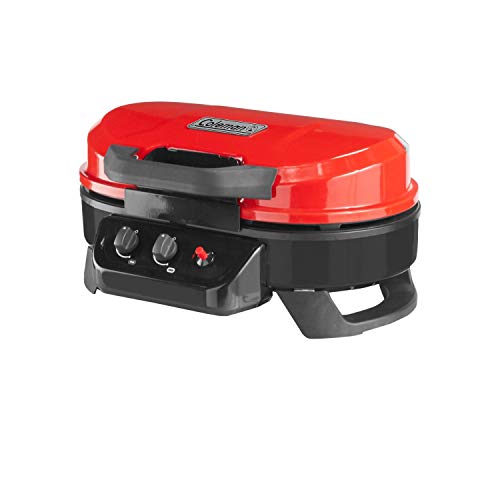
Coleman RoadTrip 225 Portable Tabletop Grill — Best Tabletop for Two
The RoadTrip 225 is the tabletop for cooks who refuse to give up technique: two burners under a lidded grate, matchless Instastart ignition, and a removable water pan that catches drips. It suits couples and small groups at campsites, tailgates, and balconies where a table is the grill stand.
Strengths
- Two burners on a tabletop format — real zone control that travels
- Instastart ignition lights without matches or lighters
- Water pan catches grease and simplifies the campsite cleanup
Trade-offs
- Tabletop means you supply the surface, everywhere, forever
- 11,000 BTU is honest heat for its size, not a sear station for thick steaks
- Runs best on 1 lb cylinders; frequent cooks will want the tank adapter
| Output | 11,000 BTU (from Amazon title) |
| Burners | 2 (from Amazon title) |
| Ignition | Instastart (from Amazon title) |
Most tabletops are one-burner compromises; the 225’s second burner is what makes it a grill instead of a hot plate with a lid. Sear the burgers on one side, hold the buns and finished food on the other, and a campsite dinner runs like a patio dinner in miniature. The water pan is an old Coleman trick that earns its keep twice — catching the fat that causes flare-ups, then lifting out to wash at the camp sink. For two-person travel cooking with real technique intact, this is the affordable portable benchmark.
Best for: couples and small groups cooking at campsites and tailgates / Not suited for: standing-grill devotees who hate cooking at table height
Check the current price on Amazon

Cuisinart Grillster Portable Gas Grill CGG-059A — Best Ultra-Portable
The Grillster is the minimalist’s portable: 13 pounds, a single burner that its listing rates to 600°F, push-button ignition, and a grate that goes in the dishwasher when you get home. It suits solo cooks, couples, picnic-and-go drivers, and anyone whose grill must earn a very small space in the trunk or closet.
Strengths
- Featherweight and compact — the easiest carry in this guide
- High stated top temperature for a grill this small
- Dishwasher-safe grate makes the cleanup argument disappear
Trade-offs
- 146 sq. in. is two people’s dinner, cooked in one honest layer
- One burner, one zone — technique is timing and placement
- Small cylinders are its native fuel; plan spares for a weekend
| Weight | 13 lbs (from Amazon title) |
| Cooking area | 146 sq. in. (from Amazon title) |
| Output | 8,000 BTU, reaches 600°F (from Amazon title) |
| Grate | Dishwasher-safe (from Amazon title) |
Ultra-portables usually ask you to accept steamed burgers as the price of portability. The Grillster’s design pushes back: a small grate concentrates its burner’s output, the lid is tight, and the stated temperature ceiling is a searer’s number, not a warmer’s. Within its two-person envelope it cooks with genuine intent — dogs, burgers, kebabs, a pair of steaks — and then it washes in the dishwasher and stores in a cupboard. If your grilling life is spontaneous and small-scale, this is the affordable portable that will actually be there when the moment happens, because bringing it costs nothing.
Best for: solo cooks, couples, and spontaneous picnic grilling / Not suited for: anyone cooking for four or more at once
Check the current price on Amazon

Weber Q 1200N Portable Propane Gas Grill — Best Premium Portable
The Q 1200N is what a portable becomes when a serious grill maker designs it: a single burner under porcelain-enameled cast-iron grates in a cast body that holds heat like a patio grill, with electronic ignition. It suits traveling cooks, RVers, and balcony grillers who want patio quality in a liftable package.
Strengths
- Cast-iron grates give portable cooking a real sear and real marks
- Cast body holds heat and shrugs off travel and weather
- Weber parts and accessory ecosystem, including stands and covers
Trade-offs
- Premium price for a single-burner portable
- Heavier than the ultra-portables — liftable, not featherweight
- One zone, like every single-burner design
| Output | 10,000 BTU (from Amazon title) |
| Grates | Porcelain-enameled cast-iron (from Amazon title) |
| Ignition | Electronic (from Amazon title) |
The Q’s argument is that portability should cost you size, not quality. Its cast-iron grate is the same material story as the big Spirits, and it shows in the food: steaks and chops come off with crusts that most portables cannot produce at any price. The body is built like equipment rather than luggage, which is why Q grills accumulate years of campsite service. You pay for all of it, in money and in pounds. For the traveler who grills constantly and eats critically, it is the affordable-premium portable that ends the search; for occasional picnics, the picks above and below cost less and cook happily.
Best for: frequent travelers and RVers who grill seriously / Not suited for: occasional picnickers paying premium for rare use
Check the current price on Amazon

Charbroil Grill2Go X200 Portable Gas Grill — Best Infrared Portable
The Grill2Go X200 is Char-Broil’s infrared travel grill: a rugged, latching-lid portable whose infrared emitter sits between burner and food, evening the heat and stopping the flare-ups that plague small grills cooking fatty food over an open burner. It suits tailgaters and campers whose menus run to sausages, burgers, and anything drippy.
Strengths
- Infrared emitter tames flare-ups — the portable grill’s oldest enemy
- Latching lid and carry format make transport genuinely one-handed
- Even heat across a small grate suits mixed loads
Trade-offs
- Infrared plate needs cleaning to keep its pores open, like its patio sibling
- Single-zone cooking, as with all single-burner portables
- Rugged build is not the lightest in this guide
| Format | Portable gas grill, Grill2Go X200 (from Amazon title) |
| Style | TRU-Infrared portable line |
Flare-ups are worse on portables than on patio grills — the burners sit closer to the food and the cooks are usually distracted by the event they traveled to. The X200’s infrared plate is the engineered answer, and it doubles as an evenness upgrade: no cold corners, no scorched stripes, just a uniformly hot surface that treats sausages and chicken kindly. Keep the emitter brushed clean and this is the portable for the cook who hosts at the tailgate rather than merely feeding themselves at one. It is the thinking person’s travel grill at an unthinking price.
Best for: tailgaters and campers cooking fatty, flare-prone food / Not suited for: weight-obsessed hikers — this is a car-travel grill
Check the current price on Amazon

Royal Gourmet GT2009 2-Burner Portable Gas Grill with Folding Cart — Best Budget Folding Cart
The GT2009 is the budget answer to the folding-cart format: two burners, 17,000 BTU, and 349 square inches on a cart with large wheels, a side shelf, and a storage basket, which folds down for transport. It suits families and groups whose portable grilling is really patio grilling performed at campsites and parks.
Strengths
- 349 sq. in. is family capacity in a folding format
- Two burners keep zone technique alive on the road
- Shelf, basket, and big wheels make it a real workstation, not a compromise
Trade-offs
- Folded, it still fills a trunk — this is car camping equipment
- More parts and pivots than a tabletop; check fasteners seasonally
- At the large end of ‘portable’ by any honest definition
| Output | 17,000 BTU (from Amazon title) |
| Cooking area | 349 sq. in. (from Amazon title) |
| Format | Folding cart, large wheels, side shelf and basket (from Amazon title) |
There is a crew size where tabletops stop working, and this grill exists for exactly that crew: four to six people, a full menu, a standing cook. Its area and zones handle a family cookout without batch gymnastics, and the cart’s shelf and basket solve the portable cook’s eternal problem — nowhere to put anything. The trade is transport volume and a more complex fold, which is why it suits car campers and tailgaters rather than minimalists. Judged as the most cooking you can roll out of a trunk at a budget price, it has no real rival in this guide.
Best for: families and groups tailgating and car camping / Not suited for: minimalists and small-car owners counting trunk inches
Check the current price on Amazon

Megamaster Tabletop 2 Burner Gas Grill — Best Group Tabletop
Megamaster’s two-burner tabletop is the base-camp pick: stainless construction, folding legs, a built-in thermometer, and — its distinguishing choice — designed for a standard 20 lb propane tank rather than pocket cylinders. It suits RV sites, long campground stays, cabin decks, and balconies where the grill sets up and stays up.
Strengths
- Runs on a 20 lb tank: no cylinder-swapping through a long stay
- Two burners with 16,000 BTU give real zones and real heat
- Stainless body tolerates outdoor seasons better than painted rivals
Trade-offs
- 199 sq. in. is compact for two burners — cook in a single layer
- Tank and hose are separate luggage from the grill itself
- Folding legs are for transport, not for daily fold-and-store convenience
| Output | 16,000 BTU (from Amazon title) |
| Cooking area | 199 sq. in. (from Amazon title) |
| Fuel | Standard 20 lb tank (from Amazon title) |
Fuel logistics decide long-stay grilling, and this Megamaster is built around the right answer: a full tank that lasts the whole trip, feeding two burners with enough output for genuine two-zone cooking on a tabletop. The stainless body is the other long-stay feature — cabin decks and RV sites are outdoor life, and this grill is finished for it. Its grate asks for single-layer discipline, which base-camp cooking — unhurried, sequenced, outdoors — accommodates easily. For the portable cook who stays a while, this is the affordable tabletop that behaves like a resident.
Best for: RVers, cabin decks, and long campground stays / Not suited for: day-trippers who want the lightest possible kit
Check the current price on Amazon
Comparison Table
| Pick | Badge | Key spec | Best for |
|---|---|---|---|
| Coleman RoadTrip 225 Portable Tabletop Grill | Best Tabletop for Two | 2 burners, 11,000 BTU, tabletop, Instastart ignition | couples and small groups cooking at campsites and tailgates |
| Cuisinart Grillster Portable Gas Grill CGG-059A | Best Ultra-Portable | 146 sq. in., 8,000 BTU reaching 600°F per listing, 13 lbs | solo cooks, couples, and spontaneous picnic grilling |
| Weber Q 1200N Portable Propane Gas Grill | Best Premium Portable | 10,000 BTU, porcelain-enameled cast-iron grates, electronic ignition | frequent travelers and RVers who grill seriously |
| Charbroil Grill2Go X200 Portable Gas Grill | Best Infrared Portable | Portable infrared (TRU-Infrared line), latching lid format | tailgaters and campers cooking fatty, flare-prone food |
| Royal Gourmet GT2009 2-Burner Portable Gas Grill with Folding Cart | Best Budget Folding Cart | 2 burners, 17,000 BTU, 349 sq. in., folding cart with wheels | families and groups tailgating and car camping |
| Megamaster Tabletop 2 Burner Gas Grill | Best Group Tabletop | 2 burners, 16,000 BTU, 199 sq. in., runs on 20 lb tank | RVers, cabin decks, and long campground stays |
How to Choose the Best Affordsble Grills That Travel Well
Portable buying is logistics buying: the right grill is the one whose size, fuel, and setup fit your vehicle, your crew, and your patience. Work these four checks before falling for a folding photograph.
Format first: tabletop, folding cart, or premium portable
Tabletops are cheapest and smallest but need a surface at every destination — a picnic table, a tailgate, a stand you bring. Folding carts stand alone and cook like patio grills, at the cost of trunk volume. Premium portables split the difference with better materials and heat. Choose by your actual destinations: if your sites have tables, tabletop; if they have grass and gravel, cart; if you travel constantly and cook critically, premium.
Fuel logistics decide longer trips
One-pound cylinders are light, ubiquitous, and perfect for a weekend — and an expensive, wasteful way to grill for a month. If your portable life includes long stays, choose a model built or adaptable for a 20 lb tank, like the Megamaster tabletop here, and budget the hose and tank as part of the purchase. Refillable beats disposable on every long trip, in money and in trash.
Area honesty for small grates
Portable listings inflate area with warming racks and lid math. Plan on the primary grate and a single layer: roughly 150 sq. in. feeds two, 250–350 feeds a family in a batch or two. Two burners on a small grate are worth more than a bigger single-burner sprawl, because zones — not inches — are what let you hold finished food while the next batch cooks.
Transport details are durability details
Look for a lid that latches or locks, legs that fold without tools and lock when open, and a grease system that will not paint your trunk. Stainless or porcelain surfaces beat painted steel after the first beach trip. And check the maker’s parts channel: portable grills live hard lives, and a replaceable burner or grate doubles the useful years of a budget machine.
Vehicle and storage math: measure the trunk, not the dream
Before buying any portable, measure the space it must travel in — trunk floor, RV bay, closet shelf — with the grill’s folded dimensions from its listing, plus room for the fuel and the tote of tools. Folding carts are the usual surprise: generous folded, but still the largest item most cars carry. If the fit is marginal, step down a format; a tabletop that always comes along beats a cart that gets left behind twice and sold in spring.
Cooking for a crowd on a portable: the two-grill trick and other honest math
When the crew outgrows one portable, the experienced move is not a bigger portable — it is sequencing on one grill, as the deep-dive section teaches, or a second small grill run in parallel, which many tailgating households arrive at naturally. Two modest portables give two zones, two temperatures, and redundancy if one fails, often for less than one oversized unit. Buy the second grill only when the crowd is a pattern, not an annual event.
Cooking Well on a Small Grill: The Portable Cook’s Playbook
Small grills punish one habit above all: treating them like big grills with less room. The portable cook’s playbook starts with sequencing — cook in an order, not all at once. Proteins that hold well (sausages, chicken) go first and rest under foil; quick items (burgers, dogs, vegetables) go last and go straight to plates. A warming rack or a cool zone is a holding oven, and using it deliberately turns a 200-square-inch grill into a full dinner service for four.
Wind is the portable cook’s second curriculum. Small grills lose heat to gusts that patio grills shrug off, so placement is a cooking decision: shelter the grill with the vehicle, a wall, or your own position, keep the lid down, and give preheats extra minutes on breezy days. Marinades and sauces go on late and off the direct heat, because a small grate over a close burner flares faster than any other format in grilling.
Finally, pack the kit that makes portable cooking feel equipped rather than improvised: tongs that live with the grill, a small thermometer, a brush, spare fuel, and a lidded container for the trip home. The cooks who love portable grilling have turned setup into a five-minute ritual with everything in one tote. The grill is the centerpiece of that kit — but the kit is what makes the grill feel affordable in effort as well as price.
Portable Grill Care on the Road: Keeping the Travel Kit Alive
Portable grills live the hardest lives in grilling — bounced in trunks, rained on at campsites, stored in sheds and garages — and their care routine is built around that reality. The anchor habit is the site shutdown from the how-to: burn off, brush, empty the grease system, cool fully, latch the lid. A portable stored clean travels as equipment; a portable stored dirty travels as a smell with a handle, and its next cook starts with old grease smoking before the food even lands.
Between trips, store the grill dry and, where the design allows, indoors. Trunk-and-garage temperature swings condense moisture inside lidded grills, so a breathable cover or a cracked-open lid in storage prevents the musty, rust-friendly microclimate that kills portable fireboxes. Stainless models forgive the most; painted steel forgives the least and deserves the driest shelf. Fuel stores separately and safely: cylinders upright, valves closed, never in a hot enclosed vehicle between trips.
Seasonally, give the travel kit its inspection: legs and hinges cycled and snugged, latches confirmed honest, burner tubes brushed and checked for the spider webs that are the portable grill’s most common cause of weak flame, and the regulator hose flexed and examined. Replace a suspect hose before the trip, not during it — the nearest replacement is never near a campsite. These are fifteen minutes, twice a year, and they are why some portables are on their tenth season while identical models died in their second.
Finally, keep the kit together. Tongs, brush, thermometer, spare fuel, and a small parts envelope — a spare igniter battery where applicable, a knob screw, the manual’s key pages photographed on your phone — living in one tote with the grill is what turns portable grilling from a packing project into a grab-and-go habit. The affordsble portable life is not really about the grill’s price. It is about a system light enough to say yes to every trip, and care is what keeps it light.
The Tailgate Menu Playbook: Feeding a Crew From a Portable Grill
The tailgate menu is an exercise in logistics disguised as cooking, and it starts the night before: proteins marinated or rubbed and packed in the coldest part of the cooler, vegetables cut, sauces in squeeze bottles, and the grill kit — tongs, brush, thermometer, spare fuel — staged in its tote by the door. The cooks who look effortless in a parking lot did their effort at home, where the knives and the sink are. Arrive with the work done and the portable grill becomes the easiest station at the party.
On site, the playbook runs in waves, exactly as this guide’s deep-dive teaches. Wave one is the holders: sausages, chicken wings, and anything that improves with a rest, cooked as the grill preheats fully and the first drinks appear. Wave two is the vegetables and the bread — peppers, onions, corn, rolls toasted at the grate’s edge — which fill plates and buy the grill a recovery minute. Wave three is the heroes: burgers and dogs, cooked fast over full heat and served straight off the grate, because a tailgate burger’s half-life is measured in minutes and everyone knows it.
Sauce and cheese are the final minute’s business: cheese goes on as burgers come off the direct heat, sauce gets brushed in the last minute over the fire or served at the table, and everything lands on a folding table that someone remembered — put the table in the tote list, because the portable cook’s eternal shortage is not heat but horizontal surface. A squeeze bottle of sauce, a shaker of finishing salt, and a stack of napkins that could absorb a flood complete the professional setup.
Shutdown is part of the menu, because the game starts on time whether your grill is packed or not: burn off and brush while the last plates are being filled, close the fuel, and let the grill cool during the meal it made. By the time the crew walks to the gate, the grill is latched, the grease is contained, and the tote is in the trunk. That is the playbook’s real product — not just a fed crew, but a cook who got to be at the party. Portable grilling done right feeds the cook too.
The Portable Kit Checklist: Everything in One Tote
The difference between portable grilling as a joy and portable grilling as a packing project is a single tote that lives ready. In it, permanently: the grill’s own brush, long tongs, a spatula, an instant-read thermometer, a small cutting board, a knife in a sheath, paper towels, a spray-free policy’s worth of patience, heavy-duty foil, and a lidded container for leftovers and the trip home. Add the fuel — cylinders or the tank plan — and a lighter that you pretend the igniter makes unnecessary, right up until the day it does not.
The second layer is comfort and courtesy: a folding side table if your destinations lack surfaces, a headlamp for evening cooks, a small first-aid kit because knives and hot metal attend every cookout, and bags — one for trash, one for dirty tools — because leaving a site cleaner than you found it is the portable cook’s entire reputation. A roll of shop towels handles the grease that paper towels surrender to. None of this is heavy, and all of it together is what ‘grab and go’ actually means.
Maintain the tote like the grill: after each trip, wash what came home dirty, replace what got used up, and put it back by the door or in the vehicle, ready. The checklist’s real function is cognitive — it converts a dozen small decisions into zero decisions, so the answer to ‘should we grill at the lake?’ is always yes and the car is loaded in five minutes. That readiness is the true product this guide’s picks are selling. The grill is just the heaviest item in the tote.
How to Set Up a Portable Grill Anywhere and Cook a Full Meal on It
The same sequence works at a campsite, a tailgate, or a balcony: stable setup, fuel check, preheat, sequenced cooking, and a clean shutdown that makes the trip home grease-free.
- Set the grill on a stable, level, heat-safe surface — its own locked-open cart legs, or a sturdy table for tabletops — away from tent walls, vehicle paint, and foot traffic, with the lid able to open fully.
- Connect the fuel and leak-check the fitting with a sniff and a soapy-water brush if you have it; confirm the grease tray or water pan is in place before any flame.
- Preheat with the lid down for a full ten minutes, longer in wind. Small grills have little thermal mass; the preheat is the heat battery you will cook on.
- Cook in sequence: long-cooking items first (chicken, sausages), resting finished food on the warming rack or cool zone under foil; burgers, dogs, and vegetables last, served straight off the grate.
- Use the lid as your oven for anything thick, and a thermometer as your judge. Portable grills vary with weather more than patio grills do; internal temperature does not.
- Sauce late and briefly — sugary sauces burn fast over close portable burners. A final minute over heat is a glaze; five minutes is charcoal of the wrong kind.
- Shut down clean: burn off residue for five minutes, brush the grate, close the fuel, let everything cool fully, empty the grease system, and latch the lid before it goes back in the vehicle.
Done this way, a portable grill leaves a campsite cleaner than a campfire and feeds people better than most kitchens. The ritual is short, the payoff is dinner anywhere — which was the entire point of buying the thing.
Common Buying Mistakes
Buying by folded size and discovering the cooking size later. A grill that travels beautifully and cooks for one is a bad purchase for a family of five. Match primary grate area to your crew first, then optimize the fold.
Forgetting the surface a tabletop needs. Parks have tables until they do not. A folding stand or a tailgate plan is part of the tabletop purchase, not an afterthought at the trailhead.
Running a weekend on one 1 lb cylinder. Carry a spare, or step up to a tank-fed model for long stays. Cold burgers at hour two of the tailgate are a logistics failure, not bad luck.
Leaving the grease tray for the ride home. Hot or cold, a full tray in a moving vehicle becomes upholstery seasoning. Empty it at the site, every time, as part of shutdown.
Cooking everything at once on a small grate. Crowding a portable steams the whole load. Sequence the menu — holders first, quick items last — and the small grill feeds the whole crew properly.
Storing the grill dirty ‘until next trip.’ Old grease and a closed lid in a warm trunk is a smell with a half-life. Five minutes of burn-off and brushing at the site is the whole cure.
Final Recommendation
Match the format to your travels and this list resolves fast. The Coleman RoadTrip 225 is the tabletop most cooks should start with — two burners, honest heat, campsite manners. The Cuisinart Grillster is the ultra-portable for spontaneous, small-scale grilling, and the Weber Q 1200N is the premium travel grill for people who cook constantly and notice crust.
Take the Charbroil Grill2Go X200 when flare-ups are your enemy, the Royal Gourmet GT2009 when the crew is family-size and the trunk can take it, and the Megamaster two-burner tabletop when your stays are long and tank-fed. Every one of them folds, rolls, or lifts into a life that includes grilled food in more places — which, for the affordsble grill buyer, is the entire point.
- Coleman RoadTrip 225 Portable Tabletop Grill — Check the current price on Amazon
- Cuisinart Grillster Portable Gas Grill CGG-059A — Check the current price on Amazon
- Weber Q 1200N Portable Propane Gas Grill — Check the current price on Amazon
Keep exploring the grills in this series: Best Affordable Grills Best Affordale Grills Best Affordable Propane Grills Best Affordable Indoor Grills Best Affordable Pellet Grills Best Affordable Natural Gas Grills
Frequently Asked Questions
What size portable grill do I need for a family of four?
Plan on 250–350 square inches of primary grate, ideally with two burners or a warming rack so finished food has somewhere to wait. That covers a family dinner in one or two batches. Below 200 square inches, a family can still eat well, but the cook is running a sequence, not a single load — which some cooks enjoy and others should price honestly.
Are 1 lb propane cylinders or a 20 lb tank better for portable grilling?
For weekends and spontaneous trips, 1 lb cylinders win on weight and simplicity. For long stays, frequent cooking, or RV life, a 20 lb tank wins on cost per cook and on not running dry — several picks here support tanks natively or via an adapter hose. Match the fuel to the trip length, not to the grill’s first weekend.
Can a portable grill really sear a steak?
The better ones can: a small grate concentrates a burner’s output, cast-iron grates like the Weber Q’s store the heat, and a full preheat does the rest. Thick steaks still reward a rest-and-return technique on any portable. What portables cannot do is sear six steaks at once — that is a capacity limit, not a heat limit.
Are portable gas grills allowed at campsites and parks?
Generally yes where open flame devices are permitted, and they are often allowed during fire restrictions that ban charcoal and wood fires — but rules are local and seasonal. Check the specific park or campground policy before you travel, especially in fire season, and never use any grill inside a tent, vehicle, or enclosed shelter.
How do I stop my portable grill flaring up?
Keep the grease path clean, trim excess fat, and cook fatty items with the lid managed and a cool zone ready. Infrared portables like the Grill2Go reduce flare-ups by design, catching drips above the burner. And never leave a portable unattended with fatty food over full heat — small grills flare faster than big ones.
Why does this guide use the spelling ‘affordsble’?
Because it is a common way the search gets typed, and a misspelled search still deserves a verified answer. The keyword is preserved in the slug and headings by this program’s convention for typo keywords; the research, verification, and honesty inside are spelled exactly right.
Can I use a portable gas grill on a wooden deck or picnic table?
Only with the surface protected and the grill stable: tabletops belong on sturdy, level surfaces, ideally with a heat-resistant mat beneath, and never on plastic tables that heat can warp. Keep the grill attended, keep clearances from railings and walls, and check the venue’s rules — some parks and balconies restrict even small gas grills. When in doubt, the grill’s own legs or cart on open ground is the safest configuration.
What foods should I avoid on a portable grill at a tailgate?
Anything that needs long, unattended, precise cooking — a whole brisket, a large roast — and anything whose mess exceeds your cleanup plan, like heavily sauced items cooked for hours. Tailgate food should be fast, holdable, and hand-friendly. Save the low-and-slow projects for the patio, and let the portable do the high-heat, high-sociability cooking it was built for.
Can I use a portable grill at the beach?
Usually yes, where local rules allow it, and the format shines there — but plan for wind and sand as the site’s two conditions. Set up in the lee of a vehicle or dune, expect longer preheats, keep the lid down, and weight or stake nothing near the hot grill that can blow into it. Sand in the grease tray is the cleanup tax; the site shutdown routine from the how-to handles it. Check the beach’s own rules first, because they vary from open welcome to total ban.
How do I keep a portable grill from rusting between trips?
The routine is short: never store it with ash, grease, or moisture inside; dry it fully after the site shutdown or a wash; and store it indoors or under a breathable cover, never sealed in plastic where condensation does its slow work. Stainless models forgive the most, painted steel the least. A light wipe of cooking oil on cast-iron grates before storage is the final step — thirty seconds that stands between your portable and the orange freckles of neglect.


