Disclosure: airfryerkitchensupply.com is reader-supported. When you buy through links on our site, we may earn an affiliate commission at no extra cost to you.
Where to buy
Four-to-six-burner grills are where listings inflate hardest — burner counts that quietly include the side burner, areas that count the warming rack twice. Every pick in this guide to the best affordable 4 to 6 burner propane grills was verified against its live listing, with the main-burner count and total output taken from the manufacturer’s own listing text, and no prices are printed because this segment’s pricing swings hard by season; check the current price on Amazon before you buy.
- Nexgrill 4-Burner Propane Gas Grill — Best Overall Affordable 4-Burner. Check the current price on Amazon.
- Charbroil Performance Series 4-Burner Gas Grill — Best Cabinet Value. Check the current price on Amazon.
- Royal Gourmet 4-Burner Cabinet Gas Grill — Best Budget 4-Burner. Check the current price on Amazon.
- Royal Gourmet GA5401T 5-Burner Gas Grill — Best Affordable 5-Burner. Check the current price on Amazon.
- Nexgrill Deluxe 5-Burner Gas Grill — Best 5-Burner With Sear Power. Check the current price on Amazon.
- Royal Gourmet GA6402S 6-Burner Gas Grill — Best Affordable 6-Burner. Check the current price on Amazon.
Note the pattern in the badges: at four burners you are buying family capacity, at five you are buying zoning, and at six you are buying event capacity. The right size is the smallest one that fits your real headcount.
The best affordable 4 to 6 burner propane grills occupy the most contested ground in grilling: big enough for a family reunion, priced for a household budget. This is the segment where a family of six stops cooking in batches, where a side burner earns its footprint, and where the difference between four, five, and six burners stops being marketing and becomes a real decision about zones and headcount.
It is also the segment where cheap goes wrong fastest. A big cookbox multiplies everything: more burners to corrode, more area for thin steel to warp, more assembly to get wrong. So this list applies the affordable test strictly — every pick has stocked replacement parts, a layout that justifies its size, and output figures taken from its verified listing rather than a brochure. Two four-burners anchor the family end, three five-burners cover the zoning middle, and one six-burner serves the event cooks.
Read the reviews by your real numbers. If your biggest regular cook is ten burgers and corn, a good four-burner is not a compromise — it is the correct grill, and the money saved buys a cover, a griddle insert, and a season of propane. If you host twenty, the six-burner earns its patio. Size is a feature only when it is used.
In this guide
Quick Picks
Six verified big propane grills in the affordable tiers — four-burner family anchors, five-burner zoning machines, and one six-burner event grill that stays honest about its tier.
- Best Overall Affordable 4-Burner: Nexgrill 4-Burner Propane Gas Grill — 60,000 BTU across four burners and a side burner in stainless — the strongest all-round value at this size.
- Best Cabinet Value: Charbroil Performance Series 4-Burner Gas Grill — Charbroil’s four-burner cabinet with side burner — the enclosed-cart layout at the friendliest tier in this guide.
- Best Budget 4-Burner: Royal Gourmet 4-Burner Cabinet Gas Grill — Royal Gourmet’s cabinet four-burner at 54,000 BTU — the lowest tier in this guide with the full layout intact.
- Best Affordable 5-Burner: Royal Gourmet GA5401T 5-Burner Gas Grill — the GA5401T — five burners and 61,000 BTU in stainless, the zoning upgrade at a value tier.
- Best 5-Burner With Sear Power: Nexgrill Deluxe 5-Burner Gas Grill — Nexgrill’s Deluxe 5-burner with a ceramic side burner — 65,000 BTU and a genuine sear station.
- Best Affordable 6-Burner: Royal Gourmet GA6402S 6-Burner Gas Grill — the GA6402S — six burners and 74,000 BTU of event capacity at a tier the big brands will not touch.
How These Picks Were Chosen
Every candidate was verified: the exact model, its main-burner count, side burner configuration, and total BTU as stated on the manufacturer’s listing. Models whose “six burners” turned out to include burners that do not exist, or whose listings could not be matched to a real manufacturer model, were excluded. What remained was scored on zone control (can it hold a hot side and a gentle side across a big grate?), grate and burner materials, cabinet and cart construction, and the parts ecosystem behind the model.
Affordability was judged as cost per season at this size class. Big grills consume big wear parts — a full set of heat tents or burners for a six-burner costs real money — so platforms with reasonably priced, widely stocked replacements scored ahead of slightly cheaper orphans. Assembly burden counted too: a 100-part kit with clear instructions beats a 60-part kit with a pamphlet of mysteries.
We also required each pick to justify its burner count with usable grate layout. Some big grills stretch a four-burner firebox under a six-burner lid and call it capacity. The picks here put real, separately controlled burners under their area, which is what zoning — the entire point of size — actually requires.
The 6 Best Affordable 4- to 6-Burner Propane Grills

Nexgrill 4-Burner Propane Gas Grill — Best Overall Affordable 4-Burner
Nexgrill’s 4-burner is the reference affordable big grill: a stainless steel body, four main burners plus a side burner, 60,000 BTU total output, and a built-in lid thermometer. It hits the family brief squarely — burgers for ten, two-zone control with room to spare — and its years on the market mean every wear part is stocked by multiple sellers.
Strengths
- 60,000 BTU total is strong output for the affordable tier
- Stainless body and built-in thermometer outclass painted rivals
- Deep parts availability from years of high sales volume
Trade-offs
- Stainless at this tier is thin — it will discolor with heat, which is cosmetic but real
- Assembly is a full project; plan two hours and a helper
- Side shelves do not fold, so measure your patio honestly
| Burners | 4 plus side burner |
| Output | 60,000 BTU total |
| Body | Stainless steel |
| Gauge | Built-in thermometer |
What makes this Nexgrill the anchor pick is balance. The burner output is genuinely strong for the tier, so the big grate actually sears across its width instead of performing at the middle and sulking at the edges. Four burners zone cleanly — two high, two low — and the side burner handles the corn pot without stealing grate space. The stainless body is the value-tier kind, which means it resists rust well and shows heat tint proudly; owners who want showroom shine should look upmarket, while owners who want dinner will not care by the third cook. As the default recommendation for a family buying one big affordable grill, it is the one to beat.
Best for: families of five to eight wanting one strong, affordable four-burner for everything / Not suited for: patios needing folding shelves or buyers wanting heavy-gauge stainless
Check on Amazon — check the current price on Amazon before you buy; listings, bundles and included accessories change over time.

Charbroil Performance Series 4-Burner Gas Grill — Best Cabinet Value
The Charbroil Performance 4-burner brings the cabinet format — tank hidden, gear stored, lines clean — to the most accessible tier in this roundup. Four main burners and a side burner cover the family layout, and Charbroil’s enormous parts network stands behind it, which at this size means affordable heat tents and burners for years.
Strengths
- Closed cabinet hides the tank and stores tools — rare at this tier
- Charbroil parts are the cheapest and most available in the segment
- Four burners plus side burner is the complete family configuration
Trade-offs
- Output per burner is moderate — preheat fully for hard sears
- Value-grade steel and finish demand a cover and dry storage
- Cabinet doors and hardware feel light compared with premium carts
| Burners | 4 plus side burner |
| Cabinet | Closed cabinet cart |
| Model | 463253925 |
Cabinet versus open cart sounds like styling until you live with it: the cabinet keeps the patio tidy, the tank swap cleaner, and the dog out of the grease tray. The Performance platform trades some raw output for that livability, and the trade is fair for most families — burgers, chicken, and vegetables never notice, while only the thickest steaks ask for the full preheat you should be doing anyway. Charbroil’s scale is the hidden feature: when a burner tires in year three, the replacement is inexpensive and on the shelf. For households that want the finished look of a cabinet grill without leaving the affordable tier, this is the pick.
Best for: families who want a tidy cabinet grill and easy parts for years / Not suited for: maximum-sear seekers or uncovered storage situations
Check on Amazon — check the current price on Amazon before you buy; listings, bundles and included accessories change over time.

Royal Gourmet 4-Burner Cabinet Gas Grill — Best Budget 4-Burner
Royal Gourmet’s 4-burner cabinet model is the price floor of this roundup that still deserves the word “grill” without flinching: four burners, a side burner, 54,000 BTU total per the listing, and a closed cabinet, in silver, at the segment’s budget edge. It is the pick when the headcount is real but the budget is immovable.
Strengths
- Full four-plus-side layout at the lowest tier in this guide
- 54,000 BTU total is honest output for family-size cooking
- Cabinet storage at a price where rivals offer open frames
Trade-offs
- Assembly is long and the instructions require patience
- Materials are the thinnest here — cover it, shelter it, maintain it
- Dial precision is approximate; cook by thermometer, not by knob markings
| Burners | 4 plus side burner |
| Output | 54,000 BTU total |
| Style | Cabinet cart, silver |
Judge this grill by the standard of its tier and it impresses: the layout is complete, the output is sufficient, and the cabinet is genuinely useful. Judge it by premium standards and you will find the thin panels and basic hardware those standards predict. The owners who love these grills share a profile — they assemble carefully, keep them covered, replace a heat tent without drama when it tires, and cook family dinners for seasons on a purchase that left money in the bank. The owners who hate them left them uncovered in the rain. At this tier, the owner is part of the specification, and this Royal Gourmet rewards the careful kind.
Best for: immovable budgets feeding real family headcounts / Not suited for: set-and-forget owners or premium-material expectations
Check on Amazon — check the current price on Amazon before you buy; listings, bundles and included accessories change over time.

Royal Gourmet GA5401T 5-Burner Gas Grill — Best Affordable 5-Burner
Five burners change the cooking, not just the capacity: with the GA5401T’s five main burners and side burner making 61,000 BTU, you can run a sear zone, a roasting zone, and a holding zone simultaneously. Royal Gourmet delivers that flexibility in stainless at a value tier, which is why it takes the five-burner seat in this guide.
Strengths
- Five true zones enable sear-roast-hold cooking in one session
- 61,000 BTU total output backs the larger grate properly
- Stainless construction at a value position in the segment
Trade-offs
- A five-burner footprint is a patio commitment — measure first
- More burners means more wear parts to maintain over the years
- Assembly time grows with burner count; enlist a helper
| Burners | 5 plus side burner |
| Output | 61,000 BTU total |
| Body | Stainless steel |
The case for five burners is a mixed menu: steaks searing over two burners, chicken finishing over two more, vegetables holding over the fifth, sauce on the side burner — everything landing together without a warming drawer or a microwave apology. The GA5401T’s output per burner holds up its end of that scenario, and its stainless body shrugs off the weather better than painted rivals at the tier. The honest costs are space and upkeep: five burners are five tubes to inspect each spring, and the cart wants a wide, level home. For the household whose grill nights are productions, this is the affordable production machine.
Best for: mixed-menu hosts who cook several foods at once for six to ten people / Not suited for: small patios or minimal-maintenance owners
Check on Amazon — check the current price on Amazon before you buy; listings, bundles and included accessories change over time.
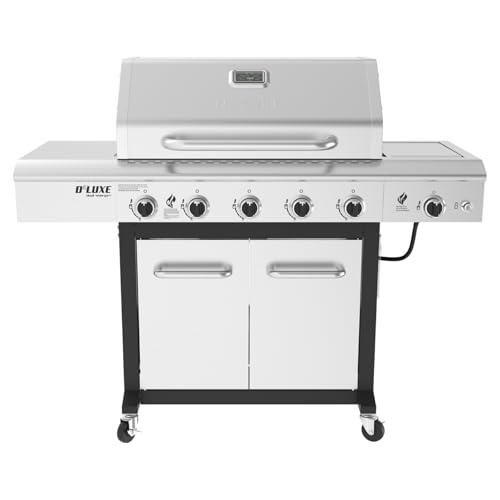
Nexgrill Deluxe 5-Burner Gas Grill — Best 5-Burner With Sear Power
The Nexgrill Deluxe 5-burner answers the standard complaint about big affordable grills — not enough finishing heat — with a ceramic side burner that doubles as a high-intensity sear station. Five main burners and 65,000 BTU total cover the crowd; the ceramic burner puts a steakhouse crust on the two steaks that matter while the rest of dinner holds on the main grate.
Strengths
- Ceramic side burner delivers sear heat the main box cannot match
- 65,000 BTU total is the strongest output in this guide
- Built-in thermometer and deluxe trim at an affordable-tier position
Trade-offs
- Ceramic burners are a premium component — treat it gently and keep it covered
- Largest assembly and footprint short of the six-burner
- Running all burners drinks propane at a rate small tanks notice
| Burners | 5 plus ceramic side burner |
| Output | 65,000 BTU total |
| Gauge | Built-in thermometer |
The ceramic side burner is not a gimmick; infrared ceramic runs far hotter than a standard tube burner, and as a sear station it changes what a big affordable grill can finish. The workflow it enables — reverse-sear on the gentle main burners, finish over the ceramic — is a premium-grill workflow at a value-tier purchase. The rest of the machine is Nexgrill’s proven big-grill formula: strong output, stocked parts, honest stainless. Respect the ceramic element — no water quenching, no dropped grates on it — and this is the most capable cooker in the roundup.
Best for: steak-focused hosts feeding crowds who want a real sear station included / Not suited for: minimalists, small patios, or owners rough on equipment
Check on Amazon — check the current price on Amazon before you buy; listings, bundles and included accessories change over time.

Royal Gourmet GA6402S 6-Burner Gas Grill — Best Affordable 6-Burner
Six burners is event territory — thirty burgers, a graduation party, the whole street — and the Royal Gourmet GA6402S is the affordable way in: six main burners plus a side burner totaling 74,000 BTU, in a silver cabinet format. It is the biggest grill in this guide and the one whose buyer should be most certain of their headcount.
Strengths
- Six true burners give unmatched zone maps and event capacity here
- 74,000 BTU total output is sized honestly for the grate
- Side burner keeps big-pot sides off the main cooking area
Trade-offs
- Enormous footprint and assembly — this is furniture, not an appliance
- Six burners of wear parts and propane consumption are ongoing costs
- For weekly family dinners it is more grill than the job wants
| Burners | 6 plus side burner |
| Output | 74,000 BTU total |
| Finish | Silver |
A six-burner earns its keep a dozen times a year and must not embarrass itself the other three hundred days. The GA6402S handles the balance sensibly: you can run two burners for a Tuesday and ignore the rest, and the cabinet format keeps the big machine looking intentional rather than industrial. On event day, the zone map is the luxury — a full sear field, a finishing field, and a holding field, with the side burner on corn duty. Output per burner is adequate rather than fierce, so work in sections and preheat thoroughly. If your calendar honestly includes regular twenty-person cooks, this is the affordable way to feed them without renting anything.
Best for: regular large-gathering hosts who need true event capacity on a budget / Not suited for: weekly small-family cooking or any patio under generous size
Check on Amazon — check the current price on Amazon before you buy; listings, bundles and included accessories change over time.
Comparison Table
| Pick | Badge | Key spec | Best for |
|---|---|---|---|
| Nexgrill 4-Burner Propane Gas Grill | Best Overall Affordable 4-Burner | 4 plus side burner — burners | families of five to eight wanting one strong, affordable four-burner for everything |
| Charbroil Performance Series 4-Burner Gas Grill | Best Cabinet Value | 4 plus side burner — burners | families who want a tidy cabinet grill and easy parts for years |
| Royal Gourmet 4-Burner Cabinet Gas Grill | Best Budget 4-Burner | 4 plus side burner — burners | immovable budgets feeding real family headcounts |
| Royal Gourmet GA5401T 5-Burner Gas Grill | Best Affordable 5-Burner | 5 plus side burner — burners | mixed-menu hosts who cook several foods at once for six to ten people |
| Nexgrill Deluxe 5-Burner Gas Grill | Best 5-Burner With Sear Power | 5 plus ceramic side burner — burners | steak-focused hosts feeding crowds who want a real sear station included |
| Royal Gourmet GA6402S 6-Burner Gas Grill | Best Affordable 6-Burner | 6 plus side burner — burners | regular large-gathering hosts who need true event capacity on a budget |
Use the table as a filter, not a verdict: eliminate the rows whose key spec fights your space, fuel rules, or headcount, and the best affordable 4 to 6 burner propane grills decision usually narrows to two finalists whose full reviews above will settle it.
How to Choose the Best Affordable 4 to 6 Burner Propane Grills for Your Patio
Count your biggest regular cook, not your biggest imaginable one. Four burners serve eight to ten burgers with sides in one wave and fit most patios and budgets — the default correct answer. Five burners add a genuine third zone, which matters when mixed menus (meat, vegetables, holding) cook simultaneously for eight to twelve. Six burners are for recurring events of fifteen-plus, where batching would keep the cook at the grill all evening. Buying one size up “just in case” costs you money, patio, assembly hours, and propane every single week to serve a day that comes twice a year.
Output per burner beats total BTU
A total BTU figure grows automatically with burner count, which makes it useless for comparing across sizes. Divide: total main-burner BTU by the number of main burners. Affordable grills that hold roughly ten thousand BTU per burner across the box sear credibly; those that sag well below it will roast fine and sear shyly. The picks here were screened on exactly that arithmetic, using the outputs stated on their verified listings.
The side burner question
A side burner earns its space if you boil corn, fry outdoors, or simmer sauces while grilling — many families use it weekly. It is dead weight if your sides all cook inside. Note that some listings fold the side burner into headline burner counts; every pick in this guide was verified so the main-burner count stated is the count under the grate.
Zone Maps for Big Grills: Cooking for a Crowd Without Chaos
Size without a zone plan is just a bigger place to burn things. On a four-burner, the working map is two-and-two: left pair hot for searing, right pair low for finishing and holding, lid down between moves. On a five-burner, run a gradient — hottest at one end, coolest at the other — and walk food down the line as it cooks: steaks start at the hot end, rest at the cool end; chicken starts cool to render, finishes hot to crisp. On a six-burner, think in three fields: sear field, roast field, holding field, with the side burner as a fourth station for pots.
The crowd workflow follows from the map. Proteins enter at staggered times — thick and bone-in first, burgers and dogs in the middle, fish and vegetables last — and everything converges on done at the same moment because each item has been migrating toward the holding field. Write the stagger on a note the first two times you host; by the third, the map is in your hands. This, more than any feature, is what a big grill is for.
Big-Grill Ownership Costs Nobody Mentions
A large affordable grill has a running budget, and planning it prevents the resentment that kills big grills. Propane first: running four to six burners drinks a standard tank in a handful of long events, so heavy hosts should keep a spare tank — running out mid-party is the classic big-grill failure. Wear parts scale with size too: a full set of heat tents or burners for six burners costs meaningfully more than for three, which is why this guide weighted platforms with reasonably priced parts ecosystems.
Covers scale as well — a six-burner cover is a sail in the wind and wants a strap or a sheltered spot. Assembly help is a real cost in time: budget two to three hours and a second person for the big models, on a flat surface, before the day you intend to cook. None of these costs are reasons to avoid a big grill. They are the difference between owners who planned for size and owners who were surprised by it.
Reading a Big-Grill Listing Like an Inspector
Big-grill listings are written to be misread quickly, so read them slowly, in this order. First, find the main burners — the tubes under the main grate — and count only those. A “6-burner grill” whose fine print reveals four mains, a side burner, and a “sear burner” that shares a main’s gas line is a four-burner grill in a costume. Every pick in this guide states its verified main count; apply the same arithmetic anywhere else. Second, find the cooking area’s definition. If the number includes the warming rack, mentally subtract a third; if it includes the side burner’s grate, subtract that too. What remains is the area your food will ever touch.
Third, divide total main-burner BTU by main burners. Around ten thousand per burner is the affordable class’s honest working figure; far below it, searing will be shy no matter what the photography shows. Fourth, look for the parts page. A manufacturer that lists replacement burners, heat tents, and grates with prices is telling you the grill is maintainable; silence on parts is also an answer. Fifth, read the assembly reviews for the pattern, not the average — complaints about missing hardware and misaligned lids describe a kit problem you will inherit.
Do this five-step read and the segment’s fog clears: you will see the same six grills this guide found, because honest specifications converge. The listings that resist the read — vague counts, missing outputs, no parts — are telling you, in the only language they have, to keep scrolling.
Four, Five, or Six: A Worked Example for Three Households
Household one: two adults, three kids, burgers and chicken twice a week, a graduation party once. Their honest answer is four burners — the Nexgrill or the Charbroil Performance — because their 80-percent cook is seven burgers and corn, and the graduation party can batch. The money not spent on burners five and six buys the cover, the spare tank, and a griddle insert they will use fifty times a year. Household two: keen cooks, eight-person Sunday dinners, mixed menus where timing is the sport. Their answer is five — the Royal Gourmet for value or the Nexgrill Deluxe for the sear station — because the third zone is not capacity for them, it is choreography.
Household three: the street’s hosts, twenty at a time, four times a summer, plus a freezer that empties in waves. Their answer is six — the GA6402S — because batching at that scale keeps the cook at the grill while the party happens elsewhere, and the whole point of hosting is the party. Notice that none of these households bought by aspiration. Each counted a real calendar, and the burner count fell out of the arithmetic.
Run your own version before you order. Write down your five biggest cooks from the last year and your thirty ordinary ones. If the big five are batchable, buy for the thirty. If the big five are the point of your summers, buy for them and accept the weekly overhead. The affordable mistake is never the grill — it is the mismatch, paid for every week in propane, patio, and parts, in service of a headcount that visits twice.
Accessories That Earn Their Space on a Big Grill
Big grills attract big accessory catalogs, and most of it is garnish. The short list that pays: a griddle insert sized to one or two burners, which converts the sear field into a smash-burger and breakfast station and gets used weekly by households that own one. A rotisserie kit, if your model supports it, which turns the big box into a whole-bird and roast machine with a patience no oven matches. A quality instant-read thermometer — not an accessory so much as the grill’s missing instrument. And a second set of grates’ worth of patience: a spare set of heat tents bought before you need them, so the spring replacement is a swap, not a shutdown.
The middle list — nice, not necessary — includes a vegetable basket (genuinely useful for small items that fall through grates), a warming-rack extension for true event days, and a fitted grill light for winter evenings. The skip list is longer: tool sets beyond tongs, spatula, and brush; branded everything; and any electronic gadget that promises to make the grill smart while adding a battery to maintain. A big grill’s accessory budget should follow the same rule as its burner count: sized to your real cooking, bought in the order it pays, and stopped the moment the grill cooks everything you actually cook.
Winterizing and Reviving a Big Gas Grill
Big grills suffer most in the off-season, and a half hour in autumn buys a painless spring. Start with a full burn-off and a deep clean while the weather still cooperates: grates scraped and oiled, cookbox vacuumed of the season’s debris, grease system emptied and washed. Disconnect the tank and store it upright outdoors; leave the grill’s gas line capped. If your winters are wet, the cover goes on over a fully dry grill — a cover over moisture is a terrarium for rust — and a small block under one wheel keeps the cart out of any standing puddle line.
Spring revival reverses the ritual with inspections attached. Before the first light: spider-check every venturi tube, examine burners and heat tents for winter’s corrosion, confirm the igniter clicks and catches, and leak-check the reconnected tank as if it were new — because after months of stillness, every seal deserves the suspicion. Run the grill empty for fifteen minutes and watch the flames’ color and pattern across all burners; a lazy or yellow burner announces its cleaning need before food depends on it.
Do this twice a year and a big affordable grill ages like equipment instead of expiring like a toy. The six picks here were chosen with this ritual in mind — parts that come off, tubes that can be brushed, tents that can be swapped — because at this size, maintainability is not a feature. It is the entire difference between the affordable grill and the expensive habit of replacing it.
Grease Management on Big Grills: The System That Prevents the Stories
Every big-grill horror story — the flare-up that torched the burgers, the grease fire that ended the party — is a grease management failure with a date on it. The system has three parts, and big grills stress all of them. The first is the path: drippings fall through the grates onto heat tents or flavorizer bars, where some vaporize into flavor and the rest run down the cookbox’s slope into the drip pan. That path only works when each stage is clean enough to flow — tents crusted shut and cookboxes layered with last season’s carbon redirect grease into pools, and pools near burners are fires awaiting a hot day.
The second part is capacity. A six-burner event cook can render more fat in an afternoon than a month of family dinners, and a drip pan sized for the month overflows at the party. The discipline is mechanical: empty the pan before any cook that will test it, line it with foil for painless disposal, and never — ever — let a disposable pan ride past full because the burgers are almost done. The third part is response: a flare-up is managed by moving food and closing the lid to starve it, never by water, and a true grease fire is a lid-closed, gas-off, extinguisher-if-it-grows event that ends the cook and starts the cleaning.
None of this is advanced technique; it is housekeeping with consequences scaled by burner count, which is why this guide returns to it for the biggest grills it recommends. Run the system — clean path, empty pan, calm response — and the six burners’ worth of capacity in these picks becomes what it was bought to be: a pleasure at scale, not a story told with gestures.
Side Shelves, Storage, and the Working Triangle of a Big Grill
A big grill is a workstation, and its ergonomics decide how pleasant event cooking feels by hour two. The working triangle is grill, prep surface, and landing zone — the place finished food goes. Built-in side shelves serve the prep corner if they are genuinely sturdy; test them in your mind against a full sheet pan of raw chicken, not a bunch of parsley. If the shelves are slight, a small rolling cart beside the grill is the professional’s answer and costs less than the upgrade to a model with furniture-grade shelves.
Storage follows the same logic. The cabinet on the cabinet models here swallows the tank and the brush; everything else — tools, trays, the spare tank — wants a home within two steps that is not the ground. Hosts who set the triangle before the guests arrive cook calmly at any burner count; hosts who improvise it mid-service discover that six burners of capacity cannot compensate for nowhere to put anything. Measure your patio for the workstation, not just the grill, and the big purchase will feel designed rather than merely large.
The First Event: A Host’s Timeline for a Six-Burner Saturday
Two days out, the work is shopping and the tank check — a full working tank on the grill and a full spare beside it, because the only unforgivable big-grill failure is a silent tank at minute forty. One day out, proteins are seasoned or marinating, the zone map is sketched against the actual menu, and the grill gets its pre-event service: grates scraped, drip pan emptied and foiled, burners test-lit in sequence so any lazy tube is discovered by you and not by twenty guests. Morning of, the workstation is built — prep surface, landing zone, tools, towels, a bin for trash — before a single burner lights.
Ninety minutes out, the whole box preheats and settles into its zones. Sixty out, the longest proteins start at the roast field. Thirty out, the sear field earns its name in waves, finished food migrating to the holding field and the low oven inside. At service, the grill becomes a holding instrument and the cook becomes a host — which was the entire point of the size, the spare tank, and the timeline. Run it once by this script and the second event writes itself; big-grill hosting is a procedure long before it is a talent.
How to Set Up and Run a Big Propane Grill for a Crowd
Big grills reward procedure. This is the sequence experienced hosts use to turn four to six burners into a calm, staggered service instead of a smoky scramble.
- Leak-check and light in sequence: after any tank swap, brush soapy water on connections and watch for bubbles. Light with the lid open, one burner at a time, confirming each catches before opening the next.
- Preheat the whole box, then set your zones: ten to fifteen minutes on high with the lid down heats the grates and cookbox evenly; then dial in your zone map — hot field, roast field, holding field — and give it three minutes to stabilize.
- Do the bread test once per grill: slices of white bread across a medium-hot grate map your hot spots in two minutes. Every big grill has them; knowing yours is free accuracy for the grill’s whole life.
- Stage proteins by cook time: thick and bone-in items go on first at the roast field; burgers and sausages follow; fish, vegetables, and buns work the final minutes at the edges. Staggering is what makes everything finish together.
- Keep the lid down and the moves few: every opening dumps the heat your zones depend on. Move food deliberately, close the lid, and let the map work. Check doneness with an instant-read thermometer, not by pressing and guessing.
- Shut down and scrape while warm: burners off, tank valve closed, grates scraped with a brass brush while residual heat loosens the residue. A two-minute ritual now prevents the deep-clean weekend later.
Run this sequence twice and a big grill stops feeling like an event and starts feeling like a kitchen that happens to live outside. The picks in this guide were chosen because their zones hold honestly — the procedure does the rest.
Common Buying Mistakes
Counting the side burner as a main burner. Listings blur this constantly. Your zoning lives under the main grate; verify the main-burner count before you buy — every pick here was checked.
Buying six burners for a twice-a-year party. The other fifty weeks you will pay in patio space, propane, assembly, and parts for capacity you do not use. Rent or batch-cook for the party; buy for the routine.
Running one tank with no spare. Big grills drink propane at event scale. A spare tank is the cheapest insurance in this entire category.
Skipping the leak check after tank swaps. Thirty seconds with soapy water after every connection change. Big grills move more gas; the habit matters more, not less.
Letting the grease system overflow at an event. A full drip pan plus six burners of fatty burgers is a flare-up with an audience. Empty the pan before big cooks, every time.
Final Recommendation
Most families should stop at four burners and choose between the Nexgrill 4-Burner Propane Gas Grill for output and stainless, the Charbroil Performance Series 4-Burner Gas Grill for cabinet value, and the Royal Gourmet 4-Burner Cabinet Gas Grill when the budget is the binding constraint. All three were verified burner by burner against their listings.
Hosts who cook mixed menus for a crowd should step to five — the Royal Gourmet GA5401T 5-Burner Gas Grill for zoning value or the Nexgrill Deluxe 5-Burner Gas Grill if a true sear station matters — and genuine event cooks to the six-burner Royal Gourmet GA6402S 6-Burner Gas Grill. Size up only as far as your regular headcount, and no further.
Whichever size you land on, buy the cover, keep a spare tank, and learn your zone map on a quiet weekend before the crowd arrives. A big affordable grill, run with a plan, feeds a party like a professional kitchen — that is the entire promise of this segment, and these six keep it.
Keep comparing within the same family before you decide: Best Affordable Gas Grills · Best 4 Burner Gas Grills · Best 6 Burner Gas Grills.
Frequently Asked Questions
How many people can a 4-burner grill feed?
Comfortably eight to ten for burgers and mixed grilling in one wave, more in staggered batches. A 4-burner is the right size for most families and regular small gatherings.
Is a 6-burner grill worth it?
Only if you regularly cook for fifteen or more. For weekly family use it costs extra space, propane, assembly, and parts without adding anything a 4-burner lacks.
How much propane does a big grill use?
Far more than a small one at full power — a standard tank may last only a handful of long events with all burners running. Keeping a spare tank is standard practice for 5- and 6-burner owners.
Does more burners mean hotter grilling?
Not necessarily. What matters is output per burner and cookbox sealing. A strong 4-burner can sear better than a weak 6-burner; check the per-burner arithmetic in the buying guide.
Are side burners worth it on big grills?
If you boil, fry, or simmer sides outdoors, yes — they keep pots off the main grate. If all your sides cook indoors, the side burner is storage with a knob.
What wears out first on an affordable big grill?
Heat tents and burners, typically after a few seasons, followed by igniters. Choose platforms with stocked, reasonably priced replacements — as all six picks here have.
Related reading: Best Affordabke Grills · Best 5 Burner Gas Grills · Best 3 Burner Gas Grills.


