Disclosure: airfryerkitchensupply.com is reader-supported. When you buy through links on our site, we may earn an affiliate commission at no extra cost to you.
Where to buy
Gas grills are the most embellished listings in outdoor cooking — burner counts padded with side burners, areas swollen with warming racks. Every pick in this guide to the best affordable gas grills was verified against its live Amazon listing, with burner configuration and output taken from the manufacturer’s listing itself. Prices in this segment swing by season, so none are printed: check the current price on Amazon on the day you buy.
- Charbroil Classic 3-Burner Propane Gas Grill — Best Budget Gas Grill. Check the current price on Amazon.
- Charbroil Performance Series 4-Burner Gas Grill — Best Family Value. Check the current price on Amazon.
- Royal Gourmet 4-Burner Cabinet Gas Grill — Best Cabinet on a Budget. Check the current price on Amazon.
- Nexgrill 4-Burner Propane Gas Grill — Best Affordable Stainless. Check the current price on Amazon.
- Nexgrill Deluxe 5-Burner Gas Grill — Best Affordable 5-Burner. Check the current price on Amazon.
- Charbroil Pro Series Amplifire Infrared 4-Burner Grill — Best Infrared on a Budget. Check the current price on Amazon.
The six picks form a ladder: a compact three-burner, two four-burner family anchors from rival camps, a stainless four-burner with real output, a five-burner deluxe, and a four-burner infrared dark horse. Climb only as high as your headcount requires.
The best affordable gas grills answer the most common grilling question in the country: what propane grill should a normal household buy without overpaying? Gas is the default fuel for good reasons — instant ignition, dial control, no ash, no pellets — and its affordable tier is crowded with look-alikes whose differences only appear in year two: a burner that cannot be reordered, a lid that never sealed, a grate that rusted by August. This guide is built to see year two coming.
Six verified grills made the cut, spanning three to five burners and the value-to-mid tiers where most households actually shop. Each was matched to its live Amazon listing — model, burner count, output — and each review applies the same tests: does it zone, does it sear after a real preheat, are its wear parts stocked and cheap, and what will its owner honestly be maintaining in season three.
If you want the one-line version: buy the smallest grill here that fits your regular crowd, from a platform whose parts you can reorder, and spend the savings on the cover. The reviews below exist to tell you which of the six that is for your patio — because “affordable” done right is not the cheapest grill, it is the last grill you buy for a long while.
In this guide
Quick Picks
Affordable propane, honestly ranked — from the compact Classic to a ceramic-sear deluxe, each badged for the household it fits.
- Best Budget Gas Grill: Charbroil Classic 3-Burner Propane Gas Grill — 30,000 BTU, three burners, 360 square inches — the entry point to real propane grilling.
- Best Family Value: Charbroil Performance Series 4-Burner Gas Grill — the Performance 4-burner cabinet — family layout, side burner, and the friendliest parts pipeline in gas.
- Best Cabinet on a Budget: Royal Gourmet 4-Burner Cabinet Gas Grill — Royal Gourmet’s 54,000 BTU cabinet four-burner — the layout of grills twice its tier.
- Best Affordable Stainless: Nexgrill 4-Burner Propane Gas Grill — 60,000 BTU in a stainless body with a built-in thermometer — the strongest output-per-dollar in this guide.
- Best Affordable 5-Burner: Nexgrill Deluxe 5-Burner Gas Grill — the Deluxe 5-burner with ceramic side burner — 65,000 BTU and a sear station, at a value-tier position.
- Best Infrared on a Budget: Charbroil Pro Series Amplifire Infrared 4-Burner Grill — Charbroil’s Pro Series with Amplifire infrared — even heat and no flare-ups in a four-burner cabinet.
How These Picks Were Chosen
Verification came first: every candidate’s model identity, main-burner count, side burner configuration, and stated output were confirmed against the live listing. Grills whose listings inflated burner counts or could not be matched to a manufacturer model were excluded, as were platforms with no reorderable burners or heat tents — the two parts whose absence turns a repairable grill into landfill.
Performance scoring weighted zoning and recovery over headline BTU. A gas grill lives on its ability to hold a hot side and a gentle side simultaneously and to bounce back after the lid opens for a tray of chicken. Grate material counted heavily — porcelain-coated and enameled cast iron ahead of bare chrome — as did cookbox sealing, judged by design: lid fit, depth, and grease management.
Ownership cost completed the picture. We priced the ownership pattern, not the box: wear parts availability, cover necessity, propane appetite by size, and assembly burden. The badges then assigned each grill its household, because the best affordable gas grill for a couple and for a family of seven are different machines, and pretending otherwise is how patios fill with wrong grills.
The 6 Best Affordable Gas Grills Reviewed

Charbroil Classic 3-Burner Propane Gas Grill — Best Budget Gas Grill
The Charbroil Classic 3-burner is the floor of honest gas grilling: three burners making a verified 30,000 BTU under 360 square inches of porcelain-coated cooking surface, with side shelves and a compact footprint. It zones, it roasts, it fits the patios and budgets that four-burner flagships ignore, and Charbroil’s parts empire stands behind every wear item on it.
Strengths
- True three-burner zoning at the lowest tier in this guide
- Compact footprint suits small patios and balconies
- Every wear part is cheap, stocked, and swappable in minutes
Trade-offs
- No side burner or cabinet — the frame is open and honest about it
- Thin steel demands a cover and dry storage
- Searing thick steaks requires the full preheat discipline
| Burners | 3 |
| Output | 30,000 BTU |
| Cooking area | 360 sq. in. |
| Grates | Porcelain-coated |
The Classic’s genius is sufficiency. Most households grill for three to five people, and for that duty its 360 square inches and three burners are not a compromise — they are the correct size, heating faster and burning less propane than the big boxes. Heat is even enough for family dinners, the porcelain grates clean up easily, and when a heat tent tires in year three the replacement costs less than a bag of charcoal. Where it asks care is storage: this tier of steel rusts when abandoned and serves for years when covered. As the budget gas benchmark, it is the pick to beat — and several pricier grills in this guide beat it only on size, not on sense.
Best for: couples and small families wanting real gas grilling at the lowest honest tier / Not suited for: crowd cooking or uncovered, maintain-nothing ownership
Check on Amazon — check the current price on Amazon before you buy; listings, bundles and included accessories change over time.

Charbroil Performance Series 4-Burner Gas Grill — Best Family Value
Charbroil’s Performance 4-burner is the family step-up: four main burners, a side burner, and a closed cabinet that hides the tank, at the most accessible tier of any cabinet grill here. It is the grill for households whose Classic-sized dreams ended at the first eight-burger Saturday.
Strengths
- Four burners plus side burner cover the full family menu at once
- Cabinet storage keeps the patio tidy and the tank hidden
- Charbroil parts pricing makes long ownership genuinely cheap
Trade-offs
- Per-burner output is moderate; thick steaks want full preheats
- Value-grade finish and hardware, honestly presented
- Assembly is a real session — instructions reward patience
| Burners | 4 plus side burner |
| Cabinet | Closed cabinet cart |
| Model | 463253925 |
The Performance platform succeeds by being the rational family purchase: sized for eight to ten burgers with corn alongside, zoned well enough for chicken-and-vegetable nights, and supported by the deepest budget parts network in the industry. Its compromises are the tier’s compromises — lighter steel, simpler hardware — and its defense is arithmetic: the money not spent here covers years of propane, a good cover, and every wear part it will ever need, with change. Households that keep it covered routinely report the same story: it just keeps cooking dinner. In the affordable gas segment, that is the review that matters.
Best for: families of five to eight wanting the full layout without premium pricing / Not suited for: maximum-output seekers or rust-belt uncovered storage
Check on Amazon — check the current price on Amazon before you buy; listings, bundles and included accessories change over time.

Royal Gourmet 4-Burner Cabinet Gas Grill — Best Cabinet on a Budget
Royal Gourmet’s 4-burner cabinet grill competes on layout per dollar: four burners, side burner, 54,000 BTU total per its verified listing, and a closed silver cabinet — the configuration of premium grills, at the budget edge of this guide. For buyers whose budget is fixed but whose family is not small, it is the stretch pick.
Strengths
- Complete four-plus-side layout at the guide’s budget edge
- 54,000 BTU total is honest output for the grate size
- Cabinet format at a price where rivals give open frames
Trade-offs
- Assembly is the longest here relative to price — go slowly
- Thinnest materials in the guide; the cover is not optional
- Knob markings are approximate — cook by thermometer
| Burners | 4 plus side burner |
| Output | 54,000 BTU total |
| Style | Cabinet cart, silver |
This grill asks to be judged as a system: the purchase, the careful assembly, the cover, and the occasional inexpensive part. Judged that way it delivers family-size gas grilling at a total ownership cost its premium-looking layout would never suggest. Judged as a set-and-forget appliance, its thin panels and basic hardware will eventually disappoint. The pattern among happy owners is consistent — they assembled it on a flat surface without rushing, they keep it covered, and they cook on it constantly. If that is your temperament, the Royal Gourmet returns far more grill than its tier promises.
Best for: careful owners feeding a family on a fixed, tight budget / Not suited for: rough handling, rushed assembly, or uncovered storage
Check on Amazon — check the current price on Amazon before you buy; listings, bundles and included accessories change over time.

Nexgrill 4-Burner Propane Gas Grill — Best Affordable Stainless
Nexgrill’s 4-burner brings the segment’s muscle: a stainless steel body, four burners plus a side burner totaling a verified 60,000 BTU, and a built-in lid thermometer. It is the affordable gas grill for cooks who found the value tier’s output wanting and want searing authority without leaving the tier.
Strengths
- 60,000 BTU total leads the affordable class for searing headroom
- Stainless body resists rust better than painted rivals
- Built-in thermometer and years of parts availability behind the model
Trade-offs
- Value-tier stainless shows heat discoloration — cosmetic, permanent, and normal
- Fixed side shelves demand honest patio measurements
- Full-size assembly with many parts; enlist help
| Burners | 4 plus side burner |
| Output | 60,000 BTU total |
| Body | Stainless steel |
| Gauge | Built-in thermometer |
Output is this grill’s argument and it holds up in use: the big grate sears across its width, recovers quickly after loading, and zones with authority — two burners high, two low, and the difference is real. The stainless body is the affordable kind, which means it will tint gold and blue near the firebox and shrug off the rust that eats painted steel; owners who can love function over showroom shine get the better of that trade. Nexgrill’s long production run means burners, tents, and grates are stocked by many sellers. For the performance-minded budget buyer, this is the top of the affordable gas ladder that still counts as affordable.
Best for: sear-focused families wanting maximum output in the affordable tier / Not suited for: small patios or buyers wanting pristine showroom finishes forever
Check on Amazon — check the current price on Amazon before you buy; listings, bundles and included accessories change over time.
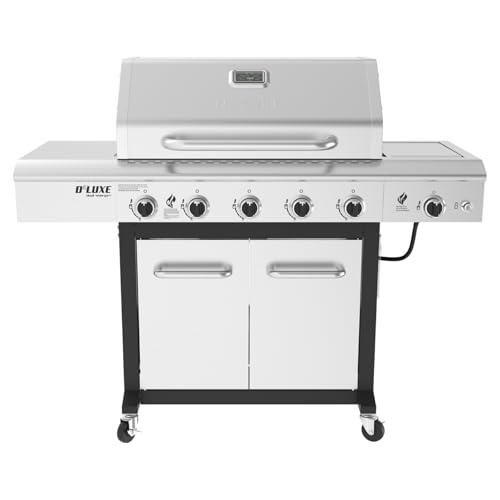
Nexgrill Deluxe 5-Burner Gas Grill — Best Affordable 5-Burner
Nexgrill’s Deluxe 5-burner is the affordable way to buy two upgrades at once: a fifth burner for a true three-zone map, and a ceramic side burner that works as an infrared sear station. At 65,000 BTU total with a built-in thermometer, it is the most capable grill in this guide — and still priced in the affordable conversation.
Strengths
- Five burners create a genuine sear-roast-hold zone map
- Ceramic side burner finishes steaks like a premium grill’s sear box
- 65,000 BTU total backs the larger grate without sagging
Trade-offs
- Ceramic burner is a delicate component — no water quenching, no dropped tools
- Big footprint and the longest assembly here
- Full-power running drinks propane; keep a spare tank for events
| Burners | 5 plus ceramic side burner |
| Output | 65,000 BTU total |
| Gauge | Built-in thermometer |
The ceramic side burner changes this grill’s ceiling. Reverse-sear workflow — gentle roasting on the main burners, a violent finish on the ceramic — is how premium grills justify themselves, and here it is at a value position. The five-burner box handles the crowd work beneath that flourish: gradient zoning from one end to the other, room for the full mixed menu, and recovery that keeps up with loading. Ownership asks respect for the ceramic element and the usual cover discipline. For hosts who cook productions and steak lovers who host them, this is the affordable gas grill with the fewest apologies.
Best for: hosts and steak lovers wanting premium workflows at an affordable tier / Not suited for: minimalists, small patios, or the rough-on-equipment
Check on Amazon — check the current price on Amazon before you buy; listings, bundles and included accessories change over time.

Charbroil Pro Series Amplifire Infrared 4-Burner Grill — Best Infrared on a Budget
The Charbroil Pro Series brings infrared cooking down-tier: its Amplifire system places an emitter plate between burners and food, which evens out hot spots, all but eliminates flare-ups, and keeps juices in the food instead of in the fire. In a four-burner cabinet with a side burner, it is the tech-forward pick of the affordable gas field.
Strengths
- Infrared emitter design delivers the most even heat in this guide
- Flare-ups are nearly eliminated — fatty chicken behaves itself
- Cabinet format with side burner completes the family layout
Trade-offs
- Emitter plates need regular cleaning to keep performing
- Infrared character is different — fierce, even heat with less open-flame flavor
- Top of the affordable tier; the Classic and Performance undercut it
| Burners | 4 plus side burner |
| System | Amplifire infrared |
| Cabinet | Closed cabinet cart |
Infrared is the one gas technology that genuinely changes results rather than decorating spec sheets. The emitter plate converts the burners’ chaotic flame into uniform radiant heat, so the back-left corner cooks like the center, and the drippings that would flare on an open system vaporize on the plate and season the food instead. Chicken thighs — the flare-up final exam — come off evenly browned instead of scorched and raw in patches. The maintenance price is real: keep the emitter plate’s ports clear with the included tool and a brush, or the evenness fades. For cooks whose nemesis is hot spots and flare-ups, this is the affordable gas grill engineered at their problem.
Best for: cooks frustrated by hot spots and flare-ups on conventional gas grills / Not suited for: open-flame traditionalists or owners who skip cleaning rituals
Check on Amazon — check the current price on Amazon before you buy; listings, bundles and included accessories change over time.
Comparison Table
| Pick | Badge | Key spec | Best for |
|---|---|---|---|
| Charbroil Classic 3-Burner Propane Gas Grill | Best Budget Gas Grill | 3 — burners | couples and small families wanting real gas grilling at the lowest honest tier |
| Charbroil Performance Series 4-Burner Gas Grill | Best Family Value | 4 plus side burner — burners | families of five to eight wanting the full layout without premium pricing |
| Royal Gourmet 4-Burner Cabinet Gas Grill | Best Cabinet on a Budget | 4 plus side burner — burners | careful owners feeding a family on a fixed, tight budget |
| Nexgrill 4-Burner Propane Gas Grill | Best Affordable Stainless | 4 plus side burner — burners | sear-focused families wanting maximum output in the affordable tier |
| Nexgrill Deluxe 5-Burner Gas Grill | Best Affordable 5-Burner | 5 plus ceramic side burner — burners | hosts and steak lovers wanting premium workflows at an affordable tier |
| Charbroil Pro Series Amplifire Infrared 4-Burner Grill | Best Infrared on a Budget | 4 plus side burner — burners | cooks frustrated by hot spots and flare-ups on conventional gas grills |
Use the table as a filter, not a verdict: eliminate the rows whose key spec fights your space, fuel rules, or headcount, and the best affordable gas grills decision usually narrows to two finalists whose full reviews above will settle it.
How to Choose an Affordable Gas Grill That Lasts
Size first, by your regular crowd: three burners for up to five people, four for families and small gatherings, five for regular hosts. Every burner beyond your crowd costs money, propane, patio, and parts forever. Then check the platform: search the model’s replacement burners and heat tents before you fall in love. If those parts are stocked and reasonably priced by multiple sellers, the grill is maintainable; if they are absent or exotic, the grill is a countdown.
Grate and burner materials, decoded
Porcelain-coated steel grates are the affordable standard — serviceable and easy to clean, with a lifespan of several seasons. Enameled cast iron is the upgrade: heavier, better searing, longer-lived. Bare chrome wire is the false economy. For burners, stainless tube burners outlast aluminized steel, but at this tier the availability of the replacement matters more than the metallurgy of the original. A cheap burner you can reorder beats a noble burner you cannot.
The cover is part of the price
Every grill in this guide should be budgeted with its fitted cover. Affordable steel — even stainless at this tier — loses to weather on a schedule, and the cover resets that schedule more cheaply than any other purchase. If the cover money is not in the budget, buy the smaller grill and the cover rather than the bigger grill alone; you are buying seasons, not square inches.
Infrared vs. Conventional Gas: Which Affordable Technology Suits You?
Conventional gas cooks with flame-heated air and metal: burners heat the cookbox, grates conduct heat into food, and drippings flare when they hit flame or hot tent. It is the familiar, forgiving system — and its known flaws are hot spots and flare-ups. Infrared inserts an emitter plate that absorbs the flame’s energy and re-radiates it evenly, so heat arrives uniformly and drippings vaporize on the plate instead of igniting. The Charbroil Pro in this guide is the affordable expression of that idea; the Nexgrill Deluxe’s ceramic side burner applies the same physics in a single high-intensity station.
Choose infrared if your cooking is flare-prone (chicken, sausages, fatty burgers) or if uneven heat has been your standing complaint. Choose conventional if you prefer the classic open-flame character, simpler cleaning, and the lowest parts complexity. Neither is the future defeating the past — they are two heat delivery systems with different manners, and at the affordable tier both are now honestly available.
The Three-Season Plan: Maintaining an Affordable Gas Grill
Season one is about habits: burn off residue after cooks while the grate is hot, empty the grease pan before it is full, and keep the cover on whenever the grill is cold. Season two adds inspection: pull the grates in spring, look at the burners and heat tents, clear spider webs from the venturi tubes (the classic cause of weak flames), and replace any tent that has thinned to lace. Season three is where affordable grills are won: a burner or igniter replaced in an hour returns the grill to first-season performance for a fraction of replacement cost.
Owners who run this plan get five-plus seasons from value-tier grills and stop thinking of them as disposable. Owners who skip it buy the same grill twice in the same span and conclude, wrongly, that affordable gas grills are junk. The platform matters — every pick here has the parts pipeline the plan requires — but the plan is the product. Budget the hour each spring along with the money each purchase, and affordability becomes durability.
Propane Economics: Tanks, Gauges, and Never Running Dry
Gas grilling runs on a consumable with a peculiar market: the 20-pound tank, exchanged everywhere and owned by almost nobody in the transaction. The economics reward attention. A tank exchange swaps your empty for a full one at a convenience price; a refill station fills your own tank, usually with more gas for less money, and keeps a tank you know in service. Either way, the gauge question matters: most tanks carry no gauge, and the affordable solutions are a hanging scale, a pressure gauge fitted to the valve, or simply the spare-tank discipline this guide keeps recommending.
Consumption scales with ambition. A three-burner on a weeknight rhythm sips; a five-burner at full event tilt can empty a tank in a handful of long cooks. The spare tank is therefore not paranoia but inventory management — the same logic as a second roll of paper towels, applied to fire. Store spares upright, outdoors, away from heat sources and ignition, with caps on the outlets; propane storage rules are simple and absolute.
Do the annual math once and the fuel stops being a surprise: your cooks per month, your average burn time, your grill’s appetite at working settings. Most households land at a tank or two per season for small grills and two to four for big ones. Against that modest line item, gas’s convenience — instant on, instant off, no ash, no pellets, no charcoal bags — is bought cheaply, which is precisely why it remains the default fuel of the affordable market this guide serves.
Diagnosing Weak Flames and Uneven Heat: A Troubleshooting Ladder
When an affordable gas grill starts cooking badly, the cause is almost never the grill’s soul — it is one of five fixable things, and this ladder climbs them in order of likelihood. First, the regulator’s safety mode: modern regulators restrict flow after a sudden valve opening, and the fix is free — close everything, disconnect, wait a minute, reconnect, and open the tank valve slowly before lighting. A startling share of “broken” grills are cured on this rung alone.
Second, the venturi tubes: spiders and insects nest in them over winter, and the flame goes yellow, lazy, and low. A bottle brush or pipe cleaner through each tube in spring is the cure and the prevention. Third, the burners themselves: rust and food debris clog the ports along the tube, making flames uneven; a wire brush and a port-by-port check with a straightened paper clip restores the pattern. Fourth, the heat tents: a tent rusted to lace no longer spreads heat or protects the burner, and its replacement — cheap on every platform in this guide — transforms the cooking in an afternoon.
Fifth, and only fifth, consider the regulator or hose itself, replaced as a unit if flames stay weak after the first four rungs. Climb the ladder before you shop for a new grill and you will discover what this guide’s picks were chosen for: platforms whose every rung is reachable, cleanable, and replaceable by the owner, with parts that exist. That reachability — not the first season’s shine — is the true definition of an affordable gas grill.
Natural Gas Conversions and Other Money Questions, Answered Straight
A question every affordable propane buyer eventually asks: can this grill run on natural gas if a line arrives later? Some models offer manufacturer conversion kits; many value-tier grills do not, and converting a grill without its maker’s kit voids warranties and invites genuine danger, because the two gases run at different pressures through different orifices. The straight answer is to buy the fuel you have. If a natural gas line is truly imminent, shop the shorter list of dual-fuel or convertible models deliberately; otherwise, propane’s portability — the grill can move with you, lend itself, and rearrange the patio — is worth more than a hypothetical conversion.
The second money question is the extended warranty and service plan routinely offered at checkout. On the platforms in this guide — whose wear parts are cheap, stocked, and owner-swappable — the plan usually insures against the exact failures you can fix in an hour for the price of a pizza. The arithmetic favors self-insuring: bank the plan’s price as your parts fund and you will come out ahead on every platform here with a parts pipeline. The exception is the buyer who will never open a grill with a wrench; for them, a plan is a legitimate purchase of other people’s hands.
And the third question — when is a cheap grill too cheap — has been this guide’s refrain: when its parts cannot be reordered, when its steel cannot survive its second winter, when its listing will not state its own burner count plainly. The six picks clear those bars at their tiers. Below them lies a shelf of grills that are not affordable at any price, because their cost per season is the highest in the store.
The Gas Grill Owner’s Year: A Maintenance Calendar That Fits on a Card
Spring, before the first cook: leak-check the fresh connection, brush the venturi tubes clear of winter tenants, inspect burners and heat tents, oil the grates, and run the bread test if anything was replaced. Summer, in season: scrape grates while hot after cooks, empty the grease pan monthly or after every big event, keep the cover on between sessions, and glance at the flames once a month — blue and even is health; yellow and lazy is a cleaning appointment. Autumn: one deep clean before storage, tank disconnected and stored upright outdoors, cover on a dry grill.
Winter asks almost nothing — a monthly glance that the cover is seated and no water is pooling on it — which is precisely the point of doing autumn properly. Across the year the total is perhaps three hours of maintenance, and the return is the thing this entire guide is about: an affordable grill that cooks in its fifth season like its first, because its wear parts were treated as a rhythm instead of a surprise.
Tape the calendar inside the cabinet door of any pick here and the grill will out-teach it. Owners who keep calendars stop shopping for grills and start shopping for dinners — the surest sign that “affordable” has done its work. The six platforms above were chosen to reward exactly this relationship: standard parts, reachable tubes, honest steel. The calendar is yours to keep; the grill will do the rest.
Reading Flame Color and Other Free Diagnostics
A gas grill announces its health in its flames, and learning the language takes one cook. Healthy flames are mostly blue with small yellow tips, even in height along each burner, and steady when the lid opens and closes. Flames that lift off the burner, roar, or blow out in a breeze suggest excess air or a regulator in its restricted safety mode — reset the connection sequence before suspecting parts. Flames that burn yellow, lazy, and tall are starved of air: the classic signature of a spider nest or debris in the venturi tube, cured by the brush described in this guide’s troubleshooting ladder.
Uneven flames tell a spatial story. A burner strong at the back and weak at the front usually has clogged ports along its length — clean them port by port. A whole side of the grill running weak points upstream: a shared supply issue, a kinked hose, or a regulator complaint. A single burner dead while its neighbors thrive is that burner’s tube, crossover, or igniter — all owner-replaceable on every platform in this guide, which is not a coincidence but a selection criterion.
Make the flame check a monthly in-season habit, done in the dim light of early evening when flame color reads truest. It takes ninety seconds, it costs nothing, and it catches every common gas ailment while the cure is still a cleaning rather than a part — or a part rather than a grill. The affordable platforms chosen here expose their burners to exactly this kind of owner attention. Fluency in flames is how you collect on that design.
When Your Grill Outgrows Its Warranty: Finding Help and Parts
Sooner or later an affordable gas grill needs something beyond a wear part — a valve, a manifold, a lid handle with a peculiar mount — and the owner’s options are better than most expect. Start with the manufacturer’s parts line and the model number you photographed at setup; the platforms in this guide maintain real parts catalogs, and a surprising share of “obsolete” components are one phone call from existing. Independent grill-parts retailers stock cross-referenced burners, tents, and igniters for every high-volume platform here, often with fitment charts more honest than the original manual.
Local propane and hearth shops are the underused resource: many service what they did not sell, diagnose regulator and valve questions over the counter, and will tell you plainly when a grill’s remaining life does not justify a repair — advice worth more than the part. And the owner communities around high-volume models have documented every failure and fix imaginable; a model-specific search before you spend is due diligence, not desperation. The through-line is the one this guide selected for: buy platforms with ecosystems, and help will exist when you need it, years after the warranty’s polite expiration.
Assembly Day: Getting a Kit Grill Right the First Time
Affordable gas grills arrive as kits, and assembly quality is the hidden variable in half the reviews you will ever read. Set up like it matters: a flat, open workspace, the parts inventoried against the manual before the first bolt, and every fastener started by hand before any is fully tightened — a frame snugged progressively stays square, while a frame tightened corner by corner racks itself into a lid that never seals. Keep the hardware sorted in a muffin tin or magnetic tray; the bolt that rolls into the lawn is always the one the firebox needed.
Two moments deserve special patience. The burner and venturi alignment decides flame quality for the grill’s life — tubes should sit centered on their valves without force, and a burner that must be sprung into place will cook like it. The lid and hinge decide the seal — close it slowly and watch the gap; even contact all around is the goal, and gentle hinge adjustment now beats a season of heat leaking past a cocked lid. Finish with the manual’s own checklist, register the warranty the same day, and photograph the rating plate. An afternoon of care at assembly is the cheapest performance upgrade in this entire guide, and it is available on every single pick.
How to Set Up a New Gas Grill for Its First Cook
The first hour with a new gas grill decides how it cooks for years. This sequence — leak check, burn-in, heat mapping — is the difference between a grill you understand and a grill you guess at.
- Leak-check every connection: with the tank connected and burners off, open the tank valve and brush soapy water on the regulator and hose connections. Bubbles mean a leak: close the valve, reseat the fitting, and retest. No exceptions, no first cook until it passes.
- Burn in the grill empty: light all burners, close the lid, and run at medium-high for twenty to thirty minutes. Manufacturing oils and coatings burn off now, instead of flavoring your first dinner.
- Season the grates: while hot, wipe the grates with a paper towel dipped in high-heat oil, held in tongs. Repeat twice. This starts the nonstick, rust-resistant seasoning every grate material benefits from.
- Map the heat with bread: lay white bread slices across the whole grate at medium heat for two minutes. The browning pattern is your grill’s hot-spot map — photograph it; you will cook by it for years.
- Calibrate the lid thermometer mentally: compare the lid reading against the grill’s behavior on a simple cook, and note the offset. Lid gauges read dome air; your notes turn that into useful information.
- Write down the model and part numbers: photograph the rating plate and save the manual’s parts list. Future you, ordering a burner in year three, will be grateful for thirty seconds spent now.
An hour of procedure, and your affordable grill is a known instrument: safe connections, seasoned grates, a mapped firebox, and paperwork ready for the parts it will someday want. That is professional setup at a household price — and it is the real difference between cheap and affordable.
Common Buying Mistakes
Trusting the headline burner count. Side burners get counted, sear burners get counted twice. Verify the main-burner count under the grate — every pick here was checked against its listing.
Never leak-checking after a tank swap. Connections loosen in handling. Thirty seconds with soapy water after every swap is the cheapest safety habit in grilling.
Letting the grease pan overflow. Most “my grill caught fire” stories are housekeeping failures. Empty the pan on a schedule, not on a smoke signal.
Ignoring spider webs in burner tubes. Weak, yellow, lazy flames in spring are usually an insect condo in a venturi tube. A pipe cleaner in April prevents a season of bad heat.
Buying size instead of platform. A five-burner orphan with no parts loses to a three-burner platform with a parts pipeline every time the first burner tires.
Final Recommendation
The ladder, plainly: the Charbroil Classic 3-Burner Propane Gas Grill for small households and tight budgets, the Charbroil Performance Series 4-Burner Gas Grill or Royal Gourmet 4-Burner Cabinet Gas Grill for families choosing between parts-network polish and cabinet value, and the Nexgrill 4-Burner Propane Gas Grill when output and stainless matter most.
Step up only for a reason: the Nexgrill Deluxe 5-Burner Gas Grill if you will use five zones and a sear station, the Charbroil Pro Series Amplifire Infrared 4-Burner Grill if hot spots and flare-ups are your standing enemies. Every one was verified against its live listing, burner by burner, before earning its badge.
Buy the cover in the same order, run the first-hour setup, and put the spring inspection on your calendar. Do those three things and an affordable gas grill stops being a compromise — it becomes the hardest-working appliance on your patio.
Keep comparing within the same family before you decide: Best Affordable 4 To 6 Burner Propane Grills · Best Affordabke Grills · Best 4 Burner Gas Grills.
Frequently Asked Questions
How many burners does a family actually need?
Four covers most families completely — burgers for eight to ten with sides in one wave. Three suits households up to five; five is for regular hosts who use multiple zones at once.
Are affordable gas grills safe?
Yes, with the standard habits: leak-check after tank swaps, keep the grease system clean, and follow clearance guidelines. The picks here are mainstream manufacturer models with standard safety hardware.
How long will an affordable gas grill last?
Three to five seasons is typical with a cover and basic care; the three-season maintenance plan in this guide stretches value models beyond that. The kettle-class lifespans of charcoal do not apply — gas has wear parts by design.
What is the first part to fail on a gas grill?
Heat tents (flavorizer bars) usually thin first, followed by igniters and then burners. All are inexpensive and user-replaceable on the platforms chosen here.
Is infrared worth it on a budget gas grill?
If flare-ups and hot spots are your main frustrations, yes — the evenness difference is real. If you are happy with conventional gas behavior, the same money buys a larger conventional grill.
Should I buy a grill with a side burner?
If you boil corn, simmer sauces, or fry sides outdoors, it earns its space weekly. If your sides live in the kitchen, spend the money on the main box instead.
Related reading: Best Affordable Bbq Grills · Best 3 Burner Gas Grills · Best 8 Grills.


