Disclosure: airfryerkitchensupply.com is reader-supported. When you buy through links on our site, we may earn an affiliate commission at no extra cost to you.
Where to buy
All six air conditioners in this guide passed the same test: their listing titles, returned by Amazon listing data on 2026-11-22, state 220V outright. One honest warning before the list: every verified 220V portable unit on the US storefront is an industrial spot cooler, not a slim bedroom appliance, and this guide explains what that means instead of pretending otherwise.
- HQHAOTWU 220V Portable Air Conditioner 12000Btu/h Industrial Spot Cooler (Best Overall): Check the current price on Amazon
- INTSUPERMAI 220V Portable Air Conditioner 12000BTU Spot Cooling System (Best for Events and Shared Spaces): Check the current price on Amazon
- INTBUYING Industrial Portable Air Conditioner 220V 18700BTU Spot Cooler (Best Mid-Power Upgrade): Check the current price on Amazon
- HayWHNKN Industrial Spot Cooler Portable Commercial Air Conditioner 22500 Btu/h 220V (Best High-Capacity): Check the current price on Amazon
- WYDDDARY Portable Air Conditioner 22,178 BTU Industrial Spot Cooler 220V (Best Airflow): Check the current price on Amazon
- PreAsion 22500 BTU Industrial Spot Cooler Portable Air Conditioner 220V (Best Maximum Airflow): Check the current price on Amazon
Search for the best 220 volt portable air conditioner and you step into one of the most misleading corners of appliance retail. The familiar home brands sell portable air conditioners for the North American market at 115 volts, and their listings dominate the first pages. The machines that genuinely run on 220V, the supply used across Europe, most of Asia, Africa and South America, are almost entirely industrial spot coolers: heavy, wheeled units built to blast cold air at a workstation, a server rack, a repair bay or a market stall rather than to cool a whole bedroom evenly.
That is not a reason to give up; it is a reason to shop with clear eyes. A spot cooler used knowingly is a superb tool. It delivers a powerful stream of genuinely cold air exactly where a person or a machine needs it, it runs natively on 220V with no transformer nonsense, and it shrugs off hot, dusty environments that would kill a domestic unit. What it will not do is behave like a whisper-quiet home appliance, and it still needs its hot exhaust air ducted away and its condensate managed.
All six picks below are 220V machines with the voltage confirmed in the listing title itself, spanning roughly 12,000 to 22,500 BTU per hour and airflows from about 550 to over 1,000 cubic metres per hour. The guide explains how to match that muscle to a space, how to install a spot cooler so it actually cools, and when a different kind of 220V cooling, a locally bought split system or a home-market portable, is the smarter money.
In this guide
Quick Picks
- HQHAOTWU 220V Portable Air Conditioner 12000Btu/h Industrial Spot Cooler — Best Overall: A 12,000 BTU/h 220V spot cooler with 550 cubic metres per hour of airflow and a two-tube design for indoor or outdoor duty. — Check price on Amazon
- INTSUPERMAI 220V Portable Air Conditioner 12000BTU Spot Cooling System — Best for Events and Shared Spaces: Another verified 220V 12,000 BTU option with an adjustable vent, aimed by its maker at factories, hospitals, warehouses and outdoor events. — Check price on Amazon
- INTBUYING Industrial Portable Air Conditioner 220V 18700BTU Spot Cooler — Best Mid-Power Upgrade: A heavy-duty 220V step up to 18,700 BTU and 780 cubic metres per hour, with a double adjustable outlet for two cooling zones. — Check price on Amazon
- HayWHNKN Industrial Spot Cooler Portable Commercial Air Conditioner 22500 Btu/h 220V — Best High-Capacity: Top-tier verified capacity at 22,500 Btu/h from a 2.5KW 220V commercial unit for indoor and outdoor mobile cooling. — Check price on Amazon
- WYDDDARY Portable Air Conditioner 22,178 BTU Industrial Spot Cooler 220V — Best Airflow: A 22,178 BTU 220V cooler pushing 910 cubic metres per hour through a three-column outlet at 2400W. — Check price on Amazon
- PreAsion 22500 BTU Industrial Spot Cooler Portable Air Conditioner 220V — Best Maximum Airflow: The airflow leader of the verified group: 22,500 BTU and 1,000 to 1,100 cubic metres per hour through a column outlet, built for factory, warehouse and workshop duty. — Check price on Amazon
How These Picks Were Chosen
Selection began with voltage verification: only listings whose returned titles state 220V were eligible, which immediately removed every mainstream 115V home portable from contention. Among the verified survivors we compared cooling capacity in BTU per hour, airflow in cubic metres per hour, outlet design, since a focused column or adjustable vent suits different jobs, and the settings each machine is honestly built for, workshops, warehouses, hospitals, repair centres and outdoor events recur in the titles because those are the true habitats of these machines.
We also weighted clarity. Several verified listings state their airflow and capacity plainly, which makes matching a unit to a workstation far easier. Where a title leaves a detail unstated, this guide leaves it unstated too rather than filling gaps with guesses. Noise figures, notably, are absent from these industrial titles, so the guide treats noise qualitatively and honestly: expect industrial fan noise, plan for it, and do not buy any of these for a light sleeper’s bedroom.
The 6 Best 220 Volt Portable Air Conditioners
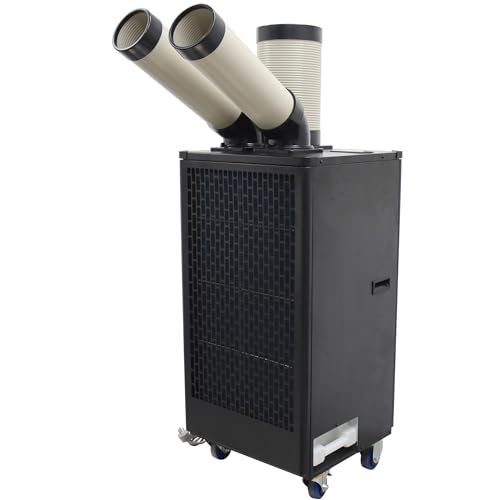
HQHAOTWU 220V Portable Air Conditioner 12000Btu/h Industrial Spot Cooler — Best Overall
The HQHAOTWU earns the top spot by being the most balanced verified 220V machine in the list. Its 12,000 BTU per hour rating is the joint-smallest here, which in spot-cooler terms means the most manageable: strong enough to transform the working conditions at a bench, a till point, a small workshop or a food stall, without the sheer bulk of the 22,000 BTU class. The stated 550 cubic metres per hour of airflow is honest, useful output, and the two-tube arrangement helps it work in both indoor and outdoor placements.
Strengths
- 220V supply confirmed in the listing title, with a clear 12,000 BTU/h capacity rating
- Two-tube design supports flexible indoor and outdoor spot cooling setups
- 550 cubic metres per hour airflow is well matched to cooling one or two workstations
Trade-offs
- Industrial build and fan noise; not a quiet domestic bedroom appliance
- Spot cooling chills where the air is aimed, not a whole large room evenly
- At 12,000 BTU/h it is the joint-smallest here and will struggle in very large hot spaces
| Voltage (from listing title) | 220V |
| Capacity (from listing title) | 12,000 BTU/h |
| Airflow (from listing title) | 550 m³/h |
| Design (from listing title) | Industrial spot cooler, 2 tubes, mobile |
Spot cooling works by a different logic from room cooling, and this unit shows the logic at its most approachable. Park it a few metres from where people actually work, aim the cold stream at torso height, and give the hot exhaust a path out of the space. The person in the stream feels a dramatic drop, often the difference between coping and not coping in a heatwave shift, while the machine never wastes energy trying to refrigerate a warehouse roof void. For small businesses in 220V countries, that targeted efficiency is exactly the point.
The two-tube layout deserves its mention because exhaust arrangement is where spot coolers succeed or fail. A unit that dumps its hot air into the same space it cools is fighting itself; tubes that carry heat away, through a door gap, a window panel or into a ceiling void, let the cold side win. Set this machine up with that discipline and it performs like the industrial tool it is.
Best for: Small workshops, stalls, kiosks and workstations in 220V regions needing strong targeted cooling / Not suited for: Quiet bedrooms, nurseries, or anyone expecting whole-house comfort cooling

INTSUPERMAI 220V Portable Air Conditioner 12000BTU Spot Cooling System — Best for Events and Shared Spaces
The INTSUPERMAI matches the HQHAOTWU on headline numbers, 220V, 12,000 BTU and 550 cubic metres per hour, and differentiates itself with an adjustable vent and an explicitly broad brief: factory floors, hospitals, warehouses and outdoor events all appear in its title. That breadth suits buyers who move a cooler between jobs, a facilities team covering whichever corner of a building is suffering this week, or an events crew cooling a marquee workstation, a stage wing or a catering tent.
Strengths
- 220V confirmed in the title with 12,000 BTU capacity and 550 m³/h airflow stated
- Adjustable vent makes aiming the cold stream at changing work positions easier
- Maker explicitly targets factories, hospitals, warehouses and outdoor events, so the duty rating is honest
Trade-offs
- Same industrial noise and presence as the rest of this class
- Adjustable vent is a convenience, not a substitute for correct exhaust ducting
- Two 12,000 BTU rivals in this guide means the choice comes down to vent style and availability
| Voltage (from listing title) | 220V |
| Capacity (from listing title) | 12,000 BTU |
| Airflow (from listing title) | 550 m³/h cold air flow |
| Vent (from listing title) | Adjustable vent, movable spot cooler |
The adjustable vent is more valuable than it sounds. Workstations move through a shift: a mechanic slides along a vehicle, a stallholder steps between counter and store room, a nurse’s station has two chairs rather than one. A vent you can redirect in seconds keeps the cold stream on the people instead of on a patch of empty floor, and it reduces the temptation to drag the whole unit around, exhaust duct and all, every time the work moves.
For events use, think in terms of relief points rather than cooled rooms. A spot cooler behind a bar, beside a DJ booth or at a first-aid post creates a pocket of survivable air in an otherwise brutal marquee. Organisers in 220V countries who have watched staff wilt through a summer wedding or market day will recognise the value instantly; just plan the exhaust route and a power feed rated for a serious appliance before the day itself.
Best for: Facilities teams and event crews in 220V regions who move cooling between changing work positions / Not suited for: Fixed quiet interiors, or buyers who want set-and-forget whole-room climate control

INTBUYING Industrial Portable Air Conditioner 220V 18700BTU Spot Cooler — Best Mid-Power Upgrade
When a single 12,000 BTU stream is not enough, the INTBUYING is the natural step up: 18,700 BTU of capacity, 780 cubic metres per hour of cold air and a double adjustable outlet that can split the stream between two positions. Its title names hospitals, automobile repair centres, factories and warehouses, which is a fair description of where this class of machine earns its keep: bigger spaces, hotter processes and more than one person to keep functional.
Strengths
- 220V confirmed in the title, with a substantial 18,700 BTU capacity
- 780 m³/h airflow and a double adjustable outlet can serve two work positions at once
- Heavy-duty positioning for repair centres, factories and warehouses is stated plainly by the maker
Trade-offs
- Bigger, heavier and thirstier than the 12,000 BTU class; check your circuit capacity
- Two outlets split the stream, so each position gets less than the full output
- Still a spot cooler: it will not evenly condition a large open floor on its own
| Voltage (from listing title) | 220V |
| Capacity (from listing title) | 18,700 BTU |
| Airflow (from listing title) | 780 m³/h cold air volume |
| Outlets (from listing title) | Double adjustable outlet |
The double outlet changes the deployment maths. Instead of one powerful stream, you get two useful ones: both bays of a small repair shop, the two ends of a packing bench, a workstation and the supervisor’s desk beside it. In many real buildings that coverage beats a single stronger blast, because heat distress happens to people in places, plural. Aim each outlet deliberately and resist the urge to point one at a doorway, which is just cooling the car park.
Power planning matters at this size. An 18,700 BTU industrial cooler is a major appliance on a 220V circuit, and it deserves a socket and breaker chosen with the same respect you would give a large heater. If the building’s wiring is elderly, have an electrician confirm the circuit before the hottest week of the year does the testing for you.
Best for: Repair centres, factories and warehouses in 220V regions needing two cooled positions or a hotter space handled / Not suited for: Small single workstations, where the 12,000 BTU class is cheaper to run and easier to place

HayWHNKN Industrial Spot Cooler Portable Commercial Air Conditioner 22500 Btu/h 220V — Best High-Capacity
The HayWHNKN sits at the top of the verified range: 22,500 Btu per hour of cooling from a 2.5 kilowatt 220V commercial machine, built for mobile indoor and outdoor work. This is the class of cooler rolled out for serious heat: production lines that cannot stop, commercial kitchens’ outer stations, loading bays, workshops in metal buildings that turn into ovens by midday. Its title gives capacity and power draw plainly, which helps the circuit planning this size demands.
Strengths
- 220V confirmed in the title with the joint-highest capacity here, 22,500 Btu/h
- 2.5KW power figure stated in the title, making electrical planning straightforward
- Commercial mobile design for indoor and outdoor duty
Trade-offs
- A 2.5KW continuous load needs a properly rated circuit, not a random spare socket
- Size, weight and noise are all at the industrial end of the scale
- Overkill, and needlessly expensive to run, for a single small workstation
| Voltage (from listing title) | 220V |
| Capacity (from listing title) | 22,500 Btu/h |
| Power (from listing title) | 2.5 KW |
| Use (from listing title) | Mobile indoor outdoor cooling, commercial |
Capacity like this earns its place where heat is a production problem, not a comfort preference. A line that must keep running, a kitchen pass that must stay staffed, a print shop whose machines misbehave above a threshold temperature: in those settings a 22,500 Btu/h stream aimed well can protect output worth far more than the electricity bill. Judge this machine as plant equipment and it makes complete sense.
The same framing tells you when to walk away. If your problem is a hot bedroom or a home office, this unit is the wrong tool wearing the right voltage: too loud, too bulky and too blunt. The buying guide below points those readers toward the home-market alternatives that this US-storefront search cannot supply. Matching the tool class to the problem is the whole skill in this category.
Best for: Commercial and industrial sites in 220V regions with serious, production-level heat loads / Not suited for: Homes, quiet offices, or any single small workstation

WYDDDARY Portable Air Conditioner 22,178 BTU Industrial Spot Cooler 220V — Best Airflow
The WYDDDARY pairs near-top capacity, 22,178 BTU, with the second-highest stated airflow in this guide, 910 cubic metres per hour, delivered through a three-column outlet. Columns throw cold air in tall, directed streams, which suits cooling people standing at benches or machines rather than seated at desks. The title states its 2400W draw alongside the 220V supply, so there are no electrical surprises for those who read it.
Strengths
- 220V and 2400W draw both confirmed in the title, with 22,178 BTU capacity
- 910 m³/h airflow is near the top of this verified group
- Three-column outlet throws tall directed streams suited to standing work positions
Trade-offs
- Column outlets are specialised; seated, low workstations may be better served by adjustable vents
- 2400W continuous draw requires deliberate circuit planning
- Industrial noise and footprint, as with every verified 220V unit here
| Voltage (from listing title) | 220V |
| Capacity (from listing title) | 22,178 BTU |
| Airflow (from listing title) | 910 m³/h |
| Power (from listing title) | 2400W |
| Outlet (from listing title) | Three column |
Airflow is the figure buyers underrate. Capacity tells you how much heat the machine can remove; airflow tells you how convincingly the cold reaches the person. At 910 cubic metres per hour through column outlets, this unit projects its cooling across a working distance rather than letting it pool at the machine’s feet, which is what you want in a warehouse aisle, a production line or a market hall where the cooler cannot sit within arm’s reach of everyone it serves.
The three-column format is the decision point. Columns excel at bathing a standing worker in moving cold air from a few metres away. They are less precise for a single seated operator, who would get more from the adjustable vents of the smaller machines. As ever in this category, picture the exact human, in the exact spot, doing the exact job, and choose the outlet that reaches them.
Best for: Standing workstations, aisles and lines in 220V warehouses and halls needing projected cooling / Not suited for: Seated single-desk cooling, or quiet and domestic settings

PreAsion 22500 BTU Industrial Spot Cooler Portable Air Conditioner 220V — Best Maximum Airflow
If airflow is your deciding metric, the PreAsion closes the argument: 1,000 to 1,100 cubic metres per hour, the highest stated figure among the verified 220V machines, matched with 22,500 BTU of capacity and a column outlet. Its title aims it squarely at factories, warehouses and workshops, including outdoor mobile use. This is the unit for big, hot, open spaces where the cold stream has to travel and the people it serves are spread along a line or a bay.
Strengths
- 220V confirmed in the title with joint-highest capacity, 22,500 BTU
- Highest stated airflow here, 1,000-1,100 m³/h, for cooling at a distance
- Column outlet and outdoor mobile design suit factories, warehouses and workshops
Trade-offs
- The largest commitment here in size, power draw and running cost
- maximum airflow is wasted, and noisy, in small enclosed spaces
- Column throw is a blunt instrument for one seated worker
| Voltage (from listing title) | 220V |
| Capacity (from listing title) | 22,500 BTU |
| Airflow (from listing title) | 1,000-1,100 m³/h |
| Outlet (from listing title) | Column outlet |
| Use (from listing title) | Factory, warehouse, workshop, outdoor mobile |
In a large workshop the enemy is distance: heat sources everywhere, people spread out, and a roof full of hot air that no portable machine will ever fully condition. The PreAsion’s strategy is the correct one for that fight, overwhelming airflow aimed along the line of work so every station catches a moving stream of cold. Crews feel the benefit within minutes, and in heat-stress terms those minutes matter.
Budget honestly around it. A machine of this class draws serious power for as long as it runs, needs an exhaust path that does not simply relocate the heat problem onto a colleague, and wants a condensate plan for humid days. None of that is a flaw; it is the operating reality of industrial cooling, and buyers who plan for it get a tool that transforms a brutal workspace.
Best for: Large factories, warehouses and workshops in 220V regions where cooling must travel across distance / Not suited for: Small rooms, quiet environments, or buyers counting every watt
Comparison Table
| Pick | Badge | Key spec | Best for |
|---|---|---|---|
| HQHAOTWU 220V Portable Air Conditioner 12000Btu/h Industrial Spot Cooler | Best Overall | 220V, 12,000 BTU/h, 550 m³/h, 2 tubes | Small workshops, stalls, kiosks and workstations in 220V regions needing strong targeted cooling |
| INTSUPERMAI 220V Portable Air Conditioner 12000BTU Spot Cooling System | Best for Events and Shared Spaces | 220V, 12,000 BTU, 550 m³/h, adjustable vent | Facilities teams and event crews in 220V regions who move cooling between changing work positions |
| INTBUYING Industrial Portable Air Conditioner 220V 18700BTU Spot Cooler | Best Mid-Power Upgrade | 220V, 18,700 BTU, 780 m³/h, double outlet | Repair centres, factories and warehouses in 220V regions needing two cooled positions or a hotter space handled |
| HayWHNKN Industrial Spot Cooler Portable Commercial Air Conditioner 22500 Btu/h 220V | Best High-Capacity | 220V, 22,500 Btu/h, 2.5KW | Commercial and industrial sites in 220V regions with serious, production-level heat loads |
| WYDDDARY Portable Air Conditioner 22,178 BTU Industrial Spot Cooler 220V | Best Airflow | 220V, 22,178 BTU, 910 m³/h, three-column outlet | Standing workstations, aisles and lines in 220V warehouses and halls needing projected cooling |
| PreAsion 22500 BTU Industrial Spot Cooler Portable Air Conditioner 220V | Best Maximum Airflow | 220V, 22,500 BTU, 1,000-1,100 m³/h, column outlet | Large factories, warehouses and workshops in 220V regions where cooling must travel across distance |
How to Choose the Best 220 Volt Portable Air Conditioner for a Workspace
Begin by accepting what a spot cooler is. It does not lower the average temperature of a big space the way a fixed split system does; it creates a river of cold air and puts a person or a process in it. Choose by workstation first: how many people, standing or seated, at what distance from where the machine can stand? Those answers point straight at an outlet style, adjustable vent for close seated work, columns for standing work at a distance, and at an airflow figure, which matters as much as BTU.
Capacity comes second. Around 12,000 BTU per hour handles one or two workstations in a moderately hot space. The 18,000 to 19,000 BTU class covers bigger or hotter positions and can split between two outlets. Above 22,000 BTU you are equipping commercial heat loads: production lines, loading bays, metal-roofed workshops. Oversizing wastes money and power; undersizing in a genuinely hot industrial space achieves nothing at all, so be honest about the heat your space generates, including machinery, ovens, vehicles and sun-loaded roofing.
Finally, audit the practicalities before ordering: a 220V circuit with capacity for a 2.4 to 2.5 kilowatt continuous draw on the big units, a route for hot exhaust air to leave the working area, a plan for condensate on humid days, and floor space for a heavy wheeled machine plus turning room. A cooler that fails any of those four checks will disappoint no matter how strong its numbers look.
Spot Cooler, Home Portable or Split System: Picking the Right 220V Cooling
The verified 220V machines in this guide are industrial spot coolers because that is what the US storefront actually sells in 220V. In your own country, though, you have more options, and the honest guide names them. A locally bought home portable air conditioner, the familiar upright with a window hose, suits a bedroom or home office far better than any spot cooler: quieter, gentler and designed for whole-room duty. It simply is not sold in 220V through the US listings we verified, so it cannot appear as a linked pick here.
A fixed split system, professionally installed, is the best cooling of all for a permanent room: quiet, efficient and even. It loses on portability and upfront cost and wins on everything else. The spot cooler wins when the cooling must move, when the building cannot be modified, when the heat is concentrated at workstations, or when a rental or temporary site rules installation out. Choose by the shape of your problem, not by which machine has the biggest number.
Running Costs and Electrical Planning for 220V Spot Coolers
These are heavy appliances. The largest verified units state draws around 2.4 to 2.5 kilowatts, comparable to running an electric heater in reverse, and they may run for an entire shift. Multiply the draw by your hours and your local electricity tariff to forecast the bill before the first heatwave, and remember that targeted spot cooling usually still beats trying to condition a whole industrial volume, which is why the category exists.
Electrically, give a big cooler its own properly rated circuit where possible, avoid extension leads entirely, and never run one through a travel adapter or a multi-way strip. If breakers trip, that is information, not bad luck: the circuit is telling you it is undersized for the load, and an electrician is the correct next call.
Heat Loads: Estimating What Your Space Actually Throws at a Cooler
Workshops do not heat up evenly or innocently. A metal roof in afternoon sun can radiate like a ceiling heater, a vehicle engine brought in hot adds a furnace to the room, and a production machine may dump its waste heat exactly where its operator stands. Before choosing a capacity class from this guide, walk the space at the hottest hour and list the heat sources near each workstation. Buyers are routinely surprised to find the problem is not the building’s size but one brutal local source, and a well-aimed 12,000 BTU stream defeats a local source that a larger unit aimed generally would merely argue with.
People are heat sources too, and working people more than seated ones. A packing line of six active workers generates a meaningful load before any machine is switched on. That is why this guide sizes by workstations and their surroundings rather than by floor area, and why the step from one cooled position to two, the INTBUYING’s double outlet territory, so often matters more than a raw capacity increase.
Exhaust Routing in Real Buildings: Windows, Doors and Ceiling Voids
The exhaust duct is where spot cooling succeeds, and real buildings offer imperfect options. A window with a fitted panel is the cleanest route in offices and cabins. A door gap works if the opening around the duct is sealed with board or foam; an unsealed doorway simply invites the hot air back in at floor level. Ceiling voids are legitimate only when they vent onward rather than storing heat above a colleague’s head. In workshops, a roller door cracked exactly the duct’s width, with the remaining gap blanked, is the pragmatic classic.
Whatever route you choose, walk it once with the machine running and your hand as the instrument. If you can feel warm air leaking back into the working zone anywhere along the path, that leak is a percentage of your cooling walking out of the room. Ten minutes with foam tape and a board at installation repays itself every hot day of the season, and it costs less than the electricity a leaking setup wastes in its first week.
Spot Cooling and Heat-Stress Duty: The Employer’s Angle
In many workplaces cooling is not a perk but a duty. Heat stress degrades judgement before it endangers health, and the first symptoms, slowed work, mistakes, irritability, are production problems before they are medical ones. A spot cooler aimed at the most exposed workstation is often the fastest intervention available to a manager: no installation, no building works, relief the same afternoon. That speed is why these machines appear in hospitals, repair centres and warehouses in their own listings; facilities teams buy them when a heatwave makes a specific post untenable.
Used this way, the cooler is also a diagnostic. If one workstation needs spot cooling every summer, the building is telling you something about its roof, its ventilation or its process layout, and the permanent fix belongs in next year’s budget. The portable machine handles this year honestly and buys the organisation time to fix the cause rather than merely surviving the symptom.
Condensate, Humidity and the Wet-Day Reality of Serious Cooling
Every air conditioner is also a dehumidifier, because cold coils wring moisture from the air that crosses them. In a humid climate, a hard-working spot cooler can produce a surprising volume of water across a shift, and that water has to go somewhere planned. A continuous drain hose to a suitable outlet is the professional answer; a tank with a scheduled emptying rhythm is the workable one; discovering the tank exists when the machine stops on a full-float switch during the hottest hour is the third option, and it is the one unprepared buyers reliably choose by default.
Plan the water when you plan the exhaust, because the two decisions share a route out of the workspace in most buildings. Check the drain path weekly in humid season, keep the hose’s fall continuous so water cannot pool and stagnate, and treat any musty smell at start-up as a cleaning instruction rather than a personality trait of the machine. Cooling that smells swampy is cooling whose condensate system has been ignored, and the fix is an hour of attention, not a replacement unit.
Seasonal Storage and Start-Up: Keeping a Spot Cooler Ready for the Next Heatwave
Spot coolers live a seasonal life: heroic service through the hot months, then a corner of the store room until the next year. Store yours properly and it will start the next season like it ended the last. Clean or wash the filters, drain every trace of condensate and let the unit dry fully before it is covered, because a machine stored damp grows the musty smell that owners then blame on the technology. Coil the exhaust duct without crushing it, note any perished seals or cracked ducting on a tag tied to the handle, and store the unit upright in a dry place where its weight will not be stacked upon.
Start-up deserves the same care in reverse. Before the first forecast heatwave, not during it, wheel the unit out, inspect the duct and cord, clean the filters again if the store room was dusty, and run it for twenty minutes in its working position. Any fault, a tripping breaker, a leak, a rattle, announces itself on a mild day when you have time to fix it, rather than at noon on the hottest day of the year when the whole region’s electricians are busy. That single rehearsal is the cheapest reliability insurance in this entire category.
How to Set Up a 220V Spot Cooler So It Actually Cools
A spot cooler installed carelessly can run all day and cool almost nothing. These steps are the difference.
- Position the unit on level floor a few metres from the workstation, close enough for the cold stream to arrive with force, far enough that its own heat and noise are tolerable.
- Aim the outlet at torso height of the person working, not at the floor, the ceiling or an open doorway.
- Duct the hot exhaust out of the working area: through a window panel, a door gap with the opening sealed around the duct, or into a ceiling void that vents elsewhere. Never let it discharge beside the cold outlet.
- Keep the exhaust duct as short and straight as the space allows; every bend and extra metre costs performance.
- Arrange condensate drainage before you need it: a drain hose to a suitable outlet, or a scheduled emptying routine for the tank on humid days.
- Plug directly into a rated wall socket on a circuit that can carry the draw, with no extension lead and no multi-way adapter.
- Run the unit for fifteen minutes and stand in the stream. Adjust aim and distance until the cooling lands on the worker, then mark the floor position so the setup survives cleaning crews and shift changes.
- At shift end, check the condensate, coil the duct neatly and note any icing, leaks or breaker trips for maintenance before the next hot day.
Reviewed this way after the first day, a spot cooler becomes a reliable part of the workplace rather than a noisy mystery. Most disappointment in this category traces back to exhaust air dumped in the wrong place, so if performance ever disappoints, check the duct first.
Common Buying Mistakes
- Buying a spot cooler to cool a bedroom. These verified 220V units are industrial machines with industrial noise. For home rooms, buy a home-market 220V portable or a split system locally.
- Dumping exhaust heat into the same space. A cooler whose hot air stays in the room is fighting itself and will barely move the temperature where it matters.
- Choosing on BTU alone. Airflow and outlet style decide whether the cold reaches the person. A high-BTU column aimed wrong cools nobody.
- Running a 2.5KW unit on any spare socket. Big spot coolers need deliberate circuit planning, direct wall connection and no extension leads.
- Forgetting condensate. Humid air plus serious cooling equals water. Without a drainage plan, the first humid day ends with a full tank, a shutdown or a puddle.
- Expecting whole-warehouse conditioning. One portable spot cooler protects workstations. Promising a whole floor even cooling sets the machine up to be blamed for physics.
Final Recommendation
For most buyers the HQHAOTWU is the right verified 220V machine: balanced capacity, a two-tube layout and manageable size for one or two workstations. The INTSUPERMAI matches it where an adjustable vent and events duty matter more. Step up to the INTBUYING when two positions or a hotter space demand it, and reserve the HayWHNKN, WYDDDARY and PreAsion for commercial heat loads, choosing among them by outlet style and airflow: HayWHNKN for stated power clarity, WYDDDARY for column throw at standing height, PreAsion for maximum airflow across distance.
And keep the honest caveat in view: if what you actually need is a quiet machine for a bedroom in a 220V country, none of these industrial units is your answer, and the local-market route in the buying guide is. The best purchase is the one matched to the real job.
The shortlist in one line: HQHAOTWU 220V Portable Air Conditioner 12000Btu/h Industrial Spot Cooler; INTSUPERMAI 220V Portable Air Conditioner 12000BTU Spot Cooling System; INTBUYING Industrial Portable Air Conditioner 220V 18700BTU Spot Cooler; HayWHNKN Industrial Spot Cooler Portable Commercial Air Conditioner 22500 Btu/h 220V; WYDDDARY Portable Air Conditioner 22,178 BTU Industrial Spot Cooler 220V; PreAsion 22500 BTU Industrial Spot Cooler Portable Air Conditioner 220V.
Keep exploring related guides on this site: Best 220 Volt Microwave Best 220 Volt Keurig Best 220 Volt Icecream Maker Machine Best Portable Air Conditioner Best 230 Volt Portable Air Conditioner
Frequently Asked Questions
Why are all the verified 220V portable air conditioners industrial models?
Because that is what the US storefront sells in 220V. Mainstream home portables are built for the 115V North American market, while 220V demand on Amazon.com comes mainly from industrial and export buyers. Home-style 220V portables exist in local markets overseas, but their listings do not appear on the US site we verified.
Can a spot cooler cool a whole room?
Not in the way a fixed system does. A spot cooler creates a strong stream of cold air for the people or equipment in its path. In a small enclosed room it will pull the temperature down somewhat, but its design purpose, and its real strength, is targeted cooling of workstations in spaces too large or too open to condition fully.
What size 220V portable air conditioner do I need for a workshop?
Match it to workstations, not floor area. One or two positions in moderate heat suit the 12,000 BTU class. Hotter processes or two separated positions point to 18,000 to 19,000 BTU. Production lines, loading bays and metal-roofed buildings in serious heat are the natural home of the 22,000 BTU class and above.
Do these 220V units need a transformer or special wiring?
No transformer: they run natively on 220V, which is their main attraction. They do need a circuit that can carry the draw, up to about 2.5 kilowatts on the largest models, a direct wall connection and no extension leads. If your building’s wiring is old, have an electrician confirm the circuit first.
How loud is an industrial spot cooler?
Expect noticeable industrial fan and compressor noise, closer to workshop equipment than to a home appliance. The listings verified for this guide do not state decibel figures, so treat any exact noise claim from any seller with suspicion and do not plan one of these machines for a bedroom or a recording space.
What maintenance does a spot cooler need?
Keep air filters clean, keep the condensate drain or tank managed, keep the exhaust duct short, sealed and undamaged, and store the unit dry. Most performance complaints in this category trace back to clogged filters or an exhaust duct that has been lengthened, kinked or left discharging into the room.
Can one spot cooler serve two rooms?
Not at once in any meaningful way. A spot cooler creates one stream of cold air and one stream of exhaust heat; it belongs where the people are. Moving it between rooms on different days is perfectly sensible, and wheeled industrial units are built for exactly that, but a single machine cannot be in two places during the same heatwave afternoon.
How close should the cooler be to the person it serves?
Close enough that the cold stream arrives with noticeable force, typically a few metres, and far enough that the machine’s own heat and noise are tolerable. The setup section’s fifteen-minute test is the practical method: stand in the stream, adjust the aim and distance, and mark the floor position once it feels right.