Disclosure: airfryerkitchensupply.com is reader-supported. When you buy through links on our site, we may earn an affiliate commission at no extra cost to you.
Where to buy
Every microwave below that carries an Amazon link earned it the hard way: its listing title, checked on 2026-11-22, states 220 volts in plain language. US-market microwaves whose titles say nothing about voltage are not presented as 220 volt models anywhere in this guide, and the two supporting picks are labelled for exactly what they are.
- Sharp R-20MT 20-Liter 800W Microwave Oven, 220 Volts (Best Overall): Check the current price on Amazon
- Sharp R-75MT(S) 900W Microwave Oven with Grill, 220-Volt, 25-Liter (Best with Grill): Check the current price on Amazon
- Sharp R-562Ct(St) 1200W 62-Liter Microwave Oven, 220V (Best Extra-Large): Check the current price on Amazon
- VEVOR Voltage Converter Transformer, 2000W Step Up/Down (Best for Running a 120V Microwave You Already Own): Check the current price on Amazon
- LVYUAN Voltage Transformer Converter 2000 Watt Step Up/Down (Best Transformer Alternative): Check the current price on Amazon
- The Local-Market Model Bought In Country (Best Unlinked Route): This route sits across all quality tiers, from budget local brands to premium regional lines, because it is bought in your own market rather than from a US listing.
Finding the best 220 volt microwave on a US storefront is a strangely frustrating job, and it helps to say why up front. Amazon.com is stocked overwhelmingly for the North American market, where countertop microwaves run on 120 volts. Genuine 220 volt models exist on the site, but they are a thin slice of the catalogue, they are usually export models built for Europe, the Middle East, Africa and much of Asia, and their listings often carry the words Not for USA as a warning to American buyers rather than as a description for everyone else. If you live in a 220 volt country, or you are equipping a home, office, site cabin or vessel wired for 220 to 240 volts, those words are your confirmation, not a deterrent.
This guide therefore works differently from a normal microwave roundup. Instead of ranking twenty near-identical boxes, it verifies voltage first and features second. Three Sharp models passed that test with the voltage printed in the title itself: a compact 20-litre 800 watt everyday oven, a 25-litre 900 watt model that adds a grill, and a very large 62-litre 1200 watt family and light-commercial oven. Around those three anchors, the guide adds two honestly labelled supporting picks: a heavy-duty step-down transformer for readers who already own a 120 volt microwave they refuse to abandon, and an unlinked route, buying the local-market model in country, which for many readers is genuinely the smartest purchase of all.
Read the voltage sections before the feature sections. With microwaves, voltage is not a detail. A 120 volt microwave plugged into a 220 volt supply through a cheap travel adapter will be destroyed, usually within seconds, and a microwave is one of the highest-wattage appliances in any kitchen, so the transformer maths in this guide is conservative on purpose. Get the electrical side right and the rest of the decision, size, wattage, grill or no grill, is the easy part.
In this guide
Quick Picks
- Sharp R-20MT 20-Liter 800W Microwave Oven, 220 Volts — Best Overall: A compact 20-litre, 800 watt oven whose title states 220 volts outright, sized for singles, couples and small kitchens. — Check price on Amazon
- Sharp R-75MT(S) 900W Microwave Oven with Grill, 220-Volt, 25-Liter — Best with Grill: A 25-litre, 900 watt 220-volt oven that adds a grill element for browning, in a silver finish. — Check price on Amazon
- Sharp R-562Ct(St) 1200W 62-Liter Microwave Oven, 220V — Best Extra-Large: A very large 62-litre, 1200 watt stainless 220V oven for big households, shared kitchens and light commercial use. — Check price on Amazon
- VEVOR Voltage Converter Transformer, 2000W Step Up/Down — Best for Running a 120V Microwave You Already Own: A 2000W step up/down transformer that can step 220V down to 110V for an existing US microwave, with strict wattage headroom rules. — Check price on Amazon
- LVYUAN Voltage Transformer Converter 2000 Watt Step Up/Down — Best Transformer Alternative: A second verified 2000 watt step-down option, converting 220-240V to 110-120V with two US and two universal outlets. — Check price on Amazon
- The Local-Market Model Bought In Country — Best Unlinked Route: For many readers the smartest 220 volt microwave is the one sold locally in their own country, with a local plug, warranty and service network.
How These Picks Were Chosen
Picks were chosen in two passes. The first pass was electrical, not culinary: we searched Amazon listing data for 220 volt microwaves and kept only listings whose returned title states 220 volts, 220 volt or 220V outright. Models from major brands whose titles were silent on voltage were excluded from the linked picks no matter how good they looked, because a silent title usually means a 120 volt US model. That rule is why this shortlist is short, and it is deliberate.
The second pass covered the things that decide daily satisfaction once the voltage is right: cavity size in litres, cooking wattage, whether a grill element is included, turntable and control style, and whether the machine suits a single person, a family or a shared space. Supporting picks were judged by a different standard: a transformer had to be a true step-down unit with a wattage rating comfortably above a microwave’s draw, and it is presented as a workaround, never as an equal substitute for a native 220 volt oven.
The 6 Best 220 Volt Microwaves

Sharp R-20MT 20-Liter 800W Microwave Oven, 220 Volts — Best Overall
The R-20MT is the pick most 220 volt households should start with. Its 20-litre cavity is the classic compact countertop size: big enough for a full dinner plate, a soup bowl and everyday reheating, small enough to sit on the narrow counters common in apartments across Europe, Asia and Africa. The 800 watt output sits in the honest middle of compact-microwave power, and the listing title confirms the one fact that matters here, 220 volts, with the Not for USA export marking that identifies it as a genuine export model rather than a relabelled US unit.
Strengths
- Voltage confirmed in the listing title itself: 220 volts, no guessing and no converter needed
- 20-litre cavity handles a full dinner plate while keeping a compact countertop footprint
- 800 watts is enough for fast reheating and everyday cooking without oversizing the circuit load
Trade-offs
- 800 watts cooks dense or frozen food more slowly than 1000 watt class machines
- Compact cavity will not take large casserole dishes or tall containers
- Export model, so local warranty and service support vary by country
| Voltage (from listing title) | 220 volts |
| Capacity (from listing title) | 20 litres |
| Power (from listing title) | 800W |
| Market note (from listing title) | Not for USA — export model |
In daily use this is a reheat-first microwave, and that is a compliment. Most compact-oven owners run the same handful of jobs: reheating plates, defrosting bread and meat, warming soup and drinks, and cooking vegetables. At 800 watts those jobs take a little longer than in a 1000 watt oven, typically a modest pause rather than a different routine, and the smaller cavity heats its contents evenly because there is less dead space for the turntable to cover. For one or two people, that trade is exactly right.
It is also the lowest-risk purchase in this guide. Because the voltage is native, there is no transformer to size, no adapter chain and no ambiguity about what happens at the socket. Plug it into a 220 volt outlet with the correct local plug arrangement for your country, give it the ventilation clearance the manual asks for, and it simply works. Readers furnishing a rental flat, a student room or a small office kitchen in a 220 volt region will find this the least complicated route to a working microwave.
Best for: Singles, couples and small 220 volt kitchens that mostly reheat and cook everyday portions / Not suited for: Large families or anyone regularly cooking big frozen dishes who needs a bigger cavity and more watts

Sharp R-75MT(S) 900W Microwave Oven with Grill, 220-Volt, 25-Liter — Best with Grill
Step up one size and add one feature and you get the R-75MT(S). The cavity grows to 25 litres, output rises to 900 watts, and a grill element joins the microwave mode so food can be browned and crisped on top rather than merely heated through. The title again does the honest work: 220-volt is stated directly, with the same Not for USA export marking as its smaller sibling. For households that want one countertop box to reheat, cook and finish dishes with some colour, this is the most complete native 220 volt option we verified.
Strengths
- 220-volt supply confirmed in the listing title, with a grill element for browning and finishing
- 25-litre cavity fits larger plates and family-size dishes the 20-litre class cannot
- 900 watts shortens cooking times on dense and frozen foods versus 800 watt compacts
Trade-offs
- Larger footprint needs more counter depth and ventilation clearance
- Grill mode adds a second heating system to clean and to learn
- Export model, so plug type and local support depend on your market
| Voltage (from listing title) | 220-volt |
| Capacity (from listing title) | 25 litres |
| Power (from listing title) | 900W |
| Extra mode (from listing title) | Grill |
| Finish (from listing title) | Silver |
The grill is the real reason to choose this model. Microwave-only cooking leaves cheese pale, pastry soft and chicken skin rubbery; a grill element fixes the top surface while the microwaves handle the interior. Toasted sandwiches, gratins, jacket potatoes finished under the grill and reheated pizza all come out noticeably better than in a solo microwave. Combination cooking takes a little practice, a few minutes of microwave followed by grill time is the usual pattern, but the learning curve is an afternoon, not a project.
The 25-litre cavity also changes what fits. A whole chicken in a roasting dish, a family lasagne or a large mixing bowl for steaming vegetables all sit comfortably where the 20-litre class would refuse them. If your household cooks in the microwave rather than only reheating in it, this is the native 220 volt pick that matches that ambition without jumping to the very large 62-litre model below.
Best for: Families in 220 volt regions who cook, brown and finish food in the microwave, not just reheat / Not suited for: Very small kitchens, or buyers who never grill and would rather save counter space with the 20-litre model

Sharp R-562Ct(St) 1200W 62-Liter Microwave Oven, 220V — Best Extra-Large
The R-562Ct(St) plays in a different league. At 62 litres its cavity is roughly three times the compact class, and its 1200 watt output is the strongest in this guide. This is the microwave for large households that cook in batches, for staff kitchens and site facilities, for caterers warming multiple dishes, and for anyone whose current oven forces them to microwave in relays. The stainless finish suits semi-commercial settings, and once again the title states the essential fact plainly: 220V, export model, not for USA.
Strengths
- 220V supply confirmed in the listing title, with the highest output here at 1200 watts
- 62-litre cavity swallows batch cooking, big platters and multiple dishes at once
- Stainless build suits shared, staff and light commercial kitchens
Trade-offs
- Very large and heavy; measure the counter, the doorway and the shelf before ordering
- 1200 watts is a serious continuous load; the circuit and socket must be up to it
- Oversized for one person reheating a mug of soup
| Voltage (from listing title) | 220V |
| Capacity (from listing title) | 62 litres |
| Power (from listing title) | 1200W |
| Finish (from listing title) | Stainless |
Capacity this large changes the workflow rather than just the portions. Two dishes can reheat side by side, a whole batch of meal-prep containers can cycle through quickly, and oversized serving platters that physically cannot enter a compact oven fit without argument. In a shared kitchen that throughput is the difference between a queue at lunchtime and a system that works. The 1200 watt output keeps individual items fast even though the cavity is big, so the oven never feels underpowered for its size.
The cautions are practical rather than electrical. Confirm the footprint and the door swing, confirm the shelf or counter can carry the weight, and confirm your circuit is happy supplying a 1200 watt appliance alongside whatever else shares it. None of that is difficult, but all of it is cheaper to check before delivery than after. For the right setting, though, this is the only verified 220V model in the guide that removes capacity as a concern entirely.
Best for: Large households, staff kitchens, caterers and batch cookers in 220 volt regions / Not suited for: Small apartments, light users, or any counter that cannot fit and support a very large appliance
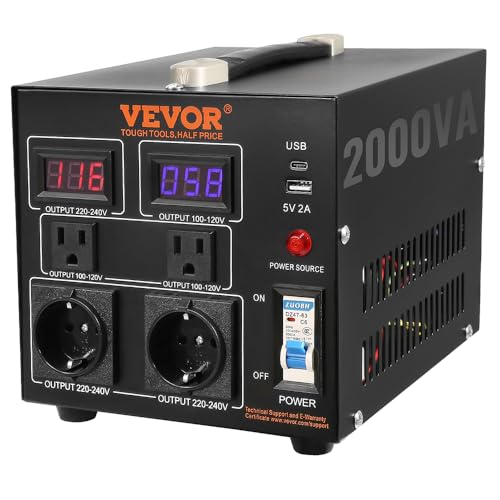
VEVOR Voltage Converter Transformer, 2000W Step Up/Down — Best for Running a 120V Microwave You Already Own
This pick exists for one specific reader: someone who already owns a good 120 volt microwave, has moved to a 220 volt country, and wants to keep it. The VEVOR unit is a heavy-duty 2000 watt transformer whose title confirms it converts from 220 volt to 110 volt as well as the reverse, with US and EU outlets and CE certification stated in the listing. Used correctly, with the headroom rules below, it is a legitimate bridge. Used casually, it is how appliances and transformers both get ruined, so read the trade-offs as carefully as the strengths.
Strengths
- Title confirms both conversion directions, including 220 volt down to 110 volt for US appliances
- 2000W rating is in the class a microwave demands, unlike travel adapters rated for phone chargers
- CE certification and both US and EU outlets are stated in the listing title
Trade-offs
- A microwave’s cooking watts understate its electrical draw; a 1000W oven can pull far more, so only smaller microwaves belong on a 2000W transformer
- Transformers are heavy, hum softly and waste some power as heat; this is a workaround, not an elegant solution
- Running a heating appliance through a converter for years usually costs more in losses and risk than buying the native 220V oven
| Type (from listing title) | Step up/down voltage converter transformer |
| Rating (from listing title) | 2000W |
| Conversion (from listing title) | 110V to 220V and 220V to 110V |
| Outlets (from listing title) | US outlet, EU outlet, 5V USB port |
The sizing rule is the whole game. Transformers should not run continuously at their badge rating; the long-standing safe practice is to keep the appliance’s input draw at or below about half to two-thirds of the transformer’s rating for sustained use, and a microwave’s input draw is higher than its cooking output because magnetrons are not perfectly efficient. In practice that means a 2000 watt transformer is a match for a compact 700 to 800 watt class US microwave, and a poor gamble for a 1200 watt family oven. Check the input watts printed on your microwave’s rear label, not the headline cooking watts, before you commit.
Placement matters too. Put the transformer on a hard, ventilated surface, never under a cloth or inside a closed cabinet, and plug the microwave directly into it with no power strips in between. If the transformer runs hot, hums loudly or trips its protection, stop: that is the system telling you the pairing is undersized. For a short posting abroad this route can make real sense. For a permanent home, treat it as the bridge that buys you time until a native 220 volt oven arrives.
Best for: Relocators keeping a compact 120V microwave for a defined period on a correctly sized transformer / Not suited for: Large 120V microwaves, permanent installations, or anyone tempted to use a lightweight travel adapter instead

LVYUAN Voltage Transformer Converter 2000 Watt Step Up/Down — Best Transformer Alternative
The LVYUAN converter covers the same job as the VEVOR with a slightly different socket layout: its title confirms conversion from 220-240 volt down to 110-120 volt, a 2000 watt rating, two US outlets and two universal outlets. Having two verified alternatives matters in this category because transformer stock fluctuates, and because the universal outlets suit readers whose other small US appliances, a stand mixer or a coffee grinder, also made the move. The same strict sizing discipline applies in full.
Strengths
- Title confirms 220-240V to 110-120V step-down conversion at a 2000 watt rating
- Two US plus two universal outlets cover a small cluster of relocated appliances
- A second verified option if the first transformer is out of stock
Trade-offs
- Same microwave sizing ceiling as any 2000W unit: compact ovens only, judged by input watts
- Universal outlets accept many plug shapes, which makes it easier to overload by accident
- Still a workaround with heat, hum and conversion losses, not a substitute for a native oven
| Type (from listing title) | Voltage transformer converter, step up/down |
| Rating (from listing title) | 2000 watt |
| Conversion (from listing title) | 220-240V to 110-120V and reverse |
| Outlets (from listing title) | 2 US outlets, 2 universal outlets |
Choose between the two transformers on outlets and availability rather than on any claimed performance gap; both are 2000 watt class units with title-confirmed step-down conversion. The LVYUAN’s universal sockets are convenient for a relocated kitchen generally, but discipline yourself to run one substantial appliance at a time. A microwave plus a kettle on the same transformer is exactly the kind of stacking that overheats converters.
One more honest note applies to both transformer picks. Frequency is not converted by units like these: a US microwave designed for 60Hz running on a 50Hz supply through a transformer will power its electronics, but its turntable motor and timer behaviour can drift slightly, and long-term reliability is not guaranteed by anyone. That is acceptable for a temporary setup with open eyes. It is another reason the native Sharp models above remain the primary recommendation of this guide.
Best for: Relocators who want one verified step-down unit for a compact microwave and small US appliances / Not suited for: Anyone planning to run several appliances at once, or a large microwave beyond the sizing rules
The Local-Market Model Bought In Country — Best Unlinked Route
The sixth pick is not a product, and presenting it as one would be dishonest. It is the route experienced expats and importers recommend first: buy the microwave in the country where it will be used. Every 220 volt market, from Germany to South Africa to Vietnam to Brazil’s 220 volt regions, has local retailers selling microwaves built for that exact supply, with the correct plug moulded on, manuals in the local language and a warranty a local service centre will actually honour.
Strengths
- Correct voltage, plug, frequency and safety certification for your market by definition
- A real local warranty and service network instead of an export model’s grey area
- Far wider choice of sizes and features than the handful of export listings on a US storefront
Trade-offs
- No single Amazon.com link can represent it; you shop local retailers or your regional Amazon storefront
- Prices and brands vary enormously by country, so no universal model recommendation is possible
- You lose the convenience of one familiar checkout if you are ordering from abroad for someone else
Consider this route seriously if you are furnishing a permanent home. The export Sharps in this guide are good machines and their voltage is verified, but they are a narrow range chosen from what a US website happens to list. Your local market will offer inverter models, convection combinations, flatbed designs without turntables and sizes tuned to local kitchens, none of which appear in the US export listings. For a machine you will use daily for years, that breadth plus a walk-in warranty is worth a great deal.
This route is also the answer for gift buyers. Sending a microwave to family in a 220 volt country by ordering locally for delivery avoids international shipping damage, customs surprises and the plug problem in one move. The linked picks above earn their place for readers who specifically need to order from Amazon.com, for a short-notice replacement, a workplace purchase or a region with thin local retail. Everyone else should at least price the local option before deciding.
Best for: Permanent residents of 220 volt countries who want full choice and a local warranty / Not suited for: Buyers who must order from Amazon.com specifically, or who need a machine delivered internationally
This route sits across all quality tiers, from budget local brands to premium regional lines, because it is bought in your own market rather than from a US listing.
Comparison Table
| Pick | Badge | Key spec | Best for |
|---|---|---|---|
| Sharp R-20MT 20-Liter 800W Microwave Oven, 220 Volts | Best Overall | 20 L, 800W, 220 volts confirmed in title | Singles, couples and small 220 volt kitchens that mostly reheat and cook everyday portions |
| Sharp R-75MT(S) 900W Microwave Oven with Grill, 220-Volt, 25-Liter | Best with Grill | 25 L, 900W, grill, 220-volt confirmed in title | Families in 220 volt regions who cook, brown and finish food in the microwave, not just reheat |
| Sharp R-562Ct(St) 1200W 62-Liter Microwave Oven, 220V | Best Extra-Large | 62 L, 1200W, 220V confirmed in title | Large households, staff kitchens, caterers and batch cookers in 220 volt regions |
| VEVOR Voltage Converter Transformer, 2000W Step Up/Down | Best for Running a 120V Microwave You Already Own | 2000W step-down 220V to 110V (title-confirmed) | Relocators keeping a compact 120V microwave for a defined period on a correctly sized transformer |
| LVYUAN Voltage Transformer Converter 2000 Watt Step Up/Down | Best Transformer Alternative | 2000W step-down 220-240V to 110-120V (title-confirmed) | Relocators who want one verified step-down unit for a compact microwave and small US appliances |
| The Local-Market Model Bought In Country | Best Unlinked Route | Bought locally: native voltage, plug and warranty | Permanent residents of 220 volt countries who want full choice and a local warranty |
How to Choose the Best 220 Volt Microwave for Your Country
Start with your supply, not with the microwave. Most of the world runs on 220 to 240 volts at 50Hz: Europe, the UK and Ireland at 230 to 240 volts, most of Asia, Africa and South America in the same band, while North America and Japan sit at 100 to 120 volts. A microwave built for one band cannot run on the other without conversion. Check the rating label of any machine you already own and the stated voltage of any machine you are buying; if a listing does not state voltage, treat it as unconfirmed and do not buy it for a 220 volt home on hope.
Then size the cavity honestly. Around 20 litres suits one or two people reheating plates and cooking simple meals. The 25-litre class is the family sweet spot, taking large dinner plates and casserole dishes. Above that, 30 litres and beyond, you are equipping big households or shared spaces, and the 62-litre Sharp in this guide is a deliberate outlier for batch work. Measure your largest plate or dish before choosing; a cavity that refuses your everyday crockery will annoy you daily.
Wattage sets pace more than quality. Output between 800 and 900 watts handles the full range of normal microwave cooking with slightly longer times on dense food. Around 1200 watts is noticeably faster and better for cooking from frozen, but draws more from your circuit. Whatever you choose, remember the input draw exceeds the cooking watts, which is the number that matters for breakers and for any transformer maths.
Native 220 Volt vs a Transformer: The Honest Comparison
A native 220 volt microwave is one appliance, one plug and no conversion losses. It is the right default for any permanent installation, and it is why the three Sharp models headline this guide. Their export status means thinner local support in some countries, but electrically they are exactly what a 220 volt kitchen asks for.
A step-down transformer is a bridge for a specific situation: you already own a 120 volt microwave worth keeping, your stay is temporary or your budget is committed elsewhere. Respect its limits. Size it by the microwave’s input watts with generous headroom, run one appliance at a time, ventilate it, and accept that frequency is not converted, so motors and timers designed for 60Hz may behave slightly differently on 50Hz. Never substitute a travel adapter: those are rated for low-wattage electronics and using one on a microwave is a fire risk, not a shortcut.
The third path, buying locally in country, beats both on warranty and choice and loses only on ordering convenience. Weigh the three routes by how long the machine will live in that kitchen: months favour the transformer, years favour native or local, every time.
Plug Types, Frequency and Safety Checks Before You Order
Voltage is necessary but not sufficient. Plug shapes differ across 220 volt countries: the chunky three-pin of the UK, the two round pins of most of Europe, and several other national patterns elsewhere. An export microwave may arrive with a plug that does not match your wall, and the correct fix is a properly rated plug replacement by a competent person or a single high-quality adapter rated for the full appliance load, never a chain of adapters and never a lightweight travel accessory.
Frequency deserves one check. Most 220 volt countries supply 50Hz; a few supply 60Hz. Microwaves designed for the export market are generally built for the 50Hz world they are sold into, which is another point in favour of native models over converted US machines. Finally, confirm the basics of safe siting: a stable surface, the ventilation gaps the manual specifies, and a socket that is not already sharing its circuit with a kettle and a toaster oven at breakfast time.
Reading a Microwave Rating Label Like an Inspector
Every microwave carries a rating label, usually on the back or inside the door frame, and that label is the single most trustworthy document in this entire category. It states the supply the machine was built for in unambiguous terms: voltage, frequency and input power. When you view any microwave in person, or receive a delivery, photograph that label before the box is recycled. If the label’s voltage band does not include your supply, nothing the seller said, and nothing a headline claimed, changes what the machine is.
The input power figure on the label deserves its own habit. Buyers compare cooking watts, the 800, 900 or 1200 in the headlines of this guide, but circuits, breakers and transformers all live in the input world, where the same machines draw meaningfully more. Reading the label’s input figure and comparing it with your circuit’s capacity, or a transformer’s rating, is the five-second check that prevents the two classic failures of this category: the nuisance breaker trip and the overheated converter.
What 220 Volt Microwave Ownership Looks Like After Year One
The export models in this guide settle into ordinary life quickly, which is their virtue. The ownership differences from a locally bought machine are administrative rather than daily: keep the purchase documentation somewhere findable, because an export model’s support route may run through the seller rather than a national service network, and note the exact model code, the R-20MT pattern of letters and numbers, in your phone for the day a turntable ring or a door switch needs replacing. Wear parts on mainstream export lines are generally obtainable precisely because these models sell across many countries.
Electrically, a native 220 volt machine asks nothing of you after installation day, which is the deepest argument for choosing one over a converted setup. There is no transformer to ventilate, no pairing to label, no guest or cleaner who can accidentally replug it into trouble. Readers who have lived with both arrangements consistently describe the native machine as the one they stopped thinking about, and in appliance terms that forgettability is the highest available praise.
Sizing the Cavity to Your Actual Cooking: A Plate-First Method
Forget litres for one paragraph and think in objects. The plate you eat dinner from, the bowl you make soup in, the casserole your family actually uses: those three objects are your true capacity specification. A 20-litre oven that takes all three beats a 25-litre oven whose turntable or door geometry refuses your casserole. When shopping in person, take the plate. Online, compare the cavity claims against the dimensions of your largest everyday dish, which you can measure in ten seconds with a ruler you already own.
Height is the dimension buyers forget. Mugs are short, but the jug you heat milk in, the tall container you defrost stock in and the covered bowl you steam vegetables in all need vertical room plus clearance for steam. The jump from the 20-litre to the 25-litre class in this guide buys as much height as it buys width, and for households whose cooking is bowl-and-jug shaped rather than plate shaped, that is the real reason to step up.
How to Set Up a 220 Volt Microwave Safely in a New Home
Whether your machine is a native export model or a local purchase, the first hour decides how safely and well it will serve you. Work through these steps in order.
- Unpack and inspect before plugging in: check the door, hinges and latch for transit damage, and never run a microwave with a bent door or damaged seal.
- Remove every piece of internal packaging, including any cardboard microwave guide or accessory pack sitting in the cavity.
- Confirm the rating label on the back or door frame states a voltage that matches your supply, 220 to 240 volts for the models in this guide, before the plug goes anywhere near a socket.
- Position the oven on a flat, stable surface with the manual’s ventilation clearances on the top, sides and back; blocked vents are the quiet cause of many early failures.
- Fit the turntable ring and glass tray correctly if your model uses one, and check the tray rotates freely by hand.
- If the plug does not match your wall socket, have the plug replaced properly or use one single adapter rated for the full load; never stack adapters.
- Run a first test: heat a mug of water for one minute. It should come out steaming, with no arcing, unusual smells or breaker trips.
- Wipe the cavity, set the clock, and read the defrost and power-level pages of the manual; those two features do most of the real work in microwave cooking.
If the first test trips a breaker, smokes or smells of hot electrics, unplug and stop. Those symptoms mean a supply or appliance fault, and they are exactly what this careful setup is designed to catch while the stakes are still low.
Common Buying Mistakes
- Assuming a US listing is dual voltage. Almost no countertop microwave is. If the title and specifications do not state 220 volts, the machine is a 120 volt model until proven otherwise.
- Using a travel adapter for a microwave. Travel adapters change plug shape, not voltage, and most are rated far below a microwave’s draw. This mistake destroys ovens and starts fires.
- Sizing a transformer by cooking watts. The microwave’s input draw is higher than its output rating. Judge by the rear label’s input figure and keep generous headroom.
- Ignoring the plug and frequency. A correct-voltage machine can still arrive with the wrong plug for your country, and 50Hz versus 60Hz differences matter for converted US machines.
- Buying the biggest cavity by default. A 62-litre oven in a studio flat wastes counter, power and money. Match the cavity to the plates and dishes you actually use.
- Blocking the vents. Pushing a microwave flush into a cubby with no airflow shortens its life and can cause thermal cut-outs mid-cooking.
Final Recommendation
The recommendation resolves cleanly once voltage is settled. For most 220 volt households, the Sharp R-20MT is the verified, native, no-fuss answer, and the R-75MT(S) is the upgrade when you want a grill and a family-size cavity. Very large households and shared kitchens should go straight to the 62-litre R-562Ct(St). Relocators with a compact US microwave they love can bridge with either verified 2000 watt transformer, sized by input watts and used with discipline. And permanent residents should price the local-market route before ordering anything internationally, because a local warranty is a feature no export listing can match.
Whichever route you take, buy the electrical facts first and the features second. A microwave whose voltage is confirmed in writing will serve you for years; a beautiful machine bought on a voltage assumption may not survive its first minute.
The shortlist in one line: Sharp R-20MT 20-Liter 800W Microwave Oven, 220 Volts; Sharp R-75MT(S) 900W Microwave Oven with Grill, 220-Volt, 25-Liter; Sharp R-562Ct(St) 1200W 62-Liter Microwave Oven, 220V; VEVOR Voltage Converter Transformer, 2000W Step Up/Down; LVYUAN Voltage Transformer Converter 2000 Watt Step Up/Down; The Local-Market Model Bought In Country.
Keep exploring related guides on this site: Best 220 Volt Portable Air Conditioner Best 220 Volt Keurig Best 220 Volt Icecream Maker Machine Best Countertop Convection Microwaves Best 1 1 Cu Ft 1000 Watt Microwaves
Frequently Asked Questions
Can I use a 120 volt microwave in a 220 volt country?
Only through a properly sized step-down transformer, never by plugging it in directly or through a travel adapter. Direct connection will destroy the oven almost immediately. Even with a transformer, check the microwave’s input watts against the transformer’s rating with generous headroom, and accept it as a temporary arrangement rather than a permanent installation.
What does Not for USA mean on a 220 volt microwave listing?
It means the model is built for export markets with 220 volt supplies and is not intended or certified for the US 120 volt market. For a buyer in a 220 volt country that marking is actually useful confirmation that the machine is a genuine 220 volt model rather than a US unit.
How can I tell if a microwave listing is really 220 volts?
Look for the voltage stated in the title or the specification table, or on a photographed rating label. In this guide, only models whose listed titles state 220 volts outright were linked as 220 volt picks. If a listing is silent about voltage, contact the seller and ask directly before buying.
What size transformer does a microwave need?
Bigger than intuition suggests. A microwave’s electrical input draw exceeds its cooking output, so a 2000 watt transformer suits only compact ovens in roughly the 700 to 800 watt cooking class. Larger microwaves need proportionally larger transformers, at which point buying a native 220 volt oven is usually the better economics.
Will a 220 volt microwave work on a 240 volt supply?
Generally yes. Appliances rated 220 volts are built for the 220 to 240 volt band used across most of the world, and supplies in that band vary within tolerances the machines are designed for. Check the rating label’s stated range if you want certainty for a specific model.
Is it better to buy a microwave locally or order an export model?
For a permanent home, local purchase usually wins on plug fit, warranty, service and choice of models. Export models ordered from a US storefront make sense for specific situations: replacing fast, buying for a workplace, or living somewhere with limited local retail. Compare both before deciding.
Can I run a 220 volt microwave on a generator or inverter?
You can, provided the generator or inverter supplies a clean sine wave at the right voltage and is rated comfortably above the microwave’s input draw, remembering that input exceeds cooking watts. Microwaves are demanding loads with high start-up surges, so size generously and test with a simple heating task before relying on the setup.
Why do 220 volt microwaves cost more on US websites?
Because they are export models sold in small volumes to a niche of relocators, aid workers, military families and overseas buyers, rather than mass-market domestic stock. The premium buys verified voltage and international availability. If the price stings, compare it with the local-market route described in this guide before deciding it is unreasonable.