Disclosure: airfryerkitchensupply.com is reader-supported. When you buy through links on our site, we may earn an affiliate commission at no extra cost to you.
Where to buy
If you are shopping for the best 2 zone cookung grills — two-zone cooking grills, in the spelling the rest of the world uses — you are shopping for the single most useful capability in gas grilling: a hot zone and a cool zone burning side by side, so food can be seared and finished, crisped and held, charred and rested, all on one grate. Every pick below was verified against a live Amazon listing, and every pick is a two-burner grill whose burner layout creates genuine, controllable zones. Check the current price on Amazon for the models that match your format.
- Cuisinart Chef’s Style Portable Propane Tabletop Gas Grill CGG-306P (Best Overall for Two-Zone Cooking) — Check the current price on Amazon
- Weber Spirit E-210 Gas Grill (Best Cart for Two-Zone Cooking) — Check the current price on Amazon
- Blackstone OTG Outdoor Tabletop Griddle, 22 Inch (Best Griddle Zones) — Check the current price on Amazon
- Nexgrill Tabletop 2 Burner Gas Grill, Stainless Steel (Best Tabletop Zones) — Check the current price on Amazon
- Charbroil Classic 2-Burner Propane Gas Grill (Best Budget Zones) — Check the current price on Amazon
- Megamaster Deluxe 2 Burner Gas Grill (Best Area for Zone Cooking) — Check the current price on Amazon
Best 2 Zone Cookung Grills: Why Two Zones Change Everything
Ask experienced grillers what separates controlled cooking from hopeful cooking and most give the same answer that this search — best 2 zone cookung grills — is hunting for: zones. A two-zone fire means one side of the grate runs hot and direct while the other runs gentle or entirely indirect. Steaks sear on the hot side and finish on the cool side without burning. Chicken renders its skin over indirect heat and crisps at the end. Burgers hold warm on the cool side while the next round sears. Nearly every failure in home grilling — burnt exteriors with raw centers, flare-up fires, food dried out while waiting — is a one-zone failure, and nearly every professional technique is a two-zone technique.
Two burners is the smallest engine that creates true zones, which is why this guide’s picks are all two-burner grills judged primarily on zone quality: how independently the burners run, how distinct the temperature boundary is, how much usable area each zone gets, and how the grate material behaves across the gradient. Some picks were designed for zones from the first sketch — the Cuisinart’s listing says “two-zone cooking” in so many words, and the Blackstone griddle advertises its two heat zones — while others earn their place through burner independence and even, predictable heat maps. All of them will run the technique; the reviews explain how each one runs it differently.
A note on the search itself: we use it exactly as given, misspelling and all, because that is the search real people typed. Everywhere the technique is discussed, this guide calls it two-zone cooking, and by the end of the article you will know more about running zones than most four-burner owners ever learn — because a two-burner grill makes the technique unavoidable, visible, and therefore learnable.
In this guide
Quick Picks
- Best Overall for Two-Zone Cooking: Cuisinart CGG-306P — twin 10,000 BTU burners designed explicitly for two-zone cooking, in stainless tabletop form. Check the current price on Amazon
- Best Cart for Two-Zone Cooking: Weber Spirit E-210 — the evenest heat map here, which makes its zones the most predictable. Check the current price on Amazon
- Best Griddle Zones: Blackstone OTG 22-Inch — two heat zones across a hooded flat top; the listing says so itself. Check the current price on Amazon
- Best Tabletop Zones: Nexgrill Tabletop Stainless — strong listing-rated output across two independently controlled burners in 251 sq in. Check the current price on Amazon
- Best Budget Zones: Charbroil Classic 2-Burner — a natural hot-back, cool-front gradient that teaches zone cooking by feel. Check the current price on Amazon
- Best Area for Zone Cooking: Megamaster Deluxe 2 Burner — the largest grate here, so each zone is a real cooking area, not a strip. Check the current price on Amazon
How These Picks Were Chosen
The filter was functional before it was numerical. Each candidate needed two independently controlled burners — verified from its manufacturer’s Amazon listing — because a grill whose burners cannot run at different settings cannot hold two zones, whatever its marketing says. We then weighed zone distinctness (the temperature difference the layout can sustain), zone area (a cool zone that fits one burger is a garnish, not a zone), and heat-map predictability, since a zone you cannot predict is a zone you cannot cook with.
Format coverage completes the list: the zone technique matters on carts, tabletops, and griddles alike, so the six picks span all three, with the griddle included because its two heat zones — stated in its own listing — make it a legitimate zone cooker of a different surface. Specs in the mini boxes come from the listed listings, verified 2026-11-20; the one optimistic figure in the set, a tabletop’s listing-rated BTU, is flagged where it appears.
The 6 Best 2 Zone Cookung Grills

Cuisinart Chef’s Style Portable Propane Tabletop Gas Grill CGG-306P — Best Overall for Two-Zone Cooking
The CGG-306P is the rare grill whose own listing names the technique: “two-zone cooking with twin 10,000 BTU burners.” Two equal burners under 275 square inches of stainless steel means either side can be the hot side, the boundary sits mid-grate where you expect it, and the zones are symmetric — a property zone cooks value more than raw power. It suits technique-focused cooks in small spaces. It does not suit crowds or cart seekers.
Strengths
- Designed and marketed explicitly around two-zone cooking
- Equal twin burners create symmetric, predictable zones
- Stainless tabletop format stores anywhere and travels
Trade-offs
- 275 sq in splits into two modest zones — plan the menu accordingly
- Moderate total output; the hot zone rewards a full preheat
- No warming rack in the verified listing
Key specs (from the verified listing): 2 burners; twin 10,000 BTU burners (20,000 BTU total); 275 sq in; stainless steel; portable tabletop; two-zone design per the listing itself.
Zone quality is about the boundary as much as the temperatures. On the Cuisinart, the two burners are equals, so the transition between zones is a clean line you can straddle deliberately — a steak half on the heat to finish its crust while its other half rests, a tray of chicken parked exactly at the gradient’s edge. That controllability, in a body that stores on a shelf, makes it the purest expression of this guide’s keyword: not the biggest zone cooker, but the most deliberate one.
Best for: technique-first cooks in small spaces / Not suited for: crowds or freestanding-cart buyers — Check the current price on Amazon

Weber Spirit E-210 Gas Grill — Best Cart for Two-Zone Cooking
The E-210 earns its zone badge on predictability. Its heat map is the evenest in this guide, which sounds like the opposite of zoning until you cook on it: each zone is uniformly itself, the boundary is stable, and a setting you learn in May behaves identically in September. With cast-iron grates storing heat on the hot side, it is the cart for cooks who run zones as a system. It suits frequent grillers with a patio. It does not suit travelers or entry budgets.
Strengths
- Even, stable heat makes both zones predictable and repeatable
- Cast-iron grates hold the hot zone’s sear through a full load
- Per-burner Snap-Jet ignition supports one-burner (indirect-only) cooks
Trade-offs
- Premium position
- Household-sized zones; party volumes still batch
- Permanent cart format only
Key specs (from the verified listing): 2 burners; porcelain-enameled cast-iron grates; Snap-Jet ignition; Weber Works rails; liquid propane cart.
The Weber’s party trick for zone cooks is the indirect-only cook: light one burner, park bone-in chicken entirely on the dark side, close the lid, and the grill becomes a convection oven with a sear station waiting. Because the E-210’s lit side is so even, the unlit side’s temperature is steady and learnable — the condition that makes reverse searing and low-and-slow finishes repeatable rather than lucky. For a household that will run zones weekly for years, that repeatability is the whole argument.
Best for: systematic zone cooks with a patio and a long horizon / Not suited for: travel or budget-first buying — Check the current price on Amazon
Blackstone OTG Outdoor Tabletop Griddle, 22 Inch — Best Griddle Zones
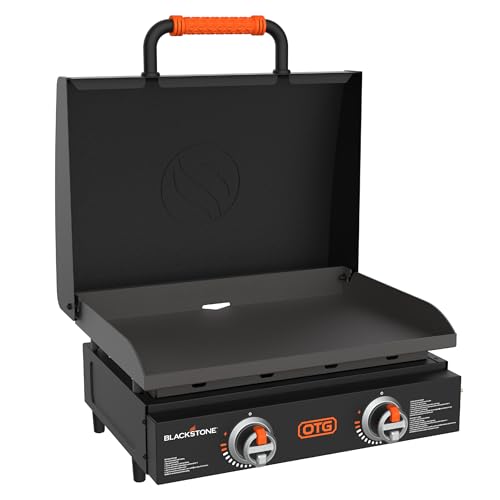
The OTG takes zone cooking to the flat top: its listing promises two heat zones across a 22-inch steel surface, under a protective hood, with rear grease management. On a griddle, zones are arguably more useful than on a grate — eggs and pancakes scorch where burgers sear — and the Blackstone’s two independently heated areas let a cook run a true hot half and gentle half across one continuous sheet of steel. It suits breakfast-and-everything households and campers. It does not suit grill-mark traditionalists.
Strengths
- Two heat zones stated in the listing — the flat top’s native technique
- Hood included: steam, melt, and protect between cooks
- Rear grease management keeps the zones’ surface clean as you cook
Trade-offs
- No grate — no marks, no open-flame flavor
- Steel needs seasoning discipline to stay non-stick in behavior
- Tabletop format; the stand is yours to provide
Key specs (from the verified listing): 22-inch tabletop griddle; 2 heat zones (per the listing); built-in hood; rear grease management; propane.
Griddle zoning has its own grammar. The hot zone sears smash burgers and crisps hash browns; the gentle zone holds pancakes at golden, keeps eggs from toughening, and parks finished food without drying it. Because the surface is continuous, food slides between zones with a spatula rather than being lifted — a small ergonomic fact that makes zone cooking on a griddle feel less like a technique and more like a default. For households whose menu is griddle-shaped, this is the zone cooker to buy.
Best for: griddle households that cook across temperatures at once / Not suited for: grate-and-flame cooking — Check the current price on Amazon

Nexgrill Tabletop 2 Burner Gas Grill, Stainless Steel — Best Tabletop Zones
The Nexgrill tabletop pairs two independently controlled burners with the strongest listing-rated output in the tabletop class, under a locking lid on folding legs. Its zones are compact — 251 square inches split in two — but genuinely distinct, because the heat density on the lit side is high enough to sear while the other side idles low. It suits campers, tailgaters, and balcony cooks. It does not suit buyers who want a warming rack. One flag, carried through this series: the 28,000 BTU figure is the listing’s claim, repeated here as a claim.
Strengths
- Strong listing-rated heat makes the hot zone decisively hot
- Locking lid and folding legs — zones that travel
- Stainless body cleans fast between cooks
Trade-offs
- BTU figure is a listing claim to verify against your own preheat
- Zones are compact — a two-to-four-person stage
- No warming rack in the verified listing
Key specs (from the verified listing): 2 burners; 28,000 BTU (listing-stated); 251 sq in; stainless steel; folding legs; locking lid; push-and-turn ignition.
Tabletop zoning succeeds or fails on contrast: a small grill whose burners are weak produces two lukewarm halves rather than two zones. The Nexgrill’s output — even discounted from its headline claim — gives it the contrast the technique needs, so a steak can genuinely sear on one half while vegetables hold on the other. For portable cooking with real technique, it is the strongest tabletop in this guide.
Best for: portable cooks who refuse to give up zone technique / Not suited for: warming-rack devotees or large groups — Check the current price on Amazon

Charbroil Classic 2-Burner Propane Gas Grill — Best Budget Zones
The Classic teaches zoning the old way: its two burners and its natural front-to-back gradient give a cook a hot zone, a cool zone, and a working boundary between them, in a complete budget cart. No feature list advertises it — the grill simply behaves zonally, and generations of owners have learned the technique on exactly this layout. It suits first-time owners and budget households. It does not suit precision seekers or daily heavy use.
Strengths
- A complete cart at an entry position, zones included by physics
- The natural gradient makes zone cooking intuitive to learn
- 280 sq in splits into two usable working areas
Trade-offs
- Zone boundary is a slope, not a line — precision is learned, not given
- Porcelain-coated grates store less searing heat
- Lighter construction than the premium carts
Key specs (from the verified listing): 2 burners; 20,000 BTU; 280 sq in; porcelain-coated grates; compact cart with side shelves.
There is a genuine pedagogical virtue in the Classic’s sloped boundary: food can be parked at any point along the gradient, so a cook learns temperature as a landscape rather than a switch. Chicken starts at the hot back, migrates forward as it renders, and finishes wherever the color says. Expensive grills make zones cleaner; this one makes them legible, and for a first grill that may matter more.
Best for: beginners and budgets learning zone cooking / Not suited for: precision cooks or premium expectations — Check the current price on Amazon

Megamaster Deluxe 2 Burner Gas Grill — Best Area for Zone Cooking
Zones need room, and the Megamaster has the most of it here: a stated 418 square inches with cast iron grates and 28,000 BTU, so the cool zone is a true second cooking area — a whole chicken’s worth of indirect space — rather than a holding strip. It suits families and entertainers who run zones at volume. It does not suit buyers prioritizing branded parts depth. As elsewhere in this series, the stated area typically includes warming space; the main grate remains the largest in this guide regardless.
Strengths
- The largest zones in this guide — indirect cooking at family scale
- Cast iron grates hold the hot zone under full loads
- 28,000 BTU gives the hot side genuine authority
Trade-offs
- Stated area includes warming space — read it as the series advises
- Value-tier frame and finish
- Large zones take longer to preheat than compact ones
Key specs (from the verified listing): 2 burners; 28,000 BTU; 418 sq in stated cooking space; cast iron grates; built-in thermometer; electronic ignition; foldable shelves.
Area changes what zoning can do. On the Megamaster, the indirect side fits a spatchcocked chicken or a full rack of ribs laid flat — cooks that compact zone grills must shrink or skip — while the direct side still sears for the table. If your zone cooking is ambitious in volume rather than delicate in technique, this is the pick: the technique is the same, the stage is simply bigger.
Best for: families running zones at volume / Not suited for: small spaces or parts-depth planners — Check the current price on Amazon
Comparison Table
| Pick | Badge | Key spec | Best for |
|---|---|---|---|
| Cuisinart CGG-306P | Best Overall for Zones | Twin 10,000 BTU burners, two-zone by design | Deliberate technique in small spaces |
| Weber Spirit E-210 | Best Cart for Zones | Cast-iron grates, even heat map | Predictable, repeatable zoning |
| Blackstone OTG 22-Inch | Best Griddle Zones | 2 heat zones, hood, flat top | Two-temperature griddle cooking |
| Nexgrill Tabletop Stainless | Best Tabletop Zones | 251 sq in, locking lid | Zones that travel |
| Charbroil Classic 2-Burner | Best Budget Zones | 20,000 BTU, 280 sq in cart | Learning zones on a budget |
| Megamaster Deluxe 2 Burner | Best Area for Zones | 28,000 BTU, 418 sq in stated | Zone cooking at family volume |
How to Choose a Two-Zone Grill
Judge zone quality by three tests you can apply to any listing, in any store, for any grill that will ever claim this search. First, burner independence: two burners with separate controls are the minimum; equal burners, like the Cuisinart’s twins, give the cleanest boundaries, while unequal layouts bias one side as the permanent hot zone — workable, but less flexible. Second, area per zone: divide the honest primary area by two and ask whether your typical indirect load — a chicken, a rack of ribs, a tray of vegetables — fits the half. If it does not, the Megamaster’s class is your class. Third, heat-map character: even grills like the Weber zone predictably, gradient grills like the Classic zone intuitively, and griddles zone by surface temperature you can test with a flick of water.
Format then follows life, as in every guide in this series: cart for the permanent patio, tabletop for storage and travel, griddle for the flat-top menu and weeknight breakfasts. And one last test belongs to the shopper rather than the listing: picture your three most-cooked dinners and walk each one across the candidate’s zones, item by item, minute by minute. The grill whose zones carry all three dinners without a traffic jam is the grill this search was asking for. What should not decide the purchase is a “zone” claim without the hardware behind it — a single burner with a warming rack is not a two-zone grill, and a three-burner grill run with one burner off is a two-zone technique on a bigger stage, not a different product. This search, at its heart, asks for two burners doing two jobs, and the six picks above are the verified answers.
How to Set Up Two-Zone Cooking on Any Grill in This Guide
The setup is a five-minute ritual. Preheat with both burners on medium-high, lid down, until the grill is fully hot — ten minutes for carts, less for tabletops, and for the griddle until a flicked water droplet dances. Then create the zones: leave the left burner at high and drop the right to low, or turn it off entirely for a true indirect side. Give the new arrangement three minutes to settle; the boundary you feel with a hand hovered — carefully, above the grate — is the boundary your food will experience. Resist the urge to start cooking during those three minutes: a boundary still forming is a boundary still moving, and the first item cooked on a half-settled map teaches you a geography that will not be there tomorrow.
Verify with the bread test the first time you run a new grill: slices across the grate for a minute map both zones and the boundary’s exact position, which on gradient grills sits forward of where you expect. Mark it mentally. From then on, the setup is muscle memory: preheat, split the burners, settle, cook. The technique’s entire learning curve is that first mapping session, and it repays itself at the first chicken that comes off the indirect side with rendered skin and a juicy center. Photograph the toast map if your memory is visual — cooks have kept stranger references in their phone, and few more useful.
The Two-Zone Playbook: Five Cooks That Teach the Technique
Reverse-seared steak: the thick steak sits on the cool side until it approaches temperature, then moves to the hot side for ninety seconds a side — the zone system’s signature cook, and the one that converts most skeptics. Order the playbook as written if you are new to zones: the steak teaches the boundary, the chicken teaches patience, the burgers teach holding, the salmon teaches gentleness, and the ribs teach time. Five cooks, one technique, a lifetime of dinners changed. Bone-in chicken: entirely indirect, skin rendering slowly, finished with two minutes over direct heat. Burgers with hold: sear in rounds on the hot side, hold on the cool side under a slice of cheese, serve six people from a four-burger grate. Salmon: skin-down on the gentle side, never flipped, while asparagus takes the hot side in the final minutes. Ribs, cheat’s edition: hours on the off side with the lit burner low and a foil pouch of wood chips over it, finished sauced over direct heat. Master these five and you have mastered the practical content of two-zone cooking — every other dish is a variation.
The Science of Indirect Heat: Why the Cool Zone Cooks Differently
Direct heat cooks by radiation and contact from below: intense, fast, and unforgiving, browning surfaces while the interior chases behind. Indirect heat — the cool zone with the lid closed — cooks by convection, like an oven: hot air circulates around the food, temperatures equalize, and thick items cook through without their surfaces racing ahead. Understanding that the two zones are not “hot” and “less hot” but two different cooking methods sharing a grate is the conceptual leap that makes zone cooks good. The hot zone is a broiler and a searing iron; the cool zone is a roasting oven that happens to live outdoors and taste of the grill.
That is why the signature two-zone dishes work. A thick steak roasted gently in the convective zone reaches an even interior temperature edge to edge; its final minute in the radiant zone adds the crust without cooking the interior further — the reverse sear, demystified. Chicken skin, which burns under direct radiation before its fat renders, renders fully in the oven-like zone and needs only a brief direct finish to crisp. Once a cook sees the zones as two appliances, menu planning becomes obvious: every food is assigned to the appliance that suits it, and moved between them as its needs change.
Zone Cooking, Food by Food
Burgers: sear hot, hold cool — the cool zone is a cheese-melting, juice-preserving waiting room that lets a small grate serve a crowd in rounds. Sausages: start indirect to cook through without splitting, finish direct for snap and color. Pork chops: the steak playbook at lower stakes — gentle side to temperature, hot side to crust. Fish fillets: gentle side almost exclusively, with the hot side reserved for the vegetables that accompany them; the zone system is what makes delicate fish a grill food at all. Vegetables: direct for char, indirect for through-cooking the thick ones — corn, halved squash, whole peppers blistered first and finished gently. Bread and buns: the cool zone in the final minute, because the hot zone turns bread to charcoal in the time a cook turns around.
Fruit, the zone system’s party trick: peaches and pineapple on the gentle side until their sugars concentrate, kissed on the hot side for marks. A cook who runs this list once understands that zones are not a technique among others — they are the difference between a grill that cooks one food at a time and a grill that cooks dinner.
Troubleshooting Your Zones
Problem: the cool zone is not cool — everything finishes too fast and nothing rests properly. The usual cause is a preheat that saturated the whole firebox, or a lit burner set too high for the grill’s size. Let the grill settle longer after splitting the burners, drop the lit burner a notch, and on compact tabletops consider turning the cool-side burner fully off rather than low. Problem: the hot zone will not sear. Check the mundane first — full preheat, dry food surfaces, a grate that is clean enough to contact properly — before blaming the burners; nine times in ten the sear was lost to moisture or impatience, not hardware.
Problem: the boundary wanders — food at the zone edge cooks unpredictably. That is the gradient behaving like a gradient; the fix is to cook decisively in one zone or the other and use the boundary only for brief transitions, or to choose a grill with a cleaner boundary, like the twin-burner Cuisinart, at your next purchase. Problem: flare-ups keep erupting on the hot side. Trim excess fat, let fatty items render first on the cool side, and keep a spray bottle for flare management — and recognize the pattern’s lesson: the food was telling you it wanted to start indirect all along.
Zones Beyond Gas: Charcoal Banks and Stove Top Plates
The two-zone idea predates gas grills and outlives any format, and a zone cook’s skill transfers everywhere. On a charcoal grill or the charcoal side of a dual-fuel combo, zones are built by banking coals to one side — the original two-zone fire, with the empty side as the indirect zone and the coal side as the direct. On a stove top plate, the two burners under the iron create the same geography indoors. Even a single-burner situation can borrow the principle with a raised rack or a cooler corner, though — as this guide has argued — the genuine article needs two heat sources under independent control.
Why include this in a buying guide? Because it clarifies what you are paying for. A two-burner gas grill is, in essence, a zone machine with the fire already built and the dials already fitted — the convenience of instant, repeatable zones is the product. Cooks who learn zones on gas carry the skill to every fire they ever tend; cooks who learn on charcoal carry it to gas in an afternoon. The technique is the constant; the six picks in this guide are simply its most convenient current instruments.
Accessories That Serve Zone Cooking
A short kit serves the technique specifically. A probe thermometer with a grate-level clip turns your cool zone from a feeling into a number, and is the single most educational accessory a zone cook can own. A second, instant-read thermometer verifies what the probe suggests. Long tongs matter more in zone cooking than anywhere, because food moves between zones constantly and at arm’s length from the hot side. A flat tray or sheet pan is the zone cook’s staging area — the place food waits before and rests after, keeping the grate itself uncluttered.
Two accessories earn skepticism. A raised warming rack sold as a “third zone” is a holding shelf with good marketing — useful, but not a cooking zone, and no substitute for burner independence. And elaborate multi-probe monitoring systems, while genuinely fun, measure a two-burner grill’s two zones perfectly well with one probe and a notebook. Zone cooking is a low-technology discipline; its barrier was never equipment, only the decision to light one burner differently from the other.
Zone Cooking in Wind and Cold
Weather attacks zones asymmetrically, and zone cooks should know the countermeasures. Wind strips heat from the whole grill but punishes the cool zone’s stability most, because the indirect side lives on borrowed heat from its neighbor. In a crosswind, position the grill so the lit burner is on the sheltered side, keep the lid down religiously, and expect to run the hot burner a notch higher to hold the boundary where you set it. In cold weather, both zones drop, but the technique survives intact: extend the preheat, verify the cool zone with the probe rather than by habit, and favor the cast-iron picks in this guide, whose grates bank heat that stabilizes both zones against the cold.
The encouraging fact is that zone cooking is more weather-resilient than one-zone cooking, not less. A one-zone cook in wind has a single, failing temperature; a zone cook has a system with a hot side to borrow from and a lid discipline that protects the rest. Winter grillers who run zones routinely report their most consistent results of the year — the cold makes the boundary between the zones cleaner, and food finished in a frigid, gentle indirect zone and seared at the last moment is a genuine cold-weather delicacy.
Maintaining the Hardware That Makes Zones Possible
Zone quality degrades invisibly when burner maintenance lapses, because the technique depends on each burner delivering its set output honestly. A burner with half its ports clogged does not produce a weaker zone — it produces a dishonest one, hot at the front and cool at the back, and the cook blames the technique for the hardware’s lie. The seasonal routine from this series applies with zone-specific emphasis: brush both burners’ ports clear, confirm each lights across its full length with an even blue flame, and re-run the bread test whenever a zone starts behaving strangely. Nine times out of ten, the map reveals a maintenance issue, not a mystery.
Ignition deserves the same zone-aware care: a grill whose left burner lights reliably and whose right needs coaxing will quietly train its owner out of one-burner indirect cooks, and the technique withers from a hardware fault. Keep igniters fresh, keep the grease path clear so the cool zone is not cooking over a smoldering tray, and a two-burner grill will hold its zones faithfully for years — which is to say, it will keep being the grill this search went looking for.
Common Buying Mistakes
The first mistake is buying a grill whose burners cannot be controlled independently and discovering that “two-zone” was a brochure word. The second mistake is the mirror image: buying an excellent zone grill and never once turning a burner off, because the old one-zone habit feels safer than the technique the grill was bought for. The third is sizing zones by total area: a compact grill’s cool zone may fit two burgers, which is a holding area, not an indirect cooking zone — divide by two before you buy. The fourth is neglecting the preheat split — zones created from a cold grill are guesses, while zones created after a full preheat are instruments.
Final Recommendation
Buy the Cuisinart CGG-306P if two-zone cooking is the point of the purchase — it was designed for nothing else, and a cook who learns the technique on it will find every other grill in the world suddenly legible, because the Cuisinart teaches zones in their purest, most symmetric form. Buy the Weber Spirit E-210 for zones with premium predictability, the Blackstone OTG for zones on a flat top, the Nexgrill for zones that travel, the Charbroil Classic to learn zones on a budget, and the Megamaster Deluxe when your zones need to be big enough for whole birds. Deepen the research with our companion guides: Best 2 Burner Grills, Best 2 Burner Propane Grills, Best 2 Person Propane Grills, Best 2 Burners Grills, and Best 2 Burner Grills For Stove Top.
Frequently Asked Questions
What is two-zone cooking, exactly?
Running two heat environments on one grate at the same time: a direct zone over a lit burner for searing, and an indirect zone over an unlit or low burner for gentle cooking and holding. It is the foundation technique of serious grilling — the method behind reverse searing, burn-free chicken skin, and coordinated multi-item meals — and two burners is the smallest format that supports it properly. If you take one idea from this entire guide, take this one: the second burner is not there to make the grill bigger. It is there to make the grill two grills — and a cook with two grills side by side can cook almost anything.
Can I do two-zone cooking on a one-burner grill?
Only in a limited imitation: banking food to the grate’s cooler edge gives a weak gradient, but there is no true indirect zone, because the whole grate sits over the same fire. The difference shows immediately with chicken and thick steaks. This is the core reason this guide — and the search itself — specifies two-burner grills. A raised rack over a one-burner grill lifts food away from the worst of the direct heat and is a fair camping improvisation, but it cannot hold a temperature the way a dark burner can, and it disappears the moment the lid opens. Improvisation has its place; it is not a substitute for the second burner.
Which side should be the hot zone?
Whichever suits your layout and habits; on symmetric grills like the Cuisinart it is a free choice. Practical considerations: right-handed cooks often keep the hot zone on the left so finished food moves right, toward the side shelf and the dominant hand’s workspace. What matters is consistency — pick a geography, learn it, and let muscle memory accumulate. There is one exception worth breaking consistency for: wind. When a crosswind is stripping one side of the grill, make the sheltered side the hot zone and let the windward side be the cool one; the technique survives the swap easily, and the boundary holds far better with the weather as your ally instead of your opponent.
How hot should the indirect zone be?
For most finishing and holding, the indirect side of a two-burner grill with one burner on medium settles in the gentle roasting range — hot enough to cook chicken through and render fat, cool enough to forgive timing. Learn your own grill’s number with an inexpensive probe thermometer clipped at grate level on the cool side; every model in this guide has its own personality, and one measurement session replaces all guessing. Repeat the measurement once in summer and once in winter: the two numbers bracket your grill’s year, and knowing both turns seasonal surprises into settings you already have written down.
Do griddles really have heat zones?
Yes — the Blackstone OTG’s listing states its two heat zones outright, and any two-burner flat top creates them by running its burners at different settings. Griddle zones are used constantly in practice: searing on the hot half, holding pancakes and eggs on the gentle half. The continuous surface makes moving food between zones easier than on any grate. Griddle zones are also the easiest to verify: a flick of water dances on the hot half and simmers on the gentle half, and a cook can map the whole surface in ten seconds without a single instrument — one more reason flat-top owners tend to become zone cooks without ever hearing the term.
Can I create three zones on a two-burner grill?
In effect, yes: the boundary itself is a third, transitional zone, and experienced cooks park food there deliberately — sausages finishing at the gradient’s edge, vegetables charring gently at the border. Treat the boundary as a bonus rather than a plan, though: it is the least stable territory on the grate, and food that needs a defined temperature belongs decisively in one zone or the other. On grills with a warming rack, the rack adds a fourth, holding level above the cool zone — the finishing school’s waiting room, where cooked food rests at serving temperature while the zones below it work on the next course.
Does two-zone cooking use more propane?
Usually less. An indirect cook runs one burner low or off for most of its duration, and holding food on a cool zone replaces the reheating and re-cooking that one-zone mistakes cause. The zone method’s fuel story matches its food story: control is cheaper than waste, in propane as in dinners. The one exception is the long, low indirect cook — ribs over hours — which burns steadily the whole time; but that cook is impossible without zones at any fuel price, so the comparison is not against a cheaper method but against not cooking the dish at all.
Is two-zone cooking worth learning for a beginner?
It is the first thing worth learning — before marinades, before gadgets, before any recipe. One afternoon with the bread test and the five-cook playbook in this guide will improve a beginner’s results more than a season of one-zone guessing, because zones convert grilling from a single temperature gamble into a controlled process with a safe side. Every expert habit is built on it. Beginners also discover a kindness in the method: the cool zone is a pause button. Food that is cooking too fast moves; food that needs another minute waits without penalty; the cook breathes. Most early grilling disasters are really time disasters, and zones are how a grill gives you time.


