Disclosure: airfryerkitchensupply.com is reader-supported. When you buy through links on our site, we may earn an affiliate commission at no extra cost to you.
Where to buy
If you are shopping for the best 2 burner propane grills, start with the six verified models below. Every pick was confirmed against a live Amazon listing before it earned a place here, and every pick is a genuine two-burner propane design — no three-burner grills trimmed down, no electric stand-ins. Check the exact configuration on the listing before ordering, because grate material and shelf layouts can vary by production run, and check the current price on Amazon.
- Weber Spirit E-210 Gas Grill (Best Overall) — Check the current price on Amazon
- Charbroil Classic 2-Burner Propane Gas Grill (Best Budget) — Check the current price on Amazon
- Nexgrill Deluxe 2-Burner Gas Grill (Best Value Cart Grill) — Check the current price on Amazon
- Kenmore 2-Burner Portable Gas Grill (Best Tabletop) — Check the current price on Amazon
- Royal Gourmet GT2009 2-Burner Portable Gas Grill with Folding Cart (Best Folding Cart) — Check the current price on Amazon
- Cuisinart Chef’s Style Portable Propane Tabletop Gas Grill CGG-306P (Best for Two-Zone Cooking) — Check the current price on Amazon
Why Two Propane Burners Are the Sweet Spot for Most Homes
The best 2 burner propane grills hit a balance that bigger grills genuinely struggle to match: enough cooking area for a family dinner, a small enough footprint for a balcony or a modest patio, and a fuel bill that does not punish you for firing the grill up on a Tuesday. Two burners also give you the single most useful technique in gas grilling — a hot zone and a cool zone side by side — without the wasted preheat time and propane that come with heating four or five burners for four burgers.
Propane is the default fuel in this class for good reasons. It lights instantly, it is sold everywhere, the standard 20 lb tank swaps in minutes, and heat control is a knob turn rather than a twenty-minute charcoal ritual. The trade-off is flavor: propane is a clean, neutral fuel, so the smoke character has to come from the food itself, a smoker box, or wood chips in a foil pouch. If charcoal flavor is non-negotiable for you, a dual-fuel combo belongs on your list instead; if weeknight speed matters more, propane wins and it is not close.
This guide covers the full shape of the two-burner propane market: a premium cart grill, two value cart grills, a folding-cart portable, and two tabletops. Every model below was verified against its live Amazon listing, and the specs quoted in the mini spec boxes come from those listings — nothing here is copied from a spec sheet we could not confirm.
In this guide
Quick Picks
- Best Overall: Weber Spirit E-210 Gas Grill — the benchmark two-burner cart grill, with porcelain-enameled cast-iron grates and Weber’s Snap-Jet ignition. Check the current price on Amazon
- Best Budget: Charbroil Classic 2-Burner Propane Gas Grill — 20,000 BTU and 280 square inches in a compact cart format at an entry-tier position. Check the current price on Amazon
- Best Value Cart Grill: Nexgrill Deluxe 2-Burner Gas Grill — 28,000 BTU, a warming rack, and foldable shelves in a four-wheel cart. Check the current price on Amazon
- Best Tabletop: Kenmore 2-Burner Portable Gas Grill — a warming rack, foldable legs, and compatibility with both small and full-size propane tanks. Check the current price on Amazon
- Best Folding Cart: Royal Gourmet GT2009 2-Burner Portable Gas Grill with Folding Cart — 349 square inches on a cart that folds down for storage and travel. Check the current price on Amazon
- Best for Two-Zone Cooking: Cuisinart Chef’s Style Portable Propane Tabletop Gas Grill CGG-306P — twin 10,000 BTU burners explicitly built around two-zone cooking. Check the current price on Amazon
How These Picks Were Chosen
We started with one hard filter: the grill must run on propane and must have exactly two main burners, confirmed from the manufacturer’s own Amazon listing rather than from a retailer’s category page. That filter removes a surprising amount of noise — “2 burner” searches routinely surface one-burner portables, three-burner carts, and electric grills that share nothing with the keyword but an algorithm.
From the verified shortlist we weighed five criteria. First, heat output relative to cooking area: a two-burner grill needs enough BTU density to sear, not just to bake under a closed lid. Second, grate material, because porcelain-enameled cast iron holds and marks heat in a way thin porcelain-coated steel wire does not. Third, footprint honesty — a “compact” grill that needs a full-size patio defeats its purpose. Fourth, ignition and fuel flexibility: push-button or jet ignition that works every time, and tabletop models that accept a standard 20 lb tank with a hose rather than locking you into small canisters. Fifth, format coverage, so the final six serve cart, folding-cart, and tabletop buyers rather than six near-identical carts.
Every ASIN in this guide was cross-checked against Amazon listing data on 2026-11-20, and the product titles and headline specs in the spec boxes are drawn from those listed listings. Where a listing’s stated cooking area appears to include warming-rack space, we say so in the review instead of repeating the number uncritically.
The 6 Best 2 Burner Propane Grills

Weber Spirit E-210 Gas Grill — Best Overall
The Spirit E-210 is the grill the rest of this category is measured against, and after working through the current two-burner field it still earns the top spot. It suits buyers who grill several times a week, want a cart grill that feels like a long-term appliance rather than a seasonal purchase, and care about even heat more than raw square inches. It does not suit bargain hunters — it sits at the premium end of the two-burner tier — or anyone who needs to cook for a crowd of ten at once.
Strengths
- Porcelain-enameled cast-iron grates that hold serious searing heat and leave proper grill marks
- Snap-Jet ignition that lights each burner individually and reliably
- Weber Works rails and the broader Weber accessory and parts ecosystem behind the grill
Trade-offs
- Premium tier pricing within the two-burner class
- Cooking area is sized for households, not parties
- No side burner — sauces and sides need the kitchen or a separate burner
Key specs (from the verified listing): 2 burners; porcelain-enameled cast-iron grates; Snap-Jet ignition; Weber Works rails; liquid propane cart format.
The E-210’s advantage is not any single headline number — it is heat quality. The burners and flavorizer-bar layout spread heat evenly across the grate, so the back-left corner is not a cold spot the way it is on cheaper two-burner carts. In practice that means chicken thighs finish at the same time across the whole surface, and you spend your cook turning food on schedule instead of shuffling pieces away from hot and cold zones. The cast-iron grates also recover heat fast when a cold steak lands, which is exactly where thin steel grates on budget rivals fall behind: the first side sears, the grill’s temperature sags, and the second side steams.
Ownership is the other half of the case. Weber’s parts pipeline for the Spirit line is deep — burners, grates, igniters, and flavorizer bars stay available for years — and the Weber Works rail system lets you clip on prep accessories instead of balancing a tray on the side shelf. If you plan to keep one grill for a decade, this is the two-burner propane grill most likely to still be fully supported at the end of it.
Best for: frequent grillers who want the most even heat and the longest parts support in the class / Not suited for: buyers shopping the entry tier or cooking for large groups — Check the current price on Amazon

Charbroil Classic 2-Burner Propane Gas Grill — Best Budget
The Charbroil Classic 2-Burner is the honest entry point into cart-style propane grilling: a real cart with side shelves, a lid, and two burners, positioned at the budget end of the tier. It suits first-time grill owners, renters, and small households that grill a few times a month. It does not suit daily grillers who will wear through its lighter materials, or anyone chasing a hard sear on thick steaks.
Strengths
- 20,000 BTU across two burners — adequate heat for everyday grilling
- 280 square inches of cooking area in a genuinely compact cart
- Side shelves included, which many entry-tier rivals charge extra for or omit
Trade-offs
- Porcelain-coated grates are thinner than cast iron and mark food less deeply
- Lighter-gauge construction than mid-tier and premium carts
- Heat distribution is workable rather than even — expect to rotate food
Key specs (from the verified listing): 2 burners; 20,000 BTU; 280 sq in cooking area; porcelain-coated grates; compact cart with side shelves.
What the Classic gets right is proportion. Twenty thousand BTU over 280 square inches is a sensible ratio for burgers, sausages, chicken pieces, and vegetables, and the compact frame fits the small patios and decks where a two-burner grill actually lives. Assembly is straightforward, the cart rolls on two wheels, and the whole package asks very little of a first-time owner.
Where the budget shows is in the details experienced grillers notice: the grates are porcelain-coated rather than cast iron, so they store less heat and produce softer marks; the lid and firebox are lighter gauge, so the grill loses more heat on windy days; and the two burners create a noticeable front-to-back gradient you manage by rotating food rather than ignoring. None of that makes it a bad grill — it makes it a correctly priced one. Buy it knowing it is a three-to-five-season appliance with normal care, and it is one of the strongest values in this guide.
Best for: first-time owners and small households grilling a few times a month / Not suited for: daily grillers or thick-steak searing purists — Check the current price on Amazon

Nexgrill Deluxe 2-Burner Gas Grill — Best Value Cart Grill
The Nexgrill Deluxe 2-Burner splits the difference between the Charbroil Classic and the Weber: more heat, more stated cooking space, a warming rack, and foldable shelves, at a value-tier position. It suits families who grill weekly and want cart convenience without paying the premium-brand premium. It does not suit buyers who prioritize decade-long parts support over upfront value.
Strengths
- 28,000 BTU — the strongest heat output among the cart picks in this guide
- Warming rack included for buns, corn, and resting meat
- Foldable shelves and four-wheel transport make it easy to store and move
Trade-offs
- Stated 401 sq in cooking space typically includes warming-rack area — plan around the main grate
- Finish and hardware are a step below premium-brand carts
- Brand parts support is thinner than Weber’s over the long term
Key specs (from the verified listing): 2 burners; 28,000 BTU; 401 sq in stated cooking space; built-in thermometer; electronic ignition; warming rack; foldable shelves.
The headline here is heat. At 28,000 BTU the Nexgrill preheats quickly and holds searing temperature better than the 20,000 BTU budget carts when the lid opens and cold food lands. The built-in thermometer and electronic ignition are small things that remove daily friction, and the warming rack earns its keep constantly — it is where buns toast, finished burgers rest, and corn waits while the main grate finishes the proteins.
Be clear-eyed about the cooking-area number: like most grills in this class, the stated total folds the warming rack into the figure, so the primary grate is smaller than the headline suggests. For a household of four that is still plenty. For regular six-person cookouts, you will cook in batches — which, to be fair, is true of every grill in this guide. Judged as a weekly family grill bought on value, the Nexgrill Deluxe is the easiest recommendation in the middle of the range.
Best for: weekly family grilling with strong heat at a value-tier position / Not suited for: buyers who rank long-term parts depth above upfront value — Check the current price on Amazon
Kenmore 2-Burner Portable Gas Grill — Best Tabletop
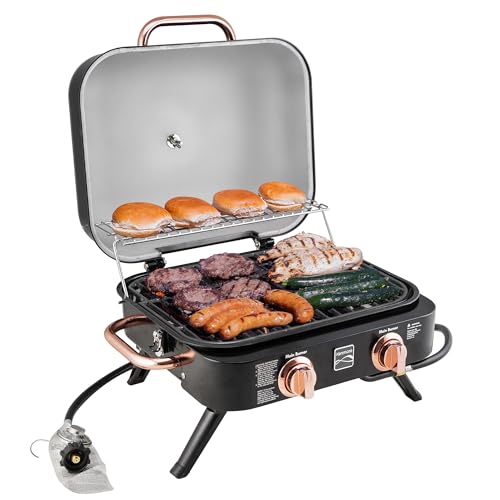
The Kenmore 2-Burner Portable is the tabletop pick for people who want a real two-burner grill head — with a warming rack — that can live on a patio table all summer and ride in a trunk in the fall. It suits apartment dwellers, campers, and tailgaters. It does not suit anyone who wants a standing cart; there is no stand, by design.
Strengths
- Warming rack — rare on tabletops and genuinely useful for two-stage cooking
- Fits both 5 lb and 20 lb propane tanks, so home use does not burn through small canisters
- Foldable legs and a tabletop format that stores on a shelf
Trade-offs
- Stainless steel burners in a portable frame — keep them covered and cleaned to get full life
- No cart or stand included; you supply the table
- Tabletop cooking area is sized for two to four people, not a crowd
Key specs (from the verified listing): 2 burners; tabletop format with warming rack; foldable legs; stainless steel burners; fits 5 lb and 20 lb propane tanks.
Most tabletop grills force a compromise the Kenmore avoids: they run happily on one-pound canisters at the campsite and then become expensive to feed at home. The Kenmore’s compatibility with a standard 20 lb tank (with the appropriate hose) means the same grill is economical on the patio and portable on the road. The warming rack is the second differentiator — resting burgers, toasting buns, and holding vegetables at serving temperature is the difference between a grill that handles a whole meal and one that handles a single protein.
The black-and-copper finish also makes it one of the better-looking tabletops in the class, which matters more than specs admit when the grill lives in view on a small patio. Care is the caveat: portable frames and stainless burners reward a cover and a quick brush-down, and punish being left out in the rain. Treat it like the dual-purpose tool it is and it covers more roles than any other pick here.
Best for: apartment patios, camping, and tailgating with one grill that also works at home / Not suited for: buyers who want a freestanding cart — Check the current price on Amazon

Royal Gourmet GT2009 2-Burner Portable Gas Grill with Folding Cart — Best Folding Cart
The GT2009 answers the most common tabletop complaint — “I am tired of grilling off a picnic table” — by putting a two-burner grill head on a folding cart with large wheels. It suits campers and tailgaters who want standing-height grilling that still packs down, and patio owners whose space has to serve double duty. It does not suit buyers who want a permanent, heavy cart that never moves.
Strengths
- 349 square inches of cooking area — generous for a folding design
- Folding cart with large wheels rolls over grass and gravel better than small casters
- Left basket and right-side shelf keep tools and trays off the ground
Trade-offs
- 17,000 BTU is the lowest output in this guide — preheat patiently and sear in smaller batches
- Folding mechanisms need the occasional bolt check to stay rattle-free
- Portable-first design means lighter materials than a fixed cart
Key specs (from the verified listing): 2 burners; 17,000 BTU; 349 sq in cooking area; folding cart; large wheels; side shelf and storage basket.
The GT2009’s party trick is logistics. The cart folds, the wheels are big enough for a campground or a tailgate lot, and the grill arrives at standing height with a shelf and a basket — a combination no bare tabletop matches. The 349 square inches is honestly sized for the format: four to six burgers with room to spare, or a mixed load of chicken and vegetables using the two burners as zones.
The honest limitation is heat. Seventeen thousand BTU across that area is adequate, not aggressive. You will get good results by preheating with the lid down for a full ten minutes, searing in one batch rather than crowding the grate, and letting the grill recover between batches. Buyers who mostly grill burgers, dogs, brats, and chicken will never feel short-changed; buyers chasing steakhouse crusts should look at the Nexgrill or Weber instead. As a travel-and-storage solution, though, nothing else in this guide folds this flat while grilling this big.
Best for: tailgaters, campers, and small patios that need a grill which folds away / Not suited for: high-heat searing specialists — Check the current price on Amazon

Cuisinart Chef’s Style Portable Propane Tabletop Gas Grill CGG-306P — Best for Two-Zone Cooking
The CGG-306P is the technician’s pick: a stainless tabletop built explicitly around two-zone cooking, with twin 10,000 BTU burners under 275 square inches. It suits small households and cooking enthusiasts who use indirect heat deliberately — reverse-seared steaks, bone-in chicken, ribs finished low and slow. It does not suit buyers who want a cart, or who grill for more than four people at once.
Strengths
- Twin 10,000 BTU burners designed for true two-zone setups
- Stainless steel construction throughout the grill head
- Compact 275 sq in footprint that still fits a family meal for two to four
Trade-offs
- Tabletop only — a stand or table is on you
- Total output is moderate; recovery after loading cold food is slower than the big carts
- No warming rack in the verified listing
Key specs (from the verified listing): 2 burners; twin 10,000 BTU burners (20,000 BTU total); 275 sq in cooking area; stainless steel; portable tabletop format.
Two-zone cooking is where two burners stop being a compromise and start being a technique, and the Cuisinart leans into it harder than any rival here. Light one burner, leave the other off, and you have a sear side and a gentle side: sear a thick steak over direct heat, slide it to the cool side to finish without burning, or run bone-in chicken entirely on the indirect side so the skin renders instead of flaring. The stainless build wipes down easily and shrugs off the weather better than painted steel when the grill lives outdoors.
Size discipline is the price of admission. Two hundred seventy-five square inches is a four-burger, two-steak, or one-spatchcocked-chicken surface. For couples and small families that is the right size — less propane per cook, faster preheat, less to clean. If your headcount regularly exceeds four, step up to a cart pick and use the same two-zone technique there.
Best for: couples and small families who cook with two-zone technique / Not suited for: crowds or buyers wanting a freestanding cart — Check the current price on Amazon
Comparison Table
| Pick | Badge | Key spec | Best for |
|---|---|---|---|
| Weber Spirit E-210 | Best Overall | Cast-iron grates, Snap-Jet ignition | Frequent grilling, long-term ownership |
| Charbroil Classic 2-Burner | Best Budget | 20,000 BTU, 280 sq in | First-time owners, small households |
| Nexgrill Deluxe 2-Burner | Best Value Cart Grill | 28,000 BTU, warming rack | Weekly family grilling |
| Kenmore 2-Burner Portable | Best Tabletop | Warming rack, fits 5 & 20 lb tanks | Apartments, camping, tailgating |
| Royal Gourmet GT2009 | Best Folding Cart | 17,000 BTU, 349 sq in, folding cart | Travel and storage-limited patios |
| Cuisinart CGG-306P | Best for Two-Zone Cooking | Twin 10,000 BTU burners, 275 sq in | Technique-focused cooking for 2–4 |
How to Choose a 2 Burner Propane Grill
Start with format, because format decides everything else. A cart grill is a patio appliance: it stays outside, it is always ready, and it gives you shelves, storage, and the largest grates. A tabletop is a tool: it stores indoors, travels, and asks you to supply the surface. A folding cart like the GT2009 splits the difference. Be honest about where the grill will live and how often it will move; the wrong format is the one regret no amount of BTU can fix.
Next, read BTU against area, not as a standalone number. As a working rule, a two-burner grill wants roughly 70 to 100 BTU per square inch of primary cooking area to sear confidently. The Nexgrill Deluxe and the cart picks clear that bar comfortably; the folding GT2009 sits below it, which is why we steer it toward burgers and chicken rather than thick steaks. Raw BTU bragging without the area math is how buyers end up with a big, lukewarm grill.
Grate material is the third decision. Porcelain-enameled cast iron — the Weber’s grates — stores heat, marks food deeply, and rewards a quick brush and oil routine with years of service. Porcelain-coated steel is lighter and cheaper, heats fast, and produces gentler marks; it is the right call at the budget tier as long as you know the trade. Stainless rod grates, found on some tabletops, are the low-maintenance middle path.
Finally, think about fuel logistics. Cart grills run on a 20 lb tank stored in the cabinet — the cheapest, simplest setup. Tabletops often default to one-pound canisters, which are convenient for camping and expensive for home use; a model like the Kenmore that also accepts a full-size tank saves real money across a season. Whichever you choose, keep a spare tank or canister on hand: running out mid-cook is the most preventable failure in propane grilling.
Cart, Tabletop, or Folding Cart: Matching the Format to Your Space
Measure before you buy, and measure the whole footprint, not just the grate. A cart grill with shelves up typically needs a rectangle of patio roughly four feet wide and two feet deep, plus working room in front. Balcony rules in many apartment buildings also restrict tank size or require minimum distances from railings and siding — check your lease and local code before a cart follows you home. Tabletops need a stable, heat-safe surface; a wooden picnic table is fine, a plastic folding table is not.
Storage is the second half of the space question. A cart lives outside under a cover. A tabletop lives on a shelf, in a closet, or in the trunk. A folding cart lives in the sliver of garage or storage-unit space that neither of the others fits. If your grill has to disappear between uses — shared patios, small garages, rental rules — the folding and tabletop formats are not compromises; they are the point.
How to Set Up and Season a New Propane Grill
Unbox and inventory the parts before you assemble anything; a missing igniter clip discovered at step one is a nuisance, discovered at step twelve it is an afternoon. Assemble on a flat surface, leave bolts finger-tight until the frame is square, then tighten in sequence. Connect the regulator to the tank with the tank valve closed, then perform a leak test: brush soapy water on every connection, open the valve slowly, and watch for growing bubbles. Bubbles mean gas is escaping — close the valve, remake the connection, and test again. Never skip this step on a new grill or after a tank swap.
Before the first food touches the grates, run a burn-in: light all burners, close the lid, and run on high for fifteen to twenty minutes to burn off manufacturing oils, then let the grill cool. Lightly oil the grates with a high-smoke-point oil on a folded paper towel held with tongs. That first seasoning layer, refreshed after each cook while the grates are still warm, is what keeps porcelain-enameled and cast-iron grates releasing food cleanly for years.
Finish the setup by learning your grill’s geography. Preheat for ten minutes, then lay slices of white bread across the whole grate for a minute or two. The toast pattern is a map of your hot and cool spots — every two-burner grill has them, and knowing yours is worth more than any accessory.
Propane vs Charcoal vs Electric in the Two-Burner Class
Propane’s case is convenience with control: instant ignition, knob-precise heat, cheap fuel that is sold at every hardware store and gas station, and a grill that is ready in ten minutes on a weeknight. Its weakness is flavor neutrality — propane contributes nothing to the food, so smoke has to come from the meat’s own drippings, a smoker tube, or a foil pouch of chips over a burner. For most weeknight cooking that trade is obviously correct, which is why propane dominates this class.
Charcoal’s case is flavor and peak heat. A charcoal fire can out-sear any two-burner propane grill here and gives food the smoke signature gas cannot replicate. The costs are time and mess: twenty minutes to light, ash to manage, and temperature control that is a skill rather than a knob. Electric’s case is permission: it is the only fuel many apartment buildings allow, and modern electric grills cook far better than their reputation. But electric elements recover heat slowly after the lid opens, and no electric model offers the two-zone flexibility that defines this guide. Choose propane for speed and control, charcoal for flavor-first weekend cooking, electric when the lease leaves you no choice — and dual-fuel, covered in our hybrid guide, when you refuse to choose.
Reading a Two-Burner Spec Sheet Without Getting Fooled
Three numbers on a grill listing deserve skepticism. The first is cooking area: as noted above, totals often fold in the warming rack, and some brands measure to the very edge of the grate frame. The second is BTU: it describes maximum fuel consumption, not cooking quality. A well-sealed 20,000 BTU grill with heavy grates can out-sear a leaky 28,000 BTU grill with thin ones, because what matters is how much heat reaches and stays in the cooking surface. Treat BTU as a sanity check on the burner-to-area ratio, never as a ranking.
The third is grate description. “Porcelain-coated” can mean a thin enamel over steel wire or a substantial coating over cast iron, and the two cook very differently. Listing photos of the grate itself are more informative than the adjective: thick, flat-topped bars hold heat and mark food; thin round wire does neither. Similarly, “stainless steel burners” spans several grades — the practical question is whether replacement burners for the model are easy to find, because burners are the part every gas grill eventually needs.
Ignition deserves a line of its own. Individual-burner ignition, like the Weber’s Snap-Jet design, lets you light one burner for a small cook and gives you a backup path if one igniter weakens. Single-button systems that light both burners from one module are simpler and cheaper. Either is fine when new; the difference shows up in year four, which is why parts availability keeps appearing in this guide’s verdicts.
How to Cook a Full Meal Using Both Zones
Here is the two-zone workflow that makes a two-burner propane grill outperform its size. Preheat with both burners on medium-high for ten minutes. Set the left burner to high and the right to low — that is your sear side and your finishing side. Start thick items first on the sear side: two minutes per side for steaks and chops, skin-side down for chicken. Move everything to the cool side, close the lid, and let the grill work like an oven while you put vegetables on the now-vacant sear side, where they char quickly over direct heat.
Resting is the step home grillers skip and should not. Move finished proteins to the warming rack if your grill has one, or to a platter tented with foil for five to ten minutes; the juices redistribute and the vegetables finish in the meantime. Sauces and buttered buns go on in the final two minutes over the cool zone. Run this sequence twice and it becomes automatic — and it is the honest answer to anyone who claims two burners are limiting. The limit is rarely the grill; it is whether the cook uses the second burner as a tool instead of a duplicate of the first.
Maintenance Schedule: Keeping a Small Propane Grill Alive for Years
Two-burner grills die from neglect in predictable places, and a light routine prevents nearly all of it. After every cook, run the burners on high for five minutes with the lid closed to carbonize residue, then brush the grates while they are hot. That two-minute habit is worth more than any deep clean. Once a month during the season, empty and wash the grease tray — a full tray is both a flare-up risk and the main reason small grills start smoking excessively — and check that the drip pan underneath is not quietly overflowing onto the tank or the patio.
Once a season, go deeper. Pull the grates and heat tents, brush loose scale out of the firebox, and inspect the burner tubes: the port holes should be open and evenly sized, and spider webs or insect nests inside the venturi tubes are a classic cause of weak, yellow flames and hard starting. A soft brush and a straightened paper clip for stubborn ports are the whole toolkit. Check the regulator hose for cracks and the connections with soapy water, exactly as you did at setup.
Going into winter, the routine decides whether spring starts with grilling or with repairs. Clean the grill thoroughly, run it dry, oil the grates, close the tank valve, and disconnect the regulator if the grill stores anywhere enclosed. A breathable cover keeps rain and debris out without trapping condensation against the metal. Do these things and the difference between a three-season grill and a ten-season grill is mostly this page — the hardware in this guide, cared for this way, is built to last far longer than its price tier suggests.
Who Should Skip a Two-Burner Grill Entirely
Honesty about the category matters as much as the picks. If you regularly cook for eight or more people, a two-burner grill will turn every gathering into batch management — step up to a three or four-burner cart and accept the larger footprint. If you want rotisserie cooking, a dedicated sear station, or a side burner for big pots, those features live in larger formats. And if your household grills twice a year, the most economical pick in this guide is still money parked on the patio; a quality tabletop you store indoors, like the Kenmore or the Cuisinart above, fits that life better than any cart. Two burners are the sweet spot for a wide middle of households — but the middle is not everybody, and buying for the cook you actually are beats buying for the cook you imagine.
Common Buying Mistakes
The first mistake is buying on stated cooking area alone. Manufacturers routinely include warming racks in the headline number, which inflates a two-burner grill’s apparent capacity by a fifth or more. Compare primary grate area when you can, and size for your real headcount: roughly 275 to 350 square inches serves two to four people comfortably.
The second mistake is ignoring ignition until it fails. Piezo clickers and electronic igniters are consumables in spirit if not in fact; a grill whose ignition design lets you light a burner with a long lighter through a lighting hole — and whose igniter module is cheaply replaceable — will age more gracefully than one that leaves you stranded.
The third mistake is forgetting the total cost of the format. A tabletop bargain can quietly require a stand, a tank hose, and a cover; a cart can require a new tank and a patio mat. Price the whole setup, not the box. The fourth mistake is leaving a new grill uncovered outdoors: two-burner grills at every tier last measurably longer under a cover, and burners clog far less often when rain and debris stay out of the firebox.
Final Recommendation
For most buyers, the Weber Spirit E-210 is the two-burner propane grill to beat — the most even heat, the best grates, and the deepest parts support in the class. On a budget, the Charbroil Classic 2-Burner covers the fundamentals honestly, and the Nexgrill Deluxe 2-Burner is the value sweet spot for weekly family grilling. If the grill has to travel or disappear between cooks, choose between the Kenmore tabletop, the folding-cart Royal Gourmet GT2009, and the two-zone specialist Cuisinart CGG-306P based on where it will actually be used. Widen the research with our companion guides: Best 2 Burner Grills, Best 2 Burner Gas Grills, Best 2 Burner Grills Under $200, Best 2 Burner Small Grills, and Best 2 Person Propane Grills.
Frequently Asked Questions
How many people can a 2 burner propane grill cook for?
Comfortably four, and six with batch cooking. A two-burner grate in the 275 to 350 square inch range holds eight to ten burgers at once; larger groups simply mean cooking proteins in two rounds and holding the first round on a warming rack or in a low oven. For a mixed menu — say burgers, a tray of vegetables, and corn — plan the sequence rather than the surface: vegetables first over direct heat, proteins second, corn on the warming rack throughout. Sequenced that way, even the smallest pick in this guide feeds six without stress.
How long does a 20 lb propane tank last on a two-burner grill?
A 20 lb tank holds roughly 430,000 BTU of fuel. A two-burner grill running both burners on high uses around 20,000 to 28,000 BTU per hour, so expect roughly fifteen to twenty hours of full-power grilling — and considerably more at the medium settings most cooking actually uses.
Can I convert a propane grill to natural gas?
Some cart grills offer manufacturer conversion kits, but many two-burner models do not, and an unapproved conversion is a genuine safety hazard. If natural gas matters to you, confirm the specific model’s kit before buying; never change orifices with third-party parts on a grill that was not designed for it.
What is the advantage of two burners over one?
Heat control. Two burners let you run a direct zone and an indirect zone at the same time, which is the foundation of reverse searing, bone-in chicken without flare-up burns, and keeping finished food warm while the rest cooks. A single burner gives you one temperature everywhere.
Do I need a side burner on a small grill?
Rarely. None of the picks in this guide carries one, and most owners of small grills use a side burner a handful of times a year. A portable induction plate or the kitchen stove covers sauces and beans with less cost and one less burner to clean and maintain.
Is a premium two-burner grill worth it over a budget one?
It depends entirely on frequency. Grill twice a month in season and the budget Charbroil covers your needs for years; the premium premium buys you little you will notice. Grill three or four times a week and the calculus flips: heavier grates, evener heat, an igniter that still works in year five, and burners you can actually buy replacements for all compound into a grill that is simply less frustrating every single cook. The honest dividing line is not income, it is sessions per season — past roughly fifty cooks a year, the Weber’s build and support pay for themselves in avoided replacements alone.
Can a two-burner grill reach proper searing temperature?
Yes, with technique. Preheat ten to fifteen minutes with the lid closed, cook with dry-surfaced meat at room temperature rather than fridge-cold, and do not crowd the grate — an overloaded grate drops surface temperature and steams the food. The cast-iron-grate and higher-BTU picks in this guide sear most easily, but even the budget cart produces a respectable crust when it is fully preheated and loaded sensibly.
How do I keep a two-burner grill from rusting out?
Cover it, brush the grates after each cook, empty the grease tray regularly, and once a season clear the burner ports with a soft brush so the flame stays even. Burners and heat tents are the parts that eventually wear; on well-supported models they are replaceable in minutes.


