Disclosure: airfryerkitchensupply.com is reader-supported. When you buy through links on our site, we may earn an affiliate commission at no extra cost to you.
Where to buy
If you are shopping for the best 2 burners grills — two-burner grills in every format the category offers — this guide takes the widest honest view: a premium cart, a value cart, an infrared griddle cabinet, a dual-fuel combo, a portable, and a flat-top griddle, each verified against a live Amazon listing and each running exactly two burners. The search does not name a fuel or a format, so this guide does not pretend one: it shows you the whole two-burner landscape and helps you pick your shape of grill. Check the current price on Amazon for the models that fit your life.
- Weber Spirit E-210 Gas Grill (Best Overall) — Check the current price on Amazon
- Megamaster Deluxe 2 Burner Gas Grill (Best Value Cart) — Check the current price on Amazon
- Charbroil Pro Series Amplifire 2-Burner Gas Grill and Griddle Cabinet (Best Infrared) — Check the current price on Amazon
- Royal Gourmet ZH3002N 2-Burner Propane Gas and Charcoal Grill Combo (Best Dual-Fuel) — Check the current price on Amazon
- Coleman RoadTrip 225 Portable Tabletop Grill (Best Portable) — Check the current price on Amazon
- Blackstone 1813 Original 22-Inch Tabletop Griddle with Hood (Best Griddle) — Check the current price on Amazon
One Keyword, Six Shapes of Grill: How to Read This Guide
Search for the best 2 burners grills and the results sprawl across every format in outdoor cooking, because “two burners” describes an engine size, not a product. Two burners power the classic patio cart, the infrared cabinet, half of a dual-fuel combo, the folding portable in a camper’s trunk, and the flat-top griddle at a tailgate. They all share the same essential virtue — a hot zone and a cool zone in a footprint a small household can house — and they diverge in everything else: fuel, surface, portability, and the kind of cooking they make easy.
There is a reason the two-burner size keeps reasserting itself against larger formats, and it is worth naming before the picks: proportionality. A two-burner grill preheats in the time it takes to season the food, burns fuel in proportion to a household’s actual dinner, cleans in minutes, and stores in the footprint of a chair. Every larger grill pays for its extra capacity on every ordinary cook, in fuel, time, and cleaning, whether the capacity is used or not. The two-burner is the format whose costs arrive only when its capabilities do — which is why, across all six shapes in this guide, it remains the default recommendation for households that cook for themselves rather than for an audience.
This guide is organized to make that sprawl useful. Each pick is the strongest verified example of its shape, with a badge that names the shape’s purpose. The buying guide then works the decision in the right order: format first, because it determines where the grill lives; surface second, because it determines what you will cook; and specifications last, because a two-burner grill with the right shape and surface at modest numbers will make you happier than a wrong-shaped grill with impressive ones. If you already know your format — propane cart, portable, griddle — our companion guides go deeper on each; this is the map of the whole territory.
In this guide
Quick Picks
- Best Overall: Weber Spirit E-210 — the two-burner cart perfected: cast-iron grates, even heat, decade-grade support. Check the current price on Amazon
- Best Value Cart: Megamaster Deluxe 2 Burner — 28,000 BTU and the largest stated area here, with cast iron grates. Check the current price on Amazon
- Best Infrared: Charbroil Amplifire 2-Burner — radiant searing, no flare-ups, plus a griddle in the same cabinet. Check the current price on Amazon
- Best Dual-Fuel: Royal Gourmet ZH3002N — a two-burner gas side married to a charcoal chamber. Check the current price on Amazon
- Best Portable: Coleman RoadTrip 225 — two burners, Instastart ignition, and the easiest cleanup on this page. Check the current price on Amazon
- Best Griddle: Blackstone 1813 22-Inch — a two-burner flat top with a hood, for breakfast and smash-burger households. Check the current price on Amazon
How These Picks Were Chosen
One hard filter governed everything: exactly two burners, verified from the manufacturer’s own Amazon listing — a filter that quietly eliminates the one-burner portables and three-burner carts that crowd two-burner searches. Beyond the filter, we chose for coverage with quality: each format represented in the current two-burner market gets exactly one champion, chosen on the verified merits of its listing — heat, area, grate or surface, ignition, and the format-specific details (locking lids, charcoal chambers, emitter systems) that decide real ownership.
Specs in the mini boxes are drawn from the listed listing titles, verified 2026-11-20. Where a stated figure carries the category’s usual optimism — total areas that include warming space — the review says so. No prices or ratings are printed anywhere in this guide, per the standing rules of this series; positions are described by tier instead.
The 6 Best 2 Burners Grills

Weber Spirit E-210 Gas Grill — Best Overall
If the phrase “two-burner grill” conjures one image, it is this: a compact propane cart with a lid, side shelves, and a family’s dinner on cast-iron grates. The E-210 is that image at its best — porcelain-enameled cast-iron grates, Snap-Jet ignition per burner, and the evenest heat in this guide. It suits frequent grillers with a permanent patio spot. It does not suit travelers, charcoal seekers, or firm budgets.
Strengths
- Cast-iron grates and even heat — the conventional two-burner benchmark
- Per-burner Snap-Jet ignition and Weber’s deep parts ecosystem
- Two true zones for the full range of gas technique
Trade-offs
- Premium position among two-burner carts
- Propane only — no charcoal character, no griddle surface
- Household capacity; parties mean batches
Key specs (from the verified listing): 2 burners; porcelain-enameled cast-iron grates; Snap-Jet ignition; Weber Works rails; liquid propane cart.
The E-210 keeps winning this badge across our guides because its virtues are the ones felt at every cook: the grate that stays hot when the steaks land, the burner that lights when you turn the knob in year five, the heat map so even you stop rotating food out of habit. In a format-spanning guide it stands as the reference point — the grill each other shape is implicitly compared against when a household decides whether its needs are standard or specialized.
Best for: the classic two-burner cart buyer who grills weekly / Not suited for: portability, charcoal flavor, or entry budgets — Check the current price on Amazon

Megamaster Deluxe 2 Burner Gas Grill — Best Value Cart
The Megamaster Deluxe is the cart for buyers who measure value in grate and heat per dollar: 28,000 BTU, a stated 418 square inches, cast iron grates, a thermometer, electronic ignition, and foldable shelves on a four-wheel frame. It suits families cooking for five or six on a value budget. It does not suit buyers who rank branded parts depth first.
Strengths
- The largest stated cooking space among this guide’s carts
- Cast iron grates at a value position — the tier’s best searing value
- Full feature set: thermometer, electronic ignition, warming capacity
Trade-offs
- Stated area typically includes warming space — the main grate is smaller
- Value-tier frame and finish
- Long-term parts support trails the legacy brands
Key specs (from the verified listing): 2 burners; 28,000 BTU; 418 sq in stated cooking space; cast iron grates; built-in thermometer; electronic ignition; foldable shelves; four-wheel transport.
Capacity changes menus: on this grate, a family cookout runs in one round — burgers on the hot zone, chicken finishing indirect, vegetables in the gaps — and the cast iron holds its temperature through the load in a way thin coated grates cannot. Judged purely as cooking hardware per dollar, it is the strongest cart value in the two-burner market, and the natural pick when the Weber’s premium buys support you do not expect to need.
Best for: families wanting maximum cart capacity and searing per dollar / Not suited for: decade-horizon parts planners — Check the current price on Amazon

Charbroil Pro Series Amplifire 2-Burner Gas Grill and Griddle Cabinet — Best Infrared
The Amplifire is the two-burner category’s technology outlier: an infrared emitter system that sears radiantly and all but abolishes flare-ups, paired with a griddle surface in a cabinet body. It suits searing-focused cooks and households that want two surfaces in one appliance. It does not suit buyers who want conventional simplicity or the lowest price.
Strengths
- Infrared cooking: even, intense searing with virtually no flare-ups
- Grill plus griddle in one two-burner cabinet
- Juicier burgers and chicken than conventional burners typically deliver
Trade-offs
- Premium position
- Emitter plates add a maintenance routine conventional grills skip
- Infrared runs hot — expect a short calibration period
Key specs (from the verified listing): 2 burners; Amplifire infrared technology; propane grill and griddle cabinet; model 463676724.
Infrared earns its own badge because it is not a feature but a different physics, covered in depth in our infrared guide: radiation instead of hot air, drippings vaporized on the emitter instead of flaring, moisture kept in the food. The Amplifire wraps that physics in the most versatile body in this guide — sear on the infrared grate, finish onions and peppers on the griddle beside it — and for households whose menu fits, it is not an alternative to the classic cart but an upgrade path from it.
Best for: searing enthusiasts and two-surface cooks / Not suited for: set-and-forget minimalists or entry budgets — Check the current price on Amazon

Royal Gourmet ZH3002N 2-Burner Propane Gas and Charcoal Grill Combo — Best Dual-Fuel
The ZH3002N is the pick for households that refuse the fuel argument: a two-burner propane chamber for weeknights beside a charcoal chamber for weekends, 759 stated square inches across both, in one cart. It suits genuine two-fuel households. It does not suit single-fuel cooks, who would be housing a chamber they never light.
Strengths
- True dual fuel: gas convenience and charcoal flavor in one footprint
- A real two-burner gas side — not a token burner strip
- Two side shelves and a stainless lid complete the station
Trade-offs
- Each chamber is smaller than a dedicated grill
- Charcoal side brings ash management and lighting time
- Wider and heavier than a simple cart
Key specs (from the verified listing): 2-burner propane side; charcoal chamber; 20,000 BTU (gas side); 759 sq in stated total area; dual fuel; two side shelves.
The combo’s logic is a calendar: gas four nights a week because it is Tuesday-proof, charcoal on the weekend because flavor is the point of the weekend. One footprint, one cover, one set of tools — and the household argument about fuel ends not with a winner but with a schedule. Our hybrid guide compares the full dual-fuel field; within this map of the category, the ZH3002N is its balanced representative.
Best for: households that will use both fuels monthly / Not suited for: single-fuel households or small balconies — Check the current price on Amazon
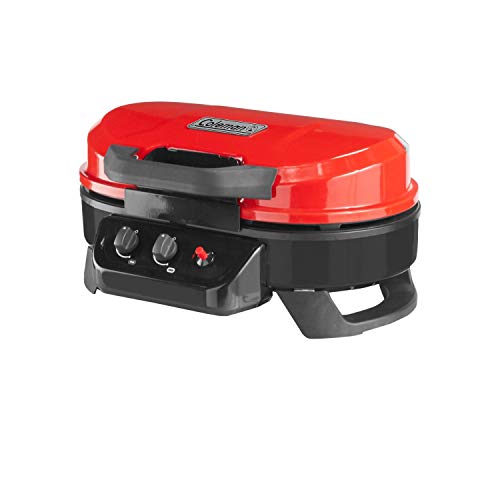
Coleman RoadTrip 225 Portable Tabletop Grill — Best Portable
The RoadTrip 225 represents the portable shape: two burners and 11,000 BTU in a tabletop body with Instastart ignition and a removable water pan for painless cleanup. It suits campers, tailgaters, and picnickers. It does not suit high-heat searing or patio-permanent duty.
Strengths
- Instastart ignition — reliable, matchless lighting
- Water pan cleanup — the easiest in this guide
- Two burners with adjustable control, so zone cooking survives the road
Trade-offs
- 11,000 BTU is moderate, picnic-grade heat
- Serves two to four
- Needs a table or stand you provide
Key specs (from the verified listing): 2 burners; 11,000 BTU; Instastart ignition; adjustable temperature control; removable water pan; portable tabletop format.
Portability is a cooking feature: the grill that travels is the grill that cooks at campsites, trailheads, and tailgates, and the RoadTrip’s design — light, reliable, cleanable in the field — has made it the format’s reference for years. Its two burners matter more on the road than at home, because campsite menus are sequenced by necessity and a cool zone is where finished food waits while the rest catches up.
Best for: camping, tailgating, and picnic grilling / Not suited for: searing purists or permanent patio duty — Check the current price on Amazon

Blackstone 1813 Original 22-Inch Tabletop Griddle with Hood — Best Griddle
The Blackstone represents the shape that has redrawn the category in recent years: a two-burner flat-top griddle, 22 inches wide, with a hood and a stainless front plate. It is a grill only in the broader sense — there is no grate — and it earns its place because a large share of two-burner cooking has migrated to the flat top. It suits breakfast households, smash-burger devotees, and anyone whose vegetables keep falling through grates. It does not suit cooks who want flame-kissed, marked food.
Strengths
- A full flat top: breakfast, smash burgers, fried rice, cheesesteaks
- Two burners create two temperature zones across the steel
- Hood included — melts cheese, steams, and protects the surface
Trade-offs
- No grate, no grill marks, no open-flame flavor
- Flat tops ask for seasoning and scraping discipline
- Tabletop format — the stand or table is on you
Key specs (from the verified listing): 2 burners; 22-inch tabletop griddle; hood; stainless steel front plate; powder coated steel body; propane.
The griddle’s case is a menu: eggs, pancakes, bacon, onions, peppers, mushrooms, shrimp, fried rice, and the smash burger’s unmatched crust — foods a grate handles badly or not at all. Two burners zone the steel so onions caramelize on the cool side while burgers sear on the hot. Households that add a flat top rarely go back to grate-only cooking, which is why the shape stands in this guide as a first-class citizen of the two-burner world rather than a footnote.
Best for: griddle-menu households and breakfast devotees / Not suited for: grill-mark and open-flame traditionalists — Check the current price on Amazon
Comparison Table
| Pick | Badge | Key spec | Best for |
|---|---|---|---|
| Weber Spirit E-210 | Best Overall | Cast-iron grates, premium cart | The classic two-burner experience |
| Megamaster Deluxe 2 Burner | Best Value Cart | 28,000 BTU, 418 sq in stated | Capacity and searing per dollar |
| Charbroil Amplifire 2-Burner | Best Infrared | Infrared + griddle cabinet | Searing technology, no flare-ups |
| Royal Gourmet ZH3002N | Best Dual-Fuel | Gas + charcoal, 759 sq in stated | Both fuels in one footprint |
| Coleman RoadTrip 225 | Best Portable | 11,000 BTU, water pan | Camping and tailgating |
| Blackstone 1813 22-Inch | Best Griddle | 2-burner flat top with hood | Breakfast and smash-burger menus |
How to Choose Among Two-Burner Formats
Ask the questions in the order this guide has been quietly teaching. Where will it live? A permanent patio spot argues for a cart or cabinet; a closet, trunk, or balcony argues for a tabletop or portable. What will you cook most? Marked, flame-kissed food argues for a grate; breakfast and flat-top food argues for the Blackstone or a combo with a griddle surface; both fuels’ flavors argue for the ZH3002N. How do you feel about flare-ups and searing intensity? If they are your delight and your nemesis respectively, infrared is your physics. How long will you keep it? A decade argues for the Weber’s support; a season of learning argues for value.
Then, and only then, read specifications — and read them with this series’ standing skepticism: areas include warming racks, BTU is fuel draw rather than a searing guarantee, and grate material tells you more about dinner than either number. A two-burner grill chosen by format, surface, and horizon will satisfy at almost any specification; one chosen by headline numbers alone satisfies until the first cook in the wrong shape.
How to Run Any Two-Burner Grill: The Two-Zone Method
Whatever shape you buy, the operating system is the same, and it is worth learning as a single transferable skill — the one piece of grilling knowledge that will still be serving you on whatever appliance you own in twenty years, long after every model in this guide has been replaced twice over. Preheat fully with the lid down — ten minutes for carts, less for tabletops and the griddle. Set one burner high and one low: that gradient is your sear zone and your finishing zone. Sear proteins on the hot side, move them to the cool side to finish, and use the freed hot side for vegetables. Rest finished food rather than holding it over heat. Close the lid to cook thick items through; open it to manage flare and watch delicate food.
On the griddle, the same system applies across the steel: hot half for searing, cool half for holding, with a squeeze bottle of water for steam-melting cheese under the hood and a scraper that keeps the surface seasoned rather than stripped between items. On the dual-fuel, the gas side runs the method on weeknights and the charcoal side teaches its own version — coals banked to one side, food finished over the empty half. Learn the method once and every two-burner grill in this guide, and every one you will ever own after it, becomes legible within a single cook.
Setup and First-Week Care for a New Two-Burner Grill
Gas models start with assembly on a flat surface, a soapy-water leak test on every connection, and a fifteen-minute burn-in on high to clear manufacturing oils completely before any food touches the grate. Season cast iron grates with a thin oil film while warm; season the Blackstone’s steel properly with repeated thin coats of high-smoke-point oil heated past smoking, until the surface darkens evenly — a griddle’s seasoning is its non-stick, and the first hour decides it. Light the charcoal side of a dual-fuel with a chimney, never fluid, and empty its ash only when fully cold.
Across the first week, keep the routine deliberately boring: brush or scrape while hot, empty the grease path, cover or store the grill dry. Boring is the goal — the cooks who keep a grill for a decade are never the ones with an elaborate ritual, but the ones whose two-minute habit never felt like a chore worth skipping. Every pick in this guide rewards that routine with years of service, and every one of them — premium and value alike — is quietly ruined by the opposite. The category’s dirty secret is that care, not price, is the strongest predictor of a grill’s fifth-year performance.
Fuel and Running Costs Across the Formats
Two burners are the fuel-efficient end of outdoor cooking by construction: a compact firebox heating a compact grate wastes little propane on empty space, and every format in this guide shares that economy. The differences live at the margins. Carts on a 20 lb tank buy propane at its cheapest; tabletops and portables run the same fuel at canister prices unless they accept a tank hose — the single most valuable running-cost feature a portable can have. The dual-fuel splits its budget between propane and charcoal, and most owners find the tank lasting longer while a modest charcoal budget appears. The griddle, running both burners under a steel plate, uses fuel comparably to a cart of the same width.
Across a season, the format decision dwarfs the model decision for running costs, and the care decision dwarfs both for lifetime costs: a covered, maintained value grill will out-serve a neglected premium one, and its replacement parts will be the smaller bill. Buy the format for your life, maintain whatever you buy, and the two-burner category remains what it has always been — the cheapest respectable way to cook outdoors.
Accessories, Matched to Format
The universal kit is short: long tongs, a wide spatula, a brush or scraper matched to your surface, an instant-read thermometer, and a cover or storage solution fitted to the grill. Beyond that, each format has one accessory that transforms it. For carts, it is a second tank — running dry mid-cook is the category’s most preventable embarrassment. For the dual-fuel, a chimney starter, which removes lighter fluid and guesswork from the charcoal side forever. For the griddle, a proper scraper and squeeze bottles, the flat top’s native tools. For portables, the tank hose discussed above. For infrared, a spare set of emitter plates on the shelf, turning the technology’s one wear item into a scheduled swap.
The accessories to skip are the ones sized for bigger grills or broader promises: oversized tool sets, universal rotisseries on grills never designed for them, and any gadget whose storage footprint rivals a tabletop grill’s. In a category defined by compactness, accessories should be held to the same standard as the grills themselves — every item earns its space or it does not come home.
When Two Burners Is the Wrong Answer
Honesty about the category’s ceiling matters as much as enthusiasm for its floor. Two burners are the wrong answer for regular crowds above eight, for whole-animal and large-format cooking, for rotisserie-centered menus, and for households whose grilling is a weekly production rather than a meal. They are also the wrong answer, at the other extreme, for the twice-a-year griller, whose honest best buy is the smallest tabletop that stores in a closet — or a stove top plate, which asks for no storage, no tank, and no weather at all.
Between those poles lies the wide middle this guide serves: households of two to six, cooking weekly to monthly, in spaces from balconies to modest patios. For that middle, two burners is not a compromise size. It is the size the cooking actually is, and the larger formats are the ones carrying unused capacity through every ordinary Tuesday.
How to Read Any Two-Burner Grill Review Critically
Finish with a skill that outlasts this guide: reading the category’s claims like an editor. When a listing quotes a cooking area, ask whether the warming rack is inside the number. When it quotes BTU, ask over what area, and look for grate material as the tiebreaker. When a roundup shows you six “best” two-burner grills, check whether all six are actually two-burner, actually current, and actually the format the headline promised — in this category, a surprising share are none of the three. When a review praises a grill’s sear, ask about its preheat discipline; when it condemns one, ask about its owner’s maintenance.
The picks in this guide were built to survive that reading: verified listings, specs quoted from the listings themselves, optimism flagged where it lives, and formats labeled for what they are. Hold every other source — and every future version of this one — to the same standard, and the two-burner market becomes a much easier place to shop.
Surfaces Compared: Grates, Plates, Emitters, and Coals
Four cooking surfaces divide this guide’s six picks, and a buyer who understands them understands the category. The conventional grate — Weber’s cast iron at its best, Megamaster’s as its value champion — cooks by contact and convection, marks food, and forgives beginners. The infrared emitter cooks by radiation: faster, more even, immune to flare-ups, and demanding of calibration and plate care. The flat-top plate cooks by pure contact across its whole area, owning breakfast and small foods, and asking for seasoning discipline. The charcoal bed cooks by radiation and smoke together, the oldest surface here, trading convenience for flavor that no burner reproduces.
Notice that the burners underneath are nearly the least interesting part of the comparison — two tubes of gas doing the same work in four different philosophies. That is the deepest lesson of the two-burner category: choose the surface and the format, and the grill chooses itself. Shoppers who start from BTU start from the one specification that matters least.
Cooking for a Crowd on Two Burners: The Batch Playbook
Every two-burner owner eventually faces the eight-person Saturday, and the format handles it better than its reputation suggests — with sequencing rather than surface. Start the items that hold well: sausages and chicken pieces, cooked first and held in a low oven or on the grill’s coolest corner under foil. Grill the vegetables second, while the proteins rest — they are at their best warm rather than hot. Finish with the fast, must-be-fresh items: burgers and steaks in two tight rounds on a fully recovered, ripping-hot grate. Bread and buns toast in the final two minutes wherever space appears.
The playbook’s rules are simple: never crowd a cold grate, let the grill recover between rounds, and let resting — which improves meat anyway — be your holding strategy instead of a warming rack at its limit. Run this way, a two-burner grill feeds eight with less stress than a four-burner owner cooking everything at once and finishing nothing together. Capacity, it turns out, is partly a property of the cook.
A Brief History of the Two-Burner Format
The two-burner grill is where gas grilling began for most households: the compact cart that brought propane cooking to the suburban patio was, in its classic form, a two-burner with a warming rack and a pair of side shelves. As patios grew, the category stretched upward — three, four, six burners, sear stations, rotisseries — and the two-burner was quietly repositioned as the entry level. What the market rediscovered, and what this guide’s sprawl of formats reflects, is that the original size was never a starter version of anything. It matches the arithmetic of real households: two to six people, weeknight frequency, finite space.
The format’s modern renaissance — infrared cabinets, dual-fuel combos, the griddle boom, portables with real temperature range — is the category being taken seriously again at its original scale. The six picks in this guide are that renaissance in miniature: not smaller versions of big grills, but fully realized designs that happen to share an engine size. Buyers who understand that buy better grills.
Safety and Placement, Across Every Format
The safety rules do not shrink with the grill. Every gas model here belongs outdoors, in open air, with clearances from siding, railings, and overhangs that your local code specifies — never in a garage, tent, or enclosed porch, where carbon monoxide accumulates regardless of burner count. Tanks stay upright, connections get the soapy-water test at season start and after every change, and grease paths get emptied before they become fuel. The charcoal side of a dual-fuel adds its own rules: light with a chimney away from structures, and treat ash as live for a full day, disposing of it only in metal.
Placement shapes safety as much as hardware does. A cart parked out of the wind cooks more evenly and tempts no one to move it closer to the house; a tabletop on a stable, heat-safe surface is a tool, and on a plastic table it is a hazard; a griddle’s oil management — a full grease cup emptied on schedule — is its version of the same discipline. None of this is onerous, and all of it is the standing price of cooking with fire, at two burners as at twelve.
What a Second Grill Looks Like: How Two-Burner Owners Expand
An underappreciated virtue of starting with a two-burner is how gracefully it composes with a second appliance later. The cart owner adds a tabletop griddle for breakfast and takes it camping. The griddle owner adds a small charcoal kettle for the weekend ritual. The dual-fuel owner, having sampled both fuels in one body, eventually learns which one deserves a dedicated upgrade. In each case the two-burner remains in service — as the weeknight grill, the travel grill, the vegetable grill beside a bigger main act — rather than being discarded.
This composability is a financial argument as much as a culinary one. A household that starts at two burners spends its money in stages, guided by experience, and ends with a kit matched to its real cooking. A household that starts at six burners has spent the whole budget on a guess. If you are reading this guide at the beginning of your grilling life, that sequencing — start at the size of your Tuesdays, expand toward your Saturdays — is the most valuable advice in it.
Common Buying Mistakes
The first mistake is shopping specifications before format — falling for a BTU figure on a grill whose shape does not fit your space or your menu. The second is assuming two burners means the same product everywhere: a griddle, a combo, and a cart share an engine size and nothing else. The third is ignoring the second surface or second fuel you are paying for; a combo or griddle bought aspirationally is a single-purpose grill carrying dead weight. The fourth is skipping the leak test and burn-in on a new gas grill, which converts a ten-minute safety ritual into a season of wondering why the grill smells of chemicals. The fifth, quietest mistake is buying for guests instead of for yourselves — sizing, surfacing, and spending for the four Saturdays a year when the yard is full, and living with the oversized result on the forty-eight weeks when it is not.
Final Recommendation
Start with the Weber Spirit E-210 if your needs are the classic ones — it is the two-burner grill perfected, and the reference against which every other shape in this guide should be justified before it replaces the classic in your cart. Take the Megamaster Deluxe for value capacity, the Amplifire for infrared, the ZH3002N for both fuels, the RoadTrip 225 for the road, and the Blackstone for the flat-top menu. Then go deeper with the companion guide for your format: Best 2 Burner Grills, Best 2 Burner Propane Grills, Best 2 Burner Hybrid Grills, Best 2 Burner Infrared Grills, and Best 2 Burner Small Grills.
Frequently Asked Questions
What is the best type of 2 burner grill overall?
For most households, the propane cart — it is the format with the fewest compromises: permanent, capacious enough, technique-complete. But “overall” dissolves on contact with real lives: the camper’s best is the portable, the breakfast household’s best is the griddle, the flavor devotee’s best is the dual-fuel. This guide’s badges exist because the honest answer is a matching exercise, not a crown. If forced to a single sentence for the undecided: buy the cart if you have the patio, the tabletop if you do not, and let your menu argue for the griddle, the combo, or the infrared only when it argues loudly — specialty formats reward conviction and punish curiosity bought on impulse.
Are 2 burners enough for a family?
For a family of four, yes, comfortably — every cart in this guide cooks a family dinner in one round, and the tabletops do it in at most two quick ones. Families of six cook in batches on any two-burner; families who regularly feed eight should be shopping three and four-burner formats, where the extra capacity stops being a luxury. The batch-cooking playbook elsewhere in this guide is the bridge for the in-between cases — the monthly gathering, the visiting relatives — and it works because two-burner grills recover heat quickly between rounds. Judge the format by your weekly headcount and borrow the playbook for the exceptions, rather than buying a bigger grill for the exceptions and paying its costs every week.
Gas, charcoal, or both: which two-burner should I choose?
Gas for frequency and convenience, charcoal for flavor and ritual, both — in a dual-fuel combo — when your household genuinely cooks both ways across a month. The wrong answer is the one bought aspirationally: a charcoal chamber lit twice a year is a shelf, and a gas grill bought by a charcoal devotee is an appliance of resentment. Your calendar, honestly read, decides. A practical tiebreaker for the undecided: count your last twenty outdoor cooks, or the twenty you realistically expect. If fifteen were weeknight-fast, gas is your grill and charcoal is your someday. If fifteen were weekend projects, reverse it. The household in the true middle — and it is larger than the industry admits — is the dual-fuel’s natural owner.
Is a griddle a real grill?
It is a real cooker that shares the two-burner engine and the outdoor ritual, and for a large class of foods it outperforms a grate outright. It does not mark food or kiss it with flame. The mature position, which this guide takes, is that the two-burner category includes both surfaces and the household’s menu — not a definition — decides between them. The market has voted with its driveways on this question: flat tops went from novelty to staple in a few seasons because the foods they cook best — breakfast, burgers, and everything small or delicate — are the foods households actually cook most. A definition of grilling that excludes the most-cooked meals is a definition in need of revision.
How much should I expect to spend on a good 2 burner grill?
Positions, not prices: capable two-burner grills exist from the entry tier of tabletops and value carts through the premium tier of the Weber and the Amplifire, and this series prints no prices because they move with the season. The durable rule is to spend first on format fit and grate or surface quality, and to let brand premium buy you longevity only when your horizon is long enough to collect it. One more allocation rule serves buyers in every tier: reserve a small share of the budget for the cover, the tank, and the tools named in this guide. A grill bought with its whole budget, leaving nothing for the cover that doubles its life, is a false economy that this category’s owners learn exactly once.
Can I leave a two-burner grill outside all year?
Carts and cabinets, yes, under a fitted cover, with the tank valve closed and the grill cleaned before long idle stretches — the picks in this guide are built for outdoor life. Tabletops and portables live longer stored indoors, and their folding designs exist precisely to make that easy. In coastal or very wet climates, even cart owners gain seasons by adding a sheltered parking spot to the cover. Winterizing takes ten minutes and pays in years: clean the grill, run it dry, oil the grates or the griddle steel, close and disconnect the tank if the grill stores anywhere enclosed, and let the cover — not the weather — be the last thing the grill feels until spring.
Do two-burner grills get hot enough for pizza?
On a stone or steel, yes — a preheated two-burner cart with the lid closed reaches pizza temperatures, and the griddle’s flat top does a respectable flatbread directly on the steel. The two-zone layout helps here too: the stone lives over the hot side, and finished pies rest on the cool side. It will not match a dedicated pizza oven’s floor temperature, but weeknight pizza is well within the format. Give the stone a full preheat — twenty minutes is not excessive — and launch the pie with confidence; the most common two-burner pizza failure is an underheated stone, not an underpowered grill.
What maintenance do all two-burner grills share?
Heat it, brush or scrape it while hot, empty its grease path, keep it dry and covered or stored, and inspect burners and connections seasonally. Charcoal chambers add ash discipline; griddles add seasoning discipline; infrared adds emitter care. Fifteen minutes a month, in any dialect, is the price of a grill that cooks like new for years. The seasonal deep clean deserves its appointment: pull the grates, brush the firebox, clear the burner ports, and check the igniter before the heavy season starts, and every format in this guide will greet spring ready rather than apologetic. Owners who keep that single appointment rarely meet the mid-season failure that sends everyone else to the parts aisle in July.


