Disclosure: airfryerkitchensupply.com is reader-supported. When you buy through links on our site, we may earn an affiliate commission at no extra cost to you.
Where to buy
Every pick below is a compact lithium jump pack sold on Amazon, sized for a glovebox, center console, or motorcycle luggage rather than a workshop shelf. Use the links in this section for a fast shortlist, then read the full reviews before you decide, because the right mini pack depends far more on your engine size and climate than on the biggest number printed on the box. Prices move constantly on this category, so each pick is listed with a check-price link instead of a fixed figure.
- NOCO Boost GB40 — Check the current price on Amazon
- NOCO Boost GB20 — Check the current price on Amazon
- AstroAI S8 — Check the current price on Amazon
- GOOLOO GP2000 — Check the current price on Amazon
- NOCO Boost GBX45 — Check the current price on Amazon
- NOCO Boost GB50 — Check the current price on Amazon
If you are shopping for the best 12 volt mini jump starter, the first thing to understand is that ‘mini’ is doing real work in that phrase. A mini jump starter is a pocketable lithium battery pack with short jumper clamps, designed to live in the car full-time and rescue a flat 12-volt battery in a parking lot, not a heavy lead-acid booster on wheels designed for a repair shop. The six packs in this guide are all genuinely small, all built for 12-volt vehicles, and all verified as current Amazon listings before a single word of this guide was written.
The honest market picture is this: mini jump starters have converged on a similar recipe. Almost every credible pack now uses a lithium cell, offers spark-proof and reverse-polarity protection, doubles as a USB power bank, and includes an LED light for night use. What actually separates them is how much starting current they can honestly deliver, how they behave in cold weather, how fast they recharge after months in a glovebox, and how good the clamps and cables feel when you are using them on a dark, wet morning. Peak-amp numbers on the box are the least reliable guide of all, because there is no single enforced standard behind them, so this guide weights engine-size ratings, protection features, and recharge speed more heavily than headline amperage.
This guide is organized the way a careful buyer actually decides. The Quick Picks give you the shortlist. The detailed reviews explain who each pack suits and who should skip it. The buying guide then covers the four layers that matter together: choosing the right size for your engine, using the pack safely step by step, avoiding the mistakes that leave people stranded with a dead pack as well as a dead battery, and answering the questions owners ask most. If your vehicle is a large diesel truck or you jump-start cars for a living, a mini pack is the wrong tool and the guide says so plainly where that applies.
In this guide
Quick Picks
Six mini packs, six different jobs. One is the default recommendation for most drivers, one is the smallest sensible choice for motorcycles and small cars, and the rest trade size, recharge speed, and engine coverage in ways the reviews spell out.
NOCO Boost GB40 — Best Overall. The default buy for most drivers. It covers the engines the vast majority of cars and SUVs actually have, the safety protections are the benchmark for the class, and the clamps feel like proper tools rather than toys. Check price on Amazon.
NOCO Boost GB20 — Best for Motorcycles and Small Cars. The smallest NOCO worth buying. Rated for engines up to 4.0 liters of gasoline, it is the natural pack for motorcycles, ATVs, lawn tractors, and compact cars, and it disappears into bike luggage in a way bigger packs cannot. Check price on Amazon.
AstroAI S8 — Best Budget. The value pick. The stated numbers match the GB40’s coverage on paper, the bright orange shell is easy to find in a dark trunk, and the three-mode light and power-bank functions cover the emergency basics for noticeably less money than the premium brands. Check price on Amazon.
GOOLOO GP2000 — Best Lightweight Power. A featherweight pack with heavyweight claims: a stated 2,000 amps, coverage to 8.0-liter gasoline and 6.0-liter diesel engines, and a BOOST mode for batteries drained too low for a normal pack to detect, all at a stated weight of just 1.2 pounds. Check price on Amazon.
NOCO Boost GBX45 — Best Fast-Charge. The modernized NOCO. It edges past the GB40 on stated coverage, to 6.5 liters of gasoline and 4.0 of diesel, and belongs to the GBX generation built around fast USB-C charging, which matters when the pack itself is the thing that is flat. Check price on Amazon.
NOCO Boost GB50 — Best for Larger Engines. The top of the classic mini range. Stated coverage reaches 7.0 liters of gasoline and 4.5 of diesel, which brings full-size pickups and large SUVs into mini-pack territory while staying far smaller than a lead-acid booster. Check price on Amazon.
How These Picks Were Chosen
Every product in this guide was cross-checked against Amazon’s own catalog data for the airfryerkitchensupply.com store before inclusion. That check confirms the exact model, its stated engine-size coverage, and that the listing is live. Only products that passed that verification carry a purchase link in this article; anything that could not be confirmed was left out rather than guessed at. That is why you will not see obscure no-name packs here even though the category is full of them.
The shortlist was then filtered for genuine mini size. Full-size lead-acid boosters, workshop chargers, and packs that are really power stations with jump leads were excluded, however good they are at their own job. What remained was scored on five criteria: stated starting capability against engine size, safety protections (spark-proof connection and reverse-polarity protection at minimum), recharge speed and port type, clamp and cable quality as described in listing specifications, and the usefulness of the extras, mainly the flashlight modes and USB output for phones.
A note on honesty: this guide deliberately prints no popularity scores and no review tallies. Those numbers change daily, differ between listings of the same product, and tell you little about whether a pack will start your specific engine in February. Engine coverage, protection circuits, and recharge behavior are slower-moving, checkable facts, so the reviews are built on those instead.
The 6 Best 12 Volt Mini Jump Starters
Badges are consistent between the Quick Picks and these reviews, so you can scan the shortlist and land on the same recommendation here. Each review covers who the pack suits, three strengths, three honest trade-offs, the verified key specifications, and a plain verdict.

NOCO Boost GB40 — Best Overall
The GB40 is the pack we would hand to a family member without a briefing beyond ‘read the clamp order on the card.’ Its stated coverage, up to 6.0-liter gasoline and 3.0-liter diesel engines, spans ordinary family cars, crossovers, most SUVs, and light pickups, which is exactly the fleet a mini pack is meant to serve. NOCO’s UltraSafe design language means the pack will not spark if the clamps touch and will not deliver power if you clip it on backwards, and those two protections matter more in real parking lots than another few hundred claimed amps.
Strengths
- Benchmark safety package: spark-proof and reverse-polarity protection as standard
- Stated coverage fits most cars, SUVs, and light trucks without upsizing
- Compact enough for a glovebox yet substantial enough to handle confidently with cold hands
Trade-offs
- Costs more than no-name packs with bigger printed numbers
- No fast USB-C recharge at the speed of the newer GBX line
- Overkill for a motorcycle-only owner, who can buy smaller and lighter
Key specs
- Stated peak output: 1,000 amps (manufacturer’s stated rating)
- Stated engine coverage: Up to 6.0L gasoline, 3.0L diesel
- Protections: Spark-proof connection, reverse-polarity protection
- Vehicle types (stated): Car, truck, motorcycle, SUV, boat, ATV, RV
In ownership terms, the GB40’s appeal is boring reliability. It holds charge well in storage, the clamp springs are strong, and the housing shrugs off being tossed in a trunk organizer. It also works as an emergency phone charger and light, though like all mini packs it should be treated as a jump tool first and a power bank second. If you own one ordinary vehicle and want one pack that simply covers it, this is the pick to beat, and the rest of this list exists for people whose needs bend away from that center: smaller, cheaper, faster-charging, or stronger.
Best for: Most car, crossover, and SUV owners who want one dependable glovebox pack / Not suited for: Large diesel trucks, commercial use, or buyers who need the fastest possible recharge
NOCO Boost GB20 — Best for Motorcycles and Small Cars
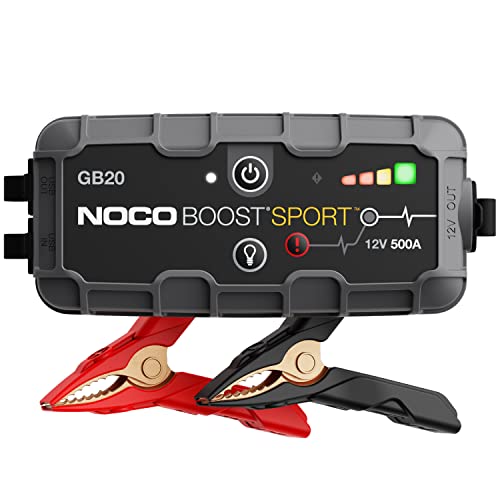
Motorcycle owners have a storage problem car owners do not: every cubic inch of luggage counts, and a full-size jump pack is simply left at home, where it helps nobody. The GB20 solves that by shrinking the formula to a stated 500 amps and 4.0-liter gasoline ceiling, which is still far more than any motorcycle, ATV, side-by-side, or small hatchback needs to crank. It keeps the same spark-proof and reverse-polarity protections as its bigger siblings, which matters even more on a bike, where battery terminals are small, close together, and often awkward to reach.
Strengths
- Genuinely miniature; fits motorcycle luggage, ATV storage, and small gloveboxes
- Same core safety protections as the larger NOCO packs
- Ample stated output for motorcycles, powersports, and compact cars
Trade-offs
- Stated ceiling of 4.0L gasoline excludes larger V6 and V8 family vehicles
- Not the pack to lend to a neighbor with a big SUV
- Small size means a smaller reserve for repeated jump attempts
Key specs
- Stated peak output: 500 amps (manufacturer’s stated rating)
- Stated engine coverage: Up to 4.0L gasoline
- Protections: Spark-proof connection, reverse-polarity protection
- Vehicle types (stated): Car, truck, motorcycle, SUV, boat, ATV, RV
Think of the GB20 as the specialist of this list. For a rider, a boat owner with a small outboard, or a household whose largest engine is a four-cylinder, it delivers the essential rescue with the least bulk and the least cost in the NOCO line. The mistake would be buying it as a household’s only pack when a larger vehicle also lives in the driveway; in that case step up to the GB40 and accept the extra size. Matched to the right fleet, though, the GB20 is the pack most likely to actually be with you when the battery gives up, and that is the only metric that counts at the roadside.
Best for: Motorcycles, ATVs, boats with small engines, and compact-car owners / Not suited for: Households whose only pack must also cover a large SUV or V8 truck

AstroAI S8 — Best Budget
Budget jump packs live or die on trust, because a cheap pack that fails once is worse than no pack at all. The S8 earns its place here by pairing a sensible stated specification, 1,500 peak amps with coverage to 6.0 liters of gasoline and 3.0 liters of diesel, with the features that matter in practice: smart clamps with protection logic, a proper three-mode flashlight for night work, and power-bank output for a phone. The orange housing sounds trivial until you are searching a cluttered trunk by phone light at midnight.
Strengths
- Strong stated coverage for the budget tier, matching mid-size cars and SUVs
- Bright, easy-to-find housing and a genuinely useful 3-mode light
- Smart clamps and power-bank output included rather than sold as extras
Trade-offs
- Brand support and long-term parts availability are thinner than NOCO’s
- Printed peak-amp figures in this tier should be treated as optimistic
- Finish and clamp feel are a step below the premium picks
Key specs
- Stated peak output: 1,500 amps (manufacturer’s stated rating)
- Stated engine coverage: Up to 6.0L gasoline, 3.0L diesel
- Extras (stated): 3-mode flashlight, power bank function, smart jumper cables
- Color: Orange housing for visibility
The honest way to frame the S8 is as the pack for a second car, a new driver, or a tight budget where the alternative is no pack at all. Test it when it arrives, keep it charged on a calendar reminder like any lithium pack, and it will very likely do its one job the one morning you need it. Buyers who want the deepest safety engineering and the longest track record should still pay for the GB40, but the S8 narrows that gap more than its price suggests, and for a spare pack in a teenager’s first car it is arguably the smartest money in this guide.
Best for: Second cars, new drivers, and budget-conscious buyers who still want stated coverage for mid-size engines / Not suited for: Buyers who prioritize brand support and premium build over value

GOOLOO GP2000 — Best Lightweight Power
The GP2000’s party trick is how little of it there is. At a stated 1.2 pounds it is closer to a large phone than to a traditional booster, yet GOOLOO rates it for engines well beyond mini-pack territory. Treat the biggest engine figures with the usual skepticism that applies to every brand’s ceiling claims, but for ordinary V6 and V8 cars the reserve here is generous. The feature that genuinely matters is BOOST mode: when a battery is drained so deeply that a smart pack refuses to recognize it, a manual boost override lets you attempt the start anyway, with appropriate caution.
Strengths
- Very light and small for its stated output class
- BOOST override for deeply drained batteries that smart packs may reject
- Wide stated temperature range for a lithium mini pack
Trade-offs
- Ceiling engine claims are best read as optimistic, as with all brands
- Manual BOOST mode bypasses some protections, so it demands careful clamp placement
- Lightweight build feels less substantial than the NOCO packs
Key specs
- Stated peak output: 2,000 amps (manufacturer’s stated rating)
- Stated engine coverage: Up to 8.0L gasoline, 6.0L diesel
- Stated weight: 1.2 lb
- Stated operating range: -4°F to 140°F
This is the pick for drivers who want one small pack to cover a mixed household fleet, including a larger vehicle, without stepping up to a bulky unit. It is also a sensible choice for cold-climate drivers who like the idea of extra reserve, since cold is exactly when stated ratings shrink in the real world. Follow the manual’s caution around BOOST mode, keep the clamps clean and dry in storage, and the GP2000 covers more scenarios per ounce than anything else in this guide. If your vehicles are all small, its extra muscle is wasted; the GB20 or S8 will serve you for less.
Best for: Mixed fleets and larger engines where you still want a truly mini, light pack / Not suited for: Buyers uncomfortable using a manual boost override on a fully dead battery

NOCO Boost GBX45 — Best Fast-Charge
Every jump-pack owner eventually meets the second failure mode: the car battery is fine to rescue, but the rescue pack has sat so long that it needs charging first, and an old slow-charging pack can take most of a day to recover. The GBX generation exists to fix that, pairing USB-C input with much faster turnaround, so a forgotten pack found flat in the morning can be usefully charged over a coffee rather than overnight. The GBX45 wraps that convenience in the familiar NOCO safety package and slightly broader stated engine coverage than the GB40.
Strengths
- Fast USB-C recharge turns a forgotten, flat pack around quickly
- Stated coverage slightly exceeds the GB40 on both gasoline and diesel
- Same spark-proof, reverse-polarity safety foundation as the classic line
Trade-offs
- Premium pricing for what is, in starting terms, a close cousin of the GB40
- Fast charging needs a suitably capable USB-C supply to shine
- Still a mini pack; very large diesels remain out of scope
Key specs
- Stated peak output: 1,250 amps (manufacturer’s stated rating)
- Stated engine coverage: Up to 6.5L gasoline, 4.0L diesel
- Protections: Spark-proof connection, reverse-polarity protection
- Series: GBX line with USB-C charging (manufacturer’s line positioning)
Choose the GBX45 over the GB40 if your life is USB-C everything, if the pack will be shared between vehicles and therefore charged irregularly, or if you simply want the newest platform. Choose the GB40 if none of that applies and the price difference matters. In pure starting ability for ordinary cars the two are effectively interchangeable, which is why this guide treats recharge behavior, not amps, as the deciding factor between them. For commuters who cannot afford a slow morning, that faster recovery is a real, practical advantage rather than a spec-sheet ornament.
Best for: Commuters and shared-vehicle households who value fast USB-C recharging / Not suited for: Buyers who charge on a strict schedule and would rather save money with the GB40
NOCO Boost GB50 — Best for Larger Engines
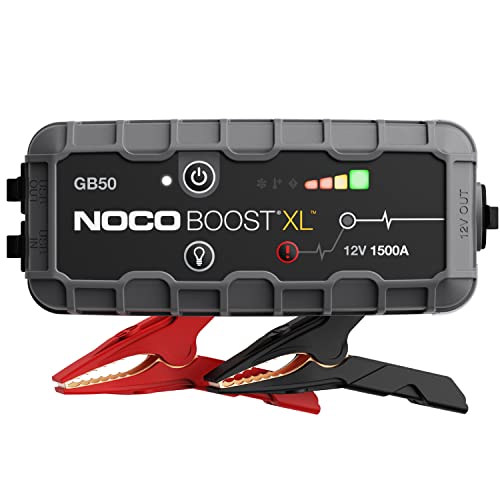
There is a ceiling to what ‘mini’ can honestly do, and the GB50 sits right at it. Its stated ratings cover the big gasoline V8s in full-size trucks and SUVs and reach into mid-size diesel territory, the engines that make smaller packs struggle on a cold morning. You pay for that headroom in size and price: this is the largest pack in this guide, and calling it glovebox-sized is generous for smaller cars. In a truck console or under a seat, though, it still disappears, and it remains dramatically more portable than any traditional booster.
Strengths
- Broadest stated coverage in the classic NOCO mini line
- Extra reserve that shows its worth in cold weather and on tired batteries
- Full safety package and power-bank utility retained
Trade-offs
- Largest and priciest of the classic mini packs here
- Still not a substitute for a shop booster on large or sick diesels
- Oversized for small cars and motorcycles, where its bulk buys nothing
Key specs
- Stated peak output: 1,500 amps (manufacturer’s stated rating)
- Stated engine coverage: Up to 7.0L gasoline, 4.5L diesel
- Protections: Spark-proof connection, reverse-polarity protection
- Vehicle types (stated): Car, truck, motorcycle, SUV, boat, ATV, RV
The GB50 is the right buy for the truck or large-SUV household that wants mini convenience without mini compromises, and for drivers in genuinely cold regions, where every pack’s real-world output drops and starting with headroom is the difference between driving away and calling for help. If your largest engine is a mid-size V6, the GB40 gives you the same ownership experience for less, so buy the headroom only if your fleet or your winters actually demand it. Judged on that basis, the GB50 is the strongest classic mini pack in this guide.
Best for: Full-size trucks, large SUVs, and cold-climate drivers who want maximum mini-pack reserve / Not suited for: Small-car and motorcycle owners paying for capacity they will never use
Comparison Table
Use this table to compare the six packs at a glance. Engine coverage figures are the manufacturers’ stated ratings from the verified listings; treat them as ceilings for a healthy battery in mild weather, not guarantees for a frozen diesel.
| Pick | Badge | Key spec | Best for |
|---|---|---|---|
| NOCO Boost GB40 | Best Overall | Stated 1,000A; up to 6.0L gas / 3.0L diesel | Most car, crossover, and SUV owners who want one dependable glovebox pack |
| NOCO Boost GB20 | Best for Motorcycles and Small Cars | Stated 500A; up to 4.0L gas | Motorcycles, ATVs, boats with small engines, and compact-car owners |
| AstroAI S8 | Best Budget | Stated 1,500A; up to 6.0L gas / 3.0L diesel | Second cars, new drivers, and budget-conscious buyers who still want stated coverage for mid-size engines |
| GOOLOO GP2000 | Best Lightweight Power | Stated 2,000A; up to 8.0L gas / 6.0L diesel; 1.2 lb stated | Mixed fleets and larger engines where you still want a truly mini, light pack |
| NOCO Boost GBX45 | Best Fast-Charge | Stated 1,250A; up to 6.5L gas / 4.0L diesel; USB-C line | Commuters and shared-vehicle households who value fast USB-C recharging |
| NOCO Boost GB50 | Best for Larger Engines | Stated 1,500A; up to 7.0L gas / 4.5L diesel | Full-size trucks, large SUVs, and cold-climate drivers who want maximum mini-pack reserve |
How to Choose a 12 Volt Mini Jump Starter
Start with your largest engine, not your favorite car. A jump pack must be sized for the biggest engine it may ever need to start, including a partner’s vehicle or a family member’s SUV you might rescue. Manufacturers state coverage as a maximum engine displacement for gasoline and a smaller one for diesel, because diesels need far more cranking effort. Buy with honest headroom: if your engine sits at the very top of a pack’s stated range, that pack will likely still work on a mild day with a healthy battery, but winter and an aging battery eat margin fast. Stepping one size up is cheap insurance.
Gasoline versus diesel, and why the diesel number is always smaller
Diesel engines use much higher compression and glow-plug loads, so they demand substantially more from a starter battery. That is why every pack in this guide lists two ceilings, and why a pack rated generously for gasoline may be marginal for even a mid-size diesel. If you own a diesel, shop by the diesel figure only, and be skeptical of any mini pack that promises to start the largest truck diesels; that job belongs to full-size boosters. Several packs here state diesel coverage in the 3.0 to 4.5-liter range, which suits diesel cars and smaller diesel SUVs rather than heavy-duty pickups.
Safety protections are not optional extras
The two protections to insist on are spark-proof connection and reverse-polarity protection. Together they mean the pack will not deliver current if the clamps are reversed or touching, which removes the two most common beginner errors from the equation. Every pick in this guide includes both. Beyond those, look for sturdy clamps with strong springs and cables long enough to reach both terminals without stretching; on many vehicles the ground point is not beside the battery, and a stretched cable is how clamps slip off at the critical moment.
Recharge speed and storage behavior decide whether it works in month nine
A jump pack is an insurance product, and insurance you forget to maintain is worthless. Lithium mini packs hold charge well, but they still self-discharge slowly and should be topped up on a schedule, typically a few times a year, and always after a use. Newer USB-C packs recharge far faster than older micro-USB designs, which makes the maintenance habit much easier to keep. Whichever pack you choose, put a recurring reminder in your calendar the day it arrives, store it inside the cabin rather than a freezing trunk when practical, and check its charge indicator whenever you check your tire pressures.
Budget tiers, in framing terms only
This guide prints no product prices, because they change too often to print honestly, but the tiers are stable. The budget tier buys you a competent rescue for small and mid-size cars with basic extras. The mid-range tier, where the GB40 sits, buys the best safety engineering, clamp quality, and support. The premium tier buys headroom for larger engines or much faster recharging. None of the tiers buys magic: no mini pack of any price will reliably start a large diesel with a truly dead battery in deep cold, and any listing that promises otherwise is marketing, not engineering.
Peak Amps, Cranking Amps, and Why the Big Number Lies a Little
Peak amps is the number on the front of the box, and it is the number least worth trusting across brands. It describes a brief maximum the pack can theoretically deliver, measured under conditions each manufacturer chooses for itself. Two packs with identical peak-amp claims can behave very differently on the same engine, and a lower-claimed pack from a conservative brand may outperform a higher-claimed pack from an optimistic one. That is why this guide leads with stated engine coverage instead: it is still a manufacturer’s claim, but it at least describes an outcome, starting a given size of engine, rather than an electrical instant.
Cranking performance in the real world depends on the battery’s internal health, the temperature, the thickness and length of the clamp cables, and how clean the connection is. Cold is the great equalizer. A lithium pack stored in a freezing car delivers less, at the exact moment the engine needs more, because cold oil is thick and a cold lead-acid battery is weak. This double squeeze is the practical argument for buying headroom and for storing the pack in the cabin. It is also why a pack that started your car easily in October deserves a recharge check before January, not after the first failure.
Finally, understand what a mini pack cannot diagnose. If your car needs a jump every week, the problem is a dying battery, a failing alternator, or a parasitic drain, and a jump pack is a bandage, not a cure. Use the pack to get moving, then have the charging system tested. Owners who treat repeated jumps as normal eventually meet the morning when the battery is too far gone for any mini pack, and that morning is never convenient.
Keeping a Lithium Pack Alive for Years, Not Months
A mini jump starter is mostly a battery waiting for an emergency, and batteries age whether you use them or not. The good news is that the aging is largely under your control. Lithium cells dislike two things above all: sitting completely full in high heat for months, and sitting completely empty at any temperature. Everyday ownership lands between those extremes if you follow a simple rhythm: keep the pack somewhere in the cabin rather than the trunk in summer, check its indicator a few times a year, and top it up after any use and whenever the indicator shows it has sagged. That rhythm, followed loosely, is worth more years of service than any feature on the box.
Heat deserves special emphasis because it is the silent killer in this category. A parked car’s trunk can reach temperatures that accelerate cell aging dramatically, and a pack that lives there can lose meaningful capacity in a couple of summers while appearing fine on its indicator. Under a seat or in a console is not just more convenient on the day you need the pack; it is measurably kinder to it every other day of the year. Cold, by contrast, mostly reduces output temporarily rather than causing permanent harm, which is another reason the cabin beats the trunk in winter as well: the pack starts the day closer to room temperature and delivers closer to its rated performance.
Finally, treat the clamps and cable as part of the battery system. A pack with corroded clamp jaws or a cable pinched by a seat rail will underperform no matter how healthy its cells are. Coil the cable loosely rather than folding it sharply, keep the jaws clean and dry, and store the pack in its case if it came with one. When the day comes that the pack struggles with an engine it used to start easily, believe it: capacity fade is real, replacement is the honest fix, and a tired pack demoted to phone-charging duty is a better outcome than a failed rescue at midnight.
One last ownership detail: write the purchase month on a small label on the case. When the pack is four or five years old, that label turns a vague feeling about its age into a decision you can actually make, and replacing a pack on your own schedule is always cheaper and calmer than replacing it after a failed start in an airport parking garage.
How to Use a Mini Jump Starter Safely, Step by Step
Using a mini jump starter is simple, but the order matters and the details below are the difference between a clean start and a confused one. Read your specific pack’s manual first, because button layouts differ, then follow this general sequence, which matches how the packs in this guide are designed to be used.
- Park safely, switch everything off: ignition, lights, heater, and accessories in the dead vehicle, and make sure the jump pack itself is switched off before connecting anything.
- Connect the pack’s clamps in the order the pack’s instructions state, typically red to the battery’s positive terminal first, then black to an unpainted metal ground point on the engine or chassis away from the battery, rather than directly to the negative terminal where the manual directs you to use a ground point.
- Switch the pack on and check its indicator. A solid ready light means the pack sees a valid connection; a flashing error or alarm usually means reversed clamps or a battery too deeply drained, so re-check placement before doing anything else.
- If your pack has a boost or override mode and the battery is too flat to be detected, use it only after double-checking clamp polarity by eye, because override modes bypass the automatic protection that normally guards that mistake.
- Start the vehicle. If it does not start within a few seconds of cranking, stop, wait a minute for the pack and starter to cool, and try again. Repeated long cranking helps nobody and overheats both.
- Once the engine runs, switch the pack off and remove the clamps in reverse order, black ground clamp first, then red, keeping the clamp jaws from touching each other or painted surfaces as you stow them.
- Drive the vehicle for a proper run, at least twenty to thirty minutes, or connect a battery charger at home, because idling for two minutes does not replace the charge a start consumed. Then recharge the jump pack itself at the first opportunity.
Two habits separate owners whose packs work from owners whose packs disappoint. First, rehearse once in daylight: connect the pack to your healthy car, find the terminals and a good ground point, and learn the indicator lights before you ever need them in the dark. Second, maintain the pack like the emergency tool it is: a charge check every few months, a recharge after every use, and storage out of extreme heat, which ages lithium cells faster than cold does. A mini jump starter asks for about five minutes of attention a year; give it that, and it will give you back the one morning that matters.
Common Buying Mistakes
Buying by peak amps alone. The biggest printed number is the weakest comparison in this category. Compare stated engine coverage, protections, and recharge behavior instead, and treat any brand that leads with an enormous amp figure and nothing else as a warning sign.
Sizing the pack to your smallest car. The pack must cover the largest engine it may need to start. A motorcycle-sized pack kept in a household with a V8 SUV is a rescue tool for exactly the vehicle that needs it least.
Leaving the pack uncharged for a year. Lithium packs hold charge well, not forever. A pack stored flat cannot rescue anything. Calendar reminders and a quick indicator check whenever you check tires prevent the most common failure in this entire category.
Clamping both leads straight onto a filthy battery. Corroded terminals and a rushed connection waste the pack’s output as heat. Clean the terminals when you buy the pack, learn where a proper ground point is on your engine, and seat the clamps fully before switching on.
Jumping the same car every week. Repeated jumps mean the battery, alternator, or a parasitic drain needs attention. The pack is for emergencies and diagnosis-free rescues, not a substitute for a healthy charging system.
Storing the pack in extreme heat. A summer trunk shortens lithium cell life faster than normal use ever will. Keep the pack in the cabin, in a console or under a seat, where temperatures stay closer to what the cells prefer.
Final Recommendation
If you only read one paragraph, read this one. For most drivers, the NOCO Boost GB40 is the best 12 volt mini jump starter to buy: right-sized for ordinary cars and SUVs, protected against the two classic connection mistakes, and built by the brand that defined this category. Riders and small-car owners should save money and space with the GB20. Budget buyers and second-car owners get remarkable value from the AstroAI S8. Drivers of larger vehicles who still want a genuinely small pack should look at the GOOLOO GP2000 for its weight and boost mode, or the GB50 for classic-line headroom, and anyone who hates slow recharging should pick the GBX45 and its fast USB-C turnaround.
Whichever pack you choose, the purchase is only half the job. Charge it fully the day it arrives, learn its indicators in daylight, set a recurring charge reminder, and store it in the cabin. Do those four small things and the best pack is simply the one that is in your car, charged, on the one morning your battery is not.
- NOCO Boost GB40 — Check price on Amazon
- NOCO Boost GB20 — Check price on Amazon
- AstroAI S8 — Check price on Amazon
Keep researching the rest of this 12-volt cluster here: Best 12 Volt Portable Car Jump Starter Best 12 Volt Monitor Best 12 Volt Motorcycle Battery Best 12 Volt Power Inverter Best 12 Volt Marine Battery Charger
Frequently Asked Questions
How long will a mini jump starter hold its charge in the car?
Lithium mini packs hold charge well for months at a time, but they do self-discharge slowly and lose a little capacity to age and temperature. The safe habit is to check the charge indicator every two to three months and top the pack up whenever it has dropped noticeably, and always after an actual jump. A pack checked on that schedule will be ready when you need it; a pack ignored for a year may not be.
Can a mini jump starter start a diesel?
Yes, within limits. Every pack in this guide states a separate, smaller diesel ceiling, roughly in the 3.0 to 4.5-liter range for the stronger models, because diesels need far more cranking effort than gasoline engines of the same size. That covers diesel cars and smaller diesel SUVs. Heavy-duty diesel pickups, especially in cold weather with a tired battery, are beyond honest mini-pack territory and need a full-size booster.
What does boost or override mode actually do?
Smart packs normally refuse to deliver power unless they detect a battery with at least a small amount of voltage, which protects you if the clamps are reversed. A battery drained completely flat can fall below that detection threshold, so boost mode lets you manually override the refusal and attempt the start. Because the automatic guard is off, you must verify clamp polarity carefully by eye before using it.
Will a jump pack damage my car’s electronics?
A quality pack with spark-proof and reverse-polarity protection is designed specifically to be safe for modern vehicle electronics, and all six picks here include those protections. The risks come from reversed connections, cheap unprotected packs, and repeatedly jump-starting a vehicle with a failing charging system. Follow the connection order in the manual and fix the underlying battery problem if jumps become frequent.
How many jumps should I expect from one charge?
It depends on the engine size, the battery’s condition, and the temperature, so any exact figure would be invented precision. In practical terms, a fully charged mini pack should handle several starts of an ordinary car before needing a recharge, fewer for large engines or in deep cold. Treat the first successful start as the signal to recharge the pack soon, not as proof it can do five more.
Can I fly with a mini jump starter?
Lithium jump packs are generally treated like large power banks by airlines: carry-on only, never in checked baggage, and subject to the airline’s watt-hour limits and approval rules, which vary. Many owners simply leave the pack in the car rather than travel with it. If you must fly with one, check your specific airline’s current rules for lithium battery devices before you pack, because policies change and airport staff have the final say.


