Disclosure: airfryerkitchensupply.com is reader-supported. When you buy through links on our site, we may earn an affiliate commission at no extra cost to you.
Where to buy
Every best 12 volt marine battery charger pick in this guide is sold on Amazon, and that is where we recommend buying: you can compare bank counts and amp ratings side by side, confirm the exact model number against the listing title, and check the current price on Amazon before ordering. Onboard chargers are heavy, sealed electrical equipment, so buying through a channel with straightforward returns matters if the unit arrives damaged or turns out to be the wrong bank configuration for your battery layout.
- NOCO GENPRO10X1 — check price on Amazon
- NOCO GEN5X2 — check price on Amazon
- NOCO GENPRO10X2 — check price on Amazon
- ProMariner ProSport HD 12A — check price on Amazon
- Minn Kota Precision MK-440PCL — check price on Amazon
- ECO-Worthy 2-Bank Marine Charger 5X2 — check price on Amazon
Finding the best 12 volt marine battery charger for your boat comes down to one decision most buyers rush: how many batteries the charger has to maintain at the same time. A single starting battery on a small center console needs a very different unit from a bass boat running a starting battery plus a 24-volt or 36-volt trolling bank, and buying the wrong bank count is the most expensive mistake in this category because onboard chargers are hard-wired in place.
The good news is that the onboard marine charger market is mature and honest. The six chargers below cover one to four banks, from compact single-bank maintainers to a four-bank precision unit, and every one of them is a sealed, waterproof, permanently mounted charger designed to live in a bilge or battery compartment rather than a garage workbench. Portable clamp-style chargers have their place for winter storage, but they are not what this guide is about: an onboard charger is wired once, plugged into shore power at the dock or in the driveway, and then forgotten until the batteries need attention.
One honest note about the market before the picks. Cheap no-name onboard chargers exist, but the verified listings from established marine electrical brands — NOCO, Minn Kota and ProMariner — dominate this category for a reason: a charger that lives inches from your batteries, in a damp compartment, connected to shore power, is not the place to gamble on unknown electronics. The budget pick below is the one exception we were comfortable including, and we explain its trade-offs plainly.
In this guide
Quick Picks
Short on time? These are the six chargers we would shortlist for most boats, from a single-battery skiff to a four-bank tournament setup.
- Best Overall: NOCO GENPRO10X1 — a fully sealed, IP68-rated single-bank onboard charger with 10 amps of output, temperature compensation and profiles for both lead-acid and lithium batteries — the default choice for a one-battery boat. — Check on Amazon
- Best for Two-Battery Boats: NOCO GEN5X2 — two independent banks sharing 10 amps, in the same IP68-sealed housing style as its bigger siblings — the natural match for a starting battery plus one trolling or house battery. — Check on Amazon
- Best for Fast Turnaround: NOCO GENPRO10X2 — the two-bank charger for people who fish hard on consecutive days — a full 10 amps per bank, 20 amps total, with the same IP68 sealing and temperature compensation as the rest of the GENPRO line. — Check on Amazon
- Best Value Two-Bank: ProMariner ProSport HD 12A — a 12-amp, two-bank charger with distributed-on-demand output and an unusually wide chemistry menu — lithium, flooded, AGM and gel — at a friendlier price than the premium NOCO units. — Check on Amazon
- Best for Multi-Bank Trolling Setups: Minn Kota Precision MK-440PCL — four banks at 10 amps each — the charger for a starting battery plus a 36-volt trolling system, from the company that builds the trolling motors those batteries feed. — Check on Amazon
- Best Budget: ECO-Worthy 2-Bank Marine Charger 5X2 — the budget route to two-bank onboard charging — 5 amps per bank, IP68 sealing on paper, and an activate-and-repair mode for tired lead-acid batteries, at a fraction of the premium brands’ prices. — Check on Amazon
How These Picks Were Chosen
We chose these chargers the way a marine electrician would spec them: by bank count first, per-bank amps second, and sealing third. Bank count has to match the number of individual 12-volt batteries in the boat, because every battery deserves its own charging profile. Per-bank amps decide turnaround time. Sealing — the IP rating — decides whether the charger survives the compartment you actually have, rather than the dry, ventilated one you wish you had.
Every charger in this guide was verified against the manufacturer listings available through Amazon’s Creators API data for this site, and the specifications quoted in the spec boxes come from those listing titles, not from memory or third-party roundups. Where a listing did not state a figure, we left it out rather than guessing. We also excluded portable clamp-on chargers entirely: they are a different product category, useful for storage and workshop duty, but they are not marine onboard chargers and they do not belong in a bilge.
Chemistry support was the final filter. A modern onboard charger must handle the battery you own today and the one you are likely to buy next, so every pick here covers lead-acid, and most cover lithium as well. One pick, the ProMariner, additionally lists gel support, which is increasingly rare and genuinely valuable for cruising boats with older house banks.
- Bank count matched to the number of individual 12V batteries aboard
- Per-bank amps, not headline totals, used to judge charging speed
- IP67 or IP68 waterproof sealing required for onboard mounting
- Verified listing specifications only — no guessed figures
- Lead-acid support mandatory; lithium support strongly preferred
The 6 Best 12 Volt Marine Battery Chargers
Below, each charger gets the same treatment: who it suits, three strengths, three honest trade-offs, a spec box limited to verified listing data, and a plain verdict. Read the verdicts first if you are in a hurry — they are written to be enough on their own.

NOCO GENPRO10X1 — Best Overall
The GENPRO10X1 is the charger we would bolt into most single-battery boats without a second thought. It delivers a full 10 amps to one 12-volt battery, which is enough to recover a deeply discharged starting or house battery overnight rather than over a weekend, and its sealed housing carries an IP68 waterproof rating, the strongest sealing figure among the chargers in this guide. If your boat has exactly one battery and you want the fit-and-forget option, this is it.
Strengths
- IP68 waterproof sealing suits wet bilge and compartment mounting
- Full 10-amp output recovers a discharged battery far faster than a small maintainer
- Temperature compensation adjusts charging for hot compartments and cold mornings
Trade-offs
- One bank only — adding a trolling battery later means adding a second charger
- Costs more per bank than multi-bank units if your layout grows
- Fixed mounting means it stays with the boat, not the workbench
| Banks | 1 bank, 10 amps total |
| Output | 12V, 10A |
| Sealing | IP68 waterproof |
| Battery types | Lead-acid and lithium (per API listing title) |
| Protection | Overcharge protection, temperature compensation |
Ten amps is the output figure that separates a real charger from a maintainer, and it matters in a specific, practical way: a 100 amp-hour battery pulled down to half charge needs roughly five hours of bulk charging at 10 amps before the absorption stage even begins, while a 2-amp maintainer would need more than a day. For a boat that fishes Saturday and Sunday and charges in between, that difference decides whether the battery starts the week full or chronically undercharged — and chronic undercharging is what quietly shortens lead-acid battery life.
The temperature compensation deserves more attention than it usually gets. Battery compartments in the sun can run far hotter than the weather outside, and a charger that keeps pushing a fixed voltage into a hot battery accelerates water loss in flooded cells and stress in sealed ones. A compensated charger backs the voltage off as temperature rises and raises it in the cold, which is exactly the behavior you want from equipment that charges unattended for months at a time.
Best for: single-battery boats that want the fastest, best-sealed onboard charger / Not suited for: boats with a separate trolling bank that need multi-bank charging
Check on Amazon — check the current price on Amazon before ordering, and confirm the listing matches the model described here.

NOCO GEN5X2 — Best for Two-Battery Boats
The GEN5X2 is built for the most common two-battery layout afloat: one starting battery and one deep-cycle battery, each wired to its own bank so each gets its own charging profile. Total output is 10 amps shared across the two banks, which is a maintainer-plus pace rather than a rapid-recovery pace, and that shapes who this charger suits: boats that sit on shore power between trips and simply need both batteries kept full, healthy and ready.
Strengths
- Two truly independent banks, so a starting and a deep-cycle battery charge on separate profiles
- IP68 sealing matches the best in this guide
- Lead-acid and lithium profiles cover a future battery upgrade without replacing the charger
Trade-offs
- 10 amps total means slower recovery of a big, deeply discharged trolling battery
- Two banks will not cover a 24V trolling setup plus a starting battery
- Per-bank output is modest next to the GENPRO10X2 below
| Banks | 2 banks, 10 amps total |
| Output | 12V, 10A combined |
| Sealing | IP68 waterproof |
| Battery types | Lead-acid and lithium (per API listing title) |
| Protection | Overcharge protection, temperature compensation |
Independent banks are the detail to understand here. Chargers that simply split one output across two batteries force both batteries to accept the same voltage at the same time, which is a poor compromise when one battery is a cranking battery that barely discharged and the other is a deep-cycle battery pulled down by a day of trolling. Independent banks let the charger finish the full battery and float it while still working on the empty one, and that is the difference between a battery bank that lasts five seasons and one that fades in three.
Where the GEN5X2 asks for compromise is pace. Five amps per battery is fine for overnight and between-trip charging, and it is genuinely all most weekend boats need. But if you fish two hard days in a row and need a big trolling battery turned around by morning, look at the GENPRO10X2 instead — it doubles the per-bank muscle for exactly that job.
Best for: starting-plus-house or starting-plus-trolling layouts on shore power between trips / Not suited for: anglers who must fully recharge a large trolling bank overnight, every night
Check on Amazon — check the current price on Amazon before ordering, and confirm the listing matches the model described here.

NOCO GENPRO10X2 — Best for Fast Turnaround
The GENPRO10X2 exists for one scenario: you come off the water with two tired batteries and you need both of them genuinely full by tomorrow morning. With 10 amps available to each bank — 20 amps in total — it charges at twice the pace of the GEN5X2 above, and it keeps the IP68 waterproof housing and temperature-compensated charging that make the GENPRO series easy to recommend for permanently mounted use.
Strengths
- 10 amps per bank doubles recovery speed versus shared-output two-bank chargers
- IP68 sealing for exposed or damp mounting locations
- Handles lead-acid and lithium banks, including mixed future upgrades
Trade-offs
- Priced at the premium end of the two-bank class
- Still only two banks — 36V trolling systems need a three-bank unit
- Faster charging is wasted on boats that sit plugged in all week anyway
| Banks | 2 banks, 10 amps per bank |
| Output | 12V, 20A total |
| Sealing | IP68 waterproof |
| Battery types | Lead-acid and lithium (per API listing title) |
| Protection | Overcharge protection, temperature compensation |
Think of per-bank amps as the honest specification of an onboard charger. Marketing totals blur the picture: a “20-amp” charger might deliver 20 amps to one bank or split 10 and 10, and those are very different tools. The GENPRO10X2 is explicit — each bank is a full 10-amp charger in its own right — which is why it can take a pair of group 27 or group 31 deep-cycle batteries from a hard day of trolling to full during a normal night on shore power.
It is also the right pick for lithium conversions. Lithium trolling batteries accept charge quickly and benefit from a charger that can actually feed them at pace, and a profile-matched 10-amp bank does that without the long, slow tail that a small maintainer imposes. If you are planning a lithium upgrade next season, buying this charger now means the charging side of the upgrade is already done.
Best for: tournament and multi-day anglers running two batteries hard / Not suited for: boats that stay on shore power for days between trips and never need speed
Check on Amazon — check the current price on Amazon before ordering, and confirm the listing matches the model described here.

ProMariner ProSport HD 12A — Best Value Two-Bank
ProMariner has built marine chargers for decades, and the ProSport HD is its mainstream two-bank answer: 12 amps across two banks, an IP67 waterproof housing, and a charging system that distributes output on demand, sending more current to the battery that needs it instead of splitting the total evenly by default. Its chemistry support is the broadest in this guide — the listing explicitly covers lithium, flooded, AGM and gel batteries — which makes it the natural pick for mixed or older battery banks.
Strengths
- Distributed-on-demand output favors the emptier battery automatically
- Widest chemistry support here: lithium, flooded, AGM and gel
- LED status display makes at-a-glance checks easy in a dark compartment
Trade-offs
- IP67 sealing is a step below the IP68 housings of the NOCO picks
- 12 amps total is shared, so dual deep discharges still charge slowly
- Design is functional rather than compact; check compartment space
| Banks | 2 banks, 12 amps total |
| Output | 12A with distributed-on-demand sharing |
| Sealing | IP67 waterproof |
| Battery types | Lithium, flooded, AGM and gel (per API listing title) |
| Display | LED status display |
Distributed-on-demand is a genuinely useful answer to the shared-output problem. On a typical trip the starting battery might come back nearly full while the house battery is half empty; a fixed-split charger wastes half its output trickling a battery that needs almost nothing. The ProSport HD instead steers its 12 amps toward the battery doing the work, then balances out as both approach full. For mixed-use boats — some starting, some house loads, some trolling — that flexibility is worth more than a slightly higher headline amp figure.
The gel compatibility deserves a specific mention because so few modern chargers still list it. Gel batteries need a gentler, lower-voltage profile than AGM, and charging one on an AGM profile shortens its life. If your boat still runs a gel house battery — and many cruising boats do — this is one of the few current onboard chargers whose listing explicitly says it can charge that battery correctly.
Best for: mixed-chemistry banks, including boats still running gel house batteries / Not suited for: buyers who want the strongest waterproof rating for a very wet mounting spot
Check on Amazon — check the current price on Amazon before ordering, and confirm the listing matches the model described here.

Minn Kota Precision MK-440PCL — Best for Multi-Bank Trolling Setups
When the battery count climbs to four — typically a starting battery plus three trolling batteries wired for a 36-volt motor — the charger choices narrow fast, and the MK-440PCL is the mainstream answer. Each of its four banks delivers 10 amps, so a full 36-volt trolling bank and the starting battery all recover at proper charger pace overnight, from one permanently mounted unit on one shore-power cord.
Strengths
- Four independent 10-amp banks cover a starting battery plus a 36V trolling bank
- Per-bank pace matches the fast-turnaround NOCO two-bank pick
- Purpose-built for trolling-motor boats by a trolling-motor manufacturer
Trade-offs
- The largest and heaviest class of charger here; plan the mounting space
- Overkill — in banks and in budget — for one- or two-battery boats
- Four sets of leads mean the most involved installation in this guide
| Banks | 4 banks, 10 amps each |
| Output | 40A total across banks |
| Application | On-board marine charger (per API listing title) |
Series-wired trolling banks create a charging trap that catches people out: three batteries wired in series for 36 volts must still be charged as three individual 12-volt batteries, each on its own bank, or charged with a dedicated 36-volt charger. A four-bank charger like this one handles the whole system — three banks for the trolling batteries, one for the starting battery — and keeps every battery individually profiled, which also makes a single failing battery visible instead of letting it drag the series string down silently.
Installation effort is the honest cost. Four banks mean four fused lead sets to route, secure and protect from chafe, plus a mounting location with enough airflow and enough flat surface for a large housing. Budget a proper afternoon for the install, use the opportunity to inspect every battery terminal and cable in the system, and the result is a charging setup you will not think about again for years.
Best for: 36V trolling systems plus a starting battery — four batteries, one charger / Not suited for: simple one- or two-battery boats, where it is wasted capacity
Check on Amazon — check the current price on Amazon before ordering, and confirm the listing matches the model described here.
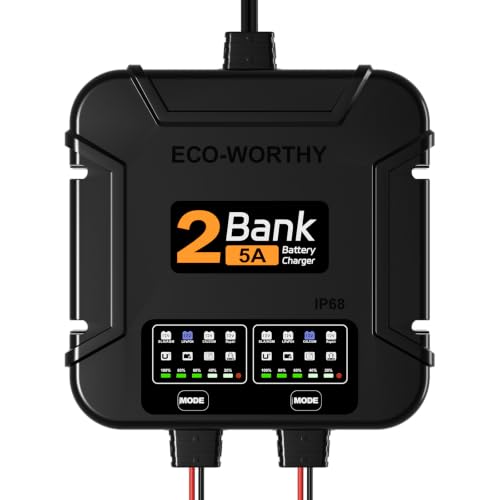
ECO-Worthy 2-Bank Marine Charger 5X2 — Best Budget
Not every boat justifies a premium charger, and the ECO-Worthy 5X2 is the honest budget option: two banks at 5 amps each, a claimed IP68 waterproof housing, support for lead-acid and lithium batteries, and a repair mode intended to wake up and condition neglected lead-acid batteries. For a jon boat, a small skiff, or a second boat that fishes a few weekends a year, that specification covers the actual job — keeping two batteries full between trips — without paying for speed you will never use.
Strengths
- Lowest-cost way into true two-bank onboard charging in this guide
- 5 amps per bank is adequate for between-trip maintenance charging
- Repair mode may help recover a neglected lead-acid battery
Trade-offs
- 5 amps per bank is slow after a genuinely deep discharge
- Long-term durability is less proven than NOCO, Minn Kota or ProMariner
- Support and documentation are thinner than the established marine brands
| Banks | 2 banks, 5 amps per bank |
| Output | 12V, 10A total |
| Sealing | IP68 waterproof (per API listing title) |
| Battery types | Lead-acid and lithium (per API listing title) |
| Modes | Activate and repair mode for lead-acid |
The right way to judge this charger is by duty cycle. If your boat plugs in on Sunday evening and unplugs on Saturday morning, five amps per bank has roughly 130 hours to do its work — far more than any battery needs — and the premium chargers’ extra speed buys you literally nothing. The math flips only when turnaround time shrinks: a guide boat or a multi-day trip with one overnight charge window is where 5-amp banks start to feel thin.
The repair mode should be treated as a bonus, not a resurrection promise. Pulse-style repair cycles can help a sulfated battery accept charge again, and on a battery that sat flat over winter that is worth trying before buying a replacement. But a battery with a shorted cell or shed plates is done regardless of what any charger claims, so set expectations accordingly and load-test the battery after any repair cycle before trusting it on the water.
Best for: budget two-battery boats with long plugged-in time between trips / Not suited for: daily-use or guide boats that need fast, proven, high-output charging
Check on Amazon — check the current price on Amazon before ordering, and confirm the listing matches the model described here.
Comparison Table
| Pick | Badge | Key spec | Best for |
|---|---|---|---|
| NOCO GENPRO10X1 | Best Overall | 1 bank, 10A, IP68 waterproof | One-battery boats |
| NOCO GEN5X2 | Best for Two-Battery Boats | 2 banks, 10A total, IP68 | Two-battery weekend boats |
| NOCO GENPRO10X2 | Best for Fast Turnaround | 2 banks, 10A per bank, IP68 | Back-to-back fishing days |
| ProMariner ProSport HD 12A | Best Value Two-Bank | 2 banks, 12A, gel-compatible | Mixed and older battery banks |
| Minn Kota Precision MK-440PCL | Best for Multi-Bank Trolling Setups | 4 banks, 10A each | 36V trolling plus starting |
| ECO-Worthy 2-Bank Marine Charger 5X2 | Best Budget | 2 banks, 5A per bank, IP68 | Budget two-battery boats |
Two patterns in the table are worth internalizing. First, total amps mislead: the GEN5X2 and the ECO-Worthy both claim 10 amps total, but what reaches your battery is the per-bank figure. Second, bank count is destiny — no charger can be reconfigured later, so if a trolling-motor upgrade is even a possibility next season, buy the bank count for the boat you are about to own, not just the one in the driveway today.
How to Choose a 12 Volt Marine Battery Charger
Start with a battery census. Count every individual 12-volt battery on the boat: starting, house, and each battery in a series trolling string counts separately. That number is your minimum bank count, and it is non-negotiable — sharing one bank between two batteries in parallel works only when the batteries are identical, the same age, and always discharged together, which in practice means almost never.
Next, be honest about your charge window. If the boat lives on shore power or a driveway outlet for days at a time, 5 amps per bank maintains everything perfectly well. If you fish consecutive days with only overnight charging, you want 10 amps per bank. If the boat charges from a generator for a few hours at a remote camp, per-bank amps matter even more, because total energy delivered is amps multiplied by the hours you actually run the generator.
Finally, match chemistry profiles to your batteries and your plans. Flooded, AGM and gel lead-acid batteries each want slightly different charging voltages, and lithium batteries want a distinctly different profile again. A charger that lists your exact chemistry — as the ProMariner does for gel, unusually — will treat that battery measurably better over a full season than a one-profile-fits-all unit.
- Count batteries first; that number is your bank count
- Judge speed by amps per bank, not the total on the box
- Match the charger’s chemistry profiles to your actual batteries
- Choose IP67 or IP68 sealing for any compartment that gets damp
- Buy one bank count up if a trolling upgrade is planned
Onboard vs Portable Chargers: Which Belongs on a Boat?
Portable chargers with battery clamps are workshop tools. They are excellent for winter storage, for reviving a battery on a bench, and for households with several vehicles — but on a boat they mean opening compartments, clipping onto terminals, and running a cord across the deck every single time, which in practice means it happens less and less often until the battery quietly dies of neglect.
An onboard charger removes the friction entirely. It is mounted once, wired to each battery once, and from then on charging is a single shore-power plug. That convenience is not laziness; it is the mechanism by which batteries actually get maintained. Every pick in this guide is an onboard unit for exactly that reason, and the modest installation effort pays for itself the first winter your batteries come through storage fully charged instead of sulfated.
What Do IP67 and IP68 Ratings Mean for a Charger?
The IP code rates how well a sealed enclosure keeps out dust and water. The first digit covers solids; the second covers liquids. IP67 means the unit can survive temporary immersion — typically up to a metre of water for a short period — while IP68 means it is rated for longer or deeper immersion under conditions the manufacturer specifies. For a charger, both ratings mean the electronics live in a sealed, usually potted housing with no fan openings for spray to enter.
In practice, either rating is plenty for a battery compartment, a center-console interior, or under-gunwale mounting. IP68 buys extra margin for genuinely wet locations — open skiffs, compartments that take green water, or washdown-prone areas. What the rating does not cover is the wiring: connections, fuses and ring terminals still need marine-grade, sealed, adhesive-lined heat-shrink treatment, because the charger’s housing rating cannot protect a corroded crimp.
Charging Stages Explained: Bulk, Absorption and Float
Every smart charger in this guide runs the same fundamental program, and understanding it turns mysterious charger behavior into readable information. In the bulk stage the charger delivers its full current while battery voltage climbs steadily; this is the fast part of charging, and it restores the majority of capacity. When voltage reaches the chemistry’s target, the charger holds that voltage constant and lets current taper — the absorption stage — coaxing the last portion of charge into the plates slowly, because that final portion cannot be rushed without heat and damage.
Float follows: the charger drops to a lower maintenance voltage that exactly offsets the battery’s self-discharge, holding it full indefinitely without overcharging. This is the stage your batteries live in all winter, and its voltage accuracy is what separates a maintainer from a battery cooker. Some chargers add further refinements — reconditioning pulses for sulfated lead-acid batteries, temperature-compensated adjustments of every stage, and periodic re-bulk cycles — but bulk, absorption and float are the skeleton everything hangs on.
Reading your charger’s stage indicators against this model is genuinely diagnostic. A bank that never leaves bulk has a battery that cannot accept a full charge — failing, sulfated or shorted. A bank that reaches float in minutes has either a tiny discharge or a battery whose capacity has quietly collapsed. The chargers in this guide report their stages precisely so that an observant owner catches a dying battery at the dock in May rather than on the water in July.
Shore Power Habits That Make Batteries Last
The charger is only half of the charging system; the other half is the habit of plugging in. Batteries discharged on Saturday and recharged on Saturday night live dramatically longer than identical batteries recharged “sometime before the next trip”, because lead-acid chemistry begins sulfating the moment it sits discharged and the sulfate hardens with every day of delay. The owners whose batteries last six seasons are not lucky — they are prompt.
Build the plug-in into the docking routine itself: shore cord connected before the boat is even fully secured, charger indicators glanced at as part of shutdown, cord removed last at departure. Add a monthly habit of confirming each bank reaches float, and an annual habit of cleaning terminals and checking cable condition at the charger, and the system in this guide will quietly do its work for years. The equipment is good; the routine is what makes it great.
Battery Types and Charger Profiles: A Quick Reference
Flooded lead-acid batteries — the kind with removable caps — want a robust charge and periodic equalization attention, and they reward owners who check water levels. AGM batteries want slightly different voltages and no aggressive equalization. Gel batteries, as our gel guide explains at length, want the gentlest profile of the lead family and are damaged by settings meant for the others. Lithium iron phosphate wants its own profile entirely: different absorption behavior, no float in the traditional sense on some designs, and protection against charging in freezing conditions.
The practical consequence for charger shopping is that the profile list is not fine print — it is the product. Every charger in this guide publishes its chemistry support in its listing, and matching that list to your bank, today and after your next battery purchase, is the decision that determines whether the charger serves for two battery generations or gets replaced with the next set of batteries. When in doubt, buy the charger whose profile list covers the battery you are dreaming about, not just the one bolted down today.
When to Replace a Charger Instead of Repairing the System Around It
Chargers fail slowly and then suddenly, and the slow phase is full of misleading symptoms. A bank that never quite reaches full, a battery that seems to age a year in a season, a charger that runs hot or cycles oddly — each gets blamed on the battery first, because batteries are the consumable. Before replacing a second battery in two seasons, suspect the charger: measure its output voltage at the battery during absorption and compare it with the chemistry’s requirement, and watch whether it ever settles into a true float. A charger stuck a few tenths of a volt high cooks batteries; one stuck low starves them, and both failures masquerade as battery problems.
Replacement is the right call when the charger cannot produce its rated profile, when its housing or cabling shows heat or water damage, or when the boat’s battery plan has outgrown its bank count or chemistry list. The picks in this guide cover every one of those upgrade paths — and because they are verified, current models, the replacement you install this season will still be the right charger two battery sets from now.
How to Install an Onboard Marine Battery Charger
Installing an onboard charger is a half-day job with basic tools, and it is well within reach of a careful boat owner. The principles are simple: mount the unit where air can move around it, keep leads short and protected, and fuse every positive lead near the battery. Work through these steps in order, and disconnect the shore-power cord before touching anything.
- Disconnect shore power and remove the negative cable from every battery first, so nothing can short while you work.
- Choose a mounting spot on a vertical surface near the batteries, with clearance around the housing for cooling air and with the status lights visible if possible.
- Mount the charger using stainless hardware; on fiberglass, back the screws with a plywood or starboard pad if the surface flexes.
- Route each bank’s leads to its own battery — positive to positive, negative to negative — keeping the factory fuse holder in each positive lead close to the battery end.
- Protect every run from chafe with loom or grommets where it passes through bulkheads, and secure cables so they cannot swing against sharp edges.
- Terminate with marine ring terminals and adhesive-lined heat shrink; never use bare automotive crimps in a bilge environment.
- Connect the charger’s AC input to the boat’s shore-power inlet if one exists, or route the cord so it can reach a dock or garage outlet without crossing walkways under tension.
- Reconnect battery negatives last, plug in, select the correct chemistry profile for each bank if the charger offers a choice, and confirm each bank shows a charging indicator.
- After the first full charge cycle, check that every battery rests at full charge and that no lead, fuse holder or terminal is warm to the touch.
One installation habit separates tidy boats from troubled ones: label each bank’s leads with the battery they serve — “starting”, “trolling front”, “trolling rear”. Two seasons from now, when a battery needs replacing at the dock, those labels will save you from the classic mistake of reconnecting a series trolling string incorrectly.
Common Buying Mistakes
Buying by total amps instead of per-bank amps. A charger advertised as 20 amps might give one battery 20 amps or two batteries 10 each — or quietly split 10 and 10 while claiming the bigger number. Always find the per-bank figure before comparing prices, because per-bank amps are what determine whether your trolling battery is full by morning.
Under-buying bank count. Chargers cannot grow. A two-bank unit bought today becomes scrap the season you add a second trolling battery for a 24-volt motor. If an upgrade is plausible, buy the extra bank now; it costs far less than replacing the whole charger later.
Charging a series string as one battery. Three batteries wired for a 36-volt trolling motor are three 12-volt batteries that each need their own bank or a dedicated high-voltage charger. Treating the string as a single battery guarantees imbalance, and imbalance guarantees one battery in the string dies early.
Ignoring chemistry profiles. Running a gel battery on an AGM profile, or a lithium battery on a basic flooded profile, shortens battery life in ways that only show up a season later. Match the profile to the battery, and re-check the setting every time a battery is replaced with a different chemistry.
Mounting the charger in a sealed, airless box. Waterproof housings still shed heat through their cases, and a charger entombed in an unventilated compartment will throttle or cook itself. Waterproof means spray cannot get in; it does not mean the unit wants to live in an oven.
Final Recommendation
For most boats, the recommendation is simple. One battery: the NOCO GENPRO10X1. Two batteries with relaxed charging time: the NOCO GEN5X2, or the ProMariner ProSport HD if your bank includes a gel battery or you want the value pick. Two batteries fished hard on back-to-back days: the NOCO GENPRO10X2. Four batteries behind a 36-volt trolling motor: the Minn Kota MK-440PCL. A tight budget and a small boat: the ECO-Worthy 5X2, bought with clear eyes about its pace and pedigree.
Whichever charger you choose, pair it with the right batteries and keep the whole system in mind: our companion guides cover Best 12 Volt Marine Battery For Trolling Motor, Best 12 Volt Marine Deep Cycle Battery and Best 12 Volt Marine Gel Cell Battery if your bank runs gel chemistry. The electrical system does not end at the charger, either — see Best 12 Volt Marine Fans for keeping the cabin comfortable on the power your bank stores, and Best 12 Volt Marine Tv for running entertainment straight off the 12-volt system.
If you are ready to buy, start with these three: NOCO GENPRO10X1, NOCO GEN5X2, NOCO GENPRO10X2. Each link goes to the exact model reviewed above — check the current price on Amazon and confirm the model name matches before ordering.
Frequently Asked Questions
How many amps do I need per bank?
Five amps per bank is enough for maintenance and between-trip charging when the boat stays plugged in for days. Ten amps per bank is the right figure when batteries must recover fully overnight, especially larger group 27 and group 31 deep-cycle batteries that were heavily discharged.
Can one charger handle both my starting battery and my trolling battery?
Yes, if it has at least two independent banks. Each battery gets its own bank and its own charging profile, which is exactly how the two-bank picks in this guide are designed to be used.
Can I leave an onboard marine charger plugged in all winter?
That is precisely what these chargers are designed for. A modern smart onboard charger finishes the charge cycle and then maintains the battery at a safe float level, compensating for temperature. It is far better for the battery than letting it sit discharged in the cold.
Do I need a different charger if I switch to lithium batteries?
You need a charger with a lithium profile. Most picks in this guide list lithium support in their specifications, including the NOCO and ECO-Worthy models; the ProMariner lists lithium alongside flooded, AGM and gel. Check the profile setting after any battery swap.
What does the IP rating on a marine charger actually protect against?
IP67 covers temporary immersion and IP68 covers longer immersion under manufacturer-specified conditions. Both mean a sealed housing that shrugs off spray, washdowns and damp compartments. Your wiring connections still need their own marine-grade sealing.
Why does my charger show one bank finished and another still charging?
That is independent banks working as intended. The fuller battery reached the end of its cycle first and moved to maintenance, while the emptier battery is still absorbing charge. It is only a concern if one bank never finishes, which usually points to a failing battery rather than a failing charger.


