Disclosure: airfryerkitchensupply.com is reader-supported. When you buy through links on our site, we may earn an affiliate commission at no extra cost to you.
Where to buy
Every pick in this guide to the best 12 volt dual car outlet options is sold on Amazon, and that is where we recommend buying. Before ordering, do one piece of arithmetic that decides whether any splitter will work in your car: add up the watts of everything you intend to run at once — dash cam, phone chargers, a GPS, a tyre inflator — and compare the total against both the splitter’s rating and your vehicle’s own outlet fuse rating, which is often the lower of the two. Every rating quoted below comes from the verified listing titles.
- SUPERONE 180W Cigarette Lighter Splitter (2-Socket, PD USB-C) — Best Overall: Check the current price on Amazon
- JOYROOM 7-in-1 Cigarette Lighter Splitter (225W, 2-Socket) — Best for Fast Charging: Check the current price on Amazon
- BESTEK 150W 2-Socket Cigarette Lighter Splitter with Cord — Best with Extension Cord: Check the current price on Amazon
- 2-Socket Cigarette Lighter Splitter with LED Voltage Display and Switch — Best with Voltage Display and Switch: Check the current price on Amazon
- Ankuee 12V/24V Cigarette Lighter Splitter with USB-C and Voltmeter — Best Compact with Voltmeter: Check the current price on Amazon
- YANTU Cigarette Lighter Splitter (150W, 3-Sockets) — Best Step-Up to Three Sockets: Check the current price on Amazon
What “dual car outlet” means in this guide: a splitter that turns one 12 volt cigarette lighter socket into two full 12 volt sockets, usually with USB charging ports alongside. That is different from a plain USB car charger, which gives you no 12 volt sockets at all, and from an inverter, which makes household AC power. Every pick below provides two genuine 12 volt sockets — except the final pick, a three-socket step-up included honestly for buyers whose device count has already outgrown two.
Introduction
If you are shopping for the best 12 volt dual car outlet, your car has the most common modern problem: one socket and four things that want it. The dash cam lives there permanently. The phone needs charging on any trip longer than an hour. The GPS, the passenger’s phone, the tyre inflator and the kids’ devices all queue behind them. A dual outlet splitter ends the queue by turning one socket into two real 12 volt outlets plus USB charging — and the good ones add the safety and information features, from voltage displays to independent switches, that make the extra power manageable.
The verified market is more varied than the humble product suggests. Ratings run from 150W to 225W in these listings. Some splitters are compact plugs that sit flush in the console; others run the sockets out on a cord so they can live where the devices are. USB sections range from simple dual ports to fast-charging arrays with USB-C Power Delivery that can charge a modern phone at full speed or even feed a laptop. This guide compares six verified picks across those designs and explains the fuse maths and heat habits that separate a splitter you trust from one you unplug nervously.
One safety framing before the picks, because it governs everything else in this guide: a splitter divides your car’s outlet capacity; it does not multiply it. The vehicle’s fuse decides the true ceiling, and two hungry devices can exceed it through the best splitter ever made. Buy the splitter for its sockets, switches and charging — and respect the arithmetic in the buying guide, and dual outlets are one of the cheapest quality-of-life upgrades a car can get.
In this guide
Quick Picks
Six verified splitters: five dual-socket models for five different priorities, plus one three-socket step-up. Badges match the full reviews exactly.
- SUPERONE 180W Cigarette Lighter Splitter (2-Socket, PD USB-C) — Best Overall. The balanced splitter: two 12 volt sockets, a stated 180W rating, USB-C Power Delivery and dual QC3.0 USB charging in the verified listing. Check the current price on Amazon
- JOYROOM 7-in-1 Cigarette Lighter Splitter (225W, 2-Socket) — Best for Fast Charging. The charging flagship: a stated 225W rating, two sockets, and a USB array of three QC3.0 ports plus PD36W and PD30W outputs in the verified listing. Check the current price on Amazon
- BESTEK 150W 2-Socket Cigarette Lighter Splitter with Cord — Best with Extension Cord. The flexible layout: two sockets and dual USB on a stated 26-inch cord, so the outlets live where the devices are instead of where the dashboard put them. Check the current price on Amazon
- 2-Socket Cigarette Lighter Splitter with LED Voltage Display and Switch — Best with Voltage Display and Switch. The informative splitter: two sockets, dual USB quick charging, an LED voltage display and an on/off switch in the verified listing — know your battery, control your loads. Check the current price on Amazon
- Ankuee 12V/24V Cigarette Lighter Splitter with USB-C and Voltmeter — Best Compact with Voltmeter. A compact dual-socket splitter with USB-C and an LED voltmeter display, rated for 12V and 24V vehicles in the verified listing — information without bulk. Check the current price on Amazon
- YANTU Cigarette Lighter Splitter (150W, 3-Sockets) — Best Step-Up to Three Sockets. The honest exception: three sockets and dual USB fast charging at a stated 150W, for cars whose device count has already defeated every dual outlet. Check the current price on Amazon
The short version: most drivers should buy the SUPERONE 180W, fast-charging households should take the JOYROOM 225W, and anyone who wants to see their battery voltage at a glance should take the splitter with the LED display.
How These Picks Were Chosen
These picks were chosen by verifying each listing and sorting on the facts that differentiate splitters: the total power rating stated in watts, the number of true 12 volt sockets, the USB charging specification (plain ports versus QC and USB-C PD fast charging, with stated wattages), and the practical extras — voltage displays, independent on/off switches, extension cords — that the listings confirm. Any adapter that offered USB ports but no additional 12 volt socket was excluded, however good a charger it was, because it does not answer this keyword.
The second filter was coverage of real use: a balanced all-rounder, a fast-charging flagship, a corded model for awkward consoles, a display-and-switch model for information and control, a compact voltmeter model, and a three-socket step-up for device-heavy cars. That spread mirrors the actual reasons people buy these adapters.
Finally, ratings honesty was checked across listings: the wattage figures quoted in this guide are the figures the listings themselves print, and the guide repeatedly reminds you that your vehicle’s fuse — commonly the tighter limit — governs what you can actually run. A splitter is a convenience and safety device, and it is reviewed as one.
What are the 6 best 12 volt dual car outlet picks?

SUPERONE 180W Cigarette Lighter Splitter (2-Socket, PD USB-C) — Best Overall
The SUPERONE 180W is the splitter most drivers should buy, because it balances the three jobs these adapters do. Two genuine 12 volt sockets handle the dash cam and the rotating cast of inflators, GPS units and heated accessories. A stated 180W total rating gives honest headroom for typical mixed loads. And the USB section — USB-C Power Delivery at a stated 20W alongside dual QC3.0 ports — charges modern phones at genuinely fast speeds rather than the token trickle of bargain adapters.
It is also the pick that ages best. Phone charging standards have settled around USB-C PD, so a splitter bought around it stays correct as phones change; the sockets stay correct as long as cars have dash cams. If your device list is the normal one — camera, two phones, occasional extras — this is the complete answer in one plug.
Strengths
- Two real sockets plus modern fast charging in one unit
- 180W stated rating suits typical mixed loads with headroom
- USB-C PD stated — full-speed charging for current phones
Trade-offs
- Compact plug format puts both sockets at the console, which can crowd chunky plugs
- No voltage display or independent socket switches in the verified title
- 180W is the splitter’s ceiling; your car’s fuse may set a lower one
| Sockets | 2-socket adapter, as stated in the verified listing title |
| Rating | 180W, as stated in the listing title |
| USB charging | PD USB-C with 20W USB-C and dual QC3.0, as stated in the listing title |
| Typical loads | GPS, dash cam, laptop, tablet and phones, per the listing title |
The detail to appreciate is the combination, not any single figure. Many splitters pair good sockets with feeble USB, or fast USB with one socket. This one refuses both compromises, which is why it anchors the guide: it is the splitter you recommend to a friend without a follow-up conversation about what it cannot do.
Use it with the guide’s one rule — add up your simultaneous watts — and it will simply disappear into the car’s routine, which is the highest praise available for an adapter. Devices charge, the camera records, and the socket shortage that sent you shopping stops existing.
Best for: Most drivers — a dash cam in one socket, a device in the other, and fast USB charging alongside / Not suited for: Running two high-draw 12 volt appliances at once; respect the vehicle fuse maths in the guide
Check the current price on Amazon
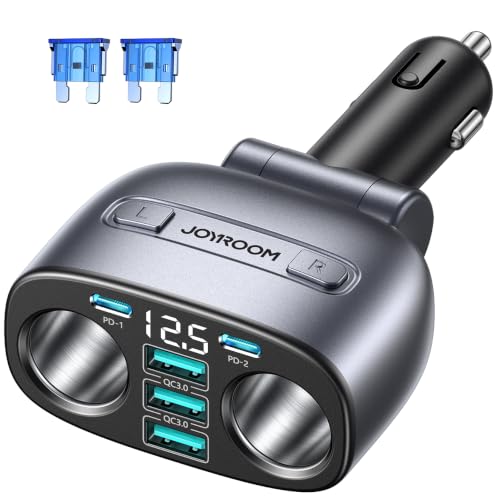
JOYROOM 7-in-1 Cigarette Lighter Splitter (225W, 2-Socket) — Best for Fast Charging
Some cars are not short of sockets so much as short of charging. The JOYROOM 7-in-1 answers that version of the problem: two 12 volt sockets for the socket devices, and the most complete USB fast-charging array in this guide — three QC3.0 ports stated at 30W, plus USB-C PD outputs stated at 36W and 30W — under a headline rating of 225W. Two phones, a tablet and a passenger’s device can all charge at speed simultaneously, which no other pick here attempts.
The PD36W output deserves a specific mention: it reaches into small-laptop and fast-tablet territory, turning the car into a genuine charging station on long drives. For families, rideshare drivers and anyone whose work bag charges from the car, this is the splitter that ends the charging rota.
Strengths
- The strongest USB fast-charging specification in this guide, port by port
- 225W stated headline rating is the highest here
- Two full sockets retained — charging did not eat the sockets
Trade-offs
- Most hardware and most heat in one plug; keep it ventilated and respect total-load maths
- Over-specified for drivers who charge one phone
- No voltage display stated in the verified title
| Sockets | 2-socket, as stated in the verified listing title |
| Rating | 225W, as stated in the listing title |
| USB charging | Three QC3.0 (30W) ports plus PD36W and PD30W outputs, as stated in the listing title |
| Format | 7-in-1 fast car charger adapter, per the listing title |
A necessary honesty note that applies to this pick most of all: the 225W headline is the adapter’s design rating, and your vehicle’s outlet fuse — frequently far lower — still governs what the car will actually supply. The JOYROOM’s real advantage is not that it repeals that limit but that its charging electronics divide power intelligently among many devices within it. Judge it as the best multi-device charger with sockets attached, and it has no rival here.
If your trips involve a driver phone, a passenger phone, a tablet for the back seat and a camera overhead, this is the one-plug answer. Everyone else can buy down the list with a clear conscience.
Best for: Families and heavy phone users who charge several devices at full speed at once / Not suited for: Minimalists — this is a lot of charging hardware for a one-phone car
Check the current price on Amazon

BESTEK 150W 2-Socket Cigarette Lighter Splitter with Cord — Best with Extension Cord
BESTEK has sold versions of this splitter for years, and the design explains itself the first time you use it: the plug goes into the dashboard, and the two sockets and dual USB ports arrive 26 inches away, wherever you actually need them — in the console bin, beside the seat, within reach of a passenger. For cars whose single socket hides behind the gear lever or inside a lidded cubby, that cord is not an accessory; it is the entire point.
The specification is deliberately honest: a stated 150W rating and dual 2.4A USB ports. That USB figure is standard-speed charging — fine for phones on a journey, GPS units and dash cams — without the fast-charge claims of the newer picks. BESTEK’s long presence in this exact product also counts for something in a category full of anonymous adapters: this is a known maker’s known design.
Strengths
- 26-inch cord relocates the sockets to where devices actually are
- Established maker with a long-running design in a category of clones
- Dual USB included for the phone-and-GPS basics
Trade-offs
- USB is standard-speed 2.4A — no fast charging
- 150W stated rating is the joint-lowest here; do the load maths
- A cord to route and tidy, where plug-style splitters have none
| Sockets | 2 sockets, as stated in the verified listing title |
| Rating | 150W, as stated in the listing title |
| USB charging | Dual 2.4A USB ports, as stated in the listing title |
| Cord | 26-inch cord, as stated in the listing title |
Choose this pick by geometry. Sit in your car and look at the socket: if a plug-style splitter would jam against trim, block a control or force chunky device plugs into a fistfight, the corded design wins before any specification is read. Ergonomics is a specification in a car, and this is the only pick that treats it as one.
The cord also quietly serves back-seat passengers better than any console plug: sockets and USB within their reach, cables short, no leads trailing from the dashboard. Families in larger vehicles should weigh that heavily.
Best for: Cars with awkward, recessed or crowded dashboard sockets, and anyone who wants the sockets within reach of the back seat / Not suited for: Fast-charge hunters — the USB here is honest standard-speed charging, not PD or QC
Check the current price on Amazon

2-Socket Cigarette Lighter Splitter with LED Voltage Display and Switch — Best with Voltage Display and Switch
This splitter adds the two features that turn an adapter into an instrument. The LED voltage display shows your vehicle’s electrical voltage continuously — which means, in practice, that you can see a weakening battery or a lazy alternator developing weeks before it strands you, and you can watch the voltage sag when heavy loads run. The on/off switch cuts the splitter’s loads without unplugging, ending the parasitic drain of devices that sip power while parked.
For older vehicles, project cars, and anyone who has ever come back to a flat battery, those two features are not garnish. The display is the cheapest battery monitor you will ever own, and the switch is the difference between a dash cam that records while parked by your choice and one that drains by default.
Strengths
- Voltage display doubles as an early-warning battery monitor
- On/off switch controls parasitic drain without unplugging
- Two sockets plus dual USB covers the standard device set
Trade-offs
- Total wattage is not stated in the verified title — check the listing and be conservative with loads
- The display is one more light in the cabin at night; placement matters
- Unbranded listing — inspect build expectations accordingly
| Sockets | 2 socket splitter, as stated in the verified listing title |
| Display | LED voltage display, as stated in the listing title |
| Control | On/off switch, as stated in the listing title |
| USB charging | Dual USB quick car charger adapter, per the listing title |
Learn the two numbers this display teaches and it pays for itself: the resting voltage of a healthy charged battery, and the higher voltage that shows the alternator charging while you drive. A morning reading that creeps downward week by week is a battery asking to be replaced on your schedule rather than its own — usually at an airport, in the rain.
Pair that awareness with the switch discipline — off when parked for days, on when driving — and this modest adapter becomes the most protective pick in the guide for the vehicle itself, not just for the devices plugged into it.
Best for: Drivers who want battery health at a glance and the ability to cut power without unplugging / Not suited for: Drivers who will never look at a voltage number — the SUPERONE serves them more simply
Check the current price on Amazon

Ankuee 12V/24V Cigarette Lighter Splitter with USB-C and Voltmeter — Best Compact with Voltmeter
The Ankuee splitter packages the modern essentials compactly: dual 12 volt sockets, USB-C charging, and an LED voltmeter, in a plug format that suits consoles where the bigger feature-led picks feel like clutter. Its verified listing also states 12V/24V compatibility, which quietly widens its world to the trucks and commercial vehicles that run 24 volt systems — a detail most splitters do not offer.
Against the display-and-switch pick above, the trade is clear: this one keeps the voltmeter and the USB-C but drops the switch, in a tidier body. If your parasitic-drain discipline is handled by the car or by habit, the Ankuee is the neater instrument.
Strengths
- Voltmeter and USB-C in a compact format
- 12V/24V stated compatibility covers trucks as well as cars
- Covers the canonical loads — phones, GPS, dash cameras — per the listing
Trade-offs
- No on/off switch stated
- Total wattage not stated in the verified title — keep loads modest and check the listing
- Less USB depth than the JOYROOM flagship
| Sockets | Dual-socket output, as stated in the verified listing title |
| Display | LED voltmeter display, as stated in the listing title |
| USB charging | USB-C, as stated in the listing title |
| Vehicles | 12V/24V, for phones, GPS units and dash cameras, per the listing title |
Compact splitters live or die by fit, and this one’s restraint is its virtue: it asks little console space, gives the two sockets the keyword promises, and adds the two modern touches — USB-C and a voltmeter — that drivers actually use weekly. In a small car, that restraint is the recommendation.
The 24V compatibility deserves its sentence: owners of larger trucks and imported commercial vehicles are routinely forgotten by accessory makers. A verified listing that states both voltages saves them the adapter roulette entirely.
Best for: Drivers who want a voltmeter and USB-C in a compact plug, including 24V vehicle owners / Not suited for: High-load users — no total wattage is stated in the verified title
Check the current price on Amazon

YANTU Cigarette Lighter Splitter (150W, 3-Sockets) — Best Step-Up to Three Sockets
This guide is about dual outlets, and five of its six picks are exactly that. The YANTU earns the sixth slot as the declared step-up: three 12 volt sockets plus dual USB fast charging at a stated 150W, for the minority of cars — work vehicles, family haulers with heated seats and throws, camera-and-GPS-and-radio setups — where two sockets are a ration, not a solution. Including it, clearly badged, is more honest than pretending the need does not exist.
The discipline matters more here than anywhere: three sockets invite three loads, and 150W divided three ways with a vehicle fuse behind it is a budget, not an invitation. The drivers who thrive with this splitter are the ones who read the buying guide’s arithmetic and run several light loads — cameras, GPS, chargers — rather than several heavy ones.
Strengths
- A third socket for genuinely device-heavy setups
- Dual USB fast charging included alongside
- Stated 150W rating keeps expectations honest
Trade-offs
- It is not a dual outlet — it is the step beyond this guide’s brief
- Three sockets make it easiest of all to exceed the vehicle fuse; discipline required
- LED ambient lighting is a matter of taste in a dark cabin
| Sockets | 3 sockets, as stated in the verified listing title |
| Rating | 150W, as stated in the listing title |
| USB charging | Dual USB fast charging, as stated in the listing title |
| Extras | LED ambient lighting, per the listing title |
If you are choosing between this and the SUPERONE, count your simultaneous socket devices on your worst day, not your average one. Two or fewer: buy the dual and enjoy the tidier console. Three, regularly: buy this, and budget your watts like fuel. The wrong answer is buying the triple “just in case” and running it carelessly — headroom you do not manage is not headroom.
YANTU’s inclusion also marks the boundary of the category’s sense. Beyond three sockets, the correct product is no longer a splitter but proper auxiliary power wiring, and the guide says so plainly in the mistakes section.
Best for: Device-heavy cars — camera, GPS, two heated accessories, work vehicles — that genuinely need a third socket / Not suited for: Anyone whose real load is two devices; the dual picks are tidier and this guide’s actual subject
Check the current price on Amazon
Comparison Table
Ratings and port specifications are reproduced from the verified listing titles. Where a listing does not state a wattage, the table says so — treat those picks as light-load adapters until the listing page tells you more.
| Pick | Badge | Key spec | Best for |
|---|---|---|---|
| SUPERONE 180W Cigarette Lighter Splitter (2-Socket, PD USB-C) | Best Overall | 2 sockets, 180W, 20W USB-C PD + dual QC3.0 (listing) | Most drivers — a dash cam in one socket, a device in the other, and fast USB charging alongside |
| JOYROOM 7-in-1 Cigarette Lighter Splitter (225W, 2-Socket) | Best for Fast Charging | 2 sockets, 225W, 3x QC3.0 + PD36W + PD30W (listing) | Families and heavy phone users who charge several devices at full speed at once |
| BESTEK 150W 2-Socket Cigarette Lighter Splitter with Cord | Best with Extension Cord | 2 sockets + dual 2.4A USB, 150W, 26-inch cord (listing) | Cars with awkward, recessed or crowded dashboard sockets, and anyone who wants the sockets within reach of the back seat |
| 2-Socket Cigarette Lighter Splitter with LED Voltage Display and Switch | Best with Voltage Display and Switch | 2 sockets, dual USB, LED voltage display, on/off switch (listing) | Drivers who want battery health at a glance and the ability to cut power without unplugging |
| Ankuee 12V/24V Cigarette Lighter Splitter with USB-C and Voltmeter | Best Compact with Voltmeter | Dual-socket, USB-C, LED voltmeter, 12V/24V (listing) | Drivers who want a voltmeter and USB-C in a compact plug, including 24V vehicle owners |
| YANTU Cigarette Lighter Splitter (150W, 3-Sockets) | Best Step-Up to Three Sockets | 3 sockets, 150W, dual USB fast charging (listing) | Device-heavy cars — camera, GPS, two heated accessories, work vehicles — that genuinely need a third socket |
The pattern: sockets are table stakes, so the real choices are charging speed (JOYROOM), information and control (the display picks), layout (BESTEK’s cord) and headroom (SUPERONE’s balance). Pick the axis your car actually lacks.
How to Choose the Best 12 Volt Dual Car Outlet for Your Devices
Do the wattage maths first, because it vetoes more purchases than any feature list. List every device you will run simultaneously and its watts: a dash cam sips a few watts, phone fast-charging takes tens, a tyre inflator or heated blanket can take well over a hundred. Add them. Your ceiling is the lower of the splitter’s rating and your vehicle’s outlet fuse — and the vehicle’s figure, found in the fuse box or manual, is commonly the binding one. A splitter rated 180W behind a modest car fuse is a 120W-class system in practice, and planning to that number keeps fuses intact and adapters cool.
Then choose your USB honestly. If your household charges phones on journeys, fast charging — USB-C PD or QC, with stated wattages like the SUPERONE and JOYROOM picks — is the difference between arriving charged and arriving hopeful. If the USB ports only feed a GPS and a camera, standard ports like the BESTEK’s are entirely sufficient and the money belongs elsewhere.
Finally, fit the format to the car. Plug-style splitters suit open, accessible sockets. Corded splitters suit recessed sockets, crowded consoles and back-seat service. Voltage displays suit older vehicles and careful owners; switches suit anyone whose devices drain while parked. The six picks were chosen so that each of those sentences names one — match your car’s sentence to its pick.
- Typical mixed loads: SUPERONE 180W.
- Many devices charging at speed: JOYROOM 225W.
- Awkward socket location: BESTEK corded.
- Battery awareness/control: display-and-switch pick; compact version: Ankuee.
- Three simultaneous socket devices: YANTU step-up.
Is a dual outlet splitter safe for your car?
Yes, within its arithmetic — and the arithmetic is the safety system. A splitter does not create power; it shares the outlet’s fused supply among more devices. Stay under the lower of the splitter rating and the vehicle fuse rating, and a quality splitter is as safe as the socket itself. Exceed it and the fuse does its job, which is annoying rather than dangerous — provided the fuse is the correct one and nobody has “upgraded” it, a genuinely dangerous old habit that defeats the car’s wiring protection.
Heat is the second safety signal, and it is yours to monitor. Any adapter running warm under a heavy sustained load is telling you the load is at its limit; hot, discoloured or smelling is a stop-now signal. Keep splitters ventilated rather than buried under coats, avoid running maximum loads for hours unattended, and unplug high-draw accessories when parked. The display-equipped picks add a third signal — voltage sag under load — which is why this guide rates them for older vehicles.
Buy quality in this category without apology. A splitter carries every device you plug into it, all day, in a hot car. Established makers, honest ratings and features like switches and displays are worth their modest premium over the cheapest anonymous plug, every time.
How should you budget for a dual car outlet?
This is one of the cheapest categories in the car, and the tiers are gentle: basic dual splitters at the accessible end, fast-charging and display models in the middle, and the charging flagship at the top — all of them modest next to the devices they power. Check price on Amazon for the models you shortlist rather than budgeting from any printed figure, and let your device list, not the tier ladder, choose.
The only real budgeting error here is buying twice: a bargain splitter that charges slowly and runs hot, replaced within the year by the one you should have bought. Given the sums involved, buy the pick that matches your devices the first time — it is the cheapest path even at the top of this small category.
What can you actually run at once? Three worked examples
The load arithmetic in this guide becomes real when it is attached to actual cars, so here are three honest examples. Example one, the commuter: a dash cam drawing a few watts, one phone fast-charging at the SUPERONE’s stated USB-C rate, and a GPS unit. The total is a small fraction of any vehicle’s outlet capacity, and every pick in this guide — including the models whose listings do not state a wattage — handles it indefinitely without warmth worth mentioning. This is most drivers, most days, and it is why compact splitters satisfy most buyers completely.
Example two, the family holiday: two phones fast-charging, a tablet charging from the JOYROOM-class USB array, a dash cam, and a 12 volt cool box running from the second socket. Now the total is a real number worth adding up before departure, the splitter should be one with an honest stated rating, and the driver should check the adapter’s warmth at the first fuel stop. This is the scenario the balanced and flagship picks were chosen for, and the one where a voltage display earns its place by showing the car’s electrical health under sustained load.
Example three, the roadside: a tyre inflator doing real work. Inflators are among the heaviest common 12 volt loads, and the correct pattern is inflator alone — phones paused, cool box unplugged, engine running to support the battery — for the few minutes the job takes. Run this way, even a modest splitter and a modest fuse cope. Run an inflator alongside a heated blanket and two fast chargers, and the fuse will deliver the verdict the arithmetic predicted. The examples share one moral: splitters fail socially, not electrically — they fail when everything is plugged in at once because nobody did the thirty-second sum.
What about running a splitter with the engine off?
You can, briefly and knowingly — and the knowingly is the whole answer. With the engine off, every watt comes from the starter battery, which is built for seconds of cranking rather than hours of accessory load. Charging phones for twenty minutes while you wait is harmless in a healthy car. Running a cool box, heated blankets or an inflator for an extended period is how healthy cars become no-start cars, and no splitter — however good its rating — changes that chemistry.
This is where the display-equipped picks repay their small premium in a second way: the voltage readout shows the battery’s decline in real time, turning an invisible risk into a number you can act on. Watch it fall toward the low end of the healthy resting range and start the engine or unplug. Owners of older vehicles, whose batteries live closer to the edge, should treat engine-off running as a measured activity rather than a default — the gauge makes that easy, which is precisely why this guide keeps recommending it.
How do you keep cables and plugs from becoming the weak point?
In long-term splitter use, the failures are almost never electronic; they are mechanical. Lighter plugs work loose under vibration until they arc at the contact, cables chafe where they cross seat rails and door shuts, and USB leads die at their strain reliefs after a year of being yanked from the back seat. A five-minute quarterly habit defeats all three: reseat every plug firmly, run a hand along each cable looking for pinched or worn spots, and replace any lead that feels hot at its connector under load. Route the permanent cables once, properly, with slack where seats move and clips where gravity pulls, and the splitter you bought for its electronics will be allowed to grow old on its merits rather than its wiring.
How to Install and Use a Dual Car Outlet Safely
A splitter takes thirty seconds to plug in and ten minutes to set up properly. The ten minutes are the ones that matter.
- Find your outlet’s fuse rating. Check the vehicle manual or fuse diagram for the accessory outlet circuit, and write the figure down — it is your true power ceiling.
- Total your simultaneous loads. Add the watts of everything that will run together, worst case, and confirm the total sits comfortably under that ceiling and the splitter’s rating.
- Seat the plug fully. A half-seated lighter plug arcs and heats. Push it home and confirm the splitter sits firmly; a corded model should be routed so it cannot pull loose.
- Assign the sockets deliberately. Permanent devices (dash cam) in one socket, rotating devices in the other; fast-charge cables in the USB ports that match them.
- Route cables out of harm’s way. No cables across the gear selector, pedals or airbag paths; no pinched leads in seat rails or doors.
- Set your parked behaviour. If your splitter has a switch, use it when parked for long periods; if not, know which devices drain while parked and unplug them.
- Check heat on the first long drive. After an hour at full typical load, touch the splitter. Warm is normal; hot means reduce the load.
For display models, add one habit: glance at the voltage weekly. A resting figure that trends downward, or a charging figure that sags, is your vehicle asking for attention while the asking is still cheap.
Common Buying Mistakes
Believing the splitter’s wattage is the car’s wattage. The vehicle fuse is usually the lower ceiling. A 225W splitter does not give a modest outlet 225W to give.
Running two heavy loads together. An inflator plus a heated blanket plus fast charging is how fuses blow at the roadside. Stagger heavy loads.
Upsizing the fuse. Never replace the outlet fuse with a higher rating to stop it blowing. The fuse protects the wiring; defeating it risks the car.
Ignoring parasitic drain. Devices sip power through a splitter while parked. Use the switch if you have one; unplug if you do not.
Buying USB-only and calling it an outlet. A USB charger adds no 12 volt sockets. If your devices plug into sockets, you need a splitter like the picks here.
Chaining splitters. A splitter in a splitter multiplies every risk in this section. Beyond three sockets, the answer is proper auxiliary wiring, not more adapters.
Final Recommendation
For most drivers, the SUPERONE 180W is the dual outlet to beat: two sockets, honest headroom and modern fast charging in one plug. Charging-heavy households should take the JOYROOM 225W; awkward consoles belong to the corded BESTEK; battery-conscious owners should choose between the display-and-switch splitter and the compact Ankuee voltmeter model; and genuinely device-heavy cars can step up to the YANTU’s third socket with their eyes open and their watts counted.
Whichever you choose, do the fuse arithmetic before the first journey, then check price on Amazon for the exact model you intend to order.
Keep researching the cluster: Best 12 Volt Dvd Player For Car Best 12 Volt Dual Zone Fridge Freezer Best 12 Volt Dsp Controller
Frequently Asked Questions
Will a dual outlet splitter drain my car battery?
The splitter itself draws negligible power, but the devices plugged into it may draw while parked — dash cams with parking mode are the usual culprit. If your vehicle’s outlet stays live when parked, use a splitter with an on/off switch, like one of the picks in this guide, or unplug loads during long parking. A voltage display model also lets you watch the battery’s state at a glance.
How many watts can I safely run from a car outlet splitter?
Stay under the lower of two numbers: the splitter’s stated rating and your vehicle’s outlet fuse rating, which you can find in the manual or fuse diagram. The vehicle figure is commonly the binding limit. Add up the watts of everything running simultaneously, keep a margin, and stagger heavy loads like inflators rather than running them together.
What is the difference between a splitter and a USB car charger?
A USB car charger only adds USB ports. A dual outlet splitter adds a second full 12 volt socket — which socket-powered devices like dash cams, GPS units, inflators and 12 volt fridges need — and usually includes USB charging as well. If any of your devices has a lighter plug rather than a USB cable, you need the splitter.
Can I run a 12 volt fridge from a dual outlet splitter?
Yes, if the maths allows it: a compressor fridge’s running draw is modest, but confirm the total with everything else running stays under your outlet’s fuse rating, and prefer a dedicated socket for the fridge on long trips. The dual zone fridge freezer guide in this series covers the fridges themselves; the splitter’s job is simply to give one a socket of its own.
Why does my splitter get warm?
Some warmth under sustained load is normal electrical behaviour; heat is the adapter telling you it is working near its limit. Reduce simultaneous loads, make sure the plug is fully seated and the splitter is ventilated, and stop using it if it becomes hot, discoloured or smells — those are replacement signals, not quirks.
Do I need a voltage display on a splitter?
It is optional for a new car and genuinely valuable for an older one. The display shows resting and charging voltage continuously, which reveals a weakening battery or alternator long before a no-start morning. Two picks in this guide include one; if your vehicle is aging or you run loads while parked, it is the feature you will use most.
Related guides on this site: Best 110 To 12 Volt Converter Best 12 Volt Dry Cell Battery For Drag Racing


