Disclosure: airfryerkitchensupply.com is reader-supported. When you buy through links on our site, we may earn an affiliate commission at no extra cost to you.
Where to buy
Trolling motor batteries are heavy, and buying on Amazon means the battery comes to your door instead of riding in your truck bed from a marine store. Check the current price on Amazon for each pick, confirm the group size against your boat’s battery tray, and plan the wiring at the same time — a battery upgrade is the right moment to replace corroded ring terminals and undersized cable.
- LiTime 12V 100Ah Trolling Motor LiFePO4 Battery, Group 31 — Check the current price on Amazon
- Dumfume 12V 100Ah LiFePO4 Battery, Group 31 — Check the current price on Amazon
- ECO-WORTHY 12V 100Ah LiFePO4 Battery with Bluetooth and SOC Display — Check the current price on Amazon
- DC HOUSE 12V 30Ah Mini LiFePO4 Battery — Check the current price on Amazon
- Interstate Batteries Marine/RV 12V 100Ah AGM, Group 31 — Check the current price on Amazon
- Renogy 12V 100Ah Deep Cycle AGM Battery — Check the current price on Amazon
Choosing the best 12 volt battery for trolling motor duty is a runtime problem before it is a brand problem. A trolling motor draws serious, sustained current — a mid-size motor at moderate speed can pull 20 to 30 amps for hours — and it tells you exactly when the battery fades: thrust drops, steering gets vague, and the last hour of the day becomes a paddle. The battery that solves that is the one whose usable capacity, weight, and discharge behavior match your motor’s appetite and your boat’s tray.
Lithium iron phosphate has changed this category more than any other in boating. A 100Ah LiFePO4 delivers nearly its full rating at trolling-motor currents, holds voltage almost flat until it is nearly empty — so the motor pulls hard in hour five the way it did in hour one — and weighs roughly half what the lead-acid battery it replaces weighed. That weight saving matters twice on a small boat: once at the ramp, and again in how the boat sits and runs. This guide leads with lithium, keeps two quality AGM options for owners who prefer them, and includes a compact lithium for kayak and small-boat anglers.
Every pick was verified against Amazon’s catalog data before linking, and spec boxes quote only the manufacturer’s verified listing. The buying guide below shows you how to convert your motor’s amp draw into the capacity you actually need, because buying capacity by guesswork is how anglers end up either stranded or carrying 30 unnecessary pounds.
In this guide
Quick Picks
Best Overall: LiTime 12V 100Ah Trolling Motor LiFePO4 Battery, Group 31 — A trolling-specific Group 31 lithium with a 100A BMS and low-temperature protection, built for exactly this job. Check price on Amazon
Best Value: Dumfume 12V 100Ah LiFePO4 Battery, Group 31 — The same 100Ah Group 31 lithium formula — 100A BMS, 1280Wh — at the value end of the market. Check price on Amazon
Best with Bluetooth Monitoring: ECO-WORTHY 12V 100Ah LiFePO4 Battery with Bluetooth and SOC Display — A 100Ah lithium whose Bluetooth BMS and SOC display tell you exactly how much fishing time is left. Check price on Amazon
Best for Kayaks and Small Boats: DC HOUSE 12V 30Ah Mini LiFePO4 Battery — A 30Ah lithium in a 20Ah-size case with a 30A BMS, low-temperature cutoff, and a DC port — sized for kayaks, canoes, and jon boats. Check price on Amazon
Best Dual-Purpose AGM: Interstate Batteries Marine/RV 12V 100Ah AGM, Group 31 — A Group 31 AGM from a legacy battery name, rated 100Ah with strong cranking figures, for boats that want one battery type to start and troll. Check price on Amazon
Best AGM for Simple Setups: Renogy 12V 100Ah Deep Cycle AGM Battery — A sealed 100Ah AGM with low self-discharge that charges from any standard marine charger, no lithium profile required. Check price on Amazon
How These Picks Were Chosen
We selected for the realities of trolling duty. Sustained discharge came first: a trolling motor is a continuous load, so batteries were judged on usable capacity at real motor currents, not on cranking amps, which are nearly irrelevant here. Voltage behavior came second — the flat lithium discharge curve preserves thrust late in the day, and that advantage is real, not marketing. Third was fit: Group 31, Group 27, and Group 24 trays cover most bass boats and walleyes boats, and every pick matches a standard tray or, in the compact pick’s case, the small compartments of kayaks and jon boats.
Each candidate was verified through the Creators API on this site’s Amazon integration, with the listing title matched to the product before any link was assigned. Only specs in those verified titles appear in spec boxes. We also weighed BMS discharge rating, because a battery whose management system cuts out under a motor’s full-throttle draw is worse than useless, and low-temperature protection for anglers who fish early and late seasons.
The result is six batteries that answer six different boats: the dedicated trolling lithium, the value lithium, the Bluetooth-monitored lithium, the compact kayak battery, and two AGM options for owners who want sealed lead-acid simplicity or a dual-purpose battery that also starts the outboard.
The 6 Best 12 Volt Batteries for Trolling Motors
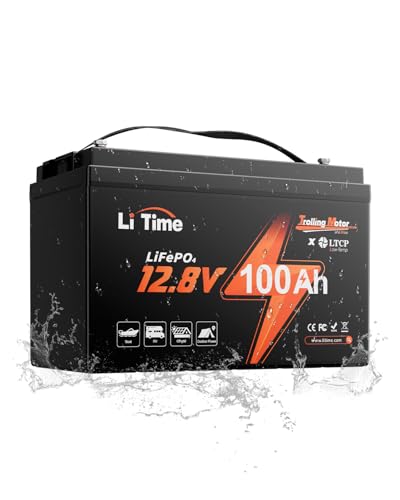
1. LiTime 12V 100Ah Trolling Motor LiFePO4 Battery, Group 31 — Best Overall
This is the battery for the angler who fishes full days and is tired of fading thrust. It suits 12V trolling motors on bass boats, walleye boats, and larger jon boats, and its Group 31 footprint matches the tray most of those boats already have. If your motor is a 24V or 36V system, this battery is a building block — you would run two or three in series per the manufacturer’s guidance — rather than a single-battery answer.
Strengths
- Purpose-positioned for trolling motors, with a 100A BMS that handles full-throttle draw without cutting out
- Low-temperature protection guards early- and late-season charging
- Group 31 fit matches standard marine battery trays and boxes
Trade-offs
- No Bluetooth in this model, so runtime tracking is by voltage or a separate gauge
- Series wiring for 24V/36V motors must follow the manufacturer’s limits exactly
- Premium category pricing compared with basic AGM
| Specification | Detail |
|---|---|
| Capacity | 100Ah |
| Chemistry | LiFePO4 |
| Group size | Group 31 |
| BMS | 100A |
| Protection | Low-temp protection |
The difference between a trolling-specific lithium and a generic one is mostly in the details that matter on the water: a BMS rated for the motor’s sustained draw, protection against charging on a frosty morning at the ramp, and a case sized for a marine tray. In use, the headline experience is consistency — speed settings mean the same thing at 4 p.m. as at 8 a.m., because lithium voltage barely sags across the discharge. Anglers consistently underestimate how much of their old battery’s ‘fade’ was voltage sag rather than empty capacity. Pair this battery with a lithium-profile onboard or portable charger, keep the connections clean and tight, and a single battery covers most 12V motors for a full day with reserve.
Best for: full-day anglers with 12V trolling motors / Not suited for: kayak anglers who need a much smaller, lighter battery
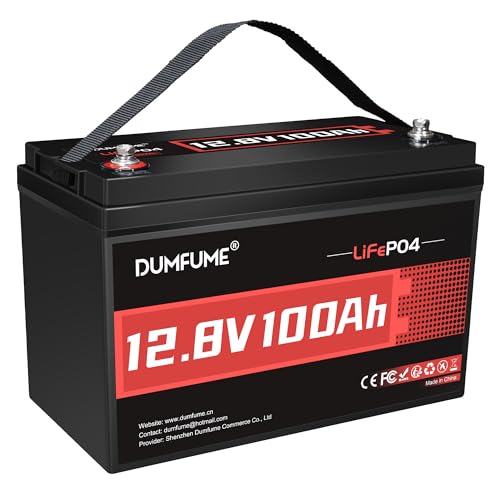
2. Dumfume 12V 100Ah LiFePO4 Battery, Group 31 — Best Value
Choose this battery if you want lithium runtime without paying for monitoring extras. It suits weekend anglers, second-boat builds, and anyone replacing a pair of lead-acid trolling batteries with one lithium unit. It is not the pick if you want the trolling-specific positioning and low-temperature protection of our top pick, or app-based monitoring.
Strengths
- Full-size Group 31, 100Ah, 1280Wh specification at a value position
- 100A BMS suits sustained trolling-motor discharge
- Listing explicitly covers trolling motor use among its applications
Trade-offs
- No low-temperature protection stated in the verified listing
- No Bluetooth or display for state-of-charge checks
- Newer brand with a shorter support history
| Specification | Detail |
|---|---|
| Capacity | 100Ah / 1280Wh |
| Chemistry | LiFePO4 |
| Group size | Group 31 |
| BMS | 100A built-in |
Value lithium batteries earn their place when the fundamentals check out, and here they do: standard Group 31 case, honest 100Ah and 1280Wh figures, and a 100A BMS. On the water it delivers the core lithium experience — nearly all of its capacity usable, steady voltage, half the weight of the AGM it likely replaces. The savings come from what is absent: no low-temperature charge protection in the listing, no monitoring, and a younger brand behind it. Cold-weather anglers should manage charging manually — never charge it below freezing — and every owner should add at least a simple voltage gauge. For a fair-weather weekend boat, those are manageable trade-offs for the price position.
Best for: weekend anglers who want lithium runtime on a budget / Not suited for: owners who fish in freezing conditions without charge management

3. ECO-WORTHY 12V 100Ah LiFePO4 Battery with Bluetooth and SOC Display — Best with Bluetooth Monitoring
Knowing your remaining capacity changes how you fish. With Bluetooth reporting you can decide at noon whether to run to the far end of the lake or conserve, instead of finding out the hard way. This battery suits tournament-minded anglers, guides, and anyone running a motor hard all day. If you already have a battery monitor at the console, its extras duplicate your setup and the simpler picks make more sense.
Strengths
- Bluetooth BMS reports real remaining capacity, current draw, and protection status
- SOC display on the battery gives a quick check without opening an app
- Low-temperature protection included for cold-season charging safety
Trade-offs
- Bluetooth range limits checks to in-boat distance
- App quality is functional rather than refined
- Costs more than equivalent capacity without monitoring
| Specification | Detail |
|---|---|
| Capacity | 100Ah |
| Chemistry | LiFePO4 |
| BMS | 100A with low-temp protection |
| Monitoring | Bluetooth + SOC display |
On a trolling motor, information is range. A voltage gauge on a lithium battery is nearly useless mid-discharge because the curve is flat; a coulomb-counting BMS is the gauge that tells the truth. This ECO-WORTHY builds that gauge in, so the question ‘how much battery do I have?’ gets a number instead of a shrug. The low-temperature protection and flame-retardant case round out a battery clearly designed by people who thought about boats and RVs rather than adapting a storage battery. The trade-offs are the usual ones for connected batteries: you are trusting a brand app, and Bluetooth only reaches across the boat. Neither matters much at the console, which is where the decisions get made.
Best for: anglers who manage energy actively through the day / Not suited for: owners with a quality console battery monitor already installed

4. DC HOUSE 12V 30Ah Mini LiFePO4 Battery — Best for Kayaks and Small Boats
Big batteries do not belong in kayaks. This compact lithium suits kayak anglers running a small trolling motor or fish finder, canoe campers, and jon boat owners who fish a few hours at a time. Its 30A BMS matches small motors; it is not a battery for a full-size bass boat motor at sustained high throttle, where a 100Ah pick belongs.
Strengths
- 30Ah of lithium in a case the size of a 20Ah battery — ideal where space is the limit
- 30A BMS matches small trolling motors and fish finder loads
- Low-temperature cutoff and a DC port add genuine small-boat utility
Trade-offs
- 30Ah is a half-day battery for anything beyond a small motor
- 30A BMS ceiling rules out larger motors
- Small case means planning a secure mount — it is light enough to shift if loose
| Specification | Detail |
|---|---|
| Capacity | 30Ah |
| Chemistry | LiFePO4 (mini format) |
| BMS | 30A |
| Protection | Low-temp cut-off |
Kayak fishing runs on a weight and space budget that makes standard batteries absurd, which is why small-format lithium exists. Thirty amp-hours of lithium is roughly thirty usable amp-hours — comparable in practice to a much larger lead-acid battery — in a package one person can carry to the water in one hand. The 30A BMS is honestly matched to the small motors kayaks actually use, and the low-temperature cutoff protects the early-season trips kayak anglers love. Mount it low and central, secure it properly, and it transforms a paddle-and-drift kayak into a positioned fishing platform for an afternoon. Just be honest about the ceiling: this is a small-water battery, and asking it to push a heavy boat all day is asking for a paddle home.
Best for: kayak, canoe, and jon boat anglers / Not suited for: full-size boats needing all-day 100Ah capacity
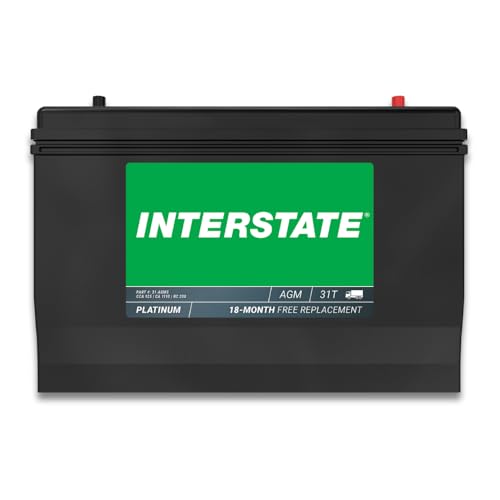
5. Interstate Batteries Marine/RV 12V 100Ah AGM, Group 31 — Best Dual-Purpose AGM
Some boats simplify life by running the same battery family for starting and trolling, and some owners simply trust a legacy name with a dealer network. This Interstate AGM suits that owner, and boats where the trolling battery occasionally doubles as a starting backup. It is not the pick for an angler optimizing runtime per pound — lithium wins that contest decisively.
Strengths
- AGM construction: sealed, spill-proof, and tolerant of any mounting angle a boat requires
- Strong cranking ratings make it a genuine dual-purpose battery
- Legacy brand with wide service availability
Trade-offs
- Usable trolling capacity is roughly half the label if you protect cycle life
- Roughly double the weight of the lithium picks at the same rating
- Voltage sag under load means thrust fades as the day goes on
| Specification | Detail |
|---|---|
| Capacity | 100Ah |
| Chemistry | AGM lead-acid |
| Group size | Group 31 |
| Cranking | 925 CCA / 1110 CA (per listing) |
There is a coherent philosophy behind choosing this battery: one proven, sealed battery type throughout the boat, serviced anywhere, charged by anything, with cranking strength in reserve. Interstate’s marine AGM delivers that, and for an angler who trolls a few hours rather than all day, its usable capacity is adequate and its manners are familiar. The cost of the philosophy is physics. You will carry about twice the weight for the same time on the water, and you will feel the motor soften as voltage declines through the day. If those trade-offs fit your fishing, this is the most conventional battery in the guide. If they do not, the lithium picks above are why this category has changed.
Best for: owners who want one dual-purpose AGM for starting and trolling / Not suited for: anglers optimizing all-day runtime and low weight

6. Renogy 12V 100Ah Deep Cycle AGM Battery — Best AGM for Simple Setups
This Renogy is for the owner who wants a sealed deep-cycle battery without changing chargers, settings, or habits. It suits occasional trolling, backup duty, and boats stored for long stretches, where its low self-discharge is a genuine virtue. It is not suited to daily deep cycling — that workload belongs to lithium, and asking AGM to do it shortens its life quickly.
Strengths
- Completely sealed and spill-proof, with a wide operating temperature range
- 3% self-discharge rate suits boats that sit between trips
- Charges correctly from standard lead-acid chargers and alternators
Trade-offs
- Plan on about half the label capacity as usable for reasonable life
- Heavy compared with every lithium pick here
- Slow to accept charge when deeply discharged
| Specification | Detail |
|---|---|
| Capacity | 100Ah |
| Chemistry | AGM lead-acid, sealed |
| Self-discharge | 3% rate (per listing) |
| Max discharge current | 1100A (per listing) |
Renogy built its name in solar, and this battery reflects that world: sealed, tolerant, low self-discharge, and undemanding about charging sources. For a boat that fishes twice a month and sits in between, those are the traits that decide whether the battery is ready when you are. Used within its honest envelope — moderate depth of discharge, prompt recharging after trips, kept charged in storage — it gives dependable service. Pushed into daily deep-cycle trolling duty, it will decline faster than its owner expects. That is not a defect; it is the chemistry’s terms, and this guide’s job is to state them plainly so you can choose with open eyes.
Best for: occasional anglers who value sealed, charger-agnostic simplicity / Not suited for: daily tournament anglers cycling a battery hard
Comparison Table
| Pick | Badge | Key spec | Best for |
|---|---|---|---|
| LiTime 12V 100Ah Trolling Motor LiFePO4 Battery, Group 31 | Best Overall | 100Ah LiFePO4, Group 31, trolling-specific | full-day anglers with 12V trolling motors |
| Dumfume 12V 100Ah LiFePO4 Battery, Group 31 | Best Value | 100Ah / 1280Wh LiFePO4, Group 31 | weekend anglers who want lithium runtime on a budget |
| ECO-WORTHY 12V 100Ah LiFePO4 Battery with Bluetooth and SOC Display | Best with Bluetooth Monitoring | 100Ah LiFePO4, Bluetooth, SOC display | anglers who manage energy actively through the day |
| DC HOUSE 12V 30Ah Mini LiFePO4 Battery | Best for Kayaks and Small Boats | 30Ah mini LiFePO4, 30A BMS | kayak, canoe, and jon boat anglers |
| Interstate Batteries Marine/RV 12V 100Ah AGM, Group 31 | Best Dual-Purpose AGM | 100Ah AGM, Group 31, dual-purpose | owners who want one dual-purpose AGM for starting and trolling |
| Renogy 12V 100Ah Deep Cycle AGM Battery | Best AGM for Simple Setups | 100Ah AGM, sealed, low self-discharge | occasional anglers who value sealed, charger-agnostic simplicity |
How to Choose a 12 Volt Battery for a Trolling Motor: Start with Amp Draw
Find your motor’s appetite first. Trolling motors draw roughly an amp per pound of thrust at full speed, and proportionally less at lower settings — a motor loafing at half speed on a calm day might pull 12 to 15 amps, while the same motor fighting wind and current at high settings can pull 40 or more. Multiply the amps you actually cruise at by the hours you fish, and that is the capacity you consume. Most anglers who do this math honestly are surprised in both directions: calm-day electric-only lake fishing uses less than feared, and windy-day boat positioning uses far more.
Then translate consumption into battery size using usable capacity, not label capacity. Lithium delivers 80 to 100 percent of its label; lead-acid delivers about half if you want it to last. A 100Ah lithium therefore covers roughly 60 to 80Ah of real fishing with reserve — a long day for most 12V motors. The same day on AGM honestly requires either a bigger battery or accepting deep discharges that shorten its life.
Finally, match voltage architecture. This guide is about 12V batteries for 12V motors and for building larger banks: two in series for 24V motors, three for 36V, following each manufacturer’s series guidance exactly. Never mix chemistries or ages within a bank, and never parallel a lithium with a lead-acid battery.
Weight, Voltage Sag, and Why Lithium Feels Stronger All Day
Two batteries with the same amp-hours do not push a boat the same way, and the reason is voltage behavior. A lead-acid battery’s voltage slides steadily downward as it discharges and sags further under load, so the motor receives less power with every passing hour — the familiar afternoon fade. A LiFePO4 battery holds nearly constant voltage until it is almost empty, then drops quickly at the very end. The practical result is that a lithium battery’s last hour feels like its first, which anglers experience as ‘more power’ even when the total energy is similar.
Weight is the second half of the story. Halving battery weight in the stern of a small boat improves how it sits, how it gets on plane, and how tired you are at the ramp. On kayaks and canoes it is the difference between a workable setup and an unsafe one. When you compare prices, compare them per usable amp-hour and per pound, not per label — lithium’s premium shrinks considerably under honest accounting.
The lithium caveat to plan around is the ending: because voltage stays high until the battery is nearly empty, the BMS will cut power with little warning when it reaches its limit. Carry a paddle, watch a gauge or app if your battery offers one, and keep a reserve habit — plan the day around 80 percent of capacity, not 100.
Charging and Caring for a Trolling Motor Battery
Charge after every trip, the same day if you can. Lead-acid batteries sulfate when left discharged, and even lithium prefers not to sit empty. Use a charger with the correct profile for the chemistry: a lithium battery on a lead-acid charger undercharges and may behave oddly, while an AGM on an aggressive lithium profile can be overcharged. Onboard chargers earn their cost on boats that fish weekly, because plugging in one cord at the dock beats hauling batteries to the garage.
Connections are the silent runtime thief. A corroded ring terminal or a loose wing nut adds resistance that wastes energy as heat and drops voltage at the motor. Clean terminals to bright metal, use proper marine cable of adequate gauge for the run length, tighten with a wrench rather than by hand, and protect finished connections. Check them each season.
In the off-season, store lithium at partial charge in a cool, dry place, disconnected. Store AGM fully charged, ideally on a maintainer, and top it up every month or two. Neither chemistry should spend the winter discharged in a freezing boat — that single habit kills more marine batteries than fishing ever does.
How to Install a Trolling Motor Battery and Wire It Correctly
A clean installation takes under an hour and prevents the voltage losses and corrosion that anglers often blame on the battery. Work in order and test at the dock, not at the far end of the lake.
- Disconnect and remove the old battery, negative cable first. Photograph the wiring before you start if the boat has multiple batteries or an onboard charger.
- Clean the battery tray, check the hold-down, and confirm the new battery’s footprint and terminal orientation match your cable reach.
- Inspect every cable end. Replace any terminal that is green, frayed, or loose on its cable — a new battery cannot fix a bad connection.
- Set the battery in the tray and secure it firmly. A battery that shifts in chop will fatigue its cables and terminals.
- Connect positive first, then negative, using the correct posts and tightening with a wrench. Add any onboard charger leads per the charger’s manual, on the correct battery in a multi-battery bank.
- If you are building a 24V or 36V bank, wire the series jumpers exactly as the battery manufacturer specifies, with identical batteries, and label each battery’s position.
- Set your charger to the correct chemistry profile before the first charge, and charge the bank fully.
- Test at the dock: run the motor through its speed range, watch for connections heating up, and confirm any gauge or app reads sensibly.
- After the first full day of fishing, re-check terminal tightness and note how much capacity you used — that number plans every future trip.
Keep a simple log for the first few trips: hours fished, conditions, and capacity used. Within a month you will know your boat’s real appetite in every condition, which is worth more than any generic runtime chart.
Reading Runtime Claims Like an Engineer
Manufacturers quote capacity at gentle discharge rates, and trolling motors are not gentle. A battery’s amp-hour rating is traditionally measured over a 20-hour discharge — a 100Ah battery delivering 5 amps. At trolling currents of 20 to 40 amps, lead-acid batteries deliver noticeably less than their rating, an effect called the Peukert effect, while lithium delivers close to its full rating even at high draw. This is the second, quieter reason lithium outperforms its label on the water: not only is more of the label usable, more of the label survives the rate at which you use it.
Translate that into a shopping habit: when comparing a lithium and an AGM of equal label capacity for trolling duty, the real-world gap is wider than the usable-capacity gap alone suggests, because the AGM is being penalized twice — once for depth-of-discharge limits, once for discharge rate. Anglers who made the switch and report ‘it lasts twice as long’ are not exaggerating; they are describing arithmetic.
Your own log beats every chart. After three trips with a note of hours, conditions, and remaining charge, you know your boat’s consumption in wind and calm, and battery sizing stops being a debate. The anglers who run out of power are almost never the ones who kept the log.
Propulsion Batteries and House Loads: Keeping the Systems Honest
Many boats ask the trolling battery to do double duty — fish finder, lights, livewell, phone charging — and each added load is a quiet tax on propulsion. A fish finder draws little; a livewell pump cycling all day and a pair of courtesy lights do not draw much either, but together across ten hours they can consume the reserve you were counting on for the run back against the wind. The cleanest setups keep a mental or physical separation: propulsion capacity is sacred, and house loads are either modest, metered, or assigned to the starting battery where the alternator replenishes them.
If your boat runs electronics off the trolling bank, at least make the draw visible. A battery with Bluetooth reporting, or a simple gauge, turns an invisible tax into a number you can manage. Tournament anglers are rigorous about this because their day has a hard ending: the livewell must run and the motor must answer at the last hour. Recreational anglers benefit from the same rigor in a lower key — know what is plugged into your range.
The corollary is charging discipline for multi-bank boats. Onboard chargers that treat each bank independently exist precisely because a trolling battery and a starting battery live different lives. Charge both after every trip, verify both reached full, and the boat is ready whenever the weather window opens — which, in the end, is what the battery system is for.
Electric-Only Lakes, Tournaments, and Other Hard Cases
Some fisheries make the trolling battery the only propulsion allowed, and those lakes rewrite the sizing math: the battery is no longer an accessory to a gas motor but the entire range of the boat. On electric-only water, plan capacity the way a pilot plans fuel — total draw for the day, a reserve that is never spent, and a hard turnaround point. The lithium picks in this guide earn their premium most clearly here, because usable capacity and flat voltage are not conveniences when the motor is the only way home.
Tournament fishing adds the livewell to the load and a clock to the day. The professional pattern is instructive for everyone: propulsion and life-support loads are budgeted separately, monitored continuously, and never allowed to surprise the angler in the final hour. A battery with real state-of-charge reporting stops being a luxury in that context and becomes tournament equipment, no different from a spare prop. Recreational anglers fishing a long Saturday can borrow the discipline at whatever scale suits them.
Cold-weather fishing is the third hard case, combining lithium’s charging restriction with the season’s best fishing. The answers are procedural: charge the battery indoors the night before, transport it warm, and let low-temperature protection — fitted to two of this guide’s lithium picks — guard the mistakes. The anglers who fish all winter are not tougher than the battery’s chemistry; they are simply more organized about it.
Trolling Motor Efficiency: Getting More Hours from the Same Battery
The cheapest amp-hours are the ones you never spend, and trolling technique is full of them. The largest is speed discipline: a trolling motor’s draw rises steeply with its speed setting, so the difference between cruising at half throttle and at three-quarter throttle is not a third more speed for a third more power — it is often nearly double the draw for a modest gain in pace. Anglers who learn their boat’s efficient cruise setting, and use high settings in bursts rather than as a default, routinely gain an hour or more from the same battery.
Boat handling saves the rest. Fish with the wind and current rather than against them, letting the motor make small corrections instead of continuous war; use an anchor or shallow-water anchor at a spot instead of hovering on the motor in a breeze; and keep the hull trimmed and the load distributed so the motor is not pushing a badly balanced boat. Each is a small saving, and together they are the size of a battery upgrade — free, and available on the next trip.
Electronics complete the picture. A fish finder is a small draw; a livewell on continuous run is not. Use livewell timers, dim screens at midday, and charge phones from the starting battery where the alternator lives. Efficiency is not austerity — it is spending the battery on propulsion and fish, which is what you bought it for.
Freshwater, Saltwater, and the Corrosion Tax
Saltwater changes the battery conversation in one specific way: everything electrical ages faster, and the battery system’s weakest points — terminals, cable ends, charger connections — corrode on a schedule that freshwater anglers never meet. The battery chemistry choice matters less than the connection discipline in salt service: sealed batteries help because there is nothing to top up and no venting to invite corrosion inward, terminals should be protected after they are torqued, and the whole installation deserves a freshwater rinse-and-inspect habit that freshwater boats can treat as optional. A lithium battery’s sealed case is a genuine advantage here, but it protects only the battery; the cables remain the owner’s responsibility.
Brackish and tidal fisheries split the difference and deserve the saltwater routine anyway, because corrosion does not grade on a curve. The practical test is simple: if your trailer bunks and hardware show salt, your battery connections are collecting it too. Build the inspection into the trip rhythm — connections checked when the boat is washed, charger leads inspected when they are coiled — and the corrosion tax becomes a small, predictable chore instead of the mysterious power loss that sends anglers shopping for batteries they do not need.
There is a warranty-and-care corollary worth one sentence: follow the battery maker’s guidance on marine use and mounting, because a battery installed against its instructions — unsecured, inverted, or in an unventilated locker with a fuel tank — has left the territory where any guide’s advice applies. The sea rewards the methodical, in batteries as in everything else.
Carrying, Mounting, and the Life of the Battery Off the Water
The trolling battery’s working life is only half its story; the other half is being carried, stored, charged, and occasionally dropped by a tired angler at a dark ramp. Weight is the obvious variable — the lithium picks in this guide cut the carry roughly in half against lead-acid — but mounting is the one that decides longevity. A battery that rides unsecured in a boat compartment is being vibrated, slammed, and occasionally launched by every wave and pothole, and its terminals and case absorb what the hold-down should have. Fit the tray, fit the strap, and route the cables so they cannot chafe or be stepped on; the battery you protect from the boat will outlast the battery you merely bought well.
Charging infrastructure at home deserves the same one-time attention. A dedicated charging spot — ventilated, off the floor, with the charger mounted and its leads dressed — turns the post-trip routine into a two-minute habit instead of a garage excavation. Habits that are easy get done, and the battery that is charged the same evening, every trip, is the battery that is ready for the surprise free morning in October. Pair that with a seasonal terminal inspection and a note of the battery’s purchase date, and you have professionalized the least glamorous, most decisive part of electric fishing.
Finally, plan the battery’s end at its beginning. Lead-acid batteries carry a core value and a recycling path at every parts store; lithium batteries have their own recycling channels that retailers can direct you to. Either way, a battery retired on schedule and recycled properly closes the loop cleanly — and the replacement, chosen with the logbook knowledge of how its predecessor actually lived, will be a better battery for your boat than the first one was.
A Note on Warranty and Support
A trolling battery is a multi-season purchase, and the support behind it deserves a paragraph of its own. Before buying, read the warranty terms the way you would read a contract for anything expected to work for years: what period it covers, whether it is full replacement or prorated, and what conditions — mounting, charging, temperature — it assumes. Lithium warranties in particular are written around correct charging, which is one more reason the lithium-profile charger in this guide is not an accessory but part of the purchase. Keep the receipt and the install date with the boat’s papers; warranty conversations go better with documents than with memories.
Support quality shows itself in the small channels: a maker that answers questions about series wiring limits, charger compatibility, and BMS behavior before the sale is a maker that will answer them after it. The picks in this guide were chosen partly on the clarity of their own listings — specifications stated plainly enough to verify — because that clarity is a proxy for the company behind the battery. A battery is cells and a management system; a purchase is also a relationship with the people who specified them, and on the water, three seasons in, that relationship is part of the product.
Common Buying Mistakes
Sizing by cranking amps. CCA measures starting bursts, not trolling endurance. A high-CCA battery can still be a poor trolling battery. Shop by usable amp-hours at your motor’s draw.
Running lead-acid to empty ‘because it still works.’ It works — and each deep discharge permanently costs capacity. Keep AGM above roughly half charge if you want it to last.
Undersized or corroded cabling. Long runs of thin cable between battery and motor waste real power. Use marine-grade cable sized for the run and keep terminals clean and tight.
Charging lithium below freezing without protection. Cold charging damages LiFePO4 cells. Choose a battery with low-temperature protection or manage charging manually on freezing mornings.
Mixing batteries in a bank. Different ages, chemistries, or capacities in series or parallel unbalance the bank and age everything faster. Build banks from identical batteries bought together.
No reserve habit. Lithium’s flat voltage means the end arrives abruptly. Plan around using 80 percent and keep the paddle accessible.
Final Recommendation
For most anglers, the LiTime trolling-specific Group 31 is the best 12 volt battery for trolling motor use: right tray size, right BMS, low-temperature protection. The Dumfume delivers the same capacity formula for less, the ECO-WORTHY adds monitoring that genuinely helps manage a day, the DC HOUSE mini opens up kayaks and small boats, and the two AGMs serve owners who deliberately prefer sealed lead-acid or dual-purpose duty.
Whatever you buy, size it from your motor’s real amp draw and your real hours. That one calculation prevents both the stranded afternoon and the overweight boat.
Related reading: Best 12 Volt Battery For Travel Trailer; Best 12 Volt Battery Maintainer; Best 12 Volt Battery Load Tester; Best 12 Volt Battery Powered Ride On Toys
Frequently Asked Questions
How long will a 100Ah battery run my trolling motor?
Divide usable capacity by your average draw. A 100Ah lithium offers roughly 90 usable amp-hours: at a 20-amp cruise that is about four and a half hours, and at a gentle 10 amps, most of a day. Wind and high speed settings shorten it quickly.
Can one 12V battery run a 24V trolling motor?
No. A 24V motor needs two 12V batteries in series (or a dedicated 24V battery), and a 36V motor needs three. Follow the battery manufacturer’s series-wiring guidance and use identical batteries.
Why does my motor slow down late in the day on lead-acid?
That is voltage sag: a lead-acid battery’s voltage falls as it discharges, so the motor gets less power. Lithium holds voltage nearly flat, which is why it feels strong until it is nearly empty.
Do I need a special charger for a lithium trolling battery?
You need a charger with a lithium profile to fill it fully and safely. Many modern onboard chargers offer selectable profiles — set it correctly before the first charge.
Is a lithium battery safe in a boat?
LiFePO4 is the most thermally stable lithium chemistry and the standard choice for marine use. Secure the battery, keep connections clean and tight, and respect the low-temperature charging limit.
How do I store the battery over winter?
Store lithium at partial charge, disconnected, in a cool dry place. Store AGM fully charged on a maintainer. Never store either chemistry discharged.


