Disclosure: airfryerkitchensupply.com is reader-supported. When you buy through links on our site, we may earn an affiliate commission at no extra cost to you.
Where to buy
Every battery in this guide is sold on Amazon, and house batteries are one of the purchases where buying through a major marketplace genuinely helps: freight delivery to your door, a clear returns window if the battery arrives damaged, and easy access to the manufacturer warranty registration. Check the current price on Amazon for each pick before ordering, confirm the group size matches your trailer’s battery box, and order early enough before a trip that you can fully charge and test the battery at home first.
- LiTime 12V 100Ah LiFePO4 Battery, Group 31 — Check the current price on Amazon
- Dumfume 12V 100Ah LiFePO4 Battery, Group 31 — Check the current price on Amazon
- ECO-WORTHY 12V 100Ah LiFePO4 Battery with Bluetooth and SOC Display — Check the current price on Amazon
- HQST 12V 100Ah LiFePO4 Battery, Group 22NF Mini — Check the current price on Amazon
- LiTime 12V 100Ah LiFePO4 Battery, Group 24 with Bluetooth — Check the current price on Amazon
- Renogy 12V 100Ah Deep Cycle AGM Battery — Check the current price on Amazon
If you are shopping for the best 12 volt battery for travel trailer use, you are really shopping for nights: how many evenings of lights, water pump, furnace fan, phone charging, and fridge control boards you can run before the battery needs a charge. A travel trailer house battery lives a harder life than a car battery. It gets discharged deeply at a campsite, recharged unevenly by a converter or solar panel, vibrated down thousands of highway miles, and then parked for weeks between trips. The right battery is the one whose chemistry, capacity, and physical size match that cycle — not simply the one with the biggest number on the label.
The market has shifted decisively toward lithium iron phosphate (LiFePO4) in the last few years, and this guide reflects that: five of the six picks are LiFePO4, because for trailer duty the usable capacity per pound and the tolerance for deep discharge are hard for lead-acid to answer. One proven AGM remains for owners whose converter cannot charge lithium properly and who do not want to change it. Every pick below was verified against Amazon’s catalog data before being linked, and the specs quoted in each mini spec box come only from the manufacturer’s own listing title — nothing here is padded with invented numbers.
Sizing honesty matters more than brand loyalty. A single 100Ah lithium battery gives most couples two to three careful nights off-grid; a furnace running all night in cold weather can halve that. Throughout this guide you will find the math to work out your own draw, guidance on when a second battery in parallel makes more sense than one larger battery, and clear notes on which picks need a lithium-capable charger to deliver their full capacity.
In this guide
Quick Picks
Best Overall: LiTime 12V 100Ah LiFePO4 Battery, Group 31 — The default recommendation for most trailers: a Group 31 lithium with a 100A BMS and IP65 sealing that drops into the common large battery box. Check price on Amazon
Best Value: Dumfume 12V 100Ah LiFePO4 Battery, Group 31 — A Group 31, 100Ah lithium with a 100A BMS and 1280Wh on the label, aimed squarely at owners who want lithium capacity without paying for extras. Check price on Amazon
Best with Bluetooth Monitoring: ECO-WORTHY 12V 100Ah LiFePO4 Battery with Bluetooth and SOC Display — A 100Ah lithium with built-in Bluetooth, an SOC display, flame-retardant case, and low-temperature protection in the BMS. Check price on Amazon
Best Compact Fit: HQST 12V 100Ah LiFePO4 Battery, Group 22NF Mini — A full 100Ah and 1280Wh packed into a smaller Group 22NF mini case, with an LED meter and low-temperature protection. Check price on Amazon
Best for Group 24 Boxes: LiTime 12V 100Ah LiFePO4 Battery, Group 24 with Bluetooth — The Group 24 version of the proven formula: 100Ah, Bluetooth, 100A BMS, and IP65 sealing for trailers whose box is the smaller standard size. Check price on Amazon
Best AGM (No Charger Change): Renogy 12V 100Ah Deep Cycle AGM Battery — A sealed, spill-proof 100Ah AGM with a low 3% self-discharge rate for owners keeping a lead-acid charging system. Check price on Amazon
How These Picks Were Chosen
We chose these six batteries by starting with the constraints real travel trailers impose. First, the battery has to fit standard trailer battery boxes and tongue racks, which is why Group 24, Group 27, and Group 31 footprints dominate the list. Second, it has to survive deep discharge: travel trailer loads routinely pull a house battery below half charge, so cycle life at deep discharge weighed heavily. Third, every candidate needed a built-in battery management system if it was lithium, with low-temperature charge protection specifically checked, because charging a frozen lithium battery is the fastest way to ruin one.
We verified each pick through the Creators API on this site’s own Amazon integration, matching the manufacturer’s listing title to the product before assigning any link. Only specifications stated in those verified titles appear in the spec boxes. Batteries that could not be verified, and specialty brands sold mainly through dealer networks, are discussed honestly as prose where relevant rather than linked on a guess.
Finally, we weighted real ownership factors: weight on the tongue, because a lighter battery can return payload you would rather spend on gear; Bluetooth or meter visibility, because guessing state of charge from a four-LED panel leads to over-discharge; and expansion, because many owners start with one battery and add a second within a season. The six picks below are the result, arranged so each badge answers a different owner’s situation rather than six versions of the same battery.
The 6 Best 12 Volt Batteries for Travel Trailers
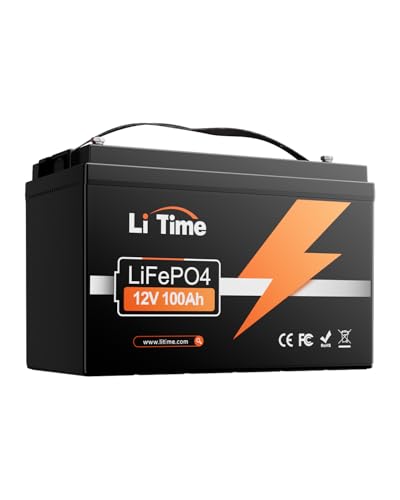
1. LiTime 12V 100Ah LiFePO4 Battery, Group 31 — Best Overall
This is the battery for the owner who wants to stop thinking about batteries. It suits couples and small families who camp two to four nights between hookups, run LED lights, a water pump, device charging, and a 12V fridge, and who may add solar later. It is less suited to very large trailers with residential fridges and inverters running microwaves — that workload wants two batteries, though two of these in parallel is exactly how many owners solve it.
Strengths
- Group 31 footprint fits the large battery boxes already on many trailer tongues and in pass-through compartments
- 100A BMS supports a modest inverter and simultaneous DC loads without nuisance cutoffs
- IP65 rating shrugs off the road spray and dust a tongue-mounted battery lives in
Trade-offs
- No Bluetooth in this version, so state of charge comes from voltage or an added shunt monitor
- Group 31 is the largest common footprint — measure your box before ordering
- Like all LiFePO4, it needs a charger with a lithium profile to reach a true full charge
| Specification | Detail |
|---|---|
| Capacity | 100Ah |
| Chemistry | LiFePO4 (lithium iron phosphate) |
| Group size | Group 31 |
| BMS | 100A built-in |
| Ingress rating | IP65 |
What makes this the overall pick is balance rather than any single headline number. The Group 31 case is the size trailer manufacturers already plan around, the 100A BMS is enough headroom for a 1,000-watt-class inverter plus house loads, and the sealed IP65 case suits the exposed tongue location where many house batteries actually live. In practice you get close to the full rated capacity as usable energy — the fundamental lithium advantage — because you are not protecting the battery from the deep discharges that shorten lead-acid life. Owners upgrading from a dealer-supplied flooded battery typically describe the change as doubling their off-grid time while halving battery weight, and that matches the arithmetic. Pair it with a lithium-capable converter or a solar charge controller set to a lithium profile, add a simple shunt-based monitor if you want accurate percentages, and it becomes a fit-and-forget system for several seasons of trips.
Best for: most travel trailer owners making the lithium switch / Not suited for: owners who need built-in Bluetooth monitoring in the battery itself
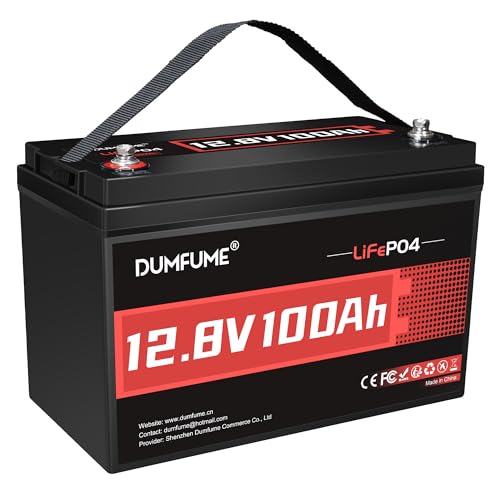
2. Dumfume 12V 100Ah LiFePO4 Battery, Group 31 — Best Value
Choose this one if your priority is verified lithium capacity in the standard large footprint at the value end of the market. It suits weekend campers, hunters with a base-camp trailer, and anyone replacing two tired lead-acid batteries with a single lithium unit. It is not the pick for owners who want app-based monitoring or a long-established dealer network behind the brand.
Strengths
- Full 100Ah Group 31 format with 1280Wh stated capacity — no shrunken ‘mini’ case compromises
- 100A BMS matches the discharge demands of typical trailer house loads
- Straightforward spec sheet that matched its verified listing exactly
Trade-offs
- No Bluetooth or display; plan on a separate battery monitor for accurate readings
- Newer brand, so long-term support history is shorter than the legacy names
- Charging below freezing still requires the same lithium precautions as any LiFePO4
| Specification | Detail |
|---|---|
| Capacity | 100Ah / 1280Wh |
| Chemistry | LiFePO4 |
| Group size | Group 31 |
| BMS | 100A built-in |
Value picks in lithium batteries deserve extra scrutiny, because the cheapest way to build a 100Ah battery is to use lower-grade cells and hope nobody measures. What earns this battery its place is that its verified listing states the fundamentals plainly — Group 31 case, 100Ah, 1280Wh, 100A BMS — and those are the numbers that determine whether it works in a trailer. For a weekend-duty trailer, the ownership experience is simple: charge it fully at home, run two or three nights of lights, pump, and charging, and recharge without worrying that a deep weekend shortened its life the way it would a flooded battery. Spend the savings over premium brands on the two accessories that actually improve a value battery’s life: a proper lithium-profile charger and a shunt monitor so you can see what the battery is really doing.
Best for: budget-conscious owners who still want full-size lithium capacity / Not suited for: owners who want app monitoring and a long brand track record

3. ECO-WORTHY 12V 100Ah LiFePO4 Battery with Bluetooth and SOC Display — Best with Bluetooth Monitoring
This pick is for the owner who has been burned by guessing. If you have ever watched a four-bar LED panel drop from three bars to empty in an evening, the appeal of a battery that reports its actual state of charge to your phone is obvious. It suits solar-equipped trailers and longer off-grid stays where managing energy is part of the trip. It is less necessary for campground campers who plug in most nights.
Strengths
- Built-in Bluetooth plus an SOC display ends state-of-charge guesswork without adding a separate shunt
- Low-temperature protection in the 100A BMS guards against charging a cold battery
- Flame-retardant case is a thoughtful touch for a battery living in a compartment
Trade-offs
- Bluetooth range is short — you check it from inside or beside the trailer, not from home
- App ecosystems from battery brands are functional rather than polished
- You still need a lithium-profile charger to fill it completely
| Specification | Detail |
|---|---|
| Capacity | 100Ah |
| Chemistry | LiFePO4 |
| BMS | 100A with low-temp protection |
| Monitoring | Bluetooth + SOC display |
Accurate state of charge is the single biggest quality-of-life upgrade in a trailer electrical system, and building it into the battery is the simplest way to get it. Voltage-based guessing fails on lithium because the discharge curve is so flat: the battery reads nearly the same voltage at 70 percent and at 30 percent, then falls off a cliff. A Bluetooth BMS reports current in and out, remaining capacity, and cell protection events, which turns decisions like ‘can we run the furnace tonight?’ from anxiety into arithmetic. The low-temperature protection matters for shoulder-season campers, cutting charge current off before a freezing morning charge can damage cells. If your trailer already has a good shunt monitor installed, this battery’s extras duplicate what you own — buy capacity instead. If it does not, this is the easiest one-box answer.
Best for: solar and off-grid campers who manage energy actively / Not suited for: owners who already run a quality shunt-based monitor
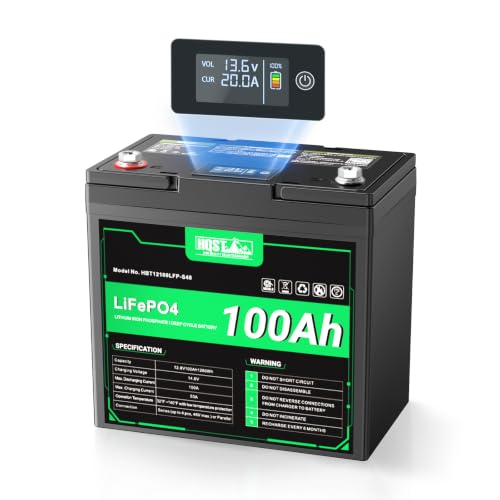
4. HQST 12V 100Ah LiFePO4 Battery, Group 22NF Mini — Best Compact Fit
Small trailers, teardrops, and pop-ups often have a battery compartment sized for a much smaller battery than the trip demands. This mini-format 100Ah exists for exactly that problem: full capacity in a Group 22NF footprint. It suits owners of compact trailers whose box will not accept a Group 31. Measure carefully — mini cases vary — and it is not the pick if your compartment already fits a standard group size, where the standard case is usually the simpler buy.
Strengths
- 100Ah and 1280Wh in a compact Group 22NF case for tight compartments
- LED meter gives a quick at-a-glance check without a phone
- Low-temperature protection included in the BMS
Trade-offs
- Compact case concentrates the same energy in less volume — leave the ventilation the manual specifies
- Non-standard size means a future replacement must match the footprint or the box changes
- Terminal layout on mini cases can be tighter to wire in parallel
| Specification | Detail |
|---|---|
| Capacity | 100Ah / 1280Wh |
| Chemistry | LiFePO4 |
| Group size | Group 22NF Mini |
| Meter | LED meter |
| Protection | Low-temp protection |
The mini-format lithium battery is one of the genuinely useful developments for small-trailer owners. Lead-acid capacity was welded to case size: a small box meant a small battery and short trips. Lithium’s energy density breaks that link, and this HQST puts a full 100Ah where a much smaller lead-acid used to sit. The LED meter is basic compared with Bluetooth, but for a teardrop owner doing a quick check before bed it is honestly enough. The cautions are practical: confirm your hold-down and cable reach in the smaller footprint, keep the specified clearance around the case, and remember that a compact battery still weighs what 100Ah of lithium weighs. For the owner whose trailer physically cannot take a Group 31, this is not a compromise pick — it is the enabling one.
Best for: teardrops, pop-ups, and small trailers with tight battery boxes / Not suited for: trailers with standard Group 27/31 boxes that fit full-size cases

5. LiTime 12V 100Ah LiFePO4 Battery, Group 24 with Bluetooth — Best for Group 24 Boxes
Many trailers — especially smaller and older ones — ship with a Group 24 box, and owners reasonably do not want to cut fiberglass or replace boxes to go lithium. This battery is built for that trailer. It suits the same camping pattern as our overall pick, in the smaller footprint, with Bluetooth monitoring included. Owners with Group 31 boxes should buy the larger-case version instead; there is no reason to leave box space unused.
Strengths
- True Group 24 drop-in for the smaller standard trailer box
- Bluetooth monitoring included, unlike the base Group 31 version
- IP65 sealing suits tongue-mounted boxes exposed to weather
Trade-offs
- Group 24 lithium still costs more per trip than reusing a bigger box you may already own
- Bluetooth check-ins require being near the trailer
- A second battery in parallel needs a second Group 24 box or a dual box upgrade
| Specification | Detail |
|---|---|
| Capacity | 100Ah |
| Chemistry | LiFePO4 |
| Group size | Group 24 |
| BMS | 100A built-in |
| Monitoring | Bluetooth |
| Ingress rating | IP65 |
Footprint discipline is unglamorous and decisive. A battery that does not fit the box does not get taken on the trip, and the Group 24 box is what a large share of the travel trailer fleet actually has. This LiTime brings the full modern package — 100Ah of lithium capacity, a 100A BMS, Bluetooth reporting, IP65 sealing — into that exact footprint, which makes it the path of least resistance for the largest number of owners. In use it behaves like its Group 31 sibling: flat discharge curve, fast charging when the charger supports it, and none of the capacity penalty for running it down on a long weekend. If you are choosing between this and enlarging your box for a Group 31, decide based on whether you will ever add a second battery; two Group 24s in a dual box is a clean upgrade path that this pick starts neatly.
Best for: owners whose trailer has the smaller Group 24 battery box / Not suited for: owners with Group 31 boxes who can fit the larger case

6. Renogy 12V 100Ah Deep Cycle AGM Battery — Best AGM (No Charger Change)
Not every trailer should go lithium. If your converter is an older lead-acid-only unit in good health, you camp mostly with hookups, and the battery’s job is overnight stops and power-outage backup rather than long off-grid stays, a quality AGM remains a rational buy. This Renogy suits that owner, plus anyone storing a trailer in freezing conditions without charge management. It is not suited to deep daily cycling off-grid, where its usable capacity is roughly half its label and its cycle life shortens quickly.
Strengths
- Sealed and spill-proof AGM works with the converter already in most trailers — no charger change
- Low 3% self-discharge rate suits trailers parked between trips
- Wide temperature range and no low-temperature charging prohibition, unlike lithium
Trade-offs
- Only about half the 100Ah label is safely usable if you want reasonable cycle life
- Much heavier than lithium at the same rating — tongue weight is real
- Slower to recharge, and chronic undercharging from short drives shortens its life
| Specification | Detail |
|---|---|
| Capacity | 100Ah |
| Chemistry | AGM lead-acid, sealed |
| Self-discharge | 3% rate (per listing) |
| Max discharge current | 1100A (per listing) |
The honest case for AGM in 2026 is compatibility and simplicity. It charges from anything, tolerates cold charging that lithium forbids, and asks nothing of the owner except not discharging it too deeply too often and keeping it charged in storage — where its low self-discharge genuinely helps. The honest case against it is arithmetic: a 100Ah AGM treated kindly delivers about 50Ah per cycle and a few hundred deep cycles, while the lithium picks above deliver nearly the full 100Ah for thousands of cycles at half the weight. Buy this Renogy if your camping is hookup-based and your converter is lead-acid-only; buy lithium if you boondock. What you should not do is buy AGM expecting lithium-style off-grid performance — that mismatch, not the battery, is what disappoints owners.
Best for: hookup campers keeping an existing lead-acid converter / Not suited for: off-grid campers who cycle the battery deeply every day
Comparison Table
| Pick | Badge | Key spec | Best for |
|---|---|---|---|
| LiTime 12V 100Ah LiFePO4 Battery, Group 31 | Best Overall | 100Ah LiFePO4, Group 31, 100A BMS | most travel trailer owners making the lithium switch |
| Dumfume 12V 100Ah LiFePO4 Battery, Group 31 | Best Value | 100Ah / 1280Wh LiFePO4, Group 31 | budget-conscious owners who still want full-size lithium capacity |
| ECO-WORTHY 12V 100Ah LiFePO4 Battery with Bluetooth and SOC Display | Best with Bluetooth Monitoring | 100Ah LiFePO4, Bluetooth, SOC display | solar and off-grid campers who manage energy actively |
| HQST 12V 100Ah LiFePO4 Battery, Group 22NF Mini | Best Compact Fit | 100Ah LiFePO4 in Group 22NF mini case | teardrops, pop-ups, and small trailers with tight battery boxes |
| LiTime 12V 100Ah LiFePO4 Battery, Group 24 with Bluetooth | Best for Group 24 Boxes | 100Ah LiFePO4, Group 24, Bluetooth | owners whose trailer has the smaller Group 24 battery box |
| Renogy 12V 100Ah Deep Cycle AGM Battery | Best AGM (No Charger Change) | 100Ah AGM, sealed, 3% self-discharge | hookup campers keeping an existing lead-acid converter |
How to Choose a 12 Volt Battery for a Travel Trailer
Start with your nightly energy budget, not with battery marketing. List what runs after you unplug: LED lights draw little, a water pump draws in bursts, phone and laptop charging adds up quietly, a 12V compressor fridge runs around the clock, and a propane furnace’s fan is usually the single biggest overnight consumer in cool weather. Add the amp-hours honestly — most couples land between 30 and 60Ah per night, and furnace-heavy cold nights can double the low end. Your battery’s usable capacity, not its label capacity, must cover that with margin.
Chemistry decides what ‘usable’ means. LiFePO4 lithium can be drawn down 80 to 100 percent of its label routinely, charges quickly, and holds voltage nearly flat until it is nearly empty. AGM and flooded lead-acid should be kept above roughly half charge for reasonable life, so a 100Ah lead-acid battery is really a 50Ah battery in daily service, at about twice the weight. That single difference explains most of the price gap and most of the satisfaction gap owners report after switching.
Then confirm the physical facts: measure the battery box in all three dimensions, check the group size of the battery you are replacing, and weigh the tongue-weight effect. Lithium typically cuts battery weight roughly in half at the same label capacity, which returns payload. Finally, audit your charger. A lithium battery connected to an old single-stage converter may only reach about 80 percent charge and will show confusing behavior; budget for a lithium-profile converter, a solar controller with a lithium setting, or at least a standalone lithium charger for home charging.
Battery Capacity, Parallel Banks, and When Two Batteries Beat One
A single 100Ah lithium battery is the right answer for most travel trailers, but the upgrade path matters. Two 100Ah batteries wired in parallel give 200Ah at 12 volts, keep the same chargers and cabling style, and add redundancy: if one battery is removed for service, the trailer still runs on the other. One larger battery saves connections and space but concentrates risk and weight in a single unit. For trailers, the parallel pair is usually the more forgiving architecture.
Wire a parallel bank correctly or not at all. Use two batteries of the same model, age, and charge state; connect them with equal-length cables; take the trailer’s positive feed from one battery and the negative from the other so current shares evenly; and fuse appropriately. Mixing an old lead-acid battery with a new lithium battery in the same bank is a genuine mistake — their voltages and charging needs differ enough that both suffer.
Know the series trap: travel trailers are 12-volt systems. Wiring two 12V batteries in series makes a 24V bank that will damage 12V appliances. Series connections belong to golf carts and larger off-grid systems, not to a trailer’s house bank. If a listing advertises series expansion, that feature is for other applications — your trailer wants parallel.
Charging a Trailer Battery: Converter, Solar, Tow Vehicle, and Shore Power
Your trailer already has more charging sources than most owners realize, and they are not equal. The built-in converter charges from shore power or a generator; modern multi-stage units with a lithium profile are the backbone of home and campground charging. Older single-stage converters were designed to avoid boiling flooded batteries, which makes them slow and incomplete chargers for everything — the most common hidden cause of ‘my new battery never seems full.’
Solar is the natural partner for lithium because the two share a daily rhythm: panels refill during the day exactly the capacity the night consumed, and a controller with a lithium profile charges at the voltage lithium wants. The tow vehicle contributes least — the charge line through a 7-pin connector is thin and voltage-drop-prone, delivering a modest top-up over a long drive rather than a real recharge. Treat it as a bonus, never as the plan.
At home between trips, lithium’s storage rules differ from lead-acid habit. Store LiFePO4 at a partial charge — roughly half — rather than brim-full, disconnect parasitic loads or use the battery disconnect, and never leave a lithium battery on a lead-acid float charger all winter. Lead-acid wants the opposite: full charge, maintained. Matching storage practice to chemistry is worth more cycle life than any brand difference in this guide.
How to Install and Set Up a New House Battery in Your Travel Trailer
Installation is a one-hour job with basic tools, and doing it carefully prevents the two classic problems: reversed polarity and loose terminals that heat up under load. Work through the steps in order, and do the charger-profile step before your first trip, not at the campsite.
- Turn off the battery disconnect if fitted, unplug shore power, and switch the converter breaker off so the system is fully de-energized.
- Photograph the existing wiring before touching it — cable colors on trailers are not always consistent, and the photo is your undo button.
- Remove the negative cable first, then the positive, and set them aside so they cannot touch the terminals. Lift the old battery out with your legs; a 100Ah lead-acid battery is heavy enough to injure a back.
- Clean the compartment, check the hold-down strap or clamp, and confirm the new battery’s footprint and terminal positions against your measurements.
- Set the new battery in place and secure it. A battery that can move will eventually chafe a cable or crack a case on rough roads.
- Connect positive first, then negative — the reverse of removal — and torque terminals snug without crushing them. Tug-test every connection.
- Set your converter, solar controller, or standalone charger to the lithium profile if you installed LiFePO4, or confirm the lead-acid setting for AGM. This step decides whether the battery ever reaches a true full charge.
- Charge the battery fully at home, then run a realistic evening test in the driveway: lights, pump, fridge, and furnace fan for a few hours while you watch the monitor or voltage.
- Label the install date on the battery with a paint pen. Future troubleshooting starts with knowing how old the battery is.
After the first trip, re-check terminal tightness — new connections settle — and glance at the battery box for any rubbing or movement. That five-minute check after trip one is the difference between a battery that lasts a decade and one that fails mysteriously in year two.
Understanding Depth of Discharge and Cycle Life in Trailer Service
Depth of discharge is the single number that predicts how long a trailer battery lives, and it works oppositely for the two chemistries in this guide. A lead-acid battery discharged to half its capacity on every trip might deliver a few hundred such trips; discharged to 80 percent routinely, it may deliver a fraction of that, because each deep cycle consumes a disproportionate share of its plate life. The battery does not fail suddenly — it fades, holding less each season, until a trip that used to work no longer does. Owners often misread that fade as a charging problem and replace converters before batteries.
LiFePO4 inverts the relationship. Its cycle life is quoted in the thousands even at deep discharge, and while shallower cycling still extends life further, the penalty for using the battery fully is small enough that the correct strategy is simply to use it. This is why lithium owners stop doing battery arithmetic at the campsite: the resource is abundant relative to the trip. If you take one technical idea from this guide, take this one — buy the chemistry whose depth-of-discharge rules match how you actually camp, not how you promise yourself you will camp.
There is a planning corollary. Because lead-acid capacity must be doubled on paper to be usable in practice, a trailer switching from a 100Ah AGM to a 100Ah lithium has not bought the same battery in a lighter case; it has roughly doubled its working capacity while also gaining cycle life. Conversely, an owner who prices lithium by comparing label amp-hours against AGM is understating what the money buys by about half. Compare usable amp-hours over the battery’s life and the premium narrows to the point where the remaining difference is mostly the charger upgrade.
Cold Weather, Heat, and the Trailer Battery’s Real Enemies
Temperature writes the trailer battery’s diary. Cold reduces the capacity any chemistry can deliver on a given night — the furnace fan runs longer precisely when the battery is weakest, which is why winter camping exposes marginal systems so ruthlessly. Lithium adds its one famous restriction: it must not be charged below freezing, because plating damage is permanent. The picks in this guide with low-temperature protection automate that rule; without it, the rule is yours to enforce by warming the battery space or delaying the charge.
Heat is the slower enemy and the more universal one. Every chemistry ages faster in a hot compartment, and a battery box baking on a sunlit tongue in summer storage is aging whether the trailer moves or not. Parked-trailer strategy should therefore include shade where possible, ventilation that is not blocked by stored gear, and the storage charge levels described earlier — partial for lithium, full for lead-acid. A battery stored cool and correctly charged can sit out a season; the same battery stored hot and wrong can lose a year of life to a single summer.
Altitude and vibration deserve a sentence each. Altitude itself does not trouble sealed batteries, but the mountain driving that comes with it does: check hold-downs after rough roads. Vibration is the quiet killer of flooded batteries in particular, one more reason sealed AGM and lithium dominate trailer service. The through-line of this section is that batteries rarely die of use; they die of environment and neglect, both of which are owner-controllable.
Wiring, Fusing, and the Details That Decide Reliability
More trailer battery systems fail at their wiring than at their batteries, and the failure is usually slow: a slightly loose terminal builds resistance, resistance builds heat under load, heat accelerates corrosion, and within a season the owner is troubleshooting a ‘bad battery’ that tests perfectly on the bench. The discipline that prevents it is boring and total — correct cable gauge for the current and run length, crimped or factory-made lugs rather than improvised connections, terminals torqued and then re-torqued after the first trip, and a fuse or breaker sized to protect the cable, placed close to the battery. None of this is expensive. All of it is the difference between a battery system and a battery hope.
Parallel banks deserve their own paragraph because they multiply both capacity and connection count. Every added connection is a future resistance point, which is why the guidance in this guide — matched batteries, equal-length cables, feeds taken from opposite ends of the bank — is not pedantry. A bank wired casually will charge unevenly, age unevenly, and confuse every monitor attached to it, and the owner will blame the batteries in rotation. Wire it once, correctly, with a diagram taped inside the compartment door, and the bank becomes the most reliable part of the trailer.
Finally, respect the disconnect switch and know what it does not disconnect. Many trailers keep small parasitic loads alive even with the switch off, which is why storage advice in this guide includes verifying actual draw rather than trusting the switch’s label. A battery that is ‘off’ but feeding a detector and a radio memory is a battery being discharged on a schedule. Measure once with a multimeter, learn your trailer’s true parked draw, and your storage intervals stop being guesses.
Solar Pairing: The Trailer Battery’s Natural Partner
Solar and the trailer house battery have a daily rhythm that fits like a key: the night’s consumption is repaid during the day’s light, and a correctly sized array makes the battery’s state of charge a sawtooth that never approaches empty. Sizing the array is the same arithmetic as sizing the battery — nightly amp-hours consumed, divided by the realistic sun hours of your camping latitude and season, with margin for the cloudy day that always arrives on day three. Panels are cheap compared with batteries; err on the generous side and the battery lives a shallow, happy life.
The charge controller is where the system’s intelligence lives, and for lithium it must offer a lithium profile with the correct voltage behavior. This is also where many underperforming lithium installations are actually failing: the battery is blamed for a controller set to a lead-acid program that never fills it. When you upgrade the battery, audit the controller in the same hour — its settings screen is part of the battery purchase whether the invoice says so or not.
Portable folding panels deserve an honorable mention for trailers that park in shade: the trailer sits cool under trees while the panel sits in the sun at the end of a cable. That arrangement — shade for the humans, sun for the panel — is impossible with roof-mounted arrays and is the reason many experienced boondockers carry a portable panel even with a roof system. However you arrange it, the goal is the same: the battery should end most days full, and a battery that ends most days full is a battery that lasts.
Common Buying Mistakes
Buying label capacity instead of usable capacity. A 100Ah AGM and a 100Ah lithium are not the same purchase. If you plan your trips around the label number of a lead-acid battery, you will discharge it too deeply, shorten its life, and blame the battery. Do the usable-capacity math for the chemistry you are buying.
Ignoring the charger. Lithium batteries installed behind lead-acid-only converters are the most common disappointment in trailer upgrades. The battery is fine; it is simply never being filled. Verify the charging profile before blaming capacity.
Charging lithium below freezing. LiFePO4 cells are damaged by charging at sub-freezing temperatures. Either choose a battery whose BMS includes low-temperature charge protection, keep the battery in a warmed space, or disconnect charging on freezing mornings.
Mixing old and new batteries in one bank. Parallel banks share everything, including decline. An aging battery drags a new partner down and confuses every reading you take. Replace banks as matched sets.
Guessing state of charge from voltage alone. Lithium’s flat discharge curve makes voltage nearly useless as a fuel gauge until the battery is nearly empty. Use a battery with Bluetooth reporting or add a shunt-based monitor.
Leaving parasitic loads connected in storage. CO detectors, radio memory, and control boards drain a parked trailer’s battery in weeks. Use the disconnect, and store lithium at partial charge rather than full.
Final Recommendation
If you want one recommendation: the LiTime Group 31 is the best 12 volt battery for travel trailer owners making the standard upgrade — right footprint, right BMS, sealed for tongue duty. Choose the Group 24 LiTime instead if that is the box your trailer has, the ECO-WORTHY if built-in Bluetooth monitoring matters to you, the HQST mini if your compartment is small, the Dumfume if value leads, and the Renogy AGM only if you are deliberately staying with a lead-acid charging system.
Whichever you choose, spend the remaining budget in the right order: correct charger profile first, battery monitoring second, additional capacity third. That order fixes more camping trips than any single battery upgrade.
Related reading: Best 12 Volt Battery For Trolling Motor; Best 12 Volt Battery Maintainer; Best 12 Volt Battery Ham Radio; Best 12 Volt Battery Load Tester
Frequently Asked Questions
How long will a 100Ah battery run a travel trailer?
For most couples, a 100Ah lithium battery covers two to three nights of lights, water pump, device charging, and a 12V fridge. A propane furnace running frequently on a cold night is the biggest variable and can cut that substantially. Lead-acid delivers roughly half the usable capacity of the same label rating.
Can I replace my trailer’s lead-acid battery with lithium directly?
Physically, usually yes — the footprint is the same or smaller. Electrically, check your converter: without a lithium charging profile the battery will chronically undercharge. Many owners add solar with a lithium-profile controller or swap the converter section at the same time.
Is one 100Ah battery or two 50Ah batteries better?
One 100Ah battery is simpler, lighter to wire, and has a single BMS managing the bank. Two smaller batteries in parallel add redundancy. For most trailers, one quality 100Ah lithium is the cleaner installation.
Can I charge a lithium trailer battery in winter?
Only if the battery is above freezing or has low-temperature charge protection that prevents charging until it warms. Discharging in the cold is acceptable within the manufacturer’s stated range; charging a frozen lithium battery is what causes damage.
Why does my new battery never read full?
The usual cause is a charger without a lithium profile stopping at a lead-acid voltage. Confirm the converter or charger setting first, then check for loose or undersized cabling causing voltage drop under charge current.
How should I store the trailer battery between seasons?
Store LiFePO4 at roughly half charge with loads disconnected, and check it every couple of months. Store AGM fully charged, ideally on a proper maintainer, since lead-acid self-discharges and sulfates when left low.


