Disclosure: airfryerkitchensupply.com is reader-supported. When you buy through links on our site, we may earn an affiliate commission at no extra cost to you.
Where to buy
Every battery in this guide to the best 12 volt battery for game feeders was verified against Amazon’s own catalog data before it was included, so each linked model is a real, currently listed product with the capacity and terminal type its listing states. Use the links in this box, in the Quick Picks, and in each review to check live availability, and check the current price on Amazon rather than trusting any figure quoted elsewhere.
- ExpertPower EXP1270 12V 7Ah SLA Battery (F1) — Check the current price on Amazon
- Wildgame Innovations 12V Edrenaline Rechargeable Battery — Check the current price on Amazon
- Mighty Max ML7-12 12V 7.2Ah SLA Battery (F1) — Check the current price on Amazon
- Mighty Max ML8-12 12V 8Ah SLA AGM Battery (F1) — Check the current price on Amazon
- TRUVALUX 2 Pack 12V 10Ah LiFePO4 Batteries (IP67) — Check the current price on Amazon
- ExpertPower EXP1280 12V 8Ah SLA Battery (F2) — Check the current price on Amazon
The best 12 volt battery for game feeders is not the biggest or the most powerful battery you can buy — it is the one that is still spinning the feeder in week six, in the rain, at the far end of the property, when nobody has visited it since the season started. Feeder duty is unlike almost any other battery job: the motor runs for a few seconds at a time, a few times a day, so the total energy demand is tiny. What kills feeder batteries is not the feeding. It is self-discharge, weather, corrosion, and the slow damage of sitting partly discharged in a hot or freezing woods.
That duty cycle produces an honest and slightly unfashionable conclusion: for most 12-volt feeders, a small sealed lead-acid battery in the 7–8Ah class is the correct, proven answer, and this guide’s top picks are exactly that — with one lithium two-pack for the owner who wants to modernize, extend intervals between visits, and stop replacing batteries every season or two. Every pick below is sized for feeder control units and their F1/F2 spade terminals, because a battery that does not fit the feeder’s battery compartment or match its terminals is not a feeder battery at all.
One compatibility warning belongs at the top, because it is the most common mistake in this category: many game feeders run on 6 volts, not 12. Check your feeder’s control unit or manual before buying anything in this guide. A 12V battery connected to a 6V feeder can damage the control unit, and a 6V battery in a 12V feeder will barely turn the motor. This guide is for the substantial family of feeders, control units, and timer systems specified for 12 volts — confirm yours is one of them.
The second theme of the guide is visits. Every battery choice here is really a choice about how often you drive out to the feeder: a basic SLA swapped or recharged monthly, the same battery stretched across a season by a small solar panel, or a lithium pack that shrugs off months of standby. The reviews are organized around that reality, because on a hunting property, convenience is measured in trips.
A third theme is standardization, and it is worth naming before the picks because experienced land managers treat it as the whole strategy: pick one battery model that fits every feeder on the property, keep charged spares of that model on a shelf, and let every visit become a two-minute swap rather than a diagnosis. The picks below are all standard formats chosen partly for that interchangeability — a property running one feeder and a property running ten want the same quality in a battery, which is boring, available, and identical every time.
In this guide
Quick Picks
Six verified feeder batteries for real properties: proven 7–8Ah sealed lead-acid in the sizes feeders actually use, plus a lithium two-pack for the longest intervals between visits.
- Best Overall — ExpertPower EXP1270 12V 7Ah SLA Battery (F1): The feeder standard: a 7Ah sealed lead-acid with F1 terminals, sized exactly for feeder control units. Check price on Amazon
- Best Feeder-Specific — Wildgame Innovations 12V Edrenaline Rechargeable Battery: The battery made for this exact job: a feeder-brand, tab-terminal SLA designed for game feeders. Check price on Amazon
- Best Budget — Mighty Max ML7-12 12V 7.2Ah SLA Battery (F1): The lowest-cost way to keep a feeder running: 7.2Ah of SLA with F1 terminals. Check price on Amazon
- Best Step-Up Capacity (SLA) — Mighty Max ML8-12 12V 8Ah SLA AGM Battery (F1): One amp-hour more in the same feeder format: 8Ah of AGM for longer intervals between charges. Check price on Amazon
- Best Lithium Upgrade — TRUVALUX 2 Pack 12V 10Ah LiFePO4 Batteries (IP67): Two sealed 10Ah lithium packs with deer feeders named in the listing: the multi-season, low-visit answer. Check price on Amazon
- Best for F2 Feeders — ExpertPower EXP1280 12V 8Ah SLA Battery (F2): The 8Ah SLA with F2 terminals — and deer feeder named in its own listing. Check price on Amazon
How These Picks Were Chosen
Every pick was verified through the Creators API against Amazon’s live catalog: the brand, model, capacity, and terminal type in each review come from the listing title the API returned, and only API-confirmed models carry a purchase link. Two of the picks are feeder-specific products whose listings name game or deer feeders directly; the rest are the standard small SLA and lithium formats feeder control units are built around.
Selection weighed what decides feeder service: correct capacity class (7–10Ah — feeders neither need nor fit more), F1/F2 terminal compatibility with feeder wiring, standby behavior over weeks and months, tolerance of outdoor temperature swings in an unheated feeder housing, and the practical economics of a component that many owners treat as seasonal and replaceable.
We also weighed honesty about chemistry. Lithium is the better battery by most measures, and this guide includes it — but feeder duty is the one job in this batch where lead-acid’s low cost and adequate standby performance keep it genuinely competitive, and the reviews say where each chemistry earns its place.
- Capacity class matched to feeders: 7–10Ah, fitting standard feeder battery compartments
- Terminal compatibility: F1/F2 spade terminals as feeder control units expect
- Standby behavior: self-discharge across weeks between visits
- Outdoor tolerance: sealed construction for an unheated, weather-exposed housing
- Solar trickle compatibility for season-long unattended operation
- Verified listing: brand, model, and capacity confirmed in Amazon catalog data
The 6 Best 12 Volt Battery for Game Feeders Picks
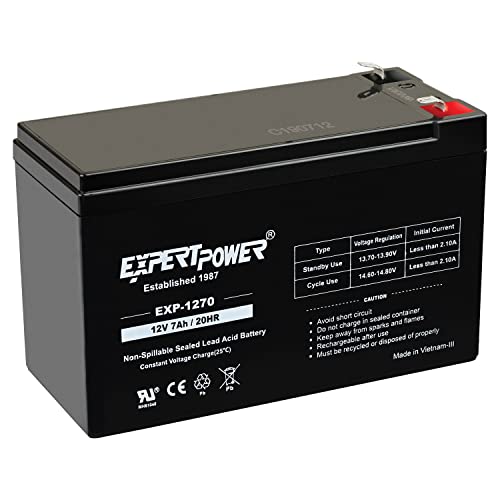
ExpertPower EXP1270 12V 7Ah SLA Battery (F1) — Best Overall
The EXP1270 is the battery class that game feeders were designed around: 12 volts, 7 amp-hours, F1 spade terminals, in a sealed case that fits the battery compartment of most 12V feeder control units. ExpertPower’s version is the default recommendation because it is the proven commodity executed properly — correct size, correct terminals, sealed against the weather inside a feeder housing, and inexpensive enough that replacing it on a schedule is a plan rather than a failure. For a feeder visited monthly, or any feeder paired with a small solar panel, this is the battery.
Strengths
- Exact feeder format: 7Ah class with F1 terminals
- Sealed and maintenance-free for outdoor feeder housings
- Inexpensive enough to replace on a preventive schedule
Trade-offs
- Lead-acid standby: expect weeks to a couple of months per charge without solar help
- Must be stored charged in the off-season or it loses capacity permanently
- No advantage in capacity over rivals; the pick rests on format and reliability
| Specification | Detail |
|---|---|
| Capacity | 7Ah |
| Chemistry | SLA (sealed lead-acid), rechargeable |
| Terminals | F1 (per API listing title) |
Feeder motors are a trivial load — seconds of draw, a few times a day — so a 7Ah battery holds, in energy terms, an enormous reserve of feedings. The battery’s real enemy is the calendar: self-discharge and the control unit’s standby draw nibble at it daily, and heat accelerates both. That is why the practical runtime of a feeder battery is measured in weeks of standby rather than in feedings, and why the solar pairing discussed in the buying guide transforms this battery’s service from monthly visits to seasonal ones.
The F1 terminal detail matters more than it looks. Feeder wiring harnesses are built with F1 or F2 spade connectors, and a battery whose terminals match the harness plugs in securely and stays connected through months of vibration and weather. The EXP1270’s F1s are the most common feeder fit; check your harness before ordering, and if yours is F2, the EXP1280 below is your version of this same pick.
ExpertPower is a sensible brand to default to in commodity SLA sizes: the batteries are consistent, the sizes are honest, and replacements are identical year after year, which matters for a component you intend to swap without thinking.
Buy it, pair it with a small solar panel if the feeder sits in any sun at all, and this is feeder power solved at the lowest sensible cost.
Best for: Most 12V feeders: monthly visits, or season-long duty with a solar panel / Not suited for: 6V feeders (check first), or owners wanting multi-month intervals with no solar and no visits
Check the current price on Amazon

Wildgame Innovations 12V Edrenaline Rechargeable Battery — Best Feeder-Specific
Wildgame Innovations makes feeders, and the Edrenaline is its battery for them: a sealed lead-acid pack with tab-style terminals, listed explicitly for game feeders. If your feeder is a Wildgame unit — or you simply prefer the battery designed by a feeder company for feeder duty, with the fit and connectors its own control units expect — this is the purpose-built pick, the one most likely to drop into the compartment and plug into the harness exactly as the original did.
Strengths
- Purpose-built for game feeders by a feeder manufacturer
- Tab terminals match feeder-brand harnesses directly
- Sealed lead-acid: the proven feeder chemistry
Trade-offs
- Listing does not state capacity in its title; it is a standard feeder-class pack, not a high-capacity one
- Brand-specific fit is its virtue and its limit — universal SLA sizes offer broader cross-compatibility
- Same lead-acid standby and storage rules as the other SLA picks
| Specification | Detail |
|---|---|
| Chemistry | Sealed lead-acid, rechargeable (per API listing title) |
| Terminals | Tab style (per API listing title) |
| Intended use (per listing) | Game feeders |
There is a real argument for buying the battery from the company that made the feeder, and it is not brand loyalty — it is fit. Feeder battery compartments are molded to a size, harnesses are cut to a length, and connectors are chosen by the feeder’s designer. The Edrenaline was specified by people who knew all three, which removes the small frictions — the tight squeeze, the stretched lead, the connector that almost seats — that make generic batteries annoying in this specific application.
On performance, expect the class standard: weeks of standby per charge, transformed into a season by a solar panel, and a service life measured in seasons if it is stored charged. Nothing about feeder duty rewards exotic specifications, and this battery’s specification is deliberately ordinary where it counts.
The capacity not being stated in the listing title is worth a transparent note: feeder-class packs cluster tightly in the 7Ah neighborhood, and this battery should be bought as a fit-and-purpose choice rather than a capacity one. Owners who need a stated, larger capacity should take the ML8-12 or EXP1280 below.
For the Wildgame feeder owner especially, this is the zero-thought replacement, and zero-thought is a genuine feature in a component checked a few times a season.
Best for: Wildgame feeder owners and anyone wanting the purpose-built feeder battery / Not suited for: Owners who need a stated high capacity, or non-standard feeder housings
Check the current price on Amazon
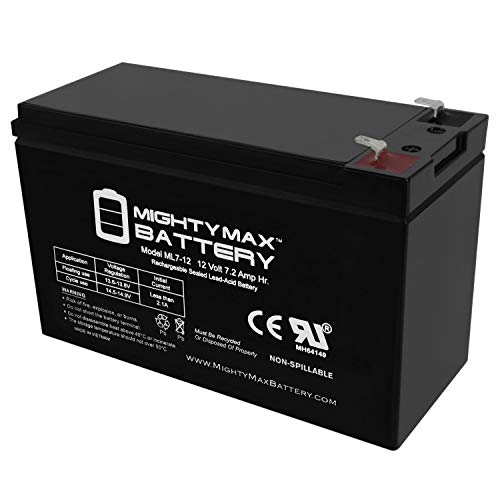
Mighty Max ML7-12 12V 7.2Ah SLA Battery (F1) — Best Budget
The ML7-12 is the budget expression of the feeder standard: a fraction more capacity than the 7Ah class at 7.2Ah, the same F1 terminals, the same sealed case, from the highest-volume small-battery brand in this guide. It suits the owner running several feeders — where battery cost multiplies by the number of units — and the owner who treats feeder batteries as seasonal consumables and buys accordingly.
Strengths
- Lowest cost in this guide, which matters across multiple feeders
- 7.2Ah: a small capacity edge over the 7Ah class
- Standard size and terminals; replacements are identical and everywhere
Trade-offs
- Commodity SLA longevity: plan on seasons, not years, especially stored carelessly
- No feeder-specific design; check compartment fit and terminal match
- Standby per charge is the class standard — solar pairing still recommended
| Specification | Detail |
|---|---|
| Capacity | 7.2Ah |
| Chemistry | SLA (sealed lead-acid) |
| Terminals | F1 (per API listing title) |
Multi-feeder properties change the economics of this category completely. A battery choice that is trivial for one feeder becomes a line item across six, and the ML7-12’s combination of the lowest price and a standard, always-available format is the rational fleet choice. Owners running several feeders also tend to standardize: one battery model, one charger routine, spares on the shelf that fit every unit.
The honest limit is the same as every commodity SLA: its life is decided by storage. A fleet of these stored charged and topped up will run for seasons; a fleet left in the feeders through a hot summer and a cold winter will be replaced annually, and at this price some owners accept exactly that trade with open eyes.
Against the ExpertPower, the differences are small — a whisker of capacity here, brand preference there — and the guide’s ordering reflects fit and feeder-specificity more than performance. Either battery, correctly stored and solar-assisted, does the whole job.
For the multi-feeder property and the budget-first buyer, this is the pick.
Best for: Multiple feeders, seasonal-consumable buyers, and the tightest budgets / Not suited for: Owners wanting maximum seasons per battery, or feeder-specific fit
Check the current price on Amazon

Mighty Max ML8-12 12V 8Ah SLA AGM Battery (F1) — Best Step-Up Capacity (SLA)
The ML8-12 is the quiet upgrade inside the SLA class: 8Ah instead of 7, in the same feeder-friendly format with F1 terminals. That extra amp-hour is roughly a 14 percent larger reserve against the standby drain that decides feeder runtime — which translates, in the field, to extra weeks between charges or a wider safety margin through a hot month. It suits the owner whose feeder is a long drive away and whose visits are the scarce resource.
Strengths
- Most capacity in the standard SLA feeder format
- Same F1 fit as the 7Ah class; a drop-in step up
- AGM construction: sealed, spill-proof, any orientation
Trade-offs
- Confirm the compartment accepts the size; most do, some are tight
- Still lead-acid standby physics — solar pairing remains the real interval extender
- Marginal gain over 7Ah; worth it for remote feeders, minor for visited ones
| Specification | Detail |
|---|---|
| Capacity | 8Ah |
| Chemistry | SLA AGM (sealed lead-acid) |
| Terminals | F1 (per API listing title) |
It is worth being precise about what one amp-hour buys a feeder, because it is not feedings — the motor’s draw is trivial — it is standby days. A feeder system’s parasitic and self-discharge drain is a slow, constant leak, and every amp-hour of capacity is a bucket under that leak. Fourteen percent more bucket is fourteen percent more time, and on a feeder checked monthly, that margin is often the difference between a spinning feeder and a silent one in the final week.
The AGM construction adds the usual sealed virtues: no orientation worries in a feeder housing that may tilt, no maintenance, and better tolerance of the vibration and temperature swings of outdoor life than a basic flooded cell.
Paired with solar, the step-up compounds: a slightly larger reserve smooths the cloudy stretches that test a solar feeder in winter, when days are short and panels are lazy. Remote-feeder owners building a fit-and-forget system should start with this battery and a panel, in that order.
For the standard feeder visited often, the 7Ah picks suffice; for the remote one, this is the SLA to buy.
Best for: Remote feeders and owners stretching intervals between charges / Not suited for: Tight compartments that only accept the 7Ah case — measure first
Check the current price on Amazon

TRUVALUX 2 Pack 12V 10Ah LiFePO4 Batteries (IP67) — Best Lithium Upgrade
The TRUVALUX two-pack is the modernization path: two 10Ah lithium packs, IP67-sealed, with F2 terminals, a 5,000+ cycle rating, and — uniquely in this guide — deer feeders named in the listing itself. Lithium changes feeder service in the ways that matter here: far lower self-discharge across long standby, no permanent damage from sitting partly charged, full capacity usable, and a lifespan measured in many seasons rather than a few. Two packs mean one in the feeder and one charged at home, or two feeders covered.
Strengths
- Deer feeders named in the listing; F2 terminals for feeder harnesses
- Lithium standby: months of readiness with minimal self-discharge
- 5,000+ cycles and IP67 sealing for many seasons outdoors
Trade-offs
- Costs several times an SLA; the value case rests on lifespan and fewer visits
- Confirm your feeder’s control unit is happy with lithium’s slightly higher resting voltage — most are, a few older units are fussy
- F2 terminals: F1-harness feeders need the SLA picks or a connector swap
| Specification | Detail |
|---|---|
| Capacity | 10Ah per battery, 2 batteries (per API listing title) |
| Chemistry | LiFePO4 |
| Ingress protection | IP67 (per API listing title) |
| BMS | 10A (per API listing title) |
| Terminals | F2 (per API listing title) |
| Rated cycles | 5,000+ (per API listing title) |
| Intended use (per listing) | Deer feeders, fish finder, kayak, solar, and more |
The feeder case for lithium is different from the usual one. It is not about weight or cranking; it is about the calendar. Lead-acid’s twin standby taxes — steady self-discharge and permanent damage when stored low — are precisely the taxes feeder duty imposes. Lithium barely self-discharges and tolerates partial charge indefinitely, so a lithium feeder battery in October is a lithium feeder battery in November, at nearly the same charge, with no harm done. For a property visited rarely, that is not an upgrade; it is a different category of reliability.
The two-pack format fits the ownership pattern exactly. Swap-and-go visits become possible: arrive, exchange the pack, and the feeder never waits on a charger. And with a small solar panel, a lithium feeder approaches true set-and-forget operation across a whole season.
The cautions are stated plainly in the trade-offs: check terminal type (F2 here), and give older control units a bench test at home before the season. Neither is a reason to avoid the upgrade; both are reasons to do it in the off-season rather than the week before opening day.
For the remote property and the owner tired of annual SLA replacements, this is the guide’s forward-looking pick.
Best for: Remote properties, low-visit owners, and anyone upgrading from annual SLA replacement / Not suited for: F1-harness feeders without a connector change, or the tightest budgets
Check the current price on Amazon

ExpertPower EXP1280 12V 8Ah SLA Battery (F2) — Best for F2 Feeders
Terminal type is the feeder detail that decides whether a battery plugs in or fights you, and the EXP1280 is the F2 answer: 8Ah of sealed lead-acid with the wider F2 spades that many feeder harnesses use, from the same ExpertPower line as our top pick — with deer feeder named among its listed uses. If your harness is F2, this is your version of the guide’s default recommendation, with the 8Ah step-up capacity included.
Strengths
- F2 terminals for the harnesses that use them — no adapters, no crimping
- 8Ah capacity: the step-up reserve in SLA form
- Deer feeder use named in the listing itself
Trade-offs
- Wrong terminals for F1 feeders; the letter matters, check yours
- Lead-acid standby and storage rules apply in full
- No lithium longevity for owners ready to upgrade chemistry
| Specification | Detail |
|---|---|
| Capacity | 8Ah |
| Chemistry | SLA (sealed lead-acid), rechargeable |
| Terminals | F2 (per API listing title) |
| Intended use (per listing) | Deer feeder, fish finder, UPS, alarm |
It is a small thing, a terminal width, and it decides real purchases: an F1 connector forced onto an F2 terminal is a loose connection in a vibrating, weather-exposed box, which is to say a feeder that stops in week three for no visible reason. The EXP1280 exists so that F2 owners never improvise that connection. Match the letter on your harness to the letter on the battery and the electrical side of feeder ownership becomes boring, which is the goal.
On capacity and chemistry it mirrors the ML8-12: the 8Ah step-up for longer standby, in sealed lead-acid with its familiar economics and its familiar storage discipline. ExpertPower’s consistency across the two terminal variants means an owner can standardize on one brand across a mixed fleet of feeders, which simplifies spares more than any single specification does.
The listing’s own mention of deer feeders is a small but real reassurance: the manufacturer expects this battery to be bought for exactly your purpose, in exactly this size.
F2 owners: this is your default. F1 owners: the EXP1270 is the same battery in your letter.
Best for: F2-harness feeders wanting the 8Ah SLA step-up / Not suited for: F1 feeders, or owners ready to move to lithium
Check the current price on Amazon
Comparison Table
Feeder runtime is standby time, not feedings: compare capacity class, terminal letter, and each chemistry’s storage behavior before anything else on this page.
| Pick | Badge | Key spec | Best for |
|---|---|---|---|
| ExpertPower EXP1270 12V 7Ah SLA Battery (F1) | Best Overall | 7Ah SLA, F1 terminals | Most 12V feeders: monthly visits, or season-long duty with a solar panel |
| Wildgame Innovations 12V Edrenaline Rechargeable Battery | Best Feeder-Specific | SLA feeder battery, tab terminals | Wildgame feeder owners and anyone wanting the purpose-built feeder battery |
| Mighty Max ML7-12 12V 7.2Ah SLA Battery (F1) | Best Budget | 7.2Ah SLA, F1 terminals | Multiple feeders, seasonal-consumable buyers, and the tightest budgets |
| Mighty Max ML8-12 12V 8Ah SLA AGM Battery (F1) | Best Step-Up Capacity (SLA) | 8Ah SLA AGM, F1 terminals | Remote feeders and owners stretching intervals between charges |
| TRUVALUX 2 Pack 12V 10Ah LiFePO4 Batteries (IP67) | Best Lithium Upgrade | 2 × 10Ah LiFePO4, IP67, F2 terminals, 5,000+ cycles | Remote properties, low-visit owners, and anyone upgrading from annual SLA replacement |
| ExpertPower EXP1280 12V 8Ah SLA Battery (F2) | Best for F2 Feeders | 8Ah SLA, F2 terminals | F2-harness feeders wanting the 8Ah SLA step-up |
How to Choose a 12 Volt Battery for Your Game Feeder
Confirm the voltage first — before brand, before capacity, before price. This guide is for 12V feeders; a large share of the feeder market runs 6V control units, and the two do not mix. The control unit’s label, the manual, or the battery it shipped with will tell you. Everything after this paragraph assumes a confirmed 12V feeder.
Then match the terminals. Feeder harnesses use F1 or F2 spade connectors, and the battery must match the letter: F1 picks (EXP1270, ML7-12, ML8-12), F2 picks (EXP1280, TRUVALUX). A matched connector seats firmly and survives months of vibration; a forced one becomes next month’s mystery failure. Capacity comes third, and the answer is almost always the 7–8Ah class the feeders were designed around, with lithium’s 10Ah as the upgrade step.
- Voltage first: confirm the feeder is a 12V model before buying anything
- Terminal letter second: F1 or F2 must match the harness exactly
- Capacity third: 7–8Ah SLA is the design class; 10Ah lithium is the upgrade
- Standby is the runtime: self-discharge and control-unit draw set the interval between visits
- A small solar panel converts any pick here into season-long service
- Standardize across multiple feeders: one model, one charger, interchangeable spares
Finally, decide your visit interval honestly and buy the chemistry that serves it: monthly visits make SLA the rational economy; quarterly visits argue for the 8Ah step-up plus solar; rare visits are lithium’s home ground.
Solar Panels: The Feeder Battery’s Best Friend
No accessory changes feeder ownership like a small solar panel. A feeder’s daily draw — a few seconds of motor, a whisper of standby — is so small that even a modest panel in partial sun replaces it with room to spare, holding the battery near full indefinitely. The practical result: an SLA battery that would need a visit every month or two instead runs a full season, and its life lengthens too, because a battery held near full charge is a battery aging slowly. Most feeder brands sell panel kits matched to their control units; universal small panels with the correct connector do the same job.
Placement is the whole craft: the panel wants the sunniest aspect the feeder’s location offers, angled toward the midday sun, clear of the canopy shadow that moves across it as seasons change. A panel in deep shade is a decoration. Check it when you check the feeder, wipe it clean, and confirm the charge indicator if the control unit has one. That thirty-second routine is the difference between a solar system and a solar hope.
One more solar point, because it decides battery life as much as runtime: a battery held near full charge by a panel is a battery that is not sulfating, not stratifying, and not sitting in the partial-charge zone where lead-acid ages fastest. The panel is therefore not merely a charger but a preservation system, and owners who add one typically discover their batteries lasting twice as many seasons as the identical batteries did without it. It is the rare accessory that pays for itself in two different currencies at once.
Feeders in Heat and Cold: What the Seasons Do to a Battery
A feeder battery lives outdoors all year, and the seasons tax it in opposite directions. Summer heat is the silent consumer: self-discharge in lead-acid roughly accelerates with temperature, and a battery in a sun-baked feeder housing on a southern property can lose its charge weeks faster than the same battery in a shaded northern one. Heat also ages the chemistry itself, which is why southern owners replace feeder batteries more often and why a solar panel — which keeps the battery topped against the accelerated drain — pays for itself fastest exactly there.
Winter cold works differently: it does not consume the battery, it weakens its delivery. A cold lead-acid battery shows lower voltage and cranks the little feeder motor with less enthusiasm, and a battery left discharged in freezing weather can be damaged outright as its electrolyte weakens. The defenses are the calendar habits this guide keeps repeating — keep the battery charged (a charged battery resists freezing far better than a flat one), and let the panel do in winter what it does in summer.
Lithium rewrites parts of this story and not others. Its self-discharge barely notices the heat, and it discharges well in the cold; its one seasonal rule is charging temperature, which a solar panel on a bright winter day can actually violate if the battery is below freezing — quality feeder-sized lithium packs protect themselves, and owners in genuinely cold country should confirm that behavior or bring the pack’s charging indoors in the coldest stretches. None of this is a reason to avoid either chemistry; all of it is a reason to match the battery to the property’s climate, not just its feeder.
Off-Season Storage: Where Feeder Batteries Live or Die
More feeder batteries die in the off-season than in the woods. The pattern is always the same: the feeder comes down (or does not), the battery sits discharged in a hot shed or a freezing barn, and by next season a lead-acid pack has sulfated itself into a paperweight. The defense takes five minutes: bring the battery in, charge it fully, store it somewhere temperate, and top it up once or twice across the off-season. Lithium asks even less — charge it partway to fully, shelve it, and ignore it until spring. Owners who build this tiny ritual get three to five seasons from batteries that their neighbors replace annually, from the same shelf, at the same store.
How Long Will a Feeder Battery Actually Last?
Owners ask for a number, so here is the honest shape of one. The motor’s draw is negligible — thousands of feedings sit inside any battery in this guide. The interval between charges is set by standby: the control unit’s idle draw plus the battery’s self-discharge, both nibbling daily, both worse in heat. In practice, a 7–8Ah SLA in a typical 12V feeder runs roughly four to ten weeks per charge depending on the unit, the temperature, and the feeding schedule; the 8Ah picks sit at the longer end; a solar panel removes the limit entirely; and the TRUVALUX lithium packs stretch the no-solar interval furthest of all, because lithium’s self-discharge is a fraction of lead-acid’s.
The practical advice follows directly: if your interval disappoints you, do not buy a bigger battery — the compartment will not fit one and the gain is small. Add the panel, or change the chemistry. Those are the two levers that actually move feeder runtime, and both are cheaper than a season of extra driving. Start with the proven EXP1270 if your visits are regular, and step to the ML8-12 when they are not.
And when a feeder stops mid-season, suspect in order: the connection (corroded or vibrated loose), the battery’s charge, the panel’s shading, and only then the control unit. The battery is usually the messenger, not the culprit.
How to Install and Maintain a Feeder Battery
Feeder battery work is simple, seasonal, and mostly about connections and charge state. Done in this order, it takes ten minutes per feeder and prevents nearly every mid-season failure.
- Confirm the feeder is a 12V model (control-unit label or manual) and identify the harness terminal type, F1 or F2, before the battery leaves its box.
- Charge the new battery fully at home first — SLA on a standard smart charger, lithium on a LiFePO4 profile — so the feeder starts its service from full.
- Power the feeder off, remove the old battery, and inspect the compartment: clear out insects, moisture, and feed dust, all of which corrode connections across a season.
- Clean the harness connectors until the metal is bright; a corroded spade connector is the single most common cause of a feeder that “just stopped.”
- Connect the new battery, matching polarity and seating each spade fully; give each connector a gentle tug to confirm it is firm, and route the leads so they cannot chafe or be pulled by the lid.
- If fitting a solar panel, mount it for the sunniest aspect available, connect it per the feeder maker’s instructions, and confirm the control unit shows charging if it has an indicator.
- Run a manual test feed and confirm the motor spins strongly; a weak, slow spin on a fresh battery means a connection or control-unit problem, not a battery problem.
- Note the install date on the battery with a marker, and set your visit or swap interval by the guide above — monthly for SLA without solar, seasonal with solar or lithium.
- At season’s end, bring the battery in, charge it, and store it temperate with a mid-off-season top-up (SLA) or as-is (lithium).
That is the entire discipline. Feeder batteries do not ask for skill; they ask for a calendar. Owners who give them one rarely think about feeder power again.
Keep one charged spare per battery model on the shelf at home, and a feeder visit stops being a repair trip altogether: swap the pack, bring the tired one home to the charger, and the property’s power system maintains itself in a loop that takes minutes per feeder per season.
Common Buying Mistakes
Putting a 12V battery in a 6V feeder. The most damaging mistake in this category, and the easiest to avoid: read the control unit before you buy. Voltage is not a suggestion, and the wrong one can kill the electronics.
Forcing the wrong terminal size. F1 and F2 differ by a few millimetres and a whole season of reliability. A loose spade in a vibrating feeder is a failure scheduled in advance.
Blaming capacity for a standby problem. Feeders die of self-discharge and parasitic draw, not of feeding. If intervals disappoint, add solar or change chemistry — a bigger battery barely helps and usually does not fit.
Skipping the solar panel on a remote feeder. A small panel costs less than the fuel for two extra visits and converts monthly battery service into seasonal service. On remote feeders it is the highest-value accessory in the system.
Storing the battery discharged all off-season. A flat SLA in a hot shed is a battery being consumed by the calendar. Charge it, store it temperate, top it up once — five minutes for seasons of life.
Ignoring the compartment. Insects, moisture, and feed dust corrode connections relentlessly. A cleaned compartment and bright connectors prevent the failures most often blamed on batteries.
Final Recommendation
For most 12V feeder owners, the ExpertPower EXP1270 is the recommendation: the exact format feeders were designed around, at a price that makes scheduled replacement painless — ideally paired with a small solar panel, which transforms its service. Wildgame owners get the zero-thought fit of the Edrenaline; multi-feeder and budget buyers, the Mighty Max ML7-12; remote feeders, the ML8-12 step-up; F2 harnesses, the EXP1280; and owners ready to end the annual replacement cycle, the TRUVALUX lithium two-pack.
The small-battery disciplines in this guide echo across the batch: the same 7–12Ah class powers the electronics in Best 12 Volt Battery For Fish Finder and Best 12 Volt Battery For A Kayak, while the deep-cycle end of the family anchors Best 12 Volt Battery For Camping and Best 12 Volt Battery For 100 Watt Led. Confirm the voltage, match the terminal letter, mind the calendar — and the feeder will be spinning when it matters.
Frequently Asked Questions
How long does a 12V battery last in a game feeder?
The feedings themselves use almost nothing; standby drain sets the interval. A 7–8Ah sealed lead-acid typically runs a feeder for roughly four to ten weeks per charge depending on the control unit and temperature. A small solar panel extends that to a full season, and lithium lasts longest of all between charges.
Can I use a lithium battery in my game feeder?
Usually yes, and deer feeders are named in the TRUVALUX listing in this guide. Confirm your terminal type (this pack is F2) and give older control units a bench test first, as a few are fussy about lithium’s slightly higher resting voltage. Never use any 12V battery in a 6V feeder.
Is my feeder 6 volt or 12 volt?
Check the control unit’s label, the manual, or the battery it came with from the maker. Many feeders are 6V; this guide covers the 12V models. The two voltages are not interchangeable, and using the wrong one can damage the control unit.
What is the difference between F1 and F2 terminals?
They are two widths of spade terminal. Your feeder’s harness is built for one of them, and the battery must match: a forced fit makes a loose connection that vibration and weather will eventually open. This guide includes picks in both letters.
Do I need a solar panel for my feeder?
Not for a feeder you visit monthly anyway. For a remote feeder, a small panel is the single best upgrade available anywhere: it holds the battery near full, stretches service to a whole season, and lengthens the battery’s life at the same time.
How should I store a feeder battery in the off-season?
Bring it in, charge it fully, and store it somewhere temperate. Top up a lead-acid battery once or twice across the off-season; a lithium battery can simply be shelved partly to fully charged. Storing any battery discharged is how next season starts with a replacement.


