Disclosure: airfryerkitchensupply.com is reader-supported. When you buy through links on our site, we may earn an affiliate commission at no extra cost to you.
Where to buy
Every battery in this guide to the best 12 volt battery for 100 watt led lighting was verified against Amazon’s own catalog data before it was included, so each linked model is a real, currently listed product with the capacity printed in its listing title. Use the links in this box, in the Quick Picks, and in each review to check live availability, and always check the current price on Amazon rather than relying on any number printed elsewhere, because battery pricing moves with sales and stock.
- Dumfume 12V 100Ah LiFePO4 Lithium Battery (Group 31) — Check the current price on Amazon
- Mighty Max ML100-12 12V 100Ah SLA AGM Battery — Check the current price on Amazon
- Renogy 12V 200Ah Deep Cycle AGM Battery — Check the current price on Amazon
- Newport 12V 50Ah Deep Cycle AGM Marine Battery — Check the current price on Amazon
- NERMAK 12V 10Ah LiFePO4 Deep Cycle Battery — Check the current price on Amazon
- GOLDENMATE 12V 10Ah LiFePO4 Battery (IP67) — Check the current price on Amazon
The best 12 volt battery for 100 watt led lighting is decided by one piece of arithmetic most listings never do for you: a 100-watt LED load draws roughly 8.3 amps from a 12-volt battery, so every amp-hour of usable capacity buys you about seven minutes of full-brightness light. That single fact sorts this entire market. A compact 10Ah lithium pack is an honest one-hour battery. A 100Ah deep-cycle battery is an all-evening battery. Anything in between is a compromise you should make deliberately, not by accident.
The second fact that matters is chemistry. A lithium iron phosphate (LiFePO4) battery can be discharged deeply, down to nearly all of its rated capacity, thousands of times. A sealed lead-acid or AGM battery should only be drawn down to about half its rated capacity if you want it to survive more than a season or two, which means a 100Ah AGM behaves like a 50Ah battery in real lighting service. When you compare the six picks below, compare usable amp-hours, not the number printed largest on the case.
This guide covers the full spread of sensible answers: a 100Ah lithium battery that runs a 100-watt LED for the better part of a night, a budget 100Ah AGM for buyers who would rather pay less up front, a 200Ah AGM for maximum lead-acid runtime, a 50Ah marine AGM that splits the difference, and two compact 10Ah lithium packs for short sessions, portable light bars, and outdoor fixtures where weather sealing matters more than capacity.
One honest note before the picks: a 100-watt LED is a serious continuous load for small batteries. The compact picks in this guide are included because many “100 watt” LED fixtures are run dimmed, run briefly, or are actually smaller loads wearing a big label. If your fixture genuinely pulls 100 watts for hours at a time, skip straight to the 100Ah class. The runtime table in the buying guide section shows exactly what each capacity buys you.
There is also a systems point worth making at the start. A battery does not light anything by itself: between the battery and the LED sit cable, a fuse, possibly a driver or dimmer, and connectors, and each of those can waste power or cause trouble if it is undersized. The how-to section of this guide covers the wiring in practical detail, because in our experience more battery-powered lighting disappoints through its wiring than through its battery. Choose the battery with the arithmetic in this guide, then wire it like the continuous 8-amp load it is.
In this guide
Quick Picks
Six verified batteries, from a one-hour pocket pack to an all-night 100Ah lithium, matched to how long your 100-watt LED actually needs to run.
- Best Overall — Dumfume 12V 100Ah LiFePO4 Lithium Battery (Group 31): A full 1,280Wh of lithium capacity that runs a 100-watt LED for roughly eleven hours, with a 100A BMS that treats an 8.3A lighting load as trivial. Check price on Amazon
- Best Budget — Mighty Max ML100-12 12V 100Ah SLA AGM Battery: The lowest-cost way into genuine all-evening runtime: 100Ah of AGM capacity, as long as you respect the 50 percent discharge rule. Check price on Amazon
- Best for Longest Runtime — Renogy 12V 200Ah Deep Cycle AGM Battery: Two hundred amp-hours of AGM: around twelve usable hours at 100W, for lighting that absolutely cannot go dark. Check price on Amazon
- Best Mid-Size — Newport 12V 50Ah Deep Cycle AGM Marine Battery: The middle path: about three usable hours at 100W in a marine-grade case that is still genuinely carryable. Check price on Amazon
- Best for Short Sessions — NERMAK 12V 10Ah LiFePO4 Deep Cycle Battery: One honest hour at full power, in a pack light enough to mount on the light itself; the listing names lighting as a core use. Check price on Amazon
- Best for Outdoor Fixtures — GOLDENMATE 12V 10Ah LiFePO4 Battery (IP67): The same one-hour class as the NERMAK, but sealed to IP67 and rated for 5,000+ cycles: the outdoor fixture battery. Check price on Amazon
How These Picks Were Chosen
Every pick below was verified through the Creators API against Amazon’s live catalog: the brand, model, capacity, and chemistry in each review come from the listing title the API returned, and only API-confirmed models carry a purchase link. No battery was included on the strength of a marketing claim we could not tie to a real listing.
Beyond verification, picks were chosen on the criteria that decide real lighting service: usable capacity at a continuous 8-amp-plus draw, chemistry and realistic cycle life, the battery management system’s continuous current rating on lithium models (it must comfortably exceed the LED’s draw), terminal style and how easily it wires to common LED drivers and fixtures, and weight, because many of these batteries get carried to where the light is.
- Usable amp-hours at a 100W (roughly 8.3A) continuous draw, not headline capacity
- Chemistry: LiFePO4 for deep discharge and long cycle life, AGM/SLA for lower up-front cost
- BMS continuous discharge rating on lithium picks, with headroom above the LED load
- Terminal type and wiring compatibility with LED drivers, strips, and fixtures
- Weight and form factor for portable lighting rigs
- Verified listing: brand, model, and capacity confirmed in Amazon catalog data
The 6 Best 12 Volt Battery for 100 Watt LED Picks
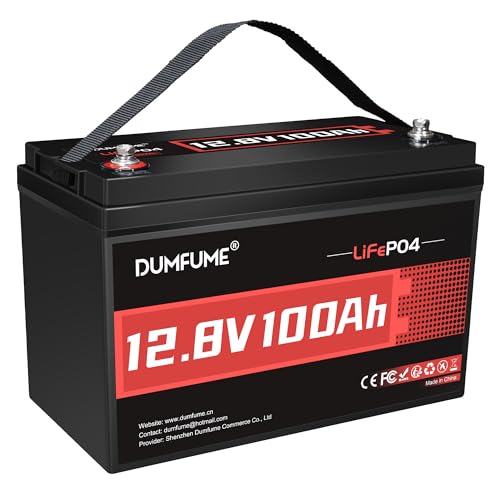
Dumfume 12V 100Ah LiFePO4 Lithium Battery (Group 31) — Best Overall
If your 100-watt LED needs to run all evening, all night, or across a weekend of off-grid use without a recharge, this is the battery the arithmetic points to. The Dumfume stores 1,280 watt-hours, and because LiFePO4 can be discharged deeply without the damage that punishes lead-acid, nearly all of that energy is genuinely available to your light. It suits workshop and barn lighting fed from a battery bank, off-grid cabins, market stalls, film and photography lighting run away from mains power, and anyone building a small solar lighting system who wants one battery rather than a rack of small ones.
Strengths
- 1,280Wh of mostly usable capacity: roughly eleven hours at a full 100W draw
- 100A BMS gives enormous headroom over an 8.3A LED load, so no nuisance cut-offs
- Group 31 case drops into standard battery boxes and trays made for big deep-cycle batteries
Trade-offs
- Group 31 size is a two-hand carry; overkill for a light you run for one hour
- Lithium up-front cost per battery is higher than AGM, even though cost per cycle is lower
- Needs a lithium-compatible charger profile to charge correctly and fully
| Specification | Detail |
|---|---|
| Capacity | 100Ah (1,280Wh) |
| Chemistry | LiFePO4 (lithium iron phosphate) |
| BMS | Built-in 100A |
| Case size | Group 31 |
| Rated cycles | 15,000+ (per API listing title) |
The reason this battery wins the top spot is depth of discharge. A 100Ah AGM in lighting service should be treated as a 50Ah battery if you care about lifespan, which halves its headline advantage and brings its real runtime to around six hours. The Dumfume’s lithium chemistry lets you use the deep majority of its 100Ah night after night, so the honest runtime comparison is roughly eleven hours against six from the same nominal capacity in lead-acid. For a light that must simply still be on at 2 a.m., that gap is the whole decision.
The 100A battery management system matters in a quieter way: it will never be the bottleneck. LED drivers, especially cheaper ones, can draw brief inrush current at switch-on, and a small battery with a 10A BMS can trip its protection and plunge you into darkness even though the steady load is within limits. Here the BMS ceiling is more than ten times the load. Wire it with sensibly gauged cable, add a fuse near the positive terminal, and this battery disappears into the background of the system, which is exactly what a lighting battery should do.
It also plays well with solar. A lighting bank that recharges from panels during the day wants a battery that accepts charge efficiently and tolerates the partial-charge life solar imposes; lithium does both, where lead-acid slowly sulfates if it spends its life between half and mostly charged. If your 100-watt LED is the night load of a small off-grid system, this is the battery that system wants at its center.
Best for: All-night and multi-evening 100W LED lighting, off-grid and solar lighting banks / Not suited for: Buyers who only need an hour of light and would rather carry something pocket-sized
Check the current price on Amazon
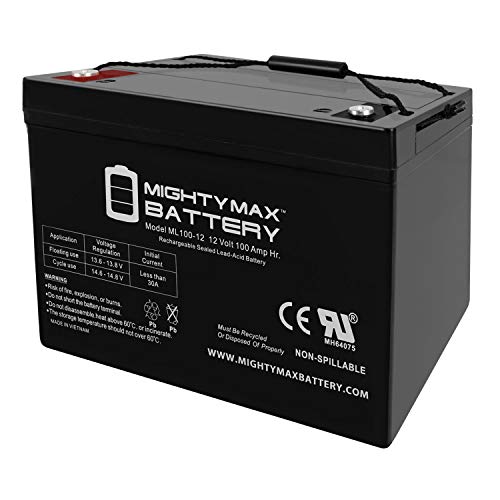
Mighty Max ML100-12 12V 100Ah SLA AGM Battery — Best Budget
The ML100-12 is for the buyer who did the runtime math, wants the 100Ah class, and would rather spend less up front and accept lead-acid’s rules. It suits stationary lighting installations — a garage, workshop, or barn where the battery sits in one place, weight never matters, and a disciplined owner recharges promptly after use. If your lighting runs most evenings but rarely through the whole night, its roughly 50Ah of lifespan-friendly usable capacity still delivers around six hours at 100 watts.
Strengths
- 100Ah class capacity at the lowest up-front cost in this guide
- AGM construction is sealed, spill-proof, and maintenance-free
- Internal thread terminals make solid, vibration-resistant bolted connections
Trade-offs
- Only about half the capacity is usable if you want long cycle life
- Heavy: a 100Ah lead-acid battery is a committed lift, not a portable
- Cycle life is a fraction of lithium’s when discharged deeply or left part-charged
| Specification | Detail |
|---|---|
| Capacity | 100Ah |
| Chemistry | SLA AGM (sealed lead-acid) |
| Terminals | Internal thread (INT) |
Treat this battery honestly and it is a perfectly good lighting battery. The failure mode to avoid is the one its price invites: running it flat every night because “it is a 100 amp-hour battery.” Drawn to empty regularly, a lead-acid battery sulfates and loses capacity fast, and within a season your six-hour battery becomes a two-hour battery. Kept above half charge and recharged promptly, it will serve for years in a fixed installation.
The internal thread terminals deserve a mention because lighting wiring is often improvised. Bolted ring-terminal connections on INT posts are far more reliable than spring clips or wrapped wire, and for a permanent lighting install that reliability is worth more than any spec-sheet number. Pair it with a proper AGM-profile charger, size your cable for the run length, and this is the value pick of the guide — provided the battery never has to travel.
One more practical note: buy the charger with the battery, not after the first flat weekend. A 100Ah lead-acid battery recharged on a tiny maintainer takes days to recover, and a battery that spends its life waiting for a full charge is a battery quietly losing capacity. A charger in the 10-amp class restores it overnight and keeps the chemistry honest.
Best for: Fixed workshop, barn, and garage lighting on a budget / Not suited for: Portable lighting rigs, or anyone who will regularly run a battery to empty
Check the current price on Amazon

Renogy 12V 200Ah Deep Cycle AGM Battery — Best for Longest Runtime
Some lighting is not optional: security lighting on a remote property, lights in a cabin that is dark by five in winter, a work site that runs two shifts. The Renogy 200Ah AGM is the pick for those cases, doubling the ML100-12’s capacity in a single case. Even respecting the 50 percent rule, its roughly 100Ah of usable capacity runs a 100-watt LED for around twelve hours — a full winter night — and its low self-discharge means it can sit in a standby role without fading away.
Strengths
- Largest capacity in this guide; a full long night at 100W within safe discharge limits
- Low 3% self-discharge suits standby and seasonal installations
- Renogy is an established solar-storage brand with a real support channel
Trade-offs
- Very heavy; plan on two people or a trolley, and a permanent home for it
- Lead-acid cycle life still applies: deep nightly discharge shortens its life
- Costs more than the 100Ah AGM while delivering its extra capacity in the heaviest chemistry
| Specification | Detail |
|---|---|
| Capacity | 200Ah |
| Chemistry | Deep cycle AGM (lead acid) |
| Max discharge current | 2,000A (per API listing title) |
| Self-discharge rate | 3% (per API listing title) |
The honest comparison for runtime shoppers is this battery against the Dumfume lithium above. The Renogy offers about twelve usable hours; the Dumfume about eleven — a near tie on the night that matters. The differences are everything around that night: the Renogy weighs far more, will need replacement sooner under daily cycling, but costs less up front and tolerates simple chargers and cold sheds without complaint. For a battery that cycles a few dozen nights a year in a cabin, that trade is entirely reasonable.
Its 2,000A maximum discharge figure is irrelevant to an 8.3A LED load, but the construction behind it — thick plates and low internal resistance — means voltage stays steadier late in the discharge, so your LED driver sees a healthier supply at hour ten than a tired small battery would give it at hour one. If your lighting is part of a larger 12V cabin system with an inverter and other loads, that stiffness is a genuine, if unglamorous, advantage.
Plan the installation like furniture, not luggage. This battery wants a ventilated, level, permanent spot, cables sized generously, and a charger matched to its capacity so recovery from a long night takes hours, not days. Installed that way, it becomes infrastructure: the light is simply always there, which is the entire point of choosing the biggest case in the guide.
Best for: Cabins, security lighting, and long winter nights where the light must not fail / Not suited for: Anyone who needs to move the battery regularly, or daily deep-cycle users
Check the current price on Amazon

Newport 12V 50Ah Deep Cycle AGM Marine Battery — Best Mid-Size
Not every 100-watt LED runs all night. For an evening of light at a campsite work area, a few hours of floodlighting for a project, or a portable rig that one person carries from a vehicle, the Newport 50Ah is the balanced answer. Its roughly 25Ah of lifespan-friendly usable capacity gives around three hours at full draw, and its marine AGM build tolerates being moved, tilted, and used outdoors in ways a big stationary battery never has to.
Strengths
- Half the bulk of the 100Ah class while keeping deep-cycle construction
- Marine AGM build is sealed and tolerant of movement and damp environments
- A sensible match for dimmed or part-evening 100W lighting
Trade-offs
- Three hours at full 100W is a hard ceiling within safe discharge limits
- Lead-acid weight per usable amp-hour is poor next to the lithium picks
- No BMS or low-voltage protection; you are the discharge manager
| Specification | Detail |
|---|---|
| Capacity | 50Ah |
| Chemistry | Deep cycle AGM (sealed lead acid) |
| Intended use (per listing) | Trolling motors, kayaks, small boats |
This is the battery for the large middle of real-world use: the light runs for an evening, not a night. Buyers routinely overshoot into 100Ah batteries they then have to store, move, and maintain, for a load that a 50Ah handles comfortably. The Newport’s marine heritage also means its case and terminals are designed for damp, vibration, and casual handling — exactly the conditions of portable lighting, and exactly where cheap UPS-style batteries are weakest.
The discipline it demands is the same as any AGM: recharge after use, do not store it discharged, and if you find yourself regularly needing a fourth hour, that is the signal to step up to the lithium 100Ah rather than abusing this one deeper. Used inside its limits, it is the most honestly sized battery in this guide for typical evening lighting.
It is also the natural battery for a small solar lighting setup on a budget: a modest panel, a simple PWM controller, and this battery will run an evening of LED light indefinitely through the brighter months. The system will not match lithium’s winter resilience, but for seasonal use the economics are hard to argue with.
Best for: Evening-length portable lighting, campsite and project floodlights / Not suited for: All-night lighting, or buyers who will not manage discharge depth
Check the current price on Amazon

NERMAK 12V 10Ah LiFePO4 Deep Cycle Battery — Best for Short Sessions
Plenty of 100-watt LED use is brief: a light bar run for an hour, a work light for a single task, a fixture that spends most of its life dimmed well below its maximum. The NERMAK 10Ah is built for that pattern. It is small and light enough to mount at the fixture, its listing explicitly names lighting among its intended uses, and its lithium chemistry means the full 10Ah is working capacity rather than a number you must halve.
Strengths
- Genuinely portable; mount it at the fixture and skip long cable runs
- Full rated capacity is usable, unlike same-size lead-acid packs
- 2,000+ cycle rating suits daily short-session use for years
Trade-offs
- About one hour at a true 100W draw; there is no way around the math
- 10A BMS leaves modest headroom over an 8.3A load; high inrush drivers may trip it
- Too small to grow with you if the lighting system expands
| Specification | Detail |
|---|---|
| Capacity | 10Ah |
| Chemistry | LiFePO4 |
| BMS | Built-in 10A |
| Rated cycles | 2,000+ (per API listing title) |
The critical detail here is the 10A BMS against an 8.3A load. In steady state it works, and thousands of these packs run LED lighting happily. But a cheap LED driver with aggressive inrush can spike past 10A at switch-on and trip the protection, which looks exactly like a dead battery. If your fixture does this, the fix is a battery with a higher BMS ceiling — the 12Ah NERMAK in our fish finder guide carries a 15A BMS — not a bigger capacity. Match the BMS to the load first; capacity second.
Within those limits, this is a delightful little battery: it charges quickly, holds its charge in storage, and delivers flat voltage through the discharge so the LED stays at full brightness rather than sagging the way a tiring lead-acid pack lets it. For task lighting and short sessions, it is the right tool.
It also earns a place as the second battery in a bigger system: the portable pack that runs the work light at the bench while the house bank runs the fixed fixtures. Small lithium packs multiply the usefulness of a lighting setup out of proportion to their size, precisely because they go to the light instead of forcing the light to come to the battery.
Best for: Task lighting, short sessions, and dimmed fixtures needing about an hour / Not suited for: Full-power lighting beyond roughly one hour, or high-inrush LED drivers
Check the current price on Amazon

GOLDENMATE 12V 10Ah LiFePO4 Battery (IP67) — Best for Outdoor Fixtures
Outdoor lighting kills batteries with weather long before it kills them with cycling: rain in the battery box, condensation, dust, and freeze-thaw. The GOLDENMATE answers with an IP67-sealed case, the strongest weather rating among our small picks, and a 5,000+ cycle rating that suits a dusk-to-late-evening fixture running every single night. Its listing names lights and camping among its intended uses, which matches exactly the role it fills here.
Strengths
- IP67 sealing shrugs off rain, splashes, and dusty battery boxes
- 5,000+ cycle rating is the highest among the compact picks
- Lithium voltage stays flat, so outdoor fixtures stay at full brightness
Trade-offs
- Same one-hour ceiling at full 100W as any 10Ah battery
- Sealed case means no user serviceability; it is a replace-not-repair unit
- Costs more than unsealed 10Ah packs; you are paying for the sealing and cycle life
| Specification | Detail |
|---|---|
| Capacity | 10Ah |
| Chemistry | LiFePO4 |
| Ingress protection | IP67 waterproof (per API listing title) |
| Rated cycles | 5,000+ (per API listing title) |
For a permanently installed outdoor fixture — a yard light, a gate light, a sign light fed by a small solar panel — this battery’s specification reads like it was written for the job. Daily shallow cycling is where a 5,000-cycle rating pays out over years, and IP67 sealing removes the most common failure mode of outdoor battery boxes. Paired with a modest solar panel and a charge controller, it becomes a fit-and-forget lighting power source.
The same one-hour-at-full-power honesty applies: if your outdoor fixture truly draws 100 watts continuously, mount this battery’s bigger siblings instead. But most outdoor LED fixtures in this class run at partial output or on motion and timer schedules, and for those real-world duty cycles, weatherproofing beats raw capacity. Choose this when the battery lives outside; choose the NERMAK when it lives indoors.
A final practical point: IP67 describes the battery case, not your connections. Use sealed connectors or a weatherproof junction box for the wiring joints, because in outdoor installs the terminals and splices — not the battery — are where corrosion starts. Protect those, and this pack should outlast the fixture it feeds.
Best for: Outdoor, solar-fed, and weather-exposed LED fixtures with daily cycling / Not suited for: Indoor task lighting, where its weather sealing buys you nothing
Check the current price on Amazon
Comparison Table
Usable capacity, not headline capacity, is the column that predicts your evening. Lithium picks deliver nearly all of their rating; AGM picks should be planned at about half of theirs for long life.
| Pick | Badge | Key spec | Best for |
|---|---|---|---|
| Dumfume 12V 100Ah LiFePO4 Lithium Battery (Group 31) | Best Overall | 100Ah LiFePO4, 1,280Wh, 100A BMS, Group 31 | All-night and multi-evening 100W LED lighting, off-grid and solar lighting banks |
| Mighty Max ML100-12 12V 100Ah SLA AGM Battery | Best Budget | 100Ah SLA AGM, internal thread (INT) terminals | Fixed workshop, barn, and garage lighting on a budget |
| Renogy 12V 200Ah Deep Cycle AGM Battery | Best for Longest Runtime | 200Ah AGM, 2,000A max discharge, 3% self-discharge | Cabins, security lighting, and long winter nights where the light must not fail |
| Newport 12V 50Ah Deep Cycle AGM Marine Battery | Best Mid-Size | 50Ah deep cycle AGM, marine grade | Evening-length portable lighting, campsite and project floodlights |
| NERMAK 12V 10Ah LiFePO4 Deep Cycle Battery | Best for Short Sessions | 10Ah LiFePO4, 10A BMS, 2,000+ cycles | Task lighting, short sessions, and dimmed fixtures needing about an hour |
| GOLDENMATE 12V 10Ah LiFePO4 Battery (IP67) | Best for Outdoor Fixtures | 10Ah LiFePO4, IP67 waterproof, 5,000+ cycles | Outdoor, solar-fed, and weather-exposed LED fixtures with daily cycling |
How to Choose a 12 Volt Battery for a 100 Watt LED
Start with runtime, because runtime is capacity in disguise. A 100-watt LED draws about 8.3 amps at 12 volts. Divide the battery’s usable amp-hours by 8.3 and you get your hours. One hour needs about 10Ah of lithium or 20Ah of lead-acid. An evening of four hours needs about 35Ah of lithium or 70Ah of lead-acid. A full night of ten to twelve hours needs the 100Ah lithium class or 200Ah of AGM. Buy the class your schedule actually requires; every step up costs money, weight, and storage space.
Next, check the discharge ceiling, not just the capacity. On lithium batteries the BMS rating is the real limit: the continuous rating should exceed your load with room to spare, because LED drivers draw inrush current at switch-on. An 8.3A load on a 10A BMS usually works but can trip with aggressive drivers; a 15A or higher BMS removes the worry entirely. On lead-acid there is no BMS, but there is a softer limit: sustained draws are fine, yet the deeper you discharge, the shorter the battery’s life, which is why the 50 percent planning rule exists.
- Runtime first: hours needed × 8.3A = usable amp-hours required at 100W
- Lithium: plan on nearly the full rated capacity being usable
- AGM/SLA: plan on about half the rated capacity for long cycle life
- BMS continuous rating must exceed the load, with inrush headroom
- Stationary installs can trade weight for cheap AGM capacity; portable rigs cannot
- Budget a lithium-compatible charger if you choose LiFePO4; AGM chargers alone may undercharge it
Finally, think about where the battery lives. A battery that never moves can be a heavy, cheap AGM and nobody suffers. A battery that travels to the light, mounts on a stand, or lives outdoors should be lithium: lighter per usable amp-hour, tolerant of deep discharge, and available in weather-sealed cases. The worst purchases in this category are mismatches of place, not of specification.
Runtime at 100 Watts: What Each Battery Size Really Buys
Because the draw is fixed, the runtime ladder is simple. A 10Ah lithium pack gives about one hour. A 20Ah lithium gives a little over two hours. A 50Ah AGM, planned at half capacity, gives about three hours. A 100Ah lithium gives roughly eleven hours; a 100Ah AGM about six; a 200Ah AGM about twelve. Dimming changes everything in your favor: an LED dimmed to half output draws roughly half the current, so every figure above approximately doubles, which is why small batteries serve dimmed fixtures so well.
Voltage behavior matters at the end of the run. Lithium holds a nearly flat voltage until it is nearly empty, so the light stays bright and then stops. Lead-acid sags progressively, and many LED drivers respond by dimming or flickering as voltage falls — your practical “bright light” runtime from an AGM is a little shorter than the raw arithmetic suggests. Neither behavior is a defect, but the lithium pattern is easier to plan around.
Lithium vs AGM for LED Lighting: The Honest Trade
Lithium iron phosphate wins on usable capacity, cycle life, weight, and voltage stability. It loses on up-front price and asks for a compatible charger and a BMS whose limits you must respect. AGM wins on up-front price, charger simplicity, and tolerance of cold storage, and loses on weight, usable fraction, and lifespan under deep cycling. For a battery cycled daily, lithium’s cost per cycle is decisively lower. For a battery used twenty nights a year in a fixed spot, AGM’s lower purchase price can be the rational choice, and this guide includes strong picks in both chemistries for exactly that reason.
There is one more chemistry note worth knowing: not all lithium is LiFePO4. The batteries in this guide are iron phosphate, the chemistry chosen for stationary and lighting work because it is thermally stable and tolerates thousands of deep cycles. That stability is part of what you are paying for, and it is why we do not recommend substituting random lithium-ion packs of the kind sold for hobby use, however impressive their energy density looks on paper.
Matching the Battery to Real 100 Watt LED Setups
It helps to ground all of this in the setups people actually build. The first is the workshop or barn light: a 100-watt LED high-bay or floodlight over a work area, run three to five hours at a stretch. That is a 25-to-40 usable amp-hour job. The Newport 50Ah AGM covers the short end of it, and the Dumfume 100Ah LiFePO4 covers all of it with room to forget a recharge. The second setup is the off-grid cabin, where the same fixture runs from dusk to bedtime every night and recharges from solar by day; daily cycling at that depth is lithium’s home ground, and lead-acid sized for it must be doubled to survive.
The third setup is the portable rig: a light stand, a 100-watt panel, and a battery that travels in the same case. Here the small lithium packs earn their place. The NERMAK 10Ah or the weather-sealed GOLDENMATE will run the panel at full output for about an hour, and for the far more common pattern — setup shots, task bursts, dimmed working light — that stretches across an entire session. The mistake is buying this class for the first two setups; the equal and opposite mistake is bolting a Group 31 battery to a light stand.
- Workshop floodlight, 3–5 hours: 50Ah AGM class or any 100Ah class battery
- Off-grid cabin, nightly cycling: 100Ah LiFePO4, solar-charged
- Portable stand lighting: 10–12Ah LiFePO4, matched BMS, dimmer as a runtime tool
- Outdoor fixed fixture: IP67-sealed small lithium, solar trickle, sealed connections
Notice what does not appear in any of these setups: a battery chosen because its headline amp-hours sounded impressive. Every good outcome above came from matching usable capacity, chemistry, and protection limits to a stated number of hours. Do that, and any of the six picks in this guide will serve you well; skip it, and even an excellent battery will disappoint you in a predictable way.
How to Wire a 12 Volt Battery to a 100 Watt LED Safely
Wiring a battery to an LED fixture is simple, but the load is continuous and the currents are real, so the details below are the difference between a system that runs for years and one that melts a connector in its first month.
- Confirm the fixture is a 12V DC fixture or that you have a 12V LED driver rated for at least 100W continuous output; never connect a mains-rated LED directly to a battery.
- Work out your cable gauge from the run length: at 8.3A, keep short runs (under about 2 metres) on 14 AWG or thicker, and step up to 12 AWG or thicker for longer runs to limit voltage drop.
- Fit an inline fuse within a few centimetres of the battery positive terminal, rated modestly above the load (a 15A fuse suits a 100W fixture), so a short in the wiring cannot draw battery-melting current.
- Connect positive (red) from battery to fuse to the fixture or driver input, and negative (black) directly back to the battery; check polarity twice before the first switch-on, because many LED drivers have no reverse-polarity forgiveness.
- For lithium batteries, confirm the BMS continuous rating exceeds the fixture draw before wiring; if the light cuts out at switch-on, inrush is tripping the BMS and you need a higher-BMS battery, not a bigger fuse.
- Mount the battery so terminals cannot be bridged by tools or loose metal, keep lead-acid batteries ventilated, and weatherproof outdoor connections with sealed connectors or a junction box.
- Test with a full discharge timed against your expectations; if runtime falls well short of the arithmetic in this guide, measure the fixture’s actual draw with a clamp meter, because many “100 watt” fixtures draw noticeably less — or occasionally more — than the label.
Recharge promptly after use. Lithium tolerates partial charging happily; lead-acid should be returned to full charge as soon as practical and never stored discharged. A battery treated this way will deliver its rated service; one left flat in a shed will not, regardless of brand.
Common Buying Mistakes
Sizing by headline amp-hours. A 100Ah AGM and a 100Ah lithium are not the same battery in lighting service. Plan AGM at about half its rating and lithium at nearly all of it, or your all-night light will go dark at 1 a.m.
Ignoring the BMS ceiling on small lithium packs. A 10A BMS feeding an 8.3A load with inrush can trip at switch-on. The symptom looks like a faulty battery; the cause is a mismatched protection limit.
Undersizing the cable. Thin cable at 8-plus amps drops voltage and heats up. The light dims, the driver strains, and the connector becomes the fuse. Gauge for the run length, not for what was in the drawer.
Skipping the fuse. A 100Ah battery can deliver enormous short-circuit current. A fuse near the positive terminal is cheap insurance against a pinched wire becoming a fire.
Leaving lead-acid discharged. AGM batteries left part-charged sulfate and lose capacity permanently. Recharge after every use and top up in storage.
Believing the fixture label. Many LED fixtures marketed at 100 watts draw substantially less, and a few draw more. Measure once with a clamp meter and size the battery to the real number.
Final Recommendation
For most buyers building serious 100-watt LED lighting, the Dumfume 12V 100Ah LiFePO4 is the recommendation: it is the only class of battery that makes the load an afterthought, running a full night with capacity to spare and a BMS that will never trip on a lighting load. If the battery will live in one place and the budget leads, the Mighty Max ML100-12 delivers the same nominal class for less money, provided you respect lead-acid’s discharge limits. Runtime maximalists should look at the Renogy 200Ah AGM; evening users, the Newport 50Ah; and short-session or outdoor-fixture users, the NERMAK and GOLDENMATE 10Ah lithium packs respectively. Every one of these choices is defensible; the indefensible purchase is the one made without the runtime arithmetic, because in battery-powered lighting the disappointment is always scheduled in advance by the numbers.
If your lighting is part of a bigger 12-volt life, the same verified batteries anchor our companion guides: see Best 12 Volt Battery For Camping for camp power built around these capacities, Best 12 Volt Battery For Fish Finder for the small lithium packs in depth, Best 12 Volt Battery For A Kayak for waterproof on-water power, and Best 12 Volt Battery For Game Feeders for the small SLA batteries that run seasonal equipment. Whichever you choose, do the runtime arithmetic first — in this category, the math is the review.
Frequently Asked Questions
How long will a 12V battery run a 100 watt LED?
Divide usable amp-hours by about 8.3 amps. A 10Ah lithium pack runs roughly one hour, a 100Ah lithium roughly eleven hours, and a 100Ah AGM about six hours if you limit discharge to half its capacity for long life. Dimming the LED extends every figure substantially.
What size battery do I need for 8 hours of 100W LED light?
You need about 66 usable amp-hours. That means a 100Ah LiFePO4 battery, or roughly 130–200Ah of AGM if you observe the 50 percent discharge rule. The 100Ah lithium class is the practical answer for most buyers.
Can a small 10Ah battery run a 100 watt LED?
Yes, for about an hour, provided its BMS continuous rating exceeds the draw. A 10A BMS is marginal with high-inrush drivers; if the light cuts out at switch-on, step up to a battery with a 15A or higher BMS rather than a larger capacity.
Is lithium or AGM better for LED lighting?
Lithium delivers nearly all its rated capacity, lasts far more cycles, weighs less, and holds voltage flat so the light stays bright. AGM costs less up front and uses simpler chargers. Daily cycling favors lithium decisively; occasional fixed use can favor AGM.
Why does my LED dim before the battery is empty?
On lead-acid batteries, voltage sags as charge falls, and many LED drivers dim in response. It is normal behavior, and your practical bright-light runtime is a little shorter than the amp-hour arithmetic suggests. Lithium’s flat discharge curve largely avoids this.
Do I need a special charger for a LiFePO4 lighting battery?
Use a charger with a lithium (LiFePO4) profile. A basic lead-acid charger may undercharge it or hold it at voltages the BMS dislikes. The battery will still work, but you will not get full capacity or the longest life.


