Disclosure: airfryerkitchensupply.com is reader-supported. When you buy through links on our site, we may earn an affiliate commission at no extra cost to you.
Where to buy
Every pump in this guide to the best 110 volt pumps is a current Amazon listing, verified through Amazon’s own product data before we wrote a word about it. Start with the AQUASTRONG 1 HP Sump Pump if you need one pump that handles basements, pools, and flooded yards with real muscle, the Hallmark Industries 1 HP Deep Well Pump if the job is lifting water from a well on household power, the 6699 1/4 HP Utility Pump if you want a light, grab-and-go pump for pools, tubs, and waterbeds, the Trupow Water Transfer Pump if your work is moving water between containers with a garden hose, the KITLUCK 1/2 HP Cast Iron Transfer Pump if you need heavy-duty transfer pressure for irrigation or long hose runs, and the VIVOSUN 800 GPH Submersible Pump if the destination is a pond, fountain, or aquarium. Check the current price on Amazon for the model you choose, and confirm the flow rating and cord length on the listing — pumps that look identical often differ in both.
Introduction: “110 volt pumps” is four different products wearing one name
The search for the best 110 volt pumps hides a complication that most roundups ignore: a “pump” that plugs into a household outlet is not one product but at least four, and buying the wrong type is the most common failure in this category. There are submersible utility and sump pumps, which sit in the water and push it up and out — for flooded basements, pool covers, and emptying anything. There are deep well pumps, long stainless cylinders that live hundreds of feet down a well casing and lift household water up. There are transfer pumps, which sit dry beside the water and pull it through a suction hose and push it out another — for moving water between tanks, draining water heaters, and boosting garden-hose pressure. And there are small circulation pumps for ponds, fountains, and aquariums, which run quietly for months moving modest volumes. All four plug into the same 110/115V outlet. Almost nothing else about them is interchangeable.
This guide is organized around that honesty. Our six picks span the four jobs, each verified through Amazon’s product data, each labeled with the work it actually does, and each with its flow (in gallons per hour or per minute) and lift figures taken from the manufacturer’s own listing. Two numbers decide every pump purchase: flow — how much water moves — and head — how high or far it can push that water against gravity and friction. A pump’s headline flow is always measured at zero lift; the higher you ask it to push, the less it delivers, along a curve the better manufacturers publish. Our buying guide teaches you to size for your real lift, not the brochure’s best case, because an undersized pump does not fail loudly — it just takes all weekend to drain the pool.
One more framing note: 110 volt (often printed 115V on pump nameplates — the same household power) tops out around 1 HP for practical plug-in pumps, which is plenty for every residential job in this guide including most wells. If your application needs more than that — a very deep well, a whole-property irrigation system — you are shopping for a hardwired 230V pump and an electrician, and no honest guide should sell you a plug-in substitute. Within the plug-in world, though, the range is wide and capable, and the six machines below cover it from fountain to farm well.
A last piece of vocabulary, because pump nameplates confuse everyone: 110V, 115V, and 120V on a North American pump all describe the same household power. The grid’s nominal voltage is 120V; 115V is a common motor nameplate rating; 110V is the traditional term this keyword uses. A pump labeled any of the three plugs into your outlet and runs as rated — do not let a nameplate that says 115V talk you out of a pump you found by searching 110, and do not pay a premium for a listing that advertises the “right” number. They are the same electrons.
In this guide
Quick Picks
- Best Overall — AQUASTRONG 1 HP Sump Pump: 4,500 GPH of thermoplastic submersible muscle for basements, pools, and flooding, with the flow to finish jobs in hours, not days. Check the current price on Amazon
- Best for Wells — Hallmark Industries MA0414X-7 1 HP Deep Well Pump: a stainless 110V well pump rated at 33 GPM, built for long service down a 4-inch casing. Check the current price on Amazon
- Best Grab-and-Go Utility — 6699 1/4 HP Utility Pump: 1,600 GPH in a light thermoplastic body with a 10-foot cord, for pools, tubs, ponds, and waterbeds. Check the current price on Amazon
- Best Transfer Pump — Trupow 115V 1/10 HP Transfer Pump: 330 GPH through a complete 6-foot hose kit, the tidy answer to draining water heaters and moving water between containers. Check the current price on Amazon
- Best Heavy-Duty Transfer — KITLUCK 1/2 HP Cast Iron Transfer Pump: 1,500 GPH from a cast-iron body with real pressure for long runs and irrigation duty. Check the current price on Amazon
- Best for Ponds and Fountains — VIVOSUN 800 GPH Submersible Pump: a quiet 50W circulation pump with 10 feet of lift for ponds, aquariums, and statuary. Check the current price on Amazon
How These Picks Were Chosen
We verified every pump through Amazon’s product data feed for this site, matching each model and ASIN against the manufacturer’s own listing. A pump qualified only if its listing states its type, its flow rating, and its voltage plainly. We then built the list by job rather than by brand: one high-flow submersible for general water removal, one deep well pump for the large rural readership that “110 volt pumps” reliably attracts, two utility/transfer sizes for the drain-and-move jobs that dominate home use, one heavy-duty transfer pump for pressure work, and one small circulation pump for ponds and aquariums. That spread is the honest shape of this keyword’s intent; a list of six near-identical sump pumps would serve only one of its four audiences.
Within each role we weighted the unglamorous specs: cord length (a pump is useless if its plug cannot reach a dry outlet), housing material (thermoplastic resists corrosion and stays light; cast iron and stainless steel survive rougher handling and longer service), and whether flow figures are stated at a usable lift or only at the zero-head fantasy point. We excluded solar and 12V pumps — fine products, wrong keyword — and anonymous pumps whose listings quote enormous GPH with no head data at all, which is the pump equivalent of a pressure washer’s invented PSI.
Well buyers should read one caution carefully: deep well selection depends on your well’s depth, casing size, and static water level, and the Hallmark pick below is a strong general answer, not a substitute for matching the pump curve to your well. Our buying guide walks through that matching in plain steps.
The 6 Best 110 Volt Pumps

AQUASTRONG 1 HP Sump Pump — Best Overall
If water is somewhere it should not be — a basement after a storm, a pool that needs draining, a flooded yard corner, a hot tub due for service — this is the pump we would hand you. The AQUASTRONG is a 1 HP submersible rated at 4,500 GPH, in a thermoplastic housing that shrugs off the corrosion that kills cheaper pumps stored wet. That flow figure is the story: at real-world lifts it still moves water at a pace that turns an all-day drain into a morning’s work, and the 1 HP motor has the headroom to push up a basement flight and out a window without fading.
Strengths
- 4,500 GPH rating gives it the highest removal speed in this guide — floods and pools are measured in hours
- Thermoplastic body resists corrosion and keeps the pump light enough to carry one-handed
- Genuine 1 HP on household power covers the deepest end of plug-in utility work
Trade-offs
- Submersible utility pumps are manual tools unless paired with a float or run supervised — plan to attend it
- Overkill for aquariums, fountains, and gentle transfer work, where its flow is a flood of its own
- Like all high-flow pumps, its real-world rate falls as lift rises; size hoses generously to protect its speed
Key specs (from the manufacturer’s listing)
- Type: submersible sump/utility pump
- Power: 1 HP, household plug-in
- Flow: 4,500 GPH
- Housing: thermoplastic
- Roles per manufacturer: water removal — pools, gardens, flooded areas
Buy the AQUASTRONG if your pump jobs arrive as emergencies or as big seasonal chores. It is the insurance-policy pick: bought before the storm, it sits in a closet taking no space and asking nothing, and on the bad day it is the difference between a wet basement and a ruined one. Buyers whose only water work is a fountain or a rain barrel should save the money and the muscle and start with the VIVOSUN or the 6699 below.
Best for: flooded basements, pool and hot tub draining, storm water removal / Not suited for: wells, aquariums, or continuous circulation duty
Check the current price on Amazon
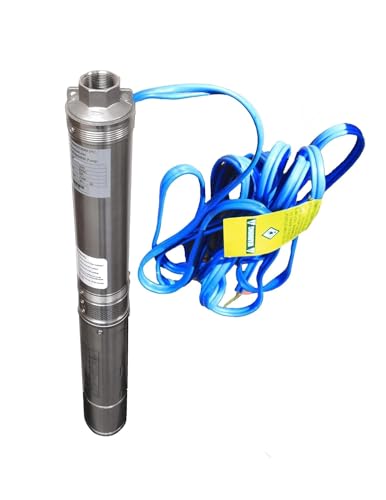
Hallmark Industries MA0414X-7 Deep Well Pump — Best for Wells
The Hallmark MA0414X-7 is the serious rural pick: a 1 HP deep well submersible that runs on 110V — unusual and valuable, since many well pumps demand 230V — delivering a rated 33 GPM from a stainless steel body built for years of submerged service in a 4-inch casing. Hallmark is a long-standing name in well pumps rather than a marketplace brand, and the MA0414X-7’s design reflects it: this is equipment bought to be lowered once and forgotten for a long time, feeding a house, a barn, or an irrigation header from a well that a surface pump could never prime.
Strengths
- Runs a genuine 1 HP well pump on 110V household power — no 230V circuit or control rewiring required
- 33 GPM rated flow serves household and light agricultural demand
- Stainless steel construction for long submerged service life
Trade-offs
- Well work is not casual DIY for most owners: pulling and setting a pump involves the well’s depth, drop pipe, wiring, and safety cable — many buyers will hire it out
- Must be matched to your well’s depth and casing; the wrong pump curve wastes money in both directions
- Useless for every other job in this guide — it is a specialist, proudly
Key specs (from the manufacturer’s listing)
- Type: deep well submersible pump
- Power: 1 HP, 110V / 60Hz
- Flow: 33 GPM rated
- Construction: stainless steel
- Model: MA0414X-7
Choose the Hallmark if your property drinks from its own well and the existing pump is aging, undersized, or was specced for a 230V circuit you would rather not run. Do the homework in our buying guide first — measure or look up your well’s depth and static level, and match the pump’s curve to the lift — and this class of pump rewards the effort with a decade of indifference. Everyone else in this guide’s audience should admire it and buy a utility pump instead.
Best for: homeowners on well water, farms, and 110V well replacements / Not suited for: any surface or draining job, or buyers unwilling to match pump to well
Check the current price on Amazon

6699 1/4 HP Utility Pump — Best Grab-and-Go Utility
The 6699 is the pump equivalent of a good shop towel: cheap enough to own without deliberation, light enough to grab without thinking, and useful monthly. Rated at 1,600 GPH from a 1/4 HP motor in a thermoplastic body, with a 10-foot power cord that actually reaches an outlet from inside a pool or across a laundry room, it is sized for the classic utility list — draining pools and hot tubs at a civilized pace, emptying waterbeds, clearing flooded window wells and tubs, and moving pond water during cleanouts.
Strengths
- 1,600 GPH is the sweet spot for household draining: fast enough to matter, gentle enough for tubs and liners
- 10-foot cord solves the reach problem that strands shorter-corded rivals
- Light thermoplastic body stores in a tote and carries anywhere
Trade-offs
- A quarter-horsepower pump has modest lift; pushing water up a full story slows it considerably
- Not the tool for a serious basement flood — that is the AQUASTRONG’s 4,500 GPH argument
- Manual operation: it works while you supervise, like every pump in this class
Key specs (from the manufacturer’s listing)
- Type: submersible utility/transfer pump
- Power: 1/4 HP
- Flow: 1,600 GPH
- Cord: 10 feet
- Housing: thermoplastic
Buy the 6699 if your water problems are chores rather than emergencies. It is also the pump to own alongside a bigger one: households with both a sump concern and a pool end up using this size ten times for every once the big pump comes out. Its tier makes the decision easy — the only wrong version of this purchase is not owning a utility pump at all and meeting a flooded water heater closet with a bucket.
Best for: pools, hot tubs, waterbeds, window wells, and routine draining / Not suited for: major flooding, wells, or high-lift work
Check the current price on Amazon

Trupow Water Transfer Pump — Best Transfer Pump
Transfer pumps solve a different problem from submersibles: the water is in a tank, a heater, a barrel, an aquarium — and it needs to be in another one, through hoses, with the pump sitting dry beside the action. The Trupow is the tidy exemplar: a 115V, 1/10 HP electric utility pump rated at 330 GPH, sold with a complete 6-foot suction hose kit so it works out of the box. Its classic jobs are draining a water heater for sediment service, emptying rain barrels into gardens, moving water between aquariums and storage, and clearing the last water a submersible cannot reach.
Strengths
- Complete kit with suction hose included — no fitting safari before first use
- Sits dry and self-contained beside the job; ideal for water heaters and tanks a submersible cannot enter
- Gentle 330 GPH rate suits controlled transfers where a flood of flow is a liability
Trade-offs
- 1/10 HP is deliberately small: long lifts and long discharge runs slow it down
- Transfer pumps must be primed and kept primed; running one dry is the classic way to kill it
- Not a flood tool and not a well tool — it is a hose-to-hose specialist
Key specs (from the manufacturer’s listing)
- Type: non-submersible transfer/utility pump
- Power: 115V, 1/10 HP
- Flow: 330 GPH
- Kit: 6-foot water hose kit included
- Roles per manufacturer: pool draining, water removal via hose
Choose the Trupow if your water work is plumbing-shaped: heaters, tanks, barrels, aquariums, boats. It is the pump that lives in the utility closet of a house that maintains itself, and its modest flow is a feature wherever control matters more than speed. Buyers who need to move serious volume across distance should look at the KITLUCK below instead — and buyers facing actual flooding should skip transfer pumps entirely and go submersible.
Best for: water heaters, rain barrels, tanks, and controlled hose transfers / Not suited for: flooding, high lift, or unattended running
Check the current price on Amazon

KITLUCK 1/2 HP Cast Iron Transfer Pump — Best Heavy-Duty Transfer
Where the Trupow whispers, the KITLUCK works: a 1/2 HP, 120V transfer pump in a cast-iron body, rated at 1,500 GPH with the pressure to push water through long hose runs, up grades, and into irrigation lines. Cast iron is the point — it tolerates the knocks, heat, and continuous duty that thermoplastic utility pumps are not built for, which makes this the transfer pump for farms, large properties, construction water management, and anyone who has worn out a lighter pump doing a bigger pump’s job.
Strengths
- 1,500 GPH with genuine pressure behind it — long runs and elevation changes stay productive
- Cast-iron construction for durability and sustained duty
- Simple on/off operation with standard garden-hose-class fittings
Trade-offs
- Cast iron is heavy and can rust if stored wet and neglected — drain and dry it after use
- Its muscle is wasted on aquariums and waterbeds; this is property-scale equipment
- Like all transfer pumps, it needs priming and hates running dry
Key specs (from the manufacturer’s listing)
- Type: portable transfer/utility pump (non-submersible)
- Power: 120V, 1/2 HP
- Flow: 1,500 GPH
- Body: cast iron
- Roles per manufacturer: garden, rain barrel, and high-pressure transfer work
Buy the KITLUCK if your transfers involve distance, height, or hours — filling a stock tank from a pond, feeding irrigation from a rain catchment, draining a pool across a yard. It is the pick most likely to be borrowed by neighbors, which is the market’s own verdict on heavy-duty transfer pumps. Small-job households will find it more pump than their lives require; the Trupow exists for them.
Best for: farms, large properties, irrigation feeds, and long transfer runs / Not suited for: delicate indoor transfers or buyers who will not maintain cast iron
Check the current price on Amazon

VIVOSUN 800 GPH Submersible Pump — Best for Ponds and Fountains
The smallest pick here does the quietest job: continuous circulation. The VIVOSUN is a 50W submersible rated at 800 GPH with a 10-foot maximum lift, built for ponds, fountains, aquariums, hydroponics, and statuary — the applications where a pump runs for months, must sip power, and should be heard as little as possible. VIVOSUN rates it as ultra-quiet, and its low wattage is its own spec: a pump that runs all season at 50W costs a fraction of what a utility pump would burn doing the same circulation badly.
Strengths
- 50W draw makes continuous, all-season operation cheap
- 800 GPH with 10 feet of lift covers most garden ponds, fountains, and large aquariums
- Quiet, compact, and made to disappear into the water feature it serves
Trade-offs
- Circulation-class flow: draining a pool with it would take days — it is not a utility pump
- Small pumps need regular intake cleaning in pond duty; algae and debris are its working environment
- Not suited to any pressure application
Key specs (from the manufacturer’s listing)
- Type: submersible circulation pump
- Power: 50W
- Flow: 800 GPH (3,000 L/H)
- Max lift: 10 feet
- Power cord: 6.5 feet
- Roles per manufacturer: pond, aquarium, statuary, hydroponics
Choose the VIVOSUN if water in your life is decorative or alive — a pond that needs movement, a fountain that needs a heart, an aquarium that needs flow. Size it by turnover: pond keepers typically circulate the pond’s volume once every one to two hours, and this pump’s 800 GPH rating (derated for your actual lift) covers small-to-mid garden ponds honestly. It is the only pick here meant to be forgotten while running, and it is good at exactly that.
Best for: ponds, fountains, aquariums, and hydroponics / Not suited for: draining, flooding, or any pressure work
Check the current price on Amazon
Comparison Table
| Pick | Badge | Key spec | Best for |
|---|---|---|---|
| AQUASTRONG 1 HP Sump Pump | Best Overall | Submersible, 1 HP, 4,500 GPH | Floods, pools, basements |
| Hallmark MA0414X-7 | Best for Wells | Deep well, 1 HP 110V, 33 GPM, stainless | Well water supply |
| 6699 1/4 HP Utility Pump | Best Grab-and-Go Utility | Submersible, 1,600 GPH, 10-ft cord | Pools, tubs, routine draining |
| Trupow Transfer Pump | Best Transfer Pump | 115V 1/10 HP, 330 GPH, hose kit | Water heaters, tanks, barrels |
| KITLUCK 1/2 HP Cast Iron | Best Heavy-Duty Transfer | 1,500 GPH, cast iron, high pressure | Farms, irrigation, long runs |
| VIVOSUN 800 GPH | Best for Ponds and Fountains | 50W, 800 GPH, 10-ft lift | Ponds, fountains, aquariums |
How to Choose a 110 Volt Pump: Type First, Then Flow, Then Head
Step 1: Name the job in one sentence. “Get the water out of my basement” is a submersible utility pump. “Supply my house from a well” is a deep well pump. “Move water from this tank to that one” is a transfer pump. “Keep my pond moving” is a circulation pump. Every bad pump purchase in history began by skipping this sentence and shopping by horsepower.
Step 2: Calculate your lift. Measure the vertical distance from the water’s surface to the highest point of discharge, then add friction: long hoses, small diameters, and many fittings all act like extra height. Your pump’s flow at that total head — not its headline flow — is the number that decides how long the job takes. When a listing publishes a flow-at-head table or curve, use it; when it does not, assume meaningful derating and buy a size up for time-critical work like flooding.
Step 3: Size the hose to the pump. A high-flow pump choked through a narrow garden hose delivers narrow-hose flow. Match discharge diameter to the pump’s outlet, keep runs as short and straight as the job allows, and remember that every elbow is a small tax. This is the cheapest performance upgrade in the entire category: the pump you already own gets faster with a better hose.
Step 4: Match the material to the storage. Thermoplastic pumps (AQUASTRONG, 6699) shrug off wet storage and corrosion but dislike being dropped on concrete. Cast iron (KITLUCK) survives the truck bed and the job site but must be drained and dried to avoid rust. Stainless (Hallmark) is for living underwater for years. Buy for the life the pump will actually lead.
Step 5 (well buyers): match the pump curve to the well. You need three facts: casing diameter (the Hallmark fits the standard 4-inch class), total lift (static water level plus drawdown plus the height of your pressure tank), and required flow (households typically plan around 10–15 GPM at the tank, with irrigation adding more). Choose a pump whose published curve delivers your flow at your lift with margin — and when the numbers are beyond your confidence, a well contractor’s one-hour consult is cheaper than the wrong pump at the bottom of a 200-foot hole.
How to Drain a Pool (or a Basement) With a Submersible Pump
Step 1: Set the discharge first. Run the discharge hose to where the water is allowed to go — a storm drain, a low corner of the yard, a utility sink for small volumes — and lay it flat and unkinked before the pump gets wet. Check local rules for pool water, which often must be dechlorinated or directed to sanitary drains rather than storm drains.
Step 2: Place the pump at the lowest point, on a flat surface. Lower it by its handle or a rope, never by the cord. In a pool, the deep-end floor; in a basement, the lowest corner or the sump pit. If the bottom is muddy, set the pump on a flat board or tile so it does not suck sediment and clog its intake.
Step 3: Route the cord to a dry, GFCI-protected outlet. Electricity and standing water demand the same respect here as with pressure washers. Keep connections out of the water entirely — this is why the 6699’s 10-foot cord matters — and never reach into water to adjust a pump that is plugged in.
Step 4: Start the pump and stay for the first minutes. Confirm discharge is flowing, the hose has not blown off, and the pump is not air-locked (tilt it briefly underwater to burp trapped air if flow sputters). Then check in periodically: submersible utility pumps are not designed to run dry, and the end of a drain — when the pump starts slurping air — is when you switch off.
Step 5: Finish by hand and store the pump dry. The last half-inch belongs to a wet vacuum or a mop; no utility pump drinks a floor perfectly dry. Rinse the pump with clean water, let it dry, coil the cord loosely, and store it where you can find it in the dark during the next storm — which is to say, not at the bottom of the flooded basement it exists to save.
Problem: the pump hums but moves no water. → Air lock or a clogged intake. Unplug, lift the pump, clear the intake screen, re-submerge it at a slight tilt to release trapped air, and restart.
Problem: flow slows to a trickle mid-job. → Usually a kinked or undersized discharge hose, or debris matting the intake. Straighten the run, clear the screen, and confirm the discharge end is not submerged and fighting back-pressure.
Problem: the transfer pump loses prime and stops moving water. → Air is entering the suction side. Check every suction fitting for tightness — suction leaks are invisible because they leak air inward — keep the suction hose short, and re-prime per the manual. Transfer pumps must never run dry for more than a few seconds.
Pump Curves, Explained Without the Engineering Degree
Every pump lives on a curve: at zero lift it delivers its maximum flow, and as lift increases, flow falls — gently at first, then steeply — until at the pump’s maximum head it delivers nothing at all. Three practical lessons hide in that shape. First, two pumps with the same headline GPH can perform completely differently at your lift; the one with the flatter curve wins real jobs. Second, the last few feet of lift are the most expensive in flow, which is why routing a discharge over a basement rim instead of up and over a wall can double a drain’s speed. Third, a pump working near its maximum head runs hot and accomplishes little — the classic sound is a busy motor and a disappointing hose. When a manufacturer publishes the curve or a flow-at-head table, it is telling you it respects you; when a listing shows only a giant GPH number with no head data anywhere, it is telling you something else. For time-critical work — a basement taking water — buy the pump whose curve still shows strong flow at your measured lift, even if its headline number is smaller than a rival’s. The AQUASTRONG’s 1 HP motor earns its place in this guide precisely because its curve has that kind of headroom for residential lifts.
Keeping a Pump Alive: The Ten-Minute Maintenance Calendar
Pumps die of neglect in storage far more often than they die of work. The calendar is short. After every job: rinse the pump with clean water if it pumped anything dirty, run it for ten seconds in a bucket of clean water if the manual allows, drain it, and let it dry before storage — seals and impellers stored wet in dirty water corrode and stick. Monthly in season: inspect the intake screen and clear it, check the cord for nicks (a pump cord lives a hard, wet life), and for transfer pumps, confirm the suction fittings still seal — a perished washer is a lost prime waiting for the worst moment. Before storm season: test-run the emergency pump in a barrel of water, confirm the discharge hose has not been crushed or borrowed, and store pump, hose, and a good flashlight together where they can be reached in the dark. For pond pumps: clean the intake sponge or screen on the schedule your water demands — a green pond can mat an intake in a fortnight — and lift the pump for winter if your pond freezes hard. Ten minutes on this calendar is the entire difference between a pump that is a tool and a pump that is a memory of a tool, discovered mid-flood.
The Job Matrix: Six Real Jobs, Six Right Answers
The 2 a.m. basement flood. Speed and lift rule. AQUASTRONG, discharge routed out the nearest window well or door, owner present until the water is down. Nothing else in this guide is close, and this scenario alone justifies owning it in any house with a below-grade room and a storm history.
The spring pool opening (and autumn closing). Either submersible works; the 6699 if the pool is modest and your patience is ordinary, the AQUASTRONG if the pool is large or the cover holds a swamp. Mind the local rules on where pool water may go.
The water heater flush. Transfer pump territory, full stop — the Trupow with its hose kit, sediment and all, at a pace that does not stir the tank into soup. Submersibles need not apply; they cannot fit the job’s shape.
The rain barrel and garden system. Trupow for moving water to cans and beds by hose; KITLUCK when the garden is far, uphill, or fed through drip lines that want pressure behind them.
The pond that turned green. Two-pump work: the VIVOSUN for daily circulation and filtration flow, the 6699 borrowed for the annual drain-and-scrub. Pond ownership teaches the type lesson faster than any article: the pump that runs forever and the pump that empties the pond are different animals, and owning both costs less than abusing either one into doing the other’s job.
The country house on a well. The Hallmark, matched to the well, installed once and forgotten — plus, if the owners are wise, one of the utility pumps in the closet for everything the well pump must never be asked to do.
Common Buying Mistakes
Buying horsepower instead of a pump type. A 1 HP circulation pump and a 1/10 HP transfer pump are not stronger and weaker versions of one tool; they are different tools. Type first, always.
Believing the headline GPH. That number is measured with the pump pushing water horizontally out of its own outlet. Your job has lift, hose, and fittings; the flow-at-head figure is the honest one, and its absence from a listing is information.
Running a pump dry “just for a minute.” Water is the coolant and lubricant for most of these designs. Dry running is the fastest route from new pump to parts pump, especially for transfer pumps and their seals.
Ignoring the cord. A pump whose cord cannot reach a dry outlet from the water it sits in forces extension-cord improvisation in exactly the wet environment where improvisation is worst. Cord length is a safety spec disguised as a convenience spec.
Guessing at a well pump. The most expensive mistake in this guide’s territory. Depth, casing, static level, and flow needs are knowable facts about your well; buy against them or hire the person who will.
Final Recommendation
Match the pump to the job and this category stops being confusing. For water where it does not belong, the AQUASTRONG 1 HP is the strongest general answer, with the 6699 1/4 HP as the lighter everyday alternative most households will use more often. For a well, the Hallmark MA0414X-7 is the rare plug-in answer — after you have matched it to your well. For moving water between containers, the Trupow is the tidy kit and the KITLUCK Cast Iron is the heavy-duty upgrade. For living water, the VIVOSUN 800 GPH circulates quietly and cheaply. Check price on Amazon, confirm the flow and cord figures on the listing, and measure your lift before the box arrives.
Pumps sit at the center of a household water toolkit. Readers building theirs will also want our guides to the Best 110 Volt Pressure Washer for cleaning with the water a pump moves, the Best 110 Volt Air Pumps for the inflatables and air-driven side of the garage, the Best 110 Volt Portable Battery Back to keep essential pumps and routers alive in an outage, and the Best 1 Hp 220 Volt Submersible Well Pump if your well ultimately needs the bigger circuit.
One closing thought for every buyer in this category: the best time to own a pump is before the water arrives. Pumps bought calmly, tested in a barrel on a dry afternoon, and stored with their hoses are tools; pumps bought at midnight in a storm are lotteries. Whichever pick fits your job, give it that dry-afternoon test during the week it arrives.
Frequently Asked Questions
What is the difference between a sump pump and a utility pump?
A sump pump is designed to live in a sump pit and switch itself on with a float when water rises — it is an installed guardian. A utility pump is a portable tool you place, run, and remove manually. Several picks here are utility-style submersibles that can do sump-like work while attended; for unattended basement protection, buy a true float-switched sump pump and consider a battery backup for it.
How many gallons per hour do I need to drain a pool?
Divide your pool’s gallons by the hours you are willing to spend, then derate for lift. A 10,000-gallon pool drained in about three hours needs roughly 3,300 effective GPH — the AQUASTRONG’s class. The 1,600 GPH 6699 does the same pool in a long afternoon, which many owners find acceptable given its price and convenience.
Can a 110 volt pump really run a house well?
Yes, within limits — the Hallmark pick in this guide is a 1 HP, 110V well pump rated at 33 GPM, suitable for many residential wells of moderate depth. Very deep wells or high-demand properties exceed what 110V can deliver and belong on 230V equipment. The pump curve matched against your well’s depth and static level is the deciding document.
Why does my pump’s flow drop when I pump uphill?
Because flow and head trade against each other along the pump’s curve: every foot of lift and every foot of hose friction consumes energy that would otherwise move water. Headline GPH is the zero-lift figure. This is physics, not a defect, and it is why sizing for your real lift — Step 2 of our buying guide — matters more than any other calculation in this category.
Can I leave a submersible pump running unattended?
Utility pumps are designed for attended use: they can run dry and overheat when the water is gone, and hoses can slip. True unattended duty belongs to float-switched sump pumps and to circulation pumps in ponds, which are built for continuous running in water that never disappears. Match the supervision to the design.
Can I use an extension cord with a pump?
Only reluctantly and correctly: a heavy-gauge, outdoor-rated cord, as short as possible, with the connection kept completely out of water and ideally off the ground. Thin indoor cords starve the motor of voltage — which overheats it — and their connections are not made for wet environments. The right fix is a pump whose cord reaches, which is why cord length appears in our spec boxes and our buying criteria.
How long do these pumps last?
It depends on duty and storage more than on brand. A utility pump used a few times a year, rinsed, dried, and stored indoors, commonly serves for many years; the same pump stored wet in a flooded-prone corner can be scrap in two seasons. Continuous-duty circulation pumps wear on a calendar of seasons rather than jobs. The maintenance calendar in this guide is short because pump longevity genuinely is mostly those ten minutes. Well pumps are the exception in scale rather than kind: a correctly matched, correctly installed unit like the Hallmark is expected to serve for many years submerged, which is precisely why the matching homework matters — the cost of a well pump is dominated by installation labor, and the cheapest well pump is the one you only install once.
What size generator or battery backup do I need for a sump pump in an outage?
Motor starting surge is the deciding figure, and it can be several times the running draw — a 1 HP pump is a serious load for portable batteries and a modest one for mid-size generators. Households whose flood risk peaks during storms should protect the sump with a dedicated battery-backup sump system or a generator sized for the surge, and test the arrangement before the weather does.


