Disclosure: airfryerkitchensupply.com is reader-supported. When you buy through links on our site, we may earn an affiliate commission at no extra cost to you.
Where to buy
Every machine in this guide to the best 110 volt pressure washer options is a current Amazon listing, verified through Amazon’s own product data before we wrote a word about it. Start with the Westinghouse WPX3400e if you want the strongest all-round cleaning power in an electric unit, the Greenworks 3000 PSI Brushless if you want premium brushless build at the top of the electric class, the Sun Joe SPX3000 if you want the proven, long-running value design, the Westinghouse ePX3500 if you want mid-range power with an onboard soap tank, the Westinghouse ePX3100v if portability and storage lead the decision, and the CRAFTSMAN 1700 PSI if your work is cars, patios, and light duty at a compact size. Check the current price on Amazon for the model you choose, and confirm the PSI and GPM figures on the listing itself — this category is notorious for headline numbers that shrink in the fine print, a problem we address head-on below.
Introduction: why every electric pressure washer is a “110 volt” pressure washer
Searching for the best 110 volt pressure washer can make the category sound more complicated than it is. Every corded electric pressure washer sold for home use runs on a standard 110/120V household outlet — there is no other kind. What actually separates these machines is not voltage but the two numbers that define cleaning: PSI, the pressure of the water jet, and GPM, the flow of water it delivers. Multiply them and you get cleaning units, the closest thing this category has to an honest single score. A 2,000 PSI machine at 1.2 GPM and a 1,700 PSI machine at 1.7 GPM are closer in real cleaning power than their headlines suggest, and the second will often rinse a driveway faster because flow is what carries dirt away once pressure has loosened it.
The second thing to know is that electric pressure washers live in a different world from gas ones, and that is mostly good news. A home electric unit will not match a gas machine’s raw force for stripping paint or scarifying concrete — but it starts instantly, runs quietly enough for a Sunday morning, needs no fuel, oil, or carburetor care, stores indoors without fumes, and covers the entire realistic homeowner workload: vehicles, siding, fences, decks, patios, driveways, outdoor furniture, and the annual spring-cleaning circuit. For those jobs, the limiting factor is rarely the machine’s peak pressure; it is whether the machine is pleasant enough — light enough, quick to set up, with a cord and hose that reach — that you actually use it instead of postponing the chore.
Third, a warning this guide takes seriously: pressure washer marketing inflates numbers. “Max PSI” figures are measured at the pump’s first instant with the trigger pulled under laboratory conditions, not at the nozzle in your hand, and anonymous listings in this category quote numbers that would embarrass professional machines. That is why every pick below comes from a named manufacturer whose ratings we could verify through Amazon’s product data, why our spec boxes quote each maker’s own published figures with the “max” label intact where the maker uses it, and why the buying guide teaches you to shop on cleaning units and motor type rather than on the biggest number in the title.
Noise deserves a sentence of its own, because it decides when you may work. A gas pressure washer announces itself to the whole street; an electric one is closer to a vacuum cleaner in volume, and the brushless models here are quieter still. That difference is the difference between washing the car at 8 a.m. on a Saturday and waiting until midday — and for townhouse and condo owners with shared walls and close neighbors, it can be the difference between owning a pressure washer and not being allowed to enjoy one. If your living situation has ears, weight the brushless picks accordingly.
In this guide
Quick Picks
- Best Overall — Westinghouse WPX3400e: 3,400 max PSI and 2.0 max GPM from a brushless motor, with an onboard soap tank and a five-nozzle set. The most cleaning power in this guide. Check the current price on Amazon
- Best Premium Brushless — Greenworks 3000 PSI Brushless: 3,000 PSI class with up to 2.0 GPM from Greenworks’ brushless line, for buyers who want top-tier electric build. Check the current price on Amazon
- Best Proven Value — Sun Joe SPX3000: the long-running 2,500 max PSI design with dual detergent tanks and one of the deepest track records in home pressure washing. Check the current price on Amazon
- Best Mid-Range — Westinghouse ePX3500: 2,500 max PSI and 1.76 max GPM with anti-tipping design, onboard soap tank, and a pro-style steel wand. Check the current price on Amazon
- Best Portable — Westinghouse ePX3100v: 2,100 max PSI in a compact body with a built-in carry handle and detachable foam cannon, built to be grabbed and stored easily. Check the current price on Amazon
- Best Compact for Light Duty — CRAFTSMAN 1700 PSI: 1,700 PSI and 1.2 GPM in a lightweight corded unit sized for cars, patios, and garage duty. Check the current price on Amazon
How These Picks Were Chosen
We verified every machine through Amazon’s product data feed for this site, matching model names and ASINs against each manufacturer’s own listing. Inclusion required a named manufacturer with a traceable product line, published PSI and GPM figures, and a standard corded electric design that runs on household power. We deliberately excluded the category’s anonymous listings — the ones advertising 4,800 or 5,000 “max” PSI from a compact electric pump at a bargain tier. Those numbers are not physically credible for a 110V machine in that class, and a guide that repeats them would be laundering marketing fiction into buying advice. If a deal looks twice as powerful as a Westinghouse or Greenworks at half the tier, the numbers, not the deal, are the story.
Within the verified pool, we balanced the roles homeowners actually buy for: maximum cleaning power for driveways and siding, a premium brushless option, a proven value design, a mid-range all-rounder, a genuinely portable unit, and a compact light-duty machine. Motor type mattered in our scoring — brushless (induction-class) motors run quieter, last longer, and hold pressure more consistently than universal motors, at a higher tier — as did the practical kit: onboard soap storage, quick-connect nozzle sets, hose and cord length, and whether the unit tips over the first time the hose tugs it, a real and common annoyance that anti-tipping designs exist to solve.
A note on figures: where a manufacturer says “max PSI” or “max GPM,” our spec boxes keep the word “max,” because the working pressure at the nozzle is lower and varies with the nozzle fitted. Sun Joe, to its credit, publishes a PWMA-rated working figure alongside its max for the SPX3000, and we note it in that pick — that kind of honesty is part of why it has sold for a decade.
The 6 Best 110 Volt Pressure Washer Picks
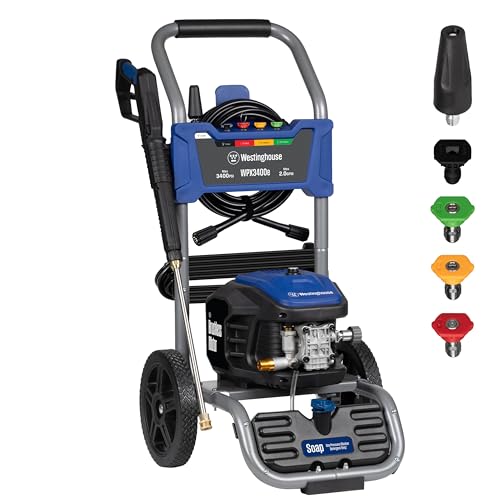
Westinghouse WPX3400e — Best Overall
The WPX3400e is the top of Westinghouse’s electric line and the strongest machine in this guide: 3,400 max PSI with 2.0 max GPM from a brushless motor, an onboard soap tank, and a five-nozzle quick-connect set on a pro-style spray gun and wand. That combination of pressure and flow — the highest cleaning-unit total here — is what big jobs feel: a two-car driveway in one session instead of two, siding washed from the ground with a reach that keeps the ladder in the garage, fence boards that come clean in one pass per side instead of two.
Strengths
- Highest cleaning power in this guide; pressure and flow are both strong rather than one propping up the other
- Brushless motor runs quieter and steadier than universal-motor rivals and is built for longer service
- Onboard soap tank and five nozzles cover the full job list without accessory shopping on day one
Trade-offs
- The most powerful electric here is still an electric: paint stripping and heavy concrete etching remain gas-machine territory
- Top-tier pricing within the electric class — light-duty users will never use its headroom
- Full-size machine: heavier and bulkier to store than the compact picks
Key specs (from the manufacturer’s listing)
- Pressure: 3,400 max PSI
- Flow: 2.0 max GPM
- Motor: brushless
- Kit: onboard soap tank, spray gun and wand, 5-nozzle set
Buy the WPX3400e if your property generates real work — long driveways, two-story siding, big decks, stone and concrete that grows algae — and you want the electric machine that finishes fastest and asks least of your patience. Its brushless motor also makes it the pick for buyers who keep tools for a decade. If your list stops at cars and a patio, it is more machine than the list needs, and the ePX3500 or CRAFTSMAN will leave money in your pocket without leaving dirt on your car.
Best for: driveways, siding, decks, and buyers who want maximum electric cleaning power / Not suited for: paint stripping, heavy etching, or small-apartment storage
Check the current price on Amazon

Greenworks 3000 PSI Brushless — Best Premium Brushless
Greenworks brings its outdoor-power-equipment polish to the top of the electric washer class: a 3,000 PSI machine with up to 2.0 GPM flow and a brushless motor. In practice it sits a half-step below the Westinghouse on headline pressure and matches it on flow, which means on real surfaces — where flow does the rinsing — the two are closer than the badges suggest. Greenworks’ advantage is ecosystem and refinement: if your garage already runs Greenworks tools, the brand’s support, accessories, and design language will feel familiar, and its brushless machines have a strong record in the lawn category.
Strengths
- Brushless motor with strong flow — rinsing speed on big flat surfaces is excellent
- Backed by one of the largest electric outdoor-power brands, with matching accessory availability
- Refined fit and finish relative to value-tier machines
Trade-offs
- Premium tier; the Sun Joe delivers most of the homeowner experience for less
- Headline PSI trails the WPX3400e for the hardest localized grime
- Like all full-size electrics, it wants garage corner space and a hose bib nearby
Key specs (from the manufacturer’s listing)
- Pressure: 3,000 PSI
- Flow: 2.0 GPM max
- Motor: brushless
- Role: premium corded electric pressure washer
Choose the Greenworks if brand ecosystem and brushless refinement top your list and your jobs are the full suburban circuit. It is also the natural upgrade pick for a buyer whose first, cheap washer died — the step up in motor quality and steadiness is the thing you feel every trigger pull. First-time buyers on a firm budget should start with the Sun Joe and upgrade only if the workload proves them wrong.
Best for: Greenworks households and buyers prioritizing brushless refinement / Not suited for: firm budgets, or buyers chasing the absolute highest PSI figure
Check the current price on Amazon

Sun Joe SPX3000 — Best Proven Value
The SPX3000 is the pressure washer equivalent of a folk song: it has been in driveways for a decade, everyone knows the tune, and it keeps selling because it works. Sun Joe rates it at 2,500 max PSI with a PWMA-rated working pressure of 2,030 PSI — a piece of honesty most rivals avoid — and equips it with dual detergent tanks so you can switch soaps without a rinse-out, a five-nozzle quick-connect set, and a total-stop system that halts the pump when the trigger releases, saving wear and water. Its motor is a conventional universal type, which is the honest trade at its tier: louder and shorter-lived than brushless, at a price that has made it the default first washer for a generation of homeowners.
Strengths
- A decade of field history and an enormous accessory and parts ecosystem
- Dual detergent tanks are a genuinely useful feature nobody else in this guide matches
- Published PWMA working-pressure rating — the most honest spec sheet in the class
Trade-offs
- Universal motor: louder, and with a shorter expected service life than the brushless picks
- Design is mature rather than modern; hose and cord management are ordinary
- Working pressure, honestly stated, is lower than rivals’ “max” headlines imply — compare cleaning units, not titles
Key specs (from the manufacturer’s listing)
- Pressure: 2,500 max PSI (2,030 PSI PWMA rated)
- Kit: dual detergent tanks, quick-connect nozzles
- Model: SPX3000
- Role: general homeowner cleaning — cars, fences, driveways, patios
The SPX3000 is the right first pressure washer for most households and the right only pressure washer for many. Its workload ceiling — cars, siding up to a story, fences, decks, driveways — is exactly the homeowner list, and its price tier leaves room in the budget for the surface cleaner attachment that transforms driveway work. Buyers who wash weekly or commercially-adjacent should step up to brushless; everyone else can stop reading here and be well served.
Best for: first-time buyers and the standard suburban workload / Not suited for: heavy weekly use, where a brushless motor’s longevity pays


Westinghouse ePX3500 — Best Mid-Range
The ePX3500 is the machine for buyers who found the SPX3000’s spec sheet honest but want a bit more muscle and modern design: 2,500 max PSI with 1.76 max GPM, an onboard soap tank, a pro-style steel wand with a five-nozzle set, and Westinghouse’s anti-tipping technology — a low, stable design that resists the classic electric-washer pratfall of toppling when the hose tugs. That last feature sounds minor until you have righted a fallen washer, mid-job, for the fifth time; stability is a quality-of-life spec.
Strengths
- Anti-tipping design solves the most common daily annoyance of compact electric washers
- Balanced pressure and flow for the full homeowner job list
- Steel wand and five-nozzle set feel a class above basic kits
Trade-offs
- Conventional motor at a tier where the brushless Westinghouse and Greenworks tempt from above
- Single soap tank versus the Sun Joe’s dual setup
- Mid-range means exactly that: neither the cheapest nor the strongest story in this guide
Key specs (from the manufacturer’s listing)
- Pressure: 2,500 max PSI
- Flow: 1.76 max GPM
- Design: anti-tipping technology
- Kit: onboard soap tank, pro-style steel wand, 5-nozzle set
Choose the ePX3500 if you want one washer that does everything a house asks, with modern manners and no drama, and you would rather spend the brushless money on something else. It is the guide’s quiet consensus pick — the one with no disqualifying weakness for any standard job — and for households that wash monthly rather than weekly, it may be the smartest money here.
Best for: all-round homeowner use with an emphasis on stability and kit quality / Not suited for: buyers who specifically want brushless longevity or dual soap tanks
Check the current price on Amazon

Westinghouse ePX3100v — Best Portable
Most pressure washers fail their owners not on power but on friction: they are awkward to carry, annoying to store, and slow to set up, so jobs get postponed. The ePX3100v attacks friction directly — 2,100 max PSI and 1.76 max GPM in a compact body with a built-in carry handle and a detachable foam cannon, designed to be grabbed with one hand, used for twenty minutes, and put away. The foam cannon deserves its own sentence: for car washing, laying a blanket of foam that dwells and lifts grit before you ever touch paint is the difference between washing a car and grinding dirt across it.
Strengths
- Carry-handle portability and compact storage — the washer most likely to actually get used
- Detachable foam cannon makes it the best car-washing pick in this guide
- Enough pressure and flow for patios, bikes, furniture, and siding touch-ups
Trade-offs
- 2,100 max PSI is light for neglected concrete and large driveway jobs — plan more passes
- Compact machines carry shorter hoses; big properties will test your outlet-and-bib geography
- Three-nozzle set is leaner than the five-nozzle kits above it in this guide
Key specs (from the manufacturer’s listing)
- Pressure: 2,100 max PSI
- Flow: 1.76 max GPM
- Design: built-in carry handle, compact body
- Kit: detachable foam cannon, pro-style steel wand, 3-nozzle set
Buy the ePX3100v if your washing life is cars, motorcycles, bicycles, patio furniture, and the front steps — frequent, short jobs where setup speed decides whether the job happens. Apartment and townhouse owners with a small storage closet should start here and only move up if a driveway enters their life. It is the specialist in convenience, and convenience is a real spec.
Best for: car washing, frequent small jobs, tight storage / Not suited for: large driveways and heavy concrete restoration
Check the current price on Amazon

CRAFTSMAN 1700 PSI Electric Pressure Washer — Best Compact for Light Duty
The CRAFTSMAN is the honest minimum: 1,700 PSI and 1.2 GPM in a lightweight corded unit from a brand every hardware store in America stocks parts and accessories for. It will not thrill anyone, and it is not meant to. It washes a car properly, cleans a patio and outdoor furniture, rinses a garage floor, and handles the light end of fence and siding work — the jobs that make up most actual pressure washing in most actual homes — at the lowest commitment of size, weight, and tier in this guide.
Strengths
- Lightweight and compact; the easiest unit here to carry, store, and lend
- CRAFTSMAN’s retail footprint means nozzles, wands, and help are never far away
- Light-duty pressure is actually a virtue on cars, screens, and soft surfaces where excess force damages
Trade-offs
- Lowest cleaning units here; big or neglected surfaces become slow work
- Basic kit and conventional motor, in line with its tier
- Buyers who outgrow light duty will replace rather than supplement it
Key specs (from the manufacturer’s listing)
- Pressure: 1,700 PSI
- Flow: 1.2 GPM
- Design: lightweight, compact corded unit
- Role: cars, driveways (light), patio, and garage duty per the manufacturer
Choose the CRAFTSMAN if your list is short and light, if storage is a shelf rather than a garage corner, or if this is a second unit for a cabin or rental property. There is wisdom in buying the smallest tool that does your actual jobs; this is that tool for light duty, wearing a badge with a century of hardware-store trust behind it.
Best for: cars, patios, and light cleaning in small homes / Not suited for: large driveways, two-story siding, or neglected concrete
Check the current price on Amazon
Comparison Table
| Pick | Badge | Key spec | Best for |
|---|---|---|---|
| Westinghouse WPX3400e | Best Overall | 3,400 max PSI, 2.0 max GPM, brushless | Maximum electric cleaning power |
| Greenworks 3000 PSI | Best Premium Brushless | 3,000 PSI, 2.0 GPM max, brushless | Premium build and ecosystem |
| Sun Joe SPX3000 | Best Proven Value | 2,500 max PSI (2,030 PWMA), dual soap tanks | First washer, standard workload |
| Westinghouse ePX3500 | Best Mid-Range | 2,500 max PSI, 1.76 max GPM, anti-tip | All-round use, stable design |
| Westinghouse ePX3100v | Best Portable | 2,100 max PSI, carry handle, foam cannon | Cars and frequent small jobs |
| CRAFTSMAN 1700 PSI | Best Compact for Light Duty | 1,700 PSI, 1.2 GPM, lightweight | Light duty, small spaces |
How to Choose a 110 Volt Pressure Washer
Shop cleaning units, not PSI alone. Multiply PSI by GPM. A 2,500 PSI × 1.76 GPM machine (≈4,400 cleaning units) out-cleans a 3,000 PSI × 1.2 GPM machine (≈3,600) on almost every real surface, because pressure loosens dirt but flow carries it away. This single habit will protect you from most of this category’s misleading headlines.
Match the machine to your hardest regular job. Cars, furniture, screens, and bikes: 1,700–2,100 PSI class is plenty and gentler. Fences, decks, siding, maintained driveways: 2,300–2,800 class. Neglected concrete, stone, two-story siding: 3,000+ class with 2.0 GPM. Paint stripping and etching: none of these — that is gas territory, and an electric buyer who accepts that boundary will be happy with everything inside it.
Weigh motor type honestly. Brushless motors (WPX3400e, Greenworks) are quieter, steadier, and longer-lived; universal motors (SPX3000, ePX3500, CRAFTSMAN) cost less and are proven adequate for monthly homeowner duty. Weekly users should buy brushless; seasonal users can pocket the difference.
Count the practical kit. Quick-connect nozzles (0°, 15°, 25°, 40°, soap) cover the work; a turbo nozzle multiplies effective cleaning on hard surfaces; a foam cannon transforms car washing; an onboard soap tank removes the bucket shuffle. Also measure your reality: hose length plus cord length must reach from your outdoor outlet and spigot to your farthest job, or you will learn to hate a machine that is otherwise excellent.
Respect the GFCI. Electric pressure washers work in water by design; their plugs carry GFCI protection for a reason. Never defeat it, never use a damaged cord, and plug into a GFCI-protected outdoor receptacle where one is available. This is the category’s one non-negotiable.
Check your water supply before blaming any machine. An electric pressure washer can only output what the spigot feeds it. A home supply delivering at least the machine’s rated GPM — with the hose fully open, unkinked, and no restrictive splitter in line — is a precondition for rated performance. The bucket test tells you the truth in a minute: time how long your hose takes to fill a five-gallon bucket. Houses with weak well pressure or long, narrow hose runs should size the machine to the supply they have, not the supply they imagine, and will get more real cleaning from a 1.76 GPM machine running fed than from a 2.0 GPM machine running starved.
How to Pressure Wash Your Driveway, Siding, and Car Without Damage
Step 1: Set up in the right order. Connect the garden hose to the machine and the spigot, connect the high-pressure hose and wand, fit the nozzle for the job, then — before switching on — squeeze the trigger until water flows steadily, purging air from the pump. Starting a pump dry or air-locked is how first-day damage happens. Then plug in (GFCI first) and switch on.
Step 2: Test on an inconspicuous patch. Every surface has a pressure it tolerates and a pressure that scars it. Start with the widest nozzle (40°), farther away than you think necessary, and close in gradually on a hidden corner. Wood, older concrete, and painted surfaces announce their limits quickly if you give them a test patch to do it on.
Step 3: Wash the driveway in overlapping lanes. Pre-treat stains with detergent on the soap nozzle, let it dwell a few minutes without drying, then rinse with a 25° nozzle in steady, overlapping passes, keeping the wand at a consistent distance and angle. Work from the house toward the street so dirty water exits over cleaned ground. A surface-cleaner attachment, available for all the full-size picks, makes this job dramatically faster and streak-free if driveways are your main work.
Step 4: Wash siding bottom-to-top with soap, top-to-bottom with rinse. Apply detergent from the bottom up so it does not streak clean lines down dirty siding, keep the jet angled downward at siding laps rather than driving water up underneath them, and never aim at windows, vents, or electrical fixtures at close range. Distance is your pressure control: the same nozzle is gentle at three feet and destructive at three inches.
Step 5: Wash the car with foam and the wide nozzle. Foam cannon first, dwell, then rinse with the 40° nozzle at a respectful distance, keeping the jet off pinstripes, badges, and any chipped paint. The ePX3100v’s detachable cannon exists for this routine; other picks accept accessory cannons.
Step 6: Shut down and store properly. Switch off, unplug, turn off the water, then squeeze the trigger to release pressure before disconnecting anything. Drain the hoses, and in freezing climates store the machine indoors — a pump that freezes with water inside is a pump replaced in spring. Run pump-saver through it if your winters are serious.
Problem: the motor surges or the pressure pulses. → Almost always water supply: check the spigot is fully open, the inlet filter screen is clean, the garden hose is unkinked and purged of air. Electrics are flow-sensitive; starve them and they complain exactly like this.
Problem: the machine leaves zebra stripes on concrete. → Inconsistent distance or speed. Slow down, overlap passes by half, and keep the wand height steady — or accept the surface cleaner attachment as the correct tool for large flat work.
Problem: the GFCI trips repeatedly. → Stop. Water has reached somewhere electrical, or the cord is damaged. Dry everything, inspect the cord and connections, and do not defeat the GFCI to finish the job — it is reporting a real fault.
Nozzles Decoded: The Five Tips That Do All the Work
Every full-size pick in this guide ships with a quick-connect nozzle set, and the color code is standardized across brands, so learn it once. The red 0° tip fires a pencil jet at full force — a cutting tool, not a cleaning tool, reserved for distant stubborn spots on hard masonry and otherwise left in the holder. The yellow 15° tip is the heavy scrubber for concrete, stone, and bare metal prep. The green 25° tip is the general-purpose workhorse: driveways, decks, fences, siding at proper distance — most of your hours will be spent on green. The white 40° tip is the gentle rinse and the car-and-wood tip, spreading the same water over a wider fan at far lower surface force. The black soap tip drops pressure deliberately so the machine can draw detergent and lay it on thick. Two habits separate good results from scars: change tips with the machine off and the trigger squeezed to dump pressure, and treat distance as a sixth, infinitely adjustable nozzle — doubling your distance from a surface cuts its punishment dramatically while barely slowing real cleaning. A turbo nozzle, where offered or bought as an accessory, spins a 0° jet in a cone for hard flat surfaces; it is the single most effective add-on for driveway owners and the single most dangerous one for wood.
Electric vs Gas: Drawing the Boundary Honestly
This guide recommends electric machines, so it owes you the exact map of where they stop. Electric wins on everything about ownership: instant starts in any weather, no fuel to store or stale, no oil changes, no carburetor, quiet operation that keeps neighbors friendly, indoor storage, and a purchase tier that undercuts gas across the board. It wins on cleaning for the entire maintained-home workload — the cars, siding, fences, decks, and driveways that make up most pressure washing actually done in America. Gas wins on three things only: raw force for stripping and etching, unlimited runtime away from outlets, and speed on very large commercial areas. If your honest job list contains none of those three, gas buys you noise, maintenance, and storage fumes in exchange for power you will never use — the most common over-purchase in the category. If your list does contain them, buy the gas machine with our blessing and keep a compact electric like the ePX3100v for the weekly small jobs you will not fire up a gas engine to do. Many experienced owners end up owning exactly that pair, in that order.
Detergents: The Half of Cleaning Nobody Shops For
Pressure loosens; chemistry lifts. On the dirtiest jobs — algae-green siding, mildewed fences, oil-spotted concrete — detergent dwell time does more than another 500 PSI ever will. The rules are simple. Use detergents made for pressure washers, matched to the surface: house-and-siding wash for exteriors, vehicle wash for cars, concrete cleaner for driveways, deck wash for wood. Apply at low pressure through the soap nozzle or tank, from the bottom up on vertical surfaces so runs do not streak, and give it five to ten minutes of dwell without letting it dry — re-mist if the sun is working against you. Then rinse at cleaning pressure from the top down. Respect runoff: detergent and loosened grime head for the storm drain, so choose biodegradable products where the label offers them, keep automotive and degreasing work on surfaces that drain to soil or a contained area where local rules require it, and never use bleach-heavy mixes near plantings you love. The dual-tank design on the Sun Joe exists for households that alternate between, say, siding wash and vehicle soap in one session; everyone else should simply rinse the tank between chemistries. Buyers who master detergent stop needing maximum pressure for most jobs — which is another way of saying the mid-range picks in this guide clean above their spec sheets in educated hands.
How Long the Jobs Actually Take
New owners consistently misjudge session length, so here is the honest calendar for a mid-range electric machine. A car, foam to final rinse: fifteen to twenty-five minutes once the routine is familiar. A standard two-car driveway with a surface cleaner: forty-five minutes to an hour; with a wand alone, double it and expect stripes until your technique settles. One story of house siding: about an hour a side including detergent dwell. A mid-size deck: thirty to forty-five minutes, plus the patience to keep distance consistent on wood. Setup and teardown — hoses, purging, coiling, draining — adds ten minutes to every session, which is why the portable picks earn their place for small jobs: when setup rivals job time, friction wins and chores slide. None of these numbers require the strongest machine in this guide; they require the machine being ready, the water supply being strong, and the operator working in a system instead of wandering the surface. Speed in pressure washing is a technique spec before it is a machine spec.
Common Buying Mistakes
Believing anonymous “4,800 PSI” listings. A compact 110V electric pump cannot out-press professional machines; those numbers are invented. Named brands with verifiable ratings — the entire basis of this guide — are the defense.
Buying pressure without flow. A high-PSI, low-GPM machine etches a narrow line beautifully and rinses a driveway at a crawl. Cleaning units, always.
Using the 0° nozzle like a pencil. The red 0° tip concentrates the full force into a point that cuts wood, scars concrete, and injures skin. It has narrow legitimate uses (distant, stubborn spots on hard masonry) and should otherwise live in the holder.
Skipping the test patch. Every scarred deck and etched driveway in the neighborhood began as confidence. Thirty seconds on a hidden corner is the cheapest insurance in the category.
Storing the machine wet in a freezing garage. Residual water cracks pumps over winter. Drain it, protect it, store it inside — the spring-you will be grateful.
Accessories Worth Owning (and Two That Can Wait)
Three accessories earn their shelf space for almost every owner. A surface cleaner — the disc that hovers over driveways with spinning jets inside — is the closest thing to a cheat code in this category: faster, streak-free, and with less splash-back than any wand technique. A foam cannon is the car owner’s essential, turning the wash from abrasion into chemistry. A longer, quality high-pressure hose quietly fixes the geography problem on larger properties and coils without fighting. Two popular add-ons can wait: extension wands for second-story work are genuinely useful but awkward enough that many owners use them twice and revert to a ladder-free detergent-and-rinse approach from the ground; and nozzle collections beyond the standard five tips mostly duplicate angles you can achieve by moving your feet. Buy accessories after your first month of real jobs, when the machine has told you which friction is actually yours — that sequence saves more money than any bundle deal offered at checkout.
Final Recommendation
For most homeowners, the contest ends in one of two places: the Westinghouse WPX3400e if your property generates heavy work and you want the strongest, longest-lived electric, or the Sun Joe SPX3000 if you want the proven value that covers the standard workload. Between them sit the Greenworks 3000 PSI Brushless for premium brushless refinement and the Westinghouse ePX3500 for stable, well-kitted mid-range duty. Car-focused and space-tight buyers should take the Westinghouse ePX3100v or the CRAFTSMAN 1700 PSI respectively. Check price on Amazon, confirm the PSI/GPM on the listing, and measure your hose-and-cord reach before the box arrives.
Pressure washing usually joins a wider household-power toolkit. Readers building theirs will also want our guides to the Best 110 Volt Pumps for moving the water a washer cannot, the Best 110 Volt Air Compressor for the other great garage utility, the Best 110 Volt Portable Battery Back for outage essentials, and the Best 110 Volt Small Vacuum for the indoor end of the cleaning spectrum.
Whichever model you bring home, give it a first session on a forgiving job — a fence panel or a patio corner — before pointing it at the car or the good siding. Twenty minutes of low-stakes practice teaches your hands the distance and pace that every later job depends on, and it is the cheapest tuition this category offers.
Frequently Asked Questions
Do electric pressure washers really work, or do I need gas?
Electric works — for the homeowner job list. Cars, siding, fences, decks, patios, and driveways are all squarely electric work, and the strongest picks here clean them quickly. Gas earns its keep for paint stripping, deep concrete etching, very large areas, and sites without power. Most households that buy electric never miss gas.
What PSI do I need to clean a concrete driveway?
Maintained concrete cleans well in the 2,300–2,800 PSI class with decent flow; neglected, stained concrete benefits from the 3,000+ class and a turbo nozzle or surface cleaner. Technique matters as much as rating: detergent dwell time and steady, overlapping passes do more than an extra few hundred PSI.
Can a pressure washer damage my car or siding?
Yes, if used carelessly — which is why the wide nozzles and distance exist. With a 40° nozzle at a respectful distance, car paint is safe; with a 0° nozzle at close range, almost nothing is. Vinyl siding tolerates washing when the jet is angled downward and kept off seams, vents, and window seals. The test-patch rule in our how-to section prevents nearly all damage stories.
Why does my pressure washer need a GFCI plug?
Because it is an electric appliance designed to be used soaking wet. The GFCI detects current leaking where it should not go — through water, through a damaged cord, through you — and cuts power in milliseconds. Keep it functional, test it occasionally with its built-in button, and never replace it with a plain plug.
How do I winterize an electric pressure washer?
Drain everything: disconnect hoses, run the pump briefly per the manual to expel water, squeeze the trigger to clear the wand, and consider a pump-saver/antifreeze product drawn through the inlet for hard-freeze storage. Store the machine indoors, coiled and dry. Five autumn minutes prevent the most common spring failure in the category.
Can I run a pressure washer from a bucket or rain barrel?
Some electric models can draft from a static water source with the right suction setup, but most home units expect pressurized supply from a spigot and will underperform or refuse on gravity feed. If off-spigot washing is your plan — a boat, a remote fence line — confirm self-priming capability on the specific listing before buying, and consider our pumps guide for moving water to where the washer works. For ordinary home duty, the spigot is the right answer.
What is a turbo nozzle, and should I buy one?
A turbo (rotary) nozzle spins a 0° jet in a cone, combining pinpoint force with coverage — on hard surfaces like concrete and stone it can nearly double effective cleaning speed. It is too aggressive for wood, cars, and soft materials. If driveways are your main work, it is the first accessory to buy; a surface cleaner is the second and last.


