Disclosure: airfryerkitchensupply.com is reader-supported. When you buy through links on our site, we may earn an affiliate commission at no extra cost to you.
Where to buy
Every machine in this guide to the best 110 volt plasma cutter options is a current Amazon listing, verified through Amazon’s own product data before we wrote a word about it. Start with the ARCCAPTAIN 50A if you want the strongest all-round balance of cut capacity and price tier, the bestarc 50A if budget leads the decision, the YESWELDER CUT-50DS PRO if third-party safety certification matters to you, the YESWELDER CUT-55DS FUSION if you do not own an air compressor, the LOTOS Apex LTP5600CD if drag cutting sheet metal is your main work, and the Hypertherm Powermax 30 Air if you want professional-grade build quality and dealer support. Check the current price on Amazon for the machine you choose, and confirm the listing matches the exact model named here before you order, because several of these brands sell near-identical machines at different amperages.
Introduction: what “110 volt” really means for a plasma cutter
If you are shopping for the best 110 volt plasma cutter, the first thing to understand is that almost no modern machine is 110-volt-only. The current generation of inverter plasma cutters is dual voltage: the same machine runs on a standard 110/120V household outlet for thinner work and on a 220/240V circuit when you need its full amperage. That is good news. It means a “110 volt” plasma cutter is not a compromise purchase — it is a machine that works in a normal garage today and grows with you if you later add a 240V receptacle. Every pick in this guide is dual voltage, verified against the manufacturer’s listing data, so nothing here strands you on household power.
The honest limitation is amperage. On a 110V circuit — typically a 20-amp breaker in a garage, sometimes only 15 amps — a plasma cutter cannot sustain its maximum rated output. A machine rated at 50 or 55 amps will usually deliver something closer to 30–40 amps of usable cutting power on household current before the breaker complains, and manufacturers’ headline cut thicknesses are almost always quoted at 220V input. On 110V, plan on clean cuts in mild steel up to about 3/8 inch from the better machines in this guide, with severance cuts a little beyond that coming out rougher and slower. If your work is automotive sheet metal, HVAC duct, fence and gate fabrication, farm repairs, and general DIY steel up to 3/8 inch, a dual-voltage machine on 110V is genuinely enough. If you regularly cut 1/2-inch plate, you should budget for a 240V circuit and treat the 110V capability as a convenience, not the plan.
The second thing to understand is air. A plasma cutter needs compressed air as well as electricity. Most machines in this class expect an external compressor delivering clean, dry air through a 1/4-inch NPT fitting. Two of our picks — the YESWELDER CUT-55DS FUSION and the Hypertherm Powermax 30 Air — build the compressor into the machine, which removes a whole layer of cost, noise management, and moisture problems for buyers who do not already own a compressor. The LOTOS Apex also carries built-in air with a drag-cut torch. Which route suits you depends on what is already in your garage, and we flag it clearly for every pick.
Finally, a word about pilot arc. Older and cheaper plasma cutters use high-frequency start or scratch start, which struggle on painted, rusty, or expanded metal. Every machine in this guide uses some form of pilot arc — most of them non-touch pilot arc — so the torch can strike an arc without contacting the workpiece and can keep cutting across rust, paint, and mesh. For real-world repair work on dirty metal, that feature matters more than five extra amps.
In this guide
Quick Picks
- Best Overall — ARCCAPTAIN 50A Plasma Cutter: dual-voltage 50-amp inverter with a 1/2-inch clean cut rating, large LED display, 2T/4T trigger modes, and adjustable post-flow. The balanced choice for most garages. Check the current price on Amazon
- Best Budget — bestarc 50A Plasma Cutter: pilot-arc 50-amp machine with mesh cutting and an air sensor at the lowest price tier in this guide. Check the current price on Amazon
- Best for Safety Certification — YESWELDER CUT-50DS PRO: ETL certified, IP21 rated, with a built-in rear air filter and overload and overheat protection. Check the current price on Amazon
- Best with Built-In Air Compressor — YESWELDER CUT-55DS FUSION: 55-amp pilot-arc cutter that makes its own air, so there is no separate compressor to buy, plumb, or drain. Check the current price on Amazon
- Best for Drag Cutting and Sheet Work — LOTOS Apex LTP5600CD: 56-amp drag-cut machine with built-in air and touch-and-go tracking aimed at HVAC and metal art work. Check the current price on Amazon
- Best Professional Premium — Hypertherm Powermax 30 Air: the established professional brand’s compact machine with a built-in compressor, built for daily use and long parts support. Check the current price on Amazon
How These Picks Were Chosen
We verified every machine in this guide through Amazon’s product data feed for this site, matching each model name and ASIN against the manufacturer’s own listing before including it. A machine only made the list if its listing confirms three things: genuine dual-voltage 110/220V (or 120/240V) input, a pilot-arc torch rather than scratch start, and a stated clean-cut capacity of at least 1/2 inch at full input power or a clearly defined specialist role, such as drag cutting or a built-in compressor. We deliberately excluded the anonymous “60-amp” machines whose listings quote implausible severance thicknesses with no brand support behind them; inflated numbers are the single most common deception in this category.
Within that verified pool, we balanced six roles a home or small-shop buyer actually needs: an all-rounder, a budget entry point, a certified machine for buyers who care about electrical safety marks, two answers to the air-supply problem, and one professional-grade option for people who cut every week and want a machine that will still have consumables available in ten years. Brand support matters in plasma cutting because torches eat consumables — electrodes, nozzles, shields — and a machine whose consumables disappear from the market becomes a paperweight. All six brands here have established consumable supply on Amazon.
One more methodological note: cut-capacity figures in the spec boxes below are the manufacturers’ own published ratings from their listings, quoted at full (220V) input unless stated otherwise. Treat them as ceilings, not promises, and read our buying guide section on derating for 110V before you match a machine to your material thickness.
The 6 Best 110 Volt Plasma Cutter Options
ARCCAPTAIN 50A Plasma Cutter — Best Overall
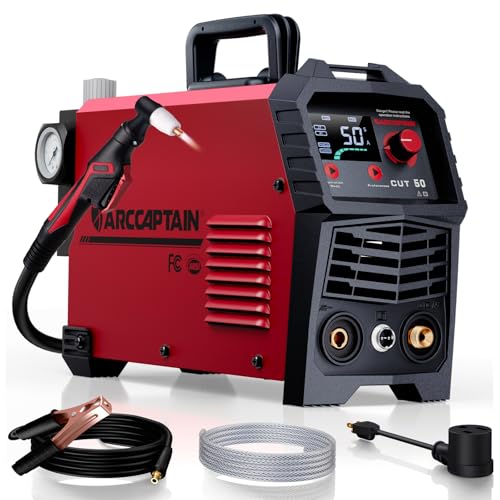
The ARCCAPTAIN 50A is the machine we would hand to most people asking this question. It is a 50-amp DC inverter cutter with genuine 110V/220V dual-voltage input, a rated 1/2-inch clean cut and 2/3-inch maximum severance at full power, non-touch pilot arc starting, and the control set that actually gets used: a large LED display you can read through a welding helmet’s peripheral vision, 2T/4T trigger modes for short cuts versus long seams, and adjustable post-flow cooling (the “PT” setting) that keeps air running after the arc stops to cool the torch and extend consumable life. A smart fan that only runs when the machine is hot keeps garage noise down between cuts.
Strengths
- Honest, mid-pack ratings: the 1/2-inch clean cut claim is consistent with what a 50-amp inverter actually delivers at 220V, and on 110V it handles 3/8-inch steel cleanly
- Adjustable post-flow and 2T/4T modes are features usually missing at this price tier, and both genuinely extend electrode and nozzle life
- Standard 1/4-inch NPT air fitting, so it connects to any normal shop compressor and regulator setup without adapters
Trade-offs
- Needs an external compressor; there is no built-in air, so budget for one if your garage does not have one
- On a 15-amp household circuit you will trip breakers at higher settings — it really wants a 20-amp garage receptacle on 110V
- The included torch lead is adequate rather than generous; long workpieces may mean moving the machine mid-job
Key specs (from the manufacturer’s listing)
- Output: 50A, DC inverter IGBT
- Input: 110V/220V dual voltage
- Clean cut: 1/2 inch; maximum cut: 2/3 inch (at 220V input)
- Start type: pilot arc; trigger modes 2T/4T; adjustable post-flow
- Air connection: 1/4-inch NPT
In use, the ARCCAPTAIN’s appeal is that nothing about it fights you. The display shows amperage rather than a vague dial position, the pilot arc lights reliably on painted steel, and the machine’s duty cycle is realistic for home fabrication: cut a bracket, fit it, cut the next. It is not a production machine and does not pretend to be. For the reader building a bumper, repairing a trailer, cutting up a rusted mower deck, or learning plasma cutting for the first time, it covers the whole job on household power for thin work and steps up to 220V when a thicker project arrives. That flexibility is exactly what a “110 volt” purchase should buy.
Best for: home fabricators and DIYers who want one machine that runs on household power now and 220V later / Not suited for: production shops cutting 1/2-inch plate all day, or buyers with no compressor and no plans to buy one
Check the current price on Amazon

bestarc 50A Plasma Cutter — Best Budget
The bestarc 50A matches the ARCCAPTAIN’s headline numbers — 50 amps, 110/220V dual voltage, 1/2-inch clean cut, 2/3-inch maximum — at the lowest price tier in this guide, and it adds two features budget machines often skip: a mesh-cut mode for expanded metal and grates, and an air sensor that warns you when supply pressure is wrong instead of letting you burn up consumables wondering why the cut quality collapsed. The large LED display and 2T/4T modes carry over as well.
Strengths
- Lowest price tier here for a genuine pilot-arc, dual-voltage 50-amp machine
- Mesh/grid cutting mode keeps the arc alive across expanded metal, where standard pilot arc machines stutter
- Air sensor and post-flow adjustment protect consumables from the two most common beginner mistakes
Trade-offs
- Fit and finish are a step below the ARCCAPTAIN and LOTOS — expect functional rather than refined controls
- Like all budget inverters, sustained cutting at maximum output on 110V will find the limit of a household breaker quickly
- Documentation is thinner than the premium brands; you will learn some settings by experiment
Key specs (from the manufacturer’s listing)
- Output: 50A, IGBT inverter
- Input: 110V/220V dual voltage
- Clean cut: 1/2 inch; maximum cut: 2/3 inch (at 220V input)
- Start type: pilot arc; mesh cut mode; air sensor; post-flow adjustment; 2T/4T
Who should buy the bestarc? The buyer whose cutting is occasional and practical: slicing up scrap, cutting rusted bolts and brackets free, trimming sheet for a project a few weekends a year. At that duty level, the difference between this machine and one a full tier up is mostly invisible, and the money saved buys the compressor, the consumables kit, and the safety gear you also need. Who should skip it: anyone planning to cut every week, where the ARCCAPTAIN’s refinement or the Hypertherm’s support network earns its keep.
Best for: occasional users and first-time plasma buyers who want real pilot-arc capability at the lowest sensible cost / Not suited for: daily users, or anyone who needs dealer-level support and documentation
Check the current price on Amazon

YESWELDER CUT-50DS PRO — Best for Safety Certification
Most budget plasma cutters carry no independent electrical safety certification at all. The YESWELDER CUT-50DS PRO is the exception in this price class: it is ETL certified, carries an IP21 ingress rating, and builds in overload and overheat protection plus a rear air filter that strips some moisture and debris from the supply air before it reaches the torch. For buyers who are (reasonably) cautious about plugging a high-frequency inverter box into a household circuit and striking an arc with it, that certification is a concrete, checkable difference — not marketing.
Strengths
- ETL certification and IP21 rating are rare at this tier and independently verifiable
- Built-in rear air filter helps consumable life when the compressor’s air is less than perfectly dry
- Digital display with post-flow, 2T, and 4T modes matches the feature set of the best machines here
Trade-offs
- Rated clean cut is 1/2 inch like the others, but the machine is tuned conservatively; it feels happiest at 3/8 inch and below
- Still needs an external compressor despite the built-in filter — the filter conditions air, it does not create it
- YESWELDER’s consumables are easy to find, but they are brand-specific patterns; keep spares on hand
Key specs (from the manufacturer’s listing)
- Output: 50A, IGBT inverter
- Input: 110V/220V dual voltage
- Clean cut: 1/2 inch (at 220V input)
- Certification: ETL listed; IP21; overload and overheat protection
- Air: built-in rear air filter; external compressor required
Beyond the certification, this is simply a well-sorted 50-amp machine. The arc is stable, the display is clear, and the protection circuits make it forgiving of the two things home users do most: running it hard on a warm day and feeding it damp compressor air. If the cutter will live in a school shop, a shared makerspace, a rental property workshop, or anywhere an insurer or a spouse might ask “is that thing certified?”, this is the pick that ends the conversation.
Best for: buyers who want independently certified electrical safety, shared workshops, and cautious first-time users / Not suited for: buyers chasing maximum cut thickness per dollar, who will get more raw capacity from the 55–56 amp picks
Check the current price on Amazon

YESWELDER CUT-55DS FUSION — Best with Built-In Air Compressor
The CUT-55DS FUSION answers the most common objection to plasma cutting at home: “I don’t own a compressor.” Its built-in compressor supplies the torch air internally, so the whole system is the machine, a power cord, and a ground clamp. It is a 55-amp, dual-voltage 110V/220V unit with non-high-frequency, non-touch pilot arc — the non-HF start also means less electrical interference with other electronics in the house, a small but real benefit when the shop shares circuits with a home office. A large LED display rounds out the controls.
Strengths
- Built-in air removes the compressor purchase, the regulator plumbing, and most moisture-related consumable problems
- Non-HF pilot arc starts cleanly on painted and rusty metal without spraying interference into nearby electronics
- 55-amp output is the joint-highest here, and on 110V the internal compressor is sized to match what household power can feed
Trade-offs
- Built-in compressors trade peak airflow for convenience; long continuous cuts on thick stock will outrun it sooner than a shop compressor setup
- One more internal system to maintain — the compressor’s intake filter needs the occasional clean
- Heavier and less portable than the external-air machines at the same amperage
Key specs (from the manufacturer’s listing)
- Output: 55A
- Input: 110V/220V dual voltage
- Air supply: built-in air compressor (external air not required)
- Start type: non-high-frequency, non-touch pilot arc
- Display: large LED digital display
The FUSION is the right answer for apartment garages, small sheds, and anyone whose “workshop” is a driveway and a folding table. Setup is genuinely five minutes: plug in, clamp on, cut. It is also the machine to lend a neighbor without a half-hour tutorial on regulators and water separators. The trade is ultimate capacity — a buyer who later adds a real compressor and a 240V circuit will eventually want a bigger external-air machine — but as a self-contained 110V cutting system, nothing else in this guide is as complete out of the box.
Best for: buyers with no compressor, small or temporary workspaces, and anyone who values five-minute setup / Not suited for: long production cuts on thick plate, where a shop compressor’s airflow wins
Check the current price on Amazon
LOTOS Apex LTP5600CD — Best for Drag Cutting and Sheet Work
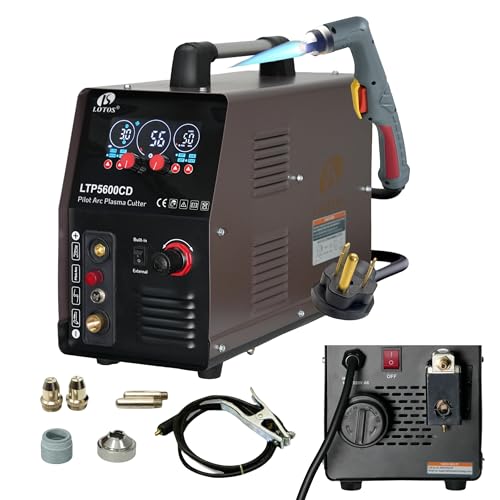
The LOTOS Apex is built around a different technique: drag cutting. Instead of holding a standoff gap, you rest the torch tip directly on the workpiece and pull it along a straightedge or template — the machine’s touch-and-go tracking keeps the arc stable in contact with the metal. For HVAC duct, sheet-metal fabrication, sign work, and metal art, where most cuts are long, thin, and guided, drag cutting is faster to learn and far more consistent than freehand standoff cutting. The Apex pairs that torch with a 56-amp inverter, built-in air, and dual-voltage 110V/220V input, and LOTOS rates it to slice 5/8-inch material cleanly at full power.
Strengths
- Drag-cut torch with touch-and-go tracking makes straight, templated cuts in sheet metal dramatically easier for beginners
- Built-in air supply, so like the FUSION it is a self-contained system with no compressor to plumb
- 56-amp output and a 5/8-inch clean rating give it the most sheet-and-plate headroom of the self-contained picks
Trade-offs
- Drag cutting wears tip shields faster than standoff cutting; budget consumables accordingly
- The technique is specialized — for freehand cuts in thick, irregular scrap, a conventional standoff torch is more forgiving
- Built-in air shares the usual airflow ceiling on long, thick cuts
Key specs (from the manufacturer’s listing)
- Output: 56A
- Input: 110V/220V dual voltage
- Clean cut: 5/8 inch (at 220V input)
- Air supply: built-in air
- Torch style: drag cut with touch-and-go tracking
LOTOS is one of the longest-established budget plasma brands, and the Apex is its most specialized home machine. If your project list reads like duct transitions, patch panels, plasma-cut signs, garden art, and trailer skins, this is the pick shaped like your work. If your list reads like demolition and thick scrap, look at the ARCCAPTAIN or the Hypertherm instead.
Best for: HVAC work, sheet-metal fabrication, metal art, and templated cuts / Not suited for: heavy demolition cutting or buyers who dislike buying torch consumables regularly
Check the current price on Amazon

Hypertherm Powermax 30 Air — Best Professional Premium
Hypertherm is the brand professional fabrication shops standardize on, and the Powermax 30 Air is its compact, self-contained machine: a 30-amp-class cutter with a built-in air compressor, designed and supported like equipment rather than a gadget. Its rated capacity is lower than the budget 50-amp machines on paper, but professional ratings are conservative — Hypertherm quotes what the machine will do all day, every day, and its consumables, torches, and service network are the deepest in the industry. It sits in a completely different price tier from the other five picks, and we include it deliberately: some buyers are not looking for the cheapest way to cut, but the last cutter they buy for a decade.
Strengths
- Professional build quality, conservative honest ratings, and the strongest dealer and parts network in plasma cutting
- Built-in compressor makes it a grab-and-go system for site work, farm repairs, and maintenance rounds
- Consumable life and cut consistency are the benchmark the budget brands are measured against
Trade-offs
- Premium price tier — it costs multiples of the budget picks, and that gap buys durability and support, not raw thickness
- Lower headline amperage than the 50-amp imports; buyers cutting mostly 1/2-inch plate should look at Hypertherm’s larger machines or 240V setups
- Overkill for a few cuts a year; the bestarc exists for that reader
Key specs (from the manufacturer’s listing)
- Output: 30A class (Powermax 30)
- Air supply: built-in air compressor
- Model: Powermax 30 Air, 088096
Choose the Hypertherm if the cutter earns money, if downtime costs more than hardware, or if you have been burned by an orphaned budget tool before and swore “never again.” Its resale value also holds up in a way no import brand matches, which quietly makes its cost of ownership more reasonable than the sticker suggests. Everyone else can buy the ARCCAPTAIN or the FUSION and be genuinely well served.
Best for: professionals, maintenance users, and buy-it-for-a-decade home shops / Not suited for: budget-first buyers or occasional users, who will never wear out a budget machine
Check the current price on Amazon
Comparison Table
| Pick | Badge | Key spec | Best for |
|---|---|---|---|
| ARCCAPTAIN 50A | Best Overall | 50A, 110/220V, 1/2″ clean cut, external air | General home fabrication |
| bestarc 50A | Best Budget | 50A, 110/220V, pilot arc, mesh mode | Occasional cutting at lowest cost |
| YESWELDER CUT-50DS PRO | Best for Safety Certification | 50A, ETL certified, IP21, air filter | Shared and cautious workshops |
| YESWELDER CUT-55DS FUSION | Best with Built-In Air Compressor | 55A, built-in compressor, non-HF pilot arc | No-compressor garages |
| LOTOS Apex LTP5600CD | Best for Drag Cutting and Sheet Work | 56A, built-in air, drag-cut torch | HVAC, sheet metal, metal art |
| Hypertherm Powermax 30 Air | Best Professional Premium | 30A class, built-in compressor, pro support | Daily and professional use |
How to Choose a 110 Volt Plasma Cutter
Start with your circuit, not the machine. Find the breaker feeding your garage or workshop receptacle. A 20-amp circuit lets a dual-voltage cutter deliver useful work on 110V — clean cuts to roughly 3/8 inch on the 50-amp class machines. A 15-amp circuit shared with lights and a garage-door opener will trip under sustained cutting; on that circuit, keep amperage low, cut thinner stock, or pick a machine and plan the 240V upgrade. Every pick in this guide is dual voltage precisely so the machine is never the bottleneck — the wall is.
Derate the headline numbers. Manufacturers quote clean-cut capacity at maximum input voltage and amperage. On 110V, expect roughly 60–75 percent of the rated clean-cut thickness in real steel, and treat “maximum” or “severance” figures as rough, slow, last-resort cuts at any voltage. Match the machine to the thickest material you cut monthly, not the thickest you can imagine cutting once.
Decide the air question early. External-air machines are lighter, cheaper, and cut longer at full power, but they assume a compressor that can sustain roughly 4–7 CFM at pressure, plus a regulator and a water separator — wet air destroys consumables and cut quality. Built-in-air machines (the FUSION, Apex, and Powermax 30 Air here) cost more per amp and give up some continuous-cut stamina, but they eliminate an entire subsystem. If you already own a decent compressor, external air is the value route. If you do not, price the compressor honestly before calling the built-in machines expensive.
Insist on pilot arc. Non-touch pilot arc starts the arc in the air and transfers to the work, so painted, rusty, and oily metal — which is to say, most real repair material — cuts without grinding a clean spot first. Scratch-start and high-frequency-only machines are obsolete at this price level; all six picks here use pilot arc.
Check consumable supply before you fall in love. Electrodes and nozzles are wear items you will buy for the life of the machine. Search for the machine’s torch consumables: if a multi-pack is cheap and in stock from several sellers, ownership will be painless. If consumables are scarce or oddly priced, walk away regardless of the machine’s price.
Read certification and duty cycle with clear eyes. An ETL or UL mark (the CUT-50DS PRO carries ETL) means an independent lab tested the electrical design. Duty cycle — how many minutes in ten the machine can cut at a given amperage — is the quiet spec that separates honest machines from optimistic ones; a very high claimed duty cycle at maximum amps on a very cheap machine is a warning sign, not a feature.
How to Set Up and Make Your First Cut on Household Power
Step 1: Prepare the circuit. Plug the cutter directly into a 20-amp receptacle where possible. Avoid long, light extension cords; if you must use one, choose the shortest, heaviest-gauge cord you own, because voltage drop starves the arc and overheats the cord. Switch the machine’s input selector or adapter to the 110V configuration per its manual.
Step 2: Sort the air (external-air machines). Connect the compressor hose to the machine’s 1/4-inch NPT inlet, set the regulator to the pressure in the manual, and drain the compressor tank first — the first blast of tank air carries the most water. Run the machine’s air-check mode and confirm steady pressure while air flows, not just at rest.
Step 3: Fit fresh consumables. Install a new electrode and nozzle, hand-tight plus a gentle snug — over-tightening distorts the swirl ring. Keep the used set as emergency spares only if the electrode’s hafnium insert is not visibly cratered.
Step 4: Clamp to clean metal, close to the cut. The ground clamp needs bare metal. Grind or wire-brush a small bright spot within the clamp’s reach of your cut line; a poor ground is the number-one cause of a weak, sputtering arc that beginners blame on the machine.
Step 5: Set amperage for the material, then test on scrap. Start at the chart value for your thickness, cut a two-inch test line on scrap of the same stock, and inspect the kerf: a slight backward drag angle and clean fall-away slag means you are close; heavy dross stuck to the bottom edge means slow down or add amps; a wide, beveled top edge means slow down or reduce amps.
Step 6: Cut with a steady drag or standoff, and mind the post-flow. Keep travel speed constant, watch the spark stream exit the bottom of the plate at a slight trailing angle, and let the machine’s post-flow finish before setting the torch down — that airflow is cooling the consumables you just paid for.
Problem: the breaker trips mid-cut. → You are asking more than the circuit has. Reduce amperage, cut thinner material on 110V, move to a dedicated 20-amp receptacle, or run the machine on 220V. Do not solve this with a bigger breaker on the same wiring.
Problem: the arc starts, then dies on rusty or painted metal. → Check the ground first (bright metal, tight clamp), then the consumables. A worn electrode produces exactly this symptom and is the cheapest fix in the shop.
Problem: cuts are beveled or dross-heavy. → Usually travel speed, not power. Too fast leaves hard bottom dross; too slow widens the kerf and bevels the edge. Change speed before you change settings.
Running on 110V vs 220V: What Actually Changes
Because every machine in this guide is dual voltage, the practical question is not which input to buy but what to expect from each. On 110V, the machine’s output ceiling drops, and so does its duty cycle at a given setting: a cutter that loafs along at 40 amps on 220V is working near its household-power limit at the same setting, heating faster and resting more. In practice this shows up as a rhythm — on household power you cut a piece, mark the next, cut again, and the machine keeps up happily; ask it for a three-foot continuous cut in 3/8-inch plate and it will ask for a pause. On 220V the same machine simply stops being the constraint for anything in its thickness class.
Cut quality changes too. The top of the thickness range on 110V produces more bottom dross and a slightly wider kerf than the same material cut at full power, because the arc has less energy to eject molten metal cleanly. For structural and repair work this is cosmetic — a grinder pass fixes it. For parts that must fit straight off the table, keep 110V work one thickness class below the machine’s rating and the edges come off nearly as clean as at 220V.
The wiring itself deserves a sentence. Many garages are fed by a single 20-amp circuit that also runs the lights, the opener, and whatever else is plugged in. A plasma cutter at household voltage draws heavily and continuously while cutting; sharing the circuit with a running compressor (for external-air machines) is the classic recipe for nuisance trips. The professional solution is a dedicated circuit; the household solution is sequencing — charge the compressor tank, unplug or idle it, then cut. And when the day comes to add a 240V receptacle, it is one of the highest-value upgrades a small shop can make: every dual-voltage tool you own, including the cutter you buy from this guide, gets stronger the day it is installed.
Torches, Consumables, and the Real Cost of Ownership
The machine is the one-time purchase; the torch is the subscription. A plasma torch consumes electrodes, nozzles (tips), swirl rings, and shield cups, and the rate of consumption is set mostly by air quality and technique rather than by the brand on the box. Dry air is the single biggest life-extender: moisture in the airstream erodes the electrode’s hafnium insert and turns a crisp arc into a wandering one, which is why external-air setups need a water separator and why the built-in-air machines, which manage their own short air path, are gentler on consumables than their price suggests.
Technique is the second factor. Piercing — starting a cut in the middle of a plate rather than at an edge — blasts molten metal back into the nozzle and is the fastest way to kill a tip; where a pierce is unavoidable, start at an angle and roll the torch upright as the arc breaks through. Dragging a standoff torch directly on the work shortens shield life; dragging is what the LOTOS Apex’s torch is designed for, and its shields are consumables priced for that expectation. Storing spare electrodes and nozzles with the machine, and swapping them at the first sign of a greenish, widening arc flame or a nozzle orifice that has gone oval, keeps cut quality consistent and prevents the cascade where a worn nozzle ruins an electrode, which ruins the next nozzle.
Budget-wise, plan ownership in tiers. The machine itself is the entry ticket. A starter consumable kit, safety gear, and (for external-air models) the regulator and separator hardware form the second tier, roughly comparable whichever machine you choose. The ongoing tier is a modest per-month consumable spend for an active home shop — small next to abrasives for a grinder, which is the tool a plasma cutter usually replaces. Readers comparing total cost against a pile of cutoff wheels and flap discs usually find the plasma cutter wins on both money and lungs within the first year of regular use.
Common Buying Mistakes
Believing the biggest amperage number on the box. Anonymous listings advertise severance thicknesses that would embarrass industrial machines. If the brand cannot tell you the duty cycle and the clean-cut rating at a stated voltage, the numbers are decoration. Every rating in this guide comes from a named manufacturer’s listing.
Forgetting the compressor in the budget. An external-air cutter is only half a system. Compressor, regulator, water separator, and hose belong in the purchase math — or choose a built-in-air machine and skip the subsystem entirely.
Planning 1/2-inch work on a 110V circuit. The dual-voltage label tempts buyers to assume full power everywhere. On household current these are 3/8-inch-class machines for clean work. Buyers with regular thick-plate work need the 240V circuit, not a different sticker on the same class of machine.
Ignoring consumables until the torch stops working. Order a consumable kit with the machine. A cutter that stops mid-project for want of a two-dollar electrode teaches this lesson the expensive way.
Skipping eye and skin protection because “it’s just a quick cut.” Plasma arcs are intensely bright and the process throws molten metal. Shade-rated eye protection, gloves, and cotton clothing are part of the purchase, every time.
Matching the Cutter to the Work: Four Common Garages
The automotive hobbyist. Your material is sheet metal, exhaust tubing, brackets, and the occasional rusted subframe — almost all of it under 1/4 inch, much of it dirty or painted. Pilot arc matters more to you than amperage, and your cutting comes in short bursts between fitting and welding. The ARCCAPTAIN 50A or bestarc 50A on a 20-amp garage circuit covers everything, and the money you do not spend on a bigger machine buys the consumables and the auto-darkening helmet you will use every session.
The farm and property maintainer. Your cuts are gates, fence panels, implement repairs, and whatever broke this week, often outdoors and away from the shop. Portability and self-contained air move to the top of the list: the YESWELDER CUT-55DS FUSION or the Hypertherm Powermax 30 Air rides in the truck, plugs into whatever receptacle the barn offers, and cuts without a compressor following it around. Thickness is unpredictable in this work, so the FUSION’s extra amperage earns its place if the budget stretches.
The HVAC and sheet-metal worker. Long, straight, guided cuts in thin material, all day. Drag cutting against a straightedge is your technique, airflow stamina matters more than peak amps, and edge quality on galvanized sheet is the metric. The LOTOS Apex was designed for exactly this bench; pair it with a straightedge and a consumable kit and it will out-produce machines with bigger numbers on the box.
The small fabrication side-business. You sell what you cut, so downtime and edge quality are money. Certification, duty cycle honesty, and consumable supply chains stop being abstractions. The Hypertherm is the business decision; the ARCCAPTAIN is the bootstrap decision that gets replaced once the order book justifies it — and because it is dual voltage, the 240V receptacle you will inevitably install makes both machines better.
Final Recommendation
For most readers, the answer is the ARCCAPTAIN 50A: honest ratings, the right controls, standard fittings, and dual voltage that lets it grow with your shop. Buy the bestarc 50A if the budget is firm and the work is occasional. Choose the YESWELDER CUT-50DS PRO if independent safety certification is a requirement in your workshop. If you have no compressor, skip the plumbing project and take the YESWELDER CUT-55DS FUSION for general work or the LOTOS Apex LTP5600CD for sheet and duct work. And if cutting is your trade, the Hypertherm Powermax 30 Air is the professional tool whose support network justifies its tier. Whichever you choose, check price on Amazon and confirm the exact model in the listing before ordering.
Plasma cutting usually arrives alongside other household-power shop tools. Readers building out a 110V workshop will also want our guides to the Best 110 Volt Mig Welder, the Best 110 Volt Arc Welder, the Best 110 Volt Air Compressor to feed an external-air cutter, and the Best 110 Volt Home Mig Gas Welders for gas-shielded work.
Frequently Asked Questions
Can a plasma cutter really cut on a normal household outlet?
Yes — that is exactly what dual-voltage machines are designed for. On a 110/120V, 20-amp circuit, a 50-amp-class cutter cleanly handles mild steel up to about 3/8 inch, which covers most automotive, fabrication, and repair work. Its full rated capacity arrives when you plug it into a 220/240V circuit.
What thickness can I cut on 110V versus 220V?
As a working rule, expect roughly 60–75 percent of the machine’s rated clean-cut thickness on 110V. A machine rated for a 1/2-inch clean cut at 220V is a 3/8-inch clean-cut machine on household power, with rougher severance cuts possible slightly beyond that.
Do I need an air compressor for a plasma cutter?
Most machines need an external compressor supplying clean, dry air. Three picks in this guide — the YESWELDER CUT-55DS FUSION, LOTOS Apex LTP5600CD, and Hypertherm Powermax 30 Air — have built-in compressors and need no external air, at some cost to continuous-cut stamina on thick material.
What is pilot arc, and why does it matter?
Pilot arc lets the torch strike an arc before touching the workpiece and maintain it across gaps, paint, rust, and mesh. It makes starting reliable on dirty real-world metal and enables cutting expanded metal. All six machines in this guide have it; avoid older scratch-start designs.
How often do plasma cutter consumables need replacing?
Electrodes and nozzles are wear parts whose life depends on amperage, air dryness, and technique — piercing thick plate and wet air shorten life fastest. Keep a spare kit with the machine, use the air-check and post-flow features, and replace the electrode when its center insert shows a deep pit; cut quality falls off a cliff after that point.
Is a cheap plasma cutter dangerous?
Any plasma cutter demands respect: the arc is extremely bright, the process sprays molten metal, and the machine is a high-power electrical device. Buying a model with independent safety certification — the ETL-listed YESWELDER CUT-50DS PRO in this guide — plus using shade-rated eye protection, gloves, and a clean, dry work area addresses the realistic risks for home use.


