Disclosure: airfryerkitchensupply.com is reader-supported. When you buy through links on our site, we may earn an affiliate commission at no extra cost to you.
Where to buy
Every welder in this guide to the best 110 volt home mig gas welders was verified on Amazon through the Creators API before inclusion. Welder pricing varies widely with promotions and included accessories, so no prices are printed — check the current price on Amazon through the links below, and read the listing carefully for what is included (gun, ground clamp, regulator, mask) before comparing one kit against another.
- Hobart Handler 140EZ MIG Welder — Best Overall
- Hobart Handler 210MVP MIG Welder — Best Dual-Voltage Upgrade
- Lincoln Electric Easy MIG 140 — Best Classic Transformer MIG
- Lincoln Electric 90i MIG and Flux Core Weld-PAK (K5256-1) — Best Lightweight
- YESWELDER 135A MIG Welder 3-in-1 — Best Value Multi-Process
- Forney Easy Weld 140 MP Multi-Process Welder — Best Multi-Process from a Heritage Brand
The best 110 volt home mig gas welders occupy one of the happiest corners of the tool world: machines that plug into an ordinary household outlet and still lay genuinely strong welds on the steel a home workshop actually meets — brackets, trailer repairs, gate hinges, exhaust work, furniture frames, mower decks. Running on 110–120V caps their output around 90–140 amps depending on the machine, which in practice means confident welding on steel up to roughly 3/16 to 1/4 inch in a single pass, and thicker work with preparation and multiple passes. For the overwhelming majority of home jobs, that is not a limitation worth paying 240V to escape.
Two clarifications keep buyers out of trouble. First, “gas” MIG means solid wire shielded by an external gas bottle (typically an argon/CO2 mix); most of these machines also run gasless flux-core wire, which needs no bottle and tolerates outdoor draughts and rusty steel, at the cost of more spatter and slag. The versatility to run both is the real prize, and most picks below offer it. Second, a 140-amp machine needs a healthy circuit — ideally a 20-amp outlet with nothing else heavy on it — to deliver its top end without tripping breakers.
The six welders below are the verified heart of the category: Hobart and Lincoln, the two heritage brands of North American home welding, in their key 110V models; a dual-voltage Hobart for owners who may gain 240V access later; and YESWELDER and Forney machines that bring multi-process flexibility to the value tier. Every output figure and capability in the spec boxes comes from the machine’s confirmed listing.
In this guide
Quick Picks
Best Overall — Hobart Handler 140EZ MIG Welder: The home MIG benchmark, updated: 30–140 amps on 120V, welds from 24-gauge sheet to 3/16-inch steel, with an EZ setup mode that gets beginners welding in two knob turns.
Best Dual-Voltage Upgrade — Hobart Handler 210MVP MIG Welder: The insurance policy: a Handler that runs on 115V today and steps up to 230V power if your workshop ever gains the circuit — one welder for both chapters of a shop’s life.
Best Classic Transformer MIG — Lincoln Electric Easy MIG 140: Lincoln’s traditional transformer machine: 30–140 amps on 115V, running MIG with gas or flux-core — the proven, repairable workhorse of the home category.
Best Lightweight — Lincoln Electric 90i MIG and Flux Core Weld-PAK (K5256-1): Lincoln’s featherweight: a 120V inverter MIG and flux-core machine in a protective metal case with a shoulder strap — the welder that goes to the fence, the trailer and the rooftop.
Best Value Multi-Process — YESWELDER 135A MIG Welder 3-in-1: The flexible bargain: a 110V machine offering gasless MIG, lift TIG and stick in one box, with synergic control and a digital display to flatten the learning curve.
Best Multi-Process from a Heritage Brand — Forney Easy Weld 140 MP Multi-Process Welder: Forney’s 3-in-1: MIG, DC TIG and stick in a 140-amp-class machine from a heritage American welding brand — the flexible pick with old-school support behind it.
How These Picks Were Chosen
Each welder was verified by brand and model through the Creators API on this site’s Amazon connection, with the ASIN attached only where the returned title matched the exact model — in welding, one digit changes the machine, so this check was done model by model. Output ranges, voltage classes and process capabilities printed in the spec boxes are drawn from those verified titles only.
The brief was gas-capable MIG for home use on household power. Machines were required to run true MIG with shielding gas on 110–120V (the Hobart 210MVP qualifies on its 115V plug), and flux-core-only machines were excluded from the top slots even where they share a model family — the keyword asks for gas welders, and the guide says plainly which picks also handle flux-core and other processes.
Balance across the set: a best-overall inverter-era Hobart, the dual-voltage insurance policy, Lincoln’s classic transformer MIG and its featherweight modern 90i line, and the two value multi-process machines. No prices or rating figures are printed; welder pricing swings too widely, and a printed number would mislead within weeks.
The 6 Best 110 Volt Home MIG Gas Welders for the Home Workshop

Hobart Handler 140EZ MIG Welder — Best Overall
The Handler line is the default answer in home MIG for a reason, and the 140EZ is its current form: full 140-amp output on household power, a stated range from 24-gauge sheet to 3/16-inch plate, and setup simplified to the point where a first-time welder can be practising beads within the hour.
Strengths
- Full 140A class output on a standard 120V supply
- EZ Mode removes the settings guesswork that defeats beginners
- Spool gun ready — aluminium MIG is an accessory away, not a new machine
Trade-offs
- 53 lb is portable by handle, not by any stretch of “light”
- Gas bottle and regulator budgeting still applies for true MIG work
- Top-end output wants a healthy 20A circuit to behave
| Input | 120V household |
| Output | 30–140A |
| Capacity | 24-gauge to 3/16 inch steel (per listing title) |
| Setup | EZ Mode — two-knob setup (per listing title) |
| Extras | Spool gun ready; infinite voltage control |
| Weight | 53 lb (per listing title) |
What makes the 140EZ the overall pick is how completely it covers the home brief. The bottom of its range — 30 amps and 24-gauge capability — is where autobody and sheet work lives, and cheap machines are usually worst exactly there, with unstable low-end arcs that blow holes in thin steel. The top of its range handles the 3/16-inch world of brackets, frames and repairs that makes up most home fabrication. Between those poles, the EZ Mode matters more than veterans admit: MIG has two variables (voltage and wire speed), and a system that pairs them sensibly from a material-thickness setting converts the beginner’s first afternoon from frustration to progress, while infinite voltage control remains available as skill grows. Spool-gun readiness quietly future-proofs it for aluminium. It is not the lightest or the cheapest machine here; it is the one with the fewest reasons to replace it later.
A note on duty and rhythm: home fabrication is mostly measuring, cutting, clamping and checking, with the arc lit a minority of the time — which is why a home-class machine’s duty cycle rarely limits real projects, and why the 140EZ’s usability features matter more than its spec-sheet endurance. The two-knob EZ logic also makes it the machine to teach on: a second person can be laying supervised beads in minutes, with settings that make sense. Shops that teach, share and build across a decade tend to converge on exactly this class of Hobart, and the aftermarket of tips, liners and drive rolls behind it is part of the purchase.
Best for: Home workshops wanting one MIG for sheet metal through 3/16-inch fabrication / Not suited for: Regular welding of steel thicker than 3/16 inch, or production use
Check the current price on Amazon
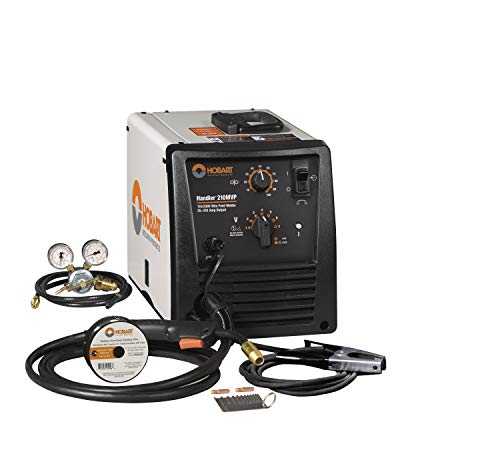
Hobart Handler 210MVP MIG Welder — Best Dual-Voltage Upgrade
The 210MVP answers the home welder’s most expensive question — “what if I outgrow 110V?” — by refusing to make you choose. On its 115V plug it is a full member of this guide; swap the plug for 230V and the same machine unlocks output no household outlet can offer.
Strengths
- Dual voltage: full home MIG now, higher output later on 230V
- Hobart build and parts support over a long ownership
- The classic upgrade path for growing workshops
Trade-offs
- Costs more than a 115V-only machine of similar class
- On 115V alone it offers no magic beyond its class — the premium buys the future
- Heavier class of machine to move around a small shop
| Input | 115V or 230V via MVP plug (per listing title) |
| Type | Wire feed MIG, single-phase |
| Brand | Hobart Handler line |
| Use | Home and light fabrication MIG |
Dual-voltage machines are bought with the head, and the 210MVP is the head’s favourite in this category. Workshops evolve: a sub-panel gets added for a compressor or a heater, a 230V outlet appears, and suddenly the welder bought for household power is the bottleneck — unless it was this one. The MVP plug system makes the voltage change a plug swap rather than a rewiring, and in the meantime the machine is a thoroughly proven Handler-class MIG for the full range of home work. The honest caveat is that on 115V it should be judged as a 115V machine; the extra money buys headroom and longevity, not present-day miracles. For a buyer setting up a long-term workshop, that is frequently the smartest money in the whole purchase — welders are decade-long tools, and this one does not need replacing when the shop grows.
The 210MVP also hedges a subtler risk: the project that outgrows the plan. A trailer build that becomes a gate, a gate that becomes a commission from a neighbour — home workshops drift upward, and the welder is the tool that most painfully caps the drift. Owners who bought dual-voltage rarely use the 230V mode in year one and rarely regret it by year five. If the budget forces a choice between accessories and the MVP’s headroom, buy the headroom and add accessories later; accessories can be bought any time, but a welder’s ceiling is cast at purchase.
Best for: Workshop owners who may add 230V power later / Not suited for: Buyers certain they will only ever weld on household outlets, on a tight budget
Check the current price on Amazon

Lincoln Electric Easy MIG 140 — Best Classic Transformer MIG
The Easy MIG 140 is the traditionalist’s pick: a transformer-based Lincoln with a 30–140 amp range on household power, equally at home on gas-shielded solid wire or gasless flux-core — the machine format that taught a generation to weld.
Strengths
- Transformer design is famously durable and repairable
- True dual capability: gas MIG for clean work, flux-core for outdoor and rusty steel
- Lincoln’s support, consumables and documentation are the category standard
Trade-offs
- Transformer machines are heavy for their output beside modern inverters
- Fewer electronic refinements than the newest models
- Like all 140A machines, top output wants a strong circuit
| Input | 115V household |
| Output | 30–140 amp |
| Design | Transformer |
| Processes | MIG (gas) and flux-cored |
| Model | K2697-1 (per listing title) |
There are two philosophies in home welding: the inverter, light and clever; and the transformer, heavy and nearly immortal. The Easy MIG 140 is the transformer philosophy from the brand that defines it. Its arc character is the one countless welders learned on, its innards are simple enough that repair is a realistic decade-two event rather than a replacement, and its process flexibility — gas MIG indoors for clean, low-spatter work; flux-core outdoors or on less-than-clean steel — covers the full home repertoire. What it concedes to the inverter era is portability and finesse features; what it keeps is trust. For buyers who keep tools for twenty years and weld everything from gates to exhausts, that trade has a clear answer, and it is this red box.
Transformer ownership has a rhythm of its own: the machine is heavy, so it tends to live in one place, and that place becomes the welding station — bench, curtain, clamps and consumables arranged around it. Shops organised that way often work better than shops chasing portability they do not need. The Easy MIG’s other long-game virtue is diagnosability: when a transformer machine misbehaves, the fault list is short and the fixes are known to every welding supplier in the country. In a tool category where the alternative is a sealed electronic box, that openness is worth real money to the keep-it-forever buyer.
Best for: Long-term owners wanting a durable, versatile, repairable MIG / Not suited for: Anyone who needs to carry their welder to the work regularly
Check the current price on Amazon

Lincoln Electric 90i MIG and Flux Core Weld-PAK (K5256-1) — Best Lightweight
Some welding jobs cannot come to the workshop. The 90i Weld-PAK is Lincoln’s answer for them: a genuine MIG — gas or flux-core — in an inverter package light enough to carry on a shoulder strap, in a metal case that treats site work as normal.
Strengths
- True portability: carry the welder to the gate, trailer or machine
- Inverter arc quality in a small-jobs format
- Metal case protects the machine in real working environments
Trade-offs
- 90-amp class output suits small jobs and thinner steel — not heavy fabrication
- Small machines run small wire spools, so consumable changes are frequent on big jobs
- Gas MIG outdoors still needs calm air or a switch to flux-core
| Input | 120V household |
| Design | Inverter, portable with shoulder strap (per listing title) |
| Processes | MIG and flux core (per listing title) |
| Case | Protective metal case |
| Model | K5256-1 (per listing title) |
The 90i line exists because the classic home-welding frustration is geographical: the broken gate hinge is at the gate. A 15-pound-class inverter you can carry one-handed changes which repairs get welded at all — the trailer in the yard, the fence at the boundary, the equipment that cannot be dragged to the bench. Its process pairing is chosen for exactly that life: flux-core for outdoor, draughty, less-than-clean steel where gas shielding would blow away, and gas MIG when the work comes indoors and cleanliness matters. The limits are output class — this is a small-jobs machine for light-gauge and moderate repairs, not a fabrication shop’s main welder — and that honesty is printed in its own positioning. As a second welder for a shop that has a big machine, or a first welder for a property maintainer, it is arguably the most useful box in this guide.
The 90i’s metal case hints at its intended biography: thrown in a truck, carried up a ladder-adjacent fence line, used in a barn aisle. Judge its output against that biography rather than against bench machines — 90-amp-class output welds the gate hinges, brackets and sheet repairs that constitute property maintenance, and it does so where they stand. Owners of larger welders buy machines like this as their second unit and report it becomes the first one they reach for, because most welding jobs are small and far from the bench. That is the highest compliment a tool class can earn.
Best for: Repairs around a property, fences, trailers and small jobs away from the bench / Not suited for: Heavy fabrication or thick-steel production work
Check the current price on Amazon

YESWELDER 135A MIG Welder 3-in-1 — Best Value Multi-Process
YESWELDER built its following by packing processes into affordable boxes, and this 135A unit is the formula at full stretch: three welding processes on household power, with synergic setup that pairs the settings for you.
Strengths
- Three processes in one machine — MIG, lift TIG and stick cover nearly all home work
- Synergic control makes setup approachable for beginners
- Digital display gives clear, repeatable settings
Trade-offs
- Its MIG mode is gasless flux-core as listed — confirm gas-MIG configuration on the listing if bottled gas is your plan
- Value brands’ long-term parts support is thinner than Hobart/Lincoln
- 135A class still obeys the household circuit’s limits
| Input | 110V household |
| Output | 135A class (per listing title) |
| Processes | Flux-core (gasless) MIG, lift TIG, stick — 3-in-1 |
| Controls | Synergic control, digital display |
| Positioning | Beginner friendly (per listing title) |
One clarification belongs at the top of this pick, because this guide insists on it: as listed, this machine’s MIG is the gasless flux-core type. Many buyers searching “gas welders” actually mean “wire welders”, and for them this box is a superb value — flux-core for outdoor and repair work, stick for thick and dirty steel, lift TIG for finer work, all on one household outlet. If your plan specifically involves bottled shielding gas and solid wire, the Hobart and Lincoln picks above are the direct answers, and you should confirm any YESWELDER variant’s gas capability on its listing before ordering. Judged as a multi-process starter, the synergic control is the feature that matters: it collapses MIG’s two-variable setup into guided choices, which is how beginners actually learn. As a first welder for auto repair and DIY metalwork — its maker’s stated targets — it is the most capability per purchase in this guide.
The YESWELDER’s three processes also serve as an education path with a natural order: start on flux-core MIG, where setup is forgiving and the wire is cheap; add stick when thick or dirty steel appears, since electrodes tolerate what wire will not; graduate to lift TIG last, when projects justify its patience and cleanliness. Synergic control supports the first stage specifically, and the digital display makes settings repeatable — write them down per material, as the how-to section advises, and the machine becomes a reference book. As a learning platform bought once, its value is difficult to beat.
Best for: Beginners and DIYers wanting maximum process flexibility on a budget / Not suited for: Buyers whose brief is specifically bottled-gas MIG only
Check the current price on Amazon

Forney Easy Weld 140 MP Multi-Process Welder — Best Multi-Process from a Heritage Brand
The Forney 140 MP splits the difference between the heritage single-process machines and the value multi-process boxes: three processes — MIG, DC TIG and stick — from a brand with a long history in American welding supply.
Strengths
- MIG plus TIG plus stick covers the full home process range
- Heritage brand with established consumables and support channels
- One machine for the learner who does not yet know their main process
Trade-offs
- Multi-process machines are jacks of all trades — dedicated MIGs edge them on MIG-only refinement
- TIG torch and other process accessories may be separate purchases — check the listing
- DC TIG does not weld aluminium (that needs AC TIG) — a category limit worth knowing
| Processes | MIG, DC TIG, stick — 3-in-1 (per listing title) |
| Class | 140 multi-process |
| Brand | Forney Easy Weld line |
| Use | Home and DIY multi-process welding |
Multi-process machines make sense at a specific moment in a welder’s life: when the work is varied, the budget is singular, and nobody yet knows whether next year’s projects are gates (MIG), brackets (stick) or something finer (TIG). The 140 MP serves that moment with a credibility the no-name boxes cannot — Forney has supplied American welders for generations, and its consumables are on shelves everywhere. The compromises are the honest ones of the format: each process is very good rather than ultimate, the accessory list needs reading so the TIG side does not surprise you at checkout, and DC TIG — as on all machines of this class — is for steels, not aluminium. For a home shop buying one box to learn and build with for years, those are trades worth making, and this is the multi-process pick with the strongest roots.
Forney’s distribution is the quiet feature here: its consumables — contact tips, nozzles, electrodes, wire — sit in farm and hardware stores across the country, so a Sunday project is never hostage to a delivery van. Multi-process owners consume more varied supplies than anyone, which makes that shelf presence a practical advantage rather than a branding point. Pair it with the machine’s process breadth and the 140 MP becomes the rural and small-town workshop’s natural choice: everything weldable, everything replaceable, all within a short drive.
Best for: Home shops wanting MIG, TIG and stick in one supported machine / Not suited for: MIG-only specialists or anyone planning aluminium TIG
Check the current price on Amazon
Comparison Table
| Pick | Badge | Key spec | Best for |
|---|---|---|---|
| Hobart Handler 140EZ MIG Welder | Best Overall | 120V, 30–140A, welds 24-ga to 3/16 in | Home workshops wanting one MIG for sheet metal through 3/16-inch fabrication |
| Hobart Handler 210MVP MIG Welder | Best Dual-Voltage Upgrade | 115V/230V dual voltage MIG | Workshop owners who may add 230V power later |
| Lincoln Electric Easy MIG 140 | Best Classic Transformer MIG | 115V, 30–140A, transformer, MIG + flux-core | Long-term owners wanting a durable, versatile, repairable MIG |
| Lincoln Electric 90i MIG and Flux Core Weld-PAK (K5256-1) | Best Lightweight | 120V inverter, MIG + flux-core, shoulder-strap portable | Repairs around a property, fences, trailers and small jobs away from the bench |
| YESWELDER 135A MIG Welder 3-in-1 | Best Value Multi-Process | 110V, 135A class, MIG/TIG/Stick 3-in-1, synergic | Beginners and DIYers wanting maximum process flexibility on a budget |
| Forney Easy Weld 140 MP Multi-Process Welder | Best Multi-Process from a Heritage Brand | 140 MP, MIG + DC TIG + stick 3-in-1 | Home shops wanting MIG, TIG and stick in one supported machine |
How to Choose a 110 Volt MIG Welder for Home Use
Start with your steel. List the thicknesses you will actually weld: sheet and autobody (thin — low-end arc quality matters most), general fabrication to 3/16 inch (the 140-amp class covers it), or regular work above 1/4 inch (be honest: that is 240V territory, or multi-pass discipline). Most home workshops live entirely in the first two bands, which is why this category thrives.
Then decide process scope. Gas MIG only, in a dedicated machine, buys refinement. MIG plus flux-core buys indoor-outdoor versatility. Full multi-process buys learning room. Finally, weigh the ownership factors veterans actually cite in year five: brand support and consumables availability, duty cycle at your working amperage, and whether the machine’s weight matches how often it must move.
- Thin steel and autobody: prioritise a smooth, low 30A bottom end
- General fabrication: 140A class on a healthy 20A circuit
- Regular thick steel: plan 240V or a dual-voltage machine
- Gas MIG for clean indoor work; flux-core for outdoor and rusty steel
- Check what the kit includes — gun, clamp, regulator, helmet are separate budgets
Gas MIG vs Flux-Core: What “Gas” Really Buys You
Gas MIG runs solid wire under a blanket of shielding gas from a bottle. The welds are clean, the spatter is minimal, there is no slag to chip, and thin sheet behaves — which is why autobody and visible fabrication prefer it. Its weaknesses are the bottle (purchase or rental, refills, storage) and the wind: outdoors, a breeze strips the shielding and ruins welds.
Flux-core wire carries its shielding inside the wire, so it welds outdoors, on rusty or painted steel, and with no bottle at all — at the cost of spatter, slag to clean, and rougher appearance. Most machines in this guide run both, and the mature home setup uses each where it wins: gas at the bench, flux-core at the fence. When a listing says “gasless MIG” — as the YESWELDER pick states plainly — it means flux-core only as configured, and that distinction is worth more than any brand badge.
Circuits, Duty Cycle and the Hidden Specs
A 140-amp welder at full output draws heavily on its circuit; a 20-amp outlet with nothing else major on it is the recommended home for the top of the range, and a 15-amp circuit will still run these machines at the moderate settings most work uses — with the breaker objecting if you demand everything at once. A short, heavy-duty extension cord rated for the load is acceptable; a light household cord is not.
Duty cycle — the percentage of ten minutes a machine can weld at a given output — is the spec that separates home machines from pro ones, and for home use it is rarely the binding constraint: fabrication involves as much measuring, cutting and fitting as arcing. It matters on long seam welds and production runs. Read it at the amperage you will actually use, not at maximum, where every machine’s number looks small.
Welding Safety: The Non-Negotiables
MIG welding concentrates several hazards into one bright point, and the safety routine is short enough that skipping any of it is inexcusable. Eye protection means a proper welding helmet — the arc’s ultraviolet will injure unprotected eyes, including those of bystanders and pets, faster than they can react. Skin coverage is the same logic: gloves, long sleeves, long trousers, no cuffs to catch sparks, and no synthetic fabrics that melt. Ventilation matters because fumes are a cumulative harm — weld outdoors or with extraction, and never on galvanised steel without serious precautions, since zinc fumes are acutely nasty.
Fire discipline is the third leg: sparks and slag travel metres and smoulder in dust, cardboard and dry grass, so the welding area is cleared, a extinguisher is within reach, and the space gets a fire watch for half an hour after the last weld — most welding fires start after the welder has gone inside. Electrically, the machine gets a sound circuit, undamaged leads, and dry conditions. None of this is optional garnish on the hobby; it is the hobby’s entry fee, and every welder in this guide assumes you have paid it.
Consumables and Running Costs: Budgeting Beyond the Box
The welder is the down payment; the consumables are the mortgage. Budget honestly for the whole system: a gas bottle (bought or rented) and regulator for gas MIG, wire in the sizes your work uses, contact tips and nozzles as wear items, a decent auto-darkening helmet, gloves, clamps and an angle grinder with flap discs — the tool that prepares and finishes most welds. Flux-core starters skip the bottle but spend more on wire per kilo and more time on cleanup.
Running costs then settle into a modest rhythm: wire and gas consumption scale with arc time, tips are cheap and disposable, and electricity is a minor line. The expensive mistakes are the false economies — a helmet too dark or slow to see through, wire too poor to feed smoothly, a bottle too small that empties mid-project. Buy the machine that fits your steel, then feed it consumables that let it perform, and the cost per finished project drops to the level that makes home welding the bargain it should be.
Your First Projects: A Sensible Progression
New MIG owners improve fastest on projects chosen in the right order. Start with scrap: beads on plate, then butt joints, then corners, until the settings chart in your machine’s door is a language you speak. The first real project should be thick enough to forgive and small enough to finish — a welding cart for the machine itself is the traditional choice, and it teaches cutting, fitting, clamping and welding in one honest loop.
Next come repairs with consequences low and gratitude high: a gate hinge, a mower deck patch, a trailer light bracket. These teach the skill that separates welders from bead-layers — preparation: cleaning to bright metal, fitting gaps honestly, clamping so the work cannot move. Only then take on the structural and the visible: the exhaust, the furniture frame, the neighbour’s trailer. Each stage uses the same machine bought from this guide; what changes is the operator, which was always the plan.
Wire, Tips and Drive Rolls: The Small Parts That Decide Arc Quality
Experienced welders diagnose most “machine problems” at the gun, not the box. The contact tip is a consumable with a short, hard life: an ovalled, spattered tip makes the wire wander and the arc stutter, and replacing it costs pennies — keep spares in the sizes you run, and change them at the first suspicion. The liner inside the gun lead is the second suspect: kinked leads and clogged liners make wire feed surge, which beginners misread as their own technique. Blow the liner out, keep the lead laid in gentle curves, and half of all feeding drama disappears.
Drive-roll tension is the third: too loose slips, too tight deforms soft wires and shaves debris into the liner. The test is tactile — the wire should feed against a gloved hand’s resistance without the roll slipping or the wire bird-nesting at the drive. Master these three small systems and any machine in this guide will weld at the top of its class; neglect them and the best machine here will feel broken. It is the cheapest expertise in the whole hobby.
Understanding Duty Cycle Without the Headache
Duty cycle frightens beginners out of proportion to its importance, so here is the whole subject in kitchen terms. A duty cycle of, say, a fifth at full output means the machine can weld for two minutes in ten at that setting before it needs to rest and cool — and its thermal protection will enforce the rest automatically, which feels like a failure the first time it happens mid-project and is actually the machine protecting itself exactly as designed.
Three facts defuse it. Home fabrication rarely holds an arc for two continuous minutes — cutting, fitting and clamping fill the rest of the ten. Duty cycle rises steeply as output falls, so at the moderate settings most home steel needs, these machines effectively weld all afternoon. And the work that does hit the limit — long seams on thick plate — is the same work that argues for 240V anyway. Read the figure at your working amperage, respect the rest light when it comes, and duty cycle will never be the reason a project fails.
A Word on Helmets and Seeing the Puddle
If one accessory decides how fast a beginner improves, it is the helmet — because MIG skill is mostly watching the puddle, and you cannot learn what you cannot see. An auto-darkening helmet with a clear, true-colour view and an adjustable shade turns the arc from a blinding event into a readable process: the puddle’s edge, the wire’s aim, the joint’s line all become visible information. Buyers routinely spend welder money first and helmet money last; reversing that instinct for even one tier of helmet quality pays back in every weld of the first year. The machines in this guide deserve eyes that can see what they are doing.
How to Set Up a Home MIG Welder for Your First Welds
This sequence takes a new machine from box to first practice beads safely. Your machine’s manual governs its specifics — this is the order of operations that manuals assume.
- Set up the circuit and the space: a healthy outlet, a metal work surface, no flammables within reach of sparks, and ventilation — welding fumes are not a seasoning.
- Fit eye and skin protection before anything is powered: auto-darkening helmet, gloves, long sleeves, and no synthetic fabrics that melt.
- Load the wire as the manual directs — correct drive-roll groove and tension for your wire size — and feed it through the gun.
- For gas MIG: fit the regulator, connect the bottle securely upright, set flow per the manual, and leak-check connections; for flux-core, confirm polarity is set for flux-core, which differs from gas MIG on most machines.
- Connect the ground clamp to clean, bare metal on the workpiece or table — paint and rust under the clamp are the cause of half of all “bad welder” complaints.
- Set voltage and wire speed from the chart inside the machine’s door for your material thickness, then run practice beads on scrap of the same thickness.
- Adjust one variable at a time: the classic reference is the sound — a steady sizzle like frying bacon means you are close — and check penetration on the back of the practice piece.
Keep a practice log for your first months: material, thickness, settings, result. Welding skill is mostly pattern recognition, and the log turns random afternoons into a reference book written for your exact machine.
Common Buying Mistakes
Buying output you cannot feed. A 140A machine on a tired 15A circuit shared with a freezer will trip and frustrate. Sort the circuit as part of the purchase.
Confusing “gasless MIG” with gas MIG. They are different processes with different wires, polarity and results. Read the listing’s process description, not just the headline.
Skipping the gas budget. True MIG needs a bottle, regulator and refills. Price the whole system, not just the welder, before comparing kits.
Welding on paint, rust and galvanising without prep. Contamination ruins welds and galvanised fumes are a genuine health hazard. Grind to clean metal and ventilate — every time.
Judging a welder by its maximum amps alone. Low-end arc quality, duty cycle at working amps, and brand support decide satisfaction. Maximum output is the least-used number on the dial.
Final Recommendation
For the majority of home workshops, the Hobart Handler 140EZ is the welder to buy: complete range, beginner-proof setup, and a brand that will still sell you parts in a decade. The 210MVP is the same instinct with an insurance policy for a future 240V shop. Lincoln loyalists and transformer traditionalists should take the Easy MIG 140, property maintainers the featherweight 90i, and buyers who want every process in one box should choose between the YESWELDER’s value and the Forney’s heritage support.
Whichever machine lands on your bench, spend the first month on scrap and settings rather than projects. MIG rewards that patience like few skills do — and a 110 volt machine, honestly matched to home steel, will not be the limit on what you can build.
Start with Hobart Handler 140EZ MIG Welder, or Hobart Handler 210MVP MIG Welder if your needs are narrower, and keep Lincoln Electric Easy MIG 140 on the shortlist as the alternative.
Related guides in this series: Best 110 Volt Arc Welder, Best 110 Volt Garage Heater, Best 110 Volt Electric Single Driveway Gate Opener, Best 110 Volt Impact Wrench, Best 110 Volt Air Compressor, Best 110 Volt Winches.
Frequently Asked Questions
Can a 110 volt MIG welder weld thick steel?
Up to a point: the 140-amp class handles about 3/16 inch confidently in a single pass and 1/4 inch with good technique, edge preparation and multiple passes on some machines. Regular work above that is 240V territory — which is why the dual-voltage Hobart in this guide exists.
Do I need a gas bottle to MIG weld?
For true gas MIG, yes — solid wire needs external shielding gas. The alternative is flux-core wire, which shields itself and needs no bottle, at the cost of spatter and slag. Most picks here run both, so you can start gasless and add a bottle when clean indoor work justifies it.
What circuit does a home MIG welder need?
Ideally a 20-amp outlet with little else on it for full-output work. A 15-amp circuit runs these machines at moderate settings — where most home welding happens — but may trip at maximum output. Never use a light-duty extension cord; a short, heavy-duty rated cord is the acceptable option.
MIG or stick for a beginner?
MIG is the easier first process to produce sound welds with, especially on the thin steel beginners meet most — which is why synergic and EZ-setup machines feature in this guide. Stick is cheaper to start and better on thick, dirty steel outdoors. Multi-process picks here let you learn both on one box.
Can these welders weld aluminium?
MIG aluminium is possible with a spool gun — the Hobart 140EZ is spool-gun ready — using pure argon gas. It is a specialist technique with a real learning curve. TIG aluminium requires an AC TIG machine, which none of these are; DC TIG on the multi-process picks is for steels.
How long will a home MIG welder last?
Welders are among the longest-lived tools in a shop — a decade or more is normal for the heritage brands, and transformer machines are famously repairable. Consumables (tips, liners, drive rolls) are wear items on every machine; buy brands whose consumables you can source easily.


