Disclosure: airfryerkitchensupply.com is reader-supported. When you buy through links on our site, we may earn an affiliate commission at no extra cost to you.
Where to buy
Every heater below is a plug-in 110/120V point-of-use mini tank that was verified against Amazon’s catalogue through the Creators API before ranking. If you are shopping for the best 110 volt mini water heater to kill the long wait at one sink — a bathroom far from the main tank, a kitchen, a workshop, an office wet bar — these six are the shortlist: three sizes from Bosch’s Tronic 3000 T line, two UL-listed ThermoMate tanks, and GE’s under-sink entry.
- Bosch Tronic 3000 T ES4 4-Gallon (Best Overall) — Check the current price on Amazon
- Bosch Tronic 3000 T ES2.5 2.5-Gallon (Best for a Single Sink) — Check the current price on Amazon
- Bosch Tronic 3000 T ES8 7-Gallon (Best Capacity) — Check the current price on Amazon
- ThermoMate ES400 4 Gallon UL Listed (Best Value) — Check the current price on Amazon
- ThermoMate ES150 1.3 Gallon UL Listed (Best Compact) — Check the current price on Amazon
- GE Appliances 2.5 Gallon Mini Tank 120V (Best Big-Brand Alternative) — Check the current price on Amazon
The problem the best 110 volt mini water heater solves is embarrassingly simple: the water in the pipe between your main water heater and a distant faucet goes cold between uses, so every handwash starts with a long, wasteful run of lukewarm disappointment while fresh hot water travels the length of the house. A mini tank heater parks a few gallons of ready hot water directly under the sink that needs it. The wait disappears, the wasted water disappears, and because these units plug into a standard 110/120V outlet, the installation is plumbing, not electrical contracting.
Understand what a mini tank is not. It is not a whole-house water heater in a small box, and it will not run a shower, fill a soaking tub or feed a family bathroom’s morning rush from its own storage — a few gallons is a few gallons. It works in two honest modes: standalone, feeding one sink (or one sink plus a light second draw), or as a booster in series with your main heater, covering the first moments of a shower or bath until the main supply arrives hot. Every pick in this guide is sized and judged for those two jobs, and the sizing section below will tell you plainly which mode your situation needs.
The category divides neatly. Bosch’s Tronic 3000 T line is the established reference — three sizes, flexible mounting, and the deepest ownership track record. ThermoMate competes hard on value with UL-listed tanks in more sizes than anyone else. GE brings an appliance giant’s distribution and an adjustable thermostat to the 2.5-gallon class. All of them plug in, all of them fit under a sink or on a nearby wall, and none of them asks for a gas line, a vent or a 240V circuit.
In this guide
Quick Picks
Six verified mini tanks, sorted by the job each does best. Badges match the full reviews below.
Bosch Tronic 3000 T ES4 4-Gallon — Best Overall. The sweet spot of the category: four gallons covers a busy bathroom sink with margin, mounts on a shelf, wall or floor, and carries Bosch’s build quality and support. Check on Amazon.
Bosch Tronic 3000 T ES2.5 2.5-Gallon — Best for a Single Sink. The classic point-of-use size for one bathroom or kitchen sink — instant hot water for handwashing and shaving without oversizing the cabinet. Check on Amazon.
Bosch Tronic 3000 T ES8 7-Gallon — Best Capacity. The largest plug-in mini tank in this roundup, for a sink plus light secondary draws, a workshop, or booster duty ahead of a shower. Check on Amazon.
ThermoMate ES400 4 Gallon — Best Value. Four UL-listed gallons at a value-tier price, wall or floor mounted — the same capacity class as the Bosch ES4 for noticeably less money. Check on Amazon.
ThermoMate ES150 1.3 Gallon — Best Compact. The smallest tank here, for a single low-use sink, a powder room, a wet bar or anywhere cabinet space is the binding constraint. Check on Amazon.
GE Appliances 2.5 Gallon — Best Big-Brand Alternative. A 120V, 2.5-gallon tank with an adjustable thermostat from a major appliance brand — the comfort pick for buyers who want GE’s name and service network under the sink. Check on Amazon.
How These Picks Were Chosen
Three gates came first. The heater had to be a genuine plug-in 110/120V mini tank — hardwired 240V point-of-use units and whole-house equipment were excluded regardless of quality. It had to store water rather than promise impossible instant performance, because at household wattage a small tank is the honest engineering answer, a point the buying guide quantifies. And the exact model had to verify through the Creators API against Amazon’s live catalogue, so every ASIN, title and capacity quoted here comes from the manufacturer’s own listing.
Within those gates we weighted: capacity matched to realistic single-sink and booster use; mounting flexibility, because under-sink cabinets are awkward and a heater that can sit on a shelf, hang on a wall or stand on the floor fits more real bathrooms; certification, with UL listing treated as a meaningful safety signal on the ThermoMate line; temperature control, since an adjustable thermostat decides both comfort and scald safety; and brand support, because a water heater is a pressurised vessel full of hot water living in your cabinet, and the company behind it should answer the phone in year five.
We excluded tankless toys that claim shower performance from a household outlet — the physics section below shows why those claims fail — and any tank with no identifiable manufacturer or certification trail. What remains is a conservative list on purpose: water, electricity and pressure deserve conservative.
The 6 Best 110 Volt Mini Water Heaters
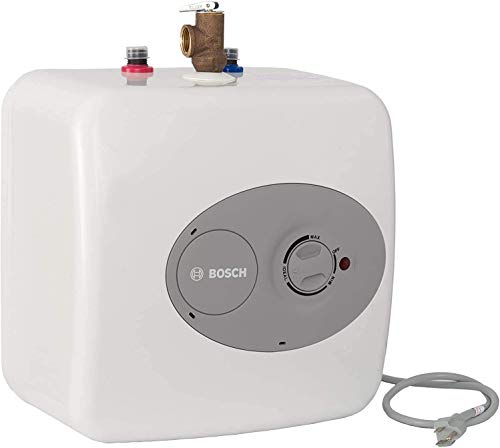
Bosch Tronic 3000 T ES4 4-Gallon — Best Overall
If one mini tank has to be recommended to the most people, it is the Bosch ES4. Four gallons is the capacity that covers a bathroom sink’s real life — handwashing, tooth-brushing, shaving, a quick basin fill — without the tepid tail that smaller tanks show on the third consecutive use, and the Tronic 3000 T line’s shelf, wall or floor mounting means it fits the cabinet you actually have rather than the one in the brochure.
Strengths
- Four-gallon capacity is the category’s sweet spot for a single busy sink
- Mounts on a shelf, wall or floor — the most flexible installation in this roundup
- Bosch build quality, documentation and parts support behind a pressurised appliance
Trade-offs
- Premium-tier pricing versus the ThermoMate value line
- Four gallons still will not run a shower standalone — booster mode only for bathing
- Needs a nearby outlet and a T&P relief drain path planned before installation
| Spec | Detail |
|---|---|
| Capacity | 4 gallons |
| Series | Bosch Tronic 3000 T (ES4) |
| Mounting | Shelf, wall or floor |
| Use | Point-of-use mini tank, plug-in |
The ES4’s real advantage shows up in the rhythm of a household morning. Two people cycling through the same bathroom sink — wash, brush, shave, wash again — draw hot water in bursts with recovery gaps between them, and four gallons of storage plus a heating element recovering between bursts is well matched to that pattern. Owners downsizing from this size to save a little money are the ones who discover the tepid third draw; owners upsizing to the ES8 for a single sink mostly bought cabinet-filling insurance they never claim.
Bosch’s presence in the category also buys documentation quality: clear installation instructions, a defined relief-valve requirement, and a support channel that knows the product line. For an appliance that holds pressurised hot water a foot from your shins, that maturity is worth the tier difference to most buyers.
Best for: a main bathroom or kitchen sink that sees continuous household use / Not suited for: standalone shower duty, or the tightest budgets
Check on Amazon — check price on Amazon before you decide, since appliance pricing shifts with promotions.
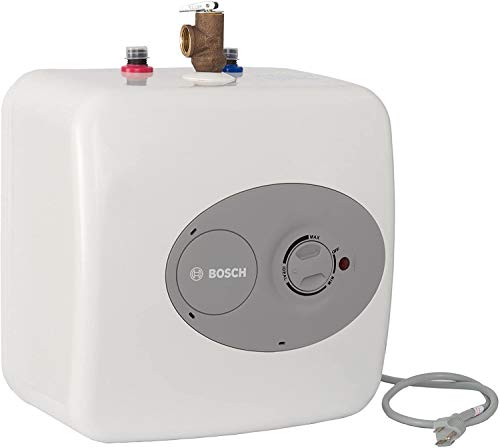
Bosch Tronic 3000 T ES2.5 2.5-Gallon — Best for a Single Sink
The ES2.5 is the original point-of-use answer and still the right one for a single sink used the way sinks are mostly used: short draws, spaced out. Two and a half gallons of stored hot water covers handwashing and shaving sessions comfortably, recovers between uses, and tucks into cabinets that would reject its bigger siblings.
Strengths
- Right-sized for one sink — no paying for capacity that never gets used
- Same Bosch Tronic line quality and mounting flexibility as the ES4
- Smaller cabinet footprint suits powder rooms and compact vanities
Trade-offs
- Back-to-back heavy draws (basin fills, long rinses) will outrun it
- Same premium tier as the ES4, so the saving over its sibling is modest
- Still not a shower solution on its own
| Spec | Detail |
|---|---|
| Capacity | 2.5 gallons |
| Series | Bosch Tronic 3000 T (ES2.5) |
| Mounting | Shelf, wall or floor |
| Use | Point-of-use mini tank, plug-in |
Choose the ES2.5 by being honest about the sink’s diary. A guest bathroom, a powder room, a home-office bathroom, a kitchen sink used for handwashing and quick rinses between a dishwasher’s shifts — these are 2.5-gallon lives. The recovery between spaced-out draws is the whole design, and in that duty the ES2.5 feels indistinguishable from a much larger heater: the water is simply hot, immediately, every time.
Where buyers go wrong is installing this size under the household’s busiest sink and then blaming the heater for arithmetic. If two people get ready simultaneously at one basin every morning, step up to the ES4. If the sink’s life is intermittent, the ES2.5 is the efficient purchase in money, space and standby energy alike.
Best for: guest baths, powder rooms and single sinks with spaced-out use / Not suited for: the household’s busiest bathroom sink at morning rush
Check on Amazon — check price on Amazon before you decide, since appliance pricing shifts with promotions.
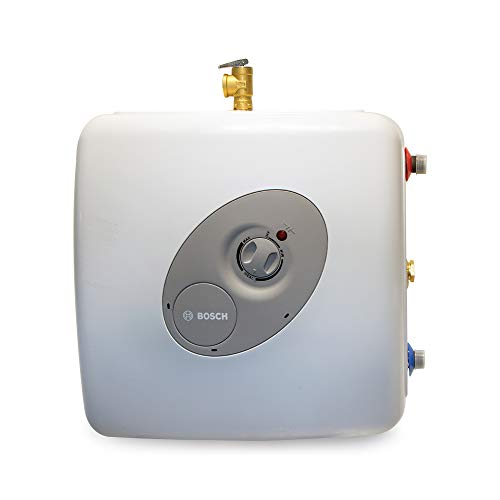
Bosch Tronic 3000 T ES8 7-Gallon — Best Capacity
The ES8 stores seven gallons — the most of any plug-in pick here — and that capacity changes its job description. This is the mini tank for a sink plus a light second draw, for a workshop or utility sink with real washing to do, for a small salon or office kitchenette, or for booster duty in series ahead of a shower, where its stored volume covers the warm-up gap generously before the main heater’s water arrives.
Strengths
- Largest plug-in capacity in the roundup — fewer tepid surprises under consecutive draws
- Credible booster for a shower or bath fill’s opening minutes
- Same Bosch line, mounting flexibility and support as its siblings
Trade-offs
- Physically the biggest box here; measure the cabinet before falling in love
- More stored water means more standby energy keeping it hot
- Highest price tier in the Bosch line
| Spec | Detail |
|---|---|
| Capacity | 7 gallons |
| Series | Bosch Tronic 3000 T (ES8) |
| Mounting | Shelf, wall or floor |
| Use | Point-of-use mini tank / booster, plug-in |
Booster duty deserves explanation because it is the ES8’s finest trick. Plumbed in series on the hot line feeding a distant bathroom, the mini tank supplies the shower’s first minutes from storage while the main heater’s hot water is still travelling through cold pipes. By the time the stored volume is spent, genuinely hot water from the main tank has arrived to take over. The result feels like instant hot water at a fixture that used to waste a minute and gallons of water on every shower — achieved without recirculation pumps or their energy costs.
The cautions are space and honesty. Seven gallons plus fittings needs a real cabinet, a closet corner or a utility space; and even seven gallons is a bridge, not a reservoir — it will not carry a long shower alone. Used as designed, though, the ES8 is the most capable plug-in heater in this guide.
Best for: booster duty for a distant bathroom, workshops, and sinks with a second light draw / Not suited for: compact vanities, or anyone expecting standalone shower performance
Check on Amazon — check price on Amazon before you decide, since appliance pricing shifts with promotions.

ThermoMate ES400 4 Gallon — Best Value
The ThermoMate ES400 makes the value argument in its title: four gallons, UL listed, 110V/120V, wall or floor mounted. It matches the Bosch ES4’s capacity class at a value-tier price, and the UL listing matters — it means the design has been through a recognised safety certification, which is exactly what you want verified on a budget pressurised appliance.
Strengths
- Four gallons and UL listing at a value-tier price
- Wall or floor mounting suits most under-sink spaces
- 110V/120V plug-in simplicity, same as the premium picks
Trade-offs
- Brand support and documentation run thinner than Bosch’s
- No shelf-mount option listed — wall or floor only
- Fit and finish are a tier below the Bosch line
| Spec | Detail |
|---|---|
| Capacity | 4 gallons |
| Model | ThermoMate ES400 |
| Certification | UL Listed |
| Input power | 110V/120V |
| Mounting | Wall or floor |
Value water heaters should be judged by a stricter standard than value gadgets, because the failure modes involve water. The ES400 passes the checks that matter: an identifiable manufacturer, a recognised certification, standard fittings and a capacity claim that matches its physical size. Where the savings live is in the surrounding experience — plainer documentation, a smaller support footprint — rather than in the vessel itself.
For a rental property, a workshop sink, a second bathroom or simply a household that would rather spend the difference on the plumber’s visit, the ES400 is the rational buy in this roundup. It does the ES4’s core job — four hot gallons, instantly, at one sink — and keeps the change.
Best for: value-focused buyers who still want UL certification and full 4-gallon capacity / Not suited for: buyers who prioritise the deepest brand support and documentation
Check on Amazon — check price on Amazon before you decide, since appliance pricing shifts with promotions.

ThermoMate ES150 1.3 Gallon — Best Compact
The ES150 stores just 1.3 gallons, and that smallness is its purpose. Powder rooms, wet bars, tiny vanities, office kitchenettes, salon back-bars — plenty of sinks need instant hot water for handwashing and little else, in cabinets that cannot swallow a four-gallon tank. The ES150 is UL listed, plugs into 110V/120V, and mounts on a wall or floor where its bigger siblings simply do not fit.
Strengths
- Smallest footprint in the roundup — fits genuinely tight cabinets
- UL listed, like its ThermoMate siblings
- Lowest standby losses of any pick: less stored water to keep hot
Trade-offs
- 1.3 gallons is handwashing territory only — consecutive real draws outrun it fast
- Recovery between draws defines its rhythm; busy sinks need not apply
- Value-tier documentation and support
| Spec | Detail |
|---|---|
| Capacity | 1.3 gallons |
| Model | ThermoMate ES150 |
| Certification | UL Listed |
| Input power | 110V/120V |
| Mounting | Wall or floor |
Small tanks get dismissed by buyers who imagine capacity is free. It is not: stored hot water loses heat around the clock, so an oversized tank under a powder-room sink spends its life paying standby losses to serve two handwashes a day. The ES150 inverts that waste. For genuinely light duty it is the most efficient purchase in this guide — in cabinet space, in purchase price and in energy alike.
Just respect its envelope. The ES150 serves a sink whose diary is handwashing, the occasional rinse and little more. Put it under a kitchen sink that fills pots and it will be found out within a week; put it where it belongs and it will feel like a magic trick every time the tap turns hot instantly.
Best for: powder rooms, wet bars and single light-duty sinks in tight cabinets / Not suited for: kitchens, busy bathrooms or any consecutive-draw duty
Check on Amazon — check price on Amazon before you decide, since appliance pricing shifts with promotions.

GE Appliances 2.5 Gallon Mini Tank — Best Big-Brand Alternative
GE’s entry covers the same 2.5-gallon single-sink ground as the Bosch ES2.5, with two distinguishing notes from its listing: an adjustable thermostat, and the backing of one of the largest appliance organisations in the country. For buyers who choose appliances by the service network behind them, that second point can be the whole argument.
Strengths
- Adjustable thermostat for setting a safe, comfortable delivery temperature
- GE Appliances’ distribution and service network behind the product
- Designed for straightforward under-sink installation on 120V
Trade-offs
- 2.5-gallon envelope: single-sink, spaced-draw duty only
- Newer to this niche than Bosch’s long-running Tronic line
- Mounting options are less varied than the Bosch line’s shelf/wall/floor flexibility
| Spec | Detail |
|---|---|
| Capacity | 2.5 gallons |
| Model | GE02P08BAW |
| Input power | 120V |
| Control | Adjustable thermostat |
| Use | Under-sink point-of-use mini tank |
The adjustable thermostat deserves its mention because temperature setting is a safety control, not a comfort garnish. Stored water should be kept hot enough to be useful and hygienic, while delivery at the tap should respect scald risk — especially in homes with children or elderly residents. A heater that makes the setpoint easy to adjust, and holds it steadily, is doing quiet safety work every day.
Between this and the Bosch ES2.5, the honest advice is to choose by ecosystem: GE if your kitchen already runs on GE service, Bosch if you value the Tronic line’s longer point-of-use pedigree and mounting flexibility. The water from either arrives hot and instantly, which is the point of the purchase.
Best for: single-sink duty in homes that prefer a major appliance brand’s network / Not suited for: busy sinks, or cabinets needing the Bosch line’s shelf-mount option
Check on Amazon — check price on Amazon before you decide, since appliance pricing shifts with promotions.
Comparison Table
| Pick | Badge | Key spec | Best for |
|---|---|---|---|
| Bosch ES4 | Best Overall | 4 gal, shelf/wall/floor mount | a busy single bathroom or kitchen sink |
| Bosch ES2.5 | Best for a Single Sink | 2.5 gal, shelf/wall/floor mount | guest baths and spaced-out single-sink use |
| Bosch ES8 | Best Capacity | 7 gal, shelf/wall/floor mount | booster duty and sink-plus-second-draw |
| ThermoMate ES400 | Best Value | 4 gal, UL Listed, wall/floor | full capacity on a value budget |
| ThermoMate ES150 | Best Compact | 1.3 gal, UL Listed, wall/floor | powder rooms and tight cabinets |
| GE 2.5 Gallon | Best Big-Brand Alternative | 2.5 gal, 120V, adjustable thermostat | single-sink duty with a major-brand network |
Capacity is the first sort, brand the second. Decide how much hot water the sink’s real diary demands, then choose the badge and support tier you prefer at that size.
How to Choose the Right Size 110 Volt Mini Water Heater
Size by the sink’s diary, not by hope. Count the hot-water events the fixture actually sees and how closely they bunch together. A powder room’s diary is a few handwashes a day, widely spaced — the 1.3-gallon ES150 was designed for exactly that page. A guest bathroom adds showers-adjacent handwashing and the odd basin fill; 2.5 gallons covers it. The household’s main bathroom or a working kitchen sink lives a denser life — consecutive draws with short gaps — and that is 4-gallon territory. Booster duty, a second light draw, or a workshop sink doing real washing pushes you to the 7-gallon ES8.
The recovery principle ties it together: between draws, the element reheats the stored water. Spaced draws let even a small tank present as ‘always hot’; bunched draws expose capacity ruthlessly. When two sizes both seem plausible, choose by the worst normal morning, not the average day — the average day forgives everything, and the worst morning is the one you will remember.
Why a tank, when ‘tankless’ sounds better?
Physics, in one paragraph. Heating water takes serious power: raising even a modest sink flow by the temperature difference between cold supply and comfortable hot takes more wattage than a household outlet can deliver — a standard 120V circuit tops out around the mid-1,000-watt range for continuous loads, which is why plug-in tankless units deliver a warm trickle rather than hot water, and why their ‘whole house shower’ claims collapse on contact with a real shower. A mini tank sidesteps the limit honestly: it heats slowly with modest power and stores the result, so the energy arrives over an hour instead of demanding it in a second. Storage is not the old-fashioned option here; at 110 volts, it is the only option that works.
Standalone vs booster: the two honest installations
Standalone is the simple case: cold water in, hot water out to one faucet, done. Booster (series) installation puts the mini tank on the hot line from the main heater, so its stored water serves the fixture immediately while the main heater’s output is still in transit; once the main supply arrives hot, it flows through and the mini tank idles. Booster mode is the right answer for distant bathrooms where showers and baths matter, and it is where the ES8 earns its capacity. If your problem fixture is a shower, plan a booster install; if it is only a sink, standalone is simpler and cheaper.
Safety details that are not optional
Three items belong in every installation. A temperature-and-pressure relief valve, plumbed to a safe drain path, because a pressurised heated vessel without one is a hazard, full stop. A sensible thermostat setting: hot enough for hygiene and usefulness, delivered at a temperature that respects scald risk — use a mixing approach or a moderate setpoint in homes with children or elderly residents. And a drip pan or at least a leak-aware placement under any tank installed over finished space, because the cheapest water damage is the kind that lands in a pan instead of a ceiling.
How to Install a Plug-In Mini Tank Water Heater
Installation is the reason this category is popular with homeowners: the electrical work is an outlet, and the plumbing is two connections and a relief line. Work carefully and in order.
- Choose the spot: under the sink or on the nearest wall, with the tank level, accessible for future service, and close enough to an outlet that the cord reaches without extension leads — never run a water heater on an extension cord.
- Shut off the water to the fixture and drain the lines. Decide standalone or booster plumbing before cutting anything, and lay out fittings dry first.
- Mount or place the tank per its listing — wall brackets secured to studs or proper anchors for wall mounting, since a full tank is heavy: water alone adds roughly eight pounds per gallon.
- Connect cold in and hot out with the manufacturer-specified fittings, using thread sealant where directed, and fit the T&P relief valve with a discharge pipe routed to a safe drain location.
- Fill before power: open the hot tap at the sink and run water until it flows steadily with no air sputter, proving the tank is completely full. Only then plug the heater in. Powering a dry tank destroys the element in moments — the classic first-day failure.
- Set the thermostat to a sensible starting point, wait for the first heat-up, then check every joint for weeping and confirm the tap delivers hot water promptly.
- Recheck joints after a day of thermal cycling, and note the installation date — future you, ordering an anode or a replacement, will be grateful.
Most owners with basic plumbing comfort finish in an afternoon. If your installation needs new supply lines run, a drain path created, or the relief routing is unclear, that is the moment a plumber earns their fee — the heater itself is the cheap part of getting this wrong.
How to Maintain a Mini Tank So It Lasts
Mini tanks ask for little: an annual drain-and-flush to clear sediment from the bottom of the tank, a periodic test of the relief valve per the manual, and a glance at fittings whenever you are under the sink for other reasons. Sediment is the slow enemy — it insulates the element, lengthens recovery and shortens life — and small tanks in hard-water homes benefit most from the flush habit. If hot water develops a sulphur smell after holidays, that is bacteria enjoying warm stagnant water; a full heat-up cycle and a flush usually resolve it. Treat the heater to this minimal attention and a quality mini tank serves for many years.
Common Buying Mistakes
Expecting a mini tank to run a shower by itself. A few gallons is a few gallons. Showers need booster mode with the main heater behind the mini tank — plan the plumbing for the job you actually want done.
Believing plug-in tankless claims. A household outlet cannot deliver shower-level heating power; the physics section above shows the arithmetic. Tankless units at this wattage serve a gentle handwash at best.
Undersizing the household’s busiest sink. The main bathroom at morning rush is 4-gallon duty. Saving a little money on a 2.5-gallon tank buys a daily tepid disappointment.
Plugging in before filling. Dry-firing destroys the element almost immediately. Fill the tank, prove it at the tap, then power it — in that order, every time.
Skipping the relief valve drain path. The T&P valve needs somewhere safe to discharge. An unrouted valve is a code violation and a scald hazard wearing a costume of compliance.
Forgetting the weight of water. A full 7-gallon tank weighs like a full suitcase. Wall mounts go into studs or proper anchors, never into drywall optimism.
Final Recommendation
For most homes the Bosch ES4 is the best 110 volt mini water heater: the right capacity for a real bathroom or kitchen sink, flexible mounting and Bosch’s support. Drop to the ES2.5 or the GE 2.5-gallon for a true single-sink life, step up to the ES8 for booster duty or a second draw, and take the ThermoMate ES400 when value leads or the ES150 when the cabinet is tiny and the duty is light. Match the gallons to the sink’s diary, fill before you plug in, and the wait for hot water simply stops being part of your day.
Keep reading in this cluster: Best 110 Volt Mini Water Heater Camping; Best 110 Volt Mini Split; Best 110 Volt On Demand Pump For A Camp; Best 110 Volt Mig Welder 141; Best 110 Volt Pancake Air Compressor.
One last piece of advice before you order: photograph the cabinet, measure its interior height, width and depth with the plumbing in place, and check where the nearest outlet actually is. More mini tank projects stall on a centimetre of cabinet or a metre of cord than on any question of brand or capacity. The heaters in this guide are all proven answers; the installation is the variable, and ten minutes with a tape measure removes it.
Mini Tank vs Recirculation Pump vs Point-of-Use Tankless
Three technologies compete for the same complaint — the long wait at a distant tap — and they solve it very differently. A recirculation pump keeps hot water moving through the main lines so every fixture is close to hot all the time. It works, and for a large house with many distant fixtures it can be the right system answer. Its costs are complexity and energy: a pump, a timer or demand control, possibly a dedicated return line, and heat bleeding from pipes around the clock unless the controls are disciplined. It also does nothing for a single problem sink in an otherwise fine house, where it is a system-wide solution to a one-fixture problem.
Point-of-use tankless at 110V, covered in the physics section, is the option that sounds modern and performs weakest: the outlet’s wattage ceiling caps it at gentle handwash duty with modest temperature rise. At 240V with a dedicated high-amperage circuit, electric tankless point-of-use becomes legitimate — but that is a different purchase, a different installation, and not the plug-in convenience this category promises.
The mini tank wins the single-fixture argument on simplicity. It is one appliance, one outlet, two plumbing connections, no system redesign, and it can be removed in an hour if the house changes. Its running cost is bounded by a few gallons of stored water rather than a loop of hot pipe. For the common case — one bathroom, one kitchen sink, one workshop — it is the proportionate answer, which is why this guide ranks tanks and treats the alternatives as context.
Where Mini Tanks Earn Their Keep, Room by Room
The distant primary bathroom is the canonical case: the farthest fixture from the water heater, used first thing in the morning, where the wait is longest and the wasted water greatest. A 4-gallon tank under that sink — or a 7-gallon booster if the shower shares the complaint — transforms the room’s mornings. The kitchen is the second classic: a sink far from the tank, used in bursts all day, where instant hot water changes everything from handwashing to rinsing produce to starting a pot. Size the kitchen at 4 gallons unless a dishwasher does most of the hot work.
Beyond the classics, the pattern repeats wherever a sink lives far from hot water. A workshop or garage utility sink that currently gets ‘hot’ water that never truly arrives. A laundry sink used for pre-treating and hand-washing delicates. A salon, barbershop or small clinic wash station where clients notice the wait. An office kitchenette or wet bar where a 1.3-gallon tank serves a day of cups and hands. An accessory dwelling unit or in-law suite with one bathroom, where a mini tank plus booster logic can postpone or replace a full water-heater installation for light occupancy. In each case the buying logic is identical: measure the fixture’s distance and diary, then buy the smallest tank that honestly covers it.
A Note on Water Quality, Sediment and Anodes
Water quality decides how hard a mini tank’s life is. Hard water lays down scale on the element and sediment in the tank bottom; the symptoms arrive slowly — longer recovery, faint rumbling during heat-up, capacity that seems to shrink year by year. The annual flush described in the maintenance section is the countermeasure, and in genuinely hard-water homes it is worth doing twice a year. Some mini tanks include a sacrificial anode rod that corrodes in the tank’s place, extending vessel life; where fitted, it belongs on the inspection list every couple of years, because a consumed anode silently hands its job back to the tank walls. None of this is demanding maintenance — it is the difference between a heater that fades at year five and one that is unremarkable at year twelve.
Three Worked Sizing Examples
Example one: the ensuite that starts the day. A primary bathroom forty feet of pipe from the main heater, used by two people between 6:30 and 7:30 — showers, two sinks, consecutive draws. Standalone thinking fails here; the shower alone outruns any mini tank. The correct build is a 7-gallon ES8 in booster mode on the bathroom’s hot feed: sinks get instant hot water from storage, the shower starts on stored water and hands over to the main heater’s arrival without a temperature event, and the morning’s total wait drops to zero. This is the installation that makes owners evangelical about the category.
Example two: the kitchen at the wrong end of the house. A kitchen sink used twenty times a day for hands, rinses and small fills, with a dishwasher handling the heavy hot work overnight. The diary is bursts — many, but small and spaced. A 4-gallon tank (the Bosch ES4 or ThermoMate ES400) under the sink covers the burst pattern with margin, and the household stops running the tap to waste while waiting. A 2.5-gallon tank would survive most days and fail the busiest ones; the 4-gallon choice is the diary-respecting one.
Example three: the powder room and the wet bar. Two light fixtures, each seeing a handful of handwashes a day, each in a cabinet too small for anything bigger than a shoebox. This is the ES150’s home turf — or two of them, one per fixture. Buying 4-gallon tanks here would purchase standby losses and cabinet resentment in exchange for capacity that is never drawn. The lesson generalises: the best-sized heater is the smallest one whose capacity honestly covers the fixture’s worst normal hour.
Troubleshooting: Problems Owners Actually Meet
Problem: hot water runs out faster than it used to. → Sediment buildup is the usual suspect, insulating the element and shrinking effective capacity. Drain and flush the tank; if recovery stays slow, the element itself may be failing and is replaceable on most models.
Problem: water is lukewarm even though the tank is hot. → In booster installations, check the mixing at the fixture and confirm the plumbing order — the mini tank belongs on the hot line feeding the fixture. In standalone installs, a failing dip tube or a thermostat set too low produces the same symptom.
Problem: the relief valve drips occasionally. → Occasional discharge during heat-up can indicate excessive system pressure or a missing/failed expansion provision in a closed plumbing system. A valve that drips constantly needs replacement, and the pressure cause needs a plumber’s diagnosis — do not plug a relief valve, ever.
Problem: a rotten-egg smell from the hot tap after a holiday. → Bacteria colonising warm, stagnant stored water. Raise the temperature for a full heat-up cycle, flush the tank, and the smell typically clears. Persistent cases may need the anode rod inspected on models fitted with one.
Problem: the breaker trips when the heater runs. → The heater shares its circuit with another load, or the circuit is undersized for the combined draw. Move the heater to a less loaded outlet circuit and never use an extension cord or power strip as a workaround.
Frequently Asked Questions
How long does a mini tank take to recover after use?
Recovery depends on how much hot water was drawn and the incoming water temperature, but the pattern is forgiving: partial draws recover in minutes, and even a heavily drawn small tank is typically ready again within the hour. Spaced household use rarely notices recovery at all. Recovery also improves if the tank is not fighting avoidable losses — an uninsulated hot line in a cold crawl space quietly taxes every reheating cycle, which is why wrapping the first stretch of outlet pipe is a five-minute upgrade worth doing during installation.
Can a 110V mini water heater feed a shower?
Not standalone — the stored volume is spent in the first minutes. In booster (series) mode ahead of the main heater’s supply, a larger mini tank like the 7-gallon ES8 covers the warm-up gap so the shower starts hot and stays hot once the main supply arrives.
Does a mini tank raise my electricity bill much?
Modestly. The element only runs to replace heat you used plus small standby losses, and it offsets water you would otherwise run down the drain waiting for hot water to arrive. Smaller tanks in light duty, like the 1.3-gallon ES150, have the lowest standby cost of all.
What temperature should I set?
Hot enough for hygiene and comfortable use, delivered at a scald-safe temperature at the tap. Homes with children or elderly residents should be especially careful and consider a moderate setpoint or a thermostatic mixing valve at the fixture.
Do I need a plumber to install one?
Many owners self-install: the electrical side is an existing outlet and the plumbing is two connections plus the relief line. If supply lines must be moved, a drain path created, or local code requires a permit, hire the plumber — and never skip filling the tank before switching it on.
Mini tank or point-of-use tankless — which is better at 110V?
The mini tank, decisively. A household outlet cannot supply the wattage true on-demand heating needs, so plug-in tankless units deliver weak, temperature-limited flow. A tank heats slowly and stores the result, which is why every pick in this guide is a tank.
Can a mini tank serve a small cabin, ADU or tiny home?
For light occupancy, yes — with honest expectations. A 7-gallon booster-class tank serving one bathroom sink and supporting short showers in sequence with the main supply works for a guest cabin or a single-occupant accessory unit whose hot-water diary is modest. A family-sized diary in a tiny home still needs a real water heater; the mini tank’s role there returns to point-of-use duty at the far sink. Match the tool to the diary and it performs exactly as promised, season after season, without complaint, fuss, drama or any daily attention whatsoever.


