Disclosure: airfryerkitchensupply.com is reader-supported. When you buy through links on our site, we may earn an affiliate commission at no extra cost to you.
Where to buy
Every heater below runs on 110V power and was verified against Amazon’s catalogue through the Creators API before ranking. If you are choosing the best 110 volt mini water heater camping setups can actually support — at a powered campsite, in an RV on shore power, or in a camp kitchen with a real outlet — these six are the honest shortlist: three small storage tanks that work anywhere a plug exists, and three compact tankless units whose promises come with circuit conditions this guide states plainly.
- Bosch Tronic 3000 T ES2.5 2.5-Gallon (Best Overall for Camp) — Check the current price on Amazon
- ThermoMate ES250 2.5 Gallon UL Listed (Best Value) — Check the current price on Amazon
- ThermoMate ES150 1.3 Gallon UL Listed (Best Compact) — Check the current price on Amazon
- DOYXC Tankless Water Heater 110V 3000W (Best Tankless for Sinks) — Check the current price on Amazon
- Geevorks Mini Tankless 110V 3500W Touch Screen (Best Touch Controls) — Check the current price on Amazon
- COHEALI Portable Instant Electric Water Heater (Best Ultra-Portable) — Check the current price on Amazon
Start with the truth that shapes this entire guide: the best 110 volt mini water heater camping trip is the one matched to the power you actually have. ‘Camping’ covers two different worlds. At a powered site — an RV pedestal, a campground hookup, a cabin, a glamping tent with real outlets, a generator humming at a respectful distance — 110V appliances work exactly as they do at home, and a small plug-in tank heater gives you genuinely hot water for washing up, dishes and camp cooking. Off-grid, with no shore power at all, no electric heater in this guide will help you; that world belongs to propane, which is why the propane question gets its own honest section below.
Within the powered world, the physics from our home mini-tank guide applies with one campsite twist. A storage tank heats slowly on modest wattage and keeps hot water ready — perfect for a pedestal circuit. The compact tankless units in this category advertise wattages that deserve scrutiny: divide watts by volts and a 3,000W unit wants roughly 27 amps, which a standard 15- or 20-amp outlet cannot continuously supply. On a 30-amp RV service it can run; on an ordinary campsite outlet it cannot, at least not at full power. This guide ranks those units for what they genuinely do well — sink-level hot water where the circuit supports them — and flags the condition every time, because a heater that trips the pedestal breaker helps nobody wash anything.
Judged that way, the category sorts itself: small tanks for dependability, tankless for sink-only convenience where power allows, and ultra-portable units for the lightest duty of all. Here is the verified shortlist, with the camping-specific reasoning spelled out.
In this guide
Quick Picks
Six verified heaters, six camping jobs. Badges match the full reviews below.
Bosch Tronic 3000 T ES2.5 — Best Overall for Camp. A proven 2.5-gallon plug-in tank that works on any powered site or RV circuit, mounts on a shelf, wall or floor, and delivers real hot water for camp washing and dishes. Check on Amazon.
ThermoMate ES250 2.5 Gallon — Best Value. The same 2.5-gallon class with a UL listing and value-tier pricing — the sensible tank for a camp kitchen, cabin or RV galley. Check on Amazon.
ThermoMate ES150 1.3 Gallon — Best Compact. A tiny UL-listed tank for a camp sink or outdoor kitchen where space and power are both tight and the duty is handwashing and rinsing. Check on Amazon.
DOYXC Tankless 110V 3000W — Best Tankless for Sinks. A compact digital-display tankless marketed for kitchen, bathroom and RV sinks — genuinely convenient where a circuit that can feed it exists. Read the circuit section before ordering. Check on Amazon.
Geevorks Mini Tankless 110V 3500W — Best Touch Controls. A touch-screen tankless with a stated 86–131°F range and no-drill installation positioning, for sink duty in RVs and camp kitchens with serious power available. Check on Amazon.
COHEALI Portable Instant — Best Ultra-Portable. The smallest, simplest instant unit here, aimed at camping trips and light kitchen/bathroom use — handwash-level hot water in the most portable form. Check on Amazon.
How These Picks Were Chosen
The first gate was the camping reality check: the heater had to make sense where a plug exists outdoors — a powered campsite, an RV, a cabin or a camp kitchen — and its power demands had to be stated honestly rather than wished away. The second gate was verification through the Creators API against Amazon’s live catalogue, so every ASIN, title and headline specification here is the manufacturer’s own listing data. The third gate was duty honesty: products were ranked for the jobs they can actually do at 110V — sink washing, dishes, camp cleanup — and not credited with shower performance that household wattage cannot deliver.
Within those gates we weighted: storage versus instant design, because at camp the tank’s patience is usually worth more than the tankless unit’s promise; circuit appetite, with standard-outlet-friendly heaters ranked ahead of high-wattage units that need RV-grade service; size and mounting, since camp kitchens and RV galleys are measured in inches; certification, with UL listing counting in a wet outdoor-adjacent environment; and brand support, favouring names with a track record where the category offers one.
Excluded: any unit whose listing promised whole-house or shower performance from a household plug, any product with no identifiable manufacturer, and — by scope, not by quality — the propane camping heaters that dominate off-grid use. They get their fair hearing in the propane section below, because pretending they do not exist would make this guide useless to real campers.
The 6 Best 110 Volt Mini Water Heaters for Camping
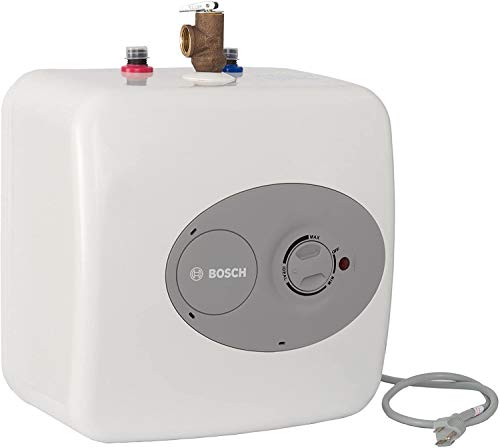
Bosch Tronic 3000 T ES2.5 2.5-Gallon — Best Overall for Camp
The ES2.5 earns the top badge for camping the same way it does at home: it is a real water heater from a real manufacturer that asks nothing exotic of its power supply. Plug it into a pedestal-fed outlet or an RV circuit, fill it, and 2.5 gallons of hot water are ready for the washing-up bowl, the handwash station and the camp kitchen sink. Shelf, wall or floor mounting means it adapts to a cabin corner, a galley cabinet or a utility tent shelf.
Strengths
- Standard plug-in power draw suits ordinary campsite and RV circuits
- Bosch build quality and support — the safest name in this category, home or away
- Mounts on a shelf, wall or floor for flexible camp installations
Trade-offs
- 2.5 gallons serves a sink, not a shower — plan camp bathing separately
- Premium-tier pricing versus value brands
- Needs freeze protection and draining when camp closes for winter
| Spec | Detail |
|---|---|
| Capacity | 2.5 gallons |
| Series | Bosch Tronic 3000 T (ES2.5) |
| Mounting | Shelf, wall or floor |
| Use | Point-of-use mini tank, plug-in |
Camp duty suits this size well. Camp hot-water demand is bursty and modest — a washing-up bowl after dinner, hands before cooking, a rinse for the coffee kit — with long recovery gaps between events while everyone is off doing camp things. A 2.5-gallon tank lives comfortably inside that rhythm, and because it draws ordinary plug-in power, it shares a pedestal with lights and a fridge without drama.
The ownership details travel well, too: the same fill-before-power rule, the same relief-valve requirement, the same annual flush. Add one camping habit — drain it before any freezing night or winter storage, because a frozen tank is a split tank — and the ES2.5 will serve seasons of trips.
Best for: powered campsites, cabins and RV galleys wanting dependable sink hot water / Not suited for: off-grid camping with no power, or shower duty
Check on Amazon — check price on Amazon before you decide, since appliance pricing shifts with promotions.

ThermoMate ES250 2.5 Gallon — Best Value
The ES250 is the value route to the same capability: 2.5 gallons, UL listed, 110V/120V plug-in, wall or floor mounted. For a permanent camp kitchen, a hunting or fishing cabin, or an RV galley renovation, it delivers the Bosch’s core promise — stored hot water at one sink, on ordinary power — at a value-tier price.
Strengths
- UL-listed 2.5-gallon tank at a value-tier price
- Standard plug-in draw, friendly to campsite circuits
- Wall or floor mounting fits cabins and camp kitchens
Trade-offs
- Support and documentation thinner than Bosch’s
- No shelf-mount option listed
- Same shower limitation as every tank this size
| Spec | Detail |
|---|---|
| Capacity | 2.5 gallons |
| Model | ThermoMate ES250 |
| Certification | UL Listed |
| Input power | 110V/120V |
| Mounting | Wall or floor |
Value matters differently at camp. A cabin or camp kitchen heater may run a few dozen days a year, and the difference between the premium tier and this one buys a lot of firewood. What must not be economised is safety, which is why the UL listing carries weight in this badge: a certified vessel, standard fittings and ordinary power draw are the whole requirement list, and the ES250 meets it.
Install it once, properly — secured mounting, relief valve routed, fill before power — and it becomes part of the camp furniture: unremarked, dependable, and hot exactly when the dishes are done.
Best for: cabins, camp kitchens and RV galleys on a value budget / Not suited for: buyers wanting the deepest manufacturer support network
Check on Amazon — check price on Amazon before you decide, since appliance pricing shifts with promotions.

ThermoMate ES150 1.3 Gallon — Best Compact
The ES150 is the minimalist’s camp heater: 1.3 gallons, UL listed, small enough for the tightest galley cabinet or a handwash station in an outdoor kitchen. Its duty is explicit — hands, faces, a quick rinse — and at a powered site it performs that duty instantly and indefinitely, recovering between the spaced-out draws that camp life naturally provides.
Strengths
- Tiny footprint fits RV galleys and camp kitchens nothing else will
- UL listed, with the lowest standby losses of any tank here
- Standard plug-in power, gentle on shared campsite circuits
Trade-offs
- 1.3 gallons is handwash territory; a full washing-up bowl stretches it
- Consecutive draws outrun it quickly
- Value-tier documentation and support
| Spec | Detail |
|---|---|
| Capacity | 1.3 gallons |
| Model | ThermoMate ES150 |
| Certification | UL Listed |
| Input power | 110V/120V |
| Mounting | Wall or floor |
Small tanks make outsized sense at camp because camp water discipline is already a virtue: nobody at a handwash station expects a hotel tap. The ES150 turns ‘wash your hands before dinner’ from a cold-water chore into a non-event, and its tiny stored volume means the energy spent keeping it ready is the lowest in this roundup — a real consideration when the power comes from a generator you are feeding or a solar-charged battery bank you are rationing.
Just respect the envelope. Put the ES150 on handwash and light-rinse duty and it is a delight; assign it the dinner dishes for six and it will be found out by the second pot.
Best for: handwash stations, tiny galleys and light-duty camp sinks / Not suited for: dish duty for groups, or any consecutive-draw work
Check on Amazon — check price on Amazon before you decide, since appliance pricing shifts with promotions.

DOYXC Tankless Water Heater 110V 3000W — Best Tankless for Sinks
The DOYXC represents the tankless temptation honestly: a compact wall unit with a digital display, marketed for kitchen, bathroom and RV sink use, heating on demand with nothing stored. Where it belongs — a single sink, modest flow, and a circuit that can genuinely feed it — it is convenient and space-free. The condition is the headline: at 3,000 watts on 110V it draws roughly 27 amps, so it needs a 30-amp-class supply such as an RV’s main service, not a standard 15/20-amp campsite outlet.
Strengths
- Nothing stored: no standby losses, no tank to drain for winter
- Compact wall format with digital temperature display
- Instant response at sink-level flows when properly powered
Trade-offs
- Roughly 27-amp appetite at full power — a 30A RV service, not a normal outlet
- Temperature rise falls as flow rises; expect sink performance, not shower performance
- Generic-brand support; verify the listing details and return window before buying
| Spec | Detail |
|---|---|
| Type | Tankless, on-demand |
| Rated power (listing) | 3000W at 110V |
| Display | Digital display |
| Marketed for | Kitchen, bathroom, RV sinks |
Run the circuit maths before the romance. A 30-amp RV pedestal circuit can feed this unit with little left over; a generator must be sized for it plus whatever else runs simultaneously; a standard campground 20-amp outlet will trip or force the unit to underperform. Buyers who do that maths and still match — an RV owner wanting sink hot water without a tank, for instance — get a tidy, drain-free appliance. Buyers who skip the maths get a breaker education.
Within its lane, the appeal is real: no stored water to freeze, split or keep hot, and a footprint a tank cannot match. The lane is just narrower than the marketing suggests, and this guide’s job is to paint its edges clearly.
Best for: RV and cabin sinks backed by a genuine 30-amp-class supply / Not suited for: standard 15/20-amp campsite outlets, generators already near their limit, or showers
Check on Amazon — check price on Amazon before you decide, since appliance pricing shifts with promotions.

Geevorks Mini Tankless 110V 3500W Touch Screen — Best Touch Controls
The Geevorks pushes the same concept further: a touch-screen mini tankless with a stated 86–131°F temperature range, positioned for no-drill installation in kitchens, bathrooms and RVs. The interface is the nicest in this category and the temperature range is stated more precisely than most. The power condition is also the steepest here: 3,500 watts at 110V implies roughly 32 amps at full draw, which exceeds even a 30-amp circuit’s continuous comfort zone — treat full-power operation as requiring a supply you have verified, and expect real-world use at moderated settings.
Strengths
- Touch-screen control with a clearly stated temperature range
- No-drill installation positioning suits rentals, RVs and finished cabins
- Nothing stored: no standby loss, nothing to winterise
Trade-offs
- Highest power demand in this roundup — verify the supply before anything else
- Sink-level temperature rise only; flow and heat trade against each other
- Generic brand; support is an online proposition
| Spec | Detail |
|---|---|
| Type | Mini tankless, on-demand |
| Rated power (listing) | 3500W at 110V |
| Temperature range (listing) | 86–131°F |
| Control | Digital touch screen |
Who is this actually for? An RV or cabin owner with a verified, generous circuit who wants a sleek sink unit and understands the flow-versus-temperature bargain. At low sink flows the unit can reach genuinely hot temperatures; open the tap fully and physics reasserts itself, trading temperature for volume. That bargain is acceptable for handwashing and light dish rinsing — the duties this guide assigns it — and unacceptable as a shower promise, which this listing, to its credit, frames around sinks.
Buy it as a convenience appliance with a power prerequisite, test it at your actual flow and circuit during the return window, and it can be a neat piece of camp kit. Buy it as magic and it will disappoint on schedule.
Best for: sink duty where a verified high-capacity circuit exists and touch controls appeal / Not suited for: ordinary campsite outlets, low-output generators, or bathing
Check on Amazon — check price on Amazon before you decide, since appliance pricing shifts with promotions.

COHEALI Portable Instant Electric Water Heater — Best Ultra-Portable
The COHEALI is the lightest interpretation of the brief: a small portable instant unit marketed for bathrooms, kitchens and camping trips, built around quick heating and constant-temperature delivery for light draws. It is the heater you pack when the ‘installation’ is a tap, a plug and five minutes — festival crew facilities, a temporary camp kitchen, a rental cabin’s extra sink.
Strengths
- Most portable form factor in this roundup — pack it, plug it, wash
- Constant-temperature positioning for steady handwash-level output
- No stored water, no mounting project, nothing to winterise
Trade-offs
- Lightest duty here: handwashing and gentle rinsing, not dish duty for a group
- Generic brand with the thinnest documentation in the roundup
- Output depends entirely on flow and incoming water temperature
| Spec | Detail |
|---|---|
| Type | Portable instant electric heater |
| Design | Quick heating, constant temperature |
| Marketed for | Bathroom, kitchen, camping trips |
Judge the COHEALI against a cold tap, not against a Bosch. Its competition is washing in icy water at a temporary setup, and against that baseline a unit that takes the chill off reliably — warm hands, a bearable face wash, a rinse that does not numb fingers — earns its tiny pack space. It is a comfort accessory, not a plumbing system, and priced and sized accordingly.
Because it is a generic-brand portable, buy it the way you buy all such kit: check the listing’s stated power and plug type against your supply, test it on arrival at your real flow, and keep the return window in mind. Treated as the lightest tool for the lightest job, it does its job.
Best for: temporary setups and the lightest handwash duty where portability rules / Not suited for: dish duty, groups, or anyone expecting tank-like reserves
Check on Amazon — check price on Amazon before you decide, since appliance pricing shifts with promotions.
Comparison Table
| Pick | Badge | Key spec | Best for |
|---|---|---|---|
| Bosch ES2.5 | Best Overall for Camp | 2.5 gal tank, shelf/wall/floor | dependable sink hot water on any powered site |
| ThermoMate ES250 | Best Value | 2.5 gal tank, UL Listed | cabins and camp kitchens on a budget |
| ThermoMate ES150 | Best Compact | 1.3 gal tank, UL Listed | handwash stations and tiny galleys |
| DOYXC Tankless 3000W | Best Tankless for Sinks | Tankless, digital display, ~27A at full power | RV sinks on a 30A-class supply |
| Geevorks Tankless 3500W | Best Touch Controls | Tankless, touch screen, 86–131°F stated range | sink duty on a verified generous circuit |
| COHEALI Portable Instant | Best Ultra-Portable | Portable instant, constant temperature | temporary setups and lightest duty |
Read the table by power first and size second. If your supply is an ordinary outlet, the three tanks are your shortlist. If you have verified 30-amp-class service and want sink-only convenience, the tankless pair enters the conversation.
How to Choose a Mini Water Heater for Camping: Power First, Then Size
Every camping hot-water decision starts at the pedestal, not the product page. Identify your supply honestly: a standard campsite outlet (15 or 20 amps shared with everything else you plug in), a 30-amp RV service, a cabin’s ordinary household circuit, or a generator with a rated continuous output. Storage tanks in this guide draw ordinary plug-in power and fit the first three supplies comfortably. The high-wattage tankless units fit only the generous end of that list. Write your supply at the top of the page; it eliminates half the catalogue before you spend a dollar.
Next, name the duty. Handwashing and face-washing is the lightest duty and the one every pick here handles. Dishwashing for two is tank territory — 1.3 gallons at the very least, 2.5 gallons comfortably. Dishwashing for a group site, or a camp kitchen feeding a crew, pushes toward the 2.5-gallon tank used with a washing-up bowl (fill, wash, rinse sparingly) rather than a running tap. And showers: no 110V electric in this guide runs a camp shower honestly. If a shower is the requirement, the answer is the propane section below or the campground’s bathhouse — buy the electric for the sink and stop asking it to be a bathroom.
The circuit maths, done once and remembered
Amps equal watts divided by volts. A heater’s listing wattage at 110V therefore converts directly: 3,000W ≈ 27A, 3,500W ≈ 32A. Continuous loads should sit comfortably below the circuit’s rating, and campsite circuits are shared, weather-exposed and protected by breakers that do not care about your dinner plans. Storage mini tanks avoid the entire issue by heating slowly — that is not a limitation of the design, it is the design. Whenever a listing leads with a big wattage number, do this division before admiring anything else about it.
Generators and battery banks: the honest version
A generator changes the maths but not the physics. A storage tank’s modest draw is a rounding error for most camping generators and can even run from a substantial battery-and-inverter setup for a heat-up cycle, though keeping water hot from batteries is an expensive habit. High-wattage tankless units demand a generator sized for them alone, running at full song while you wash — legal at some sites, antisocial at most, and pointless when a tank heated quietly an hour ago does the same job. Match the heater to the quietest power plan, not the loudest available one.
Water, weight and winter: camp-specific realities
Three practicalities separate camp installs from home ones. Water supply: a tank heater needs pressurised water in — from the site hookup, the RV’s system, or a pump setup like the ones in our camp pump guide — and it cannot suck from a bucket. Weight: a full 2.5-gallon tank weighs over twenty pounds in water alone, so RV mounting must be secured for travel, not just for parking. Winter: any tank or unit holding water must be drained before freezing weather, and the drain point belongs in the installation plan from day one, not discovered in November.
The Propane Question, Answered Fairly
Any honest camping hot-water guide must say this plainly: for off-grid camping, propane tankless heaters are the established answer — instant, powerful, independent of any pedestal, and built for outdoor shower and sink duty. If your camping means dispersed sites and no hookups, that is the category to buy, and no product in this guide pretends otherwise. The 110V electric case is for the other, very common kind of camping: powered sites, RV parks, cabins, seasonal camp kitchens and basecamps with infrastructure, where plugging in is easier than managing fuel, where indoor or sheltered use makes combustion appliances inappropriate, and where the heater’s job is the sink rather than the shower. Know which camper you are before choosing the fuel.
How to Set Up Hot Water at a Powered Campsite or Camp Kitchen
The setup follows the same discipline as a home install, adapted for camp conditions and temporary plumbing.
- Confirm the supply first: identify the circuit you will use, its rating, and what else shares it. Test the outlet with a known load before plumbing anything.
- Position the heater level and secure — strapped or bracketed in an RV so travel cannot move it, on a stable shelf or floor spot in a cabin or camp kitchen, protected from direct weather even under shelter.
- Connect pressurised cold water in and hot water out to the camp sink, using the manufacturer-specified fittings; fit the relief valve with a discharge routed somewhere harmless, because camp floors are still floors.
- Fill before power: run the hot tap until water flows steadily, proving the tank is full, and only then plug in. Dry-firing a tank element at camp ends the experiment for the whole trip.
- For tankless units, verify the circuit under real load at your real flow before relying on it — run the tap, watch for breaker complaints, and set the temperature at the unit rather than mixing down.
- Brief the camp: everyone should know the tank’s size rhythm — spaced draws stay hot, a drained tank needs recovery time — so the system is used the way it was sized.
- At trip’s end or season’s end, switch off, and drain the unit completely if any freeze is possible before its next use.
Half an hour of methodical setup buys a season of unremarkable hot water, which is the highest praise camp infrastructure can earn.
Common Buying Mistakes
Buying a high-wattage tankless for a standard campsite outlet. The division is unforgiving: 3,000W at 110V is roughly 27 amps. On a 15/20-amp outlet the unit trips the breaker or underperforms; save it for verified 30-amp-class service.
Expecting an electric camp shower from 110V. No product here delivers it honestly. Propane owns off-grid showers; electrics own sinks at powered sites. Buying across that line guarantees disappointment.
Forgetting the pressurised water supply. A tank heater is not a kettle — it needs water pushed in under pressure from a hookup, an RV system or a pump. A bucket and hope is not a supply.
Mounting an RV tank for parking instead of for travel. Twenty-plus pounds of water in a glass-lined box must be secured against the road, not just placed on a shelf.
Leaving water in the unit over a freeze. Ice splits tanks and cracks tankless heat exchangers alike. Draining is a five-minute job; replacement is a new purchase.
Running a big heater off a small generator at a quiet site. Even when the watts technically add up, the noise and fuel maths rarely do. Heat water with a tank on modest power and let the generator rest.
Final Recommendation
For most powered-site campers, the Bosch ES2.5 is the best 110 volt mini water heater camping can offer: ordinary power draw, proven build, real stored hot water for the sink. Cabins and camp kitchens on a budget take the ThermoMate ES250; handwash-only setups take the tiny ES150. The DOYXC and Geevorks tankless units are legitimate sink conveniences strictly where a 30-amp-class supply is verified, and the COHEALI is the packable answer for the lightest temporary duty. Off-grid? Skip this entire category and buy propane — that honesty is part of the recommendation.
Keep reading in this cluster: Best 110 Volt Mini Water Heater; Best 110 Volt On Demand Pump For A Camp; Best 110 Volt Mini Split; Best 110 Volt Pancake Air Compressor; Best 110 Volt Mig Welder 141.
Matching the Heater to Your Kind of Camp
The RV on shore power. Your supply is the strongest in the camping world — a 30-amp service that can feed any pick here — but your space is the tightest and your mounting must survive the road. A 2.5-gallon tank in the galley or bathroom cabinet is the classic fit, with the ES150 as the answer when the cabinet shrinks. Tankless units tempt with their size, but remember they draw their heavy current exactly when the air conditioner or microwave may also want the service; the tank’s modest, schedulable draw is the better citizen in an RV electrical system.
The cabin or seasonal camp. Power is ordinary household power, use is weekend-shaped, and the enemy is the off-season. Any of the three tanks installs like a home unit and asks only for a proper drain-down ritual in autumn. This is the ES250’s natural home: value-priced, certified, and sized for a kitchen-and-bathroom-sink life.
The camp kitchen and group site. Demand concentrates around meals: a rush of hands before cooking, a mountain of dishes after. The winning pattern is a 2.5-gallon tank plus washing-up discipline — a filled bowl, a rinse basin, the tap used as a tool rather than a waterfall. Groups that try to run a tankless at dish-rush flow rates discover the flow-versus-temperature trade at the worst possible moment.
The glamping and event setup. Where the ‘camp’ is a furnished tent, a wedding venue’s prep area or a festival crew village, appearances and silence matter and circuits are usually commercial-grade. Tanks disappear into cabinetry and simply work; the touch-screen Geevorks suits a finished wash station where its power supply has been professionally provided. The COHEALI covers temporary overflow stations where a permanent install makes no sense.
Safety Outdoors: The Rules That Travel With the Heater
Water and electricity share space at camp more casually than at home, so the safety discipline must be more deliberate, not less. Every camp heater circuit should be GFCI-protected — at the pedestal, at the outlet, or via the RV’s own protected circuits — without exception. Keep connections dry and off the ground; a plug resting in wet grass is an accident rehearsing. Never run a heater from a bargain extension cord: if the distance demands a cord, it demands a heavy-gauge outdoor-rated one, fully uncoiled, and the honest answer is usually to move the heater or the outlet instead. Combustion rules do not apply to these electric units — one of their genuine advantages in tents and shelters — but ventilation of common sense still does: do not enclose a running tank heater in an airtight box, and keep the relief valve’s discharge path pointed at somewhere that is not a walkway. Finally, treat lightning like a shutdown signal: unplug during electrical storms when you can, because pedestal power in a storm is not the clean power of a house panel. Make one person the camp’s power lead for the trip — the one who knows which breaker feeds what, where the heater’s plug lives and when the generator rests — because shared systems fail at the seams between everyone’s assumptions and nobody’s job.
The Low-Tech Competition: Kettles, Solar Bags and Campfire Water
Perspective helps purchasing. Campers heated water for a century before plug-in tanks: a kettle on the stove, a solar shower bag warming in the afternoon sun, a pot at the fire’s edge. Those methods still work, cost almost nothing, and ask for no circuit at all — for a weekend trip twice a year, they may be the correct total investment, and this guide says so without embarrassment. What the electric tank buys over them is not heat but readiness: hot water at the tap, at washing-up time, without a fire lit, a kettle watched or a bag remembered at noon. The more permanent the camp — the seasonal cabin, the weekly RV site, the working camp kitchen — the more that readiness is worth, because it is used daily rather than admired occasionally. Buy the electric when the camp is infrastructure; keep the kettle when the camp is an excursion.
There is also a hybrid worth knowing: many experienced camp kitchens pair the tank with the kettle deliberately. The tank covers hands and rinses all day; the kettle tops up the washing-up bowl for the greasiest pans, stretching 2.5 stored gallons across a meal for six. Systems thinking beats specification shopping — the best camp hot-water setup is usually a modest heater inside a sensible routine.
Pairing a Heater With a Camp Water Pump
Where the water itself is not pressurised — a camp drawing from a tank, barrel or cistern — the heater is only half the system. A 110V on-demand pressure pump upstream gives the tank the pressurised feed it requires and the sink a civilised flow; the pump guide in this cluster covers the verified options. Size the pair together: the pump’s flow should suit a sink rather than a shower, its circuit adds to the pedestal maths, and its pressure switch should be set so the heater fills calmly instead of hammering. Heater plus pump is how a dry cabin becomes a plumbed one, and the two purchases belong in the same plan.
What Camp Veterans Do Differently
Experienced camp cooks treat hot water as a scheduled resource rather than an infinite utility, and their habits are worth copying regardless of which heater you buy. They heat the tank before the meal, not during the washing-up panic. They wash in order — glasses and cutlery first in the hottest water, greasy pans last, with a kettle boost for the final bowl. They rinse with a basin or a trigger nozzle instead of an open tap, because every litre of hot water was heated by a finite circuit and stored in a finite tank. And they put the heater’s switch somewhere visible, so ‘someone left it on all week’ is a story about other people’s camps. None of this is deprivation; it is the ordinary competence that makes a small system feel large, and it is why two camps with identical heaters can have completely different opinions of them.
Troubleshooting: Problems Campers Actually Meet
Problem: the pedestal breaker trips when the heater runs. → Something else shares the circuit — a fridge, lights, a neighbourly charger. Move the heater to its own outlet where possible, and switch off competing loads during heat-up. If a tankless unit is the tripper, reread the circuit maths: it is asking for current the outlet cannot give.
Problem: water is hot at first, then fades fast. → On a tank, that is capacity arithmetic — draws are outrunning storage; slow the flow, use a bowl, let recovery happen. On a tankless, it is the flow-versus-temperature trade; reduce flow and the temperature returns.
Problem: the tank takes forever to recover at camp. → Cold supply water is the usual cause — mountain and well water arrives far colder than city water, and recovery stretches accordingly. It is physics, not failure; size up a tank class if it happens every trip.
Problem: a sulphur smell after the camp sat closed. → Stagnant warm water grows bacteria. Drain, flush, run a full hot cycle before use, and add the flush to your opening-weekend routine.
Frequently Asked Questions
Can a 110V mini water heater run a camp shower?
Not honestly. Storage tanks this size are spent in minutes, and plug-in tankless units cannot raise shower flows to shower temperatures on household wattage. For showers at powered sites, use the campground facilities or a larger plumbed system; off-grid, propane is the established answer.
Will a 3000W tankless heater work on a normal campsite outlet?
No — 3,000W at 110V draws roughly 27 amps, beyond a standard 15/20-amp outlet’s capacity. It needs a 30-amp-class supply such as an RV’s main service, verified before purchase.
Can I run a mini tank heater from a generator?
Yes, comfortably — storage tanks draw ordinary plug-in power, well within most camping generators’ continuous ratings. The high-wattage tankless units are the difficult load, demanding a large generator running hard for sink-level results.
How do I winterise a camp water heater?
Switch off the power, let the water cool, and drain the unit completely through its drain point or lowest connection, leaving valves open. Any water left inside during a freeze can split the tank or crack a heat exchanger.
Does an RV need a special heater, or will a home mini tank work?
A home mini tank works well in an RV on shore power, provided it is mounted securely for travel, the circuit is respected, and it is drained before freezing weather or long storage. The RV-specific part is the mounting and the discipline, not the heater.
Tank or tankless for a camp kitchen?
For most camp kitchens, the tank: it heats on modest power, tolerates shared circuits, and delivers a washing-up bowl of genuinely hot water on demand. Tankless suits single-sink, low-flow duty where a generous circuit is guaranteed — a narrower case than most camps offer.
Can I use one of these heaters in a tent?
Only where the tent is part of a powered, structured setup — a glamping installation with proper outlets, GFCI protection and the heater placed on a stable, dry, level surface away from bedding and traffic. In a conventional camping tent with a cord run from a distant pedestal, the honest answer is no: use the site’s facilities or low-tech methods instead. The heaters in this guide belong in RVs, cabins and camp kitchens, and their safety case depends on that setting.
How much water pressure does a mini tank need?
It needs a normal pressurised supply — site hookup pressure, an RV system, or a pressure pump feeding it — and standard camp supplies qualify. What it cannot do is draw from an unpressurised container on its own; if your camp’s water lives in a barrel, pair the heater with an on-demand pump as described above.
Is it worth electrifying hot water for a few weekends a year?
Usually not, and this guide would rather tell you than sell you. For two or three weekends annually, a kettle and a washing-up bowl deliver 90 percent of the comfort for almost none of the money, and there is nothing to winterise, mount or maintain. The electric case strengthens with frequency: a cabin used monthly, an RV that tours all season, a camp kitchen feeding people every weekend. Count your camp nights honestly; past roughly a dozen a year with a sink that matters, the tank starts paying for its keep in pure convenience, and past a full season of regular use it becomes the piece of camp kit nobody would give back, trade away or leave behind.


