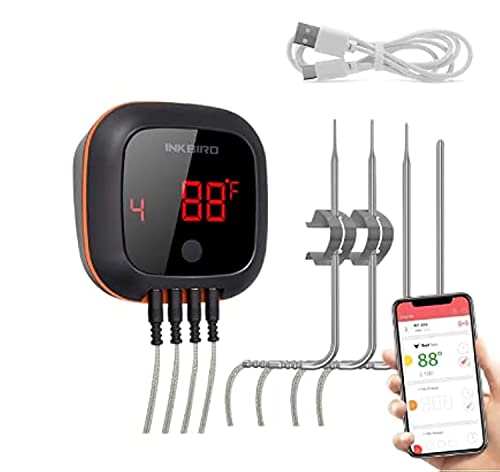
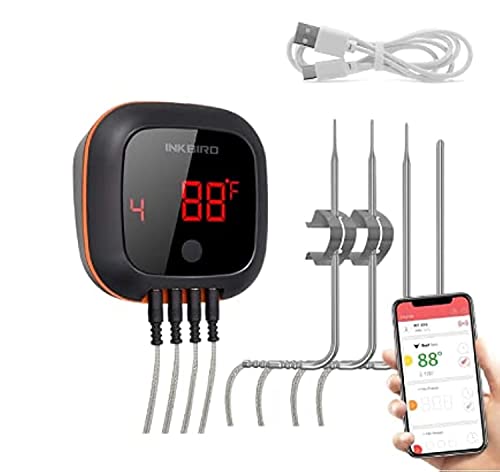
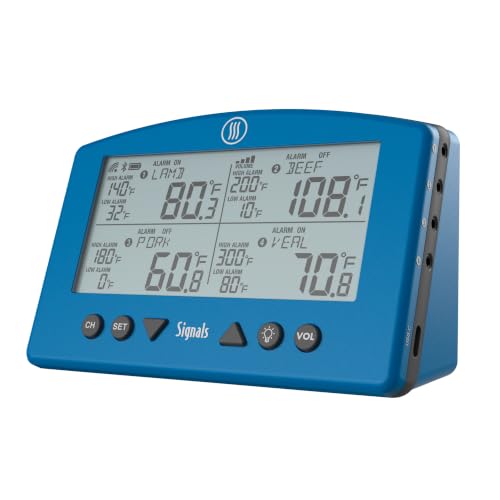
A wireless grill thermometer lets you leave the grill and still watch what is happening inside it. Some use a receiver that stays in your hand, others send readings to your phone, and a few ditch the cable altogether with a fully wireless probe.
The six picks below cover each style, from a simple remote model to app-based systems. We have not used these thermometers ourselves, and we avoid figures we cannot confirm. Check the current listing for range, probe count and app support, since these details change with firmware and updates.
As an Amazon Associate we earn from qualifying purchases. Links below are affiliate links, and they do not change the product information we give.
What to Look For
| Feature | Why it matters |
|---|---|
| Connection | Radio receivers are simple; Bluetooth and Wi-Fi add app alerts |
| Probe style | Wired probes are sturdy; wire-free probes are easier to handle |
| Range | Walls and distance cut signal strength, so check realistic range |
| Heat rating | Probe cables and bodies differ in what they tolerate on a hot grill |
In this guide
Specs at a Glance
| Thermometer | Connection | Probe style | Best for |
|---|---|---|---|
| ThermoPro TP20 | Radio receiver | Two wired probes | Simple remote checks |
| Weber iGrill 2 | Bluetooth | Wired probes | Weber grill owners |
| Weber Connect Smart Grilling Hub | Wi-Fi and Bluetooth | Wired probes | Guided cooks |
| MEATER Plus | Bluetooth | Wire-free probe | Roasts and steaks |
| ThermoPro TempSpike | Bluetooth | Wire-free probe | Rotisserie and big cuts |
| Govee Bluetooth meat thermometer | Bluetooth | Wired probes | Simple app tracking |
The 6 Best Wireless Grill Thermometers
Top pickBest for cooks who want an app-free option
1. ThermoPro TP20
A dual-probe remote thermometer with a handheld receiver that you carry around the yard. It does not need a phone, which keeps things simple. The two probes let you watch a roast and the grill air at once.
Suits: cooks who want an app-free option. Strengths: simple operation. Weaknesses: limited to what the receiver can show. Skip it if you want phone alerts and logs.
Best for weber owners and app fans
2. Weber iGrill 2
A Bluetooth thermometer designed with Weber grills in mind, with wired probes and phone alerts through the Weber app. It also works on other grills. Check the listing for how many probes ship in the box.
Suits: Weber owners and app fans. Strengths: tight integration with the Weber ecosystem. Weaknesses: it requires a smartphone. Skip it if you prefer a standalone receiver.
Best for people who like guided cooking
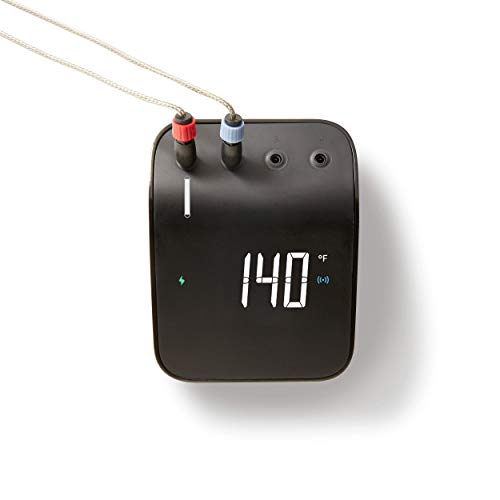
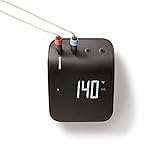
3. Weber Connect Smart Grilling Hub
A Wi-Fi and Bluetooth hub that guides you through cooks with prompts on your phone. It reads food temperature and gives step-by-step cues. Check the listing for the probe types it supports.
Suits: people who like guided cooking. Strengths: strong guidance for newer cooks. Weaknesses: it depends on the app and a phone connection. Skip it if you want the simplest receiver.

Best for roasts, steaks and whole chickens
4. MEATER Plus
A fully wireless probe that sits in the meat and sends readings by Bluetooth, with a charging case that extends range. It tracks food temperature and ambient heat. The charging case doubles as a signal booster.
Suits: roasts, steaks and whole chickens. Strengths: no cable to snag on the lid. Weaknesses: one probe measures only one cut. Skip it if you cook many items at once.

Best for rotisserie, roasts and long cooks
5. ThermoPro TempSpike
A wire-free probe from ThermoPro with Bluetooth connection and a booster for range. It is made for large cuts and rotisserie cooking. Check the current listing for the exact range and battery notes.
Suits: rotisserie, roasts and long cooks. Strengths: a wire-free design from a familiar brand. Weaknesses: probe count is limited. Skip it if you want multiple wired probes.
View ThermoPro TempSpike on Amazon

Best for home cooks who want straightforward app tracking
6. Govee Bluetooth meat thermometer
A Bluetooth thermometer with wired probes and an app, from a brand known for smart home gadgets. It tracks several probes on your phone. Look at recent owner feedback on app stability.
Suits: home cooks who want straightforward app tracking. Strengths: easy phone access. Weaknesses: app features may change. Skip it if you want a dedicated receiver.

Care and Setup
- Wipe probes clean after each cook, and never submerge connectors.
- Keep transmitters and hubs away from direct flames.
- Replace batteries before a long cook.
- Store cables loosely coiled so the wires do not crack.
Mistakes to Avoid
- Placing the probe tip against bone or the pan.
- Leaving the transmitter on a hot grill ledge.
- Counting on Bluetooth range through thick walls.
- Forgetting to calibrate or test the reading.
Wired Probes Versus Wire-Free Probes
Wireless grill thermometers transmit readings to a display or phone, but the probe itself can be wired or wire-free. A wired probe has a thin cable running from the food to a transmitter or base outside the grill. This design supports multiple probes in a single unit and lets you monitor several cuts or measure the grill temperature with an ambient probe.
A wire-free probe sits entirely in the food and sends its reading wirelessly, so there is no cable to thread through the lid. It can be easier to place and handle, and it avoids lid gaps caused by cables. The trade-offs vary by product: wire-free probes are often single or limited in number, and their signal path may be weaker through a closed grill or thick metal. Check the listing for details.
Think about what you cook. If you grill several items at once, such as multiple steaks or a pork shoulder and a side, a multi-probe wired design may suit you. If you mainly cook a single roast, whole chicken or rotisserie item, a wire-free probe may be simpler. Always confirm the maximum temperature rating of both the probe and cable in the manual, and avoid letting a cable touch hot grates or direct flame.
Probe Placement and Reading the Right Spot
A thermometer is only as useful as where you put the probe. Insert it into the thickest part of the meat, away from bone, fat pockets and the cooking surface, since these can give misleading readings. For thin cuts such as steaks or chops, insert from the side so the tip sits in the center. For poultry, the thickest part of the breast or thigh away from bone is the usual target.
Many probes sense temperature along part of their length, or at the tip, depending on the design. Check the manual for the correct insertion depth so the sensing area is fully inside the food. Pushing the probe too deep or not deep enough can cause errors.
Helpful habits include:
- Insert the probe before the food goes on the grill when the manual says that is fine
- Keep the probe from touching the grate or the pan
- Check a second spot with a separate instant-read thermometer when in doubt
- Follow recognized food-safety temperature guidance from official sources for the food you are cooking
Remember that food continues to cook slightly after you remove it from heat, so pay attention to resting guidance from your recipe.
Connectivity: Bluetooth, Radio and Hubs
Wireless thermometers connect in different ways, and the method affects how far you can wander. Bluetooth models pair with a phone and are convenient for app alerts, but range depends on walls, distance and the environment. Radio-frequency models often include a separate handheld receiver that does not need a phone, which some cooks prefer. Hub-based systems use a base unit that communicates with the probes and may also connect to a home network, depending on the product.
Think about how you want to monitor your cook. If you like to stay near the grill, Bluetooth or a handheld receiver may be enough. If you want to walk around the house or yard, check the listed range and the conditions that affect it, and remember that a stated range is usually measured in open space. A closed metal grill lid and walls can reduce range.
Check app compatibility before buying. Confirm which phone operating systems are supported and read the manual for how alerts work. If the app is critical to your use, consider what happens if the connection drops: some devices store data and reconnect, while others stop updating. Having a model with a built-in display as a backup can be useful.
Durability, Heat Limits and Cleaning
Grilling is hard on electronics, so look at how the manufacturer describes heat limits and water resistance. Probes and cables have maximum temperatures, and the transmitter or base unit usually must stay outside the hot zone. Do not leave a base unit sitting on a hot grill surface or near flames. Check the manual to learn which parts can withstand the oven or grill and which cannot.
Cleaning varies by design. Many probes can be wiped or washed by hand, but some parts must not be submerged, and the probe tip may need extra care. Follow the manual rather than assuming a dishwasher is safe. Avoid abrasive pads on the probe and let it dry before storing.
Take care of cables by not kinking or pinching them in the grill lid. Store probes loosely coiled and keep batteries or charging connectors dry. If the unit uses a rechargeable battery, check the manual on charging and storing it between seasons. If the product has a protective case or storage sleeve, use it. Signs of wear include frayed cable, corroded connectors, inconsistent readings and a display that dims or flickers. Compare against a separate thermometer from time to time.
Alerts, Presets and Planning Your Cook
The best wireless thermometers do more than show a number. Alerts can notify you when food approaches or reaches your target, which lets you step away from the grill. Check how alerts are delivered: a sound from the handheld, a phone notification or both. Think about whether you will hear them over the noise of a gathering.
Many products offer presets for common foods, while others require you to enter your own target. Treat presets as a starting point, and compare them with guidance from your recipe or official food-safety sources. The ability to set custom targets is useful when you follow your own recipe, and a high and low alert is helpful for monitoring grill temperature with an ambient probe.
Plan before you light the grill. Charge or install batteries, pair the device and test it with the probe in a glass of water or at room temperature to confirm it reads sensibly. Have a backup way to check doneness. Write down the settings you used for a favorite recipe so you can repeat them. These simple habits make a thermometer far more useful than the features alone.
Wireless Range and Connection Types Explained
The word wireless covers two quite different technologies, and the difference shapes how you use the thermometer. Radio-frequency models, like those with a separate handheld receiver, usually offer a longer stated range and do not need a phone. Bluetooth models connect to an app, which gives you graphs, alerts and cooking guides, but their working range is often shorter, especially with walls or a metal grill body in the way.
Manufacturers state a range figure, but treat it as a best case measured in open air. A closed lid, a steel cart and a wall between you and the grill all reduce the real distance. If you plan to watch the cook from the kitchen or the couch, think about the path the signal must take and read what the maker says about obstacles. Some hubs repeat the signal or connect through your home network, which can extend reach.
- Radio receiver: simple, no phone needed, shorter feature list
- Bluetooth app: rich data, depends on your phone and the signal path
- Hub with wifi: longer reach, needs network setup
Probe Count and Placement Choices
How many probes you need depends on what you cook. One probe is enough for a single roast or a whole bird. Two or more help when you cook several cuts together, or when you want to watch both the meat and the grill air temperature. Having the ambient reading right beside the food gives a clearer picture than the lid gauge alone, which can be far from the grate.
Placement matters as much as count. Insert the tip into the thickest part of the meat and away from bone and large pockets of fat, and avoid letting the probe touch the grate. For safe final temperatures, follow official food safety guidance and the maker’s instructions for the meat you are cooking. Do not rely on color or feel alone.
Comparing Formats at a Glance
| Format | Strength | Consideration |
|---|---|---|
| Wired probes with a base unit | Reliable signal, easy to read | Cables must route around the lid |
| Wire-free probe | No cable to snag | Small body, must be cleaned with care |
| App-based hub | Alerts and history | Needs a phone or network |
A wire-free probe feels convenient, but its internal electronics have their own heat limits, so read the maker’s stated maximum. Wired probes handle high heat well, though cables need to run through the lid gap without being pinched.
Setup Mistakes That Cause Bad Readings
A common issue is pairing the device just before the cook, then discovering the app needs an update. Set everything up the day before, and charge or replace batteries then as well. Another is dragging cables across hot surfaces, which can wear the coating over time. Route them along the cooler side of the grill and check them for damage before each cook.
Also check your accuracy now and then. Many makers describe a simple method for confirming a probe, such as using a bath of ice water. Follow their instructions rather than improvising. If a probe drifts beyond what the maker allows, stop using it for food safety decisions and contact the maker.
Keeping Probes Clean and Ready
After each cook, let probes cool fully before cleaning. Wipe the metal with a damp cloth and mild soap, and keep the cable ends and connectors dry. Never immerse a probe or a transmitter unless the maker clearly says it is safe to do so. Store everything in a case or a dry drawer, and replace worn parts according to the maker’s guidance.
Alerts, Apps and Alarms Worth Having
Most wireless thermometers can alert you when food reaches a target, but the way they do it varies. Some beep from the base unit, others buzz your phone, and a few do both. Think about where you will be during the cook. If you wander the yard with a drink in hand, a phone alert is useful. If you leave your phone indoors, a receiver with a loud tone may serve better.
Look at what the app offers beyond alerts. Preset target temperatures can be handy, but treat them as rough guides and compare them with official food safety guidance. A graph of the cook helps you see how fast the meat is climbing, so you can plan when to wrap, rest or serve. Make sure the app is supported on your phone, and check what happens if the connection drops: does the probe keep logging?
Who Should Pick Which Style
A person who grills a quick weeknight dinner needs something fast to set up and easy to read, so a simple base unit with one or two probes often fits. A smoker enthusiast who cooks large cuts for many hours will want longer battery life, a stable signal and the ability to track the pit temperature. Someone who loves gadgets may enjoy the data and guides inside a smart hub.
Consider your grill as well. Pellet grills, gas grills and charcoal kettles differ in lid shape and cable routing, and a wire that fits one may be awkward in another. Match your tool to the way you cook, and you will use it far more often than a feature-packed model that sits in a drawer.
Choosing a Wireless grill thermometer With a Clearer Eye: The Criteria That Deserve a Second Look
The opening sections of this guide cover the headline points to check when you compare wireless grill thermometers. This section slows down and looks at the same decision from the owner’s side: not what a wireless grill thermometer promises on the day it arrives, but how the choice plays out across months of tracking food and grill temperatures from a distance so you are not chained to the lid. Reading it before you settle on a pick will help you use the product sections above more sharply, because you will know which details in each description actually matter for your household and which are simply nice to have.
Fit and space, measured honestly
Start with how you actually cook — the probes, base unit or app arrangement has to suit your grill, your phone habits and how far from the grill you will be. Measure twice, in the unhurried way that feels excessive, and write the numbers down rather than trusting memory. Allow for the unglamorous details too: how the wireless grill thermometer is reached, what sits around it in the grill side table and wherever you wait while food cooks, and whether the space you have measured is the space that will still be there once everything else is back in place. Most disappointing purchases in this category are not bad products; they are good products matched to the wrong space, and nearly all of them could have been avoided with a tape measure and ten quiet minutes before ordering.
Performance where it counts
Next, think about a connection that holds through a closed lid and across your garden, and readings that stay trustworthy at grilling temperatures. Headline claims are easy to compare and often the least useful guide, because daily satisfaction comes from consistency: the tenth use behaving like the first, and the result staying predictable when conditions are less than perfect. As you read the pick-by-pick sections above, keep returning to this question — does this option perform in the specific way my routine actually demands, or is it strong in ways I will rarely call on? A wireless grill thermometer that is merely good at everything but exactly right for your main job usually beats a more impressive all-rounder.
Everyday ease, not first-day impressions
Consider pairing and setup you can repeat without relearning, alarms you can set quickly and probes that are easy to handle with gloves. Ease of use rarely appears in a feature list, yet it decides whether a wireless grill thermometer becomes part of your routine or an obstacle you work around. Picture the busiest, messiest moment of normal use — not a calm demonstration — and ask whether the design still helps you then. Small frictions repeat: a control that needs two attempts, a part that is awkward to lift, a routine that takes a minute longer than it should. Multiplied across a year of regular use, those small frictions are the difference between a purchase you recommend to friends and one you quietly stop using.
Cleaning and upkeep you will actually do
Be honest about probe surfaces that meet smoke, fat and marinades, and cables or charging contacts that need wiping after every cook. Every wireless grill thermometer in this guide asks for some upkeep, and the realistic question is not whether the cleaning is easy in theory but whether it fits the time and patience you genuinely have. Short, regular attention almost always beats occasional heroic deep cleans, both for results and for how long the product lasts. As you compare the picks, favour the design whose upkeep matches your habits — a slightly simpler model you keep clean will outperform a sophisticated one you neglect, every single time.
Safety and the people around you
Finally, think about food safety temperatures judged properly, hot probes handled with gloves and lithium batteries and chargers kept dry. Safety in this category is mostly a matter of habits and placement rather than dramatic risks: where the wireless grill thermometer sits, who can reach it, and whether your routine includes the small checks that keep everything sound. Read the safety notes in each product section above with your own household in mind — the presence of children, pets, elderly relatives or simply a busy, distracted cook changes which precautions matter most. A few minutes spent setting things up safely at the start is repaid every time you use the wireless grill thermometer without thinking about it.
Putting It to Work: How a Wireless grill thermometer Fits Real Routines
Specifications describe a wireless grill thermometer; routines reveal one. The scenarios below describe the situations readers most often have in mind when they shop for wireless grill thermometers, and what each situation rewards. Find the scenario closest to your life and weight it heavily: a pick that shines in your scenario is a better buy than a pick that wins on a comparison table but belongs to somebody else’s routine. Many households recognise themselves in two scenarios at once, in which case the overlap between them is usually where the right choice sits.
Long grill sessions and roasts
This is about a whole chicken or joint cooking slowly while you are inside preparing everything else. In this situation, the wireless grill thermometer is not an occasional tool but part of a repeating pattern, so reliability and ease matter more than novelty. Look again at the picks above and ask which of them is described in terms that match this pattern: steady performance across a long session, straightforward handling when you are busy, and upkeep that can keep pace with frequent use. It is also worth thinking about what happens on the busiest version of this day, not the average one, because a wireless grill thermometer chosen for the average day is the one that lets you down precisely when the stakes are highest — guests waiting, a deadline looming or a car packed and ready to leave.
Cooking several items at once
This is about different thicknesses finishing at different times, each needing its own watch. In this situation, the wireless grill thermometer is not an occasional tool but part of a repeating pattern, so reliability and ease matter more than novelty. Look again at the picks above and ask which of them is described in terms that match this pattern: steady performance across a long session, straightforward handling when you are busy, and upkeep that can keep pace with frequent use. It is also worth thinking about what happens on the busiest version of this day, not the average one, because a wireless grill thermometer chosen for the average day is the one that lets you down precisely when the stakes are highest — guests waiting, a deadline looming or a car packed and ready to leave.
Social grilling
This is about being with guests instead of hovering over the grate with a handheld thermometer. In this situation, the wireless grill thermometer is not an occasional tool but part of a repeating pattern, so reliability and ease matter more than novelty. Look again at the picks above and ask which of them is described in terms that match this pattern: steady performance across a long session, straightforward handling when you are busy, and upkeep that can keep pace with frequent use. It is also worth thinking about what happens on the busiest version of this day, not the average one, because a wireless grill thermometer chosen for the average day is the one that lets you down precisely when the stakes are highest — guests waiting, a deadline looming or a car packed and ready to leave.
Smoker-style low cooks on a grill
This is about holding a low temperature for hours, where an ambient reading matters as much as the meat. In this situation, the wireless grill thermometer is not an occasional tool but part of a repeating pattern, so reliability and ease matter more than novelty. Look again at the picks above and ask which of them is described in terms that match this pattern: steady performance across a long session, straightforward handling when you are busy, and upkeep that can keep pace with frequent use. It is also worth thinking about what happens on the busiest version of this day, not the average one, because a wireless grill thermometer chosen for the average day is the one that lets you down precisely when the stakes are highest — guests waiting, a deadline looming or a car packed and ready to leave.
Day-to-Day Use, Cleaning and Care in More Detail
The care sections earlier in this guide give the essentials. What follows is the longer view: how to build the small habits that keep a wireless grill thermometer performing well, how to clean it without turning the job into a chore you avoid, and how to store and look after it between uses. None of this requires specialist products or skills — it requires doing simple things regularly, which is unglamorous and entirely effective.
The first uses set the pattern
When your wireless grill thermometer is new, take the first use slowly. Read the maker’s instructions properly — not as a formality, but because the details that matter, from first setup to what not to do, are specific to your model and are not repeated anywhere else. Run through the basic routine once without time pressure, notice what feels awkward, and adjust your setup while the stakes are low. Owners who give a new wireless grill thermometer one unhurried first session almost always have a smoother first month than owners who debut it in front of an audience or a deadline.
A cleaning rhythm that sticks
For cleaning, little and often is the whole secret. Deal with probe surfaces that meet smoke, fat and marinades, and cables or charging contacts that need wiping after every cook while traces are fresh and the job takes minutes; leave them and the same job becomes the kind of task that gets postponed indefinitely. Keep the basic supplies you need within reach of where the wireless grill thermometer lives, use only cleaning methods and products the maker allows for the surfaces involved, and let everything dry fully before the next use or before storage. If several people share the wireless grill thermometer, agree on the rhythm out loud — most neglected equipment belongs to everyone in theory and nobody in practice.
Storage and the time between uses
What happens between uses shapes a wireless grill thermometer’s life as much as the uses themselves. Store it and its accessories together, dry and protected from knocks, dust and damp, in a place that does not require a struggle to reach — equipment stored awkwardly gets used reluctantly. Before a longer break, a proper clean and a quick check of the parts that wear, loosen or perish means the wireless grill thermometer comes back to service ready rather than needing rescue. When you return to it, a brief inspection before the first use catches the small problems — a frayed edge, a loose fitting, a part left dirty — while they are still small.
Knowing what is normal and what is not
Every wireless grill thermometer develops a familiar pattern of sounds, smells, timings and behaviour, and learning that pattern is a genuine skill. Once you know what normal looks like, changes announce themselves early: a new noise, a slower result, a part that no longer sits as it did. Most changes have simple causes covered in the troubleshooting spirit of this guide — something needs cleaning, adjusting or replacing as a consumable. The ones that do not respond to the simple checks are the ones to hand to a professional, and catching them early is usually what keeps a repair minor.
How the Picks in This Guide Compare With Each Other
Readers often ask for a simple ranking of the wireless grill thermometers above, but the honest comparison is about fit. Each pick in this guide earned its place for a slightly different reader, and the sections describing them already contain everything needed to separate them: who each one suits, the strengths highlighted, and the honest limitation mentioned alongside. The notes below show how to run that comparison for yourself, pick by pick, so the final choice rests on your priorities rather than on a generic verdict.
Consider the ThermoPro TP20. Return to its section above and note three things in order: the reader it is described as suiting, the strength the guide emphasises most, and the limitation it openly flags. Then hold those three points against the criteria and scenarios earlier on this page. If the reader it suits sounds like you, and its flagged limitation touches something you rarely do, it belongs on your shortlist even if another pick looks stronger on paper. If the limitation sits squarely in your main routine, that is the comparison doing its job — cross it off without regret and move to the next pick, because a wireless grill thermometer whose weakness meets your most common use will disappoint you weekly, however good its strengths are.
Consider the Weber iGrill 2. Return to its section above and note three things in order: the reader it is described as suiting, the strength the guide emphasises most, and the limitation it openly flags. Then hold those three points against the criteria and scenarios earlier on this page. If the reader it suits sounds like you, and its flagged limitation touches something you rarely do, it belongs on your shortlist even if another pick looks stronger on paper. If the limitation sits squarely in your main routine, that is the comparison doing its job — cross it off without regret and move to the next pick, because a wireless grill thermometer whose weakness meets your most common use will disappoint you weekly, however good its strengths are.
Consider the Weber Connect Smart Grilling Hub. Return to its section above and note three things in order: the reader it is described as suiting, the strength the guide emphasises most, and the limitation it openly flags. Then hold those three points against the criteria and scenarios earlier on this page. If the reader it suits sounds like you, and its flagged limitation touches something you rarely do, it belongs on your shortlist even if another pick looks stronger on paper. If the limitation sits squarely in your main routine, that is the comparison doing its job — cross it off without regret and move to the next pick, because a wireless grill thermometer whose weakness meets your most common use will disappoint you weekly, however good its strengths are.
Consider the MEATER Plus. Return to its section above and note three things in order: the reader it is described as suiting, the strength the guide emphasises most, and the limitation it openly flags. Then hold those three points against the criteria and scenarios earlier on this page. If the reader it suits sounds like you, and its flagged limitation touches something you rarely do, it belongs on your shortlist even if another pick looks stronger on paper. If the limitation sits squarely in your main routine, that is the comparison doing its job — cross it off without regret and move to the next pick, because a wireless grill thermometer whose weakness meets your most common use will disappoint you weekly, however good its strengths are.
Consider the ThermoPro TempSpike. Return to its section above and note three things in order: the reader it is described as suiting, the strength the guide emphasises most, and the limitation it openly flags. Then hold those three points against the criteria and scenarios earlier on this page. If the reader it suits sounds like you, and its flagged limitation touches something you rarely do, it belongs on your shortlist even if another pick looks stronger on paper. If the limitation sits squarely in your main routine, that is the comparison doing its job — cross it off without regret and move to the next pick, because a wireless grill thermometer whose weakness meets your most common use will disappoint you weekly, however good its strengths are.
Consider the Govee Bluetooth meat thermometer. Return to its section above and note three things in order: the reader it is described as suiting, the strength the guide emphasises most, and the limitation it openly flags. Then hold those three points against the criteria and scenarios earlier on this page. If the reader it suits sounds like you, and its flagged limitation touches something you rarely do, it belongs on your shortlist even if another pick looks stronger on paper. If the limitation sits squarely in your main routine, that is the comparison doing its job — cross it off without regret and move to the next pick, because a wireless grill thermometer whose weakness meets your most common use will disappoint you weekly, however good its strengths are.
Two further checks sharpen any shortlist. First, compare upkeep: the picks differ in how much routine attention they ask for, and the one whose care routine matches your habits will still be performing well long after a needier rival has been neglected. Second, compare the whole purchase, not just the unit — the accessories, consumables, replacement parts and storage the wireless grill thermometer needs over its life. A pick that looks like the premium choice sometimes asks the least over time, and the reverse is just as common. Decide with both checks done and you will rarely need to second-guess the order.
The Longer View: Owning One Well
A wireless grill thermometer is one of those purchases whose value compounds quietly. The first month is about learning it; the first year is about the routine settling around it; after that, it simply becomes how things are done in your home. Owners who get the most from wireless grill thermometers share a few traits that have nothing to do with which model they bought. They keep the basic accessories and consumables in stock so a missing item never cancels a plan. They do the small cleaning and checking jobs on rhythm rather than on memory. And they revisit their setup occasionally — as households, tastes and routines change, the way a wireless grill thermometer is used can change with them, and a small rearrangement sometimes unlocks value that was there all along.
It is also worth keeping a light record, even if only mentally, of what works for you: the settings, timings, arrangements or combinations that produced your best results. The guides and product sections can start you off, but your own notes — adjusted for your space, your ingredients, your car, your collection, your people — are what turn a good wireless grill thermometer into the right one. When the time eventually comes to replace it, that record tells you exactly which of the criteria in this guide mattered in practice, and the next purchase becomes the easiest one you have made in this category.
Wireless Grill Thermometer FAQ
Do wireless grill thermometers need Wi-Fi?
Not always. Radio receivers need none, Bluetooth models work with a phone nearby and Wi-Fi models extend range.
How accurate are they?
Accuracy figures vary by model. Test your probe in ice water and boiling water now and then, and follow the maker guidance.
Can the probe stay in the grill?
Probe bodies tolerate heat to a degree, but follow the maker’s guidance for the cable and transmitter.
What is the benefit of a wire-free probe?
There is no cable to pinch in the lid, so it suits rotisserie and roasts.
Should I choose a wired or wire-free probe?
Wired probes often support multiple probes and ambient monitoring, while wire-free probes avoid cables and can be simpler to place. Pick based on how many items you cook at once and check the listing for details.
Where should I place the probe?
Place it in the thickest part of the food, away from bone, large fat pockets and the cooking surface. Check the manual for the correct insertion depth so the sensing area is fully inside the food.
Is Bluetooth range as long as the listing says?
Stated ranges are usually measured in open space. Walls, distance and a closed metal grill can reduce range, so test the connection in your own setup.
Can I wash the probe in a dishwasher?
Only if the manual says so. Many probes should be washed by hand and some parts must not be submerged. Follow the care instructions for your model.
Do I still need a separate instant-read thermometer?
Many cooks like having one as a second check. It can help confirm a reading in another spot of the food or verify that the wireless unit is reading sensibly.
What should I do if the readings look wrong?
Check probe placement, make sure the probe is clean and fully inserted and compare with a second thermometer. If the readings still seem off, consult the manual and the seller about options.
How should I store the probes?
Let them cool and dry, then store them coiled loosely or in the supplied case. Avoid kinking cables and keep connectors dry, as the manual advises.
Why does the connection drop when I close the lid?
A metal lid and grill body can weaken wireless signals, and distance plus walls weaken them further. Positioning the base or transmitter as the maker suggests, and keeping your phone or receiver in a sensible spot, fixes most dropouts. A connection that only fails at long range is physics, not a fault.
How do I know the readings are accurate?
Test in a glass of ice water and, if the maker allows, in boiling water, comparing against the expected temperatures for those simple references. A probe that reads sensibly at both ends of the scale can be trusted in the middle, where your cooking actually happens.
Can probes stay in the food for the whole cook?
That is what leave-in probes are designed for, within the temperature limits the maker states. Keep any part with electronics or a transmitter within its rated conditions, route cables away from direct flame, and treat the stated limits as real rather than approximate.
What is the difference between an ambient probe and the grill’s own gauge?
The ambient probe reads the air temperature at grate level, beside the food, which is the heat the food actually experiences. Lid gauges read where they sit, often higher and hotter. When the two disagree, the grate-level reading is the one to cook by.
How should probes be cleaned after a greasy cook?
Wipe probes down while residues are still warm and soft, wash them as the maker allows — many probe tips can be washed while electronics cannot be submerged — and dry them fully before storing. Marinade baked onto a probe is much harder work tomorrow than tonight.
Do I need an app, or is a standalone receiver better?
Apps offer graphs, presets and alerts on a phone you already carry; standalone receivers work without a phone and keep working if the phone is busy elsewhere. Neither is automatically better. Choose the arrangement you will genuinely use on an ordinary Tuesday, not the one with the longest feature list.
The Short Version
For a simple receiver, the ThermoPro TP20. For Weber owners, the iGrill 2. For guided cooking, the Weber Connect hub. For roasts, the MEATER Plus. For rotisserie, the ThermoPro TempSpike. For app-based tracking, the Govee.