Weber has sold gas grills for decades, and the line splits cleanly into portable models you can carry to a park and full-size carts that live on the patio. Choosing between them comes down to how many people you feed, how much space you have and whether you want to hook up a small cylinder or a full-size tank.
The six grills below cover a small tabletop model, a folding travel grill, two mid-size Spirit carts and a larger Genesis. We have not used these grills ourselves, and we state only general facts about each one. Confirm burner count, cooking area and fuel type on the current listing before you buy.
As an Amazon Associate we earn from qualifying purchases. Links below are affiliate links, and they do not change the product information we give.
What to Look For
| Feature | Why it matters |
|---|---|
| Burner count | More burners give more heat zones for searing on one side and keeping food warm on the other |
| Cooking area | Match the grate size to your usual group, not your biggest party |
| Fuel type | Small cylinders suit portable grills; carts normally use a standard propane tank |
| Portability | Folding legs and light bodies matter if you tailgate or camp |
In this guide
Specs at a Glance
| Grill | Type | Burners | Best for |
|---|---|---|---|
| Weber Q 1200 | Portable tabletop | One | Balconies and camping |
| Weber Q 2200 | Portable with cart-ready base | One | Small groups on the move |
| Weber Traveler | Folding portable | One | Tailgates and road trips |
| Weber Spirit II E-210 | Full-size cart | Two | Small patios |
| Weber Spirit II E-310 | Full-size cart | Three | Families who grill often |
| Weber Genesis E-325s | Larger cart | Three | Big cooks and side-burner fans |
The 6 Best Weber Gas Grills
Top pickBest for a balcony or a campsite
1. Weber Q 1200
A compact portable gas grill that sits on a table or tailgate and runs on small propane cylinders.
Suits: a balcony or a campsite. Strengths: a light build and quick start-up. Weaknesses: a small grate and limited room for more than a few burgers. Skip it if you regularly cook for a crowd.
Best for people who want portable now and a cart later
2. Weber Q 2200
A step up from the 1200 in cooking space, still a single-burner portable grill.
Suits: people who want portable now and a cart later. Strengths: more room than the smallest Q and the same simple controls. Weaknesses: it is still a one-burner design, so only one heat zone. Skip it if you want to sear and keep food warm at once.
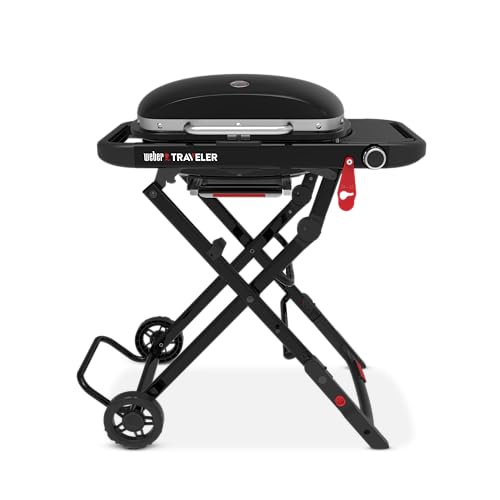
Best for tailgaters and campers who also want a rolling base
3. Weber Traveler
A folding portable gas grill with a stand that collapses for transport and wheels to roll it around. It is aimed at tailgating and trips where you want a fuller grill than a tabletop unit.
Suits: tailgaters and campers who also want a rolling base. Strengths: a stand that folds and moves easily. Weaknesses: it is bulkier to store than a tabletop model. Skip it if you only need a grill for a balcony rail.


Best for small yards and everyday weeknight cooking
4. Weber Spirit II E-210
A two-burner full-size cart that runs on a standard propane tank. It offers a proper lid and side tables without taking over a small patio.
Suits: small yards and everyday weeknight cooking. Strengths: an easy path into full-size Weber ownership. Weaknesses: two burners give fewer heat zones than the larger carts. Skip it if you cook for big groups often.

Best for families who grill most weekends
5. Weber Spirit II E-310
The three-burner version of the Spirit II, giving you more room to set up zones for searing, cooking through and resting food.
Suits: families who grill most weekends. Strengths: three burners and roomy side shelves. Weaknesses: it needs more patio space than the E-210. Skip it if you have a tiny balcony.
View Weber Spirit II E-310 on Amazon
Best for cooks who like to prepare a whole meal outdoors
6. Weber Genesis E-325s
A larger Genesis cart in the three-burner class, with a side burner for sauces or sides. Weber positions the Genesis range above the Spirit for build and features.
Suits: cooks who like to prepare a whole meal outdoors. Strengths: a side burner and a sturdier feel than the Spirit. Weaknesses: a bigger footprint and a bigger commitment. Skip it if you want the simplest, smallest setup.
View Weber Genesis E-325s on Amazon
Care and Setup
- Brush the grates after each cook while they are still warm.
- Empty the grease tray on a regular schedule to prevent flare-ups.
- Check hose connections with soapy water at the start of each season.
- Cover the grill once cool.
Mistakes to Avoid
- Buying a portable grill when you cook for six or more people.
- Ignoring the space around a full-size cart for safe clearance.
- Forgetting that portable models use small cylinders, not a standard tank.
- Skipping the preheat.
Portable or Full-Size: Deciding Your Grill Class
The first choice with a Weber gas grill is whether you want a portable model or a full-size cart. Portables are compact, lighter and made to move. They suit balconies, campsites, tailgates and small households. Full-size carts live in one spot, have more cooking space and normally include side shelves for prep and tools.
Start by thinking about how many people you cook for on an ordinary night, not your largest gathering. A small grill used well often beats a large grill that is cumbersome to light and clean. If you regularly cook for a family, extra grate area and more burners make it easier to cook several items at once and keep finished food warm.
Think about your outdoor space too. A cart needs clearance on all sides and a spot where it can sit without blocking doors, walkways or railings. A portable can be stored indoors between uses, which is helpful if your outdoor area is limited or exposed to harsh weather.
- Choose a portable if you move the grill often, have limited space or cook for one to three people.
- Choose a full-size cart if you grill several times a week or entertain regularly.
- Consider owning both if you have different needs at home and on the road.
Check the listing for dimensions with the lid open and shelves extended, because the footprint during cooking is larger than the figure with everything folded.
Understanding Burners and Heat Zones
Burner count is a rough guide to flexibility, not a measure of quality. A single-burner grill gives one heat zone, which works well for simple cooking but cannot do a hot sear and a gentle finish side by side. Two burners allow you to run one side hot and the other lower. Three or more burners give additional room to set up zones for searing, cooking through and warming.
Indirect cooking is a useful technique on any multi-burner grill. Light the burners on one or both outer sides, leave the center off, and place roasts or whole chicken over the unlit area with the lid closed. It cooks more like an oven and reduces flare-ups. On single-burner models, indirect setups are limited, so check the manual for guidance.
Heat distribution varies by design. Components such as burner tubes, flavorizer bars and grates are arranged to spread heat and catch drippings. Look at the layout described in the listing and the manual, and confirm whether parts are replaceable.
- Preheat with the lid closed so grates are hot before food goes on.
- Use the cooler zone as a safe place to move food that is browning too fast.
- Keep the lid down for thicker cuts so heat circulates.
More burners also mean more fuel use at high settings, so consider the supply you plan to use and how often you will need to refill.
Fuel Connections, Regulators and Leak Checks
Gas safety starts with the connection. Portable grills commonly use small disposable or refillable cylinders, while carts typically connect to a larger tank through a hose and regulator. Some carts are offered in natural gas versions with a different connection. Never try to convert a grill yourself, since parts and orifices are specific to the fuel type.
Before first use each season, inspect the hose for cracks, brittleness, kinks or burn marks. Check that the regulator and fittings are firmly seated and clean. A common leak test is to brush a mix of soapy water onto connections with the gas on and the burners off; growing bubbles indicate a leak. Follow the maker’s instructions and turn off the gas if you suspect a problem.
Keep cylinders upright, away from heat and out of enclosed spaces. Do not store spare cylinders indoors or near the grill. Know how to check how much fuel is left, whether by weighing the tank, using a gauge or tracking cook time.
- Open the lid before lighting, as the manual directs, so gas does not collect inside.
- Turn the burners off first and then close the cylinder valve when you finish.
- Replace worn hoses and regulators with parts specified for your model.
- Use the grill outdoors only, with plenty of ventilation.
If you smell gas and cannot find the cause, stop using the grill and contact a qualified service professional.
Side Burners, Shelves and Extras Worth Paying For
Extras can make a grill more convenient, but they add cost and complexity. Side shelves give you a place for plates, tools and seasonings. Look at whether they fold down for storage and whether they feel sturdy. Hooks for tools and a built-in storage cabinet or open shelf under the grill help keep things organized.
A side burner gives you a small cooking surface for sauces, boiling water or side dishes while the main grill is busy. It is helpful if you like to cook a full meal outside, but it uses fuel and needs cleaning. If you rarely cook sides outdoors, you may prefer to skip it.
Ignition systems vary. Check how the grill lights, what power source it requires, if any, and whether the manual describes a manual lighting method as a backup. Lid thermometers are useful for a general idea of heat, though a separate probe thermometer is better for food doneness.
- Check the grate material and thickness in the listing, since they affect heat retention and cleaning.
- Consider a cover made for your model to protect the cart and controls.
- Ask whether lighting accessories, a rotisserie or a griddle insert are compatible, and note that they are normally sold separately.
Prioritize extras that match how you cook now, not ones you might use someday.
Routine Cleaning and When to Replace Parts
Gas grills need regular cleaning to run well and stay safe. Grease and food residue can build up in the cookbox and drip tray, and neglected buildup increases the risk of flare-ups. After each cook, brush the grates while warm. On a regular schedule, scrape the interior, empty and replace disposable drip liners and check that the grease path is clear.
Burner tubes and ports can clog with debris, spider webs or food. Uneven flames, a yellow flame or difficulty lighting are common signs. Clean them according to the manual, and replace tubes that are corroded or damaged. Make sure the grill is off, cool and disconnected from fuel before cleaning.
Look at the grill body and cart. Rust spots, loose wheels, sagging shelves or damaged hinges can often be repaired by tightening hardware or replacing small parts. A cover helps limit weather exposure, but allow the grill to cool completely before covering it.
- Replace igniters or batteries if the grill is slow to light.
- Replace grates that are rusted through or deformed.
- Avoid using harsh cleaners that the manual does not recommend.
When burners, cookbox and frame are all showing heavy corrosion, repair may not be worthwhile. Use the same size and feature questions to choose a replacement, and recycle or dispose of the old unit according to local rules.
Reading a Weber Model Name Without Getting Confused
Weber sells several families of gas grills, and the names can blur together when you are comparing listings. The Spirit line covers mid-size family grills, the Genesis line is the larger and more feature-rich range, the Q line is built around compact portable cookers, and the Traveler is a folding portable grill on a cart. Within each family, numbers and letters indicate burner counts, generation and features. Retailers sometimes sell variants made for a particular store, with slightly different parts, so confirm the exact model number on the maker’s own site before you order. Matching the model code also lets you find the correct manual, cover and replacement parts later.
- Family name: Tells you the general size and style of the grill.
- Burner count: Usually part of the model code, and it affects cooking zones.
- Fuel type: Propane or natural gas versions are separate models, and conversion kits are not always offered.
- Cart or tabletop: Some families come in both forms.
- Side burner and storage: Features that differ between trims.
- Generation or year: Parts can change between versions, so check compatibility.
Choosing Between Spirit, Genesis, Q and Traveler by Situation
Instead of asking which family is better, ask which one suits your yard and your cooking habits. A small patio, a camping trip and a large backyard each call for a different grill. The table lines up each family with typical situations, based on the maker’s descriptions of each range.
| Situation | Family to look at | Why it fits |
|---|---|---|
| Small balcony or tailgate | Q or Traveler | Compact and designed for portability |
| Family dinners and weekend cookouts | Spirit | Mid-size cooking area on a cart |
| Regular hosting and varied cooking | Genesis | Larger grate and extra features |
| Apartment with rules | Check building policies first | Some buildings restrict gas grills |
| Camping and road trips | Traveler or Q | Folding frames and small fuel cylinders |
Assembly, First Lighting and Everyday Operation
Weber grills are shipped in boxes that need assembly, and the manual includes diagrams and a parts list. Allow a couple of hours, work on a clear surface and check each step before moving on. Connect the gas supply as the manual describes and perform the leak check using the method given. When you light the grill for the first time, open the lid before ignition and follow the lighting steps exactly, since the order of valve and ignition matters for safety.
- Assemble the cart and attach the grill head as the manual describes.
- Connect the regulator and tank, then perform the leak check.
- Open the lid, open the tank valve slowly and ignite the burner.
- Close the lid and preheat for the recommended time.
- Brush the grates, cook, and then turn off the burners and the tank.
Cleaning, Covers and Replacement Parts
Burn off residue after cooking, brush the grates, and empty the grease tray regularly. A fitted cover protects the grill once it has cooled. Weber publishes parts diagrams, so order replacement burners, igniters and grates by model number.
Cooking Zones, Lid Use and Getting Even Results
Gas grills reward a bit of method. Use direct heat for foods that cook fast and need browning, such as burgers, sausages and thin steaks. Switch to indirect heat, with the burners under part of the grate turned off or low, for thicker cuts, whole chickens and roasts. The lid traps heat and turns the grill into something closer to an oven, which is why most guidance suggests closing it for anything that is not a quick sear. Preheat long enough for the grates to be hot, because that is what makes grill marks and helps prevent sticking. Keep a thermometer handy, since doneness depends on internal temperature and official food safety guidance.
- Two-zone setup: Leave one burner off to create a cool area for resting or finishing.
- Preheat and brush: Clean grates grip less food residue.
- Oil the food, not the hot grate: A light coat on the food helps prevent sticking.
- Resist constant flipping: Let each side brown before turning.
- Rest the meat: Juices settle and slices stay moist.
- Close the lid: Keeps heat steady for roasts and vegetables.
Watch for flare-ups caused by dripping fat, and move food away from flames until they settle.
Choosing a Weber gas grill With a Clearer Eye: The Criteria That Deserve a Second Look
The opening sections of this guide cover the headline points to check when you compare Weber gas grills. This section slows down and looks at the same decision from the owner’s side: not what a Weber gas grill promises on the day it arrives, but how the choice plays out across months of fast weeknight grilling, larger cooks for guests and reliable results at the push of a button. Reading it before you settle on a pick will help you use the product sections above more sharply, because you will know which details in each description actually matter for your household and which are simply nice to have.
Fit and space, measured honestly
Start with the footprint with the lid open and side tables in use, a safe spot away from walls and a sensible route for the gas supply or bottle. Measure twice, in the unhurried way that feels excessive, and write the numbers down rather than trusting memory. Allow for the unglamorous details too: how the Weber gas grill is reached, what sits around it in the backyard or patio, and whether the space you have measured is the space that will still be there once everything else is back in place. Most disappointing purchases in this category are not bad products; they are good products matched to the wrong space, and nearly all of them could have been avoided with a tape measure and ten quiet minutes before ordering.
Performance where it counts
Next, think about even heat across the grates, recovery after the lid is lifted and burners that light reliably first time, every time. Headline claims are easy to compare and often the least useful guide, because daily satisfaction comes from consistency: the tenth use behaving like the first, and the result staying predictable when conditions are less than perfect. As you read the pick-by-pick sections above, keep returning to this question — does this option perform in the specific way my routine actually demands, or is it strong in ways I will rarely call on? A Weber gas grill that is merely good at everything but exactly right for your main job usually beats a more impressive all-rounder.
Everyday ease, not first-day impressions
Consider ignition, temperature adjustment and grease management that make the grill feel effortless rather than temperamental. Ease of use rarely appears in a feature list, yet it decides whether a Weber gas grill becomes part of your routine or an obstacle you work around. Picture the busiest, messiest moment of normal use — not a calm demonstration — and ask whether the design still helps you then. Small frictions repeat: a control that needs two attempts, a part that is awkward to lift, a routine that takes a minute longer than it should. Multiplied across a year of regular use, those small frictions are the difference between a purchase you recommend to friends and one you quietly stop using.
Cleaning and upkeep you will actually do
Be honest about grates, burner tubes, flavouriser bars or their equivalents and the grease tray, where build-up is both a mess and a flare-up risk. Every Weber gas grill in this guide asks for some upkeep, and the realistic question is not whether the cleaning is easy in theory but whether it fits the time and patience you genuinely have. Short, regular attention almost always beats occasional heroic deep cleans, both for results and for how long the product lasts. As you compare the picks, favour the design whose upkeep matches your habits — a slightly simpler model you keep clean will outperform a sophisticated one you neglect, every single time.
Safety and the people around you
Finally, think about gas connections and leak checks, flare-ups from fatty food and keeping the bottle and hoses in sound condition. Safety in this category is mostly a matter of habits and placement rather than dramatic risks: where the Weber gas grill sits, who can reach it, and whether your routine includes the small checks that keep everything sound. Read the safety notes in each product section above with your own household in mind — the presence of children, pets, elderly relatives or simply a busy, distracted cook changes which precautions matter most. A few minutes spent setting things up safely at the start is repaid every time you use the Weber gas grill without thinking about it.
Putting It to Work: How a Weber gas grill Fits Real Routines
Specifications describe a Weber gas grill; routines reveal one. The scenarios below describe the situations readers most often have in mind when they shop for Weber gas grills, and what each situation rewards. Find the scenario closest to your life and weight it heavily: a pick that shines in your scenario is a better buy than a pick that wins on a comparison table but belongs to somebody else’s routine. Many households recognise themselves in two scenarios at once, in which case the overlap between them is usually where the right choice sits.
Weeknight dinners in under an hour
This is about quick preheating and direct grilling that fits around work and school schedules. In this situation, the Weber gas grill is not an occasional tool but part of a repeating pattern, so reliability and ease matter more than novelty. Look again at the picks above and ask which of them is described in terms that match this pattern: steady performance across a long session, straightforward handling when you are busy, and upkeep that can keep pace with frequent use. It is also worth thinking about what happens on the busiest version of this day, not the average one, because a Weber gas grill chosen for the average day is the one that lets you down precisely when the stakes are highest — guests waiting, a deadline looming or a car packed and ready to leave.
Cooking for a crowd
This is about several zones at different temperatures so burgers, vegetables and buns all finish together. In this situation, the Weber gas grill is not an occasional tool but part of a repeating pattern, so reliability and ease matter more than novelty. Look again at the picks above and ask which of them is described in terms that match this pattern: steady performance across a long session, straightforward handling when you are busy, and upkeep that can keep pace with frequent use. It is also worth thinking about what happens on the busiest version of this day, not the average one, because a Weber gas grill chosen for the average day is the one that lets you down precisely when the stakes are highest — guests waiting, a deadline looming or a car packed and ready to leave.
Mixed grills and delicate foods
This is about fish and vegetables that need gentler, more controllable heat than charcoal gives. In this situation, the Weber gas grill is not an occasional tool but part of a repeating pattern, so reliability and ease matter more than novelty. Look again at the picks above and ask which of them is described in terms that match this pattern: steady performance across a long session, straightforward handling when you are busy, and upkeep that can keep pace with frequent use. It is also worth thinking about what happens on the busiest version of this day, not the average one, because a Weber gas grill chosen for the average day is the one that lets you down precisely when the stakes are highest — guests waiting, a deadline looming or a car packed and ready to leave.
Year-round grilling
This is about a grill that lights reliably in colder weather for households that never really stop. In this situation, the Weber gas grill is not an occasional tool but part of a repeating pattern, so reliability and ease matter more than novelty. Look again at the picks above and ask which of them is described in terms that match this pattern: steady performance across a long session, straightforward handling when you are busy, and upkeep that can keep pace with frequent use. It is also worth thinking about what happens on the busiest version of this day, not the average one, because a Weber gas grill chosen for the average day is the one that lets you down precisely when the stakes are highest — guests waiting, a deadline looming or a car packed and ready to leave.
Day-to-Day Use, Cleaning and Care in More Detail
The care sections earlier in this guide give the essentials. What follows is the longer view: how to build the small habits that keep a Weber gas grill performing well, how to clean it without turning the job into a chore you avoid, and how to store and look after it between uses. None of this requires specialist products or skills — it requires doing simple things regularly, which is unglamorous and entirely effective.
The first uses set the pattern
When your Weber gas grill is new, take the first use slowly. Read the maker’s instructions properly — not as a formality, but because the details that matter, from first setup to what not to do, are specific to your model and are not repeated anywhere else. Run through the basic routine once without time pressure, notice what feels awkward, and adjust your setup while the stakes are low. Owners who give a new Weber gas grill one unhurried first session almost always have a smoother first month than owners who debut it in front of an audience or a deadline.
A cleaning rhythm that sticks
For cleaning, little and often is the whole secret. Deal with grates, burner tubes, flavouriser bars or their equivalents and the grease tray, where build-up is both a mess and a flare-up risk while traces are fresh and the job takes minutes; leave them and the same job becomes the kind of task that gets postponed indefinitely. Keep the basic supplies you need within reach of where the Weber gas grill lives, use only cleaning methods and products the maker allows for the surfaces involved, and let everything dry fully before the next use or before storage. If several people share the Weber gas grill, agree on the rhythm out loud — most neglected equipment belongs to everyone in theory and nobody in practice.
Storage and the time between uses
What happens between uses shapes a Weber gas grill’s life as much as the uses themselves. Store it and its accessories together, dry and protected from knocks, dust and damp, in a place that does not require a struggle to reach — equipment stored awkwardly gets used reluctantly. Before a longer break, a proper clean and a quick check of the parts that wear, loosen or perish means the Weber gas grill comes back to service ready rather than needing rescue. When you return to it, a brief inspection before the first use catches the small problems — a frayed edge, a loose fitting, a part left dirty — while they are still small.
Knowing what is normal and what is not
Every Weber gas grill develops a familiar pattern of sounds, smells, timings and behaviour, and learning that pattern is a genuine skill. Once you know what normal looks like, changes announce themselves early: a new noise, a slower result, a part that no longer sits as it did. Most changes have simple causes covered in the troubleshooting spirit of this guide — something needs cleaning, adjusting or replacing as a consumable. The ones that do not respond to the simple checks are the ones to hand to a professional, and catching them early is usually what keeps a repair minor.
How the Picks in This Guide Compare With Each Other
Readers often ask for a simple ranking of the Weber gas grills above, but the honest comparison is about fit. Each pick in this guide earned its place for a slightly different reader, and the sections describing them already contain everything needed to separate them: who each one suits, the strengths highlighted, and the honest limitation mentioned alongside. The notes below show how to run that comparison for yourself, pick by pick, so the final choice rests on your priorities rather than on a generic verdict.
Consider the Weber Q 1200. Return to its section above and note three things in order: the reader it is described as suiting, the strength the guide emphasises most, and the limitation it openly flags. Then hold those three points against the criteria and scenarios earlier on this page. If the reader it suits sounds like you, and its flagged limitation touches something you rarely do, it belongs on your shortlist even if another pick looks stronger on paper. If the limitation sits squarely in your main routine, that is the comparison doing its job — cross it off without regret and move to the next pick, because a Weber gas grill whose weakness meets your most common use will disappoint you weekly, however good its strengths are.
Consider the Weber Q 2200. Return to its section above and note three things in order: the reader it is described as suiting, the strength the guide emphasises most, and the limitation it openly flags. Then hold those three points against the criteria and scenarios earlier on this page. If the reader it suits sounds like you, and its flagged limitation touches something you rarely do, it belongs on your shortlist even if another pick looks stronger on paper. If the limitation sits squarely in your main routine, that is the comparison doing its job — cross it off without regret and move to the next pick, because a Weber gas grill whose weakness meets your most common use will disappoint you weekly, however good its strengths are.
Consider the Weber Traveler. Return to its section above and note three things in order: the reader it is described as suiting, the strength the guide emphasises most, and the limitation it openly flags. Then hold those three points against the criteria and scenarios earlier on this page. If the reader it suits sounds like you, and its flagged limitation touches something you rarely do, it belongs on your shortlist even if another pick looks stronger on paper. If the limitation sits squarely in your main routine, that is the comparison doing its job — cross it off without regret and move to the next pick, because a Weber gas grill whose weakness meets your most common use will disappoint you weekly, however good its strengths are.
Consider the Weber Spirit II E-210. Return to its section above and note three things in order: the reader it is described as suiting, the strength the guide emphasises most, and the limitation it openly flags. Then hold those three points against the criteria and scenarios earlier on this page. If the reader it suits sounds like you, and its flagged limitation touches something you rarely do, it belongs on your shortlist even if another pick looks stronger on paper. If the limitation sits squarely in your main routine, that is the comparison doing its job — cross it off without regret and move to the next pick, because a Weber gas grill whose weakness meets your most common use will disappoint you weekly, however good its strengths are.
Consider the Weber Spirit II E-310. Return to its section above and note three things in order: the reader it is described as suiting, the strength the guide emphasises most, and the limitation it openly flags. Then hold those three points against the criteria and scenarios earlier on this page. If the reader it suits sounds like you, and its flagged limitation touches something you rarely do, it belongs on your shortlist even if another pick looks stronger on paper. If the limitation sits squarely in your main routine, that is the comparison doing its job — cross it off without regret and move to the next pick, because a Weber gas grill whose weakness meets your most common use will disappoint you weekly, however good its strengths are.
Consider the Weber Genesis E-325s. Return to its section above and note three things in order: the reader it is described as suiting, the strength the guide emphasises most, and the limitation it openly flags. Then hold those three points against the criteria and scenarios earlier on this page. If the reader it suits sounds like you, and its flagged limitation touches something you rarely do, it belongs on your shortlist even if another pick looks stronger on paper. If the limitation sits squarely in your main routine, that is the comparison doing its job — cross it off without regret and move to the next pick, because a Weber gas grill whose weakness meets your most common use will disappoint you weekly, however good its strengths are.
Two further checks sharpen any shortlist. First, compare upkeep: the picks differ in how much routine attention they ask for, and the one whose care routine matches your habits will still be performing well long after a needier rival has been neglected. Second, compare the whole purchase, not just the unit — the accessories, consumables, replacement parts and storage the Weber gas grill needs over its life. A pick that looks like the premium choice sometimes asks the least over time, and the reverse is just as common. Decide with both checks done and you will rarely need to second-guess the order.
The Longer View: Owning One Well
A Weber gas grill is one of those purchases whose value compounds quietly. The first month is about learning it; the first year is about the routine settling around it; after that, it simply becomes how things are done in your home. Owners who get the most from Weber gas grills share a few traits that have nothing to do with which model they bought. They keep the basic accessories and consumables in stock so a missing item never cancels a plan. They do the small cleaning and checking jobs on rhythm rather than on memory. And they revisit their setup occasionally — as households, tastes and routines change, the way a Weber gas grill is used can change with them, and a small rearrangement sometimes unlocks value that was there all along.
It is also worth keeping a light record, even if only mentally, of what works for you: the settings, timings, arrangements or combinations that produced your best results. The guides and product sections can start you off, but your own notes — adjusted for your space, your ingredients, your car, your collection, your people — are what turn a good Weber gas grill into the right one. When the time eventually comes to replace it, that record tells you exactly which of the criteria in this guide mattered in practice, and the next purchase becomes the easiest one you have made in this category.
Weber Gas Grill FAQ
Do Weber gas grills use natural gas or propane?
Most of the grills here are sold as propane models, and some carts have natural gas versions. Check the exact listing for the fuel type before you order.
What is the difference between the Spirit and Genesis lines?
The Genesis range is positioned above the Spirit with a larger build and more features. Both are full-size carts.
Can a portable Weber replace a patio grill?
For one or two people, often yes. For regular family cooking, a three-burner cart gives more room and more heat zones.
How do I know how much propane is left?
Some owners weigh the tank, use a gauge, or keep a spare on hand. Check the tank's labeled empty weight and the grill manual for guidance.
Why is my flame yellow or uneven?
It can point to blocked burner ports, debris or a regulator problem. Turn the grill off, let it cool, and follow the manual's cleaning steps, or contact the maker if it continues.
Can I use a portable grill indoors?
No. Gas grills should be used outdoors in a well-ventilated space only, because they produce carbon monoxide.
Do I need to preheat?
Yes, in most cases. Preheating with the lid closed heats the grates, helps prevent sticking and gives better searing.
How often should I clean the grease tray?
Check it regularly and empty it before it fills. Heavier cooking with fatty foods means more frequent cleaning.
Are covers necessary?
They are not required, but a cover that fits your model helps protect the grill from rain, sun and debris. Let the grill cool before putting it on.
Is assembly difficult?
Assembly time depends on the model and your experience. Read the manual first, check that all parts are present, and ask for help moving heavy pieces.
How do I check a gas connection for leaks?
With the bottle connected and the gas on but burners off, brush soapy water over the connections and look for bubbles, which reveal escaping gas. Tighten or replace parts as the manual directs and never use the grill if a leak persists; gas checks take two minutes and are never wasted.
Why does one side of my grill cook hotter than the other?
Check for a partly blocked burner, a grate that is not seated properly and wind funnelling across one side. Cleaning burner ports gently as the maker describes fixes many cases; a difference that remains after cleaning and a bottle change is a service question.
Should I preheat with the lid open or closed?
Closed, in almost every case. Preheating with the lid down brings the grates to a proper searing temperature and burns off residue from the last cook so it can be brushed away. Opening the lid during preheat mostly heats the neighbourhood instead of the grill.
How often should the grease tray be emptied?
Check it far more often than you think — fatty cooks fill it quickly, and an overflowing tray is a flare-up and mess risk. A quick glance before each cook, and emptying or replacing the liner whenever it is visibly filling, keeps the habit effortless.
Can I convert between bottled gas types or natural gas?
Only with the correct kit and procedure for your exact model, if the maker offers one at all. Gas conversions are not a place for improvisation; if a conversion matters to you, confirm it is supported for the model before buying, and have it done properly.
Why does my grill flare up with certain foods?
Fat rendering onto hot surfaces is the cause, and fatty cuts flare more. Trim excess fat, keep a cooler zone to move food to, and avoid pressing burgers, which squeezes fat straight onto the burners. A brief flare is drama; a sustained one means move the food, not the panic.
The Short Version
For the smallest footprint, the Weber Q 1200. For a bit more space, the Weber Q 2200. For tailgating, the Weber Traveler. For a compact patio cart, the Spirit II E-210. For a family grill, the Spirit II E-310. For a side burner and more room, the Genesis E-325s.


