Weber has made charcoal kettles for decades, and the shape is nearly synonymous with backyard grilling. A kettle’s vents, lid and bowl give simple control, and the range now stretches from a tiny tabletop model to a full kamado.
The six grills below cover different sizes and budgets. We have not used these products ourselves, so confirm the size, included accessories and the exact version on the current listing before buying.
As an Amazon Associate we earn from qualifying purchases. Links below are affiliate links, and they do not change the product information we give.
What to Look For
| Feature | Why it matters |
|---|---|
| Size | A 22 inch kettle is the all-rounder; 14 inch suits small spaces |
| Ash catcher | A one-touch cleaning system makes ash removal easy |
| Lid | A hinged lid or hook keeps the lid steady during cooks |
| Work space | Side tables and shelves make prep easier |
| Gauge | Built-in thermometers help, but a probe is more accurate |
| Portability | Compact models fit a car trunk or balcony |
In this guide
Specs at a Glance
| Product | Size class | Style | Notes |
|---|---|---|---|
| Weber Original Kettle 22 | 22 inch | Kettle | Classic design |
| Weber Master-Touch GBS 22 | 22 inch | Kettle | Gourmet BBQ System grate |
| Weber Performer Deluxe 22 | 22 inch | Kettle cart | Side table and ignition |
| Weber Jumbo Joe 18 | 18 inch | Portable kettle | Compact |
| Weber Smokey Joe 14 | 14 inch | Tabletop | Very small |
| Weber Summit Kamado E6 | Kamado class | Ceramic kamado | High-end |
The 6 Best Weber Charcoal Grills
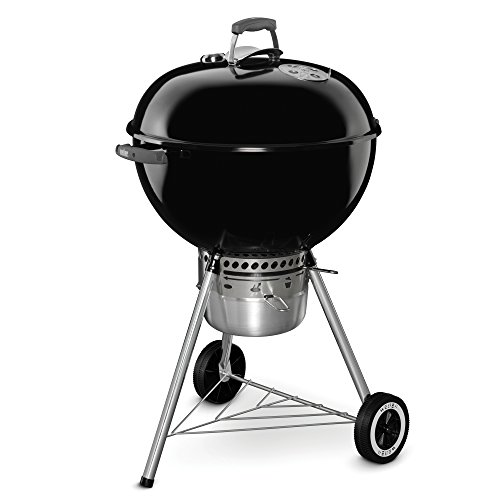
Top pickBest for everyday grilling and a first charcoal grill
1. Weber Original Kettle 22-inch Charcoal Grill
The classic kettle that most people picture when they think of charcoal grilling. A porcelain-enameled bowl and lid, adjustable vents and a one-touch ash catcher make it simple to run and clean. It is a good way to learn fire control.
Suits: everyday grilling and a first charcoal grill. Strengths: a proven design and easy ash cleanup. Weaknesses: no side table. Skip it if you want a built-in ignition.

Best for cooks who like to modify setups
2. Weber Master-Touch Charcoal Grill 22-inch
A kettle with an upgraded cart-style stand, a lid hook and a Gourmet BBQ System-compatible grate. The grate has a removable center for adding pans or cast iron.
Suits: cooks who like to modify setups. Strengths: extra features over the base kettle. Weaknesses: costs more than the Original. Skip it if you want the plainest grill.

Best for entertaining on a patio
3. Weber Performer Deluxe Charcoal Grill 22-inch
A kettle on a cart with a side table, a storage bin and an ignition system that skips lighter fluid. The extras suit cooks who grill often and like a tidy workspace.
Suits: entertaining on a patio. Strengths: a work table and ignition. Weaknesses: larger to store. Skip it if you are short on space.
View Weber Performer Deluxe Charcoal Grill 22-inch on Amazon

Best for small yards and trips
4. Weber Jumbo Joe 18-inch Charcoal Grill
A portable 18-inch kettle with a lid lock, vents and a small footprint. It sits on a short stand and fits a balcony or a car trunk. It makes a great second grill.
Suits: small yards and trips. Strengths: compact size and portability. Weaknesses: smaller grate. Skip it if you cook for large groups.

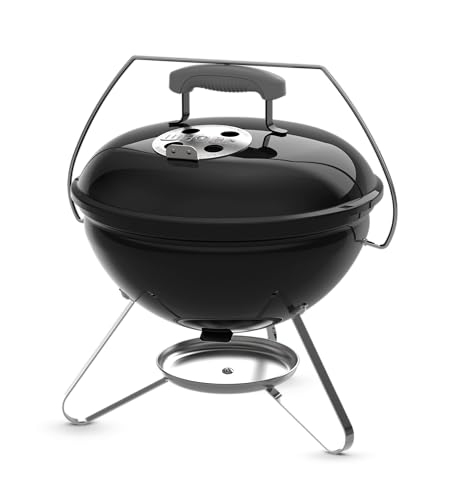
Best for camping and tailgating
5. Weber Smokey Joe 14-inch Charcoal Grill
A tiny tabletop kettle for camping, tailgates or a single meal. It has the same basic design as its larger siblings in a very small body. Pack a chimney starter for easy lighting.
Suits: camping and tailgating. Strengths: small and light on fuel. Weaknesses: very little cooking surface. Skip it if you often feed a crowd.
Best for serious charcoal cooks
6. Weber Summit Kamado E6 Charcoal Grill
A high-end kamado from Weber with thick insulation and a precise vent system. It holds heat for long smokes and high-heat sears alike. Check the listing for the stand and accessories included.
Suits: serious charcoal cooks. Strengths: insulated build and a wide range. Weaknesses: heavy to move and to place. Skip it if you want a basic kettle.
View Weber Summit Kamado E6 Charcoal Grill on Amazon
Care and Setup
- Empty ash after each cook.
- Brush the grate while the grill is warm.
- Cover the grill when it is cold.
- Check the vent dampers for rust or sticking.
- Keep a chimney starter and a long pair of tongs near the grill.
Mistakes to Avoid
- Starting a fire with too much lighter fluid.
- Cooking over flaming coals.
- Closing the vents fully and snuffing the fire.
- Leaving ash in the bowl and clogging the vents.
- Lifting the lid too often.
Kettle Versus Kamado Design
The Weber charcoal range spans two different cooking styles. A kettle is a thin-walled steel bowl and lid with a coated finish. It heats up quickly, responds fast to vent changes and is straightforward to clean. A kamado style cooker, by contrast, has thick, insulated walls that hold heat for long periods and use fuel steadily over a long cook.
That difference changes the experience. A kettle suits hands-on grilling: burgers, sausages, chicken pieces and vegetables, with the option to set up indirect heat for roasts. It rewards attention but is forgiving. A kamado is better at stable temperatures over many hours, so it suits long smokes and also high-heat sears. It is heavier and takes more care when moving.
Think about how you cook most often. If weeknight grilling is the goal, a kettle is usually the simpler choice. If you want to smoke large cuts or bake with steady heat, kamado construction may be worth considering, though it asks for more space and a stronger stand.
- Check the weight and dimensions on the listing so you know whether you can place and move it safely.
- Look at what the stand or cart is made of and whether it is included.
- Confirm which accessories are part of the package and which are sold separately.
Neither style is universally better. The best fit depends on your space, your patience for fire management and the kinds of food you plan to cook most.
Setting Up Direct and Indirect Heat Zones
Charcoal grilling becomes easier once you understand two setups. In direct cooking, coals are spread under the food, which suits thin items that cook quickly. In indirect cooking, coals are placed to one side or in two piles, with the food over the empty area, which suits larger cuts, bone-in chicken and anything that would burn on the outside before cooking through.
A two-zone fire gives you the most flexibility. Pile the lit coals on one side, place the food over the cool side or sear first over the hot side and then move it. Holding the lid closed with vents set correctly keeps heat circulating around the food, like an oven.
Charcoal baskets or rails are an optional accessory that can keep coals bunched on one side. Check compatibility with your grill size before buying. Sold separately or included, they should match the diameter listed by the maker.
- Place the top vent over the food during indirect cooking so smoke and heat travel across it.
- Open the bottom vents wider for more heat and close them partway to cool the fire.
- Leave the lid on as much as possible, since lifting it lets heat escape.
Adding a few wood chunks to the coals can give smoke flavor during indirect cooking. Use only wood meant for cooking, and add it sparingly to avoid bitter results. A probe thermometer remains the best way to judge when food is done.
Lump Charcoal Versus Briquettes and Lighting Methods
Fuel choice affects temperature, burn time and cleanup. Lump charcoal is made from carbonized wood pieces, is irregular in shape and often lights quickly and burns hot. Briquettes are uniform and generally burn more evenly and longer, which many cooks prefer for steady cooking. Some briquettes contain binders or additives, so read the package and choose products labeled for cooking.
Avoid charcoal with lighter fluid built in unless you are comfortable with the flavor trade-off. A chimney starter is a widely used alternative: fill it with charcoal, light paper or a starter cube beneath, and wait until the top coals are ashed over before pouring them into the grill. It lights fuel without liquid accelerants.
Electric starters and ignition systems built into some carts are another option. Check the manual for how they work and any power requirements, and follow safety instructions for storage and use.
- Store charcoal in a dry place, since damp fuel is slow to light and burns poorly.
- Do not add lighter fluid to hot or lit coals.
- Let the first coals burn off any initial smoke before putting food on.
- Keep extra fuel on hand for long cooks and plan how you will add it.
Try both fuel types and see which suits your taste and routine. Many cooks keep both on hand, using lump for quick sears and briquettes for longer cooks.
Space, Storage and Accessory Planning
A charcoal grill takes up room even when idle. Measure the area where it will live, including space to open the lid fully and to stand safely while cooking. Keep it a safe distance from siding, fences, railings and overhead structures, and place it on a stable, non-flammable surface. Check your building or community rules before using charcoal on a balcony, since many places restrict open flames.
Think about work space. Larger carts often include side tables, hooks or storage bins, while basic kettles may have none. If you prefer to keep everything within reach, consider whether the model has shelving or whether you will need a separate table.
Plan accessories that suit your cooking. A chimney starter, long tongs, a heat-resistant glove, a grate brush and a probe thermometer cover the basics. A cover protects the grill from weather when cool. Confirm that any accessory matches the model and size you are buying, because fit varies across the range.
- Check that replacement grates, ash catchers and covers are available for your model.
- Measure the grill in its carrying position if you plan to take it on trips.
- Plan a safe place to dispose of cooled ash in a metal container.
If storage is tight, a smaller model or a portable design might fit better than a large cart, even if it limits how much you can cook at one time.
Maintenance, Rust Prevention and Replacement Signs
With regular care, a charcoal grill can last many seasons. Clean ash out regularly, since ash holds moisture and can speed up corrosion at the bottom of the bowl. Brush the grate and wipe away grease that could catch fire. Do not use harsh cleaners on porcelain-coated surfaces unless the manual allows them.
Look at the finish. Chips in the coating can expose metal that rusts over time. Small spots can be managed by keeping the grill dry and covered, while large areas of flaking or rust-through suggest the grill is nearing the end of its useful life. Check that vents move freely, since sticking dampers make temperature control difficult.
Inspect structural parts at the start of each season: legs, wheels, handles, hinges and lid hooks. Tighten loose hardware and replace worn parts when possible. Many parts are available separately, so repair is often more practical than replacement.
- Cover the grill when it is cool and dry, and allow moisture to escape from underneath the cover.
- Avoid dragging the grill across rough surfaces if wheels are not designed for it.
- Replace a grate that is badly corroded or bent.
When the body is warped, the lid no longer fits closely or multiple parts need replacement, it may be time for a new grill. Before buying, review what you liked and disliked about the old one, then reuse the same size and feature questions.
A Buyer Checklist for Charcoal Kettles
Weber charcoal grills share a familiar look, but sizes and features vary. Use these questions to narrow the field.
- How many people do you usually cook for? That sets the diameter you need.
- Do you have room for a full-size kettle, or do you need a compact one for a balcony or trips?
- Do you want a simple bowl and lid, or extras such as a hinged grate, ash catcher or side table?
- How important is easy ash cleanup to you?
- Are you interested in long, low cooks, which suit a heavier, more insulated body?
- Where will you store the grill when not in use?
Your answers matter more than a feature count. A small kettle used often beats a big one that is awkward to light.
Comparing Sizes and Styles
The table gives a general picture of how the main styles differ.
| Style | Suited to | Think about |
|---|---|---|
| Full-size kettle | Family meals and weekend cooks | Needs patio space and a spot for ash disposal |
| Kettle with cart and shelves | Frequent cooks who want a work surface | Larger footprint, more assembly |
| Compact kettle | Small gardens, tailgates | Less room for indirect cooking |
| Portable tabletop | Camping or beach trips | Needs a heat-safe stand |
| Ceramic style | Long cooks and variety of temperatures | Heavier and more of a long-term purchase |
Think about how you will use the vents too. Learning how air flows through a kettle is the most useful skill for any of these models.
Mistakes New Charcoal Cooks Make
Most early frustrations come from habit, not from the grill itself.
- Lighting the grill with the lid closed and the vents shut, which cuts off the air the coals need.
- Adding food before the coals are ready and evenly lit.
- Using too much lighter fluid, which can leave a bad taste, instead of a chimney as the maker suggests.
- Leaving ash to build up, which blocks airflow and can hold moisture against the metal.
- Throwing out hot ashes, instead of letting them cool fully before disposal.
Spend a first session learning without food on the grill. Light the coals, adjust the vents and watch how the temperature responds.
Following the Manual and Fire Safety
Charcoal grills involve open fire, so use them outdoors, away from walls, railings, overhangs and dry plants. Follow the maker’s instructions for assembly, lighting and ash handling, and keep a bucket of water or a suitable extinguisher nearby. Check any local rules or restrictions on open fires, especially in dry seasons. Allow ashes to cool completely, then dispose of them in a metal container as official guidance suggests. Never use a charcoal grill indoors or in a garage.
Seasonal Care and Storage
A little maintenance keeps a kettle looking and working well. Brush the grate after each cook, empty the ash catcher once everything is cold and wipe the lid interior if grease builds up. A fitted cover protects the finish between uses. At the end of the season, give the bowl and lid a deeper clean, look over the vents and wheels, and store the grill in a dry place. Replacement parts like grates and ash catchers are usually easy to find from the maker if wear shows up.
Direct and Indirect Heat in Plain Terms
The main reason people love kettles is flexibility. Pile the coals on one side and you create a hot zone for searing and a cooler zone where food cooks gently with the lid closed. Spread them evenly and you have strong, direct heat across the whole grate. Learning to switch between the two styles covers most backyard cooking.
- Direct: burgers, sausages, thin steaks and vegetables.
- Indirect: whole chicken pieces, larger roasts and anything that needs more time.
- Two-zone: sear first, then move food to the cool side to finish.
Use the lid vents to manage temperature, opening them for more heat and closing them partway to slow things down. Always follow official guidance on safe internal temperatures for meat and poultry, and use a thermometer instead of guessing.
Choosing a Weber charcoal grill With a Clearer Eye: The Criteria That Deserve a Second Look
The opening sections of this guide cover the headline points to check when you compare Weber charcoal grills. This section slows down and looks at the same decision from the owner’s side: not what a Weber charcoal grill promises on the day it arrives, but how the choice plays out across months of direct grilling, indirect roasting and gentle smoking over real charcoal. Reading it before you settle on a pick will help you use the product sections above more sharply, because you will know which details in each description actually matter for your household and which are simply nice to have.
Fit and space, measured honestly
Start with the space the grill occupies with its lid open, safe clearance around it and whether you need it to move easily or live in one spot. Measure twice, in the unhurried way that feels excessive, and write the numbers down rather than trusting memory. Allow for the unglamorous details too: how the Weber charcoal grill is reached, what sits around it in the backyard or patio, and whether the space you have measured is the space that will still be there once everything else is back in place. Most disappointing purchases in this category are not bad products; they are good products matched to the wrong space, and nearly all of them could have been avoided with a tape measure and ten quiet minutes before ordering.
Performance where it counts
Next, think about temperature control through the vents, evenness across the grate and how the grill behaves once a chimney of coals has settled. Headline claims are easy to compare and often the least useful guide, because daily satisfaction comes from consistency: the tenth use behaving like the first, and the result staying predictable when conditions are less than perfect. As you read the pick-by-pick sections above, keep returning to this question — does this option perform in the specific way my routine actually demands, or is it strong in ways I will rarely call on? A Weber charcoal grill that is merely good at everything but exactly right for your main job usually beats a more impressive all-rounder.
Everyday ease, not first-day impressions
Consider ash management, grate handling and lighting routines that decide whether weeknight grilling feels easy or like a project. Ease of use rarely appears in a feature list, yet it decides whether a Weber charcoal grill becomes part of your routine or an obstacle you work around. Picture the busiest, messiest moment of normal use — not a calm demonstration — and ask whether the design still helps you then. Small frictions repeat: a control that needs two attempts, a part that is awkward to lift, a routine that takes a minute longer than it should. Multiplied across a year of regular use, those small frictions are the difference between a purchase you recommend to friends and one you quietly stop using.
Cleaning and upkeep you will actually do
Be honest about ash in the bowl, grease and residue on the cooking grate and soot inside the lid. Every Weber charcoal grill in this guide asks for some upkeep, and the realistic question is not whether the cleaning is easy in theory but whether it fits the time and patience you genuinely have. Short, regular attention almost always beats occasional heroic deep cleans, both for results and for how long the product lasts. As you compare the picks, favour the design whose upkeep matches your habits — a slightly simpler model you keep clean will outperform a sophisticated one you neglect, every single time.
Safety and the people around you
Finally, think about hot coals, safe ash disposal, lighting fuel choices and keeping the grill stable and away from anything combustible. Safety in this category is mostly a matter of habits and placement rather than dramatic risks: where the Weber charcoal grill sits, who can reach it, and whether your routine includes the small checks that keep everything sound. Read the safety notes in each product section above with your own household in mind — the presence of children, pets, elderly relatives or simply a busy, distracted cook changes which precautions matter most. A few minutes spent setting things up safely at the start is repaid every time you use the Weber charcoal grill without thinking about it.
Putting It to Work: How a Weber charcoal grill Fits Real Routines
Specifications describe a Weber charcoal grill; routines reveal one. The scenarios below describe the situations readers most often have in mind when they shop for Weber charcoal grills, and what each situation rewards. Find the scenario closest to your life and weight it heavily: a pick that shines in your scenario is a better buy than a pick that wins on a comparison table but belongs to somebody else’s routine. Many households recognise themselves in two scenarios at once, in which case the overlap between them is usually where the right choice sits.
Weeknight burgers and sausages
This is about a single chimney of coals, direct heat and dinner without a long setup. In this situation, the Weber charcoal grill is not an occasional tool but part of a repeating pattern, so reliability and ease matter more than novelty. Look again at the picks above and ask which of them is described in terms that match this pattern: steady performance across a long session, straightforward handling when you are busy, and upkeep that can keep pace with frequent use. It is also worth thinking about what happens on the busiest version of this day, not the average one, because a Weber charcoal grill chosen for the average day is the one that lets you down precisely when the stakes are highest — guests waiting, a deadline looming or a car packed and ready to leave.
Indirect roasts and whole chickens
This is about coals banked to the sides and the lid down, using the kettle as an oven. In this situation, the Weber charcoal grill is not an occasional tool but part of a repeating pattern, so reliability and ease matter more than novelty. Look again at the picks above and ask which of them is described in terms that match this pattern: steady performance across a long session, straightforward handling when you are busy, and upkeep that can keep pace with frequent use. It is also worth thinking about what happens on the busiest version of this day, not the average one, because a Weber charcoal grill chosen for the average day is the one that lets you down precisely when the stakes are highest — guests waiting, a deadline looming or a car packed and ready to leave.
Low-and-slow experiments
This is about ribs and shoulders cooked gently with vent control and patience. In this situation, the Weber charcoal grill is not an occasional tool but part of a repeating pattern, so reliability and ease matter more than novelty. Look again at the picks above and ask which of them is described in terms that match this pattern: steady performance across a long session, straightforward handling when you are busy, and upkeep that can keep pace with frequent use. It is also worth thinking about what happens on the busiest version of this day, not the average one, because a Weber charcoal grill chosen for the average day is the one that lets you down precisely when the stakes are highest — guests waiting, a deadline looming or a car packed and ready to leave.
Portable cooks away from home
This is about smaller kettles that travel to parks, beaches and campsites where rules allow. In this situation, the Weber charcoal grill is not an occasional tool but part of a repeating pattern, so reliability and ease matter more than novelty. Look again at the picks above and ask which of them is described in terms that match this pattern: steady performance across a long session, straightforward handling when you are busy, and upkeep that can keep pace with frequent use. It is also worth thinking about what happens on the busiest version of this day, not the average one, because a Weber charcoal grill chosen for the average day is the one that lets you down precisely when the stakes are highest — guests waiting, a deadline looming or a car packed and ready to leave.
Day-to-Day Use, Cleaning and Care in More Detail
The care sections earlier in this guide give the essentials. What follows is the longer view: how to build the small habits that keep a Weber charcoal grill performing well, how to clean it without turning the job into a chore you avoid, and how to store and look after it between uses. None of this requires specialist products or skills — it requires doing simple things regularly, which is unglamorous and entirely effective.
The first uses set the pattern
When your Weber charcoal grill is new, take the first use slowly. Read the maker’s instructions properly — not as a formality, but because the details that matter, from first setup to what not to do, are specific to your model and are not repeated anywhere else. Run through the basic routine once without time pressure, notice what feels awkward, and adjust your setup while the stakes are low. Owners who give a new Weber charcoal grill one unhurried first session almost always have a smoother first month than owners who debut it in front of an audience or a deadline.
A cleaning rhythm that sticks
For cleaning, little and often is the whole secret. Deal with ash in the bowl, grease and residue on the cooking grate and soot inside the lid while traces are fresh and the job takes minutes; leave them and the same job becomes the kind of task that gets postponed indefinitely. Keep the basic supplies you need within reach of where the Weber charcoal grill lives, use only cleaning methods and products the maker allows for the surfaces involved, and let everything dry fully before the next use or before storage. If several people share the Weber charcoal grill, agree on the rhythm out loud — most neglected equipment belongs to everyone in theory and nobody in practice.
Storage and the time between uses
What happens between uses shapes a Weber charcoal grill’s life as much as the uses themselves. Store it and its accessories together, dry and protected from knocks, dust and damp, in a place that does not require a struggle to reach — equipment stored awkwardly gets used reluctantly. Before a longer break, a proper clean and a quick check of the parts that wear, loosen or perish means the Weber charcoal grill comes back to service ready rather than needing rescue. When you return to it, a brief inspection before the first use catches the small problems — a frayed edge, a loose fitting, a part left dirty — while they are still small.
Knowing what is normal and what is not
Every Weber charcoal grill develops a familiar pattern of sounds, smells, timings and behaviour, and learning that pattern is a genuine skill. Once you know what normal looks like, changes announce themselves early: a new noise, a slower result, a part that no longer sits as it did. Most changes have simple causes covered in the troubleshooting spirit of this guide — something needs cleaning, adjusting or replacing as a consumable. The ones that do not respond to the simple checks are the ones to hand to a professional, and catching them early is usually what keeps a repair minor.
How the Picks in This Guide Compare With Each Other
Readers often ask for a simple ranking of the Weber charcoal grills above, but the honest comparison is about fit. Each pick in this guide earned its place for a slightly different reader, and the sections describing them already contain everything needed to separate them: who each one suits, the strengths highlighted, and the honest limitation mentioned alongside. The notes below show how to run that comparison for yourself, pick by pick, so the final choice rests on your priorities rather than on a generic verdict.
Consider the Weber Original Kettle 22-inch Charcoal Grill. Return to its section above and note three things in order: the reader it is described as suiting, the strength the guide emphasises most, and the limitation it openly flags. Then hold those three points against the criteria and scenarios earlier on this page. If the reader it suits sounds like you, and its flagged limitation touches something you rarely do, it belongs on your shortlist even if another pick looks stronger on paper. If the limitation sits squarely in your main routine, that is the comparison doing its job — cross it off without regret and move to the next pick, because a Weber charcoal grill whose weakness meets your most common use will disappoint you weekly, however good its strengths are.
Consider the Weber Master-Touch Charcoal Grill 22-inch. Return to its section above and note three things in order: the reader it is described as suiting, the strength the guide emphasises most, and the limitation it openly flags. Then hold those three points against the criteria and scenarios earlier on this page. If the reader it suits sounds like you, and its flagged limitation touches something you rarely do, it belongs on your shortlist even if another pick looks stronger on paper. If the limitation sits squarely in your main routine, that is the comparison doing its job — cross it off without regret and move to the next pick, because a Weber charcoal grill whose weakness meets your most common use will disappoint you weekly, however good its strengths are.
Consider the Weber Performer Deluxe Charcoal Grill 22-inch. Return to its section above and note three things in order: the reader it is described as suiting, the strength the guide emphasises most, and the limitation it openly flags. Then hold those three points against the criteria and scenarios earlier on this page. If the reader it suits sounds like you, and its flagged limitation touches something you rarely do, it belongs on your shortlist even if another pick looks stronger on paper. If the limitation sits squarely in your main routine, that is the comparison doing its job — cross it off without regret and move to the next pick, because a Weber charcoal grill whose weakness meets your most common use will disappoint you weekly, however good its strengths are.
Consider the Weber Jumbo Joe 18-inch Charcoal Grill. Return to its section above and note three things in order: the reader it is described as suiting, the strength the guide emphasises most, and the limitation it openly flags. Then hold those three points against the criteria and scenarios earlier on this page. If the reader it suits sounds like you, and its flagged limitation touches something you rarely do, it belongs on your shortlist even if another pick looks stronger on paper. If the limitation sits squarely in your main routine, that is the comparison doing its job — cross it off without regret and move to the next pick, because a Weber charcoal grill whose weakness meets your most common use will disappoint you weekly, however good its strengths are.
Consider the Weber Smokey Joe 14-inch Charcoal Grill. Return to its section above and note three things in order: the reader it is described as suiting, the strength the guide emphasises most, and the limitation it openly flags. Then hold those three points against the criteria and scenarios earlier on this page. If the reader it suits sounds like you, and its flagged limitation touches something you rarely do, it belongs on your shortlist even if another pick looks stronger on paper. If the limitation sits squarely in your main routine, that is the comparison doing its job — cross it off without regret and move to the next pick, because a Weber charcoal grill whose weakness meets your most common use will disappoint you weekly, however good its strengths are.
Consider the Weber Summit Kamado E6 Charcoal Grill. Return to its section above and note three things in order: the reader it is described as suiting, the strength the guide emphasises most, and the limitation it openly flags. Then hold those three points against the criteria and scenarios earlier on this page. If the reader it suits sounds like you, and its flagged limitation touches something you rarely do, it belongs on your shortlist even if another pick looks stronger on paper. If the limitation sits squarely in your main routine, that is the comparison doing its job — cross it off without regret and move to the next pick, because a Weber charcoal grill whose weakness meets your most common use will disappoint you weekly, however good its strengths are.
Two further checks sharpen any shortlist. First, compare upkeep: the picks differ in how much routine attention they ask for, and the one whose care routine matches your habits will still be performing well long after a needier rival has been neglected. Second, compare the whole purchase, not just the unit — the accessories, consumables, replacement parts and storage the Weber charcoal grill needs over its life. A pick that looks like the premium choice sometimes asks the least over time, and the reverse is just as common. Decide with both checks done and you will rarely need to second-guess the order.
The Longer View: Owning One Well
A Weber charcoal grill is one of those purchases whose value compounds quietly. The first month is about learning it; the first year is about the routine settling around it; after that, it simply becomes how things are done in your home. Owners who get the most from Weber charcoal grills share a few traits that have nothing to do with which model they bought. They keep the basic accessories and consumables in stock so a missing item never cancels a plan. They do the small cleaning and checking jobs on rhythm rather than on memory. And they revisit their setup occasionally — as households, tastes and routines change, the way a Weber charcoal grill is used can change with them, and a small rearrangement sometimes unlocks value that was there all along.
It is also worth keeping a light record, even if only mentally, of what works for you: the settings, timings, arrangements or combinations that produced your best results. The guides and product sections can start you off, but your own notes — adjusted for your space, your ingredients, your car, your collection, your people — are what turn a good Weber charcoal grill into the right one. When the time eventually comes to replace it, that record tells you exactly which of the criteria in this guide mattered in practice, and the next purchase becomes the easiest one you have made in this category.
Weber Charcoal Grill FAQ
Which Weber kettle is best for beginners?
The 22-inch Original Kettle is the usual starting point.
Do I need a chimney starter?
It is not required, but a chimney starter lights charcoal cleanly without fluid.
Can I smoke on a kettle?
Yes, with indirect heat and wood chunks. A dedicated smoker is easier for long cooks.
Which charcoal should I use?
Lump charcoal burns hot and clean, while briquettes burn evenly and last longer. Use whichever suits your recipe.
Are kettles easy to clean?
Yes. The ash catcher and porcelain finish make cleanup simple.
Can I use a charcoal kettle on a balcony?
Many buildings restrict open flames on balconies, so check your lease, building rules and local fire codes first. If allowed, keep a safe distance from walls and railings.
How much charcoal do I need?
It depends on the grill size, the food and how long you cook. Start with the amount the manual suggests, and add fuel gradually during longer cooks.
Do I need to season a new grill?
Follow the maker's instructions. Some owners burn a first fire to cure the finish and remove manufacturing residue.
Why does my fire die out?
Common causes include closed vents, ash blocking airflow, damp fuel or too little charcoal. Check these before adding more fuel.
Is a built-in thermometer accurate enough?
It gives a general sense of the temperature near the lid. For food safety and precision, use a probe thermometer placed at the food.
Can I grill in the rain?
Some people do, but it is a safety and comfort issue. Keep the grill in a stable, open, well-ventilated place and follow the manual, and never use it in an enclosed area.
How do I dispose of used coals?
Let them cool completely, often for a day, then place them in a metal container. Do not put warm ash in a trash can or on a deck.
How do the vents actually control the temperature?
Charcoal needs oxygen, so the vents are the throttle. Opening them feeds the fire and raises the heat; closing them down starves it and lets the temperature fall. Small adjustments and a few minutes of patience work better than swinging vents fully open and shut.
Why does food stick to the grate?
Usually the grate was not hot enough, the food went on too early or it was moved before it had released naturally. A clean, well-heated grate and a light touch of oil on the food — plus resisting the urge to prod — solve most sticking without any special equipment.
Can I reuse charcoal that did not fully burn?
Many cooks knock the ash off partly burned pieces once they are completely cold and mix them with fresh charcoal next time. Store them dry, and accept that reused pieces light a little differently; for a long or important cook, fresh charcoal is the predictable choice.
How do I grill for both meat-eaters and vegetarians on one kettle?
Use zones. Keep vegetables on a cooler, cleaner section of grate — a grill basket or tray helps — and cook them first or keep them separated from meat juices with placement and utensils, the same cross-contamination care you would use in a kitchen.
What is the simplest way to tell when the coals are ready?
For briquettes, wait until most are edged with grey ash; for lump, look for a strong, even glow. Spreading them too early gives fierce, uneven heat, while waiting too long wastes the best of the fire, so learn your chimney’s timing over a few cooks.
How should I store a kettle grill between uses?
With the vents managed as the maker suggests, ash removed once cold, and the grill under cover or shelter where you can. Ash left in the bowl absorbs moisture and encourages rust, so the two-minute clean after a cook is the real storage routine.
The Short Version
For the classic, the Original Kettle 22. For upgraded features, the Master-Touch. For a work table, the Performer Deluxe. For portability, the Jumbo Joe. For tiny spaces, the Smokey Joe. For a premium kamado, the Summit.


