Jerky is dried more than cooked, so the best smokers for it hold a low, even temperature and keep air moving between strips. Electric vertical cabinets are popular for this job because they run cool and need very little attention once the meat is loaded. Most of the models below also let you prop racks open for airflow and add smoke only when you want it.
The picks below range from tiny front-load smokers to roomy cabinets for hunters with a freezer full of venison. We have not used these products ourselves, so confirm rack counts, power needs and features on the current listing before buying.
As an Amazon Associate we earn from qualifying purchases. Links below are affiliate links, and they do not change the product information we give.
What to Look For
| Feature | Why it matters |
|---|---|
| Low heat | Jerky needs gentle heat so it dries rather than cooks |
| Rack space | More racks mean larger batches |
| Airflow | A vent lets moisture escape |
| Cleanup | Removable racks and trays make cleanup faster |
| Power | Check the plug type and cord length for your spot |
| Smoke source | Chips or bisquettes decide how strong the flavor gets |
In this guide
Specs at a Glance
| Product | Power | Size class | Notes |
|---|---|---|---|
| Bradley Original Smoker | Electric | Four racks | Uses wood bisquettes |
| Smokehouse Little Chief | Electric | Compact | Front-load; uses wood chips |
| Smokehouse Big Chief | Electric | Larger than Little Chief | Front-load |
| Cuisinart COS-244 30 inch | Electric | Mid-size | Digital control |
| Char-Broil Analog Electric | Electric | Mid-size | Simple dial |
| Masterbuilt 40-inch Digital | Electric | Large | Digital panel |
The 6 Best Vertical Smokers for Jerky
Top pickBest for regular jerky makers
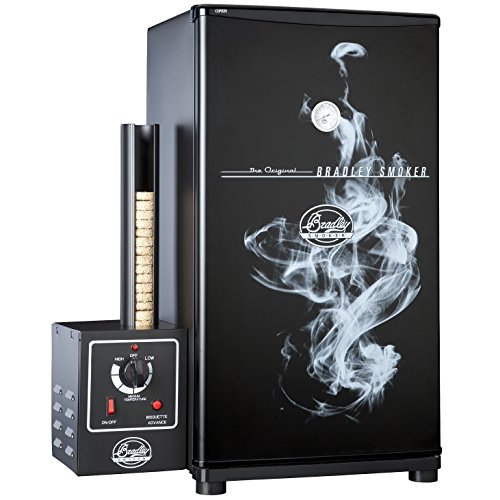
1. Bradley Original Smoker
A cabinet smoker that feeds pressed wood bisquettes automatically for steady smoke. Bradley is a long-known name for jerky, fish and cured meats, and the separate generator keeps smoke and heat easy to manage on their own.
Suits: regular jerky makers. Strengths: automatic smoke feed. Weaknesses: bisquettes are an ongoing cost. Skip it if you want the lowest-effort starter.
Best for small batches
2. Smokehouse Products Little Chief Front Load Smoker
A small electric smoker with a low-powered heating element and a pan for wood chips. It has been a jerky favorite for decades because it keeps temperatures gentle and has almost nothing to go wrong.
Suits: small batches. Strengths: gentle heat. Weaknesses: few racks. Skip it if you cook for a crowd.
View Smokehouse Products Little Chief Front Load Smoker on Amazon
Best for bigger batches
3. Smokehouse Products Big Chief Front Load Smoker
The larger sibling of the Little Chief, with more rack room and the same simple operation. A front door makes loading and rotating racks easy, and the design suits fish and sausage as well as jerky.
Suits: bigger batches. Strengths: simple operation. Weaknesses: still limited next to full cabinets. Skip it if you want a digital panel.
View Smokehouse Products Big Chief Front Load Smoker on Amazon
Best for tidy patios and balconies
4. Cuisinart 30-inch Electric Smoker COS-244
A digital electric cabinet with several racks and a glass window. The timer and temperature control help hold a steady jerky setting, and a vertical shape keeps the footprint small on a balcony or patio.
Suits: tidy patios and balconies. Strengths: digital control. Weaknesses: a glass door gets sooty. Skip it if you want charcoal flavor.
View Cuisinart 30-inch Electric Smoker COS-244 on Amazon
Best for low-fuss batches
5. Char-Broil Analog Electric Smoker
A simple electric cabinet with a dial and a wood chip tray. It plugs in and avoids fuel handling, which suits cooks who want to load strips, set the dial and check back later.
Suits: low-fuss batches. Strengths: easy use. Weaknesses: a dial offers less precision. Skip it if you want exact control.
View Char-Broil Analog Electric Smoker on Amazon

Best for hunters with big batches
6. Masterbuilt 40-inch Digital Electric Smoker
A tall electric smoker with a digital panel and many racks. It offers capacity for deer season and large batches, and some versions add Bluetooth control, so check which one is listed.
Suits: hunters with big batches. Strengths: lots of space. Weaknesses: needs a power outlet. Skip it if you have a small yard.
Care and Setup
- Wipe racks while they are still slightly warm.
- Empty and clean the chip tray after each use.
- Keep the power cord out of wet areas.
- Store the smoker covered and dry.
- Rotate racks halfway through a batch so top and bottom strips finish together.
Mistakes to Avoid
- Cranking the heat and cooking the strips instead of drying them.
- Laying slices too close together.
- Using wet chips that smolder and turn bitter.
- Skipping a rest and a cool-down before storage.
- Mixing thick and thin strips on one rack.
Drying Versus Smoking: What Jerky Needs
People often treat jerky as a smoking project, but the real work is drying. Smoke adds flavor and a surface character, while gentle heat and moving air do the job of removing moisture. A vertical smoker can do both, as long as it holds a low temperature and lets humid air escape. That is why electric cabinets and small front-load smokers appear so often in jerky advice: their elements run gently and there is no live fire to manage.
Think about the balance between heat, airflow and time. Too much heat dries the outside quickly and leaves a moist center. Too little airflow traps humidity and stretches the process out. A cabinet with an adjustable vent, or a door that can be left slightly open where the manual allows it, gives you control over how fast moisture leaves. Racks that can be spaced out help as well.
It also helps to separate the smoke step from the drying step. Some cooks smoke for the first part of the batch, when meat accepts smoke best, then continue drying with the chip tray empty. This avoids bitter, over-smoked strips.
- Run the smoker empty first to learn how it behaves at its lowest setting.
- Use a separate thermometer to compare the real cabinet temperature to the dial.
- Check strips early and often near the end of a batch.
- Keep notes on thickness, time and result so you can repeat what worked.
If your smoker cannot hold a low setting, consider a different tool for drying, or pair it with a separate dehydrator for the final stage.
Front-Load or Full Cabinet: Choosing a Format
Vertical smokers for jerky come in a few formats. Small front-load boxes are simple, low in power and easy to store. They suit occasional batches and cooks with limited space, but they usually offer fewer racks, so large batches take several rounds. Full cabinets with a digital panel offer more racks, timers and sometimes a glass door, and they suit people who make jerky regularly or cook for a group.
Consider the smoke source as part of the format. Chip trays are simple and cheap to run. Automatic feed systems that use compressed wood pieces give steady smoke but tie you to a specific fuel, so check availability and the ongoing cost before committing. Propane and charcoal vertical smokers can make jerky too, but holding a very low and steady temperature takes more skill, especially in warm weather.
Think about your own habits. If you make a batch each deer season, a larger cabinet that sits idle most of the year may be fine. If you make a pound or two a month, a compact unit saves space and energy. If you want the option to smoke fish, sausage and cheese, look for a cabinet that can hold lower temperatures and has removable racks.
- Small front-load: simple, light, limited capacity.
- Digital cabinet: more control, more racks, more to clean.
- Automatic smoke feed: steady output, ongoing fuel purchases.
- Fuel-fired verticals: flexible but harder to hold very low heat.
Read the listing for rack count, rack size and what the maker says about low-temperature use.
Rack Layout and Airflow Planning
How you load the racks matters as much as which smoker you own. Strips should lie flat or hang with space around them so air can reach both sides. Overlapping strips stay damp where they touch and dry unevenly. Leave a small gap between the strips and the cabinet walls too, since the edges can run hotter or cooler than the middle.
Plan the layout before you start. If your racks are wide-gapped, strips may sag through and stick, so line racks with a food-safe mesh if the manual allows it, or hang strips from skewers laid across the rack. Check that any liner will not block airflow. Hanging strips from rods or hooks uses vertical space well and prevents flat spots, though the strips need to be of similar length.
Heat usually varies by level. In many electric cabinets, the lower racks sit closer to the element and finish first. Rotate racks halfway through, moving top to bottom, so the batch finishes more evenly. Pull finished strips as they are done instead of waiting for the whole batch.
- Group strips by thickness on each rack.
- Do not load the cabinet to the brim; air needs room to move.
- Keep a drip tray or foil-lined pan on the bottom to catch drips, without blocking vents.
- Wipe racks between batches, since sugary marinades leave sticky residue.
If humidity is high outdoors, drying takes longer. A dry, breezy day helps, while a damp or rainy day may call for extra time.
Power, Placement and Weather Considerations
Electric jerky smokers need a safe place to run for many hours. Choose a level spot outdoors, away from walls, railings and anything that can burn, with room around the cabinet for air. Never run a smoker in an enclosed garage, tent or porch. Match the plug and cord to the manual, use an outdoor-rated, grounded outlet and keep any extension cord as short as practical and rated for the load.
Weather affects results. Cold and wind pull heat from the cabinet and can make a low setting harder to hold. A sheltered corner of the patio helps. Rain and wet ground are a risk to cords and controls, so cover the connection or choose a dry spot. In hot weather, the cabinet may drift above your target, so check the thermometer more often.
Plan for long unattended stretches. Many jerky batches take hours, so decide in advance when you will check, and avoid leaving a hot smoker with pets or children around. If power drops during a cook, check the meat and discard it if it has spent too long in a warm range without proper heat; consult food safety guidance.
- Check cord condition before each use.
- Let the smoker cool completely before covering it.
- Keep the chip tray clean so old ash does not smother new wood.
- Store the smoker covered and dry between uses.
If a cabinet shows rust, a frayed cord or an element that no longer heats evenly, replace the part or retire the unit.
Why a Vertical Smoker Suits Jerky
Jerky needs long, gentle, even heat and steady airflow, and vertical smokers provide a stacked layout where racks sit above a heat and smoke source. This lets you load many thin strips of meat on several racks and keeps the footprint small. The tall, narrow shape makes them popular for backyards and patios. Understanding how they work helps you pick one that suits your batches.
- Electric vertical smokers: a heating element and a wood chip tray, with simple controls.
- Gas or propane models: use a burner and a wood box.
- Charcoal and bullet-style models: use a water pan and charcoal, with more tending.
- Dedicated jerky smokers: low-power units designed for drying.
Choose the power source you can safely use at home. Electric models are simple and steady, while charcoal gives a classic flavor with more work.
Racks, Capacity and Airflow
Capacity depends on rack area and the number of racks. Measure the length of the strips you plan to make, and check that they fit across the racks without overlapping. Space between strips lets air and smoke circulate. Racks should slide out easily so you can load and check the meat. Look at the distance between racks and the heat source, and note the vent controls.
| Feature | Why it matters for jerky |
|---|---|
| Number of racks | More racks means bigger batches |
| Rack spacing | Air must flow between strips |
| Vents and dampers | Control moisture and temperature |
| Thermometer | Helps track steady, low heat |
| Door seal | Keeps heat even |
Check whether racks are stainless steel or coated, and how easy they are to clean.
Food Safety Comes First
Jerky involves drying meat at low temperatures, and safety depends on following reliable methods. Use official guidance from your national or regional food safety authority for preparing, heating and storing jerky, and follow trusted recipes. Keep raw meat cold, wash hands and surfaces, and avoid cross contamination. Use a thermometer to check temperatures as the guidance describes. Store finished jerky as official advice recommends, and discard anything that looks, smells or feels wrong. Do not guess about times and temperatures.
- Follow a trusted recipe and official guidance.
- Slice meat evenly so it dries at the same rate.
- Keep meat cold until it goes into the smoker.
- Check the smoker temperature with a separate thermometer.
- Cool and store jerky as official guidance advises.
Wood, Smoke and Flavor
Wood chips or chunks provide smoke flavor. Different woods give different results, from mild to strong. Use chips designed for smoking, and avoid treated or painted wood. Keep smoke thin and clean, which usually looks pale and almost invisible. Thick white smoke can leave a bitter taste. Follow the maker’s advice on soaking or not soaking chips, and refill as needed. Begin with a small amount of smoke, and increase on future batches if you want more.
Placement, Fuel and Fire Safety
Place the smoker on a stable, level, non-flammable surface outdoors, well away from buildings, fences and overhanging branches. Follow the maker’s clearance rules and local fire regulations. Never use a smoker in a garage or enclosed space. For electric models, use an outdoor outlet protected by a ground fault device and follow the manual on extension cords. For gas models, check connections and store cylinders safely. Keep children and pets away, and let the smoker cool before covering it.
Cleaning After a Batch
Jerky drips fat, which can build up. After the smoker cools, remove racks, drip pans and chip trays and wash them with warm soapy water. Wipe the interior and scrape residue. Dry the smoker and store it with the door slightly open if the maker allows, to avoid moisture. Regular cleaning prevents off flavors and reduces fire risk.
Cutting, Curing and Drying Without Guesswork
Good jerky begins with good preparation. Trim visible fat, since fat can turn rancid, and slice the meat evenly, with or against the grain depending on the texture you want. Cut strips of similar thickness so that they dry at the same rate. Marinating adds flavor, and recipes often include salt and other ingredients to help preserve the meat. Follow a trusted, proven recipe, and official food safety guidance on curing and heating.
- Use fresh meat from a reliable source and keep it cold.
- Slice strips to the same thickness for even drying.
- Marinate in the refrigerator, never on the counter.
- Dry strips on paper towels before placing them on the racks.
- Leave space between strips for airflow.
Drying time depends on thickness, humidity and temperature, so check the jerky regularly. Properly dried jerky bends and cracks slightly without snapping. Let it cool, then store as official guidance advises.
Temperature Control in a Vertical Smoker
Vertical smokers run hotter at the bottom and cooler at the top, so racks may dry at different rates. Rotate racks during the process to even out the results. Use a separate thermometer on the rack level to check the actual temperature, since built-in gauges can be off. Adjust vents and dampers gradually, and avoid opening the door too often. In cold or windy weather, expect longer times and consider a sheltered location, away from combustible structures. Keep notes of each batch, including time, temperature, weather and result, to improve over time.
Choosing Between the Six by Batch Habit
The six smokers in this guide look similar on a shelf, but they suit different jerky habits, and matching the machine to the habit matters more than any single feature. Start with the Smokehouse Little Chief and Big Chief. These front-load electric smokers are the specialists: modest heat, simple construction and a long history with jerky and fish. The Little Chief suits the cook who makes a small batch now and then and wants almost nothing to learn. The Big Chief is the same idea with more room, for the household that found the small box full every time.
The Bradley Original Smoker plays a different game. Its automatic bisquette feed separates smoke production from heat, which is genuinely useful for jerky, because you can keep smoke coming steadily without opening the cabinet to tend a chip tray. The tradeoff is commitment: the fuel is a specific format from one maker, so ongoing supply and cost become part of the purchase decision. Regular makers who value a steady, unattended smoke often accept that trade happily; occasional makers may not.
The Cuisinart COS-244 and the Masterbuilt 40-inch Digital Electric Smoker are the generalists. Both are digital electric cabinets that smoke ribs and poultry as happily as they dry jerky, with the Cuisinart in a tidier mid-size and the Masterbuilt offering the tall, high-capacity end of this list. The Char-Broil Analog Electric Smoker sits between the camps: a simple dial cabinet, more versatile than the front-load boxes, less precise than the digital pair. If jerky is one job among many in your backyard, a generalist earns its space. If jerky and fish are nearly all you smoke, a specialist’s gentle, limited heat is a feature, not a compromise.
| Your habit | Best fit in this list | Why |
|---|---|---|
| Small, occasional batches | Little Chief | Gentle heat, tiny footprint, almost nothing to manage |
| Regular batches, more room | Big Chief | Same simple approach with more racks |
| Steady smoke with little tending | Bradley Original | Automatic feed keeps smoke and heat separate |
| Jerky plus everyday smoking | Cuisinart COS-244 or Char-Broil Analog | Cabinets that handle other foods too |
| Deer season and bulk batches | Masterbuilt 40-inch | The capacity end of this guide |
How the Smoke Source Changes the Result
Jerky spends hours in smoke’s company, so the way each smoker makes smoke shapes the flavor more than it does in a short, hot cook. Chip trays, used by the Smokehouse pair, the Cuisinart and the Char-Broil, burn a small load of wood that peaks and fades. The practical consequence is a rhythm: smoke is strongest after a refill and gentle later, so the cook decides the flavor curve by choosing when to refill. Refilling early loads flavor onto moist meat that accepts it readily. Letting the tray run out and finishing the batch in clean heat keeps the result milder.
The Bradley’s bisquette system replaces that rhythm with a metronome. Each pressed wood disc burns for a set period and is then pushed aside for the next, so smoke output stays close to constant for as long as the feeder is loaded. For jerky, that steadiness is the appeal: no fading between refills and no spike after one. The cost is the format itself, which only one maker supplies, and a spent-disc water bowl that needs emptying and washing as part of the routine.
The Masterbuilt’s chip tray sits between the two philosophies, a tray system in a large digital cabinet, with some versions offering ways to add chips without opening the main door. Whatever the source, two rules hold across all six. Keep the smoke thin and clean rather than thick and white, because thin strips absorb flavor fast and bitterness faster. And treat smoke as one stage of the batch, not the whole batch: meat that dries in clean heat after its smoke stage tastes cleaner than meat smoked to the very end.
Running a Long Drying Session, Hour by Hour
A jerky batch is a long, quiet cook, and it helps to know what attention it actually needs. The first hour asks the most of you. The cabinet comes up to its low setting, the meat goes in cold and wet, and your job is to confirm that the real temperature, read on a separate thermometer, matches what the dial or panel claims. Electric smokers are steady, but a dial can be off and a digital panel can only report what its own sensor feels, which may not be where your thinnest strips sit.
The middle hours are for restraint. Check the batch at sensible intervals rather than constantly, because every door opening dumps the warm, dry air you have been building and replaces it with humid kitchen or patio air. When you do open, work with purpose: rotate racks if your cabinet dries unevenly, pull any strip that has clearly finished, and note the time. Strips finish individually, not as a class, and the batch is done strip by strip.
Toward the end, shift from the clock to the test. Take a strip out, let it cool fully, and bend it. Warm jerky lies to you, feeling soft and underdone even when it will firm up correctly as it cools, and many batches are over-dried by cooks chasing a texture that only appears at room temperature. Keep a small notebook by the smoker and record when each rack finished; after two or three batches, you will know your cabinet’s true pace better than any recipe’s estimate.
- Verify real cabinet temperature with a separate thermometer early.
- Open the door with a purpose, not from habit.
- Pull strips individually as they finish.
- Judge doneness on a fully cooled test strip.
- Record finish times per rack to learn your cabinet.
Cleaning and Storing an Electric Jerky Smoker
Jerky is harder on a smoker than it looks. Marinades carry sugar and salt, drips bake onto racks over long, low sessions, and the residue that a hot cook would burn away simply accumulates in a cool cabinet. Cleaning while racks are still slightly warm, as the care notes above suggest, makes the job dramatically easier, because sugary films release from warm metal and set like varnish on cold metal. A soak in warm soapy water handles most racks; a stiff brush handles the rest. Avoid harsh tools on coated racks, and dry everything fully before it goes back, since a closed, damp cabinet is where musty smells are born.
The chip tray, water bowl and drip areas deserve the same attention. Old ash left in a tray smothers the next load of wood and adds a stale note to the smoke. Grease in a drip tray can go rancid between batches and flavor the next one from below. Empty, wash and dry these parts as a set, and wipe the interior walls and the door seal while you are there. On models with a glass door, expect soot film; it wipes away more easily after every batch than after every season.
Storage is the last step of cleaning. Keep the smoker covered, dry and, if the maker allows, with the door slightly ajar so air moves and moisture does not sit inside. Coil the cord loosely rather than wrapping it tightly around hot or sharp parts, and check it for damage at the start of each season. A cabinet stored clean and dry in autumn is a cabinet that is ready the day the hunting season or the holiday batch arrives, with no archaeology required first.
When a Dehydrator or an Oven Makes More Sense
Honesty helps here: a smoker is a flavor tool first and a drying tool second, and for some jerky makers a different appliance is the better main tool. A dehydrator dries with moving warm air, holds gentle temperatures precisely, runs indoors and asks almost nothing of the cook. If you make plain, unsmoked jerky often, or you live where outdoor smoking is impractical for much of the year, a dehydrator may serve you better than any pick in this guide, and you can add a short smoke stage before or after drying if you want both worlds.
An oven set to its lowest setting also works for occasional batches, with the door managed as recipes describe for airflow. It ties up the kitchen for hours and offers no smoke, but for a first experimental batch, before you commit to a dedicated smoker, it teaches you the slicing, seasoning and drying basics at no cost. Many committed jerky makers started exactly there and bought a smoker only when they knew the hobby had stuck.
The smokers in this guide earn their place when smoke flavor is the point, when batches are large, or when you want the drying moved out of the kitchen entirely. Choose by the jerky you actually intend to make, not by the longest feature list, and the right tool usually becomes obvious.
Where Each Format Lives Best
The right smoker in the wrong spot becomes a burden, so think about where each format in this guide will actually live. The Little Chief and Big Chief are light, simple boxes that suit a small patio corner, a balcony where local rules allow an electric appliance, or a cabin or campsite setup with power. Their modest size means they can also be stored indoors in a dry cupboard or garage shelf between batches, which extends their life and keeps them out of the weather entirely. For an occasional maker, that storability is a genuine advantage over a cabinet that must live outside all year.
The digital cabinets, the Cuisinart and the Masterbuilt in particular, ask for a more permanent home: a level, covered spot near an outdoor outlet, with room to open the door and slide racks out toward you. The Bradley, with its feeder attached to the side, needs width as well as depth, plus a dry place to store its bisquettes, which suffer in damp air just as pellets do. Whichever format you choose, the rules from the placement section hold: outdoors, ventilated, away from anything that can burn, with cords kept dry and out of walkways. A smoker that is awkward to reach gets used less, and a jerky smoker’s whole value is in the batches it actually dries, so place it where using it feels easy on a grey Saturday, not just on a sunny one.
Consumables and Running Costs to Think About
None of the smokers in this guide is expensive to run in the way a large grill can be, but each has a consumable you will buy forever, and it is worth naming yours before you commit. The Bradley’s is the most specific: its bisquettes are a single maker’s format, so your jerky habit depends on that supply line and its ongoing availability. The chip-tray models, the Smokehouse pair, the Cuisinart, the Char-Broil and the Masterbuilt, burn ordinary smoking chips, which are widely sold and easy to substitute between brands. Electricity itself is the other quiet cost of a long, low drying session, modest per batch but real over a season of batches, and worth a thought if you dry weekly.
Beyond fuel, budget attention rather than money for the wear items: racks that eventually need replacing, a door seal on the cabinets, and the drip trays and water bowls that take the worst of the marinade. None of this should decide the purchase on its own. It should simply be visible in advance, because the smoker that suits your jerky habit is the one whose ongoing needs you have already accepted, not the one whose needs surprise you in the second season.
A First Batch, Walked Through Gently
For a first batch in any of these smokers, choose the forgiving version of everything. Pick a lean cut you can get again, slice it as evenly as you can manage, and use a prepared seasoning or a trusted recipe exactly as written, without improvisation. Run the smoker empty first at its low setting and watch what your separate thermometer says, so the first thing you learn is how your cabinet behaves when nothing is at stake. Load a modest batch rather than a full cabinet; a half load dries more evenly, teaches you the rack differences and leaves you with a manageable amount of jerky to judge.
During the batch, resist improvement. Do not adjust the recipe mid-flight, do not add extra smoke because the first hour smells mild, and do not raise the heat because the clock feels slow. Check at sensible intervals, rotate racks once if your cabinet is known to dry unevenly, and start testing cooled strips near the expected finish. When the batch is done, write the log entry while the details are fresh: the cut, the thickness, the seasoning, the setting, the weather and the honest verdict. That single page is the foundation every later batch builds on, and it is the difference between a smoker you understand and one you merely own.
Learning Your Cabinet’s Personality
Every electric smoker in this guide has a personality, by which owners mean a consistent set of small behaviors: the rack that finishes first, the corner that runs cool, the setting at which the dial and the real temperature agree. Jerky exposes personality faster than any other cook, because thin strips report differences that a large roast would forgive. The Little Chief’s personality is mostly about patience, a gentle element that takes its time and rewards it. The Big Chief shares the temperament with more room to spread out in. The Bradley’s is about rhythm, the steady pulse of its feeder. The digital cabinets hide their personalities behind panels, which is why the separate thermometer matters: it tells you what the cabinet does, rather than what it displays.
Learning the personality takes about three batches, provided you write things down. After that, the smoker stops being equipment you operate and becomes a tool you understand, and jerky making shifts from a project to a routine. That shift, more than any feature difference between these six models, is what separates the smoker that gets used monthly from the one that gets sold.
Jerky Beyond Beef: A Careful Word
Beef dominates jerky making, but the cabinets in this guide regularly dry other things, and variety is part of their appeal. Venison is the traditional second, lean and well suited to the method, handled with the care wild game deserves and the guidance that applies to it. Turkey and chicken jerky appear in many recipe collections, and they demand particular respect for official safety guidance, because poultry carries risks that beef does not; this is a case where following a trusted, specific recipe exactly is the whole job. Fish, especially rich fish in the style of the Pacific Northwest where the Little Chief earned its reputation, dries at the gentlest end of what these smokers do and rewards a light hand with smoke.
Whatever the protein, the principles in this guide do not change: lean material, even thickness, cold and clean handling, a cure or recipe followed as written, verified temperatures and honest storage. The smoker is the constant; the recipe is where each protein’s specific safety and flavor needs live, and the recipe, not enthusiasm, should lead.
The Quiet Economics of a Jerky Habit
Homemade jerky is often justified as a saving over shop-bought, and it can be, but the honest accounting includes more than the meat. There is the smoker itself, the wood or bisquettes, the electricity for long sessions, the seasoning kits and the occasional replaced rack. Against that sits the quality of what you make, the control over salt and flavor, and the simple fact that a batch made at home uses meat you chose. Most owners conclude the habit pays for itself in satisfaction rather than in arithmetic, and that is a perfectly good reason. Knowing the true cost in advance simply keeps the hobby pleasant, because a jerky habit understood is a jerky habit kept.
Small Tools That Help a Jerky Maker
Beyond the smoker itself, a few modest tools recur in experienced jerky makers’ kitchens. A food-safe mesh or mat that sits on wide-spaced racks keeps thin strips from sagging through without blocking airflow, and it washes more easily than the rack itself. Skewers or hooks give you the hanging option, which uses the cabinet’s height and keeps strips from sticking to metal. A sharp, thin knife, kept sharp, does more for even slicing than any gadget, and a simple kitchen scale settles the two measurements jerky cares about: the weight of meat a seasoning quantity is meant for, and the portions you package at the end.
None of these needs to be bought before the first batch. Make one batch with what you own, notice the one annoyance that actually occurred, and buy the tool that answers it. Jerky equipment accumulates best that way, one solved problem at a time, rather than as a drawer of good intentions bought in advance of a hobby that was still introducing itself.
Jerky Smoker FAQ
What temperature is best?
Low, with enough airflow to dry the meat. Follow your recipe for safe handling.
Is an electric smoker enough for jerky?
Yes. Many jerky makers prefer one for steady low heat and simple use.
How many racks do I need?
It depends on the batch size. Check the listing for the rack count and rack dimensions.
Can I use the same smoker for fish?
Yes, most of these handle fish and sausage too. Rinse and dry the racks well between meats so flavors do not carry over.
Do I need a cure?
Many recipes use one. Follow your recipe’s guidance and keep the meat cold until it goes in.
Can I make jerky without a smoker at all?
Yes. A dehydrator or an oven set low can dry jerky, and you can add liquid smoke or a smoke tube for flavor. A smoker is a choice for flavor, not a requirement for drying.
Why is my jerky bitter?
Over-smoking is a common cause, especially with wet chips that smolder or too much wood. Use less wood, keep the smoke thin and consider smoking only for the first part of the batch.
Should I leave the vent open?
Moisture needs a way out, so many cooks keep the vent open for jerky. Check your manual for the recommended vent position at low settings.
How do I keep strips from sticking to the racks?
Lightly oil the racks with a high-heat food-safe oil, or hang strips from skewers. Clean sugary residue off after each batch.
Can I smoke jerky in cold weather?
You can, though cold and wind make low temperatures harder to hold. Use a sheltered spot, a separate thermometer and extra time if needed.
What is the difference between cured and uncured jerky?
Cured jerky uses a curing ingredient meant to help control bacteria during slow drying, while uncured recipes skip it. Follow a trusted recipe and food safety guidance for whichever method you choose.
When should I replace a jerky smoker?
Consider replacing it when the element fails, the cabinet rusts through, the cord is damaged or the unit can no longer hold a steady low temperature after cleaning.
Do I need to soak wood chips before using them?
Makers and cooks disagree, and the smoker manual is the right place to settle it for your model. What matters more for jerky is the result: smoke that stays thin and clean. Wet chips can smolder and turn bitter, so if you soak, drain them well, and never let a bitter batch convince you the meat was at fault.
Can I dry jerky and smoke other food in the same cabinet on the same day?
You can, but sequence matters. Jerky wants the cabinet at its gentlest, while other foods usually want more heat, and flavors carry between loads. Most cooks give jerky its own session, clean the racks between different meats, and avoid mixing raw products in one load.
How full should I load the smoker for jerky?
Full enough to be efficient, never so full that strips touch or air cannot move. Overlapping strips stay damp where they overlap and dry unevenly. If a batch does not fit with space around each strip, split it into two runs rather than crowding one.
What should I do if the power fails mid-batch?
Treat it as a food safety question, not an inconvenience. Meat that sat warm without proper heat for an extended period should be discarded, following official guidance. Note how long the power was out before deciding anything, and when in doubt, throw the batch out.
Does a glass door change how a smoker dries jerky?
The door itself is mostly a convenience: you can watch progress without opening the cabinet and losing dry air. It does need wiping, since soot and moisture film build up over a long session. The drying still depends on heat, airflow and time, not on the window.
Can I use these smokers for fruit or vegetables?
Electric cabinets that hold gentle heat can dry other foods, and many owners experiment with fruit, herbs and peppers. Clean the cabinet well first so smoke residue does not flavor delicate items, and follow a trusted recipe for times and preparation.
Is jerky a good first project for a new smoker owner?
Yes, with one condition: follow a trusted recipe exactly the first time. Jerky teaches the skills every other cook in a vertical smoker depends on, namely even slicing, patience with low heat, honest temperature checking and judging doneness by testing rather than by the clock. The equipment demands are modest, the batches are small enough to learn from cheaply, and the log you keep from the first batch becomes the foundation for everything you smoke afterwards. Start small, write everything down, and let the second batch be the one where you begin adjusting.
The Short Version
For automatic smoke, the Bradley. For small batches, the Little Chief. For more room, the Big Chief. For digital control, the Cuisinart. For simplicity, the Char-Broil. For capacity, the Masterbuilt 40-inch.


