A small smoker lets you make brisket slices, ribs, sausages, fish and cheese without a large backyard rig. This guide focuses on cabinet and drum-style smokers that run on electricity or charcoal, which are easy to learn and tend to hold low temperatures well. They are less about speed and more about flavor. Cooks who like to tinker with wood and rub choices often end up preferring a compact cabinet like these.
The six smokers below give you a spread of fuels and styles and avoid repeating the bullet and kamado units that suit meat-focused cooks. We have not used these products ourselves, so confirm rack count, cooking area and power needs on the current listing before buying. Follow the maker’s food safety guidance for smoking.
As an Amazon Associate we earn from qualifying purchases. Links below are affiliate links, and they do not change the product information we give.
What to Look For
| Feature | Why it matters |
|---|---|
| Fuel | Electric is easy; charcoal gives deeper flavor |
| Controls | Digital controllers take guesswork out of temperature |
| Capacity | Rack count and spacing decide how much fits |
| Door | Side or front access for chips avoids opening the main door |
| Insulation | Thicker walls hold heat in cold weather |
In this guide
Specs at a Glance
| Product | Type | Size class | Notes |
|---|---|---|---|
| Masterbuilt Digital Electric Smoker | Electric cabinet | Medium | Digital panel; side chip tray |
| Char-Broil Digital Electric Smoker | Electric cabinet | Medium | Digital control; window |
| Smoke Hollow 26142E | Electric cabinet | Medium-small | Thermostat dial; racks |
| Realcook 17 inch Charcoal Smoker | Charcoal bullet | Small | Water pan; two grates |
| Bradley Original Smoker | Electric bisquette | Medium-small | Four racks; smoke generator |
| Camp Chef Smoke Vault 24 | Propane vertical | Medium | Chip tray; water bowl |
The 6 Best Small Smokers

Top pickBest for beginners
1. Masterbuilt Digital Electric Smoker 30 inch
A vertical electric smoker with a digital panel, adjustable temperature and a side chip loader on common versions. It is among the best-known beginner smokers.
Suits: beginners. Strengths: digital controls and an external chip loader. Weaknesses: a larger body than other picks. Skip it if you need the tiniest size.
Best for people who want a window to check food
2. Char-Broil Deluxe Digital Electric Smoker
An electric cabinet smoker with a digital controller, a window and several racks in common versions.
Suits: people who want a window to check food. Strengths: a clear view without opening the door. Weaknesses: fewer controls than premium units. Skip it if you want charcoal flavor.
View Char-Broil Digital Electric Smoker on Amazon

Best for patios
3. Smoke Hollow 26142E Electric Smoker
A 26-inch class electric smoker with a thermostat and several racks, aimed at backyard use.
Suits: patios. Strengths: a simple electric setup. Weaknesses: thermostat accuracy varies. Skip it if you want a digital display.

Best for charcoal fans
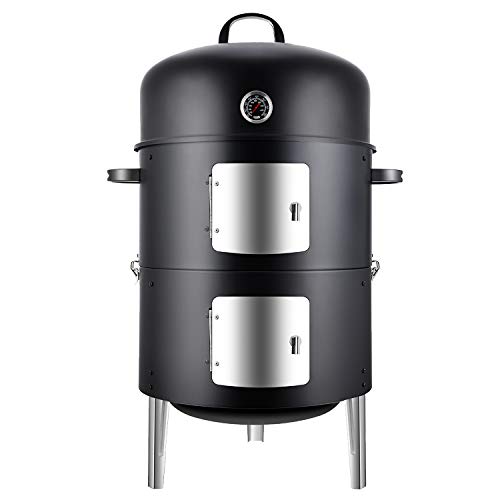
4. Realcook 17 inch Vertical Charcoal Smoker
A bullet-style charcoal smoker with a water pan and stacked racks. It is a more compact choice than electric cabinets.
Suits: charcoal fans. Strengths: a smaller footprint. Weaknesses: needs hands-on fire management. Skip it if you want to set it and forget it.

Best for consistent smoke
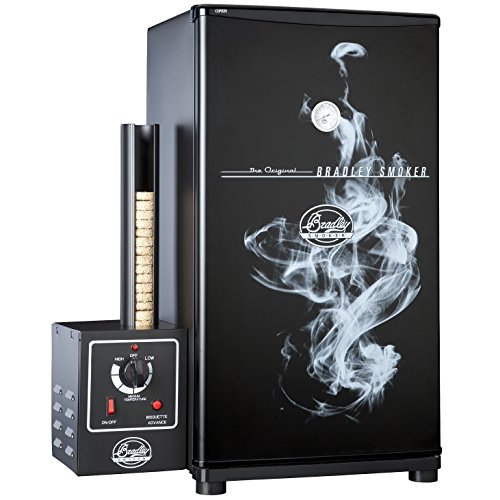
5. Bradley Original Smoker
An electric smoker that uses compressed wood bisquettes to generate smoke through a separate generator. It is known for steady, repeatable smoke.
Suits: consistent smoke. Strengths: a bisquette-fed generator. Weaknesses: bisquettes are specific to the brand. Skip it if you want to use ordinary chips.
Best for patio cooks
6. Camp Chef Smoke Vault 24
A larger propane-driven vertical smoker with a front door and a built-in thermometer, used by backyard cooks who want less hands-on work.
Suits: patio cooks. Strengths: propane convenience. Weaknesses: bulkier than small bullets. Skip it if you want electric simplicity.
View Camp Chef Smoke Vault 24 on Amazon
Care and Setup
- Season the smoker before the first cook as the manual describes.
- Use wood chips or chunks recommended by the maker.
- Clean grease and ash after each use to avoid flare-ups.
- Cover the unit with a fitted cover to protect it from the weather.
- Use a separate thermometer for the food itself.
- Pull the water pan, if there is one, and discard old water after each session.
Mistakes to Avoid
- Adding too much wood so the smoke turns bitter.
- Opening the door repeatedly.
- Overloading the racks so air cannot move.
- Cooking at too low a temperature for food safety.
- Forgetting to check that the power supply suits an electric unit.
- Using the smoker on a wooden deck without a heat-safe mat underneath.
Choosing Your Heat Source: Electric, Charcoal or Propane
The fuel decides how much attention a smoker demands and what flavor you get, so settle it before comparing models. Electric smokers use a heating element and a thermostat, which means steady temperatures with little tending. They suit beginners, people who want to cook while doing other things and places where charcoal is not allowed. They need a nearby outdoor outlet, and they usually produce a milder smoke flavor than a live fire, though good wood use helps.
Charcoal smokers give a deeper, more traditional flavor and do not need electricity, but you must manage the fire. That means lighting charcoal, controlling the air vents, and adding fuel as the cook goes on. It is a skill that rewards practice. Propane smokers give the convenience of a gas flame with a knob to adjust heat, and they use a wood chip tray for smoke. They need gas supply and safe storage of the cylinder, and a hose and regulator need checking.
- Choose electric if you want ease and predictable results.
- Choose charcoal if you enjoy tending a fire and want classic flavor.
- Choose propane if you want less hands-on work than charcoal and have a safe place to store fuel.
- Bisquette-fed designs trade ordinary chips for a specific fuel, so check whether replacements are easy to find.
Consider the conditions where you will cook. Wind, cold and rain all affect temperature control, and some fuels cope better than others. Local fire rules may also apply to outdoor cooking.
Space, Placement and Power Planning
A smoker must stand outdoors in a spot that is safe, level and sheltered from the worst of the weather. Never run any smoker in a garage, shed, tent or under a covered porch where smoke and carbon monoxide can build up. Keep it a safe distance from house walls, fences, overhanging branches and anything else that can burn, and follow the clearances in the manual. A flat, non-flammable surface such as concrete or paving is better than wood decking, and a heat-safe mat adds protection if you must use a deck.
Think about your outdoor space in practical terms. Vertical cabinet smokers have a small footprint but are tall, and they need room to open the door fully. Bullet smokers are narrow and round, and they need room to lift the lid and reach the fuel. Make sure there is room to stand and work, and a path that keeps children and pets away from the hot surface.
- For electric models, check the cord length and whether an outdoor-rated extension cord is needed, and use a protected outdoor outlet.
- For propane models, check the hose for cracks before each use and test for leaks as the manual says.
- For charcoal models, plan a way to dispose of ash safely once it has cooled fully.
- Check how heavy the smoker is and whether it has wheels or handles for moving.
Measure the space where you will store it, too. A fitted cover protects it from weather but is not a substitute for dry storage in harsh seasons.
Temperature Control, Thermometers and Food Safety
Smoking works at low temperatures over a long time, which is exactly why food safety deserves attention. Built-in dial or digital thermometers on small smokers can be off, and they measure the air near the sensor, not the temperature at your food. Use a separate leave-in probe thermometer in the thickest part of the meat to track the real internal temperature, and a second one at grate level if you want to know the cooking chamber temperature.
Food-safety guidance from your local authority gives safe internal temperatures for meat, poultry and fish, and those apply to smoking as well. Do not rely on color or the smoke ring as a sign of doneness. Avoid leaving perishable food in a low temperature range for long, and start with cold food straight from the fridge, not something that has been sitting out. Cook to temperature, not just time, since weather, load and fuel all change the schedule.
- Preheat the smoker before loading food, so it is already at its working temperature.
- Avoid opening the door often, since every opening drops heat and extends the cook.
- Leave space between items so heat and smoke can circulate.
- Expect a stall, where the temperature seems to stop climbing for a while on larger cuts, and wait it out rather than raising heat dramatically.
- Rest meat after cooking and chill leftovers promptly in shallow containers.
Keep notes on each cook, including weather, fuel, time and result, so you can repeat the successes.
Wood, Smoke Quality and Flavor Control
Good smoke is thin and almost blue, and it smells pleasant. Thick white smoke that billows from the vents is a sign of a smoldering fire that can make food bitter or acrid. For the best result, give the fire enough air and use dry, clean wood intended for cooking. Do not use treated, painted or resinous wood, and avoid anything that has been exposed to chemicals.
Different woods give different flavor strengths. Fruit woods tend to be milder and slightly sweet, while hickory and oak are stronger and more traditional for red meat. Use mild woods for fish, poultry and cheese, and stronger ones for beef and pork. Start with a small amount and add more on later cooks if you want stronger flavor, since too much smoke is a common beginner mistake. Chips burn quickly and suit short cooks, whereas chunks last longer, which suits long cooks on charcoal. Always follow the maker’s instructions on chip trays and wood size.
- Soaking chips is a matter of debate, and the maker’s manual is the best guide for your model.
- Add wood early, because meat takes up smoke mostly at the start of the cook.
- Keep wood dry and in a sealed container.
- Use a water pan if your smoker has one, to help with moisture and steadiness, and refill it if it runs low.
Seasoning is part of the process. Running the smoker empty before the first cook, as the manual describes, burns off residues from manufacturing and builds a protective layer in the chamber.
Cleaning, Weatherproofing and Knowing When to Replace
Smokers collect grease, ash and creosote, which can turn into a fire risk or give food a bad taste if neglected. After each cook, let the unit cool, then empty ash and grease trays and wipe down the racks. Clean the grates with a brush and warm soapy water when needed. Wipe the inside walls gently, but avoid scraping off the dark seasoning layer on the inner surfaces that many makers consider normal. For electric models, keep water away from the controls and the element, and unplug the unit before cleaning.
Weather protection extends life. Use a fitted cover, store the smoker out of the rain and keep it off wet ground. Check seals and door gaskets, which can wear and let smoke and heat leak. Look at hinges, latches, legs and handles for rust or looseness, and tighten bolts when needed.
- Replace a smoker with a rusted-through firebox, a corroded body that leaks smoke, a failed heating element or damaged wiring.
- Do not repair a damaged electric cord or a faulty gas hose yourself, and replace them using the maker’s recommended parts.
- Check the warranty and the availability of spare parts, such as elements, racks, gaskets and thermometers.
As for budget tiers, simpler models cost less and use thinner steel, which loses heat faster and wears sooner, especially in cold or windy places. Mid-range models usually add better seals, digital controls and sturdier racks. Higher-priced designs use thicker walls, better insulation and more precise control, though you should confirm these details on the listing. Choose the tier that fits how often you cook and the weather where you live.
Electric, Charcoal and Gas: Matching Fuel to Your Habits
Small smokers come in three main fuel styles, and each fits a different temperament. Electric models are the most hands-off, since a thermostat holds a steady temperature and you mostly add wood chips. Charcoal smokers give a classic flavor and an involved experience, but they ask for more attention to airflow and fuel. Gas models light easily and hold temperature well, as long as you have a safe place for the propane tank. Think about how much time you want to spend tending the fire.
- Electric: steady and simple, needs a nearby outlet.
- Charcoal: rich flavor, takes practice with vents.
- Gas: quick to light, needs a fuel tank.
- All three: need outdoor space and clear access.
Space, Capacity and Rack Layout
A small smoker still needs room to breathe. Measure your patio or balcony, check any building rules about open flame or smoke, and leave clearance around the unit. Capacity is described by rack area, and the number of racks affects how many items fit. Remember that a full smoker needs airflow around the food, so crowding the racks can slow the cook. Check the height between racks if you want to smoke a whole chicken or a tall cut.
| What you cook | Layout to look for |
|---|---|
| Sausages and fish | Several shallow racks |
| Chicken or small roasts | Taller space between racks |
| Ribs | Wide racks or rib holders |
| Family cooks | More racks and a larger body |
Food Safety and Maintenance Notes
Smoking is a low and slow method, so follow official food safety guidance for temperatures and holding times, and use a reliable probe thermometer to check the food itself. Do not guess by color or smoke ring. Keep raw and cooked foods apart, and wash hands and tools between steps.
After the cook, let the smoker cool fully, empty ash or wood residue and wipe grease from racks and the drip tray. Grease buildup is a fire risk and can taste stale, so clean regularly as the manual describes. Cover the smoker between uses and store fuel in a dry, safe place, away from heat and children. If anything about gas lines, fittings or electrical parts looks damaged, stop using the unit and contact a qualified professional.
Quick Checklist for Choosing a Small Smoker
Because small smokers vary widely, a checklist keeps the choice practical. Think about your favorite foods, the weather where you live and how long you are willing to wait for a cook. Smoking is a slow process, so a model that holds temperature well makes a difference to your weekend.
- Pick the fuel type you can store and handle comfortably.
- Check the footprint and the clearance needed around it.
- Look for a door or lid that seals well and opens easily.
- Find out whether a thermometer is included and where it sits.
- Read about how to add wood chips or pellets during a cook.
- See how the grease tray is removed and cleaned.
Learning is part of the fun. Keep notes on what you cooked, which wood you used and how long it took, and adjust next time. A simple log turns guesswork into a repeatable method.
Small Smoker FAQ
Are electric smokers easier than charcoal?
Yes. Electric units hold a steady temperature with little input, while charcoal needs more attention.
Can I smoke in cold weather?
Yes, but expect longer cooks and more fuel use. A smoker blanket or sheltered spot may help.
What wood should I use?
Fruit woods and hickory are common. Use wood from a trusted source meant for cooking.
How small is small?
Compact smokers are generally tall and narrow with two to four racks. Check the listing for the exact rack area.
Do I need to season a new smoker?
Most makers recommend it. You usually run the empty smoker at a set temperature for a time, sometimes with a coat of oil on the interior surfaces. Follow the manual for your model, as methods differ.
What internal temperature should smoked meat reach?
Follow food-safety guidance from your local authority for the meat you are cooking, since targets differ by type. Use a probe thermometer in the thickest part rather than judging by color or time.
Why does my smoked food taste bitter?
Too much smoke, a smoldering fire with thick white smoke, or dirty chamber walls are common causes. Use less wood, give the fire more air and keep the smoker clean. Cleaner, thin smoke gives a milder flavor.
Can I smoke cheese or fish in a small smoker?
Many people do, but these foods need low temperatures and careful food-safety handling. Check reliable instructions for the specific food, and be aware that a small smoker may run hotter than the food can take.
How often should I add wood chips?
It depends on the smoker and the size of the chips, so follow the manual. Chips burn out fairly quickly in an electric tray, and chunks last longer on charcoal. Most of the smoke flavor goes onto the food in the early part of the cook.
Is it safe to smoke in the rain?
Rain can lower the temperature and dampen fuel, and electric units must be kept dry and protected. Use a sheltered spot that is open to air, away from buildings and overhangs, and follow the manual. Never use a smoker in an enclosed space.
Should I use a water pan?
If your smoker has one, it helps even out heat and adds moisture. Fill it as the manual advises and top it up on long cooks. Empty and clean it after use.
How long does a smoker last?
It depends on the build, the weather and the care it gets. Cleaning, covering and storing it properly help a lot. Check the warranty and parts availability on the listing.
The Short Version
For a beginner electric, the Masterbuilt. For a window, the Char-Broil. For a plain thermostat, the Smoke Hollow. For compact charcoal, the Realcook. For steady smoke, the Bradley. For propane, the Camp Chef Smoke Vault 24.
Choosing for Beginners and small-space cooks choosing their first compact smoker
This guide is written for beginners and small-space cooks choosing their first compact smoker. A first smoker should teach you the craft without punishing you, and a small smoker should fit the outdoor space you actually have. Fuel style, chamber shape and how much attention a long cook demands are the decisions that matter, in that order. This guide keeps the focus on those fundamentals, so you can choose a smoker that matches your patience as well as your patio.
That focus shapes how to read everything that follows. When a section describes a trade-off, weigh it against your own week rather than against an ideal kitchen: your space, your schedule, your tolerance for cleaning and the people you actually cook for. A smoker that fits that reality will be used constantly and without resentment, which is the only definition of a good buy that matters once the novelty wears off.
How the Picks in This Guide Compare, Side by Side
With the criteria above in mind, the picks in this guide separate more clearly than a feature list suggests. Each smoker below was already reviewed on its own terms earlier in this guide; what follows compares them only on what the original reviews themselves state, so you can match a pick to your own priorities without re-reading the whole page.
Masterbuilt Digital Electric Smoker 30 inch. The original review positions this pick for beginners. Its stated strength is digital controls and an external chip loader, and its honest limitation is a larger body than other picks. That combination makes it the natural choice when the strength answers your main problem, and a poor fit when the limitation touches something you do every day. The review’s own advice is to skip it if you need the tiniest size.
Char-Broil Deluxe Digital Electric Smoker. Choose this one for people who want a window to check food, according to the review above. What it does best is a clear view without opening the door; what it does least well is fewer controls than premium units. In practice that trade-off is worth accepting if your routine plays to the strength, and worth avoiding if your routine runs straight into the weakness. The review’s own advice is to skip it if you want charcoal flavor.
Smoke Hollow 26142E Electric Smoker. This pick suits patios. The review credits it with a simple electric setup, while noting thermostat accuracy varies as the drawback to weigh. Read against the other picks, it is the option for a buyer who values the strength highly enough to plan around the drawback. The review’s own advice is to skip it if you want a digital display.
Realcook 17 inch Vertical Charcoal Smoker. The original review positions this pick for charcoal fans. Its stated strength is a smaller footprint, and its honest limitation is needs hands-on fire management. That combination makes it the natural choice when the strength answers your main problem, and a poor fit when the limitation touches something you do every day. The review’s own advice is to skip it if you want to set it and forget it.
Bradley Original Smoker. Choose this one for consistent smoke, according to the review above. What it does best is a bisquette-fed generator; what it does least well is bisquettes are specific to the brand. In practice that trade-off is worth accepting if your routine plays to the strength, and worth avoiding if your routine runs straight into the weakness. The review’s own advice is to skip it if you want to use ordinary chips.
Camp Chef Smoke Vault 24. This pick suits patio cooks. The review credits it with propane convenience, while noting bulkier than small bullets as the drawback to weigh. Read against the other picks, it is the option for a buyer who values the strength highly enough to plan around the drawback. The review’s own advice is to skip it if you want electric simplicity.
Two patterns are worth noticing across the list. First, the picks rarely differ by being better or worse overall; they differ by which job they put first, which is why the right choice follows from your routine rather than from any ranking. Second, the limitations are mostly about fit: size against your space, capacity against your batch, or a missing method against a dish you cook often. If a limitation does not touch your life, it is not a reason to reject the pick, and if a strength does not serve your routine, it is not a reason to choose it. Buy for the life you have, and the smoker will feel well chosen every time you use it.
Fuel Style Decides Your Day: Pellets, Chips, Chunks and Charcoal
Small smokers differ first in how they make heat and smoke, and that decides how you spend the cook. Pellet models feed fuel automatically and hold temperature with little attention, suiting cooks who want to set up and check occasionally. Electric models use an element with chips or chunks and are similarly steady. Charcoal and wood models ask more of you in fire management and give, in many cooks’ judgment, the deepest smoke character. There is no universal winner: there is the amount of involvement you honestly enjoy, matched to the flavor style you prefer.
Think about fuel logistics too. Pellets need dry storage and a supply of the blend you like; chips and chunks are easy to store in small amounts; charcoal takes space and makes ash. A smoker whose fuel is a chore to source in your area will be used less, whatever its other virtues.
Capacity in Racks, Ribs and Real Cuts
Judge capacity by the cuts you cook, laid out the way you cook them. A rack of ribs needs length, a chicken needs height, and several smaller items need shelf area with room for air and smoke to move between them. Compact smokers can hold more than they appear to when shelves are used well, but crowding has a cost: blocked airflow, uneven smoke and dripping from one layer onto another. Plan shelf order as part of the recipe, with the food that can take drips above the food that cannot, and leave yourself a way to reach each layer without dismantling the cook.
Temperature Control, Probes and Trusting the Readout
Low-and-slow cooking lives or dies on temperature, both in the chamber and in the meat. Built-in dials and displays are useful guides, but experienced cooks verify with a separate thermometer, because a lid thermometer reads its own spot, not the shelf where the food sits. Learn your smoker’s habits: how much it overshoots when lit, how it behaves in wind, and how far the shelf temperature sits from the display. That knowledge, written down after a few cooks, is worth more than any specification.
- Cook to internal temperature and tenderness, not to the clock alone.
- Keep a cook log: fuel, weather, times, temperatures and the result.
- Allow more time than the recipe suggests, and hold finished food safely rather than rushing it.
- Open the lid as little as possible; every look costs heat and time.
Smoke Quality: Thin, Clean and Patient
Good smoke is thin and clean-smelling; thick, white, billowing smoke usually means a fire that is smoldering badly, and it can leave food harsh and bitter. Give a new fire time to settle before the food goes in, keep vents arranged as the manual directs so smoke flows through rather than stagnating, and remember that most smoke flavor is absorbed early, while the meat is cool and its surface is moist. More wood is rarely the answer to weak flavor; better fire management usually is.
Grease, Ash and Safe Placement
Smokers drip grease and produce ash or spent fuel, and both need a plan. Use drip trays as the maker intends, clean grease before it builds into a fire risk, and dispose of ash only when it is completely cold, in a metal container. Place the smoker outdoors on a stable, non-flammable surface with the maker’s clearances, away from siding and overhangs, and never in a garage or enclosed space. Check local rules and, in an apartment setting, building rules before assuming a smoker is allowed at all.
More Smoker Questions, Answered
How long will a small cut take to smoke?
Honest answers are ranges, because thickness, starting temperature, chamber temperature and weather all change the timing. Use recipes as a guide, verify with a thermometer, and judge tenderness by how the food feels and probes, not only by temperature. Planning a finishing window rather than a precise serving minute makes the whole cook calmer.
Why is my bark or exterior not forming well?
Bark needs time, surface seasoning and a surface that is not steaming in foil or liquid too early. Wrapping can be a useful technique, but wrapping too soon softens the exterior you worked to build. Also check that your chamber temperature is genuinely where you think it is; a cool-running smoker delays everything, including the bark.
Can I smoke in cold or windy weather?
Yes, with adjustments. Wind steals heat and can push temperatures around, and cold air lengthens every stage. Shelter the smoker from wind without enclosing it, allow extra fuel and time, and open the lid even less than usual. Verify temperatures with a thermometer rather than trusting settings calibrated by a calm summer day.
What wood should a beginner start with?
Start with a widely liked, moderate wood suited to the meat you cook most: fruit woods are commonly described as milder for poultry and pork, while stronger woods are traditional for beef. Use one wood at a time while you learn, keep notes, and change gradually. Avoid wood that is painted, treated or of unknown origin, and use only fuel the maker approves for your smoker.
How do I clean a smoker without ruining the seasoning inside?
Remove ash and grease, wash racks and trays, and wipe loose residue from the interior, but do not strip the chamber back to bare metal unless the maker instructs it: the darkened interior is part of how the smoker cooks. The line to hold is grease and loose debris, which are fire and flavor risks, versus the cured surface, which is not.
When Something Goes Wrong: A Calm Troubleshooting Order
Every smoker misbehaves eventually, and the order in which you check things decides whether you find a simple cause or chase a phantom fault. Start with the unglamorous basics, because they explain most problems: the plug, the socket, the power switch, and whether the appliance is assembled exactly as the manual shows, with every part seated and every lid, door or basket properly closed. Many modern appliances refuse to start when one part sits slightly wrong, and that refusal is a safety feature doing its job, not a breakdown.
Next, check cleanliness and placement. Blocked vents, crumb-filled trays, greasy seals, overfilled chambers and appliances pushed tight against a wall all produce symptoms that look like faults: weak performance, odd smells, unexpected shut-offs, uneven results. Clean and reposition the smoker, let it cool or rest as the manual directs, and try the simplest job you know well. If it performs that job correctly, the appliance is probably fine and the earlier problem was in the setup, the load or the recipe.
Only then consult the manual’s troubleshooting section, which is written for your exact model and often lists the cause in one line. Keep a note of what you tried and what changed, because that note is gold if you later contact the maker or a repairer. And know the stopping rules: a damaged cord, a cracked safety part, sparks, a strong electrical smell, or a fault that repeats after cleaning and resetting are all reasons to stop using the smoker and contact the maker, not reasons to try once more with your fingers crossed.
- Change one thing at a time, so you learn which change fixed the problem.
- Test with a familiar, simple job before judging the appliance on a new recipe.
- Check whether the problem follows the food, the setting or the appliance itself.
- Keep proof of purchase and the model details with the manual for any support conversation.
Settling In: The First Month of Ownership
The first month with a new smoker sets the pattern for its whole life in your kitchen. In the first week, use it for familiar jobs and stay nearby, learning its sounds, its timing and the way its controls behave when your hands are full. In the second week, try the job you actually bought it for, with your notes from the first week open. By the third and fourth weeks, most owners have a short list of regular uses and a realistic sense of what the appliance will not be asked to do again, and both lists are valuable.
Resist two early mistakes. The first is judging the smoker by an ambitious first attempt: an unfamiliar recipe in an unfamiliar appliance has two chances to go wrong, and neither proves much. The second is neglecting the small maintenance the manual describes because everything is new; habits formed in the first month, such as wiping, drying and storing parts properly, are the ones that keep the appliance pleasant in its second year. A modest routine, repeated, beats an occasional deep effort every time.
Buying Mistakes This Guide Can Help You Avoid
Some mistakes repeat across every category of kitchen appliance, and smoker buyers make all of them. The first is buying for an imagined life: the daily bread baker, the weekly host, the batch cook, when the real life is quicker and simpler. The second is treating the largest or most featured option as the safest choice, when in a small kitchen the safest choice is the one that fits the space, the routine and the washing up. The third is ignoring the manual until something goes wrong, when ten minutes with it on the first day would have prevented the problem entirely.
The fourth mistake is subtler: keeping an appliance that does not suit you because returning or replacing it feels like admitting defeat. A smoker that fights your routine will be used less each month until it is furniture. It is better to recognize a mismatch early, while your options are open, than to spend years working around the wrong tool. The reviews and comparisons in this guide are written to surface those mismatches before the purchase, in plain language about who each pick suits and who should skip it, so take those lines seriously: they are the most honest sentences on the page.
A Short Decision Worksheet Before You Order
Before you order any smoker, spend five minutes on paper with the questions that actually decide satisfaction. First, write down the three jobs you will ask of it most often, in order. Second, write down the space it will live in, with the measurements or limits that space imposes, including access, clearance and any rules your building or household sets. Third, write down the cleaning you are honestly willing to do after a normal use, not after a special occasion. Those three short lists eliminate more wrong purchases than any amount of feature comparison.
Then read the reviews in this guide again with your lists open. For each pick, ask whether its stated strength serves your first job, whether its stated limitation collides with your space or your cleaning tolerance, and whether anything in its description assumes a habit you do not have. The right smoker is usually obvious after that exercise, and if two picks remain tied, choose the one that is simpler to live with: simpler controls, fewer parts, easier cleaning. In small kitchens and busy households, the smokers that get used for years are the ones that ask the least of you on an ordinary day.
- Keep the manual and your own notes together, in the kitchen, not in a drawer in another room.
- After the first week, write down the one thing that surprised you; it is usually the thing a listing never mentioned.
- If a pick needs an accessory to do your main job, count that accessory as part of the decision from the start.
- Check the maker’s returns and support information before you buy, while you still have the choice.
Companion Tools: What Helps, and What You Can Skip
A new smoker often triggers a basket of accessories, most of which a small kitchen does not need. The genuinely useful companions are boring and cheap: a reliable food thermometer for any cooking appliance, heat-resistant gloves or pads sized for your hands, a trivet or board that protects your worktop, and containers that suit the leftovers your household actually produces. For cold appliances, a simple appliance thermometer is the companion that matters, because it turns temperature from a dial position into a fact you can check.
Everything else should earn its place by solving a problem you have already met. Buy the extra rack, basket, liner or lid only after the basic setup has frustrated you in a specific way, not in anticipation of a frustration a listing predicts for you. Accessories bought for a routine you do not have become cupboard clutter, and in a small kitchen clutter is a real cost: it buries the tools you use daily. One careful addition after a month of ownership is worth five speculative ones on the first day.
Living With It Long Term: Care, Spares and Knowing When to Replace
The difference between a smoker that serves for years and one that fades in a season is usually a handful of small habits rather than luck. Keep it clean little and often, dry parts fully before storage, treat seals, coatings and moving parts gently, and fix small issues while they are small: a tired gasket, a wobbling foot, a lid that has started to sit oddly. Check occasionally whether the maker sells the spares your model will eventually need, because a smoker with available spares is a repairable appliance, while one without them is a disposable one waiting for its first worn part.
Replacement has clear triggers, and they are mostly about safety and trust rather than age. Retire a smoker whose cord or plug is damaged, whose safety parts no longer work as the manual describes, whose temperature or timing has become unreliable in ways cleaning does not fix, or whose damaged surfaces shed material or harbor grime you cannot remove. When that day comes, your notes from ownership are the best buying guide for its successor: you will know exactly which of the smokers in a guide like this one suits the life you actually lived with the old one.
Three Habits That Pay Off Immediately
Whatever smoker you choose from this guide, three habits improve results from the very first week. First, read the manual’s safety and cleaning pages before the first use, not after the first problem. Second, keep a small notebook or phone note for settings, times and results, because your own records for your own model beat any general chart. Third, clean and dry the parts you used on the same day, while the job takes a minute, rather than at the weekend, when it takes a soak and a scrub.
A Final Note on Expectations
No smoker does everything, and the honest reviews above say so plainly, pick by pick. Set your expectations by the job you bought it for, judge it after a fair first month of ordinary use rather than after one ambitious attempt, and let your own notes, not novelty, decide whether it has earned its place. An appliance that does its main job well, cleans without a fight and fits the space you have is a successful purchase, even if another model somewhere does a different job better.