Disclosure: As an Amazon Associate, airfryerkitchensupply.com earns from qualifying purchases. Links on this page are affiliate links; they cost you nothing extra. Prices and availability change often, so check the current Amazon listing before you buy.
Every garden bench is a bargain struck with the weather, and this page itemises both sides of that bargain without salesmanship. The pros are real: a bench changes how a garden is used, asks almost nothing to run, and can serve for decades. The cons are equally real: nothing outdoors stays new, comfort is narrower than the photographs suggest, and a badly sited bench becomes a large, permanent reminder of a hasty afternoon. What follows separates the advantages that survive contact with real gardens from the disadvantages that can be designed away, bought away, or simply accepted with open eyes.
Key Takeaways
Best for: a undecided buyer who wants the trade-offs stated as trade-offs — each pro beside the con that pays for it, each con beside its mitigation or its honest price. Not suited for: anyone seeking permission to stop thinking, because the verdict here is conditional: a bench is worth its cons when its pros match your routines and its worst con lands somewhere you can manage. Read the ledger in pairs. A destination in the garden, paid for with permanence. Simplicity, paid for with exposure. Longevity, paid for with maintenance. The pairs never split; you buy both sides or neither.
In this guide
The Pros, Explained Properly
Pro: a bench manufactures a destination, and destinations change behaviour out of all proportion to their cost. Gardens with a seat at the end of a path get walked more, weeded more evenly, and noticed more — owners consistently report that beds near the bench are the best-kept beds they own. This is the deepest pro on the list because it compounds: the bench improves the garden, the improved garden rewards sitting, and the sitting reveals the next improvement. No other single piece of garden furniture, at any price, reliably starts that flywheel. State the trade in the household’s own words before buying — we accept the oiling, we accept the weight, we accept the plainness — because a con that has been spoken aloud rarely returns later dressed as a surprise.
Pro: a bench is radically simple to own. It consumes nothing, connects to nothing, and asks for no subscription, fuel or winterising beyond its material’s small routine. In a garden increasingly filled with pumps, timers, lights and batteries, the bench’s analogue nature is a genuine advantage — it cannot become obsolete, its interface is sitting, and its failure modes are visible to the naked eye months before they matter. For households tired of maintaining machines, a bench is the rare purchase that reduces the total stock of things that can beep, leak or expire. The ledger also runs in the other direction over time: most pros strengthen as planting grows around a bench, while most cons, properly mitigated at setup, stay exactly as small as they were on day one.
Pro: a good bench is repairable in a way modern products rarely are. A split slat is a board, a tired finish is an afternoon, a loose joint is a bolt — the skills and materials live in any hardware shop, and the bench does not care who made the replacement part. That repairability converts directly into longevity and into value: the bench’s life is not set by its weakest sealed component but renewed, piece by piece, by its owner. Buyers who value keeping things over replacing them will find few garden purchases that cooperate as willingly. When a con cannot be mitigated and cannot be accepted, treat it as a veto rather than a challenge, because gardens are long and a resented object in daily view taxes its owners out of all proportion to its price.
The Cons, Stated Plainly
Con: nothing outdoors is weatherproof, and the bench’s exposure is total. Timber silvers, checks and eventually softens at damp joints; coatings chip and admit rust at exactly the points hands and tools strike; even recycled-plastic boards collect algae in shade and grime in their grain. This is not a defect of particular benches but the physics of the category, and any buying decision that does not budget for visible ageing is a decision to be disappointed on a schedule. The only choice on offer is which kind of ageing you find beautiful, tolerable or unacceptable. Notice which side of the ledger your eye reads first in a showroom; buyers who read only the pros are shopping, while buyers who read the cons and buy anyway are choosing, and the second group writes the satisfied reviews.
Con: bench comfort is honest but narrow. A bench offers one posture — upright, shared, interruptible — and it offers that posture at one height and depth to every body that sits on it. It will not recline for the reader, cradle the bad back, or adjust for the tall teenager and the small grandparent on the same afternoon. Households whose outdoor dream is lounging will find a bench a polite disappointment no cushion fully cures. The con is manageable — buy the bench for sitting and other furniture for sprawling — but it must be admitted before purchase, not discovered after. A con shared by every bench in the category — ageing, exposure, the single posture — should not be counted against any one model, only against the idea of the purchase itself, which is the honest comparison to make.
Con: a bench is semi-permanent in the worst way when it is wrong. It is too heavy to rearrange casually, too visible to ignore, and too useful-looking to throw away, so a misplaced bench can squat in a garden for years as a monument to a decision nobody wants to revisit. The same permanence is a pro when the placement is right, which is precisely the trade: the bench amplifies the quality of the original decision, good or bad. Gardens forgive a misplaced pot in a weekend. A misplaced bench collects apologies every time somebody walks past it. The fairest test of a trade-off is the replacement question: if this bench vanished, would you rebuy the same bundle of pros and cons? A yes settles the ledger more completely than any list, including this one.
What the Trade-Offs Mean for You
For daily sitters — the coffee-at-dawn, pause-at-dusk household — the pros dominate and it is not close. The destination effect and the zero running cost pay out every single day, while the cons arrive on a seasonal schedule that a modest routine keeps trivial. For occasional sitters, the arithmetic inverts: the bench’s pros visit monthly while its cons — the space it occupies, the ageing it displays, the maintenance it requests — are present continuously. The same bench is a bargain in one garden and a burden in the other, and the difference is a calendar, not a catalogue. Keep the autumn service in the diary as a named appointment rather than an intention, because in this ledger the difference between a small con and a large one is usually a single kept or missed hour.
For small gardens the trade-offs sharpen. The pro of a focal point becomes the con of a dominant object; the pro of permanence becomes the con of inflexibility in a plot that must serve as dining room, play space and vegetable garden by turns. Small-plot buyers should weight dual-purpose designs and honest measurements more heavily than any other group, because their bench’s cons are measured in a currency — space — that they have least of. A small garden does not forbid a bench; it forbids a careless one. And remember that the household’s temperament is itself a line in the ledger — a family that enjoys keeping things will experience half these cons as hobbies, which is not self-deception but a genuine difference in cost.
For households with children, older relatives or dogs, the ledger gains entries on both sides. Pro: a bench serves every generation at once, in a way a lounger or a dining set cannot, and becomes the garden’s natural gathering geometry. Con: it will be climbed on, pushed against, slept under and leaned on at angles its designer never drew, so fragility — thin arms, delicate finishes, tippy lightness — is punished faster here than anywhere. In these households the right trade is obvious: surrender some elegance, buy mass and rounded edges, and let the bench be furniture and equipment at once.
How to Buy Smart and Reduce the Cons
Most cons on this page shrink dramatically under three cheap disciplines. The first is siting: level, firm, drained ground with shelter removes the wobble, the rot and half the weather damage before the bench arrives. The second is the early service: fixings re-checked after the first month, chips touched up while they are chips, water traps known and cleared. The third is expectation: choosing the material whose ageing you like, so that year three looks like character rather than decline. None of these costs much money. All three are cheaper than the regret they prevent.
Some cons, however, should be bought away rather than managed. If your household will never oil timber, the correct move is not resolve but recycled-plastic lumber. If your site is soft and sloping and cannot be levelled, the correct move is a heavy bench or a prepared base, not hope. If your sitters need real back support for long sessions, the correct move is to admit a bench is the wrong tool and buy chairs with the money. The mature purchase is the one that routes around your known weaknesses instead of betting the bench that this time will be different.
The pros, symmetrically, can be maximised by placement rather than spending. A modest bench where the household already pauses will out-perform a magnificent bench in a beauty spot on every measure that matters — use, pleasure, value, even appearance, since a used bench looks intentional and an unused one looks like a stage set. Before upgrading a model, upgrade the spot in your imagination: nearer the door, in the morning sun, beside the bed you work most. In this category, geography beats budget with a consistency that should embarrass anyone who shops by price alone.
Garden bench pros and cons: The Picks in Prose
The six benches below are read here as bundles of trade-offs — the pro each family leads with, the con it cannot escape, and the buyer for whom that exchange is fair. Confirm current finishes and hardware on the listing before deciding.

Achla Designs Garden Bench
Achla Designs-style metalwork leads with presence: it gives a border a finished, traditional focal point the day it arrives, and its frame asks little structurally for years. Its unavoidable con is touch — metal runs hot in sun and cold in shade, and decorative work collects the garden’s debris. Best for: a shaded, formal spot judged by looks. Not suited for: sun-baked terraces or owners who hate brushing out scrollwork.
The exchange, stated fairly, is small regular attentions for a large visual return. The coating will chip where life knocks it, and each chip is a two-minute repair or the seed of a rust patch — there is no third option. Buyers who accept that rhythm call the bench easy; buyers who wanted a fit-and-forget object call the identical bench needy. The product is constant. The fairness of the trade depends entirely on which owner you are, which is this family’s whole lesson.

Plow & Hearth Cast Iron Garden Bench
Plow & Hearth-style cast iron and hardwood leads with permanence: mass that anchors itself, slats that can be renewed, a frame with heirloom ambitions. Its unavoidable con is that everything about it is heavy — delivery, placement, the decision to move it, the mark it can leave on soft ground. Best for: a final-answer spot in a settled garden. Not suited for: evolving layouts, renters, or weak decks.
Its second con is the timber bargain: the slats that make it comfortable and handsome are the part that weathers, silvers and eventually needs replacing, so ownership includes a slow, predictable renewal cycle. Set against the pro — a frame still true when the second set of slats is fitted — most owners judge the exchange generous. The buyers who regret it are those who wanted the permanence without the partnership; this bench asks to be kept, and rewards exactly that.

Best Choice Products Outdoor Garden Bench
Best Choice Products-tier steel leads with accessibility: a real bench, in a real garden, at the lowest commitment the category offers, light enough to experiment with position. Its unavoidable con is lifespan at the details — coatings and fixings in this tier meet their weather sooner, and joints ask for more frequent attention. Best for: learning a garden’s habits. Not suited for: a buy-it-for-life brief in a harsh climate.
The fair reading of this trade is that the con is a schedule, not a scandal. Bought with eyes open — as a first bench, a rental’s bench, a few seasons of discovery — the exchange is honest and the value real. Bought as an heirloom, the same bench becomes a disappointment with a date on it. Pros and cons are not properties of objects alone; they are properties of the match between object and expectation, and nowhere in the six is that clearer than here.
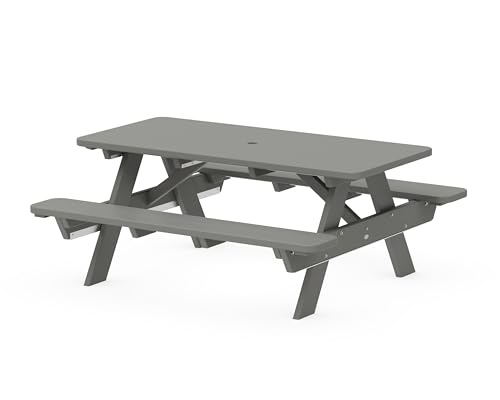
POLYWOOD Park Bench
POLYWOOD-style recycled-plastic lumber leads with the shortest con list in the category for upkeep: no sealing, no rust, no rot, a wash for algae. Its unavoidable cons are aesthetic and sensory — boards that do not mellow or gather patina, a feel some sitters call plain, and a weight that surprises buyers expecting light plastic. Best for: damp, shaded, coastal or communal sites. Not suited for: a scheme that wants furniture to age visibly.
Its subtler con is permanence of a different kind: the colour and character it arrives with are the colour and character it keeps, so a choice made carelessly cannot be softened by time or paint the way timber forgives. Against that stands a pro owners repeat like a refrain — it asks nothing — and in households where attention is the scarcest resource, that single pro outweighs every aesthetic con on this page. Judge by your scarcest resource: time, money or beauty, in that order of honesty.

Yaheetech Wooden Garden Bench
Yaheetech-style slatted timber leads with warmth — the bench visitors choose first, kind to bare legs in every season, at home against planting and paving alike. Its unavoidable con is appetite: timber in this tier wants feeding with oil or sealant on a rhythm, drinks water at its end grain, and shows every skipped season on its face. Best for: a sheltered porch and a willing keeper. Not suited for: exposed wet corners or absent owners.
The pro that redeems the con is repairability with ordinary skills: a slat can be sanded, oiled, or swapped with a matching board and basic tools, so decline is never a verdict, only a task. Households divide cleanly on this family — those who experience the care as gardening and those who experience it as housework — and the bench thrives or fades accordingly. There is no dishonour in either temperament, but there is real cost in misjudging your own before the bench is standing in the rain.
Grandin Road Garden Bench
Grandin Road-style design-led benches lead with the view: they hold a terrace together in summer and carry it through winter, turning a seat into the garden’s composition. Their unavoidable con is vigilance — finishes and lines that show dust, pollen and knocks, in a piece too prominent to ignore and too fine to treat roughly. Best for: a composed, visible site. Not suited for: boisterous multi-use gardens.
Their second con is that they raise the standard of everything around them: a statement bench on tired paving in an unprepared spot looks less like luxury than like a mistake, so the true cost includes the setting it deserves. The pro on the other side is equally real — no other family changes a garden’s feeling as completely for the price of one object. Buy this trade when the setting is ready and the household enjoys stewardship; defer it, without regret, when either is missing.
Strengths and Trade-Offs
Strengths
- The destination effect is the strongest pro in the category: a well-placed bench measurably increases how much of the garden gets used and tended.
- Ownership costs attention, not money or energy — no fuel, no power, no consumables beyond an occasional finish or fixing.
- Repairability is built into the traditional constructions, letting a bench be renewed piece by piece instead of replaced whole.
Trade-offs
- Ageing is guaranteed and merely negotiable: every material records the weather, each in a handwriting you must be willing to read for years.
- Comfort is one posture offered to every body alike, which serves social sitting well and lounging, reclining and long reading poorly.
- Permanence cuts both ways — a right placement becomes the garden’s anchor, a wrong one becomes its most visible and least movable mistake.
Setup, Care and Maintenance Essentials
Setup is where several cons can be retired before they start, so treat it as part of the ledger rather than an afterthought. Level, firm, drained ground removes the wobble con and the worst of the rot con in one act; pads or slabs under the feet on soft surfaces cost little and pay for years. Assemble in the manual’s sequence, tightening progressively, and sit on the bench before the final pass so the frame settles true under load. Then schedule the two appointments that keep the cons small: a fixings check after the first month of weather, when timber has moved and coatings have settled, and an autumn service — clear the water traps, touch up the chips, tighten what the summer loosened — before winter amplifies every neglect. A bench set up this way does not escape its trade-offs, but it meets them at their smallest, which is all that honest furniture ever promises.
More Detail: Living With a Garden Bench
Edge case: the bench under a tree. The pro is shade exactly when it is wanted and a scene straight from a gardening book. The cons arrive on schedule — drips long after rain ends, bird lime on the seat, leaf-fall filling every joint, and roots that heave the footing unevenly over years. Mitigation is real but partial: choose a tree whose canopy sheds cleanly, accept a brushing ritual, and check the footing each spring for root lift. Households that love the spot keep the bench and the ritual; households that wanted the photograph and not the tree’s company move the bench within a year. Edge case: the bench and the wasps, the bees and the nesting birds, because a bench is also a habitat whether its owner applies for that role or not. The pro is a garden visibly alive around its seat; the con is a nest in the frame’s hollow or a wasps’ interest in a sugary armrest, discovered socially. Mitigation is inspection and tolerance in the right proportions — clear the hollows in spring, wipe the spills, and accept that furniture placed in a ecosystem will be used by the ecosystem.
Edge case: the south-facing suntrap. The pro is a bench warm from March to October, the first seat of spring and the last of autumn. The con is midsummer: surfaces too hot to touch at the hour of leisure, finishes fading on a schedule set by ultraviolet rather than by years. Mitigation runs through material choice — timber and pale finishes over dark metal — and through honest scheduling, because a suntrap bench used at ten and at six is a treasure, while the same bench judged at two in the afternoon looks like a failure of planning. Edge case: the bench on a brand-new plot, where nothing is established and every object is exposed. The pro is that the bench gives a raw garden its first room and its first reason to be visited daily. The cons are full weather with no shelter, ground that is still settling from the builders, and planting too young to soften anything. Mitigation is to buy for the garden’s fifth year but site for its first — on the firmest ground available, in the toughest family, with the understanding that its hardest seasons are the ones it is living now.
Edge case: the coastal garden. The pro is that a bench before a sea view is the finest seat a household can own. The con is salt: it finds every chip, every fixing, every weld, and it works faster than inland weather on anything unprotected. Mitigation is specification — hardware that resists corrosion, coatings you can touch up, mass that laughs at the wind — plus a rinsing habit after storms. Coastal owners who spec for their air report decades of service; those who buy an inland bench for a coastal garden write the category’s shortest, saddest reviews. Edge case: the bench beside a pond or water feature. The pro is the finest seat in any garden — water sound, dragonflies, reflections — and the con is a permanent damp microclimate that ages timber and coatings at double speed while algae slickens every surface. Mitigation is distance measured in splashes rather than inches, a drained pad that lifts the feet out of the wet zone, and a family chosen for wet service rather than for the photograph the pairing will produce.
Edge case: the sloping plot. The pro is that a bench on a slope commands the garden like a theatre seat. The cons are mechanical: a frame racked by uneven feet loosens joint by joint, sitters slide subtly toward the downhill end, and drinks migrate. Mitigation is groundwork, not furniture — a levelled pad, a retained terrace, a step cut into the bank — and it must be real, because shimming one foot with a stone is a promise the first frost breaks. A slope is not a reason to skip a bench; it is a reason to build its stage first. Edge case: the bench that must serve as the garden’s only dining overflow, dragged to a table at gatherings. The pro is capacity on demand; the con is that a bench used this way lives two lives — dragged, knocked, sat on at table height it was not designed for — and a delicate piece resents the double duty within a season. Mitigation is to choose a bench whose weight one person can shift safely and whose finish treats table-side knocks as patina, or to admit that the household actually needs chairs and buy those instead.
Edge case: the bench by the vegetable plot. The pro is a working seat — somewhere to rest between rows, sort the harvest, and supervise the watering — and working benches are used more than ornamental ones. The cons are mud, tools left on the seat, and a finish asked to endure boots and buckets. Mitigation is to buy down the preciousness scale on purpose: a sturdy, repairable bench whose scratches read as honest work. Gardeners who place a fine bench by the beds end up protecting it from the garden, which is the wrong way round entirely. Edge case: the bench in a rented-out property or holiday let, where the owner is absent and the sitters are strangers. The pro is a garden that presents as cared for and invites the good reviews such properties live by. The cons are unattended damage, unreported loosening, and a care routine that depends on a cleaner’s goodwill. Mitigation is institutional thinking: the heaviest, simplest, most wipeable construction, anchored, with its service written into the property’s changeover routine rather than left to chance.
Edge case: the front garden. The pro is generosity — a bench out front invites neighbours, walkers and conversation, and gives the house a face. The cons are exposure of every kind: weather without shelter, passers-by, and in some streets the risk of theft or casual damage. Mitigation is mass, anchoring, and a finish that does not advertise value. Front-garden benches also carry a social dimension their owners should choose deliberately: a seat that invites the street is a small civic act, and households differ honestly on whether they want to perform it. Edge case: the bench bought to sit and watch children play, which is to say a bench whose view is a lawn and whose hours are long. The pro is supervision made civilised — hours outdoors that would otherwise be spent standing at a window. The con is duration: these are the longest sits a bench is ever asked to host, and a seat chosen for short pauses will be found out by half-term. Mitigation is to spec this bench like a reading bench — depth, arms, cushion storage at hand — because its true job description is endurance.
Edge case: the very small balcony or terrace. The pro is outsized — one bench can turn a ledge into a room, the place where mornings happen. The cons are measured in centimetres: depth that crowds the door swing, a back that blocks light, a piece too large to have been carried up in the first place. Mitigation is measurement discipline and a preference for backless or narrow designs that slide against a wall. Small-space owners who measure honestly report some of the highest satisfaction in the category, because their bench is used at arm’s length from life, every day. Edge case: the bench in the allotment or community plot, owned by everyone and therefore, without care, by no one. The pro is rest and society at the heart of the work, the seat where seeds are swapped and weather is discussed with the seriousness it deserves. The cons are the commons problem in furniture form — nobody’s job to oil, tighten or anchor. Mitigation is to assign the bench an owner by rota and choose the family that survives the gaps, because communal benches fail by diffusion of responsibility long before they fail by weather.
Edge case: the household that entertains. The pro is capacity — a bench seats the overflow that chairs cannot, lines a wall at a party, and gives children a natural territory. The con is that capacity is bought permanently for events that happen occasionally, and a grand bench can dominate a small plot for the other fifty weekends. Mitigation is to size for the household plus two, and let parties improvise as parties happily do. The exception proves the rule: households that genuinely host monthly should buy the width without guilt, because for them the calendar and the catalogue agree. Weigh, finally, the pro that never appears in listings because it cannot be photographed: a bench makes a garden legible. It tells a visitor where the garden wants them, tells a buyer that the plot is loved, tells the household itself that this outdoor space is a room with a purpose. Against that, the cons on this page — real as they are — read as the ordinary costs of keeping any good thing outdoors, and households that keep things well will find the exchange, on the whole and in the end, heavily in their favour.
Edge case: the bench as memorial or gift. The pro is meaning — few objects hold remembrance or celebration as gracefully as a seat in a garden, used and seen daily. The con is that sentiment forbids the usual remedies: a mismatched memorial bench cannot simply be sold, so its trade-offs become permanent companions. Mitigation is extra care at buying time — the recipients’ real care capacity, the garden’s real dimensions, a material whose ageing will comfort rather than distress. Sentiment is a pro that deserves engineering, and this is the purchase where cutting a practical corner costs most.
Edge case: the shaded damp corner, the one every garden has and no photograph shows. The pro is that a bench can civilise it — a seat in the fern corner, cool at noon in August, is a small luxury. The cons are algae, perpetual damp seats, and timber’s worst enemy given a permanent address. Mitigation is material honesty: this is the recycled-plastic family’s home ground, or a metal bench that can be wiped and forgotten, on a drained pad that lifts it out of the wet. Put timber here and the ledger is settled before the bench arrives.
Edge case: the multi-generational household. The pro is a seat that serves a toddler’s climbing, a parent’s coffee and a grandparent’s rest in the same hour, which no other garden furniture attempts. The con is that each generation stresses it differently, and a bench specified for only one of them fails the others — too low for stiff knees, too tippy for climbers, too precious for muddy boots. Mitigation is to spec for the most vulnerable user first: firm arms, steady mass, a seat height that helps rising. A bench that the oldest and youngest can both use safely is, by that test, well designed.
Edge case: the renter’s garden. The pro is that a bench is the most portable way to make an unpromising plot feel owned — it arrives, it civilises, it leaves with you. The cons are the mirror of permanence: anchoring may be forbidden, heavy benches punish the moving day, and improving the ground may be improving somebody else’s asset. Mitigation is to buy the middle — substantial enough to sit steady on existing paving, light enough to carry out, finished well enough to survive several gardens. Renters who choose that middle report benches with longer biographies than most owners’.
Edge case: the bench in a working smallholding or large rural garden, where distances are real. The pro is rest exactly where labour happens, and a seat that doubles as a staging post for tools, buckets and harvested crates. The con is that such a bench lives a labourer’s life — knocked, loaded, sat on in overalls — and decorative construction resents it within a season. Mitigation is to buy the bench like equipment: simple, heavy, repairable, with a finish whose damage is cosmetic. In working gardens the pro of utility swallows every aesthetic con, provided the bench was never pretending to be an ornament.
Now weigh the ledger as a whole, because the pattern across the edge cases is the real content of this page. In case after case, the pros belong to the bench and the cons belong to the match — to the site, the climate, the household’s habits and honesty. That is unusually good news for a buyer, because matches can be chosen. You cannot redesign the weather, but you can refuse to put timber in the damp corner, refuse to put dark metal in the suntrap, refuse to promise maintenance you will not perform. The cons are largely optional; the pros are largely guaranteed. Few purchases offer that asymmetry.
The counterweight deserves its paragraph too: some cons are not optional, and honesty requires naming them as the price of the category. Ageing will happen. The posture will stay upright. The object will occupy its ground in every season, including the ones where you would rather plant something. A buyer who cannot accept those three facts should not be talked round by any list of pros, because they are not defects to be mitigated but the nature of the thing — and a different purchase, a lounger or a set of chairs, will serve that buyer better and cheaper.
A practical way to close the decision: write your own two columns, specific to your garden, before reading anyone else’s. Your pro column might hold the morning sun by the herb bed and a grandfather who needs a rest on the path; your con column might hold the slope and the household’s known record with maintenance. Then check which column contains facts and which contains hopes. Buy when the pros are facts and the worst con is one you have a plan for. That test, applied honestly, has settled more bench decisions than any ranking — including, the reader may notice, the ones on this page.
Edge case: the bench and the lawn. The pro is the picture everyone buys — a seat rising from green, soft underfoot, deep in the garden’s calm. The cons are written by grass and water: feet that sink and stain, a mower that must be threaded around legs, a damp halo where the bench’s shade keeps the turf wet. Mitigation is to give the bench a footing disguised as landscape — flush pads, a mowing strip, a gravel apron — so the lawn keeps its look and the bench keeps its level. Without that small engineering, the lawn wins and the bench slowly lists.
Edge case: the bench in deep winter, used as a garden’s only seat. The pro is real — a frosty morning sit with coffee is a connoisseur’s pleasure, and a bench makes the winter garden a place rather than a view. The cons are tactile: surfaces at air temperature, cushions long since stored, a seat that must be wiped of frost before it can be used at all. Mitigation is material and habit — timber’s relative kindness in cold, a brush kept by the door, a household that dresses for its pleasures. Winter sitting sorts households honestly, and both answers are respectable.
Edge case: the bench bought for a view that changes. Trees grow, neighbours extend, a new fence redraws the sightline, and the pro that justified the placement quietly evaporates while the cons — the space, the upkeep — remain at full strength. Mitigation is to choose spots whose value does not depend on a single view: the working pause, the morning sun, the sheltered corner keep their worth through most changes a garden can suffer. A bench sited on a routine survives redesigns; a bench sited on a vista is hostage to everything beyond the fence.
Edge case: the very elderly gardener, gardening alone. The pro is independence — a bench at the right intervals turns an unmanageable plot back into a series of reachable stages, rest by rest. The cons concentrate in one specification: a seat too low, arms too weak or too far back, a frame with any tremor at all, each converts a rest into a risk. Mitigation is to spec this bench like equipment, test the rising with the actual person, and place it where a fall would be onto soft ground and within earshot of the house.
Edge case: the bench in a children’s play garden. The pro is a grandstand, a shop counter, a pirate ship and a rest for the supervising adult, all in one object — no other furniture multitasks through childhood like it. The cons are the physics of play: rocking loads on the backrest, standing loads on the seat, finishes meeting sticks, stones and weather in combination. Mitigation is mass, simplicity and rounded everything, plus fixings that can be re-tightened in minutes. Bought this way, the bench’s cons shrink to scratches, which in a play garden read as use, not damage.
Edge case: the inherited or house-move bench, arriving in a garden it was not chosen for. The pro is that it is free, seasoned and often of a quality nobody would buy new today. The cons are fit: the wrong size for the only level spot, a care routine the new household did not sign up for, a style at war with its new setting. Mitigation is honesty — the bench can be re-sited, re-finished, given a cushion and a new role, or passed on without guilt. Sentiment is a pro, but it does not repeal the ledger; it merely deserves a kinder reading of it.
Edge case: the second bench, bought because the first succeeded. The pro is a garden with a choice of seats — sun and shade, work and rest, solitude and company. The con is subtler: two benches double the maintenance lines in the ledger while the household’s sitting time stays the same, so each bench is used half as much and ages at the same rate. Mitigation is contrast and honesty — buy the second only when the first is demonstrably over-subscribed or a distinct second pause exists, and choose a family whose routine the household has already proved it will perform.
Where the Trade-Offs Surface in Daily Use: Garden bench Edge Cases Worth Weighing First
Fine print, first pass: dimensions decide more trade-offs than any other line. Seat depth is the comfort clause — deeper reads as generous in a listing and feels like a perch problem for shorter sitters in the garden. Seat height is the accessibility clause. Overall width is the capacity clause, but width between the arms is the honest figure. A buyer reading the fine print for trade-offs should extract those three numbers and hold them against the household’s bodies before reading another word, because no pro on any list survives a seat the family cannot comfortably occupy.
Fine print, second pass: the material clause and its small print. Timber’s trade-offs live in words like treated, sealed and finish — each implies a different ageing curve and a different duty for you. Metal’s live in the coating description and whether a matching touch-up exists, because the chip is coming and its repairability is the whole question. Recycled-plastic lumber’s live in whether boards are solid and how they are fixed. The listing will not use the words pro and con; it will hide them in specifications, and reading specifications as trade-offs is the skill this page exists to teach.
Fine print, third pass: the guarantee, read as a map of expected failures. Manufacturers warrant longest what fails least — frames and welds — and shortest what weather attacks first, which is finish and fixings. That is not cynicism; it is the maker’s own ledger, published. Use it to aim your maintenance: the parts the guarantee covers briefly are the parts your routine should cover diligently. A bench whose maker sells spare slats and touch-up finish is a bench whose maker expects it to be kept, and that expectation is itself a pro worth weighing.
Fine print, final pass: the care instructions, which are the contract that converts pros into reality. Every advantage claimed for a material assumes its care routine was performed — the timber’s longevity assumes the oil, the coating’s decade assumes the chips were closed, the lumber’s indifference assumes the occasional wash. Read the care leaflet before purchase as the price list of the pros, in hours per year. If the price is one you will pay gladly, the pros are real and the cons are small. If not, the honest trade is a different family, and making it at the listing stage costs nothing at all.
Frequently Asked Questions
How long will a garden bench actually last outdoors?
Judged across real gardens rather than catalogues, the families with the longest service are cast iron with replaceable hardwood slats, soundly built timber that is actually maintained, and solid recycled-plastic lumber — all three sharing repairability and standing, in the happy cases, on firm drained ground. The trade-off framing matters here: longevity is not a pro a bench has, it is a pro a bench and owner produce together. Choose a frame that can be renewed in parts, and the ageing that is this category’s great con becomes a schedule of small renewals instead of a decline.
Should a garden bench be anchored?
Anchoring is a con with a cheap cure, which makes it the easiest line in the ledger to settle. On hard, level surfaces a heavy bench’s mass usually suffices. On soil, grass or gravel, a light bench unanchored will migrate, rock and eventually loosen — the con is not hypothetical — while the cure is a brief job with ground anchors or added ballast at installation. Weigh it as this page weighs everything: the pro of a light, movable bench is real, and its price is exactly this one task. Pay the price at setup and the con effectively leaves the list.
What is the lowest-maintenance bench material?
The lowest-maintenance end of the ledger belongs to recycled-plastic lumber, whose whole routine is an occasional wash — the pro is time, the con is a plainer, unchanging character. Coated metal sits in the middle, asking for chips to be closed promptly. Timber asks most and, in the right household, gives most back in warmth and repairability. There is no family without a line on both sides of the page; the decision is which con your household minds least, and that is a question about your household, not about the benches.
Can a garden bench stay outside all winter?
Winter exposes the ledger honestly. The pro: a sound bench on drained ground, serviced in autumn, treats winter as a season it was built for, and several families can stay out for decades of winters. The con: winter is an amplifier — it takes the chip, the split and the standing-water trap it finds in November and returns them enlarged in March. A cover helps only when used over a dry bench with air able to move; sealed over damp, it becomes a con of its own. The trade is an autumn hour against a spring repair, and it favours the prepared.
Where is the best place to put a garden bench?
Placement is where the pros are won, so the ledger’s advice is to site for routine rather than for view: the pause on the daily path, the morning-sun corner, the spot beside the bed you work most — on level, firm, drained ground, sheltered from the worst wind, with shade at the hottest hour if the plot allows. The con of a beautiful but unused position is the saddest line in this whole accounting, because the bench did nothing wrong. Put the bench where life already happens and its pros start paying out the first week.
Do garden benches need cushions?
Cushions sit on both sides of the ledger in miniature. Pro: they convert a slatted seat into a reading chair and soften a plain bench into a generous one. Con: they import storage, drying and fading into a purchase whose charm was simplicity, and households that store them far away quietly stop using them. The balanced verdict this page offers: the bench should be comfortable bare for ordinary sits — that is the product you are buying — and a cushion is an optional extra whose value depends entirely on a dry home within a few steps of the seat.
Related Guides
garden bench review garden bench reviews garden bench buying guide is a garden bench worth it how to choose a garden bench
best patio table and chairs best patio rocking chairs best patio dining chairs best outdoor rugs for rain best outdoor deck chairs best indoor outdoor rugs