Disclosure: As an Amazon Associate, airfryerkitchensupply.com earns from qualifying purchases. Links on this page are affiliate links; they cost you nothing extra. Prices and availability change often, so check the current Amazon listing before you buy.
Buying a garden bench goes wrong in predictable places, and almost none of them are the bench. It goes wrong when the tape measure stays in the drawer, when the listing’s prettiest photograph substitutes for the seat dimensions, when the delivery route through a narrow gate goes unconsidered until a van is idling outside. This guide is built backwards from those failures. It walks the purchase in the order that prevents them: site before style, measurements before models, total effort before headline appeal. Follow it in sequence and the shortlist nearly writes itself; skip to the photographs and you will be solving avoidable problems in the rain.
Key Takeaways
Best for: a buyer who wants a process, not just opinions — measure the site, set the maintenance budget in time rather than money, shortlist by family, then interrogate the listing. Not suited for: impulse buying, because every section of this guide slows the purchase down by one deliberate check. The short version runs like this. A bench is bought three times: once as measurements, once as a material whose care routine you accept, and once as a delivered object that must fit through your gate. Get all three purchases right and the model itself becomes the easiest part of the decision.
In this guide
What a Garden Bench Does and the Main Types
Four families cover nearly the whole market, and choosing the family is the buyer’s real decision. Timber benches sell warmth and repairability: they can be sanded, re-oiled and re-slated, and they ask for that attention in return. Cast iron and hardwood pairs mass with tradition, anchoring itself by weight and outlasting its own slats. Steel frames offer the lightest, most movable and most affordable route in, with finishes that need watching at the joints. Recycled-plastic lumber sells indifference to weather: no sealing, no rust, a wash now and then. Name your family first and two-thirds of the catalogue politely leaves the room. Write the measurements down and shop with the paper, not the memory, because memory rounds generously in a showroom and a bench that was nearly right will be exactly wrong for a decade.
Within each family, designs divide by posture and purpose more than by looks. A straight-backed bench with arms suits short, social sits and helps older visitors rise. A deeper, slightly reclined seat suits readers and loungers of the upright kind. Backless benches serve as flexible overflow — at a table, along a path, under a window — and forgive tight spaces because nobody’s back needs clearance. Storage benches add a box beneath the seat, trading some sitting purity for a home for cushions and tools. Decide which job yours must do daily; the occasional jobs will manage themselves. A seller who publishes the manual, the spares list and the care instructions before purchase is telling you how they expect the ownership to go; weigh that transparency as a feature, because it is one.
Construction method is the quiet divider between a bench and a disappointment. Look for fixings you can see and reach — bolts and screws you could tighten, replace or remove — because a bench that can be maintained can be kept for decades. Look for slats that could be swapped individually. Be wary of sealed units, hidden glue lines and decorative parts doing structural work. Product photographs rarely show the underside, so use the listing’s assembly instructions, usually linked or downloadable, as your X-ray: the manual reveals the joints, the fixing count and the honest skeleton of the thing. If two retailers offer the same bench, let the returns window decide — a fortnight of living with the bench in its real spot is worth more than any small saving on the ticket.
How Much Room, Weight and Care Do You Need?
Measure three spaces, in this order. First the standing space: the bench’s footprint plus room to walk in front of seated knees, plus working room behind if it backs onto a bed you tend. Second the sitting space: seat height against your household’s legs, seat depth against your readers’ patience, width between armrests against your actual guest list rather than your hopeful one. Third the delivery space: gate width, path turns, steps, the doorway if it must pass through the house. More benches are defeated by the third measurement than by any flaw in their making, and it is the one buyers take last. Photograph the intended spot from the house and from the path before ordering, and keep both images with the receipt; they settle arguments about placement that memory would otherwise lose.
Weight is a specification with two faces, and this guide insists you look at both before buying. Heavier benches resist wind, climbing children and casual theft, and they feel reassuringly immovable under a shifting sitter. They also punish every relocation, mark soft lawns, and turn a change of mind about position into a two-person project. Lighter benches invite experiment — follow the sun, store for winter, rearrange for a party — and demand anchoring on soft ground in exchange. Decide whether your bench is a fixture or a movable, in writing if necessary, because that single decision filters the catalogue more honestly than taste does. Budget a small contingency for the footing even when the ground looks perfect, because the difference between looks level and is level is usually one slab and half an hour.
Now budget the invisible currency: your time. Every material charges an annual fee in attention — timber the most, asking for cleaning and a renewed finish on a seasonal rhythm; coated metal a little, in chip repairs; recycled-plastic lumber the least, in occasional washing. Price that fee against your real habits, not your intentions. The buyer who loves a Saturday maintenance ritual should absolutely choose timber and enjoy it. The buyer whose tools are still in their packaging from a previous hobby should choose the family that forgives neglect, and spend the saved hours sitting. When a listing’s photographs and its manual disagree about how a joint is made, believe the manual and ask the seller about the discrepancy before the money moves, not after the box opens.
How to Prioritise by Use Case
Prioritise by naming your bench’s primary shift. If it works mornings — coffee, boots, the dog’s first patrol — position and a quick-dry seat matter most, and a slatted design that sheds dew beats a cushioned one still damp at nine. If it works evenings, surface temperature at dusk and a back that supports a long conversation lead the list. If it works weekends as overflow seating for gatherings, width and robustness outrank everything. A bench asked to star every shift should be chosen for the shift it will actually work most, which for most households is the unglamorous daily one. Ask who in the household will be home for the delivery and strong enough for the carry, and write that name into the plan; heavy benches are injured, and injure, at doors and gates.
Small gardens change the priorities rather than shrinking them. In a compact plot the bench is always in view, so its winter appearance — bare, possibly weathered, holding a puddle if badly designed — belongs on the checklist beside its summer charm. Dual-purpose designs earn their premium here: a storage bench swallows the cushions and the watering can, a backless bench slides under a window without blocking light. Measure the sitting depth with a person actually seated, because in a small space the difference between a bench that fits and a bench that merely stands there is measured in knees. Keep the packaging until the bench has been sat on by the whole household in its final spot, because a return without its box is a negotiation nobody enjoys.
For households buying with children, grandparents or mobility in mind, the priority list reorders itself again. Arms stop being decoration and become equipment: firm, at a height a rising person can push through, with a frame that does not tremble under that load. Seat height rises in importance — too low is a trap for stiff knees — and stability outranks portability completely. Walkers, buggies and wheelchairs need approach space the catalogue photograph never shows. Buyers in this position should test with the actual person, in a showroom if possible, because this is the one purchase where a near miss is a daily problem. Note the finish’s exact product name at purchase time and store it with the manual, so the first touch-up in year two is a match rather than an approximation.
Mistakes to Avoid When Buying
The first classic mistake is buying the photograph: a bench styled in a vast, manicured garden, purchased for a narrow terrace where it will consume the view it was meant to complete. The second is ignoring the ground — placing a fine frame on soft, sloping soil and blaming the bench for the wobble that follows. The third is choosing a finish for its first month rather than its third year, forgetting that every outdoor material is a slow negotiation with weather. This guide repeats the antidote until it bores: site, measurements, care routine, then — only then — silhouette. If the bench is a gift, include the manual, the spares and the care kit in the giving; the recipients inherit the maintenance either way, and the kind version hands them the means.
Listing traps deserve their own warning. Overall dimensions hide the seat dimensions that decide comfort, so hunt for seat height, depth and width between arms, and walk away from listings that refuse to say. Weight limits are quoted for a static, evenly spread load and say little about a teenager bouncing on one end, so treat them as a floor, not a promise. The word weatherproof, unqualified, is marketing weather; what matters is the care instructions printed beside it, which describe the maintenance the claim quietly assumes. Read the manual, not the banner. Resist the checkout page’s urgency; benches are not concert tickets, and a model that sells out will return or be succeeded by a near twin, while a hurried bench cannot be unstood in the garden.
The final mistake is timing the purchase to the wrong season of your own life. A bench bought during a garden redesign competes with unfinished ground; a bench bought in a hurry before a party gets placed where the party was, not where your mornings are. If you can, live with the intended spot for a fortnight first — put a kitchen chair there, notice the sun at your free hours, feel the ground after rain. Buyers who rehearse the site almost never return a bench. Buyers who rehearse only the shopping almost always have a story that starts with the delivery van. A last check before paying: read the care instructions once more and picture the actual Saturday they describe, in your actual garden, with your actual tools — if the picture holds, pay with confidence.
Garden bench buying guide: The Picks in Prose
The six benches below are presented as buying examples — one per family and tier — with the questions a careful shopper should ask of each before ordering. Finishes, fixings and included hardware change between production runs, so confirm every detail on the current listing.

Achla Designs Garden Bench
The Achla Designs bench is the traditional metalwork option on this shortlist: dark frame, decorative back, the classic silhouette for a formal edge. Buying questions: is the finish a coating you can touch up with a standard product, are the feet finished with caps or pads for paving, and does the listing state the seat height your household needs? Best for: a composed, visible site in a traditional scheme. Not suited for: a buyer who will never inspect or touch up a coating.
Price it as a keeper rather than a starter: in this family you are paying for frame casting and finish, and the value shows over years of staying put. Check the delivery weight before ordering and plan the carry — decorative metalwork is awkward rather than heavy, and it chips when knocked against gateposts, which is where its first rust would otherwise begin. If the listing offers replacement parts or a finish touch-up, note it; that small availability is worth more over a decade than a decorative flourish.

Plow & Hearth Cast Iron Garden Bench
The Plow & Hearth cast iron bench is the heavyweight purchase: cast ends with hardwood slats, bought for permanence. Buying questions: are the slats a standard, replaceable timber section, what exactly does the frame guarantee cover, and can your ground — and your gate, and your helpers — handle the delivered weight? Best for: a settled garden’s permanent seat. Not suited for: decks with load worries, renters, or anyone buying for a garden still being redesigned.
Budget beyond the bench itself: this family may want a prepared pad to stand on and will certainly want a second pair of hands at delivery. Read the care page before ordering, because the bargain is explicit — seasonal attention to the timber in exchange for a frame that outlasts fashions. Buyers who accept that bargain in advance report the deepest satisfaction in the category; buyers who discover it in year two feel ambushed by a product that was, in fairness, honest from the start.

Best Choice Products Outdoor Garden Bench
The Best Choice Products outdoor bench is the entry-tier steel option, and this guide treats it respectfully: as a way to learn your garden’s sitting habits at the lowest commitment. Buying questions: are fixings standard and replaceable, is the frame’s coating described with a touch-up route, and does the returns window let you test it in place? Best for: first gardens, rentals, and buyers still discovering their spot. Not suited for: a once-for-decades brief or harsh coastal exposure.
Shop this tier by specification rather than photograph, because near-identical silhouettes hide different tube gauges, fixing counts and coating quality. The assembly manual is your best evidence — download it before ordering and count the joints. Plan, too, for the bench’s honest lifespan in your thinking: bought as a learning bench or a few seasons of service, it can be excellent value; bought as an heirloom, it will be judged by a standard its tier never claimed. Match the promise to the purpose and the purchase makes sense.
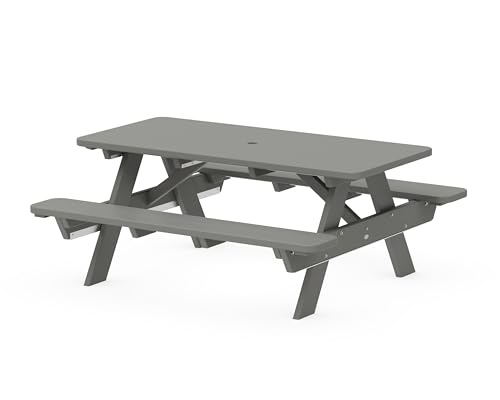
POLYWOOD Park Bench
The POLYWOOD Park bench is the recycled-plastic lumber option, bought for the lowest upkeep in the category. Buying questions: are the boards solid rather than hollow profile, is the hardware stainless or otherwise suited to wet and coastal air, and what does the long frame guarantee actually exclude? Best for: damp shade, coastal gardens, community plots, and owners whose maintenance budget in time is near zero. Not suited for: a formal scheme that needs fine furniture lines.
Do not mistake its material for lightness: this family is dense, and delivery planning matters as much as for cast iron. Check colour samples in your own light if the listing offers them, because recycled boards read differently against planting than on a white product page, and the colour you choose is the colour it will keep — this material does not mellow, fade into patina or accept paint the way timber does. What you see is a twenty-season commitment to that exact shade, which is either its virtue or its warning.

Yaheetech Wooden Garden Bench
The Yaheetech wooden bench is the slatted timber option for porches and terraces, bought for warmth of look and touch. Buying questions: what timber, how is it finished — a renewable oil or a film — and are individual slats replaceable if one splits? Best for: a sheltered site and an owner who enjoys seasonal wood care. Not suited for: an exposed corner in a wet climate, or a household that wants to unwrap and forget.
Inspect this family’s listings for the details that predict assembly happiness: pre-drilled accuracy is invisible in photographs, so reviews mentioning the build deserve weight, and a spare-fixings inclusion is a small sign of a maker who understands flat-pack reality. Plan the finish purchase alongside the bench — the oil or sealant it will want within its first year — so the maintenance rhythm starts as a stocked shelf rather than a postponed errand. Timber bought with its care kit ready is a pleasure; timber bought without one becomes a guilt object by autumn.
Grandin Road Garden Bench
The Grandin Road bench is the design-led option, bought when the bench must carry a view. Buying questions: does the finish have a stated care and touch-up route, are the proportions — especially seat depth and back height — published rather than implied, and does the delivery service match the piece’s weight and awkwardness? Best for: a considered terrace or courtyard that is looked at daily. Not suited for: rough multi-use gardens or buyers indifferent to appearance.
With design-led pieces, buy the service as carefully as the object: confirm what happens if it arrives marked, whether the finish can be repaired in place, and whether the maker’s photographs include the bench unstyled, in ordinary light. Then walk your site once more with fresh eyes, because this tier punishes a mediocre setting more than a modest one — a fine bench on poor ground looks like a mistake, while a plain bench on prepared ground looks like a decision. The ground, as this guide keeps insisting, is part of the product.
Strengths and Trade-Offs
Strengths
- The market is legible once sorted by family: four materials, four care bargains, and a right answer for most gardens becomes visible quickly.
- A bench is one of the few garden purchases with no running costs beyond attention — no fuel, no power, no consumables beyond an occasional finish.
- Repairable construction is widely available at every tier for buyers who know to look for visible fixings and replaceable slats.
Trade-offs
- Listings systematically hide the figures that matter most — seat dimensions, true weight, fixing quality — so the buyer must interrogate rather than browse.
- Every material trades something away: timber trades time, metal trades touch in heat, recycled plastic trades character, steel trades longevity.
- The delivered object is the purchase’s final exam: gates, paths and stairs defeat more benches than weather ever will.
Setup, Care and Maintenance Essentials
Set up like a buyer who intends to keep the bench. Prepare the standing place first: level, firm and drained, with pads or slabs under the feet on any soft surface, because a frame bolted true on bad ground will work itself loose. Assemble on a flat surface — a patio or a sheet of board — following the manual’s sequence, tightening fixings progressively rather than fully at each corner, and sit on the bench before the final tightening so the frame settles under real load. Keep every spare fixing, the manual and the finish’s touch-up in one labelled place; you will want all three within the first year. After the first month of weather, walk around the bench with a spanner and a cloth: re-tighten what has relaxed, wipe the traps where water sits, and touch up any chip while it is still a chip. That single early service visit, more than any purchase decision, is what separates benches that stay tight for a decade from benches that wobble by their second summer.
More Detail: Living With a Garden Bench
Make a site card before you open a single listing. On one page, write the spot’s dimensions, its surface, its sun hours at the times you are actually free, its exposure to wind and rain, and the route from the street to the spot with every width and step. This unglamorous document is the most powerful shopping tool in this guide, because it converts browsing into matching. A bench either fits the card or it does not, and the card does not fall in love with photographs. Buyers who shop with a site card return fewer benches and keep them longer. One more buying route deserves a line: the ex-display and end-of-line bench, sold from a showroom floor with its small knocks already visible. For a buyer who inspects like an owner — joints, fixings, finish at the feet — these can be the honest bargains of the category, because the damage is known, priced and almost always cosmetic, unlike the surprises a sealed box can hold.
Learn to read a product photograph like an estate agent reads a room. Wide lenses stretch small benches; styled cushions hide seat depth; a bench photographed at knee height looks grander than the same bench at eye level. Look instead for the unstyled images — the underside, the fixing close-ups, the bench in an ordinary garden posted by an owner. Where a listing offers only beauty shots, treat the missing angles as missing information and go looking for the assembly manual, which cannot pose and therefore cannot lie about how the thing is put together. Buyers furnishing a garden for a specific event — a wedding, a christening, a big birthday — should add one rule to this guide: the bench must be bought for the garden the week after the event, not for the photographs of the day, because the event lasts hours and the bench lasts decades, and the two briefs agree less often than party planning suggests.
The assembly manual deserves a section of its own because it is the most honest document in the entire purchase. It lists every part, which tells you what can break and what can be replaced. It shows every joint, which tells you where water will sit and where a spanner must fit. It states the fixing sizes, which tells you whether replacements live in any hardware shop or only in the maker’s warehouse. Download it for your final two candidates and compare them as engineering drawings; the bench you would rather assemble is usually the bench you would rather own. A word for buyers in hard-water, high-pollen or leaf-heavy districts, whose benches live under a constant fall of something: smooth, simply profiled designs clean in minutes where intricate ones take a brush and a temper, and over a decade that difference is measured in hours of your life, which belong in the purchase calculation beside everything else.
Think about the second year when you compare two similar benches, because the first year is the easy one. In year two, finishes meet their first full cycle of sun and frost, fixings meet their first loosening, and your maintenance intentions meet your actual diary. Ask of each candidate: what will I be doing for this bench next spring, and do I own the means to do it? A bench whose year-two routine fits your life beats a finer bench whose routine you will resent, every time, and the resentment — not the weather — is what retires benches early. If the bench must be carried through the house — the terraced-house route, carpet to garden — add protection to the buying plan: blankets for the door frames, a second person booked, and a model whose sharpest edges are not at hand height, because more benches receive their first chip in a hallway than in a decade of gardens.
Delivery deserves planning in proportion to weight and awkwardness, not price. Confirm whether the bench arrives assembled, partly assembled or flat-packed, because each state needs a different reception: a clear route and helpers for an assembled piece, a dry flat workspace for a flat pack, packaging disposal for both. Inspect before signing anything, photograph any damage before assembly begins, and keep the packaging until the bench has survived its first sit — returns without packaging are a misery every retailer and buyer shares. Ten careful minutes at the door protect the whole purchase. For buyers choosing between a bench now and a better bench after saving longer, this guide offers the arithmetic of seasons: a garden year contains a finite number of fine mornings, and a good bench bought this spring returns a full year of them, which a perfect bench bought next spring cannot retroactively supply.
Buying second-hand is a legitimate strategy this guide endorses with conditions. The value lives in frames: cast iron and sound hardwood frames outlast their slats, their finishes and their owners, and a frame that is true and free of deep corrosion is worth more than its price suggests. Inspect a used bench the way you would a used bicycle — sight along it for twist, rock it for play, probe timber at the joints with a fingertip for softness, and price the slats and finish it will need. Buy the frame, budget the restoration, and the arithmetic often beats new. Gift receipts and delivery notes sound like trivia until the day a weld cracks in month thirteen, when they become the whole conversation; file them with the manual as this guide advises, and photograph the bench in place on its first day, because that cheerful snapshot is also the baseline every future claim will be measured against.
Cushions, covers and anchors are the accessories that listings will press on you at checkout, and each deserves a decision rather than a reflex. A cushion is worth buying with the bench only if its storage already exists; otherwise buy the bench, live with it, and add the cushion when its home does. A cover earns its cost in harsh climates and wastes it in mild ones where it mostly traps damp against a bench that would rather breathe. Anchors, by contrast, are under-bought: on soft ground they are not an accessory but part of the bench, and the time to fit them is day one. And a closing caution against the last trap, which is buying the accessories before the bench has proved itself — cushions in three colours, a cover, a plaque — because each addition raises the cost of admitting a mismatch, and the honest fortnight of testing should be as cheap to reverse as it is to enjoy.
Warranty reading is a buying skill. Separate the frame promise from the finish promise, because weather attacks them in that reverse order: finishes fail first and are usually covered least. Note what the warranty asks of you — some require the bench to be maintained as instructed, which quietly makes the care leaflet part of the contract. Keep the receipt, the manual and a delivery photograph together; the buyer who can produce all three finds every later conversation with a retailer shorter and more successful. Paperwork is not the purchase’s boring tail; it is part of the product’s working life.
Seasonal timing can work for a patient buyer. Retailers clear outdoor lines as autumn approaches, and a bench bought then — properly inspected, properly stored or properly sited — is the same bench that cost more in May. The caution runs the other way for availability: the exact finish or size you want may vanish until spring, and a redesign may replace it with something subtly different. If your heart is set on a specific model in a specific finish, buy when you see it; if your brief is a family and a size, patience is a genuine strategy rather than a hope.
Returns policies are part of the specification, especially for a purchase you cannot sit on first. Favour sellers whose window lets you assemble the bench, place it, and live with it through a fortnight of real weather and real routines, because that fortnight is when mismatches declare themselves. Note who pays for return carriage on a heavy item — a free-return promise on a cast-iron bench is worth real money and real peace of mind. A bench is too big, too visible and too long-lived to buy under terms that forbid changing your mind.
Measure your household, not just your garden. Seat height should be tested against the legs of the people who will sit most, and the honest way is to measure a chair they already find easy and match its seat height within a small margin. Readers need depth; perchers need shallowness; anyone who rises with difficulty needs arms and height together. A tape measure applied to your favourite indoor chair will tell you more about bench comfort than any review, because comfort is a relationship between a body and a geometry, and you own one side of that relationship already.
Consider the view from inside the house as a formal buying criterion, because for months of the year it is the main one. Stand at the window where you eat breakfast and look at the intended spot in its worst month: bare beds, low light, everything dormant. The bench will be the largest object in that view. Choose a silhouette and finish that carry a winter scene — this is where darker, simpler frames earn their keep — and remember that a bench which delights in January will never embarrass in July, while the reverse is not always true.
Ground preparation is a purchase too, and it belongs in the budget from the start. A few slabs, a bag of gravel, a half-day of levelling — these unglamorous line items decide whether the bench above them performs. Buyers who spend the whole budget on the bench and nothing on its footing have bought a piano and skipped the floor. If funds are tight, this guide’s arithmetic is blunt: step one tier down on the bench and prepare the ground properly. In five years the well-sited modest bench will be the better possession, and it will not be close.
Think about theft and drift if the bench will live anywhere public-facing. Weight is the first defence, anchoring the second, and an unremarkable finish the third — a bench that looks valuable and lifts easily is a bench at risk in a front garden. Communal and front-garden buyers should also consider the neighbours’ view of their purchase, literally: a bench that invites sitting is a kind gesture on a shared green and a nuisance outside someone’s window. The buying decision includes the social site as well as the physical one, and both deserve a walk-around before ordering.
Plan for the bench’s whole life at the moment of buying, because the exit shapes the value. A repairable bench can be re-slated, repainted, moved to an allotment, handed to a child setting up a first garden; a sealed unit can only be skipped. Ask whether spare slats and fixings will plausibly exist, whether the finish can be renewed with ordinary products, whether the materials can be separated for recycling at the very end. These are not gloomy questions. They are how a buyer turns a purchase into a possession — something owned for years rather than consumed for a season.
A word on buying for gifts and memorials, because benches carry meanings other furniture does not. A bench given for a wedding, a retirement or in memory of someone needs its practicalities handled with extra care, precisely because its sentiment will make the household keep it forever: choose the family whose care routine the recipients can sustain, the size their garden can hold, and an inscription arrangement — plaque, engraving — confirmed with the maker before ordering. Sentiment deserves engineering; the bench that is loved for decades will be the one that was also, quietly, correctly bought.
Finally, keep a one-page purchase file: site card, listing printout, manual, receipt, delivery photographs, and a note of the first month’s re-tightening. It takes minutes and it converts every future question — a claim, a repair, a matching second bench, a resale — from archaeology into filing. The buyers who enjoy their benches longest are not the ones who spent most; they are the ones who bought deliberately, in the right order, and kept the evidence. This guide exists to put you in that group before the van arrives.
Compare delivery options with the same care as benches, because the last fifty metres decide the first impression and sometimes the first damage. Kerbside delivery of a heavy assembled bench is a plan that ends at the pavement; a two-person carry through a side gate wants a dry day, a cleared route and gloves. Some sellers offer placement or packaging removal for larger pieces, and for cast iron or solid recycled lumber those services can be worth more than a small price difference between retailers. Ask what the van actually does before you discover it at the door.
If you are furnishing a new garden from scratch, sequence the bench within the whole project rather than buying it in the first flush. Hard landscaping changes levels; a bench bought for ground that is about to be regraded will stand at the wrong height on the wrong surface. The experienced order runs: structure, levels, surfaces, then furniture into finished places. A bench bought last arrives to a prepared home and performs from its first week, while a bench bought first spends the project being moved, stored and knocked — acquiring its first year’s damage before its first sit.
Garden centre versus online is a genuine buying decision in this category, not a habit. In person, you can sit, rock, inspect the underside and judge the finish in daylight — evidence no photograph supplies. Online, the range is wider, the manuals are downloadable in advance, and the returns window substitutes for the showroom sit if it is generous enough. The strongest buyers combine both: sit on the family in a showroom to fix the seat facts, then buy the exact model wherever the terms are best, with the measurements already in hand.
Matching an existing garden scheme is a buying constraint worth handling deliberately. A bench does not need to match other furniture piece for piece — gardens forgive eclecticism outdoors more readily than rooms do — but it should share a logic with its setting: formal with formal, rustic with rustic, a colour temperature that agrees with the paving and planting around it. Photograph your intended spot, and hold candidate images against that photograph rather than against the retailer’s styling. The bench that survives your own garden’s photograph is the one that will look chosen rather than landed.
Buying for a business or rental property rearranges the criteria in ways households should not copy. There, the bench is judged on robustness under strangers, cleanability, replaceability of identical units, and the cost of the hour when it must be repaired. Design-led and delicate timber families fall away; heavy, simple, wipeable constructions win, and spares are bought with the benches rather than after the first loss. If your purchase serves tenants, guests or the public, shop with that colder eye from the start — domestic criteria will quietly mislead you.
Keep the negotiation where it belongs: on the total purchase, not the headline. For larger benches, the meaningful variables are delivery terms, the returns window, included fixings and finishes, and whether spare parts are stocked. A slightly higher price from a seller who delivers to the spot, takes the packaging, and lists spares is usually the cheaper purchase across five years. Buyers fixate on the figure that is printed largest; this guide’s consistent advice is to price the whole transaction, including the afternoon of your life each version of it consumes.
A Pre-Purchase Fit Audit for Garden bench: Space, Habits and the Constraints Listings Skip
The fine print begins with dimensions, so practise on them. Overall length tells you whether the bench fits the wall; seat width between the arms tells you whether three people or two-and-a-coat fit the bench. Overall depth includes a reclined back; seat depth decides whether your readers’ knees agree with the design. Height appears twice — to the seat, which your legs care about, and to the top of the back, which your view cares about. A listing that publishes all of these is a listing written by people who expect to be measured, and that is a good sign in itself.
Material fine print rewards translation into behaviour. For timber, ask which part of the tree and how it is dried — the listing may not say, but the weight will hint, since dense, slow-grown timber is heavy. For metals, the meaningful line is the coating system and whether a matching touch-up exists. For recycled-plastic lumber, the line that matters is whether boards are solid and how they are fixed, because flex in a long board is a comfort issue, not a strength one. Every family has one specification that predicts its old age; find it before you find the order button.
Close with the commercial fine print: what the guarantee covers and for how long, split by frame and finish; what the care instructions oblige you to do; what delivery actually includes and excludes; and what a return would cost in carriage and effort. None of these lines is exciting, and together they are the difference between a purchase and a gamble. The bench itself will sit in your garden for years being judged on comfort and looks. The fine print will be judged exactly once — on the day something goes wrong — and on that day it is the only part of the purchase that matters.
Frequently Asked Questions
How long will a garden bench actually last outdoors?
The feedback of long ownership and the structure of the market agree: cast iron with replaceable hardwood slats, soundly built timber, and solid recycled-plastic lumber are the families still in service after many years, provided they stand on firm, drained ground and receive their material’s modest routine. Longevity is bought as a system — frame, footing and owner together — so this guide’s answer is to choose a repairable frame, prepare its ground, and keep the small appointments. A neglected bench of any family will age faster than a kept bench of a lesser one.
Should a garden bench be anchored?
Decide by surface and mass. On paving or a deck, a heavy bench’s own weight is generally its anchor, and buyers in that position can spend their effort elsewhere. On soil, grass or gravel, plan to anchor from day one if the bench is light enough for one person to shift — wind, climbing children and sloping ground will all test it, and the test always comes. Anchoring is cheapest and easiest at installation, before the bench has settled and before the first storm writes the lesson in a tipped frame and a loosened joint.
What is the lowest-maintenance bench material?
Recycled-plastic lumber asks the least: no sealing, no rust care, an occasional wash, and attention to algae if it stands in shade. Coated steel and cast iron ask a little more — prompt touch-up of chips before weather gets under the finish. Timber asks the most, wanting cleaning and a renewed finish on a seasonal rhythm to hold its colour and shed water. This guide’s advice is to buy the routine, not the material: list what each family will ask of you each year, in hours, and choose the list you will genuinely complete.
Can a garden bench stay outside all winter?
Most soundly built benches can winter outside, and the purchase decision should focus on the conditions rather than the headline. A bench wintering on drained, firm ground, with its water traps cleared and its finish intact, weathers the season as a routine event. A bench wintering in standing water, under a sealed cover over damp timber, or with open chips in its coating, is being stored in its own worst enemy. If your climate is severe and your storage exists, a movable bench gains an advantage at buying time that no finish can fully replace.
Where is the best place to put a garden bench?
Buy the place before the bench: where the household already pauses, on level and firm ground, with shelter from the prevailing wind and, if the site allows, shade at the hour of hottest sun. In buying terms, walk the spot at the times you will use it, after rain as well as in sunshine, and let the site card you make there lead the shortlist. A bench bought for a well-understood spot can be modest and succeed completely; a bench bought for an imagined spot must be exceptional to survive its own placement, and most are not.
Do garden benches need cushions?
Treat the cushion as a separate purchase decision with its own storage question. A bench with a well-shaped seat serves ordinary sitting — coffee, conversation, a pause with the dog — perfectly well bare, and most households use theirs that way most days. A cushion earns its money for long, planned sits, and only if it can live somewhere dry within a few steps of the bench; a cushion stored far away is a cushion that stays stored. Buy the bench first, sit on it for a month, and let your actual sitting pattern, not the checkout page, decide.
Related Guides
garden bench review garden bench reviews garden bench pros and cons is a garden bench worth it how to choose a garden bench
best patio table and chairs best patio rocking chairs best patio dining chairs best outdoor rugs for rain best outdoor deck chairs best indoor outdoor rugs