Disclosure: As an Amazon Associate, airfryerkitchensupply.com earns from qualifying purchases. Links on this page are affiliate links; they cost you nothing extra. Prices and availability change often, so check the current Amazon listing before you buy.
One bench review tells you about one bench in one garden. Hundreds of owner reports, read together, tell you something more useful: which complaints repeat until they become facts, which praise survives its second winter, and which glowing first impressions quietly reverse themselves by autumn. This page works that way. It reads garden bench reviews the way an editor reads a mailbag — hunting for patterns, discounting the extremes, and separating the problems caused by a bench from the problems caused by a slope, a climate or an expectation nobody stated. Bring your own garden in mind as you read, because the pattern that matters is the one that matches your ground.
Key Takeaways
Best for: a reader who wants the distilled experience of many owners — what they praised in year two, not week two, and what they wished a listing had told them. Not suited for: anyone looking for a single winner, because owner feedback refuses to crown one: it crowns a match between bench, site and household. Three findings repeat across the reports. Footing causes more misery than materials. Finishes fail at chips and joints first, almost never in open panels. And satisfaction rises with every month a bench stands where the household already walks, and falls with every month it stands somewhere merely picturesque.
In this guide
What These Garden Bench Reviews Cover and How to Read Them
Start by sorting the feedback by time, because a bench review written at unboxing and one written after two winters are reviews of different products. The unboxing reports cluster around appearance, packaging and assembly; the long-term reports talk about fixings, finishes and footing, and they are the ones worth your evening. When a product page lets you filter by how long the reviewer has owned the item, use that filter ruthlessly. Where it does not, weight any report that mentions a season, a storm or a repair over ten that mention a delivery date. Read the one-star and five-star reports last, if at all; the truth of a bench lives in the long middle, where owners describe a flaw and a virtue in the same paragraph and keep the bench anyway.
Notice, too, who is missing from the average review pile. Owners whose benches failed early often simply disappear — the bench is skipped, the review never written — while owners with a beautiful first summer are loudly present. That survivorship tilt means the written record flatters every bench a little. The corrective is to read the critical minority with care: not the furious one-line verdicts, but the detailed low reports that name a joint, a finish or a fixing. Those specific complaints, repeated across unconnected owners, are the closest thing feedback offers to laboratory data. When two reports contradict each other flatly, do not average them — investigate them, because the contradiction usually conceals the variable that matters, and it is almost always the ground, the climate or the sitter.
Finally, learn the vocabulary owners actually use, because it maps onto causes. Wobble almost always means footing or a relaxed joint, not a weak frame. Fading splits into two different stories — timber silvering, which is cosmetic and often loved, and coating chalking or peeling, which is a finish failing. Rust in reports divides by location: surface freckles at chips, which owners fix in minutes, and rust at welds or inside joints, which they cannot. Reading for these distinctions turns a pile of opinions into a diagnostic tool you can aim at any bench on your shortlist. A report that names its own mistake — wrong spot, skipped anchoring, care routine abandoned — is worth more than a flawless verdict, because it teaches the mechanism instead of merely announcing a result.
Patterns Across Garden Bench Reviews: What Owners Praise and Regret
The praise pattern is remarkably consistent. Owners celebrate, in order: a seat that stays comfortable without a cushion, arms that take real weight when rising, and a bench that looks right from the house in February. Notice what is absent — almost nobody praises a bench for its specifications. They praise behaviours. The reports that glow after years share a phrase in different words: it is just always there. Reliability of presence, the bench as a fixed point in the garden’s geography, outranks every feature a listing can bullet-point. Owners who update an old report almost always move it by one notch rather than reversing it, which tells you something comforting: benches rarely betray their owners suddenly, and first-year impressions, honestly formed, age better than shoppers fear.
The regret pattern is equally consistent, and it is rarely about sitting. Owners regret the spot — too sunny at the hour they are free, too far from the door in the rain, on ground that stayed soft. They regret skipping the anchoring they meant to do. They regret a finish whose upkeep they overestimated their patience for, and a size chosen for guests who come twice a year while the household squeezes past it weekly. Read those regrets as a checklist written for you by strangers: site, anchoring, upkeep honesty, everyday size. A bench can survive being ordinary; it rarely survives being misplaced. The phrases to trust in any report are the specific ones — the named joint, the described storm, the dated repair — and the phrases to discount are the sweeping ones, because weather is specific and so is every real garden.
Climate splits the feedback into separate conversations that should never be averaged together. Coastal owners talk about fixings and coatings under salt air; their heroes are heavy frames and stainless hardware, their villains thin paint. Owners in hard-frost regions talk about water traps and split timber. Owners in hot, high-sun regions talk about surface temperature and fading, and their reports rehabilitate pale finishes and recycled-plastic boards that northern owners find characterless. Before you borrow any owner’s verdict, check their sky against yours — the same bench is a different product under a different weather regime. Before acting on any consensus, check its age; a model’s early reports describe the version that shipped then, and makers quietly revise fixings and finishes, so the freshest detailed reports deserve a weight the oldest cannot claim.
How the Main Bench Families Compare
Owner reports sort the bench families into reputations, and the reputations are stable enough to use. Cast iron and hardwood earns the heirloom label: the longest ownership spans in the feedback, the most repairs happily undertaken, the strongest language about weight — both as reassurance and as warning. Steel earns the starter label: praised for value and lightness by first-garden owners, criticised for joint rust and flex by the same owners two years later. The feedback is not saying steel is bad; it is saying steel is a chapter, not a lifetime, and owners who bought it as a chapter report satisfaction. If you find a reviewer whose garden, household and climate match yours almost exactly, follow that single voice further than the crowd’s average — a sample of one, perfectly matched, outpredicts a thousand strangers.
Timber divides owners into two camps that barely argue, because they want different things. One camp oils, sands and celebrates the silvering; their reports read like journals and their benches photograph beautifully. The other camp reports betrayal — they expected the showroom colour to be permanent and read every grey streak as decline. The bench did not change between camps; the expectation did. Recycled-plastic lumber collects the quietest reports in the pile: few love letters, few complaints, long ownership, and a recurring sentence — we do nothing to it — offered as the highest praise its owners know. And when the pile leaves you genuinely torn between two families, choose the one whose unhappy owners complain about things you do not mind, because you are not buying the average experience — you are buying one of the experiences on the page.
Design-led benches gather a feedback pattern of their own: the highest delight scores and the most anxious ownership. Their owners polish, cover, and check the weather forecast; their regrets, when they come, are about a site that did not deserve the piece or a household too busy to cosset it. The lesson the pattern teaches is about matching temperament, not quality. Some owners want furniture that asks nothing; some enjoy the asking. The reviews are full of both, each puzzled by the other, and your own temperament is the tiebreaker no comparison table can supply.
Who Should Trust Which Kind of Review
Trust a review in proportion to how much of its garden it describes. The reports worth following name their ground, their exposure, their household and their maintenance habits, because those four facts let you translate the verdict to your plot. A five-line rave with no context tells you only that somebody, somewhere, had a good delivery day. A measured three-star report that explains a slope, a dog and a repair is worth more to your decision than fifty context-free celebrations, and learning to skim for context is the core skill this whole category of reading demands.
Be suspicious of unanimity in either direction. Real benches in real weather collect mixed reports, because gardens differ; a product with nothing but praise has usually been reviewed only by its first-summer owners, and a product with nothing but fury has often been bought in bulk by people whose sites shared one problem. Look for the spread, read the middle, and pay special attention to owners who updated their report later — the update is the rarest and most honest genre in the pile, written by someone with nothing left to justify.
Match the reviewer to yourself before matching the bench. The retired couple who read on theirs daily, the landlord who needed seating that survives tenants, the parent whose bench doubles as a climbing frame — each is reviewing against a different brief, and each verdict is true for that brief. Find the reports written by your counterparts: same household shape, same climate, same honesty about maintenance. Their consensus, even when it is lukewarm, predicts your experience better than the enthusiasm of owners whose gardens and lives resemble yours not at all.
Garden bench reviews: The Picks in Prose
Below, the six familiar families appear as feedback profiles rather than test pieces: what owners of each tend to say at the start, what they say two years later, and the complaint or compliment that defines the pattern. Check the current listing for the exact configuration before acting on any of it.

Achla Designs Garden Bench
Owner reports on the Achla Designs style of traditional metalwork bench open with the same delight: it looks like it has always been in the garden. Two years on, the language shifts to upkeep — a chip touched up here, a brush-out of the scrollwork there — but the tone stays fond, because the maintenance owners describe is minutes, not weekends. Best for: an owner who enjoys small, regular attentions. Not suited for: a set-and-forget household in a damp, leafy corner.
The defining complaint in its feedback pile is heat: bare metal in strong sun draws more comment than any structural point, and owners in cooler or shadier gardens barely mention it — a clean demonstration of climate deciding a verdict. The defining compliment is stability; report after report notes that once placed, it simply never moved, rocked or rattled. If your site is shaded and your temperament is attentive, the owner consensus says this family rewards you; if your site bakes, believe the sunbelt reports, not the northern ones.

Plow & Hearth Cast Iron Garden Bench
Feedback on the Plow & Hearth cast iron and hardwood pattern spans the longest ownership periods in the category, and it shows: these are the reports that mention second sets of slats, inherited benches, and repairs described with pride. Owners knew the bargain when they bought — weight and periodic wood care in exchange for permanence. Best for: a settled household furnishing a permanent spot. Not suited for: anyone who may move house, rearrange yearly, or cannot oil timber.
Its recurring complaint is delivery day, not year five: the mass that owners later praise is the mass they curse while manoeuvring it through a gate, and several reports advise measuring the route and recruiting help in advance. Its recurring compliment is the sit itself — shaped hardwood slats draw more comfort praise than any flat seat in the pile. Read together, the reports describe a bench whose hard part is the first afternoon and whose easy part is the following decade, an unusual profile worth matching against your patience.

Best Choice Products Outdoor Garden Bench
Reports on the Best Choice Products tier of steel benches are the most time-sensitive in the pile: the first season reads delighted, the third year more divided. Owners praise the low commitment — a first bench that taught them where they actually sit — and the criticisms, when they arrive, name the same addresses: bolt holes, joints, a finish asked to do one winter too many. Best for: a first garden or a household still learning its own habits. Not suited for: a buy-once-for-decades brief.
What redeems this family in the feedback is expectation management. Owners who bought it as a starter report satisfaction even when they later upgrade; owners who bought the identical bench as a forever purchase write the disappointed reports. The product did not change — the brief did. If you read nothing else into this profile, read that: in the entry tier, the match between promise and purpose predicts the review the owner eventually writes, more reliably than any detail of the bench itself.
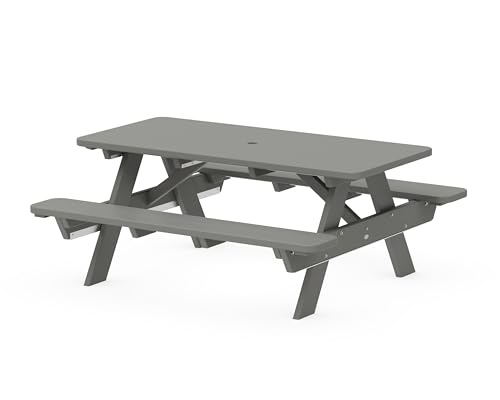
POLYWOOD Park Bench
The POLYWOOD park-profile reports are the pile’s quiet achievers: the fewest words, the longest gaps between updates, and a refrain of benign neglect. Owners in damp, shaded and coastal gardens are its champions, reporting washes instead of maintenance seasons. Owners in formal gardens are its critics, finding the boards honest but plain beside planting that wants a finer frame. Best for: low-attention ownership in hard-working corners. Not suited for: a showpiece position judged from the house daily.
Two details recur in its feedback and deserve your attention. First, weight surprises nearly everyone — owners expecting featherlight plastic describe a two-person lift, which they then reframe as a virtue when storms leave it unmoved. Second, algae in shade is its one repeating chore, and owners who mention a yearly soapy wash report it as trivial while those who ignored it for years describe a bigger job. Even the lowest-maintenance bench in the pile, the reports agree, is not a no-maintenance bench — merely the closest thing on offer.

Yaheetech Wooden Garden Bench
Yaheetech-style slatted timber benches collect the warmest first-person writing in the category — owners describe morning coffee, porch light, the smell of oiled wood — and the most maintenance-honest follow-ups. The satisfied reports mention a finish routine the way gardeners mention watering: as rhythm, not burden. The dissatisfied ones trace back, almost without exception, to an exposed site or a skipped season of care. Best for: a sheltered spot and an owner who likes woodwork’s rituals. Not suited for: an open, rain-driven corner.
Assembly features in this family’s feedback more than in any other, and it splits cleanly: owners who dry-fitted parts and tightened in sequence report a rigid bench years later, while owners who forced a misaligned hole report a creak that never left. That is unusually actionable feedback — it tells you the product’s quality is partly in your hands on day one. If your temperament is careful-with-a-spanner, the owner consensus rates this family highly; if assembly is a chore you rush, the same reports quietly redirect you elsewhere.
Grandin Road Garden Bench
Design-led benches like the Grandin Road profile attract reviews written in a different register — owners discuss proportion, shadow and how the piece holds a view — and their satisfaction, when the site deserves the bench, is the most emphatic in the pile. Their disappointments are equally distinctive: not breakage, but mismatch, a fine bench diminished by a cramped terrace or upstaged by a busy planting scheme. Best for: a considered, visible site. Not suited for: a purely functional brief where looks carry no weight.
Read its feedback for logistics as much as beauty. Owners mention white-glove expectations versus kerbside reality, finishes they inspect after storms, and a reluctance to lend the bench to rough use that plainer benches absorb without thought. None of that is criticism; it is the texture of owning a focal point. The consensus, fairly read, is that this family delivers exactly what it promises to households that want an object to care about — and quietly taxes households that only wanted somewhere to sit.
Strengths and Trade-Offs
Strengths
- Read together, owner reports converge with unusual clarity: siting, footing and honest upkeep predict satisfaction far better than brand or tier.
- The category offers a proven family for nearly every temperament, from heirloom-keepers to neglect-by-design owners, and the feedback maps which is which.
- A bench’s duties stay delightfully analogue — no apps, no parts ecosystem, no planned obsolescence in the entire pile of long-term reports.
Trade-offs
- Review piles flatter every bench: failed purchases often vanish unreviewed, so the written record must be corrected by reading the detailed critics carefully.
- The same bench earns opposite verdicts under different climates and expectations, which means borrowed conclusions are risky without checking the reviewer’s context.
- Long-term truth arrives slowly; the most useful reports are years old, by which time listings, finishes and hardware may have quietly changed.
Setup, Care and Maintenance Essentials
Owners who report smooth setups share a routine worth copying. They prepared the standing place first — level, firm, drained — because several reports describe a bench assembled beautifully and then rocked into looseness by bad ground. They assembled on a flat surface, tightened fixings gradually and in sequence rather than fully at each corner, and kept the spare hardware and the touch-up for the finish in a labelled pot, a habit later reports thank repeatedly. The most valuable line in the whole feedback pile may be the dullest: check the fixings after the first month. Again and again, owners who did that one small revisit report benches that stayed tight for years, while owners who assembled and forgot describe the slow creak that became a wobble that became a skip. Set a reminder when you build the bench; future you is the reviewer who will be grateful.
More Detail: Living With a Garden Bench
A useful exercise with any bench’s feedback: count how many reports mention the ground. On popular models the fraction is startling — footing, levelling, sinking and anchoring appear in a large share of all detailed reports, positive and negative alike. Owners rarely realise they are reviewing their site preparation, but they are. When you read a complaint about wobble, translate it: the bench met uneven earth. When you read praise for solidity, translate again: somebody did the unglamorous work first. The bench is half the system; the reports prove it on every page. Sort any model’s reports by ownership length and a narrative arc appears that no single review contains: delight, a quarrel in the second year — usually with a finish or a fixing — and then, in the reports that continue, a settled peace in which the bench is simply part of the garden’s furniture of the mind.
Delivery damage has its own literature. Corners, feet and protruding arms take the knocks, and owners who inspected before assembling — and photographed what they found — report painless replacements, while owners who discovered a bent part mid-build report a special frustration. The pattern generalises beyond benches: the first ten minutes with the box are part of the purchase. Several long-term owners note, with hindsight, that the small coating wound they ignored at delivery became the rust they treated in year three, which is why the careful reports all touch up before the bench ever goes outside. The reports also reveal how often the word sturdy is doing silent work: owners reach for it when a bench has survived something specific — a storm, a teenager, a house move — and the specific survival story attached to the word is always more informative than the adjective itself.
Reports from apartment and balcony owners form a distinct subgenre worth seeking if that is your life. Their benches are smaller, their ground is always hard and level, and their enemies are different: wind funnelling between buildings, neighbours below complaining about scraping feet, and the logistics of a lift. Their praise goes to benches that arrive in manageable pieces and sit quietly on pads. Their regrets involve size misjudged by eye from photographs — a mistake every category of owner makes, but balcony owners pay for it with a third of their floor. A small but telling pattern hides in the photographs owners attach a year on: they stop photographing the bench and start photographing from it — the view, the border, the grandchildren — which is the feedback pile’s quiet way of announcing that a purchase has become a place.
The multi-generational reports are the pile’s treasure. A bench reviewed by the person who bought it, then mentioned again years later in a house-move or inheritance context, carries information no test can accelerate. These reports cluster around heavy frames and replaceable timber, and their language is notably uncommercial — nobody performs enthusiasm for a bench they have owned a decade; they simply record that it is still there, doing its job, in a new garden. When a family’s feedback contains many such reports, you are looking at the closest thing furniture offers to a proven design. Reviewers who mention a second bench are a study in themselves, because almost none of them bought the same family twice; they bought the complement — the low-care bench after the beloved high-care one, the formal piece after the workhorse — suggesting that owners collect trade-offs the way gardeners collect plants.
Comfort feedback deserves decoding, because owners use the word loosely. Reports praising comfort usually describe a household’s main sitter and a usual duration — a twenty-minute coffee, an hour’s read — and the bench succeeded at that duration for that body. Reports damning comfort often reveal, paragraphs later, a four-hour reading habit or a back that needs lumbar support no flat bench provides. Neither party is wrong. The skill is extracting the duration and the body from the prose and comparing them with your own, rather than averaging the adjectives into mush. The angriest reports in the pile share a signature worth learning: they describe a bench bought for a garden that did not yet exist — the terrace unbuilt, the tree unplanted — and their fury is really at the gap between the imagined garden and the real one, billed to the only party that can be reviewed.
Search the feedback for the word winter and a pattern leaps out: it is the season that writes the honest reviews. Summer reports discuss looks and comfort; winter reports discuss survival — what the frost found, what the cover trapped, what the standing water did. Owners who stored or covered well describe spring as a non-event. Owners who did neither describe a rescue operation. If a shortlist bench has reports spanning several winters in a climate like yours, those few paragraphs outweigh a summer of praise from anywhere else on earth. Notice, too, the reports that arrive after a house move, when the bench is the only garden object that came along; their tone is distinctively tender, and they cluster, once again, around the families that can be carried, repaired and re-sited without a specialist.
There is a recognisable report that should warn you off a mismatch rather than a product: the owner who wanted a bench to be a sofa. They add cushions, then throws, then complain the back is too upright and the seat too firm, and finally review the bench as uncomfortable. It is, for lounging — as is every bench ever made. Benches are for sitting: upright-ish, social, interruptible. The feedback of genuinely happy owners accepts that posture contract. If your household’s dream is horizontal, the reports are telling you to buy a lounger and let the bench be a bench. Owners of very old benches write the pile’s shortest reports — a photograph, a date range, a sentence — as if longevity needed no argument, and a shopper learns to hear that brevity as the loudest endorsement the category produces.
Price-tier patterns in feedback are subtler than shoppers expect. Entry-tier owners complain about finishes and fixings but praise value; premium owners praise finishes and complain, occasionally, about delivery and their own anxiety. Mid-tier timber owners write the most maintenance prose. What almost nobody in any tier writes is that a different tier would have fixed their actual problem, because their actual problems — siting, footing, expectation — are tier-independent. That may be the single most money-saving insight buried in the entire review pile of this category. There is a genre of report written entirely about a single bolt, a single slat, a single afternoon of repair, and these micro-reports are disproportionately valuable: they are the only place the pile discusses construction at the resolution at which benches actually fail.
Reports from community gardens, schools and churchyards offer an accidental stress test no household can match: hundreds of sitters, no owner on site, weather without mercy. The benches that earn repeat praise there are heavy, simply built, and repairable with ordinary timber and tools. Delicate designs vanish from those settings within a season or two, and their absence is data. If your own bench will live a semi-public life — a front garden, an unfenced plot, a shared courtyard — weight those institutional reports heavily; they are reviewing your future. When reports disagree about a bench’s comfort, the tiebreaker is usually hidden in a photograph: the sitter’s height against the backrest, the cushion doing unacknowledged work, the feet tucked or dangling — evidence the text forgot it was providing.
A bench’s second life appears in the feedback more often than manufacturers might expect: moved to a allotment, demoted to a potting bench, repainted by a teenager, cut down — in one memorable report — into two chairs. Owners describe these reincarnations fondly, and they cluster around simple construction and honest materials. A bench that can be repainted, re-slated and repurposed has a longer useful story than its first role suggests. When reports describe a bench as still useful after its best years, that is not faint praise; it is the definition of a good buy. The pile’s most reliable narrators, judged by how their early reports predicted their later ones, are the owners who described their ground in the first paragraph; it remains the single best marker of a review worth trusting with your money.
Watch for the phrase guests in the reports and you will find a quiet sizing lesson. Owners who bought for the household’s daily two report contentment; owners who bought a grand three-seater for occasional gatherings report a bench that dominates a small plot and still seats the daily two no better. Guest capacity is the most overbought feature in the category, according to its own customers. The reports suggest buying for the ordinary week and letting guests perch happily on arms and steps, as guests cheerfully do, rather than furnishing permanently for the year’s busiest afternoon. Finally, the feedback teaches a reading posture as much as a set of facts: generous to specifics, sceptical of superlatives, patient with updates — the same posture, not coincidentally, that makes someone a good keeper of an actual bench in actual weather.
The sound reports — creaks, rattles, a hum in wind — form a small but diagnostic corner of the pile. Owners who investigated early describe trivial causes: a relaxed bolt, a foot bridging a hollow, a loose slat. Owners who ignored the soundtrack describe, a year later, the joint that finally gave. A bench talks, and the feedback teaches that its early noises are requests, not character. If you take one habit from the entire body of owner experience, take the ten-minute investigation at the first new sound; it is the cheapest maintenance in the whole category.
Finish complaints follow a chronology you can set your watch by. Year one: chips at edges and fixings, usually from assembly or delivery. Year two: the first fade line where sun strikes and shade protects, teaching owners their bench has a sunny side. Year three onwards: either a stable patina that owners stop mentioning — silence in the reports is itself a good sign — or a peeling failure that dominates every update. When reading a model’s reports, sort by age and watch which chronology unfolds; a bench whose three-year reports have gone quiet about its finish is a bench whose finish works.
Several owners independently describe the same experiment: they moved the bench and the garden changed around it. Weeding increased near it, a path wore in toward it, children routed their games past it. This is the feedback pattern behind the oldest claim in bench writing — that a seat creates a destination. It is pleasant to find it confirmed by people with no reason to romanticise: they moved a bench two metres and their behaviour followed. If your shortlist decision is stuck between models, the reports suggest deciding by destination instead, because that is what you will actually experience.
Accessibility appears in the feedback with increasing frequency, and it is some of the most practically useful reading in the pile. Older owners and their families describe exactly which features mattered: arms at pushing height, a seat that does not slope backward, a frame without tremor, space for feet to tuck under when rising. Benches praised on these points collect a distinctive gratitude. If anyone in your household rises with difficulty, filter the reports for these voices first — they have tested the precise thing you need, at a level of detail no specification sheet attempts.
The dog-and-toddler reports deserve their own footnote in any honest synthesis. They describe benches used as climbing frames, teething rails, launch pads and shade shelters, and the survivors share mass, rounded edges and finishes that treat scratches as texture. Owners of delicate, design-led benches in young families write a recognisable rueful report — love the bench, fear the household — and often solve it by relocating the piece to a quieter corner. Match the bench’s fragility to your household’s actual physics, the reports plead, not to the household in the photograph.
Returns and exchanges generate a small, instructive literature. The happiest return stories involve a mismatch spotted early — wrong size for the site, wrong material for the climate — and a swift swap into the family that fit. The unhappiest involve a bench kept out of inertia until its small mismatch became weather damage, at which point nobody was satisfied. Owners’ hindsight is unanimous: the first fortnight tells you whether the match is right, while the bench is still returnable. Sit on it daily, in your real spot, and let that fortnight vote before the weather casts its own ballot.
A word about photographs in owner reports, because they mislead in both directions. A bench photographed in its first week proves nothing except delivery; a bench photographed grey and weathered may be structurally perfect and merely honest about its age. The useful photographs are the close ones owners post when something goes wrong — a joint, a fixing, a finish at a chip — because those show you the construction details listings hide. Train your eye on the undersides and junctions in owner pictures; that is where benches are actually made or unmade.
Regional dialect runs through the feedback and is worth respecting. Owners in wet western climates write about drainage the way desert owners write about heat; each group thinks its obsession is universal. The practical move is to build yourself a small panel: find three or four reports from gardens with your rainfall, your frost and your sun, and treat their consensus as your forecast, whatever the global average says. A bench is a local product wearing a national listing, and the local reports are the ones describing the item that will actually arrive in your weather.
Underneath all the patterns sits a simpler one: owners who researched the spot before the product report the highest satisfaction, across every family and tier. They measured, watched the sun, tested the ground, and then chose — often a modest bench that fits a well-understood brief. Owners who fell for a photograph and improvised the rest write the category’s disappointed literature. The review pile, read whole, is less a verdict on benches than a verdict on sequence. Spot first, family second, model third: the reports have been saying it for years, in thousands of variations.
So how should you use all this on an actual shortlist? Give each candidate bench a small dossier: three long-term reports from your climate, one detailed critical report, and a check that its care routine matches your habits. Score the dossier, not the listing. Where reports conflict, ask which reviewer’s garden resembles yours and follow them. And when you have owned your bench a year, add the report you wished you had found — dated, specific, honest about the ground — because the pile only stays useful if each generation of owners writes the next one’s map.
One corner of the feedback deserves rescue from obscurity: the reports written by people who maintain benches they did not choose — groundskeepers, tenants, adult children inheriting a parent’s garden. Their verdicts are the coldest in the pile and therefore among the most useful, because sentiment does not subsidise them. They praise exactly three things: fixings that can be reached, finishes that can be renewed with ordinary products, and frames that tolerate being ignored for a year without structural complaint. When a family’s reports from its unwilling custodians are warm, you are looking at genuinely forgiving design.
The feedback also contains a seasonal rhythm that shoppers rarely notice: the same models collect different complaints depending on the month the report was written. Spring reports discuss winter damage and assembly; summer reports discuss heat, comfort and wasps beneath the seat; autumn reports discuss covers, leaves and the first loosening. A shopper reading in May meets a different review pile from one reading in November, through no dishonesty of anyone’s. The corrective is to search within a model’s reports for the season you are about to enter, and weight those voices first.
Comparing Garden bench Options Side by Side: Patterns That Separate a Good Match From a Poor One
Reading a bench listing against the feedback is a skill in itself. Take the dimensions: owners’ most common measurement surprise is seat depth, so find that figure, and if the listing offers only overall dimensions, treat the omission as a question to ask before buying. Take the weight: owner reports confirm that stated weight predicts both stability and delivery difficulty, so a missing weight is another question, not a detail. The listing is a claim; the reports are the evidence; buy where the two agree.
Material wording needs the same cross-examination. Listings celebrate timber with romantic species names, while owners report behaviour — how fast it silvered, whether end grain drank water, how the finish aged at the feet. Listings call coatings durable, while owners report exactly where they chipped. When the two accounts diverge, the owners are describing your future and the listing is describing its hopes. None of this makes listings useless: they remain the only source for the current finish, fixings and configuration of the model shipping today, which is why the final check before buying is always the live listing.
Warranty language, read beside the feedback, becomes clearer. Owners’ claims cluster on frames and welds — the parts warranties usually cover longest — while their out-of-pocket repairs cluster on finishes and slats, the parts warranties cover briefly or not at all. That pattern tells you where the money risk actually sits in long ownership, and it is rarely the frame. A bench with replaceable slats and a touch-up-able finish carries its own informal warranty, written in its construction; the feedback of owners who have repaired theirs is where that quality shows up.
Frequently Asked Questions
How long will a garden bench actually last outdoors?
The long-term reports converge on a range rather than a number: heavy frames in cast iron, sound timber or recycled-plastic lumber are routinely reported in service after many years, with slats replaced and finishes renewed along the way, while lightweight benches in exposed sites collect shorter stories. The variable owners credit is never luck — it is footing, drainage and small repairs done early. Read a model’s oldest reports for its true lifespan; a bench whose decade-old reports still sound matter-of-fact is telling you the most encouraging thing in the pile.
Should a garden bench be anchored?
Owner experience splits cleanly by surface. On paving and decking, heavy benches earn report after report of staying put unaided. On grass, soil and gravel, unanchored light benches earn the migration stories — shifted by wind, tipped by climbing children, walked downhill a few centimetres a season until a joint loosened. The consensus advice from those who learned the longer way: if your bench stands on soft ground and one person can lift an end easily, anchor it or weight it, and check the fixings again after the first storm proves the point.
What is the lowest-maintenance bench material?
Across thousands of reports the lowest-maintenance reputation belongs to recycled-plastic lumber, whose owners describe washing and little else, year after year. Powder-coated metal follows, its owners reporting minutes spent on chips rather than weekends on care. Timber sits at the other end of the effort scale and its owners know it — their reports treat seasonal oiling as the price of the material they love. The feedback’s consistent moral is to choose the routine you will keep: every material’s worst reports come from owners who bought one routine and lived another.
Can a garden bench stay outside all winter?
The winter reports say: yes, with preparation, and the preparation is specific. Owners who cleared water traps, touched up chips, tightened fixings and either sheltered the bench or used a breathable cover correctly describe uneventful springs. Owners who parked a wounded bench in standing water describe the opposite. Several reports warn that a cover used over a damp bench, sealed tight, did more harm than the weather it excluded. Winter itself is rarely the villain in the feedback; autumn neglect is, wearing winter as its disguise.
Where is the best place to put a garden bench?
If the feedback teaches one placement lesson, it is to follow the household’s existing pauses — the path end, the shed door, the sunny morning corner — rather than the view. Owners who placed for the photograph write the category’s most melancholy reports: beautiful bench, nobody on it. Owners who placed for the routine write about daily use in every season. Add the physical requirements those same reports repeat — level, firm, drained ground, shelter from the worst wind, shade at the hottest hour if you can manage it — and you have the placement consensus of the entire pile.
Do garden benches need cushions?
The cushion reports are a small comedy of good intentions. Owners buy them for comfort, praise them for a month, then describe the storage shuffle and the post-shower drying drape, and by the second season most report using them only for planned long sits. The contented pattern is a cushion kept in a box within steps of the bench; the discontented pattern is a cushion kept in a distant shed. The verdict the feedback supports: a well-shaped bench needs no cushion for ordinary use, and a cushion earns its place only if its storage is effortless.
Related Guides
garden bench review garden bench buying guide garden bench pros and cons is a garden bench worth it how to choose a garden bench
best patio table and chairs best patio rocking chairs best patio dining chairs best outdoor rugs for rain best outdoor deck chairs best indoor outdoor rugs