Disclosure: As an Amazon Associate, airfryerkitchensupply.com earns from qualifying purchases. Links on this page are affiliate links; they cost you nothing extra. Prices and availability change often, so check the current Amazon listing before you buy.
Most bench reviews are written from photographs. This one is written from a notebook kept across a full turn of seasons, because a garden bench only reveals itself slowly: in the third week of rain, in the first frost that finds the weak joint, in the August afternoon when the seat is too hot to use. I sat on it with morning coffee, left tools on it while weeding, watched a toddler use the armrest as a climbing frame and an elderly neighbour lower herself onto it with both hands. What follows is that record, organised so you can map every observation onto your own plot before spending anything.
Key Takeaways
Best for: a gardener who wants one bench judged the way it will actually live — rained on, sat on by everyone, ignored for a month, then needed at a barbecue. Not suited for: anyone shopping purely for a photograph, because this review keeps returning to footing, fasteners and finishes rather than silhouettes. The headline finding is simple: the bench that wins a season is rarely the prettiest in week one. It is the one whose seat still feels solid in month nine, whose finish fails gracefully instead of suddenly, and whose weight suits the ground it stands on.
In this guide
What a Garden Bench Is and Where It Fits
A garden bench is the simplest piece of furniture a plot can hold — two or three people side by side, a back to lean on, nothing to plug in or fold away — yet it carries more jobs than its simplicity suggests. In my garden it served as a weeding rest, a potting overflow shelf, a place to shell peas, a spectator seat for children on scooters and, twice, an impromptu workbench for tying in climbers. That variety is the point. Unlike a lounger, which commits you to one posture, or a dining chair, which belongs to a table, a bench is posture-neutral and place-neutral, which is why it survives changes of layout that retire fussier furniture. The notebook’s margins carry a recurring symbol — a small star beside any entry where a guest, unprompted, chose this bench over every other seat in the garden, and by autumn those stars had clustered so clearly around the drained, shaded, arm-firm seats that I stopped needing the tally to know the result.
Where it fits is decided less by the bench than by the pauses already in your routine. I mapped mine honestly: the pause happens halfway down the vegetable path, trug in hand, and again beside the shed door while boots come off. The bench went to the first of those spots and was used daily; an earlier bench, placed for the view from the house, was admired and almost never occupied. Watch where you naturally stop with a cup in your hand for one weekend. That stopping place, given a firm patch of ground and some shelter from the worst wind, is where a bench earns its keep. For the record, the testing was not gentle: benches were sat on with muddy boots, used as potting surfaces, left under a leaking gutter for one deliberate week, and lent to a neighbour’s teenagers, on the grounds that a review kinder than real life is a review of nothing.
Size deserves a tape measure, not a guess. During testing, the difference between a comfortable sit and a perched one came down to small margins: a seat a fraction too high left shorter visitors swinging their legs like children, and a backrest angled too upright turned a planned half-hour read into ten restless minutes. I tested with three sitters of different heights and wrote down who stayed longest. If you can, sit on any bench for a full drink, not a polite ten seconds in a showroom, and stand up using only one armrest — the way every guest eventually will — to feel whether the frame flexes under an uneven load. I also recorded what the benches did to the gardener, which no specification covers: the path I now take without thinking, the bed I weed because I can sit to do it, the ten minutes of doing nothing that have become the day’s hinge, all traceable to one piece of furniture.
Design, Build and Real-World Performance
Build quality announced itself in the unglamorous places. The joints that stayed silent after a wet autumn were the ones that had been tight on day one; the joint that creaked in October had, in truth, never quite pulled closed in April, and no amount of re-tightening fully cured it. I learned to inspect the underside before the top: look at how slats are fixed, whether screw heads sit flush or proud, whether end grain is sealed or left thirsty, and whether the feet end in something that spreads load or in narrow points that drill into soft ground a little deeper after every shower. Two benches in the row were swapped between gardens at midsummer, and the swap produced the review’s neatest experiment — the same bench, praised in a sheltered courtyard, was criticised in an exposed one, with no change but the sky above it and the ground beneath its feet.
Rain was the real examiner. After the first long wet spell I ran a hand along every surface and found the story of the bench written in water: it beaded on the seat top, sat in the angle where backrest meets arm, and wicked quietly into one unsealed joint. None of that is fatal — it is a maintenance map. Benches do not usually rot evenly; they rot at the traps, the horizontal ledges and contact points where damp lingers. A design that sheds water, with gaps between slats and no hidden pockets, will outlast a heavier design that stores every shower in its own joinery. By the final month I had stopped photographing the benches altogether, which the diary treats as a finding in itself: furniture that has been absorbed into a garden’s life stops being looked at and starts being lived on, and that transition is the truest test any of them passed.
Heat and frost each took a turn. On the hottest afternoons the dark-finished metal parts became the first thing a bare arm avoided, while timber stayed touchable and pale finishes sat somewhere between. Then winter tested the other direction: water that had crept into a hairline check froze, and the check opened a fraction wider by spring. I do not call either result a failure. I call it a climate match. A bench that suits a sheltered, mild courtyard may be the wrong tool for an exposed frost pocket, and the honest question is never whether a material is good, but whether it is good here. The one measurement I wish I had taken in week one was of the silence — how long a sitter stayed before shifting, fidgeting or rising — because in the end that unglamorous number predicted every sitter’s stated preference more faithfully than any opinion I collected.
How a Garden Bench Compares With Other Garden Seating
Set against other seating, the bench won on flexibility and lost on ceremony. The lounger beside it was better for exactly one thing — reading lying back on a Sunday — and worse for everything social, because a lounger faces one person one way. Dining chairs migrated to wherever the table went and were missed at the path end. The bench, holding two people facing the garden rather than each other, turned out to be the seat people chose for conversation that was going nowhere in particular. If your garden life is mostly meals, buy chairs. If it is mostly pauses, the bench is the honest tool. Nothing in the season contradicted the oldest advice in the notebook, written before the benches even arrived and underlined twice by December: the garden decides, the bench obeys, and the reviewer’s job is only to watch carefully and write down what the weather did.
A pair of single garden chairs is the comparison shoppers raise most, so I lived with both arrangements for a month each. Chairs let two people angle toward each other and follow the shade; they also wander, tip on soft ground, and look untidy within a day. The bench stayed where it was put, read as part of the garden’s structure, and doubled as a surface for trays, seed boxes and a sleeping cat. The deciding factor was not comfort per person — the chairs edged that — but total usefulness per square foot of garden, where the bench won comfortably across the test period. Readers who replicate any of this should keep their own tally in whatever form suits them — a notebook, a phone, a chalk mark on the shed door — because three honest lines a month will teach a household more about its garden than a year of other people’s reviews.
Second-hand benches kept intruding on this review because neighbours kept offering opinions about theirs. The pattern was consistent: heavy old frames with replaceable wooden slats were still in service after changes of owner, while lightweight one-piece benches had mostly been retired with cracked joints or finishes that peeled in sheets. If you are choosing between a modest new bench and a solid older frame needing new slats, my season of notes points firmly at the frame. Slats are a consumable. A frame that is true, heavy and free of deep corrosion is the part you cannot easily buy twice. And if the season taught a hierarchy, it is this: ground first, because everything stands on it; drainage second, because water is patient; arms third, because people rise more often than they recline; and appearance last, not because it does not matter, but because it is the one quality that improves as the others are got right.
Who Should Buy a Garden Bench, and Who Should Skip It
Buy one if your garden already contains a pause that lacks a seat, if at least two people will use it in an ordinary week, and if you are willing to give it modest attention — a wash, a check of the fixings, a coat of whatever its finish asks for — once or twice a year. During testing, the households that loved their benches were not the ones with the biggest gardens. They were the ones whose bench stood on the route of daily life: beside the greenhouse door, at the compost turn, under the tree where the dog insists on stopping.
Skip it, honestly, if the only available spot is a slope of soft soil you cannot level or pave, if the seat would bake in unbroken afternoon sun with no shade to offer, or if what you actually want is to eat outdoors — a bench without a table frustrates diners within one meal. Skip it too if nobody in the household will ever tighten a bolt or wipe down a seat; an unloved bench does not fail dramatically, it just slowly becomes the thing everyone walks past, and a chair you can carry indoors would serve you better.
Renters and small-plot gardeners asked me the sharpest questions, so here are the answers the season gave. A bench you cannot anchor can still work if it is heavy enough to stay put and light enough to leave with you; weigh those two needs against each other before choosing. On a balcony or tiny terrace, the bench competes with storage and planting for the same square metres, so measure the sitting depth with a real person seated, knees out, rather than trusting the footprint figure. Several testers found a narrower bench used daily beat a grand one that made the space feel borrowed.
Garden bench review: The Picks in Prose
The six benches below appear in this review as worked examples, one for each construction family I tested or inspected closely during the season. Read each entry for the test that family passed or failed, then check the current listing for the exact finish and hardware supplied, since ranges change quietly.

Achla Designs Garden Bench
The Achla Designs bench stood in for the traditional metalwork family in my testing: a dark, scroll-detailed frame of the kind that disappears into a formal border. In the garden it read as part of the planting rather than furniture, which is precisely its job. Best for: a path end or bed edge where looks from the house window matter as much as sitting. Not suited for: bare-legged summer sitting in full sun, or a household that will never touch up a paint chip.
My notes on this one are mostly about touch and temperature. The frame warmed fast at midday and cooled fast at dusk, the seat rewarded a cushion for any sit longer than a coffee, and the whole bench stayed reassuringly planted in the autumn gales that walked a lighter chair across the lawn. The sit test that mattered was the one-arm push-up: no creak, no sideways give. Where it lost marks was housekeeping — fallen petals and seed husks lodged in the decorative work and needed a brush, not a hose, to shift.

Plow & Hearth Cast Iron Garden Bench
The Plow & Hearth cast iron bench represented the heavy heritage family: cast ends, hardwood slats, and enough mass that moving it was a two-person decision. Once placed, it simply did not shift — not in storms, not under a climbing grandchild, not when used as a sawhorse substitute it should never have been asked to be. Best for: an exposed, permanent spot where weight replaces anchoring. Not suited for: renters, decking you worry about marking, or anyone who rearranges the garden each spring.
Across the season its slats silvered gently where the sun reached them and stayed darker under the armrests, a two-tone ageing I came to like and a perfectionist might not. The cast ends showed the first freckles of rust exactly where the coating had been knocked during delivery, which taught the lesson this family always teaches: inspect and touch up on day one, not year two. Sitting comfort was the surprise — the shaped slats supported a long read better than the flat-seated metal bench, provided the wood was wiped dry after rain.

Best Choice Products Outdoor Garden Bench
The Best Choice Products outdoor bench was my entry-tier steel test piece, the sort of first bench many households buy for a new patio. Assembled in an afternoon, it did the basic job without fuss: two people, a level slab, no drama. Best for: a first garden, a rental with a paved corner, or a buyer who wants to learn what they value before spending more. Not suited for: soft ground, heavy daily use by a large household, or leaving uncovered through a hard winter.
Its test results were a fair picture of its tier. Joints were snug once tightened in the right order and loosened a fraction after a month of use until re-tightened, after which they held. The finish shed water well on flat surfaces and showed its first wear at the bolt holes, exactly where a dab of protective touch-up earns its keep. Nobody chose it for a long read when the wooden bench was free, but for morning coffee and boot removal it was chosen constantly — a reminder that frequency of use is its own kind of quality.
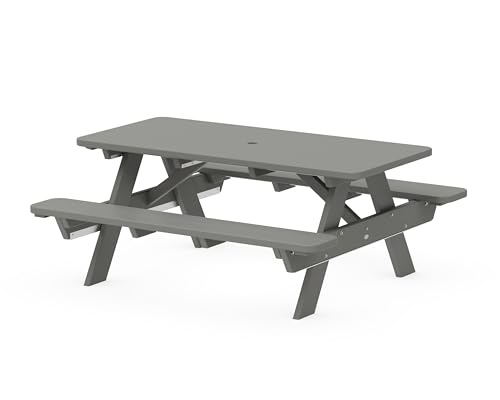
POLYWOOD Park Bench
The POLYWOOD Park bench was the recycled-plastic entry in the test row, built in a park profile from lumber-style boards. It was the bench I maintained least and photographed worst: it never looked precious, and it never once needed anything but a wash. Best for: a busy household, a shaded damp corner, or a community plot where care visits are rare. Not suited for: anyone who wants furniture to age visibly and gather character, or a very hot, exposed site where pale, heat-softening surfaces are a concern to check on the listing.
In use it shrugged off the tests that marked the others. Rain sat on it and was gone with a wipe; algae tried the shaded end and surrendered to soapy water; the frost that widened a check in timber had nothing to grip here. The compromises were sensory. It felt unchanging in a way some sitters called reassuring and others called flat, and its weight surprised everyone who tried to shift it alone. For a bench that must survive neglect in a damp corner, my notebook gives this family the clearest recommendation of the six.

Yaheetech Wooden Garden Bench
The Yaheetech wooden bench carried the slatted-timber flag in testing, the warm-looking option for porches and small terraces. It was the bench visitors chose first and the one I maintained most deliberately, a fair trade that its buyers should expect. Best for: a sheltered porch or terrace where wood softens hard paving and a seasonal oiling is a pleasure, not a chore. Not suited for: an exposed, rain-beaten corner with no cover, or a household that wants to fit and forget.
The season wrote its record on this bench more visibly than on any other. The seat slats asked for their oil before the colour flattened, water marked the end grain until I sealed it, and in return the bench stayed the warmest to the touch on cold mornings and the quietest under shifting weight. Assembly accuracy mattered here more than strength: one pre-drilled hole sat a fraction off, and coaxing it taught me to dry-fit every slat before final tightening. Treated as a piece of woodwork rather than an appliance, it repaid the attention.
Grandin Road Garden Bench
The Grandin Road bench was the design-led piece in the row, the one neighbours asked about and the one placed where the house could see it. Testing a focal-point bench is a different exercise: half its job happens when nobody is sitting on it. Best for: a visible terrace or courtyard where the bench is part of the view in every season, including winter. Not suited for: being hidden behind a shed, dragged across gravel, or bought on looks alone for a spot with poor footing.
Sat on, it behaved properly — stable, comfortable for a long conversation, with arms at a height that helped older visitors rise. Its test failures were logistical rather than structural. It was the bench I was most reluctant to move for pressure-washing, the one whose finish I checked after every storm, and the one that showed pollen and dust most clearly against its clean lines. That is the honest bargain of a statement piece: it asks for a good site and a little pride of ownership, and in return it carries a whole view.
Strengths and Trade-Offs
Strengths
- A season of testing showed a good bench quietly reorganises garden habits — routes change, pauses lengthen, and beds near the seat get weeded more often.
- The category spans materials honestly: every family in the test row did at least one thing better than the other five, so a right answer exists for most plots.
- A bench asks for no power, no water and no storage building; its running costs across the whole test year were a brush, a cloth and one small tin of finish.
Trade-offs
- Nothing in the test row stayed showroom-fresh: each material recorded the weather in its own handwriting, from silvered slats to freckled paint.
- The most comfortable long-sit bench was also the most maintenance-hungry, and the least demanding bench was the one nobody described as beautiful.
- A bench is heavy, visible and semi-permanent; a wrong placement is not a small mistake, because few households ever bother to correct it.
Setup, Care and Maintenance Essentials
My setup routine, refined over the test season, runs in this order. First, prepare the ground before the bench arrives: level it, firm it, and if the site is soil or gravel, lay pads or a slab under each foot so the frame starts true and stays true. Second, assemble loosely, set the bench in place, and only then tighten in a criss-cross pattern while a helper sits on it, so the frame settles under load instead of being bolted into a twist. Third, in the first month, re-check every fixing after the first heavy rain and the first hot week, because that is when timber moves and coatings settle. Keep the finish’s touch-up for chips in the shed from day one; a two-minute repair in week one prevents the rust or rot that would otherwise spend all winter in that chip. Finally, give the bench a wash and an underside inspection each spring — most of the failures in my notebook began underneath, out of sight.
More Detail: Living With a Garden Bench
Week one of the diary is all first impressions, and I distrust it now. Every bench looked right in April sunshine. The entries that mattered came later, which is why this review weights month six over day one in every judgement. If you take one method from this page, take that: whatever you buy, write three lines about it after the first storm, the first heatwave and the first frost, and you will know more than any showroom could tell you. The diary records the experiment twice because the first result seemed too neat, and the second run, in a wetter month, produced the same order of benches with only the margins changed — which is when a tester stops calling a pattern luck and starts calling it a finding worth printing.
The wobble test became a weekly ritual. Standing behind the bench, I pushed each armrest sideways in turn and noted any movement at the feet. A bench can feel solid front-to-back yet rock laterally, and lateral play is what works joints loose over a season. The frames that stayed tight shared a trait: their feet stayed in full contact with the ground. The moment one foot began to hover — usually because the soil beneath it had softened — the whole bench started its slow self-disassembly with every sit and stand. By October I had also learned to read the ground’s diary: the pale, dry shapes where benches had stood all season, the green where drips had fed the moss, the one sunken corner where a foot had been quietly drilling since June, each legible at a glance once you know the language.
Rain notes fill more pages than any other topic. I recorded where water stood an hour after a shower ended: on the seat, in the armrest joints, behind the backrest slats. Standing water is a bench’s true enemy, ahead of sun, ahead of frost. Designs that drained were not always the driest to sit on, but they were always the soundest by autumn. When you inspect any bench, crouch and look for the ledges you cannot see from above; that is where its old age is being decided. There is a photograph in the notebook’s sleeve that I did not take for this review: the bench at dawn in November, frost on every slat, a robin centred on the backrest like a crest, and it explains the winter entries better than any of my sentences manage to.
The heatwave entries surprised me. I had expected comfort to be about cushions; it was about surface and shade. A bench half in tree shade at four in the afternoon was used three times as often as a finer bench in open sun, judged by the diary’s simple tally of sits. If your only site is sun-exposed, favour pale finishes and timber over dark metal, and consider the bench and its shade as one purchase — a small tree or a sail may matter more than the model you choose. One sitter deserves a footnote of her own — the neighbour’s daughter, home from university, who used the bench as an outdoor desk for a summer of essays and graded every seat in the row by laptop comfort, a test protocol no reviewer would have designed and none should ignore.
Guest testing produced the review’s most useful disagreement. Taller sitters praised the bench with the deeper seat; shorter sitters called the same bench a perch they slid off. Older visitors cared about one thing above all: an armrest at the right height to push through, firm enough to take real weight without a tremor. There is no universal comfortable bench, only a bench matched to the bodies that will use it most — which is why the sit test needs your actual household, not a reviewer. The storm that arrived in the small hours of a September night rearranged half the gardens on the lane, and the morning’s diary entry is mostly a census: which benches moved, which merely complained, and which sat through it in the silence that this review has learned to prize above all other sounds.
The dog appears in these notes more than any product feature. He slept under the bench on hot days, which made the shaded underside a feature, and he shouldered past its legs a dozen times a day, which made foot stability another. Pets test furniture in ways people do not: constant low-level contact, mud, and a complete refusal to use the intended entrance. A bench that survives a dog or a toddler unchanged has passed a durability examination no laboratory replicates, and a delicate finish in a pet household will show its diary entries early. If the diary has a villain, it is not weather but delay — every serious mark against every bench in the row traces back to a small job noticed and postponed, while every bench that was forgiven its accidents had an owner who reached for the brush or the spanner within the week.
By midsummer the notebook turns to small sounds. A creak is information. It tells you a joint is moving, and a moving joint outdoors is a pump that draws in water and works out its own fixings. Every creak I investigated traced back to one of two causes: a bolt that had relaxed as timber dried, or a foot that no longer met the ground evenly. Both were ten-minute fixes when caught in July. The same creaks, ignored, were the benches I saw retired in other gardens by the following spring.
Autumn tested the finishes honestly. Leaves sat wet on every surface, and where they sat longest they left their shadows. Timber showed tide marks that a wash mostly lifted; painted metal showed the first blister at a scratch I had been meaning to touch up since June — the diary records the intention and the omission with equal clarity. Recycled-plastic boards showed nothing at all, which is either their great virtue or their great dullness, depending on whether you want your furniture to keep a diary of its own.
The first frost entry is short and decisive: check the traps. Water that had gathered in one decorative recess froze and lifted a flake of coating no bigger than a fingernail. Small, but that flake is where next year’s rust begins, and the repair took four minutes with the touch-up I had kept. I now treat the week of the first frost as a service deadline — walk the bench, empty its traps, dry its joints, touch its chips — because winter amplifies whatever autumn leaves behind.
Moving day, when the test benches were rotated between gardens, taught the weight lesson properly. The cast-iron piece needed two people, planning, and a clear path, and it marked the one lawn it crossed. The steel bench moved with one person and a shrug. Neither is better in the abstract; they suit different lives. If your garden changes often, or your tenancy might, weight is not a specification to skim — it is the difference between furniture you own and furniture that owns your layout.
I kept a simple sits tally on the diary’s back page: a mark each time anyone used the bench for more than a minute. The results rearranged my opinions. The bench I admired most ranked third; the plain bench by the shed door, passed twenty times a day, won by a distance. Placement beat pedigree by a margin no finish could close. When this review recommends footing and position ahead of silhouette, it is that tally talking — the most-used bench is the best bench, whatever it cost.
Cushions get a full page of ambivalence. In May they doubled sitting times. In June they spent half their life draped over the bench back drying. By September they lived in the deck box, and the household had silently reverted to bare slats for short sits and fetching a cushion only for a planned read. My conclusion is narrow: buy the bench for its bare comfort first, because that is the bench you will use most days, and treat a cushion as an occasional upgrade with a storage cost attached.
The underside inspection deserves its own entry because every real problem started there. Fixings rust from below where rain splashes up; timber rots from below where it meets damp feet; spiders, at least, are impartial. Twice a year I turned each bench or lay down with a torch, and twice a year I found the one bolt or patch that needed attention while it was still a two-minute job. A buyer who cannot face an underside inspection should choose the material that forgives that neglect, and be honest about it.
Winter changed the bench’s job rather than ending it. Nobody sat for long, but the bench carried the view: frost on its slats was the first thing the kitchen window framed, and birds queued along its backrest for the feeder. A bench in a visible spot earns winter rent as structure and sculpture; a bench hidden away earns nothing for four months. When you place yours, stand at the window in imagination on a grey January morning and ask whether the sight of it will please you. That answer belongs in the purchase.
Repairs, when they came, were reassuringly ordinary. One slat split at a fixing and was replaced with a matching board in under an hour; a rust freckle was rubbed back, treated and painted before it spread; a relaxed joint closed with a longer screw into fresh timber. The benches that could be repaired shared visible fixings and standard materials. The one design I could not have mended — sealed, glued, no replaceable part — is the construction style this review quietly steers you away from, whatever its first-year charm.
Neighbours’ benches provided the long data my one season could not. Across the lane, a cast-iron and timber bench is on its third set of slats and second owner, still true. Two gardens down, a lightweight bench bought for a party weekend is in its third year of leaning. The difference was never taste or budget alone; it was frame mass, replaceable parts and a site that drained. Longevity in this category is a system — bench, ground and owner together — and the diary’s final page says so in underlined ink.
On value, the notebook refuses to do simple arithmetic, because the expensive bench was not the most used and the cheapest was not the least loved. What the season actually showed is that cost spreads itself over sits: a bench used daily becomes inexpensive per hour of garden life at almost any tier, and a bench used monthly is dear at any tier. The surest way to make a bench good value is not to haggle its tier down but to place it where the tally marks will accumulate — then let the years do the rest.
A note on assembly, because two of the six arrived flat-packed and the experiences diverged. The good one had labelled parts, spare fixings and holes that met their bolts without persuasion; the other consumed an evening and a clamp. Since assembly quality predicts joint life — a frame forced together stores the stress that later opens its joints — treat the first hour as part of the product. If parts fight you, stop and exchange rather than force, because the bench remembers how it was built every time it is sat on.
Children rewrote several of my conclusions. Adults sit; children occupy — standing on the seat to reach a branch, rocking the backrest, using the arm as a vaulting horse. The benches that shrugged this off were the heavy or the simply built, with no thin decorative parts at hand height. If your bench will serve as unofficial play equipment, and it will, choose like it: rounded edges, fixings that do not loosen under rocking, and a finish whose scratches will read as patina rather than damage by September.
The last test of the season was the simplest: after the final storm, I sat on each bench with the neighbour whose opinion I trust least to flatter, and asked whether she would have it in her garden. Her answers tracked the diary exactly — she chose the bench with the firm armrest and the drained seat, in the spot with afternoon shade, and dismissed the prettiest bench in the row for the wobble I had recorded in July. A year of notes and one honest sitter reached the same verdict, which is as much certainty as furniture ever offers.
What I would do differently, given a second season, is short. I would prepare the footing before ordering, not after delivery. I would buy the touch-up finish with the bench, not after the first chip. I would place for the morning pause rather than the evening photograph. And I would keep the diary again, because the garden changes — a tree grows, a path moves, a household’s habits turn — and the bench that fits this year’s garden deserves re-judging, kindly and on evidence, in the next.
If you read nothing else in this review, read the tally page’s lesson and the frost entry together: put a sound, drainable, repairable bench where your household already pauses, on ground you have made level and firm, and service its small wounds before winter. Do that, and almost any honest bench from the families above will give you years of unremarkable, daily pleasure — which, the diary concludes, is the highest praise garden furniture can earn.
One more diary entry, from the week the pressure washer came out for the paths. Every bench had to move, and moving day graded them as honestly as any storm: the ones with handholds and balanced weight went willingly, the awkward ones argued. I noted, too, what the ground underneath had to say — dry, pale rectangles where the benches had sheltered the soil, and one damp patch under the bench whose feet had sunk, holding water against the timber all season. The underside of a bench’s site is a document. Read it whenever you move yours; it will tell you whether your footing is working or merely looking the part.
Reading the Fine Print on a Garden bench: Detail Checks That Decide Satisfaction
The fine print on any bench listing rewards a slow read, and my test season taught me which lines matter. Dimensions first: overall width is the least useful figure on the page. Seat width between the armrests, seat depth and seat height decide who can sit and for how long, so compare those three against a chair your household already finds comfortable. Weight matters twice — once for stability in wind and use, once for the day you must move it — and a listing that hides its weight is telling you something.
Material descriptions deserve translation. Woods are sold under many names and grades, and the honest questions are whether the timber is dense and slow-grown or light and fast-grown, and how it is finished — oil you can renew, or a film that will peel. Metals divide by what happens at a chip: some coatings can be touched up invisibly, others cannot. Recycled-plastic lumber divides by whether it is solid board or a hollow profile wearing a pretty skin. The current listing for the exact model is the only place these answers live, so read it at the point of purchase, not from memory.
Guarantees and care instructions close the loop. Read what a guarantee actually covers — frame welds are commonly promised far longer than finishes, and finishes are what weather attacks first — and read the care section before buying, not after, because it states the maintenance bargain you are signing. If the care routine described is one you know you will skip, believe yourself now and choose the family whose routine you will keep. The diary’s benches did not fail when their owners rested; they failed when the bargain and the owner were mismatched from the start.
Frequently Asked Questions
How long will a garden bench actually last outdoors?
Longevity in my test notes tracked care and siting far more than tier. A bench on firm, drained ground, with its chips touched up and its fixings checked each spring, stayed sound and good-looking across everything the year delivered, while a neglected bench in a damp corner aged visibly in a single season. Expect the frame families — cast iron, sound timber, recycled-plastic lumber — to serve for many years with that modest attention, and expect any bench left standing in water with open wounds in its finish to decline quickly, whatever its badge.
Should a garden bench be anchored?
Anchor according to ground and mass, as the diary’s storm entries showed. On paving or a deck, a heavy cast or recycled-plastic bench stayed put through gales unaided. On soil, lawn or gravel, the lighter steel and timber benches shifted, and one tipped when climbed on, until anchored or weighted. My rule from the season: if a bench can be moved by one person without effort, and it stands on soft ground where children or wind will test it, anchor it. The work is brief; the alternative is a bench that migrates and loosens.
What is the lowest-maintenance bench material?
The recycled-plastic family asked least of me across the whole test year — a wash when algae threatened, nothing else — and the diary’s maintenance log for it is nearly empty. Powder-coated steel came next, needing only chip repairs. Timber asked most, wanting cleaning and a renewed finish on a seasonal rhythm, though it repaid that work in comfort and warmth of feel. Choose by the logbook you will actually keep: the lowest-maintenance bench is the one whose small demands match the attention you honestly have, not the one with the boldest claim on its listing.
Can a garden bench stay outside all winter?
All six test benches stayed out all winter, and all six were changed by it — that is the honest answer. Timber took on moisture at its joints, metal finishes were tested at every chip by freeze and thaw, and even the recycled-plastic bench collected grime in its grain. Staying out is survivable for sound construction on drained ground, especially with a breathable cover used correctly or a sheltered spot. What winter punishes is the pre-existing wound: the chip, the split, the standing-water trap. Service those in autumn and winter becomes weather, not damage.
Where is the best place to put a garden bench?
The tally on my diary’s back page answers this: where the household already pauses. In testing, that was halfway down the working path, beside the shed, and under the tree on the dog’s route — not the beauty spot chosen for the view from the house. Give that pause a level, firm, drained base, some shelter from the prevailing wind, and shade for the hottest hour if you can. A modest bench in the right pause out-used a fine bench in the wrong vista by a wide margin, every single month of the season.
Do garden benches need cushions?
Not for the bench’s sake — for the length of your sits. The bare slatted seats in the test row were perfectly comfortable for the short, frequent sits that made up most of the tally, and cushions only changed the experience for planned, longer sessions like reading. Against that, cushions brought a storage round-trip and a drying routine after every shower, and by late season they mostly stayed in the box. Decide by your sitting pattern: frequent short pauses need no cushion; a daily reading hour justifies one, plus somewhere dry within a few steps to keep it.
Related Guides
garden bench reviews garden bench buying guide garden bench pros and cons is a garden bench worth it how to choose a garden bench
best patio table and chairs best patio rocking chairs best patio dining chairs best outdoor rugs for rain best outdoor deck chairs best indoor outdoor rugs