Disclosure: As an Amazon Associate, airfryerkitchensupply.com earns from qualifying purchases. Links on this page are affiliate links; they cost you nothing extra. Prices and availability change often, so check the current Amazon listing before you buy.
These kitchen scale reviews exist because no single scale is right for every kitchen, and pretending otherwise helps nobody. A sourdough baker weighing flour twice a week, a student portioning rice in a shared flat, and a parent dividing dough for six rolls all say the words ‘kitchen scale’ and mean three different tools. These kitchen scale reviews compare the leading designs side by side — in prose, with honest tiers instead of invented scores — so you can match a model to the cooking you actually do.
Key Takeaways
- Choose by use case first: baking, coffee, portioning, or a bit of everything each rewards a different design.
- Display readability under your widest bowl is the most underrated difference between models.
- Tare speed and button feel matter daily; exotic extra modes matter rarely.
- Care is shared across the field: dry platform, liquids away from the battery compartment, raw meat on a washable plate.
In this guide
Kitchen Scale Reviews: How This Round-Up Was Put Together
Rather than ranking by a single number, this round-up groups models by the job they do best. Each entry explains who the scale suits, who should look elsewhere, and the trade-off you accept in exchange for its strengths. Where models are close, the deciding factors are deliberately mundane: how the display behaves under a big bowl, how the platform cleans after a floury afternoon, and whether the controls make sense to tired hands at the end of a long day.
A note on honesty: figures that change between listings and production runs — exact capacities, graduations, dimensions — are not printed here for specific models, because printing an unverified number helps no one. What can be assessed reliably, and what this round-up sticks to, is design logic: where the display sits, how tare behaves, how the surface cleans, and which cooking habits each layout rewards or punishes.
The Shortlist, Model by Model
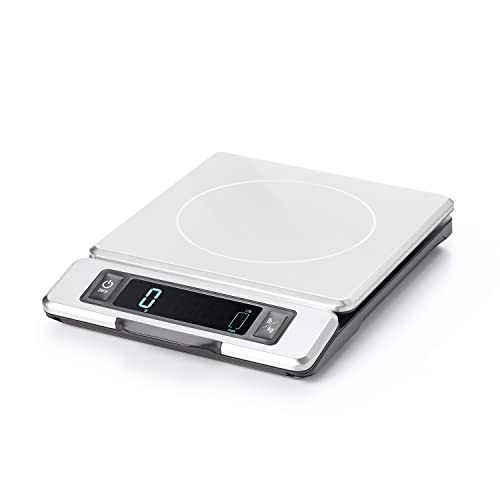
OXO Good Grips Stainless Steel Food Scale
Best for: bakers who want a pull-out display they can read under a wide mixing bowl. Not suited for: anyone who needs to weigh very heavy stockpots full of liquid, or who wants a scale that connects to a phone app for automatic logging. Tier: premium-leaning, positioned by build and features rather than by any promise about a specific listing.
What stands out in this round-up is a pull-out display, a brushed platform that wipes clean, and a calm, uncluttered face that stays readable when a large bowl overhangs the front edge. In daily use that matters more than it sounds: a kitchen scale is handled with wet, floury, or greasy hands, often mid-recipe with something already in the pan, so the distance between wanting a number and trusting a number is measured in small design choices. A display you can read without moving the bowl, a tare button you can find without looking down for long, and a platform that does not rock when a bowl lands slightly off centre all decide whether the scale becomes a habit or a drawer ornament.
Strengths include the way this model handles the tare routine — bowl on, tare to zero, first ingredient in, tare again — without forcing you to restart or do mental arithmetic between additions. Trade-offs are honest ones: like every flat home scale it still needs a level, stable counter, it still dislikes draughts and vibration while it settles, and its platform, however well shaped, cannot make an oversized roasting pan balance safely. Treat it as a precision tool for bowls, plates, and ingredient containers, wipe spills promptly so liquids never creep toward the battery compartment underneath, and it will repay the small care with years of consistent readings.
Escali Primo Digital Food Scale
Best for: everyday cooks who want simple, dependable weighing without menus to learn. Not suited for: anyone who needs to weigh very heavy stockpots full of liquid, or who wants a scale that connects to a phone app for automatic logging. Tier: mid-range, positioned by build and features rather than by any promise about a specific listing.
What stands out in this round-up is a sealed, easy-clean surface, large friendly buttons, and a reputation for straightforward one-touch taring that suits daily cooking better than feature lists do. In daily use that matters more than it sounds: a kitchen scale is handled with wet, floury, or greasy hands, often mid-recipe with something already in the pan, so the distance between wanting a number and trusting a number is measured in small design choices. A display you can read without moving the bowl, a tare button you can find without looking down for long, and a platform that does not rock when a bowl lands slightly off centre all decide whether the scale becomes a habit or a drawer ornament.
Strengths include the way this model handles the tare routine — bowl on, tare to zero, first ingredient in, tare again — without forcing you to restart or do mental arithmetic between additions. Trade-offs are honest ones: like every flat home scale it still needs a level, stable counter, it still dislikes draughts and vibration while it settles, and its platform, however well shaped, cannot make an oversized roasting pan balance safely. Treat it as a precision tool for bowls, plates, and ingredient containers, wipe spills promptly so liquids never creep toward the battery compartment underneath, and it will repay the small care with years of consistent readings.
Etekcity Food Kitchen Scale
Best for: first-time buyers and budget-conscious bakers who want to try weighing without committing much. Not suited for: anyone who needs to weigh very heavy stockpots full of liquid, or who wants a scale that connects to a phone app for automatic logging. Tier: entry-level, positioned by build and features rather than by any promise about a specific listing.
What stands out in this round-up is a slim profile that slides into a drawer, a bright backlit readout, and unit switching that covers the conversions most home recipes actually ask for. In daily use that matters more than it sounds: a kitchen scale is handled with wet, floury, or greasy hands, often mid-recipe with something already in the pan, so the distance between wanting a number and trusting a number is measured in small design choices. A display you can read without moving the bowl, a tare button you can find without looking down for long, and a platform that does not rock when a bowl lands slightly off centre all decide whether the scale becomes a habit or a drawer ornament.
Strengths include the way this model handles the tare routine — bowl on, tare to zero, first ingredient in, tare again — without forcing you to restart or do mental arithmetic between additions. Trade-offs are honest ones: like every flat home scale it still needs a level, stable counter, it still dislikes draughts and vibration while it settles, and its platform, however well shaped, cannot make an oversized roasting pan balance safely. Treat it as a precision tool for bowls, plates, and ingredient containers, wipe spills promptly so liquids never creep toward the battery compartment underneath, and it will repay the small care with years of consistent readings.

Greater Goods Digital Food Kitchen Scale
Best for: home bakers who weigh flour daily and care about a display they can read at a glance. Not suited for: anyone who needs to weigh very heavy stockpots full of liquid, or who wants a scale that connects to a phone app for automatic logging. Tier: mid-range, positioned by build and features rather than by any promise about a specific listing.
What stands out in this round-up is a high-contrast display, a smooth glass-style platform that releases flour dust with one wipe, and controls placed so a floury fingertip does not have to hunt for them. In daily use that matters more than it sounds: a kitchen scale is handled with wet, floury, or greasy hands, often mid-recipe with something already in the pan, so the distance between wanting a number and trusting a number is measured in small design choices. A display you can read without moving the bowl, a tare button you can find without looking down for long, and a platform that does not rock when a bowl lands slightly off centre all decide whether the scale becomes a habit or a drawer ornament.
Strengths include the way this model handles the tare routine — bowl on, tare to zero, first ingredient in, tare again — without forcing you to restart or do mental arithmetic between additions. Trade-offs are honest ones: like every flat home scale it still needs a level, stable counter, it still dislikes draughts and vibration while it settles, and its platform, however well shaped, cannot make an oversized roasting pan balance safely. Treat it as a precision tool for bowls, plates, and ingredient containers, wipe spills promptly so liquids never creep toward the battery compartment underneath, and it will repay the small care with years of consistent readings.
Taylor Pro Digital Kitchen Food Scale
Best for: cooks who like a classic, no-nonsense tool from a long-running measuring brand. Not suited for: anyone who needs to weigh very heavy stockpots full of liquid, or who wants a scale that connects to a phone app for automatic logging. Tier: entry-to-mid-range, positioned by build and features rather than by any promise about a specific listing.
What stands out in this round-up is a straightforward layout, a platform sized for dinner plates and mixing bowls, and the kind of plain reliability that keeps a tool in the drawer for years. In daily use that matters more than it sounds: a kitchen scale is handled with wet, floury, or greasy hands, often mid-recipe with something already in the pan, so the distance between wanting a number and trusting a number is measured in small design choices. A display you can read without moving the bowl, a tare button you can find without looking down for long, and a platform that does not rock when a bowl lands slightly off centre all decide whether the scale becomes a habit or a drawer ornament.
Strengths include the way this model handles the tare routine — bowl on, tare to zero, first ingredient in, tare again — without forcing you to restart or do mental arithmetic between additions. Trade-offs are honest ones: like every flat home scale it still needs a level, stable counter, it still dislikes draughts and vibration while it settles, and its platform, however well shaped, cannot make an oversized roasting pan balance safely. Treat it as a precision tool for bowls, plates, and ingredient containers, wipe spills promptly so liquids never creep toward the battery compartment underneath, and it will repay the small care with years of consistent readings.
What Separates the Field in Daily Use
Displays and Readability
The display is where scales quietly win or lose their owners. A readout hidden by your mixing bowl forces a lean, a lift, or a guess, and guesses undo the entire point of weighing. Pull-out displays, angled displays, and simply large, high-contrast digits are three different answers to the same problem. Judge them against your own bowls, not against a photograph of an empty platform.
Platforms, Cleaning and Flour
Flour is the natural enemy of tidy weighing: it drifts into seams, coats buttons, and turns a beautiful scale grubby in one bake. Smooth, sealed surfaces wipe clean in a second; textured or heavily seamed designs ask for a brush and patience. Stainless shrugs off a warm bowl; glass-style platforms look calm and clean easily but ask you not to drop a cast-iron pan onto them. None of this is glamorous, and all of it decides whether you still like the scale in year two.
Units, Tare and the Small Print of Use
Unit switching sounds trivial until a recipe gives water in grams, flour in ounces, and milk in millilitres on the same page. Good scales move between units with one obvious button and remember nothing they should not. Tare should be instant, repeatable, and available at any load within reason. Auto-off timing is the small print that bites: too eager, and the scale sleeps mid-pour; too lazy, and batteries fade in the drawer. The better designs lean toward staying awake while you are clearly mid-recipe.
How to Choose Between These Models
Start with your widest bowl and your messiest recipe. If both are large, prioritise display design. If you bake in small batches and store everything in one drawer, prioritise slimness. If the scale will serve a household — children weighing cereal, a partner portioning coffee — prioritise simple controls that nobody needs to be taught. Price tiers here are described in words on purpose: entry-level models cover the core job honestly, mid-range models buy better displays and surfaces, and premium-leaning models buy build and readability rather than a different kind of accuracy.
The choosing framework is expanded in
our single-scale kitchen scale review the kitchen scale buying guide a guide to choosing a kitchen scale for everyday use the best kitchen measuring spoons for small amounts
, and the single-model deep dive sits alongside this round-up for readers who prefer one recommendation examined closely.
Strengths and Trade-Offs of the Category
Strengths
- Every model here performs the core job — tare-based weighing in one bowl — well enough to transform baking consistency.
- The field is mature: even entry-level designs are slim, quick to wake, and easy to clean.
- Choice is genuine: display style, platform material, and size let you match the tool to your kitchen.
Trade-offs
- No home model loves very small spice amounts or very heavy pots; plan around both ends of the range.
- More features can mean more menus; simplicity is itself a feature for shared kitchens.
- Batteries are a recurring chore unless you choose a rechargeable design and remember to charge it.
Setup, Care and Maintenance Essentials
Whichever model you choose, the care routine is the same. Set it level, keep it dry, and let readings settle. Clean with a damp cloth rather than a soak.
Two habits protect both the scale and the food. First, wipe spills promptly — a puddle of oil or batter left sitting on the platform can creep underneath and toward the battery compartment, and liquids inside that compartment are a common, avoidable cause of erratic readings and early failure. Second, treat raw meat with respect: weigh raw meats on a washable barrier or plate rather than directly on the platform, then wash hands, the plate, and any touched surfaces afterwards before you handle other ingredients. When batteries finally die, dispose of them per local guidance rather than in household rubbish, and never mix an old battery with a fresh one to squeeze out extra weeks.
Store scales flat and unloaded — leaving a heavy bowl sitting on the platform for days is unkind to any sensor. If a scale will sit unused for months, removing the batteries protects it from leaks; when you return to it, fresh batteries and a quick check against a labelled packet restore confidence in a minute.
Final Verdict
There is no single winner here, and that is the honest result. The OXO design rewards bakers with big bowls, the Escali rewards anyone who values simplicity, the Etekcity lowers the cost of starting, the Greater Goods design rewards daily flour work, and the Taylor rewards cooks who like a classic tool. Pick the temperament that matches your kitchen, build the tare habit, and any of these will make your recipes more repeatable than they were last month.
Scenario One: The Sourdough Household
Twice a week, this household feeds a starter, mixes a dough by percentage, and divides it into loaves that must proof at the same rate. Their weighing is heavy, floury, and bowl-dominated, so their priorities are a display that survives a wide bowl, a platform that shrugs off flour dust, and a tare button that responds to a fingertip coated in dough. For them, the pull-out display design and the stainless, baker-focused models lead this round-up, because every one of their pain points is addressed by those two design choices. Slim drawer models would work, but would be out, open, and flour-covered so often that their one advantage — disappearing — would never be used.
Their secondary need is forgiveness. Sourdough is a slow, sticky process conducted by people who are often also doing something else, so a display that stays awake, a reading that settles and holds, and a surface that cleans with one wipe all matter more than any extra mode. This is the scenario where spending into the mid or premium-leaning tier is easiest to justify: the scale is used hundreds of times a year, and small daily frictions multiply accordingly.
Scenario Two: The Small Kitchen, Occasional Baker
This cook bakes monthly, portions rice and coffee weekly, and stores everything in two drawers that already close with persuasion. For them the round-up’s answer is the slim, entry-level end of the field: a scale that slides beside the chopping boards, wakes quickly, and asks nothing. The trade-off they accept — a lighter platform that rewards a steady pour — is a fair one at their frequency of use, and the money saved against premium tiers can go toward ingredients they will actually enjoy baking with.
Their risk is not buying the wrong model; it is buying any model and storing it somewhere that requires moving three other objects to reach. The reviews above therefore weigh storage honesty heavily for this scenario: the best scale for a small kitchen is the one whose home was decided before purchase, in the drawer nearest the mixing bowl, where it will be reached for without a second thought.
Scenario Three: The Meal-Prep Sunday
Every Sunday this household cooks grains, roasts trays of vegetables, and divides protein across a week of lunches. Their weighing is a production line: container, tare, portion, tare, next container. Speed and cleanability dominate — a platform that wipes between raw chicken portions and cooked grains, controls that respond instantly, and a display readable at a slight distance while hands are busy. The mid-range, smooth-platform models in this round-up suit them best, with the routine built around food safety: raw meat weighed on its own washable plate, hands and surfaces washed before cooked food is portioned, and spills wiped promptly so nothing migrates toward the battery compartment.
For this scenario the scale’s value is measured in fairness and reheating: containers that match actually do reheat evenly, and a week of lunches that are genuinely equal removes a small daily irritation most people never identify. It is the least glamorous scenario in this round-up and, week after week, possibly the most valuable.
Scenario Four: The Coffee-First Kitchen
This household weighs twice daily and bakes twice a month. Their scale lives beside the kettle, and its virtues are responsiveness — a reading that climbs smoothly as water pours — stability on a counter that also holds a grinder, and a footprint small enough to share a crowded brewing corner. Most models in this round-up serve them well; the deciding factors are how the display behaves in bright morning light and whether the auto-off timer is patient enough for a slow pour. A scale that sleeps mid-brew will be replaced, however accurate it is, because coffee is a ritual and rituals punish interruption.
Their experience also exposes a truth the other scenarios hide: frequency beats intensity. A tool used fourteen times a week in thirty-second bursts must be effortless in a way a twice-weekly baking tool need not be. When in doubt between two models, this household should choose the one with the clearer display and the simpler wake-up, every time.
How the Field Ages: Year Two and Beyond
Reviews usually end at the honeymoon; owners live in year two. What ages well across this field is simplicity: scales with few modes and sealed surfaces tend to look and behave much as they did on arrival, while complex models gather grime in seams and lose their owners’ patience one menu at a time. Batteries are the predictable maintenance — readings grow vague before they fail outright, and a fresh set restores most scales completely. Owners who dispose of spent batteries per local guidance, keep the platform dry, and store the scale flat and unloaded report the same story across brands: the tool fades into the kitchen’s background, which for a measuring instrument is the highest praise available.
What ages badly is a mismatch bought at the start: the wide-bowl baker still leaning over a hidden display in year two, the small kitchen still excavating its scale from a cupboard. Those are not product failures; they are matching failures, and they are exactly what a scenario-based round-up exists to prevent. Read the scenarios above, recognise your own kitchen honestly, and the model that fits it will still fit when the novelty is gone.
Head-to-Head: The Differences That Actually Decide
Put the baker-focused designs against the slim drawer designs and the contest is not accuracy — it is presence. The baker’s models assume the scale lives out, gets floury, and must be readable under the biggest bowl in the house; the slim models assume it lives away, appears for a task, and returns to a drawer. Neither assumption is wrong, and choosing between them is really choosing a description of your kitchen. This is why this round-up refuses a single ranked winner: a ranking would smuggle one kitchen’s assumptions into every reader’s home.
Put the simplicity-first designs against the feature-rich ones and the contest is about menus. Every extra mode must be travelled past, remembered, or ignored by every user in the household, including the ones who never asked for it. Households with one confident cook can absorb that cost happily in exchange for a percentage mode or a timer; shared and family kitchens usually cannot, and for them the plainest control layout in this round-up is a genuine feature, arguably the deciding one.
Put the entry tier against the premium-leaning tier and the honest difference is how the tool feels at six in the morning: the weight of the platform, the certainty of the buttons, the clarity of the digits in grey light. Nothing about the resulting loaf separates them. Buyers who weigh daily are buying mornings, and should spend accordingly; buyers who weigh monthly are buying a capability, and the entry tier sells exactly that, honestly and completely.
Questions Readers Ask Before Choosing From This List
The most common pre-purchase question is whether one of these scales can be shared between a baker and a coffee brewer without arguments. It can, provided the display suits the baker’s bowls and the timer behaviour suits the brewer’s pour; those two checks, done in advance, prevent the only real conflicts. The second question is whether children can use one, and the answer — with the raw-meat routine taught and hot bowls left to adults — is that weighing is one of the safest, most educational jobs in a kitchen, closer to mathematics homework than to cooking risk.
The third question is about longevity across brands, and the round-up’s answer is deliberately boring: care predicts lifespan better than badge. A dry platform, prompt spill wiping, liquids kept from the battery compartment, flat unloaded storage, and batteries replaced before they leak will carry any model here through years of service, while a neglected premium model will fail sooner than a cared-for entry one. Choose the temperament that fits, then be the kind of owner the tool deserves.
A Note on Gifts, Registries and Second Scales
A kitchen scale is a better gift than its plainness suggests, precisely because its value compounds quietly in someone else’s routine — but only for recipients who bake or brew. Given to a non-baker, it becomes the drawer monument this round-up has mentioned before. Given to a baker who measures in cups, it is often the single most-used present of the year. Second scales, meanwhile, are more rational than they sound: one for the baking counter and one for the coffee corner ends the only real territorial dispute these tools cause, and at entry tiers the second scale is a modest price for domestic peace.
Working Methods That Make the Difference
Round-ups usually stop at the shortlist, but owners live in the technique that follows the purchase. The methods below apply equally to every model reviewed above, and they explain why two households can buy the same scale and report different experiences of it.
Weighing Flour Without the Cloud
Flour technique is where new scale owners either convert or quietly give up, so it deserves plain instructions. Spoon flour lightly into the bowl on the scale rather than dropping it from a height, because a falling stream registers in jumps and invites overshooting; add the last portion slowly, tapping the spoon against the bowl rim, and stop the moment the target arrives, remembering that you can always add a spoonful and can never politely remove one from a bowl that already holds water or eggs. If you do overshoot dry flour before any liquid joins it, simply lift the excess back out with a clean spoon — one of the forgiving properties of dry ingredients that makes flour the ideal training ground for the whole weighing habit.
Weighing Sticky, Slow and Awkward Ingredients
Honey, syrups, oils, nut butters and tomato paste all punish impatience. Pour or spoon them slowly, in a thin stream or small additions, and let the display settle between additions rather than chasing a number that is still arriving. A light smear of oil inside the spoon or jug, where the recipe allows it, helps sticky ingredients release cleanly instead of leaving an unweighed residue behind. For ingredients that arrive in a jar you cannot empty, weigh the jar before and after: the difference is exactly what went into the recipe, a small piece of scale arithmetic that feels like a trick the first time and like second nature by the third.
Baker’s Percentages, Without the Intimidation
A percentage in baking is simply every ingredient expressed against the flour, which is counted as the whole. Once a recipe is weighed, those relationships become visible: water as a share of flour tells you how wet a dough will feel before you touch it, salt as a share tells you whether seasoning will be gentle or assertive, and a written record of those shares lets you resize a recipe to any amount of flour you happen to have. Nobody needs the mathematics to enjoy a scale, but weighing is what makes the mathematics available, and many home bakers find that a season of weighed loaves teaches them more about dough than years of cup recipes did.
Seasonal and Batch Cooking
Preserving, jam-making, curing and holiday baking all multiply recipes beyond the size where cups stay sane. Doubling a spoon-based recipe invites fraction errors at exactly the moment the cook is busiest; doubling a weighed recipe is a single multiplication per ingredient, checkable at a glance. Batch cooking for the freezer benefits the same way, because containers filled by weight freeze, store and reheat as true equals, and a note of the weights turns a successful batch into a repeatable one rather than a fond memory that the next attempt approximates.
Teaching the Habit to a Household
A scale only delivers its value when the people who cook actually use it, so the social rollout matters. Demonstrate tare once, on something delicious, and let the one-bowl washing-up saving make the argument. Label nothing, lecture nobody, and keep the scale exactly where the mixing happens so that using it is easier than not using it. Households report that the habit spreads by convenience rather than conviction: the second cook reaches for it because it is there, reads clearly, and has never yet made a recipe worse.
That is the final lesson of these reviews: choose the temperament that fits your kitchen from the shortlist, then let technique do the rest, because it will.
If This Round-Up Had to Shrink to Three
Forced to cut the field, this round-up would keep one baker-focused design with a display built for wide bowls, one simplicity-first model for shared and family kitchens, and one honest entry-level scale for everyone starting out. Those three temperaments cover the overwhelming majority of real kitchens, and the two models that would be cut are not worse tools — they are narrower answers to questions fewer readers are asking. Presenting all five, with their suits and skip-if profiles intact, remains the more useful service; but the exercise exposes the round-up’s underlying structure, which is temperament first and brand second, and it is why readers are urged to choose their scenario before they choose their model.
The cut exercise also clarifies what this round-up is not. It is not a laboratory ranking, because no laboratory figures are printed for any model here, and it is not a price ladder, because tiers are described in words. It is a matching service between five honest designs and the kitchens described in its scenarios, and a match made on temperament, storage and bowls will still look correct when the listings, figures and seasons have all changed around it.
How to Argue With This Round-Up
Good reviews should be arguable-with, so here is the honest way to disagree. If your kitchen weighs almost nothing but coffee, weight the responsiveness discussion more heavily than this round-up does and demote platform size. If your household includes a cook who hates any device with a battery, no review can help, and the correct purchase is none. If you bake in a professional-leaning way at home, your capacity and workflow needs may outgrow every model here, and this list becomes a floor rather than a ceiling. Each disagreement starts from your kitchen rather than from a score, which is exactly the habit this round-up has tried to teach from its first page.
And if you buy from this list and love or loathe the result, the useful feedback is scenario-shaped: which kitchen you have, which model you chose, and where the match rubbed. That is the information the next reader actually needs, far more than another number attached to a product whose listing will have changed before the comment is a month old.
One More Angle: Weighing Beyond the Recipe Book
The longer a scale stays in a kitchen, the more its job description quietly expands beyond the recipes that justified buying it, and this round-up would be incomplete without recording that expansion. Portions of pet food, measured consistently, end the household debate about whether the dog has been fed. Parcels get weighed before a trip to the post office, ending another small uncertainty. A child’s science project, a batch of homemade play dough, the coffee beans remaining in a bag before a shopping trip — each is a thirty-second weighing that nobody would have bought a scale to perform, and together they form a long tail of usefulness that spec sheets never mention and owners always do.
There is a corresponding expansion in confidence that matters more than any single extra use. A cook who weighs regularly develops a physical sense of quantity — what a hundred grams of flour looks like in their bowl, how heavy a portion of pasta feels in the hand — that transfers back into unmeasured cooking and makes even their improvisation more accurate. The scale, paradoxically, trains the very instinct that its sceptics defend, which may be the strongest closing argument available: the tool does not replace judgement, it educates it, one weighed recipe at a time, until judgement itself has quietly become more reliable everywhere in the kitchen.
None of this expansion requires a better model than the ones already discussed, a larger platform, or a single extra mode. It requires only the two things every section of this article has kept returning to: a scale matched honestly to its kitchen, and a home within reach of the work. Given those, the tool keeps finding work; denied those, even the finest design in the field is furniture. That is as true for the last reader of this article as it was for the first, and it is the note on which the discussion properly ends.
Closing Note
It is worth pausing, at the end, on how unglamorous the winning advice in this category always turns out to be. Nobody’s cooking was ever transformed by a specification; it is transformed, slowly and permanently, by a reliable number appearing at the moment an ingredient is added, recipe after recipe, until consistency becomes the kitchen’s default rather than its occasional achievement. This round-up set out to match models to kitchens rather than to crown a winner, and every scenario, comparison and head-to-head in it points the same way: temperament, display and storage decide satisfaction long after the purchase is forgotten.
So the final recommendation is deliberately plain. Decide honestly, buy at the tier your circumstances describe, keep the tool dry, level and within reach, respect the small food-safety and battery routines that protect it, and then cook — because the recipes, repeated and improved, are the only review, guide or verdict that will matter in your kitchen a year from now.
One final, practical favour a round-up can do its readers is to say what to do on the day the scale arrives: unbox it beside the mixing bowls, run the bowl and tare tests described in these pages, weigh one familiar recipe, and write the amounts down. That first hour sets the home, the habit and the expectations all at once, and readers who spend it rarely join the ranks of owners whose scales migrate to a cupboard.
Comparing Kitchen scale Options Side by Side: Patterns That Separate a Good Match From a Poor One
Comparing several examples of a kitchen scale is less about crowning a winner than about spotting patterns: which details repeat across listings because they matter, and which are decoration. Set the options against the baking and cooking habits it will support and the differences that count usually narrow to a handful — format, fit, upkeep and how each design handles the awkward cases rather than the easy ones.
Across listings, this is a pattern worth tracking from model to model. Start with fit, because fit failures cannot be fixed by enthusiasm later. In practice that means three things: check the capacity against your largest mixing bowl plus its contents; look at the smallest increment the scale reads, if your recipes use small quantities; and confirm the platform fits your biggest bowl without hiding the display. Write the answers down rather than holding them in your head, because a kitchen scale is usually chosen over several browsing sessions, and the constraint you checked on Monday is the one forgotten by Friday. If any of the three checks produces an awkward answer, treat it as information about format, not as a problem to wave away — a different format of kitchen scale often removes the conflict entirely, while a compromise on fit tends to be re-litigated every time the product is used.
Some options handle this gracefully; others expose it immediately. Then picture the product in its real situations rather than its best one. The routine cases are easy to imagine: a bread routine where flour and water are weighed for every batch, or portioning ingredients for meal prep across a week of lunches. The more useful exercise is the harder day: a heavy cast-iron pot exceeding capacity mid-recipe; and flour dust working into buttons and seams during daily baking. A kitchen scale does not need to be perfect in those moments, but it does need a workable answer to them — a way to be moved, covered, adjusted, cleaned or simply tolerated until conditions improve. If the honest answer is that the hard day would make you stop using it altogether, that is a decision-grade fact, and it is far cheaper to learn it now than after delivery.
This is where side-by-side comparison earns its keep. Most disappointments trace back to a short list of avoidable errors. The common ones here are: weighing on an uneven or soft surface and trusting the result; forgetting to tare between additions, then trying to correct the maths later; and letting liquids pool on the platform and seep toward the controls. Notice that none of them is really about build quality. They are sequencing errors — deciding before measuring, assuming instead of checking, or copying someone else’s setup whose space and habits differ from yours. Reading any listing for a kitchen scale with those three errors in mind is a fast filter: if the page in front of you encourages one of them, slow down and return to your own measurements and routine.
The pattern repeats too often across brands to be coincidence. Ownership also has a rhythm, and it is worth pricing that rhythm in before you commit. For a kitchen scale, the upkeep that keeps it pleasant is modest but specific: wipe the platform after use and keep liquids away from the seams; store the scale flat and unloaded in a dry drawer or cupboard; and replace batteries promptly when the low indicator appears rather than working around it. None of that is onerous on its own. The question is whether it attaches to a routine you already have — a weekly clean, a seasonal tidy, a habit of putting things away properly — or whether it requires a new routine invented from scratch, which is the kind that quietly lapses by the second month.
Separate the field by this criterion before comparing anything else. When a listing is open in front of you, use the examples named in this guide as a checking exercise rather than a ranking. Take the OXO Good Grips Stainless Steel Food Scale, the Escali Primo Digital Food Scale and the Etekcity Food Kitchen Scale: for each one, ask how it answers the fit checks above, what its format assumes about your space, and which of the edge cases its design handles gracefully. Listings answer those questions unevenly — dimensions and format are usually stated, while behaviour on the hard days has to be inferred from design details — but even an incomplete answer is useful, because it shows you which questions to carry to the next listing instead of buying the first plausible option.
Frequently Asked Questions
Which kitchen scale is best for a beginner?
The best beginner scale is the one with the fewest obstacles between you and a reading: clear digits, an obvious tare button, and controls that need no manual. In this round-up that points to the entry-level and simplicity-focused designs, which cover the core job honestly. Beginners rarely need extra modes; they need a scale that wakes quickly, reads clearly under a bowl, and cleans in seconds, so the habit forms instead of fading.
Is a more expensive kitchen scale more accurate?
Not in the way most buyers imagine. Across the reputable field, ordinary home weighing is consistent enough that baking outcomes do not separate by price tier. What higher tiers buy is experience: better displays, nicer platforms, sturdier build, and controls that feel right with floury hands. Spend more for readability and surface if you weigh daily; do not spend more expecting a different kind of correctness in your bread.
What matters more, capacity or display size?
For most households, the display. Capacity only matters when a load will not fit at all, which is rare for ordinary baking bowls; readability matters every single time you weigh under a wide bowl. Judge capacity against your heaviest realistic load — a bowl plus a full batch of dough — and then choose between the models that clear it by how easily you can read them in your own kitchen light.
Can one scale serve both baking and coffee?
Yes, comfortably, for most people. Baking wants a clear display and an easy-clean platform; coffee wants a responsive, stable reading while you pour. A good general scale covers both, which is why this round-up groups by temperament rather than by single hobbies. Dedicated coffee scales with timers exist for enthusiasts, but a household that brews and bakes will usually get more total value from one well-chosen general model kept within reach.
How do I keep a kitchen scale reading true over time?
Keep it level, dry, and unloaded in storage, and treat odd readings as a checklist rather than a verdict: surface first, obstructions second, batteries third. Wipe spills promptly so liquid never reaches the battery compartment, weigh raw meat on a washable plate and wash hands and surfaces afterwards, and occasionally confirm the scale against a labelled, unopened packet. Those habits keep any model in this round-up honest for years.