Disclosure: As an Amazon Associate, airfryerkitchensupply.com earns from qualifying purchases. Links on this page are affiliate links; they cost you nothing extra. Prices and availability change often, so check the current Amazon listing before you buy.
Weighing up kitchen scale pros and cons honestly means resisting two easy stories: the enthusiast’s claim that a scale changes everything, and the sceptic’s claim that good cooks never needed one. The truth about kitchen scale pros and cons sits in the middle, and it depends on what you cook. This article lays out the genuine advantages, the real drawbacks, and what the trade-offs mean for different kitchens — then shows the models in prose, and the habits that shrink the cons list in daily use.
Key Takeaways
- The biggest pro is repeatability: measured ingredients make recipes behave the same way twice.
- The biggest con is friction: another tool to store, power, clean, and remember to use.
- Scales are weak at the extremes — pinches of spice and stockpots of soup both belong to other tools.
- Most cons shrink with habits: a washable plate for raw meat, prompt spill wiping, and a fixed home for the scale.
- For bakers the pros dominate; for instinctive savoury cooks the balance is closer.
Quick verdict: the pros win decisively for anyone who bakes or follows gram-based recipes, and win narrowly for general cooks who portion and meal-prep. The cons win only where storage is impossible or cooking is entirely improvisational.
In this guide
Kitchen Scale Pros and Cons: The Pros
Repeatability You Can Taste
A cup of flour is not a fixed quantity; it is a range that shifts with scooping, humidity, and settling. Weight is a quantity. That single difference explains most of the pro case: dough hydration you can repeat, cakes that rise the same way in July as in January, and coffee that tastes like itself on a tired Monday. When something does go wrong, measured inputs let you diagnose it, because you know what actually went in.
One Bowl, Less Washing-Up
Tare turns a mixing bowl into the only measuring vessel for most of a recipe. Flour, sugar, butter, and milk can arrive in sequence, each weighed, with no parade of cups and spoons to wash afterwards. On a baking day with three projects, that saving is not trivial — it is the difference between baking again next weekend and quietly dreading the sink.
Recipes From Anywhere
Much of the world’s best recipe writing is in grams. A scale unlocks it without conversion charts, cup equivalents, or the nagging doubt that a converted amount was rounded into a different recipe. It also makes scaling painless: halving or doubling is arithmetic on one number per ingredient, not fractions of nested spoon measures.
Fair Portions and Honest Servings
Equal dough pieces bake evenly; equal burgers finish together; meal-prep containers that match reheat predictably. The scale also offers a neutral answer to portion questions that eyes answer generously. None of this requires obsession — it is simply the difference between guessing a serving and knowing one.
Learning Faster
Cooks improve by changing one variable at a time, and weighing makes variables visible. Add a little more water to a dough, note the result, adjust again next time. Without measurement, those experiments blur into each other and teach nothing. With it, a home baker develops genuine intuition — the kind sceptics rightly praise — faster and on purpose.
The Cons
Another Object in a Full Kitchen
Storage is a real cost. A scale needs a flat home, ideally near where you mix, and kitchens that are already negotiating for drawer space will feel even a slim addition. A scale exiled to a high cupboard might as well not exist, so the con is not size alone — it is size multiplied by inconvenience.
Weak at Both Extremes
Below a spoonful, a general kitchen scale is the wrong tool; yeast and spices for one loaf belong to measuring spoons. Above a loaded mixing bowl, it is also the wrong tool; a stockpot belongs on the hob, with its ingredients weighed before they go in. Owning a scale does not retire your other measures, and anyone who expects it to will be disappointed at both ends.
Batteries, Time-Outs and Small Annoyances
Scales sleep to save power, sometimes mid-pour. Displays hide under wide bowls. Readings wobble on uneven counters or near a vibrating appliance. Batteries die at the least convenient moment of a recipe. Individually these are trivial; together they form the friction that makes some owners quietly drift back to cups.
It Cannot Rescue a Bad Recipe
Precision applied to vague instructions produces precisely vague results. A scale makes a good recipe repeatable; it does not supply missing temperatures, timings, or technique. Buyers expecting the tool itself to improve their cooking, without the recipes and habits around it, are buying disappointment.
Cleaning and Care Are Real, If Small
A scale cannot be soaked, scrubbed under a tap, or left with batter drying into its seams. It asks for a damp cloth, prompt attention to spills, and respect around liquids and its battery compartment. Raw ingredients add a food-safety step: raw meat belongs on a washable plate or barrier, with hands and surfaces washed afterwards. Small asks — but they are asks, and they belong on the cons list honestly.
What the Trade-Offs Mean for You
For the regular baker, the ledger is not close: repeatability and one-bowl mixing outweigh storage and battery chores many times over. For the coffee-focused cook, the pro is narrower but daily — a ratio you can hit every morning. For the meal-prepper, portioning fairness carries the case. For the purely improvisational savoury cook, who seasons by hand and bakes twice a year, the cons have their strongest hearing: the scale will help occasionally and gather dust honestly in between.
Context: Scale Versus the Alternatives
Measuring cups are faster for a splash of liquid and worse for flour. Measuring spoons are essential below a tablespoon and tedious above it. A notebook and a good memory — the sceptic’s system — work until a recipe must be shared, scaled, or repeated after a month away. The scale does not replace these; it covers the wide middle ground where amounts decide outcomes.
The Models in Prose
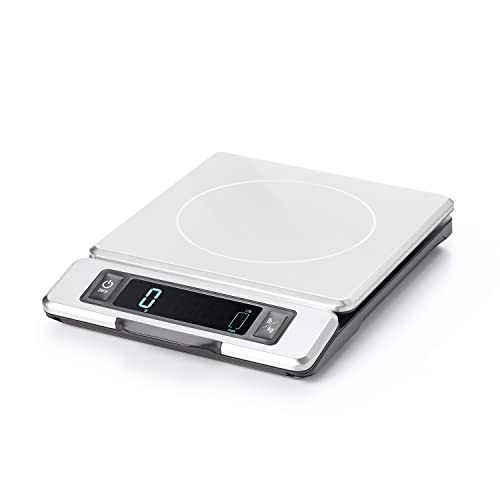
OXO Good Grips Stainless Steel Food Scale
Best for: bakers who want a pull-out display they can read under a wide mixing bowl. Not suited for: anyone who needs to weigh very heavy stockpots full of liquid, or who wants a scale that connects to a phone app for automatic logging. Tier: premium-leaning, positioned by build and features rather than by any promise about a specific listing.
What stands out in this pros-and-cons assessment is a pull-out display, a brushed platform that wipes clean, and a calm, uncluttered face that stays readable when a large bowl overhangs the front edge. In daily use that matters more than it sounds: a kitchen scale is handled with wet, floury, or greasy hands, often mid-recipe with something already in the pan, so the distance between wanting a number and trusting a number is measured in small design choices. A display you can read without moving the bowl, a tare button you can find without looking down for long, and a platform that does not rock when a bowl lands slightly off centre all decide whether the scale becomes a habit or a drawer ornament.
Strengths include the way this model handles the tare routine — bowl on, tare to zero, first ingredient in, tare again — without forcing you to restart or do mental arithmetic between additions. Trade-offs are honest ones: like every flat home scale it still needs a level, stable counter, it still dislikes draughts and vibration while it settles, and its platform, however well shaped, cannot make an oversized roasting pan balance safely. Treat it as a precision tool for bowls, plates, and ingredient containers, wipe spills promptly so liquids never creep toward the battery compartment underneath, and it will repay the small care with years of consistent readings.
Escali Primo Digital Food Scale
Best for: everyday cooks who want simple, dependable weighing without menus to learn. Not suited for: anyone who needs to weigh very heavy stockpots full of liquid, or who wants a scale that connects to a phone app for automatic logging. Tier: mid-range, positioned by build and features rather than by any promise about a specific listing.
What stands out in this pros-and-cons assessment is a sealed, easy-clean surface, large friendly buttons, and a reputation for straightforward one-touch taring that suits daily cooking better than feature lists do. In daily use that matters more than it sounds: a kitchen scale is handled with wet, floury, or greasy hands, often mid-recipe with something already in the pan, so the distance between wanting a number and trusting a number is measured in small design choices. A display you can read without moving the bowl, a tare button you can find without looking down for long, and a platform that does not rock when a bowl lands slightly off centre all decide whether the scale becomes a habit or a drawer ornament.
Strengths include the way this model handles the tare routine — bowl on, tare to zero, first ingredient in, tare again — without forcing you to restart or do mental arithmetic between additions. Trade-offs are honest ones: like every flat home scale it still needs a level, stable counter, it still dislikes draughts and vibration while it settles, and its platform, however well shaped, cannot make an oversized roasting pan balance safely. Treat it as a precision tool for bowls, plates, and ingredient containers, wipe spills promptly so liquids never creep toward the battery compartment underneath, and it will repay the small care with years of consistent readings.
Etekcity Food Kitchen Scale
Best for: first-time buyers and budget-conscious bakers who want to try weighing without committing much. Not suited for: anyone who needs to weigh very heavy stockpots full of liquid, or who wants a scale that connects to a phone app for automatic logging. Tier: entry-level, positioned by build and features rather than by any promise about a specific listing.
What stands out in this pros-and-cons assessment is a slim profile that slides into a drawer, a bright backlit readout, and unit switching that covers the conversions most home recipes actually ask for. In daily use that matters more than it sounds: a kitchen scale is handled with wet, floury, or greasy hands, often mid-recipe with something already in the pan, so the distance between wanting a number and trusting a number is measured in small design choices. A display you can read without moving the bowl, a tare button you can find without looking down for long, and a platform that does not rock when a bowl lands slightly off centre all decide whether the scale becomes a habit or a drawer ornament.
Strengths include the way this model handles the tare routine — bowl on, tare to zero, first ingredient in, tare again — without forcing you to restart or do mental arithmetic between additions. Trade-offs are honest ones: like every flat home scale it still needs a level, stable counter, it still dislikes draughts and vibration while it settles, and its platform, however well shaped, cannot make an oversized roasting pan balance safely. Treat it as a precision tool for bowls, plates, and ingredient containers, wipe spills promptly so liquids never creep toward the battery compartment underneath, and it will repay the small care with years of consistent readings.

Greater Goods Digital Food Kitchen Scale
Best for: home bakers who weigh flour daily and care about a display they can read at a glance. Not suited for: anyone who needs to weigh very heavy stockpots full of liquid, or who wants a scale that connects to a phone app for automatic logging. Tier: mid-range, positioned by build and features rather than by any promise about a specific listing.
What stands out in this pros-and-cons assessment is a high-contrast display, a smooth glass-style platform that releases flour dust with one wipe, and controls placed so a floury fingertip does not have to hunt for them. In daily use that matters more than it sounds: a kitchen scale is handled with wet, floury, or greasy hands, often mid-recipe with something already in the pan, so the distance between wanting a number and trusting a number is measured in small design choices. A display you can read without moving the bowl, a tare button you can find without looking down for long, and a platform that does not rock when a bowl lands slightly off centre all decide whether the scale becomes a habit or a drawer ornament.
Strengths include the way this model handles the tare routine — bowl on, tare to zero, first ingredient in, tare again — without forcing you to restart or do mental arithmetic between additions. Trade-offs are honest ones: like every flat home scale it still needs a level, stable counter, it still dislikes draughts and vibration while it settles, and its platform, however well shaped, cannot make an oversized roasting pan balance safely. Treat it as a precision tool for bowls, plates, and ingredient containers, wipe spills promptly so liquids never creep toward the battery compartment underneath, and it will repay the small care with years of consistent readings.
Taylor Pro Digital Kitchen Food Scale
Best for: cooks who like a classic, no-nonsense tool from a long-running measuring brand. Not suited for: anyone who needs to weigh very heavy stockpots full of liquid, or who wants a scale that connects to a phone app for automatic logging. Tier: entry-to-mid-range, positioned by build and features rather than by any promise about a specific listing.
What stands out in this pros-and-cons assessment is a straightforward layout, a platform sized for dinner plates and mixing bowls, and the kind of plain reliability that keeps a tool in the drawer for years. In daily use that matters more than it sounds: a kitchen scale is handled with wet, floury, or greasy hands, often mid-recipe with something already in the pan, so the distance between wanting a number and trusting a number is measured in small design choices. A display you can read without moving the bowl, a tare button you can find without looking down for long, and a platform that does not rock when a bowl lands slightly off centre all decide whether the scale becomes a habit or a drawer ornament.
Strengths include the way this model handles the tare routine — bowl on, tare to zero, first ingredient in, tare again — without forcing you to restart or do mental arithmetic between additions. Trade-offs are honest ones: like every flat home scale it still needs a level, stable counter, it still dislikes draughts and vibration while it settles, and its platform, however well shaped, cannot make an oversized roasting pan balance safely. Treat it as a precision tool for bowls, plates, and ingredient containers, wipe spills promptly so liquids never creep toward the battery compartment underneath, and it will repay the small care with years of consistent readings.
How to Buy Smart
Buy for display readability and surface first, because those decide daily friction — the heart of the cons list. Prefer simple controls if the kitchen is shared. Decide where the scale will live before it arrives, and check the current listing for the specifics of the model you choose rather than trusting any round-up’s memory, including this one.
The fuller choosing framework and the value question are covered in
our kitchen scale review the kitchen scale reviews round-up the kitchen scale buying guide the best kitchen scales already tested on this site a guide to choosing a kitchen scale for everyday use
for readers still on the fence.
Setup and Care That Reduce the Cons
Most cons are habit problems in disguise. Fix the scale’s home on a level stretch of counter or in the nearest drawer. Keep spare batteries where you will actually find them, or charge a rechargeable model on a routine. Let readings settle instead of chasing a flickering digit.
Two habits protect both the scale and the food. First, wipe spills promptly — a puddle of oil or batter left sitting on the platform can creep underneath and toward the battery compartment, and liquids inside that compartment are a common, avoidable cause of erratic readings and early failure. Second, treat raw meat with respect: weigh raw meats on a washable barrier or plate rather than directly on the platform, then wash hands, the plate, and any touched surfaces afterwards before you handle other ingredients. When batteries finally die, dispose of them per local guidance rather than in household rubbish, and never mix an old battery with a fresh one to squeeze out extra weeks.
Bottom Line
The pros of a kitchen scale are structural — repeatability, simplicity of process, access to the world’s recipes — while the cons are mostly frictional and shrink with decent habits and a well-chosen model. For bakers and ratio cooks the verdict is easy. For everyone else, it is a small, honest tool that earns its place if, and only if, it is kept within reach.
The Pro That Grows and the Con That Shrinks
Most product trade-offs are static; this one moves. In the first week, the cons are at their loudest — the scale must be fetched, the tare habit is new, the display hides under the big bowl until you learn the riser trick — while the pros are still promises. By the second month the balance has inverted: fetching is reflex, tare is automatic, and the repeatability pro has begun compounding, because every recipe you have weighed is now a recipe you own in a way you did not before. Judging a kitchen scale at day three is like judging a knife by the first onion; the honest assessment point is after the habit forms, which is why this article weights long-term owners’ experience over first impressions.
The con that never fully shrinks is the extremes problem, and it deserves its longevity. Spoons will always own the pinches, and the stockpot will always own the hob. Owners who accept the partnership early stop experiencing this as a con at all — it becomes simply how a kitchen measures, each tool in its range — while owners who bought expecting a single universal measuring device carry the disappointment for years. Expectation, more than engineering, decides which group you join.
Cost, Value and the Honest Ledger
Discussed in tiers rather than figures, the money side of the ledger is modest: entry-level scales perform the core job, and higher tiers purchase experience rather than correctness. The fuller ledger includes avoided waste — batches that succeed because they were measured, ingredients not lost to a failed bake — and time, where one-bowl tare mixing quietly returns minutes on every baking day. Against those stand the real debits already listed: storage, batteries, cleaning care, and the discipline of the raw-meat barrier routine. For weekly bakers the ledger is not close. For monthly bakers it balances in the scale’s favour if storage is easy. For non-bakers it can honestly tip the other way, and this article’s credibility depends on saying so.
There is also a second-hand honesty to record: a scale is one of the safer used purchases in a kitchen, because its failure modes are obvious — dead display, drifting readings, damaged platform — and a labelled packet test reveals its health in seconds. Buyers on a tight tier can consider that route with the same checklist used for new models, adding only a battery replacement and a thorough clean, with the usual food-safety routine, before first use.
What Experienced Owners Actually Say
Strip away marketing and the long-term owner reports across this category converge on a few sentences. Nobody praises a mode they use monthly. Everybody praises the display they can read and the surface they can wipe. The regrets are matching regrets — wrong size for the bowls, wrong temperament for the storage — rather than brand regrets. And the most common sentence of all is some version of surprise: that such a simple, inexpensive category of tool changed their baking more than appliances costing many times its tier. That convergence is why the pros-and-cons balance in this article favours the scale for most kitchens, while keeping the cons specific enough to act on.
The Social Life of a Scale: Partners, Children and Guests
Tools live in households, not in reviews, and the pros and cons shift with the audience. A partner who brews coffee converts a baking purchase into a shared one, doubling its value without any discussion. A partner who finds the beep irritating or the platform always in the way becomes a standing con that no specification can answer; quiet controls and a agreed home are relationship features as much as product features. Couples who weigh together, dividing dough or portioning a shared meal-prep, often report the scale becoming a small neutral arbiter — the number ends arguments about equal shares that eyesight started.
Children tilt the ledger toward the pros in a way spec sheets never capture. Weighing is arithmetic with immediate, edible results: totals, differences, halving and doubling made physical. A child who has tared a bowl and built a recipe by numbers has learned more practical mathematics than a worksheet usually delivers, and the safety routine around it — barrier plate for raw meat, washed hands and surfaces, care with hot bowls — is food education in its most usable form. The con, for completeness, is that a scale is not a toy: it does not belong in games, under feet, or under a standing toddler, however often that experiment is proposed.
Guests complete the social picture by becoming converts or sceptics in ninety seconds of watching one-bowl mixing. The demonstration that converts is never accuracy; it is the washing-up that does not happen afterwards. Kitchens are social places, and a tool that reduces the least social part of cooking — the sink of measures — earns goodwill entirely out of proportion to its size and tier.
Environmental and Practical Footnotes to the Ledger
A fair pros-and-cons account should include the small print of ownership. Batteries are the recurring footprint: choosing rechargeable models or rechargeable cells, and disposing of spent batteries per local guidance rather than in household waste, keeps that footprint modest. Longevity is the larger environmental pro — a simple scale kept dry, stored flat, and protected from liquid near its battery compartment can serve for many years, and a tool that prevents failed batches also prevents the wasted ingredients those batches represent. Against that, a scale bought and never used is pure waste in object form, which returns the environmental question, like every other question in this article, to the honesty of the original purchase.
Practical footnotes follow the same pattern. A scale flattens the learning curve for new cooks sharing a house, standardises handovers — anyone can repeat a weighed recipe — and travels surprisingly well to holiday kitchens, where unfamiliar cups and spoons are a genuine hazard to familiar recipes. Each is a minor pro; together they explain why owners so often describe the tool, years later, as basic equipment rather than as a gadget, a promotion few kitchen purchases ever earn.
Working Methods That Make the Difference
Several items on both sides of this article’s ledger are not properties of scales at all, but of technique — which means the balance of pros and cons is partly in the owner’s hands. The methods below move items from the cons column to the pros column in ordinary kitchens every week.
Weighing Flour Without the Cloud
Flour technique is where new scale owners either convert or quietly give up, so it deserves plain instructions. Spoon flour lightly into the bowl on the scale rather than dropping it from a height, because a falling stream registers in jumps and invites overshooting; add the last portion slowly, tapping the spoon against the bowl rim, and stop the moment the target arrives, remembering that you can always add a spoonful and can never politely remove one from a bowl that already holds water or eggs. If you do overshoot dry flour before any liquid joins it, simply lift the excess back out with a clean spoon — one of the forgiving properties of dry ingredients that makes flour the ideal training ground for the whole weighing habit.
Weighing Sticky, Slow and Awkward Ingredients
Honey, syrups, oils, nut butters and tomato paste all punish impatience. Pour or spoon them slowly, in a thin stream or small additions, and let the display settle between additions rather than chasing a number that is still arriving. A light smear of oil inside the spoon or jug, where the recipe allows it, helps sticky ingredients release cleanly instead of leaving an unweighed residue behind. For ingredients that arrive in a jar you cannot empty, weigh the jar before and after: the difference is exactly what went into the recipe, a small piece of scale arithmetic that feels like a trick the first time and like second nature by the third.
Baker’s Percentages, Without the Intimidation
A percentage in baking is simply every ingredient expressed against the flour, which is counted as the whole. Once a recipe is weighed, those relationships become visible: water as a share of flour tells you how wet a dough will feel before you touch it, salt as a share tells you whether seasoning will be gentle or assertive, and a written record of those shares lets you resize a recipe to any amount of flour you happen to have. Nobody needs the mathematics to enjoy a scale, but weighing is what makes the mathematics available, and many home bakers find that a season of weighed loaves teaches them more about dough than years of cup recipes did.
Seasonal and Batch Cooking
Preserving, jam-making, curing and holiday baking all multiply recipes beyond the size where cups stay sane. Doubling a spoon-based recipe invites fraction errors at exactly the moment the cook is busiest; doubling a weighed recipe is a single multiplication per ingredient, checkable at a glance. Batch cooking for the freezer benefits the same way, because containers filled by weight freeze, store and reheat as true equals, and a note of the weights turns a successful batch into a repeatable one rather than a fond memory that the next attempt approximates.
Teaching the Habit to a Household
A scale only delivers its value when the people who cook actually use it, so the social rollout matters. Demonstrate tare once, on something delicious, and let the one-bowl washing-up saving make the argument. Label nothing, lecture nobody, and keep the scale exactly where the mixing happens so that using it is easier than not using it. Households report that the habit spreads by convenience rather than conviction: the second cook reaches for it because it is there, reads clearly, and has never yet made a recipe worse.
That mobility is the deepest finding of this pros-and-cons account: the ledger is real, but it is not fixed, and a month of decent technique rewrites it in the scale’s favour for most households.
Edge Cases Where the Ledger Tilts Hard
Some kitchens sit so far from the average that the balanced ledger in this article collapses into a shout. The home preserver working through a glut of fruit, weighing sugar and fruit for batch after batch, gets pros so large the cons become rounding errors. The cook managing portions for a large family’s weekly prep, dividing protein and grains into dozens of containers, is in the same position. At the other extreme, the single cook in a studio whose entire repertoire is eggs, salads and a pan of whatever the market offered has a ledger that tilts honestly negative: the scale would work beautifully and be used almost never, which is the one failure mode no design can fix.
Between those poles live the interesting cases this article was written for, and they share a trait: their owners can name the recipe, the brew or the batch that frustrates them. A named frustration is a pro waiting to be collected. An unnamed, general sense that weighing sounds virtuous is, experience shows, a con waiting to happen — because virtue is a poor motivator at seven in the morning, while a loaf that finally repeats is an excellent one.
Keeping Score at Home: A Simple Self-Audit
Readers who remain torn can settle the question with data instead of debate. For two ordinary weeks, keep a tally on the fridge: one mark for every occasion where a recipe’s amount genuinely mattered and was guessed — a bake, a brew, a brine, a portioned batch. Count honestly, including the small ones. A tally in double figures means the pros in this article are already present in your cooking, unpaid; a tally of two or three means the cons are telling the truth about your kitchen, and the money and drawer space belong elsewhere for now.
The audit has a second use after a purchase. Repeat it a month later, counting actual weighings instead of guessed occasions, and compare. Owners whose second tally rivals the first have bought well. Owners whose scale sat idle despite a promising audit have a location problem, not a product problem, and should move the tool within arm’s reach of the mixing bowl before concluding anything at all.
One More Angle: Weighing Beyond the Recipe Book
The longer a scale stays in a kitchen, the more its job description quietly expands beyond the recipes that justified buying it, and this assessment would be incomplete without recording that expansion. Portions of pet food, measured consistently, end the household debate about whether the dog has been fed. Parcels get weighed before a trip to the post office, ending another small uncertainty. A child’s science project, a batch of homemade play dough, the coffee beans remaining in a bag before a shopping trip — each is a thirty-second weighing that nobody would have bought a scale to perform, and together they form a long tail of usefulness that spec sheets never mention and owners always do.
There is a corresponding expansion in confidence that matters more than any single extra use. A cook who weighs regularly develops a physical sense of quantity — what a hundred grams of flour looks like in their bowl, how heavy a portion of pasta feels in the hand — that transfers back into unmeasured cooking and makes even their improvisation more accurate. The scale, paradoxically, trains the very instinct that its sceptics defend, which may be the strongest closing argument available: the tool does not replace judgement, it educates it, one weighed recipe at a time, until judgement itself has quietly become more reliable everywhere in the kitchen.
None of this expansion requires a better model than the ones already discussed, a larger platform, or a single extra mode. It requires only the two things every section of this article has kept returning to: a scale matched honestly to its kitchen, and a home within reach of the work. Given those, the tool keeps finding work; denied those, even the finest design in the field is furniture. That is as true for the last reader of this article as it was for the first, and it is the note on which the discussion properly ends.
Closing Note
It is worth pausing, at the end, on how unglamorous the winning advice in this category always turns out to be. Nobody’s cooking was ever transformed by a specification; it is transformed, slowly and permanently, by a reliable number appearing at the moment an ingredient is added, recipe after recipe, until consistency becomes the kitchen’s default rather than its occasional achievement. This assessment set out to keep both columns honest, and its conclusion is that the pros are structural while most cons are frictional — which is why habits, storage and a well-matched model move the balance more than any specification can.
So the final recommendation is deliberately plain. Decide honestly, buy at the tier your circumstances describe, keep the tool dry, level and within reach, respect the small food-safety and battery routines that protect it, and then cook — because the recipes, repeated and improved, are the only review, guide or verdict that will matter in your kitchen a year from now.
One final observation belongs in any honest ledger, because owners mention it too often to omit: the scale changes how a kitchen feels about failure. An unmeasured failure is a small mystery that lingers over the next attempt; a measured failure is a clue, pointing at time, temperature or technique, and clues make cooks braver. That shift — from mystery to clue — never appears on a feature list, yet it may be the most valuable pro in this entire article, and it costs nothing beyond the weighing habit itself. Against it, the cons in these pages remain what they always were: real, specific, and, for most kitchens, entirely manageable.
There is one more quiet entry for the pros column, easy to miss because it happens between recipes rather than during them: a weighed kitchen keeps better records. The notebook beside the scale, or the annotated printouts in the drawer, become a household asset that survives memory, holidays and the departure of the cook who invented a dish. Recipes that exist as weights can be handed to a partner, a child or a friend and reproduced faithfully in another kitchen entirely — a form of generosity that cup-based, feel-based cooking, for all its charm, has never been able to offer.
Where the Trade-Offs Surface in Daily Use: Kitchen scale Edge Cases Worth Weighing First
Advantages and drawbacks read neatly in a list, but they do not arrive neatly in daily life. The trade-offs of a kitchen scale show up at specific moments — the busy one, the wet one, the one where guests are waiting — and those moments are what this section examines. Judged against the baking and cooking habits it will support, the same feature can be a genuine strength on an ordinary week and the source of the main complaint on a hard one.
This is the drawback side of the ledger, stated plainly. Start with fit, because fit failures cannot be fixed by enthusiasm later. In practice that means three things: confirm the platform fits your biggest bowl without hiding the display; decide whether you need a pull-out or angled display for tall containers; and check the capacity against your largest mixing bowl plus its contents. Write the answers down rather than holding them in your head, because a kitchen scale is usually chosen over several browsing sessions, and the constraint you checked on Monday is the one forgotten by Friday. If any of the three checks produces an awkward answer, treat it as information about format, not as a problem to wave away — a different format of kitchen scale often removes the conflict entirely, while a compromise on fit tends to be re-litigated every time the product is used.
The advantage column looks different once this scenario arrives. Then picture the product in its real situations rather than its best one. The routine cases are easy to imagine: coffee brewing where dose and water are tracked cup by cup, or a occasional baker weighing ingredients a few times a month. The more useful exercise is the harder day: batteries fading mid-session and giving drifting readings; and a bowl overhanging the display so units and tare are hard to read. A kitchen scale does not need to be perfect in those moments, but it does need a workable answer to them — a way to be moved, covered, adjusted, cleaned or simply tolerated until conditions improve. If the honest answer is that the hard day would make you stop using it altogether, that is a decision-grade fact, and it is far cheaper to learn it now than after delivery.
Weigh this heavily if it resembles your normal week. Most disappointments trace back to a short list of avoidable errors. The common ones here are: letting liquids pool on the platform and seep toward the controls; storing heavy items on the scale, which can affect its sensors over time; and weighing on an uneven or soft surface and trusting the result. Notice that none of them is really about build quality. They are sequencing errors — deciding before measuring, assuming instead of checking, or copying someone else’s setup whose space and habits differ from yours. Reading any listing for a kitchen scale with those three errors in mind is a fast filter: if the page in front of you encourages one of them, slow down and return to your own measurements and routine.
This cost does not appear in any feature list, but it is real. Ownership also has a rhythm, and it is worth pricing that rhythm in before you commit. For a kitchen scale, the upkeep that keeps it pleasant is modest but specific: replace batteries promptly when the low indicator appears rather than working around it; keep the display and buttons free of flour with a soft, dry brush; and wipe the platform after use and keep liquids away from the seams. None of that is onerous on its own. The question is whether it attaches to a routine you already have — a weekly clean, a seasonal tidy, a habit of putting things away properly — or whether it requires a new routine invented from scratch, which is the kind that quietly lapses by the second month.
The honest comparison is not good against bad, but this against the alternative. When a listing is open in front of you, use the examples named in this guide as a checking exercise rather than a ranking. Take the OXO Good Grips Stainless Steel Food Scale, the Escali Primo Digital Food Scale and the Etekcity Food Kitchen Scale: for each one, ask how it answers the fit checks above, what its format assumes about your space, and which of the edge cases its design handles gracefully. Listings answer those questions unevenly — dimensions and format are usually stated, while behaviour on the hard days has to be inferred from design details — but even an incomplete answer is useful, because it shows you which questions to carry to the next listing instead of buying the first plausible option.
Frequently Asked Questions
What is the single biggest advantage of a kitchen scale?
Repeatability. Weighing turns ingredient amounts from gestures into quantities, so a recipe that works once works again, and a recipe that fails can be diagnosed because you know what actually went in. That one advantage underlies most of the others — one-bowl mixing, easy scaling, access to gram-based recipes — and it is why bakers, who live by ratios, treat the scale as basic equipment rather than an accessory.
What is the biggest disadvantage of owning a kitchen scale?
Friction. A scale must be stored somewhere sensible, powered, kept clean without soaking, and remembered at the moment a recipe starts. Each demand is tiny; together they are the reason some scales end up unused. The honest mitigation is choosing a model that fits your storage and bowls, keeping it within reach of where you mix, and accepting the small care routine as the price of the advantages.
Can a kitchen scale replace measuring cups and spoons?
No, and it should not try. Spoons remain the right tool below a tablespoon, cups remain fast for liquids where small variations do not matter, and a stockpot will never belong on a home platform. The scale covers the wide middle — flour, sugar, produce, portions — where amounts decide outcomes. Kitchens that weigh well keep all three systems and reach for each where it is strongest.
Does a kitchen scale help with savoury cooking, or only baking?
It helps savoury cooking more than sceptics expect, just less dramatically. Brines, cures, pickling liquids, and spice blends are ratios too, and portioning meat, pasta, and meal-prep containers is savoury work. What it does not do is season for you: tasting and adjusting remain the cook’s job. Expect the scale to support savoury cooking quietly rather than transform it the way it transforms baking.
How do I stop the cons from putting me off using it?
Attack friction directly. Give the scale a fixed, reachable home. Keep spare batteries in a known place, or charge a rechargeable model on a routine. Weigh raw meat on a washable plate so clean-up stays simple, wipe spills promptly before liquid can reach the battery compartment, and wash hands and surfaces after raw ingredients. When the routine costs almost nothing, the pros are what you notice.
Who should not buy a kitchen scale despite the pros?
Cooks whose food is entirely improvised and seasoned by taste, households with genuinely no flat storage near the mixing area, and anyone buying for a hypothetical future version of their cooking. For those readers the cons are not a challenge to overcome; they are accurate information. The pros in this article are real, but they only materialise in kitchens where weighing matches the cooking that actually happens.