Disclosure: As an Amazon Associate, airfryerkitchensupply.com earns from qualifying purchases. Links on this page are affiliate links; they cost you nothing extra. Prices and availability change often, so check the current Amazon listing before you buy.
So, is a kitchen scale worth it — or is it another small appliance destined for the drawer of good intentions? The short answer is that a kitchen scale is worth it if you bake, brew, portion, or follow recipes written in grams, and it is probably not worth it if your cooking is entirely improvised and your storage is already full. The longer answer — what you actually get, what it really costs beyond money, and who it pays off for — is what this article works through, honestly and in prose.
Key Takeaways
- Worth it if: you bake regularly, brew coffee by ratio, meal-prep, or use international recipes.
- Not worth it if: you rarely bake, cook entirely by instinct, or have nowhere flat and near to keep it.
- The real costs are storage, batteries, and a short learning habit — not the purchase tier.
- Value compounds: every repeated recipe gets more reliable, so the scale pays back in avoided failures.
- Bought well and kept within reach, it is one of the highest-value small tools in a kitchen.
Short answer: Worth it if your cooking includes ratios — dough, batter, brine, coffee. Not worth it if it does not, and no amount of enthusiasm should talk a non-baker into a tool bought for someone else’s kitchen.
In this guide
Is a Kitchen Scale Worth It: What You Actually Get
You get repeatability first. The loaf that worked in spring works again in autumn, because the flour and water that went into it were quantities rather than gestures. You get access: the large share of serious recipe writing that assumes grams becomes yours without conversion. You get a cleaner process — one bowl, tare between additions, fewer measures to wash — and a quieter kind of confidence, the knowledge that when a recipe fails, the measuring was not the reason, so the real reason can be found and fixed.
You also get fairness and control in the unglamorous jobs: dough divided into rolls that bake evenly, burgers that finish together, meal-prep portions that match across the week, and a parcel or pet portion weighed without guessing. None of these uses will ever headline a product page, and together they are most of the value most owners actually receive.
The Real Costs Beyond Money
Money, described in tiers, is the smallest cost: entry-level scales cover the core job, and premium-leaning models buy display and build rather than a different outcome. The real costs are elsewhere. Space: a flat home near your mixing area, in kitchens where every drawer is contested. Attention: a short learning period while tare becomes automatic. Upkeep: batteries or charging, a damp-cloth cleaning routine, and prompt wiping of spills so liquids stay away from the battery compartment. And honesty requires one more: if nobody in the household builds the habit, the cost is a small, flat monument to optimism in a drawer.
Who It Pays Off For
The Home Baker
For anyone baking weekly, the question answers itself. Bread, cakes, pastry, and pizza dough are ratio foods; weighing is how ratios stop drifting. The payoff arrives as fewer failed bakes — and a single avoided failure of good ingredients can justify an entry-level scale on its own terms.
The Coffee and Tea Brewer
Ratio brewing is weighing by another name. A scale turns a good morning cup into the same good cup daily, and makes experimenting with strength a controlled change rather than a mood.
The Meal-Prepper and Portioner
Batch cooking lives on division: protein across containers, grains across days, portions that reheat evenly. The scale is the difference between roughly equal and actually equal, multiplied by every week you prep.
Who Should Skip It
Skip it if your cooking is almost entirely improvised savoury food seasoned by taste — your palate is already your measuring system, and it works. Skip it if storage is genuinely impossible; a tool that lives in a distant cupboard delivers no value. And skip it, for now, if you are buying it to become a different kind of cook someday: buy tools for the cooking you do this month, and let the someday kitchen equip itself later.
Strengths and Trade-Offs of Owning One
Strengths
- Repeatable recipes and diagnosable failures.
- One-bowl, tare-based mixing with less washing-up.
- Access to gram-based recipes worldwide, plus easy scaling.
Trade-offs
- Storage, batteries, and a display that wide bowls can hide.
- Weak at spice-pinch and stockpot extremes; spoons and judgement still have jobs.
- Value depends entirely on the habit forming.
Alternatives to Consider
If the verdict above was yes, one of these temperaments will fit; if it was no, they are useful reference for the day your cooking changes.
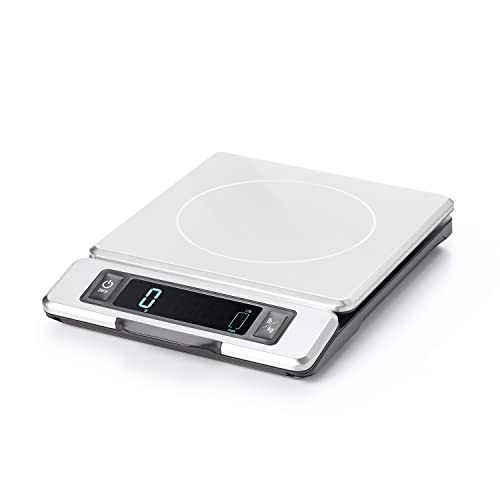
OXO Good Grips Stainless Steel Food Scale
Best for: bakers who want a pull-out display they can read under a wide mixing bowl. Not suited for: anyone who needs to weigh very heavy stockpots full of liquid, or who wants a scale that connects to a phone app for automatic logging. Tier: premium-leaning, positioned by build and features rather than by any promise about a specific listing.
What stands out in this worth-it assessment is a pull-out display, a brushed platform that wipes clean, and a calm, uncluttered face that stays readable when a large bowl overhangs the front edge. In daily use that matters more than it sounds: a kitchen scale is handled with wet, floury, or greasy hands, often mid-recipe with something already in the pan, so the distance between wanting a number and trusting a number is measured in small design choices. A display you can read without moving the bowl, a tare button you can find without looking down for long, and a platform that does not rock when a bowl lands slightly off centre all decide whether the scale becomes a habit or a drawer ornament.
Strengths include the way this model handles the tare routine — bowl on, tare to zero, first ingredient in, tare again — without forcing you to restart or do mental arithmetic between additions. Trade-offs are honest ones: like every flat home scale it still needs a level, stable counter, it still dislikes draughts and vibration while it settles, and its platform, however well shaped, cannot make an oversized roasting pan balance safely. Treat it as a precision tool for bowls, plates, and ingredient containers, wipe spills promptly so liquids never creep toward the battery compartment underneath, and it will repay the small care with years of consistent readings.
Escali Primo Digital Food Scale
Best for: everyday cooks who want simple, dependable weighing without menus to learn. Not suited for: anyone who needs to weigh very heavy stockpots full of liquid, or who wants a scale that connects to a phone app for automatic logging. Tier: mid-range, positioned by build and features rather than by any promise about a specific listing.
What stands out in this worth-it assessment is a sealed, easy-clean surface, large friendly buttons, and a reputation for straightforward one-touch taring that suits daily cooking better than feature lists do. In daily use that matters more than it sounds: a kitchen scale is handled with wet, floury, or greasy hands, often mid-recipe with something already in the pan, so the distance between wanting a number and trusting a number is measured in small design choices. A display you can read without moving the bowl, a tare button you can find without looking down for long, and a platform that does not rock when a bowl lands slightly off centre all decide whether the scale becomes a habit or a drawer ornament.
Strengths include the way this model handles the tare routine — bowl on, tare to zero, first ingredient in, tare again — without forcing you to restart or do mental arithmetic between additions. Trade-offs are honest ones: like every flat home scale it still needs a level, stable counter, it still dislikes draughts and vibration while it settles, and its platform, however well shaped, cannot make an oversized roasting pan balance safely. Treat it as a precision tool for bowls, plates, and ingredient containers, wipe spills promptly so liquids never creep toward the battery compartment underneath, and it will repay the small care with years of consistent readings.
Etekcity Food Kitchen Scale
Best for: first-time buyers and budget-conscious bakers who want to try weighing without committing much. Not suited for: anyone who needs to weigh very heavy stockpots full of liquid, or who wants a scale that connects to a phone app for automatic logging. Tier: entry-level, positioned by build and features rather than by any promise about a specific listing.
What stands out in this worth-it assessment is a slim profile that slides into a drawer, a bright backlit readout, and unit switching that covers the conversions most home recipes actually ask for. In daily use that matters more than it sounds: a kitchen scale is handled with wet, floury, or greasy hands, often mid-recipe with something already in the pan, so the distance between wanting a number and trusting a number is measured in small design choices. A display you can read without moving the bowl, a tare button you can find without looking down for long, and a platform that does not rock when a bowl lands slightly off centre all decide whether the scale becomes a habit or a drawer ornament.
Strengths include the way this model handles the tare routine — bowl on, tare to zero, first ingredient in, tare again — without forcing you to restart or do mental arithmetic between additions. Trade-offs are honest ones: like every flat home scale it still needs a level, stable counter, it still dislikes draughts and vibration while it settles, and its platform, however well shaped, cannot make an oversized roasting pan balance safely. Treat it as a precision tool for bowls, plates, and ingredient containers, wipe spills promptly so liquids never creep toward the battery compartment underneath, and it will repay the small care with years of consistent readings.

Greater Goods Digital Food Kitchen Scale
Best for: home bakers who weigh flour daily and care about a display they can read at a glance. Not suited for: anyone who needs to weigh very heavy stockpots full of liquid, or who wants a scale that connects to a phone app for automatic logging. Tier: mid-range, positioned by build and features rather than by any promise about a specific listing.
What stands out in this worth-it assessment is a high-contrast display, a smooth glass-style platform that releases flour dust with one wipe, and controls placed so a floury fingertip does not have to hunt for them. In daily use that matters more than it sounds: a kitchen scale is handled with wet, floury, or greasy hands, often mid-recipe with something already in the pan, so the distance between wanting a number and trusting a number is measured in small design choices. A display you can read without moving the bowl, a tare button you can find without looking down for long, and a platform that does not rock when a bowl lands slightly off centre all decide whether the scale becomes a habit or a drawer ornament.
Strengths include the way this model handles the tare routine — bowl on, tare to zero, first ingredient in, tare again — without forcing you to restart or do mental arithmetic between additions. Trade-offs are honest ones: like every flat home scale it still needs a level, stable counter, it still dislikes draughts and vibration while it settles, and its platform, however well shaped, cannot make an oversized roasting pan balance safely. Treat it as a precision tool for bowls, plates, and ingredient containers, wipe spills promptly so liquids never creep toward the battery compartment underneath, and it will repay the small care with years of consistent readings.
Taylor Pro Digital Kitchen Food Scale
Best for: cooks who like a classic, no-nonsense tool from a long-running measuring brand. Not suited for: anyone who needs to weigh very heavy stockpots full of liquid, or who wants a scale that connects to a phone app for automatic logging. Tier: entry-to-mid-range, positioned by build and features rather than by any promise about a specific listing.
What stands out in this worth-it assessment is a straightforward layout, a platform sized for dinner plates and mixing bowls, and the kind of plain reliability that keeps a tool in the drawer for years. In daily use that matters more than it sounds: a kitchen scale is handled with wet, floury, or greasy hands, often mid-recipe with something already in the pan, so the distance between wanting a number and trusting a number is measured in small design choices. A display you can read without moving the bowl, a tare button you can find without looking down for long, and a platform that does not rock when a bowl lands slightly off centre all decide whether the scale becomes a habit or a drawer ornament.
Strengths include the way this model handles the tare routine — bowl on, tare to zero, first ingredient in, tare again — without forcing you to restart or do mental arithmetic between additions. Trade-offs are honest ones: like every flat home scale it still needs a level, stable counter, it still dislikes draughts and vibration while it settles, and its platform, however well shaped, cannot make an oversized roasting pan balance safely. Treat it as a precision tool for bowls, plates, and ingredient containers, wipe spills promptly so liquids never creep toward the battery compartment underneath, and it will repay the small care with years of consistent readings.
How to Get the Most Value If You Buy
Keep it where you mix, not where it fits. Weigh for two full weeks without exception, until tare is reflex. Write weights on your printed recipes as you confirm them, building a personal, reliable version of each. Pair the scale with measuring spoons for small amounts and cups for quick liquids instead of forcing one tool to do everything.
Two habits protect both the scale and the food. First, wipe spills promptly — a puddle of oil or batter left sitting on the platform can creep underneath and toward the battery compartment, and liquids inside that compartment are a common, avoidable cause of erratic readings and early failure. Second, treat raw meat with respect: weigh raw meats on a washable barrier or plate rather than directly on the platform, then wash hands, the plate, and any touched surfaces afterwards before you handle other ingredients. When batteries finally die, dispose of them per local guidance rather than in household rubbish, and never mix an old battery with a fresh one to squeeze out extra weeks.
When you are ready to choose a model rather than debate the category,
our kitchen scale review the kitchen scale reviews round-up the kitchen scale buying guide colourful measuring cups and spoons for volume back-up baking sheets and cooling racks for weighed bakes
covers the buying decisions and the cup-and-spoon companions in depth.
The Decision Checklist
- Do I bake, brew by ratio, or meal-prep at least weekly?
- Do I use, or want to use, recipes written in grams?
- Do I have a flat home for it within reach of where I mix?
- Am I frustrated by recipes that will not repeat?
- Will at least one other person in the household use it, or will I use it enough alone?
- Am I buying for the cooking I do now, not a someday version of it?
Four or more yes answers: buy, at the tier your budget tier allows, and do not overthink the model. Two or fewer: skip it without guilt and spend the drawer space on something your actual cooking needs.
Final Verdict
A kitchen scale is worth it in the way a good knife is worth it: not because it is impressive, but because it quietly improves every job it touches, every week, for years. For bakers, brewers, and portioners the answer is a clear yes. For instinctive cooks with full drawers, a clear no is equally respectable. Decide by your cooking, keep it within reach if you buy, and the small flat box will earn its place.
A Month Later: What Actually Changes
Owners imagining the purchase usually picture a moment of revelation; what they get instead is a month of small, accumulating corrections. The bread recipe annotated with real weights. The coffee ratio written on the cupboard door. The meal-prep Sunday where every container matches and reheats like it. None of these moments would justify a purchase alone, and together they are the entire case: worth, for this tool, is a sum of tiny reliabilities, not a single dramatic improvement. That is also why the tool disappoints gift-buyers who expect visible gratitude — its value is private, cumulative, and mostly invisible to anyone who does not cook with it.
The month test also reveals who should have skipped it. If, after a month within reach of the mixing area, the scale has been used twice, the answer for that household is no, and it will stay no; cooking habits are honest data. The respectable response is to pass the scale to a baking friend, where it may become essential, rather than letting it occupy a drawer as evidence in an argument nobody is having.
The Opportunity Cost Question
Every purchase competes with the other things the same money and space could hold, so the worth-it question should be asked comparatively. Against other small kitchen tools, a scale’s claim is unusually strong: it improves existing recipes rather than enabling a single new dish, it serves baking, brewing, portioning, and preserving with one habit, and its running costs are batteries and a damp cloth. Few comparably tiered tools touch that many weekly jobs. Its serious rivals are not other gadgets but the free alternatives — cups, spoons, and experience — which is why this article’s verdict always returns to how you cook: where those free tools already serve you well, the scale’s marginal value is small; where they are the source of your frustrations, its value is the frustration, removed.
Space has an opportunity cost too, and in the smallest kitchens it can be the deciding one. A scale that displaces the chopping board’s home will be resented out of all proportion to its size. The worth-it answer for a tiny kitchen is therefore conditional in a specific way: yes, if it can live in the first drawer or on the one clear stretch of counter; no, if owning it means a daily negotiation with your own storage. Slim designs exist precisely to move that answer from no to yes.
Worth It for Whom, Revisited in Numbers of Habits
Count habits, not hopes. Weigh-worthy occasions in a typical week — a bake, two brews a day, a portioning session, a recipe from a gram-based source — add up quickly even in modest kitchens, and each occasion is a small payment toward the purchase. Households honest about their count usually find the verdict obvious in one direction or the other, which is the real function of the checklist in this article: it converts a vague consumer question into an inventory of your actual week. Tools bought against an honest inventory rarely end up in the drawer of good intentions; tools bought against an imagined week almost always do.
The Counterfactual Kitchen: A Year Without, A Year With
Imagine two parallel years of the same household’s cooking. In the first, recipes are followed in cups and spoons. Most succeed; some fail mysteriously; the sourdough starter is fed by feel and behaves accordingly; the coffee is good on Saturdays and merely fine on weekdays; the meal-prep containers vary enough that Thursday’s lunch reheats worse than Monday’s. Nothing is wrong, exactly — and yet a low-level randomness runs through the kitchen, taxing every recipe with a small uncertainty that nobody can name.
In the second year, a scale sits beside the mixing bowls. The recipes are the same, the cook is the same, the ingredients are the same — but the randomness is gone from the inputs, and with it goes most of the mystery. Failures still happen, and now they teach something, because the measuring can be ruled out. The coffee matches on weekdays. The containers match. Valuing that difference is the whole worth-it question, and it cannot be valued in the abstract: a household that barely notices inconsistency should not pay to remove it, while a household that finds inconsistency quietly maddening will find the scale cheap at any tier in this guide.
When the Answer Changes
Worth is not a permanent verdict, because kitchens change. The cook who skips the scale today takes up sourdough next winter, and the answer flips overnight. The baker who relied on one daily stops baking during a busy year, and the scale’s value pauses — not vanishes, because habits resume — until the next loaf. Children arriving, a household merging, a new interest in coffee or preserving: each rewrites the checklist in this article, which is why its questions are about current habits rather than identity. You are not a scale person or a non-scale person; you are a person whose cooking, this season, either runs on ratios or does not.
That fluidity argues for the entry tier as the default first purchase even for the convinced. If the season changes against weighing, little is stranded; if it deepens, experience will choose the upgrade far better than anticipation can. The only genuinely poor outcome is the premium purchase made on a hope — maximum cost, minimum information — and it is avoidable by the simple discipline of buying for the cooking you did last month.
The Final Reckoning
Add it up plainly. On one side: repeatable baking, ratio brewing, fair portions, access to the world’s gram-based recipes, less washing-up, and a diagnostic tool for every future recipe failure — delivered daily, for years, by an object that asks for a drawer corner and the occasional battery. On the other: a modest tier of money, a short learning curve, a damp-cloth cleaning habit, a washable plate for raw meat, and the honesty to admit it will not help cooking that has no ratios in it. For most households that bake, brew, or portion at all, the first side of that reckoning is longer, heavier, and more useful — and that, stated without a single price or star, is the complete answer to the question this article’s title asks.
Working Methods That Make the Difference
Whether a scale turns out to be worth it is decided less at the checkout than in the first month of technique. The methods below are what owners who answer yes actually do differently from owners who answer no, and none of them costs anything.
Weighing Flour Without the Cloud
Flour technique is where new scale owners either convert or quietly give up, so it deserves plain instructions. Spoon flour lightly into the bowl on the scale rather than dropping it from a height, because a falling stream registers in jumps and invites overshooting; add the last portion slowly, tapping the spoon against the bowl rim, and stop the moment the target arrives, remembering that you can always add a spoonful and can never politely remove one from a bowl that already holds water or eggs. If you do overshoot dry flour before any liquid joins it, simply lift the excess back out with a clean spoon — one of the forgiving properties of dry ingredients that makes flour the ideal training ground for the whole weighing habit.
Weighing Sticky, Slow and Awkward Ingredients
Honey, syrups, oils, nut butters and tomato paste all punish impatience. Pour or spoon them slowly, in a thin stream or small additions, and let the display settle between additions rather than chasing a number that is still arriving. A light smear of oil inside the spoon or jug, where the recipe allows it, helps sticky ingredients release cleanly instead of leaving an unweighed residue behind. For ingredients that arrive in a jar you cannot empty, weigh the jar before and after: the difference is exactly what went into the recipe, a small piece of scale arithmetic that feels like a trick the first time and like second nature by the third.
Baker’s Percentages, Without the Intimidation
A percentage in baking is simply every ingredient expressed against the flour, which is counted as the whole. Once a recipe is weighed, those relationships become visible: water as a share of flour tells you how wet a dough will feel before you touch it, salt as a share tells you whether seasoning will be gentle or assertive, and a written record of those shares lets you resize a recipe to any amount of flour you happen to have. Nobody needs the mathematics to enjoy a scale, but weighing is what makes the mathematics available, and many home bakers find that a season of weighed loaves teaches them more about dough than years of cup recipes did.
Seasonal and Batch Cooking
Preserving, jam-making, curing and holiday baking all multiply recipes beyond the size where cups stay sane. Doubling a spoon-based recipe invites fraction errors at exactly the moment the cook is busiest; doubling a weighed recipe is a single multiplication per ingredient, checkable at a glance. Batch cooking for the freezer benefits the same way, because containers filled by weight freeze, store and reheat as true equals, and a note of the weights turns a successful batch into a repeatable one rather than a fond memory that the next attempt approximates.
Teaching the Habit to a Household
A scale only delivers its value when the people who cook actually use it, so the social rollout matters. Demonstrate tare once, on something delicious, and let the one-bowl washing-up saving make the argument. Label nothing, lecture nobody, and keep the scale exactly where the mixing happens so that using it is easier than not using it. Households report that the habit spreads by convenience rather than conviction: the second cook reaches for it because it is there, reads clearly, and has never yet made a recipe worse.
Learn those methods and the worth-it question usually settles itself; skip them, and even the finest model in this guide is only a flat box with a display.
What Owners Say a Year Later
Ask owners a year after purchase and the answers sort themselves with unusual neatness. The yes households talk about recipes, not equipment: the loaf that repeats, the granola ratio written on the jar, the Christmas baking that scaled without tears. The no households talk about the object: where it is stored, when its battery died, how it is somehow always under something. That difference in grammar is the whole worth-it story in miniature — a tool that disappears into outcomes was worth it, and a tool that remains an object was not, whatever its tier, brand or display.
The yes households also share a mundane secret: none of them uses the scale for everything. Spoons still season, cups still splash milk into pans, and judgement still finishes every dish. The scale won its place by owning the middle ground where amounts decide outcomes, and by asking so little — a dry corner, a battery now and then, a wipe after spills, a washable plate under raw meat — that the rent it charges the kitchen feels trivial against the reliability it pays back.
The Answer, Delivered Personally
Articles like this one end with a verdict, but the honest verdict was always going to be delivered by your own kitchen rather than by any writer. So take the checklist in this article to your actual week: count the bakes, the brews, the batches and the gram-based recipes you keep meaning to try. If they are real, buy the scale at the tier your budget describes, put it where you mix, and let a month of weighed recipes deliver the verdict in the only form that cannot be argued with — your own results, repeating themselves.
If the count comes back thin, close this article with a clear conscience and spend nothing. The scale will still be there, in a mature and stable category, on the season your cooking changes — and buying it then, for a named reason, will make it worth it in a way that buying it today, on a stranger’s enthusiasm, never could.
One More Angle: Weighing Beyond the Recipe Book
The longer a scale stays in a kitchen, the more its job description quietly expands beyond the recipes that justified buying it, and this verdict would be incomplete without recording that expansion. Portions of pet food, measured consistently, end the household debate about whether the dog has been fed. Parcels get weighed before a trip to the post office, ending another small uncertainty. A child’s science project, a batch of homemade play dough, the coffee beans remaining in a bag before a shopping trip — each is a thirty-second weighing that nobody would have bought a scale to perform, and together they form a long tail of usefulness that spec sheets never mention and owners always do.
There is a corresponding expansion in confidence that matters more than any single extra use. A cook who weighs regularly develops a physical sense of quantity — what a hundred grams of flour looks like in their bowl, how heavy a portion of pasta feels in the hand — that transfers back into unmeasured cooking and makes even their improvisation more accurate. The scale, paradoxically, trains the very instinct that its sceptics defend, which may be the strongest closing argument available: the tool does not replace judgement, it educates it, one weighed recipe at a time, until judgement itself has quietly become more reliable everywhere in the kitchen.
None of this expansion requires a better model than the ones already discussed, a larger platform, or a single extra mode. It requires only the two things every section of this article has kept returning to: a scale matched honestly to its kitchen, and a home within reach of the work. Given those, the tool keeps finding work; denied those, even the finest design in the field is furniture. That is as true for the last reader of this article as it was for the first, and it is the note on which the discussion properly ends.
Closing Note
It is worth pausing, at the end, on how unglamorous the winning advice in this category always turns out to be. Nobody’s cooking was ever transformed by a specification; it is transformed, slowly and permanently, by a reliable number appearing at the moment an ingredient is added, recipe after recipe, until consistency becomes the kitchen’s default rather than its occasional achievement. This verdict set out to answer a value question with habits rather than hype, and its conclusion is that worth is counted in weekly occasions where amounts decide outcomes, not in features, tiers or enthusiasm borrowed from other people’s kitchens.
So the final recommendation is deliberately plain. Decide honestly, buy at the tier your circumstances describe, keep the tool dry, level and within reach, respect the small food-safety and battery routines that protect it, and then cook — because the recipes, repeated and improved, are the only review, guide or verdict that will matter in your kitchen a year from now.
One final observation belongs in any honest verdict, because owners repeat it too often to leave out: a scale changes how a kitchen feels about failure, and feelings decide whether people keep cooking ambitiously. An unmeasured failure is a mystery that hovers over the next attempt and quietly discourages it; a measured failure is a clue, pointing toward time, temperature or technique, and clues make cooks braver. A tool that converts discouragement into information is worth more than its tier suggests, because it protects not just this month’s recipes but next year’s willingness to attempt harder ones. Weighed against the modest costs counted in this article — a drawer corner, a battery, a damp cloth, a washable plate under raw meat — that protection is, for any household whose cooking includes ratios at all, a bargain stated without a single price.
There is one more quiet return on the purchase, easy to miss because it happens between recipes rather than during them: a weighed kitchen keeps better records. The notebook beside the scale, or the annotated printouts in the drawer, become a household asset that survives memory, holidays and even the departure of the cook who invented a dish. Recipes recorded as weights can be handed to a partner, a child or a friend and reproduced faithfully in a different kitchen, on a different continent, years later — a form of generosity that cup-based cooking, for all its charm, has never quite been able to offer. When owners in the yes camp describe the purchase as obviously worth it, this permanence is often what they are reaching for: not a gadget that impressed them, but a small system that made their cooking durable, shareable and repeatable, which is as good a definition of kitchen value as this article can offer.
And if the month of weighed cooking surprises you — as it surprises most households who try it honestly — that surprise itself is data: it means the randomness was real, it was costing you more than you knew, and it is now, for the price of a habit, gone.
The Break-Even Test in Practice: When a Kitchen scale Earns Its Place and When It Quietly Does Not
Worth is not a property of the product; it is a relationship between the product and the household using it. A kitchen scale earns its place when the jobs it does well are jobs your household actually has, week after week, in the baking and cooking habits it will support. It quietly fails to earn its place when its best features answer problems you rarely meet. The test below turns that idea into questions you can answer honestly before deciding.
This is where the value argument is won or lost. Start with fit, because fit failures cannot be fixed by enthusiasm later. In practice that means three things: check the capacity against your largest mixing bowl plus its contents; look at the smallest increment the scale reads, if your recipes use small quantities; and confirm the platform fits your biggest bowl without hiding the display. Write the answers down rather than holding them in your head, because a kitchen scale is usually chosen over several browsing sessions, and the constraint you checked on Monday is the one forgotten by Friday. If any of the three checks produces an awkward answer, treat it as information about format, not as a problem to wave away — a different format of kitchen scale often removes the conflict entirely, while a compromise on fit tends to be re-litigated every time the product is used.
Count this honestly, because occasional use changes the answer completely. Then picture the product in its real situations rather than its best one. The routine cases are easy to imagine: a bread routine where flour and water are weighed for every batch, or portioning ingredients for meal prep across a week of lunches. The more useful exercise is the harder day: a heavy cast-iron pot exceeding capacity mid-recipe; and flour dust working into buttons and seams during daily baking. A kitchen scale does not need to be perfect in those moments, but it does need a workable answer to them — a way to be moved, covered, adjusted, cleaned or simply tolerated until conditions improve. If the honest answer is that the hard day would make you stop using it altogether, that is a decision-grade fact, and it is far cheaper to learn it now than after delivery.
The purchase justifies itself here, or it does not justify itself at all. Most disappointments trace back to a short list of avoidable errors. The common ones here are: weighing on an uneven or soft surface and trusting the result; forgetting to tare between additions, then trying to correct the maths later; and letting liquids pool on the platform and seep toward the controls. Notice that none of them is really about build quality. They are sequencing errors — deciding before measuring, assuming instead of checking, or copying someone else’s setup whose space and habits differ from yours. Reading any listing for a kitchen scale with those three errors in mind is a fast filter: if the page in front of you encourages one of them, slow down and return to your own measurements and routine.
Sentimental value aside, this is the practical test. Ownership also has a rhythm, and it is worth pricing that rhythm in before you commit. For a kitchen scale, the upkeep that keeps it pleasant is modest but specific: wipe the platform after use and keep liquids away from the seams; store the scale flat and unloaded in a dry drawer or cupboard; and replace batteries promptly when the low indicator appears rather than working around it. None of that is onerous on its own. The question is whether it attaches to a routine you already have — a weekly clean, a seasonal tidy, a habit of putting things away properly — or whether it requires a new routine invented from scratch, which is the kind that quietly lapses by the second month.
Households that benefit most recognise this pattern in their own routine. When a listing is open in front of you, use the examples named in this guide as a checking exercise rather than a ranking. Take the OXO Good Grips Stainless Steel Food Scale, the Escali Primo Digital Food Scale and the Etekcity Food Kitchen Scale: for each one, ask how it answers the fit checks above, what its format assumes about your space, and which of the edge cases its design handles gracefully. Listings answer those questions unevenly — dimensions and format are usually stated, while behaviour on the hard days has to be inferred from design details — but even an incomplete answer is useful, because it shows you which questions to carry to the next listing instead of buying the first plausible option.
Frequently Asked Questions
Is a kitchen scale worth it for a beginner cook?
Usually yes, if the beginner bakes or follows recipes closely, because weighing removes the most confusing variable while technique is still developing. A beginner’s cup of flour varies enormously; a weighed amount does not, so early successes repeat and early failures can be understood. If the beginner cooks only improvised savoury food, the value is smaller and a good knife or pan will serve them better first.
How long does a kitchen scale take to pay for itself?
In avoided waste rather than in cash. A few rescued bakes — good butter, chocolate, and nuts not lost to a recipe that failed for measuring reasons — can cover an entry-level tier, and every repeated recipe afterwards is pure return. Meal-preppers see it in evenly portioned batches that reheat properly. The payback is fastest for weekly bakers and slowest for occasional cooks, which is exactly what the main article’s checklist reflects.
Can I manage perfectly well without a kitchen scale?
Millions of good cooks do, and this article will not pretend otherwise. If your baking is rare, your recipes are cup-based and familiar, and your savoury cooking runs on taste, a scale adds convenience rather than capability. What you give up is access and repeatability: gram-based recipes need converting, and a brilliant improvised result cannot be exactly repeated. Whether that trade matters is a question about your cooking, not about the tool.
What is the cheapest way to find out if weighing suits me?
Start at the entry tier with a simple, clear-displayed model, keep it on the counter rather than in a cupboard, and weigh everything for two weeks of normal cooking. If tare has become reflex and your regular recipes feel more reliable, the habit has taken and a later upgrade can be chosen from experience. If the scale sat untouched, you have learned the same lesson at the lowest possible cost in money and space.
What care does a kitchen scale need to stay worth owning?
Very little, done consistently. Wipe spills promptly so liquid never reaches the battery compartment, clean with a damp cloth rather than a soak, and weigh raw meat on a washable plate, washing hands and surfaces afterwards. Store it flat and unloaded, and replace or recharge batteries before readings turn erratic, disposing of spent batteries per local guidance. Neglected scales stop feeling worth it; lightly cared-for ones stay worth it for years.
Is a kitchen scale worth it for coffee alone?
For pour-over and other ratio brewing, often yes on its own. Coffee strength is a ratio of grounds to water, and a scale is the only home tool that holds that ratio steady day after day. If you brew with a pod machine or a method you already love by scoop and habit, the case collapses back to your baking and portioning — which is why the decision checklist weighs all your uses together rather than any single one.