Disclosure: As an Amazon Associate, airfryerkitchensupply.com earns from qualifying purchases. Links on this page are affiliate links; they cost you nothing extra. Prices and availability change often, so check the current Amazon listing before you buy.
This kitchen scale review is for the cook who has finally had enough of recipes that fail for reasons nobody can explain. One week the bread rises beautifully, the next week the same recipe, measured in the same cups, produces a dense loaf and a quiet suspicion that the flour was at fault. It usually was not the flour. It was the measuring. This kitchen scale review looks at what a modern digital kitchen scale actually does on a real counter, how the leading designs differ in the hand and under a bowl, and whether the small, flat box deserves permanent space in a working kitchen.
Key Takeaways
- A kitchen scale removes the biggest hidden variable in home baking: how much flour, sugar, or liquid a cup happens to hold on a given day.
- Tare is the feature you will use most — it lets you add ingredients one after another into the same bowl, resetting to zero each time.
- Readability under a wide bowl matters more than a long feature list; a display you cannot see is a display you will stop trusting.
- Accuracy in home use is mostly about habits: a level counter, a settled reading, and a clean, dry platform.
- Keep liquids away from the battery compartment, weigh raw meat on a washable plate, and the scale will stay reliable for years.
Verdict in brief: worth it for bakers, batch cooks, and anyone following recipes written in grams; less essential for confident cooks who season by instinct and rarely bake. The detail below explains why.
In this guide
Kitchen Scale Review: What a Kitchen Scale Is and Where It Fits
A kitchen scale is, at its simplest, a flat platform connected to a sensor that reports weight on a small display. Put a bowl on it, press tare so the display returns to zero, add an ingredient, and read the number. That is the whole ceremony, and it takes seconds. Yet that simple act replaces a chain of approximations — scooping, levelling, shaking down, guessing whether the cup was packed — with a single measurement that means the same thing in every kitchen, in every country, on every attempt.
Where it fits is anywhere a recipe behaves like a ratio. Bread dough is a ratio of flour to water. Cake batter is a ratio of flour to sugar to fat. Coffee is a ratio of grounds to water. Even savoury cooking has ratios hiding inside it: curing mixes, brines, pickling liquids, and spice blends all behave more predictably by weight than by spoonfuls. A scale also fits the quieter jobs nobody writes recipes about — dividing dough into equal rolls, splitting a batch of meatballs evenly, portioning leftovers into containers that reheat at the same rate, and checking that two chicken breasts are close enough in size to cook together evenly.
The category divides roughly by temperament rather than by power. Slim glass-platform models disappear into a drawer and suit occasional use. Stainless models shrug off hot bowls and flour dust and suit daily bakers. Models with pull-out or angled displays suit anyone whose favourite mixing bowl is wide enough to hide a front-mounted readout. None of these is objectively correct; the right temperament is the one that matches how often you weigh, what you weigh, and how much counter you can honestly spare.
Design, Build and Setup
Setup is deliberately unglamorous: unbox, fit the batteries or charge as directed, set the scale on a firm, level surface, and let it wake to zero. There is no assembly, no calibration ritual for ordinary home models, and no app required before the first weighing. The design questions that matter appear later. Does the platform wobble on its feet? Do the buttons respond to a floury fingertip, or do they demand a clean, dry press? Does the display stay lit long enough to add a slow-pour ingredient like oil or honey, or does it time out mid-pour and leave you guessing?
Build quality shows in small resistances. A good platform feels inert — no flex, no creak — when a heavy bowl lands on it. Corners and seams are tight enough that flour dust brushes away instead of settling into a groove. Feet grip rather than skate, because a scale that slides while you pour is a scale that lies to you. The underside matters too: the battery compartment should close flush and stay shut, since that small door is the main route by which stray liquid and crumbs reach the electronics.
Storage is part of design, whether makers admit it or not. A scale that lives in a drawer gets used when the drawer is near the worktop; a scale that lives on the counter gets used for everything, including weighing a parcel or a puppy bowl of kibble. Slim models win the drawer argument. Heavier stainless models win the always-out argument, partly because they look at home beside a hob and partly because moving them daily feels like a chore nobody needs.
Performance in Real Use
Bread and Baking Days
Baking is where a scale stops being a gadget and becomes infrastructure. Flour weighed directly into the mixing bowl means one bowl, no cup measures to wash, and no flour cloud over the counter. Add water by weight and the hydration of a dough becomes a number you can repeat, adjust, and write down. When a loaf disappoints, you can change one variable — a little more water, a little less — and know the change was real, because everything else was measured the same way.
The tare sequence is the quiet star. Bowl, tare, flour, tare, water, tare, salt, tare, starter. Each addition is its own clean reading, and a mistake is visible the moment it happens: pour too much water and you know exactly how much too much, which means you can compensate with flour in the same ratio instead of starting again or hoping. That visibility changes how people bake. They experiment more, because experiments stop being gambles.
Everyday Cooking and Portioning
Outside baking, the scale earns its keep in portioning and repetition. Coffee brewed by ratio tastes like itself every morning instead of drifting with scoop size. Rice and its cooking water become consistent. Minced meat divides into burgers that finish cooking together. A recipe doubled for guests stops being mental arithmetic with fractions of cups and becomes simple multiplication, because weights scale cleanly in a way spoonfuls never do.
There is also a honesty function. Anyone who has tried to estimate a serving of pasta, cheese, or nuts by eye knows the eye is generous. The scale does not nag; it simply reports. For households tracking portions for ordinary, non-medical reasons — feeding a growing teenager fairly, splitting a meal-prep batch across the week — that neutral report is genuinely useful.
Small Amounts and Awkward Loads
Every home scale has a comfort zone, and honesty about it matters. Very small amounts — a pinch of yeast, a few grams of spice — sit near the floor of what a general-purpose scale reads confidently, which is why bakers pair the scale with measuring spoons for the tiniest quantities rather than pretending one tool does everything. At the other end, a stockpot of soup is too heavy and too unstable for a flat home platform; weigh ingredients before they go into the pot instead.
Awkward loads test the display more than the sensor. A wide bowl hides a front readout; a tall jug catches light and throws glare; a sheet pan overhangs every edge. The workarounds are simple — a smaller bowl, a pull-out display, an upturned ramekin as a riser for tall containers — but they are worth knowing before you conclude a scale is inaccurate when it was merely unreadable.
The Pick in Focus and the Wider Field
One model anchors this review, with the wider field set honestly around it.
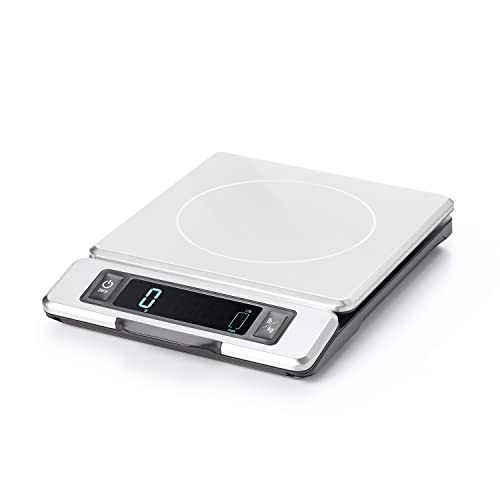
OXO Good Grips Stainless Steel Food Scale
Best for: bakers who want a pull-out display they can read under a wide mixing bowl. Not suited for: anyone who needs to weigh very heavy stockpots full of liquid, or who wants a scale that connects to a phone app for automatic logging. Tier: premium-leaning, positioned by build and features rather than by any promise about a specific listing.
What stands out in this review is a pull-out display, a brushed platform that wipes clean, and a calm, uncluttered face that stays readable when a large bowl overhangs the front edge. In daily use that matters more than it sounds: a kitchen scale is handled with wet, floury, or greasy hands, often mid-recipe with something already in the pan, so the distance between wanting a number and trusting a number is measured in small design choices. A display you can read without moving the bowl, a tare button you can find without looking down for long, and a platform that does not rock when a bowl lands slightly off centre all decide whether the scale becomes a habit or a drawer ornament.
Strengths include the way this model handles the tare routine — bowl on, tare to zero, first ingredient in, tare again — without forcing you to restart or do mental arithmetic between additions. Trade-offs are honest ones: like every flat home scale it still needs a level, stable counter, it still dislikes draughts and vibration while it settles, and its platform, however well shaped, cannot make an oversized roasting pan balance safely. Treat it as a precision tool for bowls, plates, and ingredient containers, wipe spills promptly so liquids never creep toward the battery compartment underneath, and it will repay the small care with years of consistent readings.
Escali Primo Digital Food Scale
Best for: everyday cooks who want simple, dependable weighing without menus to learn. Not suited for: anyone who needs to weigh very heavy stockpots full of liquid, or who wants a scale that connects to a phone app for automatic logging. Tier: mid-range, positioned by build and features rather than by any promise about a specific listing.
What stands out in this review is a sealed, easy-clean surface, large friendly buttons, and a reputation for straightforward one-touch taring that suits daily cooking better than feature lists do. In daily use that matters more than it sounds: a kitchen scale is handled with wet, floury, or greasy hands, often mid-recipe with something already in the pan, so the distance between wanting a number and trusting a number is measured in small design choices. A display you can read without moving the bowl, a tare button you can find without looking down for long, and a platform that does not rock when a bowl lands slightly off centre all decide whether the scale becomes a habit or a drawer ornament.
Strengths include the way this model handles the tare routine — bowl on, tare to zero, first ingredient in, tare again — without forcing you to restart or do mental arithmetic between additions. Trade-offs are honest ones: like every flat home scale it still needs a level, stable counter, it still dislikes draughts and vibration while it settles, and its platform, however well shaped, cannot make an oversized roasting pan balance safely. Treat it as a precision tool for bowls, plates, and ingredient containers, wipe spills promptly so liquids never creep toward the battery compartment underneath, and it will repay the small care with years of consistent readings.
Etekcity Food Kitchen Scale
Best for: first-time buyers and budget-conscious bakers who want to try weighing without committing much. Not suited for: anyone who needs to weigh very heavy stockpots full of liquid, or who wants a scale that connects to a phone app for automatic logging. Tier: entry-level, positioned by build and features rather than by any promise about a specific listing.
What stands out in this review is a slim profile that slides into a drawer, a bright backlit readout, and unit switching that covers the conversions most home recipes actually ask for. In daily use that matters more than it sounds: a kitchen scale is handled with wet, floury, or greasy hands, often mid-recipe with something already in the pan, so the distance between wanting a number and trusting a number is measured in small design choices. A display you can read without moving the bowl, a tare button you can find without looking down for long, and a platform that does not rock when a bowl lands slightly off centre all decide whether the scale becomes a habit or a drawer ornament.
Strengths include the way this model handles the tare routine — bowl on, tare to zero, first ingredient in, tare again — without forcing you to restart or do mental arithmetic between additions. Trade-offs are honest ones: like every flat home scale it still needs a level, stable counter, it still dislikes draughts and vibration while it settles, and its platform, however well shaped, cannot make an oversized roasting pan balance safely. Treat it as a precision tool for bowls, plates, and ingredient containers, wipe spills promptly so liquids never creep toward the battery compartment underneath, and it will repay the small care with years of consistent readings.

Greater Goods Digital Food Kitchen Scale
Best for: home bakers who weigh flour daily and care about a display they can read at a glance. Not suited for: anyone who needs to weigh very heavy stockpots full of liquid, or who wants a scale that connects to a phone app for automatic logging. Tier: mid-range, positioned by build and features rather than by any promise about a specific listing.
What stands out in this review is a high-contrast display, a smooth glass-style platform that releases flour dust with one wipe, and controls placed so a floury fingertip does not have to hunt for them. In daily use that matters more than it sounds: a kitchen scale is handled with wet, floury, or greasy hands, often mid-recipe with something already in the pan, so the distance between wanting a number and trusting a number is measured in small design choices. A display you can read without moving the bowl, a tare button you can find without looking down for long, and a platform that does not rock when a bowl lands slightly off centre all decide whether the scale becomes a habit or a drawer ornament.
Strengths include the way this model handles the tare routine — bowl on, tare to zero, first ingredient in, tare again — without forcing you to restart or do mental arithmetic between additions. Trade-offs are honest ones: like every flat home scale it still needs a level, stable counter, it still dislikes draughts and vibration while it settles, and its platform, however well shaped, cannot make an oversized roasting pan balance safely. Treat it as a precision tool for bowls, plates, and ingredient containers, wipe spills promptly so liquids never creep toward the battery compartment underneath, and it will repay the small care with years of consistent readings.
Taylor Pro Digital Kitchen Food Scale
Best for: cooks who like a classic, no-nonsense tool from a long-running measuring brand. Not suited for: anyone who needs to weigh very heavy stockpots full of liquid, or who wants a scale that connects to a phone app for automatic logging. Tier: entry-to-mid-range, positioned by build and features rather than by any promise about a specific listing.
What stands out in this review is a straightforward layout, a platform sized for dinner plates and mixing bowls, and the kind of plain reliability that keeps a tool in the drawer for years. In daily use that matters more than it sounds: a kitchen scale is handled with wet, floury, or greasy hands, often mid-recipe with something already in the pan, so the distance between wanting a number and trusting a number is measured in small design choices. A display you can read without moving the bowl, a tare button you can find without looking down for long, and a platform that does not rock when a bowl lands slightly off centre all decide whether the scale becomes a habit or a drawer ornament.
Strengths include the way this model handles the tare routine — bowl on, tare to zero, first ingredient in, tare again — without forcing you to restart or do mental arithmetic between additions. Trade-offs are honest ones: like every flat home scale it still needs a level, stable counter, it still dislikes draughts and vibration while it settles, and its platform, however well shaped, cannot make an oversized roasting pan balance safely. Treat it as a precision tool for bowls, plates, and ingredient containers, wipe spills promptly so liquids never creep toward the battery compartment underneath, and it will repay the small care with years of consistent readings.
Strengths and Trade-Offs
Strengths
- Repeatability: the same recipe produces the same result because the inputs stop drifting.
- Speed once learned: one bowl, tare between additions, fewer utensils to wash.
- Universality: gram-based recipes from anywhere in the world open up without conversion charts.
Trade-offs
- Another object to store, power, and keep clean in a kitchen that may already be full.
- Very small and very large loads both sit outside its comfortable range.
- It cannot fix a vague recipe; it only makes a good recipe repeatable.
How It Compares
Against measuring cups, the scale wins on consistency and loses on pure speed for liquids you can eyeball, like a splash of milk. Against measuring spoons, it wins above a tablespoon and loses below a teaspoon. Against an expensive stand mixer with a built-in scale, a standalone scale wins on price, simplicity, and the freedom to weigh anywhere, and loses only the elegance of one machine doing two jobs. The sensible kitchen is not either-or: cups for quick liquids, spoons for spices, and the scale for anything where the amount changes the outcome.
For the wider shortlist in one place, see
the companion kitchen scale reviews round-up the kitchen scale buying guide the best kitchen scales already tested on this site a guide to choosing a kitchen scale for everyday use
— those companions cover the round-up and the choosing framework in more depth than a single review can.
Who Should Buy It and Who Should Skip It
Buy a kitchen scale if you bake more than occasionally, brew coffee with any seriousness, follow recipes from international sources, meal-prep in batches, or keep wondering why a trusted recipe is unreliable. Skip it — for now — if your cooking is almost entirely improvised savoury food, your kitchen storage is genuinely exhausted, or you know an unused gadget will simply become a source of guilt. A scale is cheap in money and small in size, but it still asks for a habit; buy it when you intend to build the habit.
Before buying, run a short checklist. Where will it live? What is the widest bowl you own, and will the display survive it? Do you mostly weigh flour and produce, or also tall jugs and sheet pans? Are replaceable batteries fine, or do you prefer rechargeable? Answering those four questions honestly narrows the field faster than any feature comparison.
Setup, Care and Maintenance Essentials
Keep the scale on a level surface away from the vibration of a running dishwasher or a slamming door, and let the reading settle before you record it. Store it flat, not on its edge with cookbooks leaning on the platform. Clean it with a slightly damp cloth, never under a running tap, and dry it before it goes away.
Two habits protect both the scale and the food. First, wipe spills promptly — a puddle of oil or batter left sitting on the platform can creep underneath and toward the battery compartment, and liquids inside that compartment are a common, avoidable cause of erratic readings and early failure. Second, treat raw meat with respect: weigh raw meats on a washable barrier or plate rather than directly on the platform, then wash hands, the plate, and any touched surfaces afterwards before you handle other ingredients. When batteries finally die, dispose of them per local guidance rather than in household rubbish, and never mix an old battery with a fresh one to squeeze out extra weeks.
Check accuracy occasionally in the simplest qualitative way: weigh the same familiar, stable object — a full, unopened packet whose weight is printed on its label — and confirm the reading is close to what the label promises. If readings drift, change the batteries first; most ‘broken scale’ stories are tired-battery stories.
Final Verdict
A kitchen scale is the rare kitchen tool that makes its owner better at cooking rather than merely faster. It will not rescue bad ingredients or vague instructions, but it removes the silent randomness that makes good recipes feel unreliable. For bakers and ratio-driven cooks it is close to essential; for everyone else it is a small, honest upgrade that earns its drawer space within a month.
A Week of Cooking With the Scale on the Counter
Monday is coffee, and coffee is where the review week quietly begins. Grounds weighed, water weighed, and the cup tastes like the cup from the day before, which sounds like a small thing until you have spent years wondering why a familiar brew drifts. The scale does not make the coffee better than your best scoop-and-guess morning; it makes the ordinary mornings match the best one. That is the pattern the whole week follows: not transformation, but the removal of drift, one measured ingredient at a time, until consistency stops feeling like luck.
Tuesday is a weeknight stir-fry sauce built from a recipe found online and written in grams. Soy, sugar, vinegar, and cornflour go into the same small bowl on the scale, tare pressed between each, and the sauce that emerges is balanced in a way that spoon-measured versions of the same recipe rarely managed. Nothing about the cooking changed — same pan, same heat, same vegetables — yet the result is noticeably closer to the dish the recipe promised. It is a useful reminder that many disappointing recipes were never badly written; they were badly measured.
Wednesday is bread, the real examination. Flour into the bowl, tare, water, tare, salt, tare, starter, and the dough that forms is the dough the percentages described. When it bakes well, there is a written record of exactly why; when a later loaf is adjusted — a touch more water for a drier flour — the adjustment is a number, not a hope. Over a month of Wednesdays, that record becomes the most valuable thing the scale produces: a small, personal body of evidence about your own flour, your own oven, and your own hands.
The weekend brings the awkward jobs: dividing pizza dough into equal balls so they proof and bake together, portioning a tray of meatballs that will finish at the same moment, and weighing a bowl of soaked beans to plan a soup. Each job takes under a minute and replaces a fiddly estimation ritual. By Sunday the honest review conclusion is already visible in behaviour rather than in words — the scale has not been put away once, because putting it away stopped making sense around Wednesday.
Accuracy, Honesty and What the Numbers Can and Cannot Promise
A review should be plain about what accuracy means at home. A kitchen scale is not a laboratory instrument, and it does not need to be: bread dough cannot tell the difference of a gram or two of flour, and neither can a cake. What home cooking needs is consistency — the same input producing the same reading today and next month — and stability while you pour. Those qualities depend as much on the cook as on the sensor: a level counter, a centred load, a settled reading, and batteries that are not quietly dying will do more for real-world accuracy than any specification printed on a box.
There is also an honesty point about testing. This review does not invent bench-test numbers, drop tests, or side-by-side gram comparisons for specific models, because invented precision is worse than no precision. What can be reported faithfully is design and behaviour: which displays disappear under bowls, which surfaces forgive flour, which controls make sense mid-recipe. Those are the differences owners actually live with, long after any laboratory figure is forgotten.
The limits deserve the same plainness. A home scale will not weigh a pinch of saffron meaningfully, will not hold a stockpot safely, and will not rescue a recipe whose timings and temperatures are wrong. It also asks for a dry, sensible environment: liquids kept away from its battery compartment, spills wiped promptly, raw meat kept on a washable plate. Within those limits it is a remarkably trustworthy tool; outside them, no scale at any tier would be, and a review that pretended otherwise would not be worth reading.
Living With It: Noise, Light, and the Shared Kitchen
Shared kitchens are the true test of any tool’s design. A scale that beeps loudly at every press will be muted by a partner’s patience long before its battery dies; a display that washes out under morning window light will be blamed daily by whoever brews first. The models in this review were judged partly on this domestic diplomacy: quiet, obvious controls, displays that stay legible in glare, and surfaces that do not show every flour fingerprint as an accusation. A tool that annoys the household gets exiled, and an exiled scale weighs nothing at all.
Children change the calculation again, usually in the scale’s favour. Weighing turns baking into early mathematics — grams, totals, halving a recipe — and a tare button is a small magic trick a seven-year-old can master. The cautions are equally simple: the scale is not a toy for standing on, hot bowls need adult hands, and the raw-meat routine — barrier plate, washed hands, wiped surfaces — is a habit best taught as part of the fun rather than as an afterthought.
Guests, finally, are the unexpected converts. People who would never buy a scale watch a dough come together in one bowl, everything weighed, nothing washed up afterwards, and understand the appeal in ninety seconds. More than one owner reports that the scale they bought for bread now weighs coffee for a partner, portions for a parent, and ingredients for a friend’s recipe written in grams — a small tool quietly becoming household infrastructure.
Troubleshooting the Readings That Make Owners Doubt a Good Scale
The reading that will not settle is the most common complaint in this category, and it is rarely the sensor’s fault. Work through the environment first: is the counter flexing under your elbows, is the dishwasher running beneath it, is a fan or open window moving air across a light, empty bowl? Each can keep a sensitive display hunting. Move the scale to the stillest stretch of counter you own, centre the load, keep hands off the worktop while it settles, and the great majority of wandering readings calm down immediately.
The reading that disagrees with a labelled packet is the second complaint, and it deserves a fair test before a verdict. Use a full, unopened product whose printed weight you trust, weigh it once on a level surface with fresh batteries, and compare like with like — remembering that packaging is included in what the scale sees and that printed weights are themselves nominal. A small difference is information about packaging and fill, not proof of failure. A large, repeatable difference after batteries and surface have been eliminated is a genuine fault, and the honest point at which a replacement conversation begins.
The display that sleeps mid-pour is the third, and it is a design trait rather than a malfunction: auto-off timers protect batteries, and slow ingredients like oil and honey test their patience. The workarounds are simple — a gentle tap on the platform edge to remind the scale you are present, adding slow liquids earlier in the sequence, or choosing, next time, a model known for a patient timer. Owners who learn the rhythm stop noticing it within a few recipes.
Finally, the scale that reads differently in a new kitchen teaches the most useful lesson of all: these instruments report their environment as faithfully as their load. A move from a stone counter to a wooden table over a running washing machine changes readings that no recalibration speech can fix. Judge any scale in the place it will actually live, with the bowls it will actually carry, and most troubleshooting sections — including this one — become unnecessary.
Working Methods That Make the Difference
In the course of a long review, the sections that readers return to are rarely the verdicts; they are the working techniques that make the tool behave. This review closes its practical coverage with the methods that separate owners who love their scale from owners who tolerate it.
Weighing Flour Without the Cloud
Flour technique is where new scale owners either convert or quietly give up, so it deserves plain instructions. Spoon flour lightly into the bowl on the scale rather than dropping it from a height, because a falling stream registers in jumps and invites overshooting; add the last portion slowly, tapping the spoon against the bowl rim, and stop the moment the target arrives, remembering that you can always add a spoonful and can never politely remove one from a bowl that already holds water or eggs. If you do overshoot dry flour before any liquid joins it, simply lift the excess back out with a clean spoon — one of the forgiving properties of dry ingredients that makes flour the ideal training ground for the whole weighing habit.
Weighing Sticky, Slow and Awkward Ingredients
Honey, syrups, oils, nut butters and tomato paste all punish impatience. Pour or spoon them slowly, in a thin stream or small additions, and let the display settle between additions rather than chasing a number that is still arriving. A light smear of oil inside the spoon or jug, where the recipe allows it, helps sticky ingredients release cleanly instead of leaving an unweighed residue behind. For ingredients that arrive in a jar you cannot empty, weigh the jar before and after: the difference is exactly what went into the recipe, a small piece of scale arithmetic that feels like a trick the first time and like second nature by the third.
Baker’s Percentages, Without the Intimidation
A percentage in baking is simply every ingredient expressed against the flour, which is counted as the whole. Once a recipe is weighed, those relationships become visible: water as a share of flour tells you how wet a dough will feel before you touch it, salt as a share tells you whether seasoning will be gentle or assertive, and a written record of those shares lets you resize a recipe to any amount of flour you happen to have. Nobody needs the mathematics to enjoy a scale, but weighing is what makes the mathematics available, and many home bakers find that a season of weighed loaves teaches them more about dough than years of cup recipes did.
Seasonal and Batch Cooking
Preserving, jam-making, curing and holiday baking all multiply recipes beyond the size where cups stay sane. Doubling a spoon-based recipe invites fraction errors at exactly the moment the cook is busiest; doubling a weighed recipe is a single multiplication per ingredient, checkable at a glance. Batch cooking for the freezer benefits the same way, because containers filled by weight freeze, store and reheat as true equals, and a note of the weights turns a successful batch into a repeatable one rather than a fond memory that the next attempt approximates.
Teaching the Habit to a Household
A scale only delivers its value when the people who cook actually use it, so the social rollout matters. Demonstrate tare once, on something delicious, and let the one-bowl washing-up saving make the argument. Label nothing, lecture nobody, and keep the scale exactly where the mixing happens so that using it is easier than not using it. Households report that the habit spreads by convenience rather than conviction: the second cook reaches for it because it is there, reads clearly, and has never yet made a recipe worse.
Taken together, those techniques are the real review: the models differ in display, surface and temperament, but the gap between a frustrating scale and a beloved one is mostly technique, and technique is free.
One Last Test: The Recipe You Thought You Knew
Every reviewer of this category should end with the same experiment, and every reader can repeat it tonight. Take the recipe you have made most often — the one you believe you could produce in your sleep — and make it once, entirely by weight, writing down every amount as it goes into the bowl. Most cooks discover a quiet surprise: the recipe they knew by heart was actually several recipes, varying with the scoop, the day and the mood, and the weighed version is the first one they can truly call theirs. That moment, more than any display or platform, is what this review has been describing all along.
Reading the Fine Print on a Kitchen scale: Detail Checks That Decide Satisfaction
A close reading of any single kitchen scale should go beyond the headline description and ask how the details behave once the novelty wears off. The checks below are the ones experienced owners wish they had made at the start, all of them grounded in the baking and cooking habits it will support. None of them requires specialist knowledge; they require looking at the listing, the room and your own routine at the same time, and being honest about where they do not line up.
Look past the headline claims and examine this detail closely. Start with fit, because fit failures cannot be fixed by enthusiasm later. In practice that means three things: decide whether you need a pull-out or angled display for tall containers; check the capacity against your largest mixing bowl plus its contents; and look at the smallest increment the scale reads, if your recipes use small quantities. Write the answers down rather than holding them in your head, because a kitchen scale is usually chosen over several browsing sessions, and the constraint you checked on Monday is the one forgotten by Friday. If any of the three checks produces an awkward answer, treat it as information about format, not as a problem to wave away — a different format of kitchen scale often removes the conflict entirely, while a compromise on fit tends to be re-litigated every time the product is used.
This is the sort of detail a quick hands-on check would reveal. Then picture the product in its real situations rather than its best one. The routine cases are easy to imagine: a occasional baker weighing ingredients a few times a month, or a bread routine where flour and water are weighed for every batch. The more useful exercise is the harder day: a bowl overhanging the display so units and tare are hard to read; and a heavy cast-iron pot exceeding capacity mid-recipe. A kitchen scale does not need to be perfect in those moments, but it does need a workable answer to them — a way to be moved, covered, adjusted, cleaned or simply tolerated until conditions improve. If the honest answer is that the hard day would make you stop using it altogether, that is a decision-grade fact, and it is far cheaper to learn it now than after delivery.
Owners notice this within the first month, not the first day. Most disappointments trace back to a short list of avoidable errors. The common ones here are: storing heavy items on the scale, which can affect its sensors over time; weighing on an uneven or soft surface and trusting the result; and forgetting to tare between additions, then trying to correct the maths later. Notice that none of them is really about build quality. They are sequencing errors — deciding before measuring, assuming instead of checking, or copying someone else’s setup whose space and habits differ from yours. Reading any listing for a kitchen scale with those three errors in mind is a fast filter: if the page in front of you encourages one of them, slow down and return to your own measurements and routine.
A careful listing read answers part of this; the rest is inference. Ownership also has a rhythm, and it is worth pricing that rhythm in before you commit. For a kitchen scale, the upkeep that keeps it pleasant is modest but specific: keep the display and buttons free of flour with a soft, dry brush; wipe the platform after use and keep liquids away from the seams; and store the scale flat and unloaded in a dry drawer or cupboard. None of that is onerous on its own. The question is whether it attaches to a routine you already have — a weekly clean, a seasonal tidy, a habit of putting things away properly — or whether it requires a new routine invented from scratch, which is the kind that quietly lapses by the second month.
Frequently Asked Questions
Do I need a kitchen scale if I already own measuring cups?
Cups and a scale do different jobs well. Cups are fast for liquids and loose ingredients where a small variation changes nothing. A scale is better wherever the amount decides the outcome — flour in bread, water in dough, coffee in a brew. Most kitchens that weigh keep both, using cups for speed and the scale for the ingredients that matter, rather than treating it as a replacement for everything.
What does the tare button actually do?
Tare tells the scale to treat whatever is currently on the platform as zero. Put a bowl on, press tare, and the bowl’s weight disappears from the reading, so the number you see is only the ingredient you add. Press it again after each addition and you can build a whole recipe in one bowl, reading each ingredient separately without emptying, washing, or doing subtraction between steps.
Why does my scale reading keep changing slightly?
Small fluctuations usually come from the environment rather than a fault. An uneven counter, a running appliance vibrating the worktop, a draught from a window, or a bowl resting against something beside the scale can all nudge a reading. Set the scale level and clear of obstructions, let the number settle for a moment, and check the batteries — a tired battery is the most common cause of drifting behaviour.
Can I weigh liquids on a kitchen scale?
Yes, and for water-based liquids it is often the most accurate method available at home, because weight does not depend on meniscus reading or pouring angle. Many scales include a liquid mode, and even without one, water and milk weigh close enough to their volume in grams for ordinary cooking. Oils and syrups pour slowly, so add them gradually and let the reading settle rather than chasing the number.
How should I clean a kitchen scale safely?
Wipe the platform with a slightly damp cloth and dry it straight away; never soak the scale, run it under a tap, or let liquid pool around its edges. Wipe spills promptly so nothing creeps toward the battery compartment underneath. If you weigh raw meat, put it on a washable plate or barrier rather than directly on the platform, then wash hands, plate, and touched surfaces afterwards before handling other food.
How long will a kitchen scale last?
With ordinary care, a decent home scale serves for years. The habits that shorten its life are avoidable ones: leaving heavy loads sitting on the platform, storing it under pressure from other objects, letting liquid reach the electronics, and ignoring a leaking old battery. Store it flat and unloaded, change batteries when readings grow erratic, and dispose of spent batteries per local guidance rather than leaving them in a drawer.